
MEA Telehealth Market Outlook to 2030
Region:Global
Author(s):Yogita Sahu
Product Code:KROD1079
December 2024
81
About the Report
MEA Telehealth Market Overview
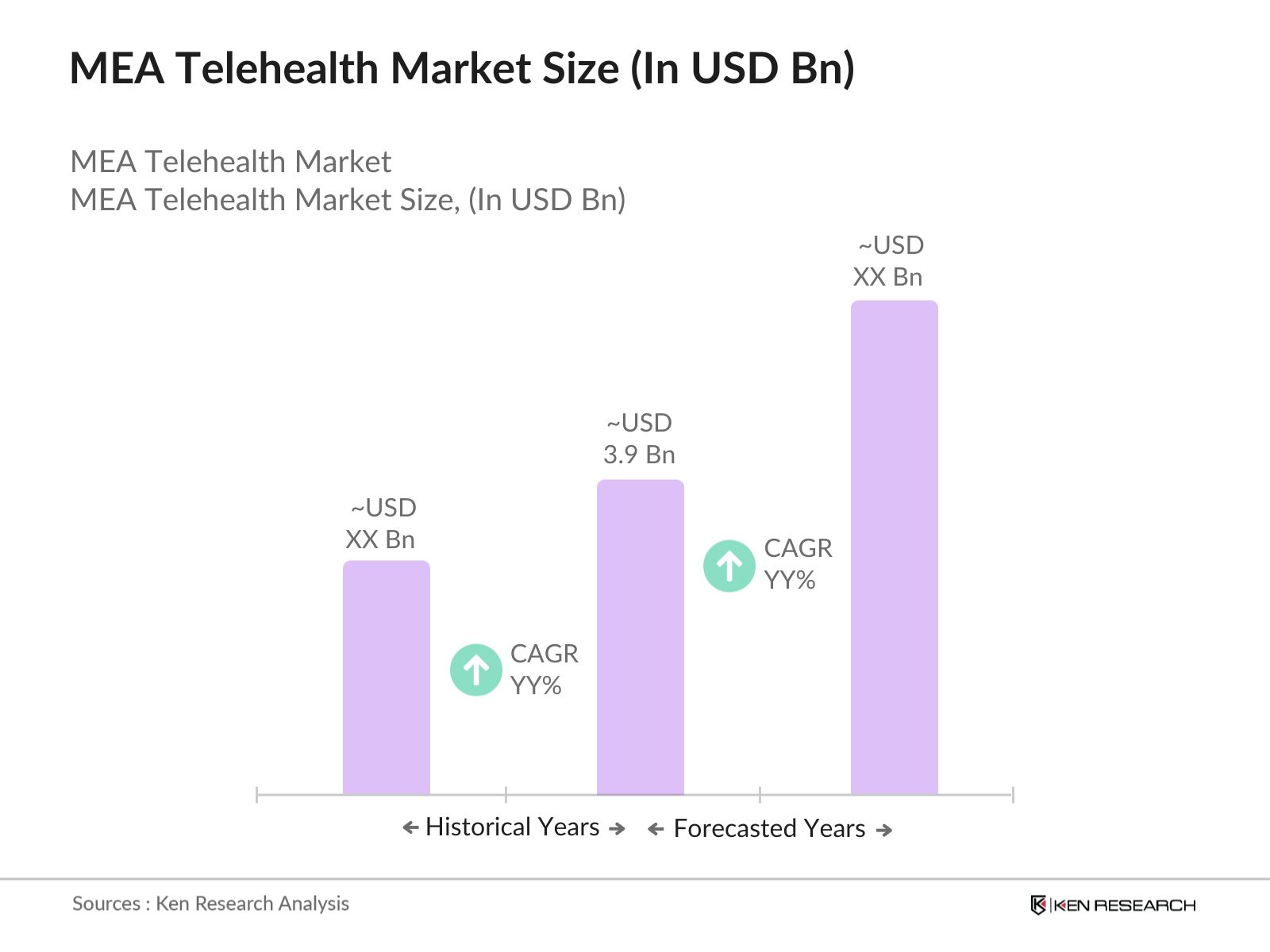
- The Middle East and Africa (MEA) telehealth market was valued at USD 3.9 billion. This expansion is primarily driven by the increasing adoption of digital health technologies, improved internet connectivity, and a rising demand for remote healthcare services. The pandemic has further accelerated this trend, highlighting the necessity for accessible and efficient healthcare solutions across the region.
- Countries such as the United Arab Emirates (UAE), Saudi Arabia, and South Africa are at the forefront of telehealth adoption in the MEA region. Their dominance is attributed to robust healthcare infrastructures, proactive government initiatives supporting digital health integration, and high levels of internet penetration. These factors collectively facilitate the widespread implementation and utilization of telehealth services, positioning these nations as leaders in the regional market.
- The United Arab Emirates launched the National Strategy for Artificial Intelligence 2031, aiming to position the country as a leader in AI adoption across various sectors, including healthcare. The strategy includes investments in AI-driven telehealth solutions to enhance patient care and streamline healthcare services.
MEA Telehealth Market Segmentation
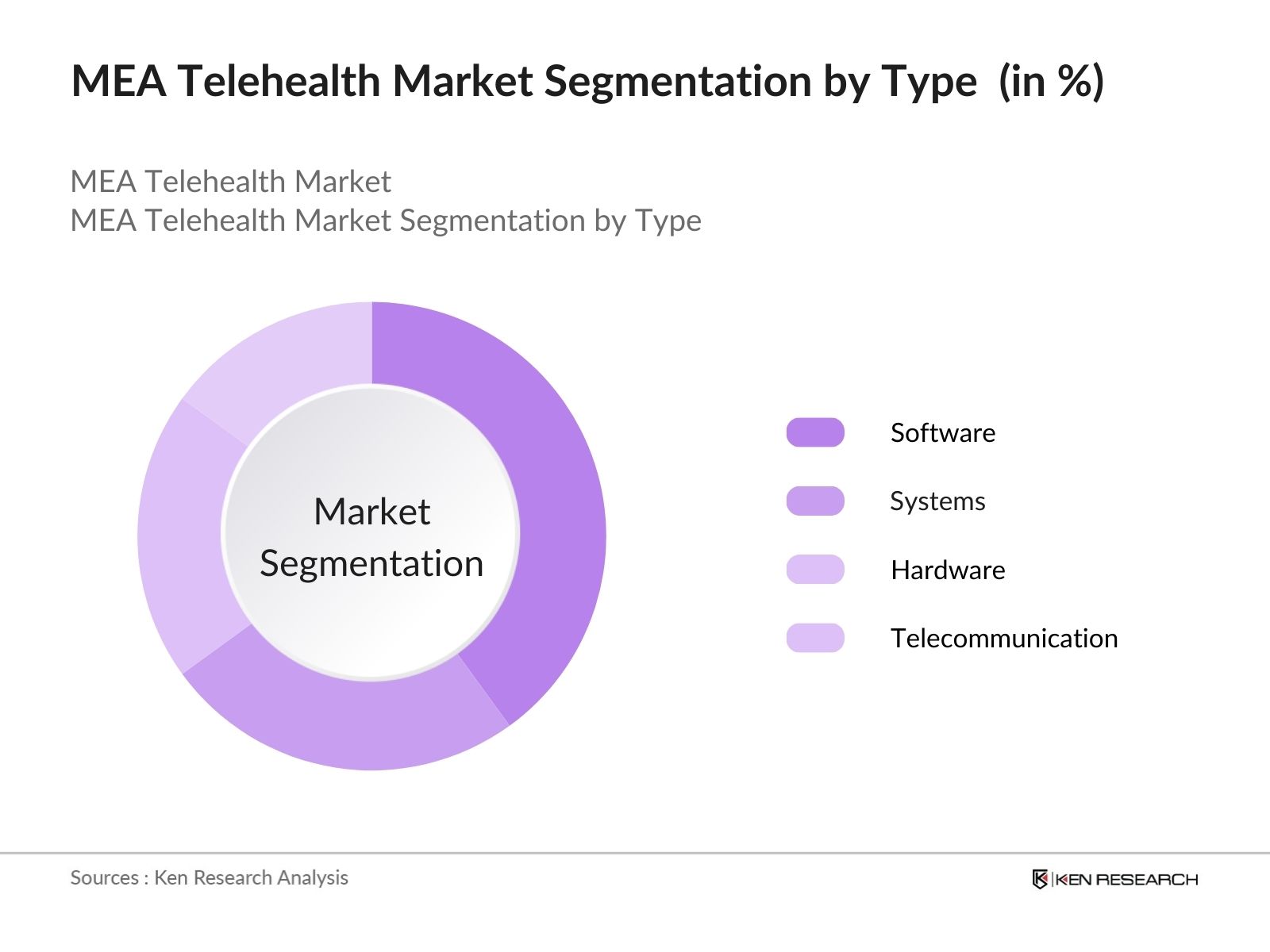
By Type: The market is segmented by type into software, systems, hardware, and telecommunication. Among these, the software segment holds a dominant market share. This is due to the increasing demand for user-friendly telehealth platforms that offer seamless integration with existing healthcare systems, enabling efficient patient management and data analytics.
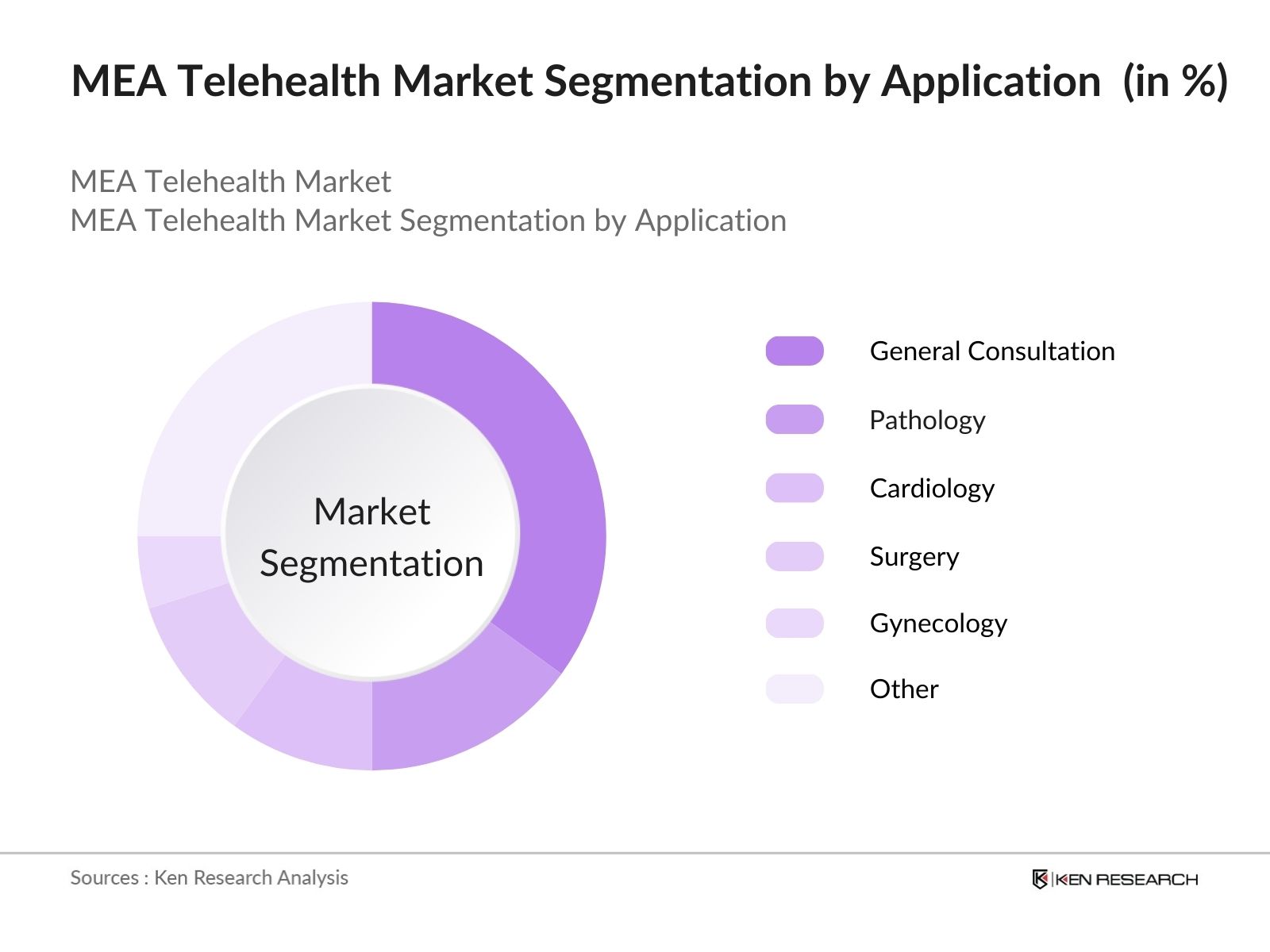
By Application: In terms of application, the market is divided into general consultation, pathology, cardiology, surgery, gynecology, neurology, radiology, dermatology, ophthalmology, orthopedics, and others. General consultation emerges as the leading segment, driven by the need for accessible primary care services. Telehealth platforms facilitate virtual consultations, reducing the burden on healthcare facilities and providing patients with timely medical advice, especially in remote or underserved areas.
MEA Telehealth Market Competitive Landscape
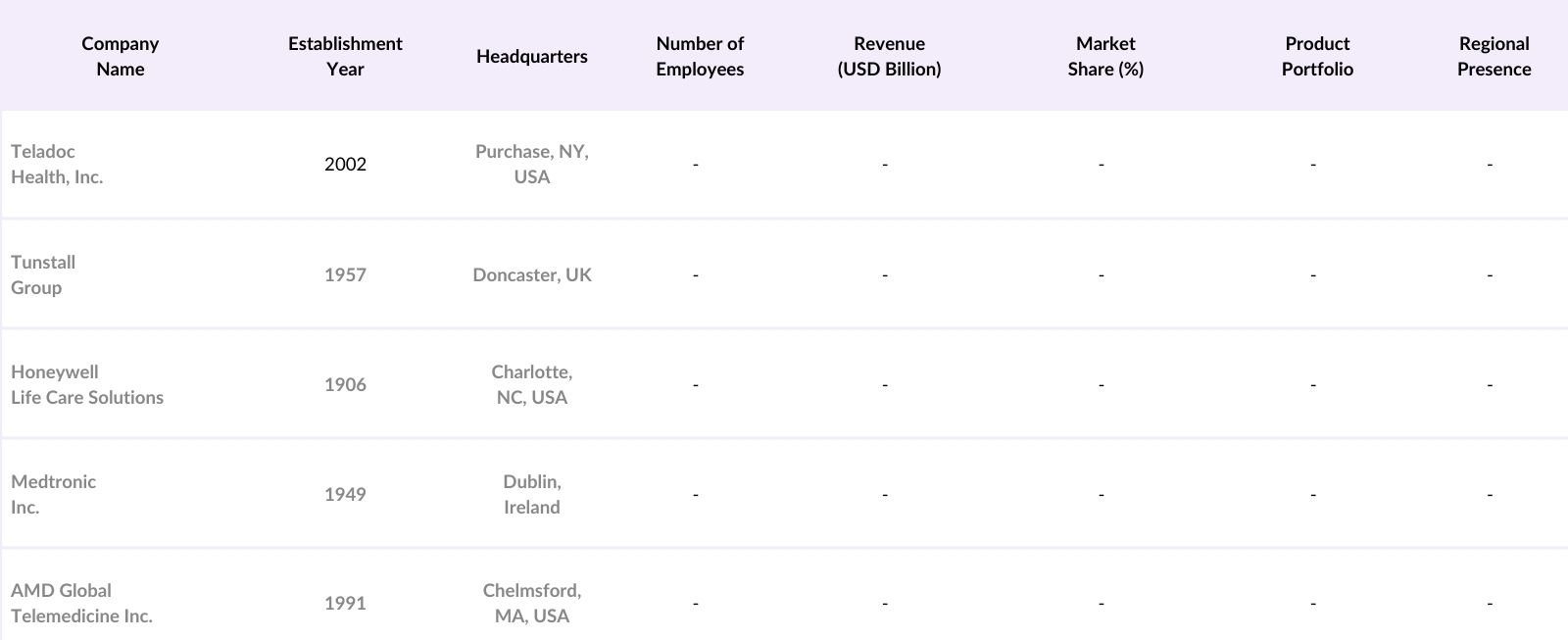
The market is characterized by the presence of several key players who contribute to its dynamic and competitive nature. These companies leverage technological advancements and strategic partnerships to enhance their market positions.
MEA Telehealth Market Analysis
Market Growth Drivers
- Rising Prevalence of Chronic Diseases: The Middle East and Africa (MEA) region is experiencing an increase in chronic diseases. For instance, the International Diabetes Federation reports that the number of adults aged 20-79 with diabetes in the Middle East and North Africa (MENA) region reached 73 million in 2021, with projections indicating a rise to 95 million by 2030. This surge necessitates continuous medical monitoring, making telehealth services essential for effective disease management.
- Government Initiatives and Investments: Governments across the MEA region are actively investing in healthcare infrastructure to enhance service delivery. Saudi Arabia's Vision 2030 plan, for example, includes substantial investments aimed at improving healthcare services, with a focus on digital health solutions. The Saudi government allocated over SAR 175 billion to the healthcare sector in 2021, underscoring a commitment to integrating telehealth into the national healthcare system.
- Expansion of Mobile Network Coverage: The MEA region has witnessed a significant expansion in mobile network coverage, facilitating the adoption of telehealth services. According to the GSMA Mobile Economy report, mobile internet penetration in the MENA region reached 54% in 2021, with projections estimating 64% by 2025. This increased connectivity enables broader access to telehealth services, particularly in remote and underserved areas.
Market Challenges
- Regulatory and Legal Barriers: The market faces complex regulatory environments, with varying laws across countries. For example, in 2021, only a few countries in the region had comprehensive telehealth regulations, leading to uncertainties for service providers and hindering market growth.
- Limited Digital Literacy: A portion of the population in the MEA region lacks digital literacy, impeding the adoption of telehealth services. The World Bank reported in 2020 that internet usage in Sub-Saharan Africa was at 30%, indicating a substantial digital divide that affects the effective utilization of telehealth platforms.
MEA Telehealth Market Future Outlook
Over the next five years, the MEA telehealth industry is poised for substantial growth, driven by continuous government support, advancements in telecommunication technologies, and increasing consumer demand for accessible healthcare solutions.
Future Market Opportunities
- Launch of Telehealth Platforms: In 2021, several telehealth platforms were launched across the MEA region. For instance, Egypt introduced the "Seha" platform, providing virtual consultations to over 500,000 users within its first year, indicating a growing acceptance of telehealth services.
- Partnerships Between Public and Private Sectors: Public-private partnerships have been instrumental in advancing telehealth. In 2021, Saudi Arabia's Ministry of Health partnered with telecom companies to provide free telehealth consultations, resulting in over 1 million virtual visits, demonstrating the effectiveness of collaborative efforts.
Scope of the Report
|
By Type |
Software |
|
Systems |
|
|
Hardware |
|
|
Telecommunication |
|
|
By Delivery Mode |
Cloud-Based Delivery Mode |
|
Web-Based Delivery Mode |
|
|
On-Premise Delivery Mode |
|
|
By Application |
General Consultation |
|
Pathology |
|
|
Cardiology |
|
|
Surgery |
|
|
Gynecology |
|
|
Neurology |
|
|
Radiology |
|
|
Dermatology |
|
|
Ophthalmology |
|
|
Orthopedics |
|
|
Others |
|
|
By End User |
Hospital Telehealth |
|
Physician Telehealth |
|
|
Home Telehealth |
|
|
By Region |
South Africa |
|
Saudi Arabia |
|
|
UAE |
|
|
Israel |
|
|
Egypt |
|
|
Rest of Middle East and Africa |
Products
Key Target Audience Organizations and Entities Who Can Benefit by Subscribing This Report:
Healthcare Providers
Telecommunication Companies
Medical Device Manufacturers
Government and Regulatory Bodies (e.g., Ministry of Health)
Insurance Companies
Technology Solution Providers
Investors and Venture Capitalist Firms
Non-Governmental Organizations (NGOs)
Companies
Players Mentioned in the Report:
Teladoc Health, Inc.
Tunstall Group
Honeywell Life Care Solutions
Medtronic Inc.
AMD Global Telemedicine Inc.
Aerotel Medical Systems Ltd.
BioTelemetry, Inc.
Cisco Systems, Inc.
Cerner Corporation
InTouch Technologies
Table of Contents
1. MEA Telehealth Market Overview
1.1. Definition and Scope
1.2. Market Taxonomy
1.3. Market Growth Rate
1.4. Market Segmentation Overview
2. MEA Telehealth Market Size (In USD Billion)
2.1. Historical Market Size
2.2. Year-On-Year Growth Analysis
2.3. Key Market Developments and Milestones
3. MEA Telehealth Market Analysis
3.1. Growth Drivers
3.1.1. Increasing Advancements in Telecommunication
3.1.2. Growing Prevalence of Chronic Diseases
3.1.3. Shortage of Physicians
3.1.4. Growing Demand for Telehealth in Rural Areas
3.2. Market Challenges
3.2.1. Stringent Regulatory Frameworks
3.2.2. Increase in Healthcare Fraud
3.2.3. Product Recalls for Telehealth Devices
3.3. Opportunities
3.3.1. Increasing Government Support
3.3.2. Rising Awareness Among Populations
3.3.3. Technological Adoption and Product Launches
3.4. Trends
3.4.1. Adoption of IoT in Telehealth
3.4.2. Integration with Smart Healthcare Systems
3.4.3. Expansion of Mobile Health (mHealth) Applications
3.5. Government Regulations
3.5.1. National Telehealth Policies
3.5.2. Licensing and Accreditation Standards
3.5.3. Data Privacy and Security Regulations
3.5.4. Reimbursement Policies
3.6. SWOT Analysis
3.7. Stakeholder Ecosystem
3.8. Porter's Five Forces Analysis
3.9. Competitive Landscape
4. MEA Telehealth Market Segmentation
4.1. By Type (In Value %)
4.1.1. Software
4.1.2. Systems
4.1.3. Hardware
4.1.4. Telecommunication
4.2. By Delivery Mode (In Value %)
4.2.1. Cloud-Based Delivery Mode
4.2.2. Web-Based Delivery Mode
4.2.3. On-Premise Delivery Mode
4.3. By Application (In Value %)
4.3.1. General Consultation
4.3.2. Pathology
4.3.3. Cardiology
4.3.4. Surgery
4.3.5. Gynecology
4.3.6. Neurology
4.3.7. Radiology
4.3.8. Dermatology
4.3.9. Ophthalmology
4.3.10. Orthopedics
4.3.11. Others
4.4. By End User (In Value %)
4.4.1. Hospital Telehealth
4.4.2. Physician Telehealth
4.4.3. Home Telehealth
4.5. By Region (In Value %)
4.5.1. South Africa
4.5.2. Saudi Arabia
4.5.3. UAE
4.5.4. Israel
4.5.5. Egypt
4.5.6. Rest of Middle East and Africa
5. MEA Telehealth Market Competitive Analysis
5.1. Detailed Profiles of Major Companies
5.1.1. Teladoc Health, Inc.
5.1.2. Tunstall Group
5.1.3. Honeywell Life Care Solutions
5.1.4. Medtronic Inc.
5.1.5. AMD Global Telemedicine Inc.
5.1.6. Aerotel Medical Systems Ltd.
5.1.7. BioTelemetry, Inc.
5.1.8. Cisco Systems, Inc.
5.1.9. Cerner Corporation
5.1.10. InTouch Technologies
5.1.11. McKesson Corporation
5.1.12. Philips Healthcare
5.1.13. GE Healthcare
5.1.14. Siemens Healthineers
5.1.15. Allscripts Healthcare Solutions
5.2. Cross Comparison Parameters (Number of Employees, Headquarters, Inception Year, Revenue, Market Share, Product Portfolio, Regional Presence, Strategic Initiatives)
5.3. Market Share Analysis
5.4. Strategic Initiatives
5.5. Mergers and Acquisitions
5.6. Investment Analysis
5.6.1. Venture Capital Funding
5.6.2. Government Grants
5.6.3. Private Equity Investments
6. MEA Telehealth Market Regulatory Framework
6.1. Telehealth Practice Guidelines
6.2. Compliance Requirements
6.3. Certification Processes
6.4. Cross-Border Telehealth Regulations
7. MEA Telehealth Future Market Size (In USD Billion)
7.1. Future Market Size Projections
7.2. Key Factors Driving Future Market Growth
8. MEA Telehealth Future Market Segmentation
8.1. By Type (In Value %)
8.2. By Delivery Mode (In Value %)
8.3. By Application (In Value %)
8.4. By End User (In Value %)
8.5. By Region (In Value %)
9. MEA Telehealth Market Analysts Recommendations
9.1. Total Addressable Market (TAM), Serviceable Available Market (SAM), and Serviceable Obtainable Market (SOM) Analysis
9.2. Customer Cohort Analysis
9.3. Marketing Initiatives
9.4. White Space Opportunity Analysis
Disclaimer Contact UsResearch Methodology
Step 1: Identification of Key Variables
The initial phase involves constructing an ecosystem map encompassing all major stakeholders within the MEA Telehealth Market. This step is underpinned by extensive desk research, utilizing a combination of secondary and proprietary databases to gather comprehensive industry-level information. The primary objective is to identify and define the critical variables that influence market dynamics.
Step 2: Market Analysis and Construction
In this phase, we compile and analyze historical data pertaining to the MEA Telehealth Market. This includes assessing market penetration, the ratio of service providers to consumers, and the resultant revenue generation. Furthermore, an evaluation of service quality statistics is conducted to ensure the reliability and accuracy of the revenue estimates.
Step 3: Hypothesis Validation and Expert Consultation
In this stage, market hypotheses are developed and validated through expert consultations. Computer-assisted telephone interviews (CATIs) with industry professionals representing diverse organizations provide critical insights. This process ensures the alignment of assumptions with industry realities, incorporating operational and financial expertise directly from stakeholders.
Step 4: Research Synthesis and Final Output
The final phase involves synthesizing insights from multiple telehealth providers across the MEA region. This step corroborates data derived from bottom-up analysis with real-world operational metrics. The result is a comprehensive and validated report offering actionable insights into the MEA Telehealth Market.
Frequently Asked Questions
01. How big is the MEA Telehealth Market?
The MEA Telehealth Market is valued at USD 3.9 billion. This valuation reflects robust growth driven by advancements in digital healthcare solutions, increasing adoption of remote consultations, and improved access to telecommunication networks.
02. What are the challenges in the MEA Telehealth Market?
Challenges in the MEA Telehealth Market include stringent regulatory requirements, limited infrastructure in rural areas, and concerns over data privacy and security. These issues hinder the seamless integration of telehealth services in certain parts of the region.
03. Who are the major players in the MEA Telehealth Market?
Key players in the MEA Telehealth Market include Teladoc Health, Inc., Tunstall Group, Honeywell Life Care Solutions, Medtronic Inc., and AMD Global Telemedicine Inc. These companies dominate the market due to their extensive product offerings, strong partnerships, and regional expansion strategies.
04. What drives the MEA Telehealth Market?
Growth drivers in the MEA Telehealth Market include increasing prevalence of chronic diseases, shortages of healthcare professionals, and the rising demand for accessible medical services. Government initiatives to improve digital healthcare infrastructure also play a significant role.
Why Buy From Us?

What makes us stand out is that our consultants follows Robust, Refine and Result (RRR) methodology. i.e. Robust for clear definitions, approaches and sanity checking, Refine for differentiating respondents facts and opinions and Result for presenting data with story

We have set a benchmark in the industry by offering our clients with syndicated and customized market research reports featuring coverage of entire market as well as meticulous research and analyst insights.

While we don't replace traditional research, we flip the method upside down. Our dual approach of Top Bottom & Bottom Top ensures quality deliverable by not just verifying company fundamentals but also looking at the sector and macroeconomic factors.

With one step in the future, our research team constantly tries to show you the bigger picture. We help with some of the tough questions you may encounter along the way: How is the industry positioned? Best marketing channel? KPI's of competitors? By aligning every element, we help maximize success.

Our report gives you instant access to the answers and sources that other companies might choose to hide. We elaborate each steps of research methodology we have used and showcase you the sample size to earn your trust.

If you need any support, we are here! We pride ourselves on universe strength, data quality, and quick, friendly, and professional service.