Middle East & Africa Connected Car Market Outlook to 2030

Region:Middle East

Author(s):Yogita Sahu

Product Code:KROD1777

Published On

October 2024

Total pages

96

About the Report

Middle East & Africa Connected Car Market Overview

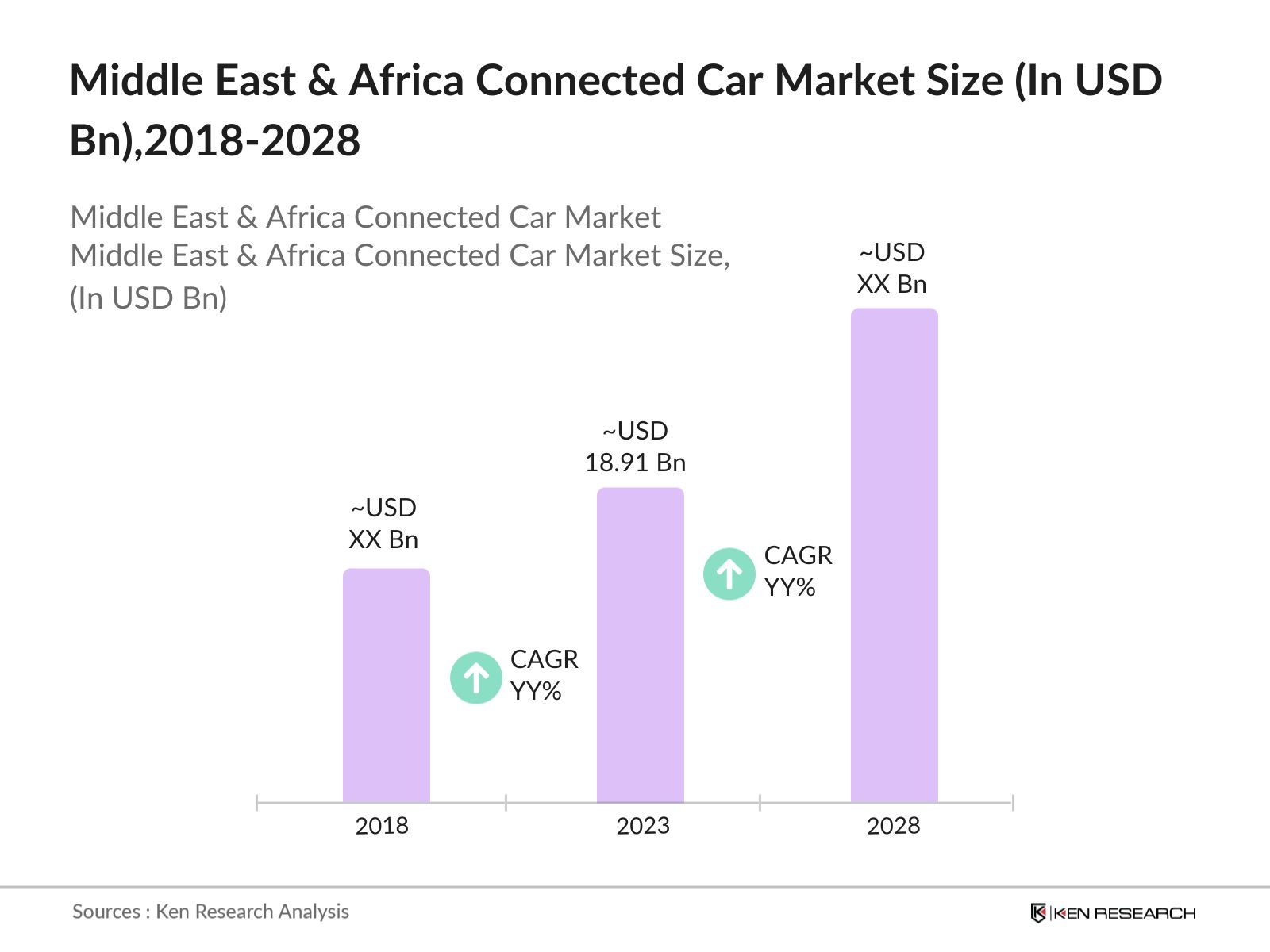
  • The Middle East Africa Connected Car Market was valued at USD 18.91 billion in 2023. The market growth is driven by a combination of technological advancements, increased consumer demand for safety and convenience, and supportive government initiatives. The increasing penetration of internet services, rising vehicle production, and a growing focus on smart transportation solutions.
  • Major players in the market are BMW, Mercedes-Benz, and Toyota are dominant due to their extensive R&D investments and strategic partnerships with tech companies like Qualcomm, Intel, and Google. These players have been instrumental in developing advanced telematics systems, autonomous driving capabilities, and vehicle-to-everything (V2X) communication technologies.
  • In 2023, the announcement by the United Arab Emirates (UAE) government of a new initiative to support autonomous vehicle deployment. The initiative called the Autonomous Transportation Strategy 2030, aims to have 25% of all transportation in Dubai be autonomous by 2030. The government is collaborating with international companies to test and deploy connected car technologies, including 5G-enabled V2X communication systems, to ensure seamless and safe autonomous vehicle operations.
  • The United Arab Emirates (UAE) has emerged as the leading country in the market, primarily due to its strong commitment to smart city initiatives and substantial investments in technology infrastructure. The government's proactive approach, including the Dubai Autonomous Transportation Strategy and significant investments in 5G networks, has positioned the UAE as a leader in the regions connected car industry.

Middle East & Africa Connected Car Market Size

Middle East & Africa Connected Car Market Segmentation

The market is segmented into various factors like product, connectivity type, and region.

By Product: The market is segmented by product into telematics, infotainment, and navigation systems. In 2023, the telematics segment held a dominant market share due to its critical role in enhancing vehicle safety and operational efficiency. The demand for telematics is driven by the increasing adoption of fleet management solutions and the growing awareness of vehicle safety features among consumers.

Middle East & Africa Connected Car Market Segmentation by Product

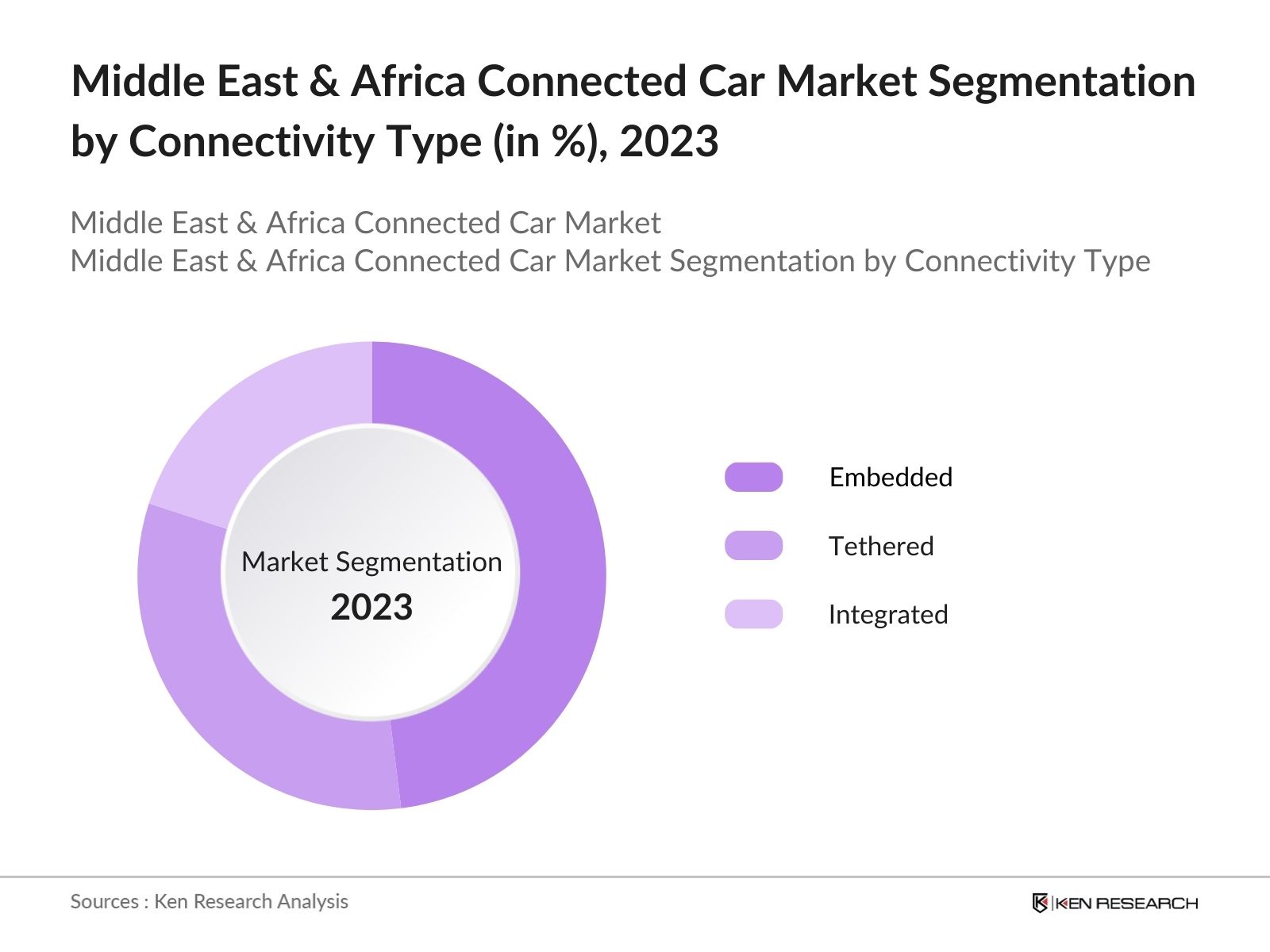
By Connectivity Type: The market is segmented by connectivity type into embedded, tethered, and integrated systems. In 2023, embedded systems accounted for the largest market share, driven by their superior reliability and seamless integration with vehicle architecture. Embedded systems are increasingly preferred by automotive manufacturers as they offer robust security features and do not rely on external devices for connectivity.
Middle East & Africa Connected Car Market Segmentation by Connectivity Type

By Region: The market is segmented by region into Israel, United Arab Emirates, Jordan, Morocco, South Africa, and the Rest of MEA. In 2023, the United Arab Emirates (UAE) held the largest market share, followed by South Africa. The UAEs market dominance is largely due to its advanced infrastructure, high penetration of smart technologies, and strong government support for autonomous and connected vehicle initiatives.

Middle East & Africa Connected Car Market Competitive Landscape

Major Players

Establishment Year

Headquarters

BMW Group

1916

Munich, Germany

Mercedes-Benz (Daimler AG)

1926

Stuttgart, Germany

Toyota Motor Corporation

1937

Toyota City, Japan

Qualcomm Incorporated

1985

San Diego, USA

Intel Corporation

1968

Santa Clara, USA

  • Qualcomm Incorporated: In 2023, Qualcomm and Aramco signed a multi-year deal to improve 4G/5G networks, adopt emerging technologies like AI and quantum computing, and invest in IoT solutions for supply chain management, predictive maintenance, asset tracking, and energy management in Saudi Arabia.The partnership aims to elevate industrial IoT and drive digital transformation on a global scale.
  • Mercedes-Benz (Daimler AG): In 2022, the launch of Mercedes-Benzs new MBUX Hyperscreen in the MEA region, a fully digital cockpit that offers an immersive in-car experience. This new system integrates AI-driven personalization features, allowing drivers to access information and control vehicle functions through voice commands or touch. The MBUX Hyperscreen is expected to set new standards for in-car connectivity and is likely to influence the future direction of connected car technologies in the region.

Middle East & Africa Connected Car Market Analysis

Market Growth Drivers

  • Increasing Vehicle Connectivity Initiatives: The Middle East is rapidly embracing autonomous vehicles, with Saudi Arabia investing USD 175 million in Volocopter's electric air taxis and the UAE conducting autonomous vehicle trials for cargo logistics. The region aims to reduce transportation costs and reach a market value of USD 100 billion by 2030, driving a transportation revolution fueled by advanced self-driving technologies.
  • Expansion of Automotive Technology Startups: The proliferation of automotive technology startups in MEA is fueling market growth. In South Africa alone, the number of automotive tech startups has increased over the past two years. These startups are focusing on innovative connected car technologies, such as advanced telematics and vehicle-to-everything (V2X) communication, which are expected to drive significant market expansion.
  • Growing Demand for Enhanced Safety Features: There is a rising demand for enhanced safety features in vehicles, which is contributing to the growth of the connected car sector. In 2024, road safety concerns in the region have led to an increase in consumer demand for advanced driver assistance systems (ADAS). This trend is reflected in the adoption of technologies such as automated emergency braking and collision avoidance systems, which are becoming standard in new vehicle models.

Market Challenges

  • Infrastructure Limitations: Infrastructure limitations in the MEA region are impacting the growth of the market. Many areas, particularly in rural regions, lack the necessary infrastructure to support advanced connected technologies. Only 25% of roads in Sub-Saharan Africa are equipped with the necessary communication infrastructure for vehicle-to-infrastructure (V2I) systems, hindering the implementation of connected car solutions.
  • High Cost of Advanced Connected Technologies: The high cost of advanced connected car technologies poses a challenge in the MEA region. The cost of integrating advanced infotainment systems and V2X communication in vehicles can exceed. This high cost limits the widespread adoption of these technologies, particularly in emerging markets where budget constraints are more pronounced.

Government Initiatives

  • Saudi Arabias Vision 2030 Smart Mobility Plan: Saudi Arabia's Vision 2030 plan includes substantial investments in smart mobility, with a focus on connected car technologies. By 2025, the government plans to deploy 1,000 smart traffic management systems and 500 intelligent transportation hubs across major cities. This initiative aims to enhance vehicle connectivity and traffic management, thereby driving the connected car market forward.
  • United Arab Emirates Smart City Initiatives: The UAE is advancing its smart city initiatives with a focus on connected cars. The Dubai Smart City project, which aims to become a global leader in smart technologies, includes the integration of connected vehicles into public transportation networks. By 2025, the city plans to have 30% of its public transport fleet equipped with connected technologies, promoting greater adoption of connected car solutions.

Middle East & Africa Connected Car Market Future Outlook

The future trends in the MES-connected car industry include the integration of autonomous driving technologies, the rise of Vehicle-to-Everything (V2X) communication, the expansion of connected car services, and growth in the regional automotive data market.

Future Market Trends

  • Advancements in 5G Technology: The deployment of 5G networks across the MEA region is expected to enhance the capabilities of connected vehicles. The MEA region will see a substantial increase in 5G adoption, with the number of 5G connections expected to grow by 2028. This will provide the necessary infrastructure for real-time data exchange, which is critical for the functioning of autonomous and connected vehicles.
  • Artificial Intelligence (AI) Integration: The integration of AI in connected vehicles is anticipated to revolutionize the driving experience by enabling features such as predictive maintenance, real-time traffic management, and personalized infotainment. AI-powered features are expected to grow in new vehicles by 2028.

Scope of the Report

By Product

Telematics

Infotainment

Navigation

By Connectivity Type

Embedded

Tethered

Integrated

By Region

Israel

United Arab Emirates

Jordan

Morocco

South Africa

Rest of MEA

Products

Key Target Audience Organizations and Entities Who Can Benefit by Subscribing This Report:

  • Telecommunications Companies

  • Insurance Companies

  • Government Regulatory Bodies (e.g., U.S. Department of Transportation)

  • Automotive Dealerships

  • Vehicle Leasing Companies

  • Fleet Management Companies

  • Logistics and Transportation Companies

  • Consumer Electronics Companies

  • Venture Capitalist


Companies

Players Mentioned in the Report:

  • BMW Group

  • Mercedes-Benz (Daimler AG)

  • Toyota Motor Corporation

  • Qualcomm Incorporated

  • Intel Corporation

  • Audi AG

  • Ford Motor Company

  • Nissan Motor Co., Ltd.

  • General Motors

  • Hyundai Motor Company

  • Volkswagen AG

  • Renault Group

  • Honda Motor Co., Ltd.

  • PSA Group

  • Volvo Car Corporation

  • Bosch GmbH

  • Continental AG

  • Valeo S.A.

  • ZF Friedrichshafen AG

  • Mobileye

Table of Contents

1. Middle East & Africa Connected Car Market Overview

1.1. Definition and Scope

1.2. Market Taxonomy

1.3. Market Growth Rate

1.4. Market Segmentation Overview

2. Middle East & Africa Connected Car Market Size (in USD Bn), 2018-2023

2.1. Historical Market Size

2.2. Year-on-Year Growth Analysis

2.3. Key Market Developments and Milestones

3. Middle East & Africa Connected Car Market Analysis

3.1. Growth Drivers

3.1.1. Advancements in 5G Technology

3.1.2. AI Integration in Vehicles

3.1.3. Government Initiatives and Regulations

3.1.4. Increasing Consumer Adoption

3.2. Restraints

3.2.1. High Costs of Connected Car Technologies

3.2.2. Regulatory Challenges Across Different Markets

3.2.3. Cybersecurity Concerns

3.3. Opportunities

3.3.1. Expansion into Emerging Markets

3.3.2. Technological Collaborations

3.3.3. Development of Autonomous Vehicles

3.4. Trends

3.4.1. Growing Demand for ADAS and V2X Communication

3.4.2. Increasing Focus on Vehicle Electrification

3.4.3. Integration with Smart City Projects

3.5. Government Regulation

3.5.1. National Strategies for Autonomous Vehicles

3.5.2. Emission Reduction Targets and Connected Vehicles

3.5.3. Smart Transportation Initiatives

3.5.4. Public-Private Partnerships

3.6. SWOT Analysis

3.7. Stakeholder Ecosystem

3.8. Competition Ecosystem

4. Middle East & Africa Connected Car Market Segmentation, 2023

4.1. By Product Type (in Value %)

4.1.1. Telematics

4.1.2. Infotainment

4.1.3. Navigation

4.2. By Connectivity Type (in Value %)

4.2.1. Embedded

4.2.2. Tethered

4.2.3. Integrated

4.3.1. United Arab Emirates

4.3.2. South Africa

4.3.3. Israel

4.3.4. Jordan

4.3.5. Morocco

4.3.6. Rest of MEA

5. Middle East & Africa Connected Car Market Cross Comparison

5.1. Detailed Profiles of Major Companies

5.1.1. BMW Group

5.1.2. Mercedes-Benz (Daimler AG)

5.1.3. Toyota Motor Corporation

5.1.4. Qualcomm Incorporated

5.1.5. Intel Corporation

5.2. Cross Comparison Parameters (No. of Employees, Headquarters, Inception Year, Revenue)

6. Middle East & Africa Connected Car Market Competitive Landscape

6.1. Market Share Analysis

6.2. Strategic Initiatives

6.3. Mergers and Acquisitions

6.4. Investment Analysis

6.4.1. Venture Capital Funding

6.4.2. Government Grants

6.4.3. Private Equity Investments

7. Middle East & Africa Connected Car Market Regulatory Framework

7.1. Safety and Security Standards

7.2. Compliance Requirements

7.3. Certification Processes

8. Middle East & Africa Connected Car Market Future Size (in USD Bn), 2023-2028

8.1. Future Market Size Projections

8.2. Key Factors Driving Future Market Growth

9. Middle East & Africa Connected Car Market Future Segmentation, 2028

9.1. By Product Type (in Value %)

9.2. By Connectivity Type (in Value %)

9.3. By Vehicle Type (in Value %)

9.4. By Region (in Value %)

10. Middle East & Africa Connected Car Market Analysts Recommendations

10.1. TAM/SAM/SOM Analysis

10.2. Customer Cohort Analysis

10.3. Marketing Initiatives

10.4. White Space Opportunity Analysis

Disclaimer Contact Us

Research Methodology

Step:1 Identifying Key Variables:

Ecosystem creation for all the major entities and referring to multiple secondary and proprietary databases to perform desk research around market to collate industry level information.

Step:2 Market Building:

Collating statistics on this industry over the years, penetration of marketplaces and service providers ratio to compute revenue generated for Middle-East and Africa Connected Car industry. We will also review service quality statistics to understand revenue generated which can ensure accuracy behind the data points shared.

Step:3 Validating and Finalizing:

Building market hypothesis and conducting CATIs with industry experts belonging to different companies to validate statistics and seek operational and financial information from company representatives.

Step:4 Research output:

Our team will approach multiple automotive companies and understand nature of product segments and sales, consumer preference and other parameters, which will support us validate statistics derived through bottom to top approach from such automotive companies.

Frequently Asked Questions

01 How big is the Middle-East and Africa Connected Car market?

The Middle East Africa Connected Car Market was valued at USD 18.91 billion in 2023. The market growth is driven by a combination of technological advancements, increased consumer demand for safety and convenience, and supportive government initiatives.

02 What are the challenges in the Middle-East and Africa Connected Car market?

Challenges in the Middle-East and Africa Connected Car market include the high cost of advanced connected technologies, data privacy and security concerns, infrastructure limitations in rural areas, and varying regulatory standards across different countries.

03 Who are the major players in the Middle-East and Africa Connected Car market?

Key players in the Middle-East and Africa Connected Car market include Toyota Motor Corporation, Volkswagen Group, IBM Corporation, and Harman International.

04 What are the main growth drivers of the Middle-East and Africa Connected Car market?

The growth of the Middle-East and Africa Connected Car market is the expansion of automotive technology startups, increasing vehicle connectivity initiatives by governments, growing demand for enhanced safety features, and the adoption of connected fleet management solutions.

Why Buy From Us?

RRR
Refine Robust Result (RRR) Framework

What makes us stand out is that our consultants follows Robust, Refine and Result (RRR) methodology. i.e. Robust for clear definitions, approaches and sanity checking, Refine for differentiating respondents facts and opinions and Result for presenting data with story

Our Reach Is Unmatched

We have set a benchmark in the industry by offering our clients with syndicated and customized market research reports featuring coverage of entire market as well as meticulous research and analyst insights.

Research
Shifting the Research Paradigm

While we don't replace traditional research, we flip the method upside down. Our dual approach of Top Bottom & Bottom Top ensures quality deliverable by not just verifying company fundamentals but also looking at the sector and macroeconomic factors.

Insite
More Insights-Better Decisions

With one step in the future, our research team constantly tries to show you the bigger picture. We help with some of the tough questions you may encounter along the way: How is the industry positioned? Best marketing channel? KPI's of competitors? By aligning every element, we help maximize success.

Trust
Transparency and Trust

Our report gives you instant access to the answers and sources that other companies might choose to hide. We elaborate each steps of research methodology we have used and showcase you the sample size to earn your trust.

support
Round the Clock Support

If you need any support, we are here! We pride ourselves on universe strength, data quality, and quick, friendly, and professional service.

Why Client Choose Us?

400000+ Reports in repository
150+ Consulting project a year
100+ Analysts
8000+ Client Queries in 2022