
Middle East & Africa Data Analytics Market Outlook to 2030
Region:Global
Author(s):Sanjna
Product Code:KROD11030
December 2024
100
About the Report
Middle East & Africa Data Analytics Market Overview
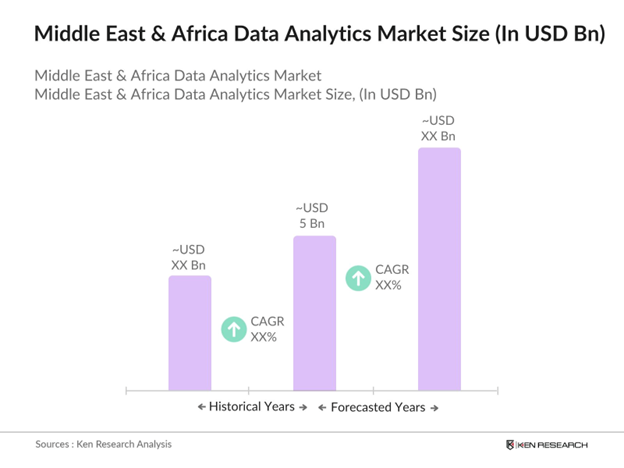
- The Middle East & Africa Data Analytics market, valued at USD 5 billion, has grown significantly due to an increased focus on digital transformation, bolstered by government investments and private sector initiatives. This growth is driven by the widespread adoption of artificial intelligence, cloud-based solutions, and IoT integration, which have streamlined data management and provided deeper insights into various sectors such as retail, banking, and healthcare.
- Countries like the United Arab Emirates and South Africa dominate the market due to their established digital infrastructure and government policies supporting data-driven decision-making. The UAE has prioritized smart city initiatives, while South Africa leads with data usage in industries like mining and financial services, owing to its strong resource-driven economy.
- United Arab Emirates has launched the UAE Digital Government Strategy 2025, aiming to integrate advanced technologies into public services and encourage data utilization for policy formulation. Similarly, Saudi Arabia's Vision 2030 emphasizes the importance of data analytics in diversifying the economy and improving governance. These initiatives create a conducive environment for the growth of the data analytics market, as organizations are encouraged to leverage data insights for strategic decision-making.
Middle East & Africa Data Analytics Market Segmentation
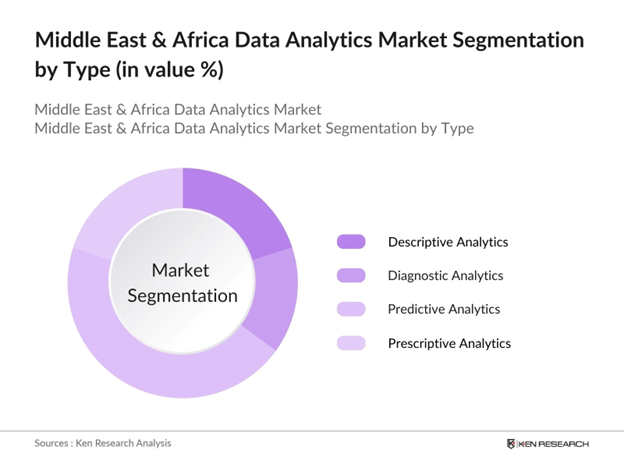
By Type: The Middle East & Africa Data Analytics market is segmented by type into Descriptive Analytics, Diagnostic Analytics, Predictive Analytics, and Prescriptive Analytics. Predictive Analytics currently leads this segment due to its application in anticipating market trends, managing risks, and optimizing customer experiences across various sectors. This segments dominance is largely attributed to the demand for tools that enable proactive decision-making and competitive advantage.
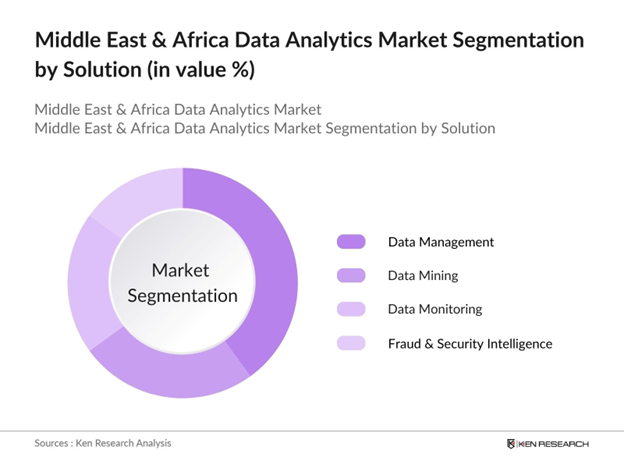
By Solution: The market is further segmented by solution into Data Management, Data Mining, Data Monitoring, and Fraud & Security Intelligence. Data Management solutions hold a dominant share in the region as companies seek efficient storage and retrieval of data. With a growing volume of data from digital transactions, IoT, and cloud computing, organizations are prioritizing data management solutions for streamlined processes and enhanced data accessibility.
Middle East & Africa Data Analytics Market Competitive Landscape
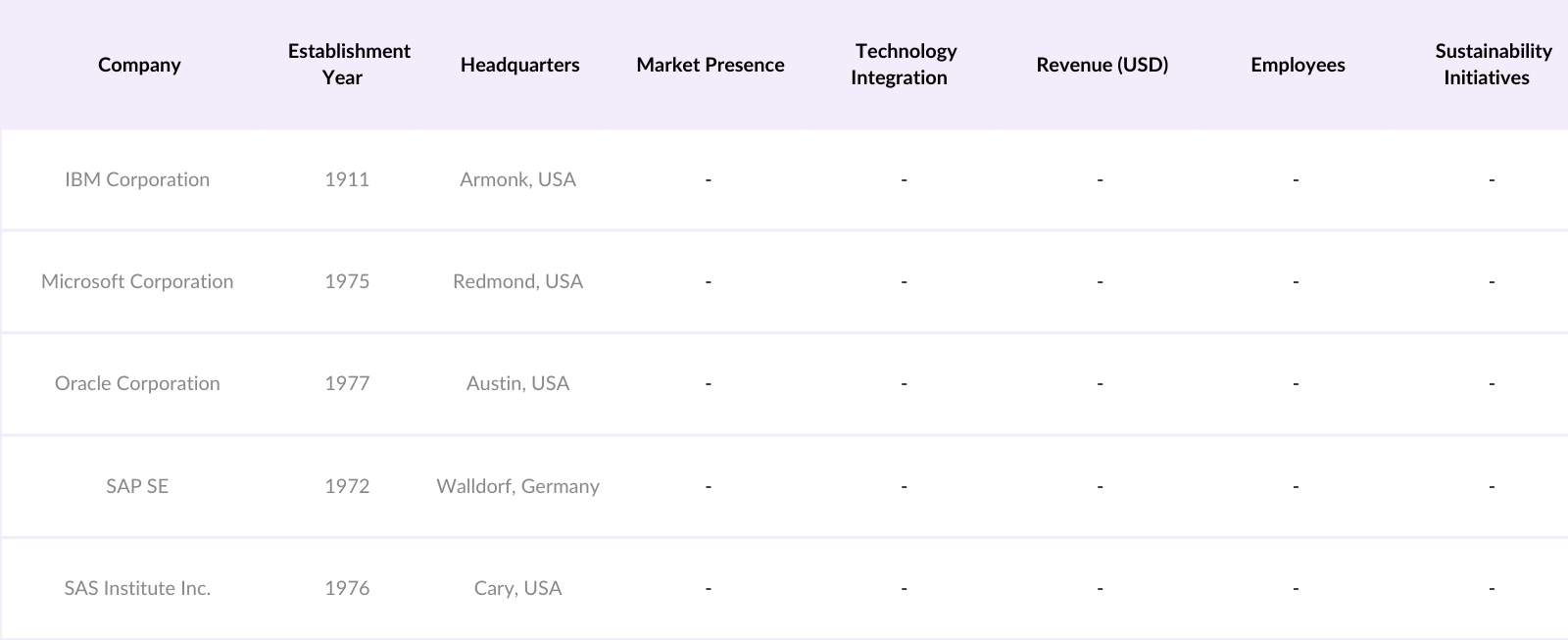
The Middle East & Africa Data Analytics market is shaped by several key players, including major technology providers and specialized firms. These companies are involved in strategic collaborations and technology advancements, leading to robust competition. Global players like Microsoft and Oracle have established a stronghold due to their extensive cloud and analytics solutions, while local companies focus on customized offerings for industry-specific needs.
Middle East & Africa Data Analytics Market Analysis
Growth Drivers
-
Digital Transformation Initiatives: Governments across the Middle East and Africa (MEA) are actively pursuing digital transformation to enhance economic growth and public service delivery. For instance, Saudi Arabia's Vision 2030 aims to diversify the economy by investing in digital infrastructure, with the government allocating substantial funds to develop smart cities and e-governance platforms. Similarly, the United Arab Emirates (UAE) has launched the UAE Digital Government Strategy 2025, focusing on integrating advanced technologies into public services. These initiatives are driving the demand for data analytics solutions to manage and interpret the vast amounts of data generated.
- Adoption of IoT and AI Technologies: The MEA region is experiencing a surge in the adoption of Internet of Things (IoT) and Artificial Intelligence (AI) technologies across various sectors. In 2023, the number of IoT connections in the region reached approximately 1.5 billion, contributing to significant data generation. Industries such as manufacturing, healthcare, and transportation are leveraging AI for predictive maintenance, patient care, and traffic management, respectively. This proliferation necessitates robust data analytics platforms to process and derive actionable insights from the data produced.
- Government Policies and Investments: Governments in the MEA region are implementing policies and making substantial investments to foster a data-driven economy. For example, Egypt's Ministry of Communications and Information Technology has launched initiatives to promote digital skills and data literacy among its population. Additionally, countries like Kenya and Nigeria are investing in ICT infrastructure to support data analytics capabilities, aiming to enhance public sector efficiency and stimulate economic growth.
Challenges
-
Data Privacy and Security Concerns: The rapid digitalization in the MEA region has heightened concerns over data privacy and security. In 2023, there were over 1,000 reported data breaches across various industries, exposing sensitive information of millions of individuals. The lack of comprehensive data protection laws in some countries exacerbates these concerns, making organizations hesitant to fully adopt data analytics solutions.
- High Implementation Costs: Implementing data analytics solutions involves substantial costs, including software acquisition, infrastructure setup, and personnel training. For small and medium-sized enterprises (SMEs) in the MEA region, these costs can be prohibitive. In 2023, the average cost of deploying a comprehensive data analytics platform was estimated at $500,000, a significant investment for many organizations.
Middle East & Africa Data Analytics Market Future Outlook
Over the next few years, the Middle East & Africa Data Analytics market is expected to experience notable growth, driven by the increasing need for real-time analytics and cloud-based solutions. Government-backed projects promoting digitalization, along with the expansion of IoT and AI, are anticipated to further boost market demand and present opportunities for regional players.
Market Opportunities
-
Expansion into Emerging Markets: Emerging markets within the MEA region, such as Ethiopia and Rwanda, are investing in digital infrastructure and data analytics capabilities. Ethiopia's Digital Transformation Strategy aims to increase internet penetration to 50% by 2025. Currently, internet connectivity in the country is relatively low, at about18%, which is below the Sub-Saharan average. The government plans to invest heavily in high-speed networks to enhance coverage, especially in rural areas where over70%of the population resides.creating opportunities for data analytics providers to offer solutions tailored to these markets.
- Integration with Cloud Services: The adoption of cloud computing in the MEA region is on the rise, with cloud service revenues reaching $2 billion in 2023. If the MEA region were to match the cloud maturity levels of Europe, it could potentially unlock around$5.6 billionin new revenue for cloud vendors; matching North America could raise this figure to approximately$14 billion. Integrating data analytics solutions with cloud platforms offers scalability and cost-effectiveness, making advanced analytics accessible to a broader range of organizations.
Scope of the Report
|
Segment |
Sub-Segments |
|
Type |
Descriptive Analytics |
|
Solution |
Data Management |
|
Function |
Marketing Analytics |
|
Deployment |
On-Premises |
|
End-Use Industry |
Banking, Financial Services, and Insurance (BFSI) |
Products
Key Target Audience
IT & Software Development Companies
Cloud Service Providers
Telecommunications Providers
Banking, Financial Services & Insurance Companies (BFSI)
Healthcare Providers and Hospitals
Retail & E-commerce Companies
Investors and Venture Capitalist Firms
Government and Regulatory Bodies (e.g., UAE Telecommunications Regulatory Authority)
Companies
Players Mentioned in the Report
IBM Corporation
Microsoft Corporation
Oracle Corporation
SAP SE
SAS Institute Inc.
Teradata Corporation
Tableau Software
Qlik Technologies Inc.
TIBCO Software Inc.
Alteryx Inc.
Table of Contents
1. Middle East & Africa Data Analytics Market Overview
1.1 Definition and Scope
1.2 Market Taxonomy
1.3 Market Growth Rate
1.4 Market Segmentation Overview
2. Middle East & Africa Data Analytics Market Size (In USD Bn)
2.1 Historical Market Size
2.2 Year-On-Year Growth Analysis
2.3 Key Market Developments and Milestones
3. Middle East & Africa Data Analytics Market Analysis
3.1 Growth Drivers
3.1.1 Digital Transformation Initiatives
3.1.2 Adoption of IoT and AI Technologies
3.1.3 Government Policies and Investments
3.1.4 Increasing Data Generation Across Industries
3.2 Market Challenges
3.2.1 Data Privacy and Security Concerns
3.2.2 Shortage of Skilled Professionals
3.2.3 High Implementation Costs
3.3 Opportunities
3.3.1 Expansion into Emerging Markets
3.3.2 Integration with Cloud Services
3.3.3 Development of Customized Solutions
3.4 Trends
3.4.1 Shift Towards Predictive and Prescriptive Analytics
3.4.2 Rise of Self-Service Analytics Tools
3.4.3 Emphasis on Real-Time Data Processing
3.5 Government Regulations
3.5.1 Data Protection Laws
3.5.2 Industry-Specific Compliance Requirements
3.5.3 Initiatives Promoting Data-Driven Decision Making
3.6 SWOT Analysis
3.7 Stakeholder Ecosystem
3.8 Porters Five Forces Analysis
3.9 Competitive Landscape
4. Middle East & Africa Data Analytics Market Segmentation
4.1 By Type (In Value %)
4.1.1 Descriptive Analytics
4.1.2 Diagnostic Analytics
4.1.3 Predictive Analytics
4.1.4 Prescriptive Analytics
4.2 By Solution (In Value %)
4.2.1 Data Management
4.2.2 Data Mining
4.2.3 Data Monitoring
4.2.4 Fraud & Security Intelligence
4.3 By Function (In Value %)
4.3.1 Marketing Analytics
4.3.2 Sales Analytics
4.3.3 Finance Analytics
4.3.4 Human Resource Analytics
4.3.5 Operations Analytics
4.4 By Deployment (In Value %)
4.4.1 On-Premises
4.4.2 Cloud-Based
4.5 By End-Use Industry (In Value %)
4.5.1 Banking, Financial Services, and Insurance (BFSI)
4.5.2 Healthcare
4.5.3 Retail & E-commerce
4.5.4 Manufacturing
4.5.5 Telecommunications
4.5.6 Government & Public Sector
4.5.7 Energy & Utilities
4.5.8 Transportation & Logistics
5. Middle East & Africa Data Analytics Market Competitive Analysis
5.1 Detailed Profiles of Major Companies
5.1.1 IBM Corporation
5.1.2 Microsoft Corporation
5.1.3 Oracle Corporation
5.1.4 SAP SE
5.1.5 SAS Institute Inc.
5.1.6 Teradata Corporation
5.1.7 Tableau Software
5.1.8 Qlik Technologies Inc.
5.1.9 TIBCO Software Inc.
5.1.10 Alteryx Inc.
5.2 Cross Comparison Parameters (Number of Employees, Headquarters, Inception Year, Revenue, Market Share, Product Portfolio, Regional Presence, Key Clients, Strategic Initiatives)
5.3 Market Share Analysis
5.4 Strategic Initiatives
5.5 Mergers and Acquisitions
5.6 Investment Analysis
5.7 Venture Capital Funding
5.8 Government Grants
5.9 Private Equity Investments
6. Middle East & Africa Data Analytics Market Regulatory Framework
6.1 Data Protection and Privacy Regulations
6.2 Industry-Specific Compliance Standards
6.3 Certification Processes
6.4 Impact of International Regulations
7. Middle East & Africa Data Analytics Future Market Size (In USD Bn)
7.1 Future Market Size Projections
7.2 Key Factors Driving Future Market Growth
8. Middle East & Africa Data Analytics Future Market Segmentation
8.1 By Type (In Value %)
8.2 By Solution (In Value %)
8.3 By Function (In Value %)
8.4 By Deployment (In Value %)
8.5 By End-Use Industry (In Value %)
9. Middle East & Africa Data Analytics Market Analysts Recommendations
9.1 Total Addressable Market (TAM), Serviceable Available Market (SAM), and Serviceable Obtainable Market (SOM) Analysis
9.2 Customer Segmentation and Cohort Analysis
9.3 Marketing and Sales Strategies
9.4 Identification of White Space Opportunities
Research Methodology
Step 1: Identification of Key Variables
The initial stage involves building a comprehensive ecosystem model, incorporating all key players within the Middle East & Africa Data Analytics market. This is achieved through a combination of secondary research and proprietary databases to identify significant market drivers and challenges.
Step 2: Market Analysis and Construction
This step involves compiling historical market data to determine the growth trends and key industry milestones. The data are analyzed for accuracy and reliability, forming the basis of revenue projections and identifying emerging trends.
Step 3: Hypothesis Validation and Expert Consultation
Hypotheses are developed based on identified trends and tested through expert interviews and computer-assisted telephone interviews (CATIs). This step ensures that qualitative insights complement quantitative data.
Step 4: Research Synthesis and Final Output
The final phase includes synthesizing insights from direct consultations with industry professionals and market leaders, providing a validated and comprehensive view of the Middle East & Africa Data Analytics market.
Frequently Asked Questions
01. How big is the Middle East & Africa Data Analytics Market?
The Middle East & Africa Data Analytics market was valued at USD 5 billion, driven by increased government investments and demand for digital transformation solutions.
02. What are the main challenges in the Middle East & Africa Data Analytics Market?
Key challenges in Middle East & Africa Data Analytics market include data privacy concerns, a shortage of skilled professionals, and the high costs of implementation, which may slow down the adoption rate for smaller enterprises.
03. Who are the major players in the Middle East & Africa Data Analytics Market?
Leading companies in Middle East & Africa Data Analytics market include IBM, Microsoft, Oracle, SAP, and SAS, each recognized for their robust portfolios and significant investment in regional projects.
04. What drives the growth of the Middle East & Africa Data Analytics Market?
Growth in Middle East & Africa Data Analytics market is driven by increased adoption of IoT, cloud computing, and AI, coupled with government initiatives aimed at fostering a data-centric economy.
Why Buy From Us?

What makes us stand out is that our consultants follows Robust, Refine and Result (RRR) methodology. i.e. Robust for clear definitions, approaches and sanity checking, Refine for differentiating respondents facts and opinions and Result for presenting data with story

We have set a benchmark in the industry by offering our clients with syndicated and customized market research reports featuring coverage of entire market as well as meticulous research and analyst insights.

While we don't replace traditional research, we flip the method upside down. Our dual approach of Top Bottom & Bottom Top ensures quality deliverable by not just verifying company fundamentals but also looking at the sector and macroeconomic factors.

With one step in the future, our research team constantly tries to show you the bigger picture. We help with some of the tough questions you may encounter along the way: How is the industry positioned? Best marketing channel? KPI's of competitors? By aligning every element, we help maximize success.

Our report gives you instant access to the answers and sources that other companies might choose to hide. We elaborate each steps of research methodology we have used and showcase you the sample size to earn your trust.

If you need any support, we are here! We pride ourselves on universe strength, data quality, and quick, friendly, and professional service.