















Middle East & Africa Printed Signage Materials Market Outlook to 2030
Region:Middle East
Author(s):Abhinav kumar
Product Code:KROD8767
November 2024
97
About the Report
Middle East & Africa Printed Signage Materials Market Overview
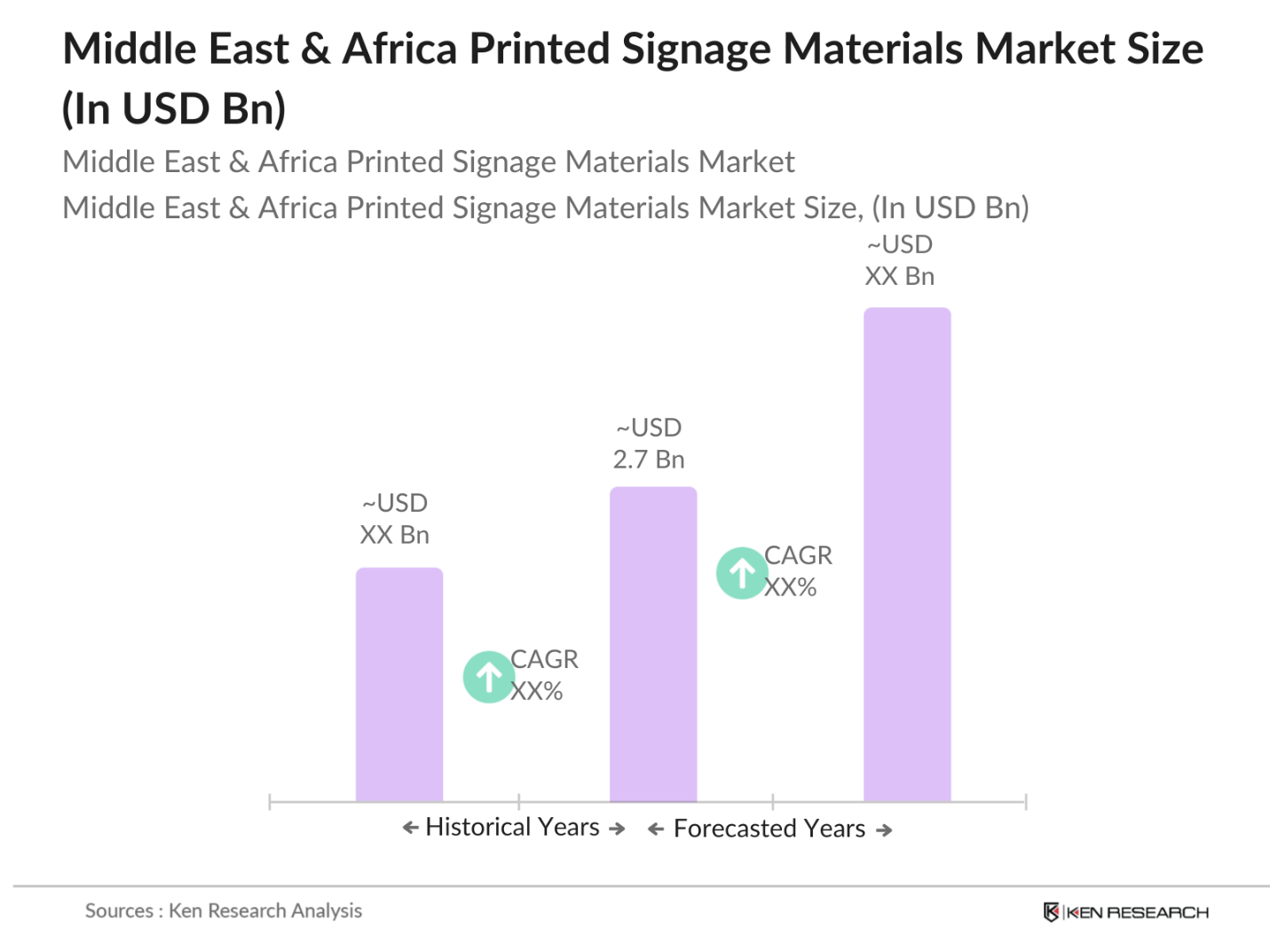
- The Middle East & Africa printed signage materials market is valued at approximately USD 2.7 billion. This market is primarily driven by the increasing need for advertising across the retail and construction sectors, as businesses aim to expand their reach and visibility. Additionally, the region's growing urbanization and infrastructural developments create a robust demand for printed signage solutions, as these materials offer cost-effective branding methods. These factors have solidified the demand for printed signage in commercial settings, with a steady rise expected to continue.
- Within this region, the Gulf Cooperation Council (GCC) countries, including Saudi Arabia and the UAE, dominate the market due to their rapidly growing infrastructure and investments in retail and tourism. South Africa is also a key player, driven by its well-developed retail industry and continuous urban development. The high concentration of retail outlets, malls, and business centers in these countries makes them pivotal in the market.
- Middle Eastern and African governments are increasingly enforcing environmental standards, mandating the use of non-toxic materials in printed signage. Saudi Arabias environmental policies, for instance, emphasize reducing hazardous waste, which includes toxic printing materials. Signage providers are therefore encouraged to adopt non-toxic inks and materials, aligning with national sustainability goals. This regulatory trend ensures compliance with environmental standards, driving the adoption of safer, environmentally friendly signage solutions.
Middle East & Africa Printed Signage Materials Market Segmentation
By Material Type: The Middle East & Africa Printed Signage Materials market is segmented by material type into paper and cardboard, plastic, metal, wood, and glass. Recently, plastic materials have gained a dominant market share within this segment, primarily due to their durability and flexibility, which makes them highly suitable for both indoor and outdoor signage. Additionally, plastic signage materials are lightweight and easy to mold into various shapes and sizes, making them a preferred choice across industries.

By Printing Technology: The market is further segmented by printing technology into screen printing, digital printing, offset printing, and UV-curable printing. Digital printing holds a prominent market share due to its versatility, allowing for high-quality prints with faster turnaround times. Digital printing technology is also increasingly used for on-demand printing, which has become highly desirable in the regions retail and advertising sectors.

Middle East & Africa Printed Signage Materials Market Competitive Landscape
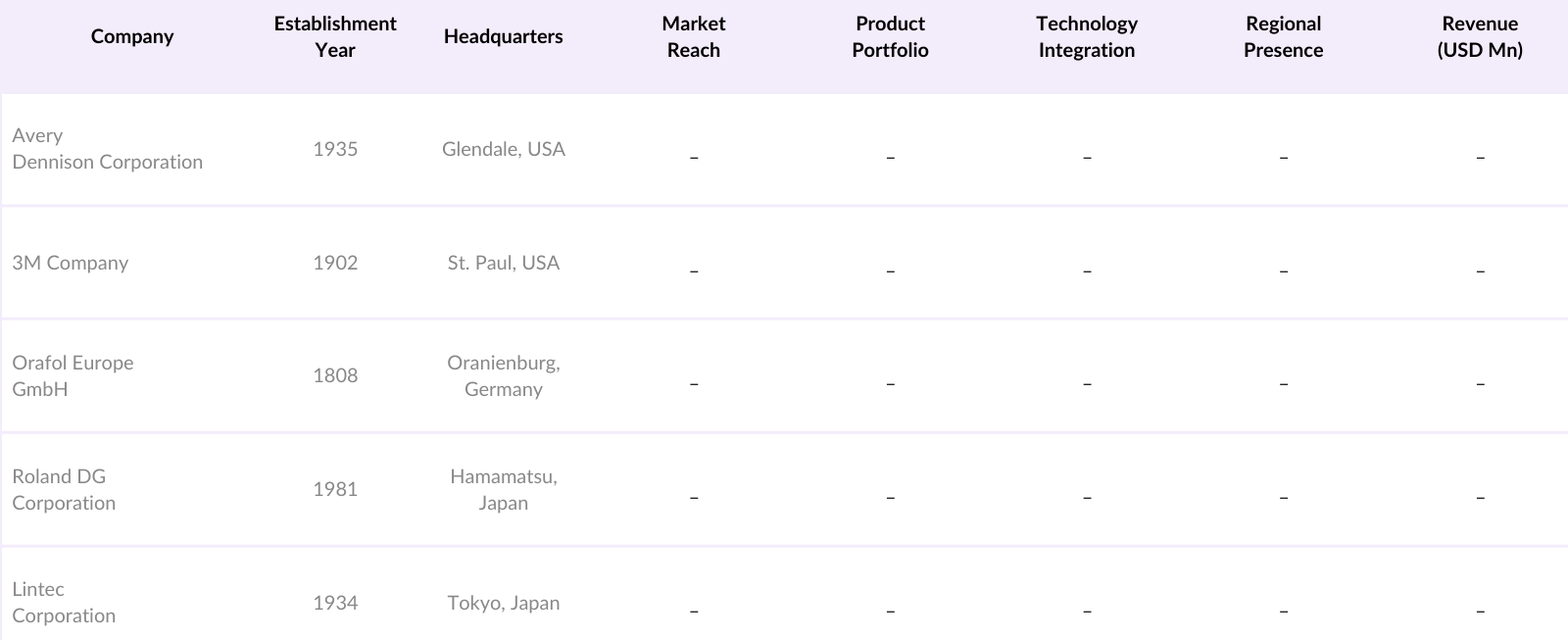
The Middle East & Africa printed signage materials market is characterized by the presence of a mix of global and regional players. Companies like Avery Dennison and 3M dominate due to their wide product range and distribution networks, while local manufacturers contribute to the competitive landscape by offering region-specific solutions at competitive prices.
Middle East & Africa Printed Signage Materials Industry Analysis
Growth Drivers
- Retail Expansion: The retail sector in the Middle East & Africa has experienced significant expansion, bolstered by a strong economic recovery and urbanization efforts. In 2023, retail sales in the Middle East alone reached approximately USD 1.5 trillion, with continued growth projected across major economies like Saudi Arabia and UAE, driving demand for in-store advertising and printed signage. The influx of shopping malls and retail complexes in cities such as Riyadh and Dubai has heightened the need for signage to attract consumers in competitive spaces. This trend underscores the essential role of printed signage materials in supporting retail branding efforts across these regions.
- Advertising Demand: In the Middle East and Africa, advertising expenditures have risen as businesses invest heavily in brand awareness strategies. In 2024, advertising expenditure in the Middle East reached USD 30 billion, driven by sectors like retail, automotive, and telecom, which depend on impactful physical signage for visibility. As businesses prioritize brand presence, printed signage materials remain integral for static, long-term advertising, especially in public spaces. This demand is amplified in countries like South Africa and Kenya, where growing urban populations create numerous advertising opportunities for localized brand messaging.
- Infrastructure Development: The robust construction sector in the Middle East and Africa has fueled demand for printed signage materials as infrastructure projects multiply. In Saudi Arabia, USD 1.2 trillion is currently allocated to construction, including high-visibility projects like Neom. This surge creates consistent demand for signage in commercial real estate, public spaces, and transport infrastructure. Printed materials are required on-site for navigation, branding, and compliance, supporting ongoing infrastructure expansion across
Market Challenges
- Digital Substitution: Digital signage is increasingly substituting traditional printed signage in urbanized regions of the Middle East, driven by technological advancements and consumer preferences. In 2024, the digital advertising market in the Middle East reached USD 4 billion, with digital signage being a significant contributor due to its flexibility and interactivity. This trend presents a challenge for printed signage materials, as businesses in urban areas gravitate towards dynamic and versatile digital solutions. Nevertheless, printed signage still holds relevance in rural areas with limited digital access.
- Economic Constraints: Economic instability in some African countries, such as inflation rates reaching 40% in Zimbabwe, has impacted spending on non-essential materials, including printed signage. Businesses facing financial constraints often reduce expenditure on physical advertising in favor of other cost-saving strategies. In Nigeria, economic challenges related to currency devaluation have also led to reduced budgets for marketing materials, creating obstacles for the signage materials market. These economic conditions contribute to a cautious approach to signage investments in impacted regions.
Middle East & Africa Printed Signage Materials Market Future Outlook
Over the coming years, the Middle East & Africa printed signage materials market is projected to experience moderate growth, driven by an increasing focus on infrastructure development and the expansion of the retail sector. With the rising adoption of eco-friendly materials and sustainable solutions, businesses in the region are expected to explore newer technologies and substrates, fostering innovation within the market. The continued demand for effective advertising and branding tools across sectors will further solidify the markets growth trajectory.
Opportunities
- Technological Innovations: Advancements in printing technology are increasing the durability and quality of printed signage materials, creating new opportunities in sectors that require long-lasting visuals. For instance, UV-resistant ink technology, widely adopted in the UAE, has improved signage lifespan, particularly in harsh outdoor environments. These technological enhancements provide a value proposition for printed signage over digital displays, especially in regions with high sunlight exposure, such as Saudi Arabia and North Africa, where UV resistance is crucial.
- Eco-Friendly Materials: The transition to sustainable materials in the Middle East & Africa printed signage market reflects global environmental goals. With eco-friendly options like biodegradable vinyl now available, companies can meet consumer and regulatory demands for sustainable advertising. Saudi Arabia, as part of Vision 2030, has introduced initiatives for greener business practices, encouraging businesses to adopt sustainable materials for advertising. This regulatory support and consumer preference are creating a solid market for eco-friendly printed signage solutions across the region.
Scope of the Report
|
Material Type |
Paper and Cardboard |
|
Printing Technology |
Screen Printing |
|
Application |
Indoor Signage |
|
End-User Industry |
Retail and E-commerce |
|
Region |
GCC Countries |
Products
Key Target Audience Organizations and Entities Who Can Benefit by Subscribing to This Report:
Retail and E-commerce Companies
Advertising and Media Companies
Construction and Real Estate Industries
Transportation and Logistics Provider Companies
Government and Regulatory Bodies (GCC Ministry of Commerce, South African Department of Trade and Industry)
Printing and Signage Manufacturing Companies
Investors and Venture Capitalist Firms
End-User Industries (Corporate Offices, Entertainment Venues)
Companies
Players Mentioned in the Report
Avery Dennison Corporation
3M Company
Orafol Europe GmbH
Roland DG Corporation
Lintec Corporation
Hexis S.A.
Ricoh Printing Systems
SAi (SA International)
Spandex Ltd.
KPMF (Kay Premium Marking Films)
Table of Contents
1. Middle East & Africa Printed Signage Materials Market Overview
1.1 Definition and Scope
1.2 Market Taxonomy
1.3 Market Dynamics
1.4 Market Segmentation Overview
2. Middle East & Africa Printed Signage Materials Market Size (In USD Mn)
2.1 Historical Market Size
2.2 Year-on-Year Growth Analysis
2.3 Key Market Developments
3. Middle East & Africa Printed Signage Materials Market Analysis
3.1 Growth Drivers
3.1.1 Retail Expansion (Impact of Retail Growth)
3.1.2 Advertising Demand (Increased Brand Awareness)
3.1.3 Infrastructure Development (Impact of Construction Projects)
3.1.4 Cost-Effectiveness (Cost-Effective Branding Solutions)
3.2 Market Challenges
3.2.1 Digital Substitution (Shift Toward Digital Signage)
3.2.2 Economic Constraints (Effect of Economic Fluctuations)
3.2.3 Environmental Concerns (Sustainable Material Demand)
3.3 Opportunities
3.3.1 Technological Innovations (Enhanced Print Durability)
3.3.2 Eco-Friendly Materials (Shift to Sustainable Options)
3.3.3 Expansion in Emerging Markets (Increased Demand from Africa)
3.4 Trends
3.4.1 Customized Solutions (Rising Demand for Tailored Signage)
3.4.2 Sustainable Practices (Adoption of Recyclable Materials)
3.4.3 UV Printing Technology (Preference for High-Quality Graphics)
3.5 Government Regulations
3.5.1 Environmental Standards (Use of Non-Toxic Materials)
3.5.2 Industry-Specific Compliance (Advertising Standards)
3.5.3 Import and Export Policies (Tariffs on Printing Materials)
3.6 SWOT Analysis
3.7 Stakeholder Ecosystem
3.8 Porters Five Forces Analysis
3.9 Competition Ecosystem
4. Middle East & Africa Printed Signage Materials Market Segmentation
4.1 By Material Type (In Value %)
4.1.1 Paper and Cardboard
4.1.2 Plastic (PVC, Polypropylene)
4.1.3 Metal
4.1.4 Wood
4.1.5 Glass
4.2 By Printing Technology (In Value %)
4.2.1 Screen Printing
4.2.2 Digital Printing
4.2.3 Offset Printing
4.2.4 UV-Curable Printing
4.3 By Application (In Value %)
4.3.1 Indoor Signage
4.3.2 Outdoor Signage
4.3.3 Point-of-Sale Displays
4.3.4 Backlit and Front-lit Displays
4.3.5 Vehicle Graphics
4.4 By End-User Industry (In Value %)
4.4.1 Retail and E-commerce
4.4.2 Entertainment and Sports
4.4.3 Healthcare
4.4.4 Transportation
4.4.5 Corporate Branding
4.5 By Region (In Value %)
4.5.1 GCC Countries
4.5.2 South Africa
4.5.3 North Africa
4.5.4 Sub-Saharan Africa
4.5.5 Levant
5. Middle East & Africa Printed Signage Materials Market Competitive Analysis
5.1 Detailed Profiles of Major Companies
5.1.1 Avery Dennison Corporation
5.1.2 3M Company
5.1.3 Orafol Europe GmbH
5.1.4 ESKO Graphics BV
5.1.5 Lintec Corporation
5.1.6 Roland DG Corporation
5.1.7 Mimaki Engineering Co., Ltd.
5.1.8 Hexis S.A.
5.1.9 Spandex Ltd.
5.1.10 Signarama
5.1.11 LG Hausys
5.1.12 Lintec Corporation
5.1.13 SAi (SA International)
5.1.14 KPMF (Kay Premium Marking Films)
5.1.15 Ricoh Printing Systems
5.2 Cross Comparison Parameters (No. of Employees, Headquarters, Revenue, Product Portfolio, Market Share, Technological Capabilities, Market Presence, R&D Investment)
5.3 Market Share Analysis
5.4 Strategic Initiatives
5.5 Mergers and Acquisitions
5.6 Investment Analysis
5.7 Private Equity and Venture Capital Funding
5.8 Government Grants and Incentives
6. Middle East & Africa Printed Signage Materials Market Regulatory Framework
6.1 Environmental Standards (Use of Non-Hazardous Chemicals)
6.2 Compliance with Advertising Laws (Signage Display Regulations)
6.3 Import and Export Policies (Tariffs on Signage Materials)
6.4 Certification and Licensing Processes
7. Middle East & Africa Printed Signage Materials Future Market Size (In USD Mn)
7.1 Future Market Size Projections
7.2 Key Factors Influencing Future Growth
8. Middle East & Africa Printed Signage Materials Future Market Segmentation
8.1 By Material Type (In Value %)
8.2 By Printing Technology (In Value %)
8.3 By Application (In Value %)
8.4 By End-User Industry (In Value %)
8.5 By Region (In Value %)
9. Middle East & Africa Printed Signage Materials Market Analysts Recommendations
9.1 TAM/SAM/SOM Analysis
9.2 Marketing Initiatives
9.3 Customer Segmentation Analysis
9.4 White Space Opportunity Analysis
Disclaimer Contact UsResearch Methodology
Step 1: Identification of Key Variables
This phase involved establishing an ecosystem map of all stakeholders within the printed signage materials market. Extensive desk research, utilizing proprietary databases and secondary sources, was used to identify the critical variables impacting the market dynamics.
Step 2: Market Analysis and Construction
Historical data was collected and analyzed to determine market penetration and revenue generation within different segments. This analysis provided insight into the service quality and demand for each segment.
Step 3: Hypothesis Validation and Expert Consultation
Market hypotheses were formulated and validated through telephone interviews with industry experts, providing direct operational and financial insights which were essential for refining the data.
Step 4: Research Synthesis and Final Output
The final phase involved consultations with signage material manufacturers, confirming product segment data and consumer preferences. This synthesis provided a comprehensive analysis of the Middle East & Africa printed signage materials market.
Frequently Asked Questions
01. How big is the Middle East & Africa Printed Signage Materials Market?
The Middle East & Africa Printed Signage Materials Market is valued at approximately USD 2.7 billion, primarily driven by growing infrastructure projects and retail expansion across the region.
02. What are the challenges in the Middle East & Africa Printed Signage Materials Market?
Challenges include the shift towards digital signage and environmental concerns over traditional materials, which may impact demand for certain printed signage solutions.
03. Who are the major players in the Middle East & Africa Printed Signage Materials Market?
Key players include Avery Dennison Corporation, 3M Company, and Orafol Europe GmbH, known for their extensive product portfolios and advanced technological capabilities.
04. What are the growth drivers of the Middle East & Africa Printed Signage Materials Market?
Growth is primarily driven by retail and infrastructure development, along with increased demand for effective branding solutions in the construction and transportation sectors.
Why Buy From Us?

What makes us stand out is that our consultants follows Robust, Refine and Result (RRR) methodology. i.e. Robust for clear definitions, approaches and sanity checking, Refine for differentiating respondents facts and opinions and Result for presenting data with story

We have set a benchmark in the industry by offering our clients with syndicated and customized market research reports featuring coverage of entire market as well as meticulous research and analyst insights.

While we don't replace traditional research, we flip the method upside down. Our dual approach of Top Bottom & Bottom Top ensures quality deliverable by not just verifying company fundamentals but also looking at the sector and macroeconomic factors.

With one step in the future, our research team constantly tries to show you the bigger picture. We help with some of the tough questions you may encounter along the way: How is the industry positioned? Best marketing channel? KPI's of competitors? By aligning every element, we help maximize success.

Our report gives you instant access to the answers and sources that other companies might choose to hide. We elaborate each steps of research methodology we have used and showcase you the sample size to earn your trust.

If you need any support, we are here! We pride ourselves on universe strength, data quality, and quick, friendly, and professional service.