















Middle East & Africa Robotic Lawn Mowers Market Outlook to 2030
Region:Middle East
Author(s):Abhinav kumar
Product Code:KROD5856
November 2024
86
About the Report
Middle East & Africa Robotic Lawn Mowers Market Overview
- The Middle East & Africa Robotic Lawn Mowers Market is valued at USD 360 million, based on a five-year historical analysis. This market's growth is driven by the rising adoption of smart home technologies and an increased demand for automation in lawn care, especially in residential areas. The expanding real estate sector and landscaping developments in high-end residential projects are also contributing to the market's growth. Urbanization and the need for efficient garden maintenance solutions further fuel market expansion.
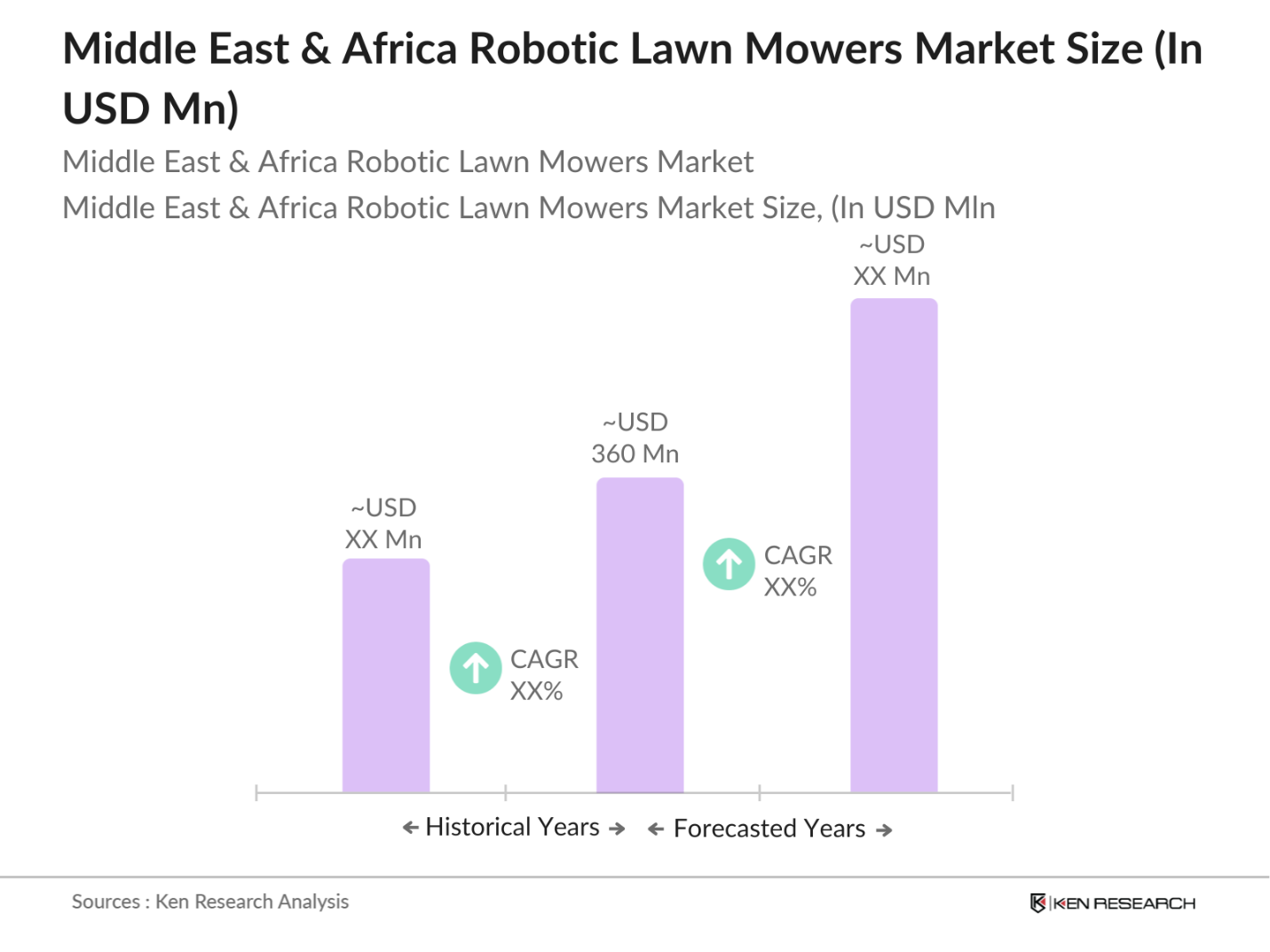
- The market is dominated by countries like the UAE, Saudi Arabia, and South Africa. The UAE and Saudi Arabia are leading due to their rapid urbanization, growing smart city projects, and large-scale adoption of advanced landscaping techniques in commercial and residential projects. South Africa is a key player due to its growing middle class and increased disposable income, which drives demand for robotic and automated home solutions. These regions have the right mix of technological advancement and market demand to dominate the industry.
- The Middle East and Africa are increasingly enforcing green building codes and sustainability standards, impacting the demand for eco-friendly devices like robotic lawn mowers. In 2023, the UAEs Ministry of Climate Change and Environment introduced new sustainability standards for residential construction, mandating the use of energy-efficient landscaping tools in public green spaces. This regulatory framework promotes the adoption of robotic mowers in public and private sectors.
Middle East & Africa Robotic Lawn Mowers Market Segmentation
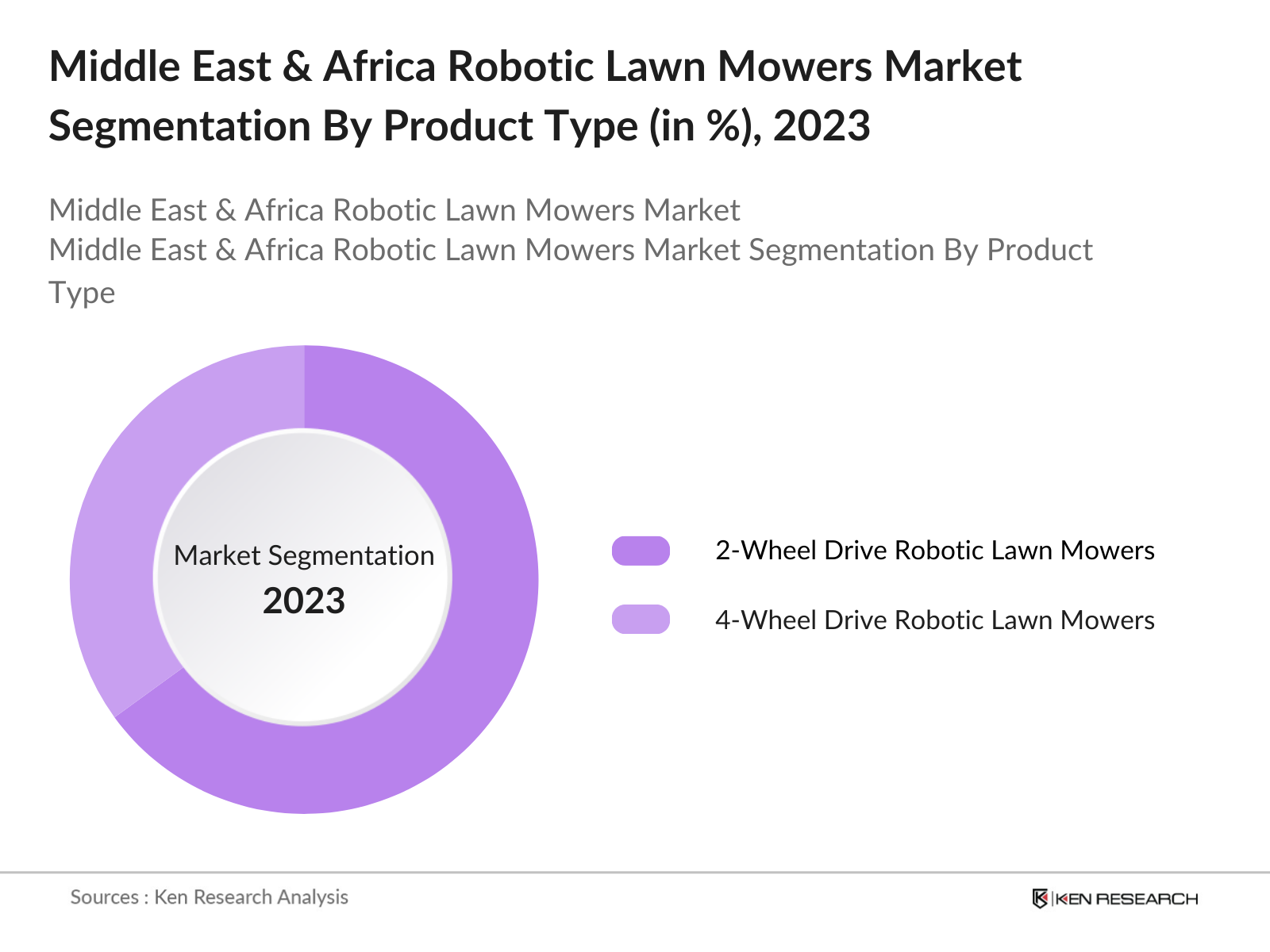
By Product Type: The Middle East & Africa Robotic Lawn Mowers market is segmented by product type into 2-Wheel Drive Robotic Lawn Mowers and 4-Wheel Drive Robotic Lawn Mowers. Recently, 2-Wheel Drive Robotic Lawn Mowers have dominated the market share under the product type segmentation. This dominance is due to their cost-effectiveness and efficiency for small- to medium-sized lawns, which make up the majority of residential spaces. These mowers are also favored for their ease of use and lightweight design, making them more accessible to homeowners with smaller plots.
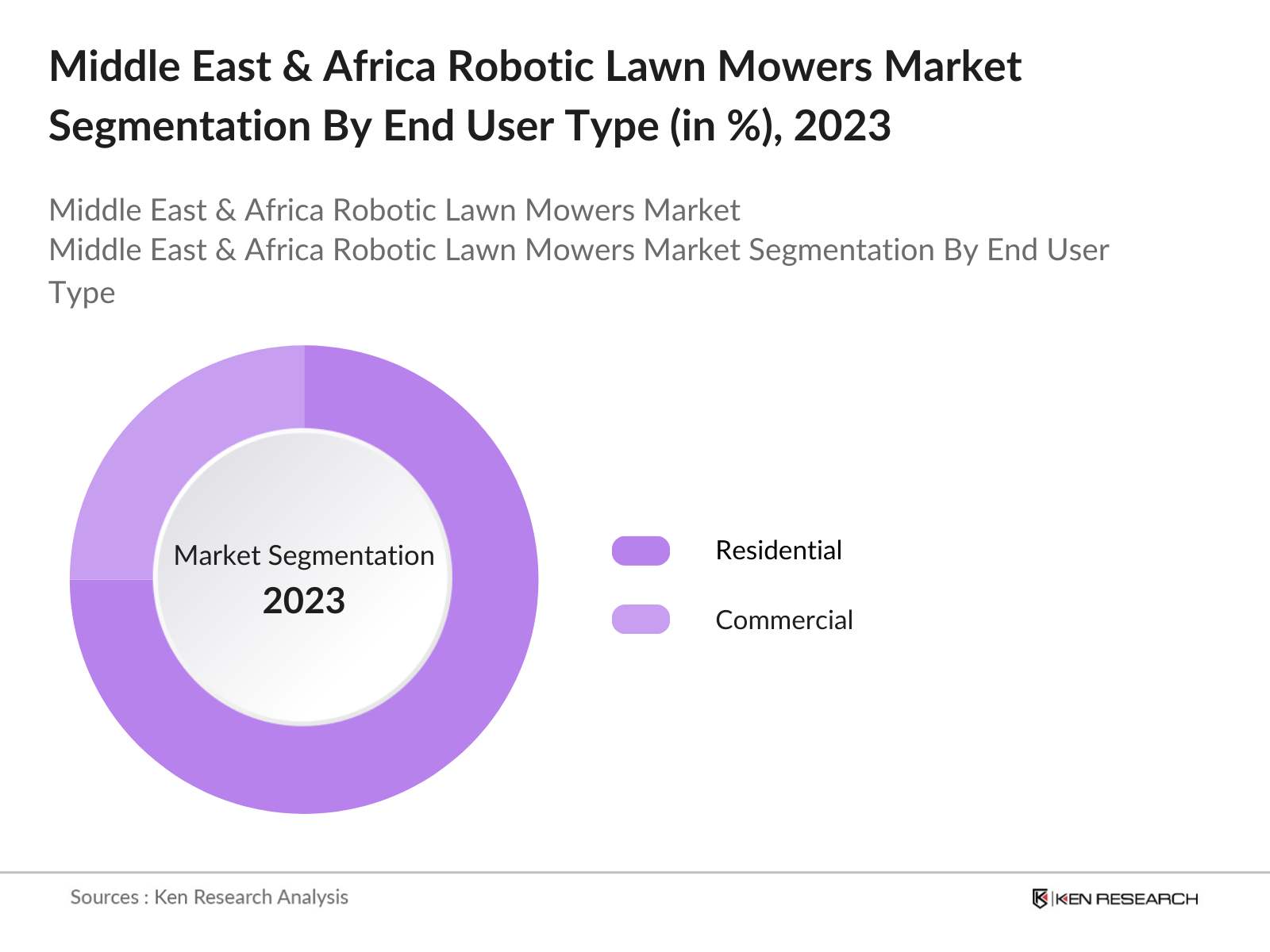
By End-user: The market is also segmented by end-user into Residential and Commercial.
Residential users have dominated the market under this segmentation. This is because robotic lawn mowers offer a convenient and automated solution for homeowners, who are increasingly looking for ways to simplify yard maintenance. As real estate and property development continue to rise across the region, especially in high-end suburban neighborhoods, the demand for robotic mowers in residential applications is on the rise.
Middle East & Africa Robotic Lawn Mowers Market Competitive Landscape
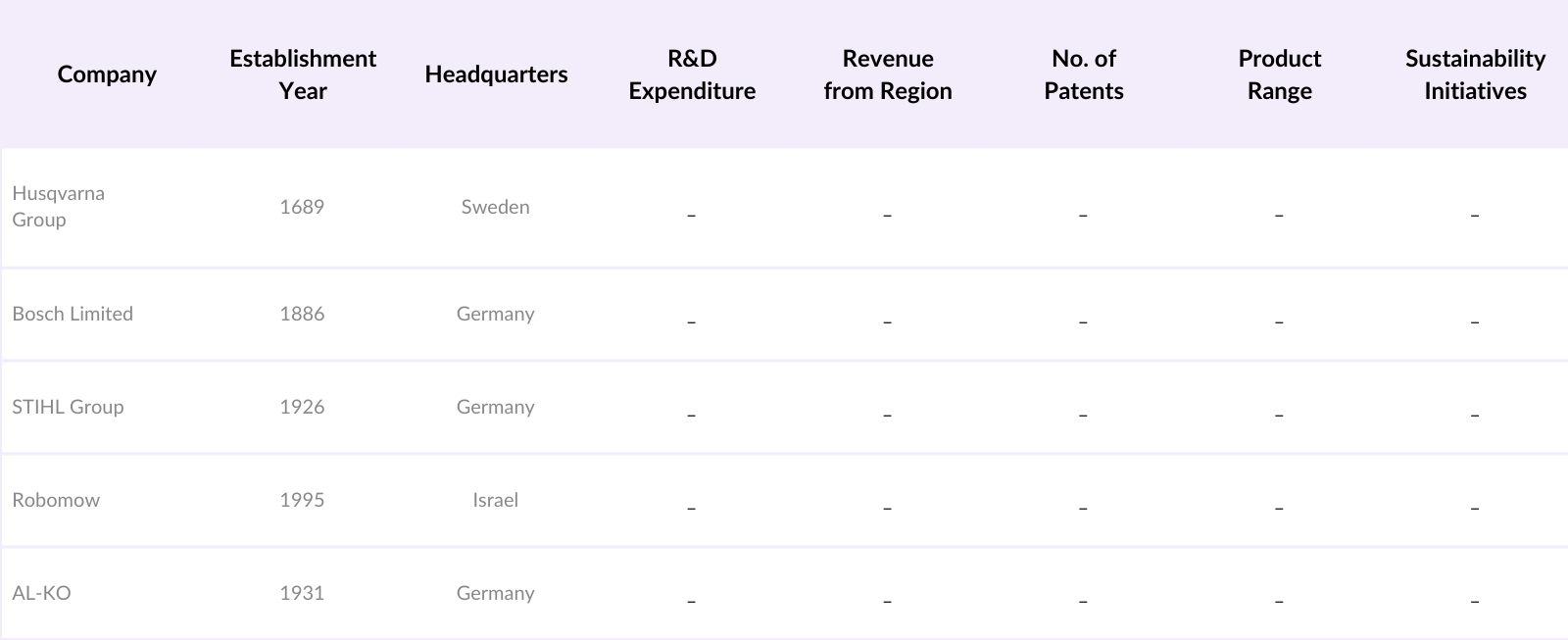
The Middle East & Africa Robotic Lawn Mowers market is dominated by a few key players that lead in terms of product innovation, distribution networks, and strategic market expansion. Companies such as Husqvarna Group and Bosch Limited have capitalized on their strong global presence to secure a foothold in the market. The competitive landscape is marked by the presence of a few global leaders, such as Husqvarna, which enjoys a strong reputation for technological innovation and reliability. The market sees consolidation among key players who dominate due to robust R&D investments and extensive distribution channels across the region. As smart technologies like IoT integration become more prevalent, major players are likely to continue to hold significant influence in the market.
Middle East & Africa Robotic Lawn Mowers Industry Analysis
Growth Drivers
- Rising Adoption of Smart Home Solutions: The Middle East and Africa have witnessed a significant increase in smart home solutions, driven by urbanization and government investments in smart infrastructure. In 2023, the number of smart homes in the UAE exceeded 500,000 units, according to the Ministry of Energy and Infrastructure. In South Africa, the residential sector is expected to reach 2.2 million smart devices by 2025, according to the South African Government's Integrated Energy Plan. This growing adoption creates a conducive environment for robotic lawn mowers as part of integrated smart home solutions, helping automate home maintenance.
- Increasing Urbanization and Landscaping Trends: The World Bank reported that urbanization in the Middle East reached 72% in 2023, with Africa following at 43%. Urban population growth, coupled with lifestyle changes, has fueled demand for aesthetically pleasing outdoor spaces, especially in high-income residential areas. This trend is reflected in the landscaping industry's expansion, with the United Arab Emirates allocating $50 million to urban parks and green spaces. Increased landscaping trends drive the demand for automated solutions like robotic lawn mowers in these urbanized zones.
- Technological Advancements in AI and Sensor Technology: Technological advancements in AI and sensor technology are critical enablers for the growth of robotic lawn mowers. According to the International Telecommunication Union (ITU), over 1.2 million AI-powered smart devices, including lawn mowers, were deployed across smart homes in the Middle East by 2023. AI technology facilitates obstacle detection, efficient energy use, and automated mowing patterns, which improve product efficiency. Additionally, sensor innovations make lawn mowers more adaptive to different terrains, further driving their demand across the region.
Market Challenges
- High Initial Costs of Robotic Lawn Mowers: Robotic lawn mowers remain relatively expensive compared to traditional mowers, with average prices ranging between $800 and $1,200. According to the World Bank, the average monthly income in African countries like Nigeria is under $150, limiting widespread adoption in low-income regions. This pricing challenge restricts market growth, particularly in developing economies across Africa, where affordability is a critical issue.
- Low Penetration in Developing Economies: Despite growing urbanization, robotic lawn mowers have yet to see substantial penetration in developing economies due to limited awareness and access to smart technologies. In sub-Saharan Africa, only 12% of households reported having access to smart home devices in 2023, as per the African Unions technology report. Low digital infrastructure, combined with economic constraints, hinders market expansion, especially in rural and semi-urban regions.
Middle East & Africa Robotic Lawn Mowers Market Future Outlook
Over the next five years, the Middle East & Africa Robotic Lawn Mowers Market is expected to see robust growth, driven by ongoing smart city initiatives, the increased demand for automation in both residential and commercial landscaping, and advancements in technology such as AI and IoT integration. Governments across the region are also pushing for sustainability and environmental solutions, further propelling the adoption of eco-friendly automated mowers. The rapid urbanization and rising disposable incomes in key countries will continue to shape the market dynamics, providing growth opportunities for existing and new players.
Opportunities
- Expanding Green Spaces and Government Initiatives for Landscaping: Governments in the Middle East and Africa are increasingly focusing on expanding green spaces as part of urban planning initiatives. The Dubai Municipality has committed over $100 million to expand parks and green areas in the city. Similarly, in Nigeria, the government launched the Green Lagos initiative to develop 10,000 hectares of public green spaces by 2025. These government-led initiatives provide an opportunity for the wider use of robotic lawn mowers, particularly in maintaining public spaces.
- Integration with Renewable Energy Solutions: The integration of renewable energy solutions, such as solar-powered robotic lawn mowers, is an emerging opportunity in the region. The African Union reported a 25% increase in solar energy installations across Africa in 2023, providing a sustainable power source for smart devices like lawn mowers. This trend aligns with the regions growing focus on eco-friendly products and energy efficiency, driving demand for solar-powered options in both urban and semi-urban areas.
Scope of the Report
|
By Product Type |
2-Wheel Drive Robotic Lawn Mowers |
|
By End-user |
Residential |
|
By Technology |
Smart Connectivity |
|
By Sales Channel |
Direct Sales |
|
By Region |
GCC |
Products
Target Audience Organizations and Entities Who Can Benefit by Subscribing This Report:
Government and Regulatory Bodies (Dubai Municipality, Saudi Arabias Ministry of Municipal Affairs)
Residential Property Development Companies
Golf Course and Sports Complex Asoosciations
Commercial Landscaping Companies
Home Automation Companies
Landscaping Equipment Distributors Companies
Investor and Venture Capitalist Firms
Local Municipalities and Urban Planning Companies
Companies
Players Mentioned in the Report
Husqvarna Group
Bosch Limited
STIHL Group
Robomow
AL-KO
Worx (Positec Group)
Honda Motor Co. Ltd.
ZCS (Zucchetti Centro Sistemi)
Deere & Company
Echo Robotics
Table of Contents
1. Middle East & Africa Robotic Lawn Mowers Market Overview
1.1. Definition and Scope
1.2. Market Taxonomy
1.3. Market Growth Rate (CAGR, Growth Drivers)
1.4. Market Segmentation Overview (By Product, By End-user, By Technology, By Region, By Sales Channel)
2. Middle East & Africa Robotic Lawn Mowers Market Size (In USD Mn)
2.1. Historical Market Size
2.2. Year-On-Year Growth Analysis (Volume & Value)
2.3. Key Market Developments and Milestones
3. Middle East & Africa Robotic Lawn Mowers Market Dynamics
3.1. Growth Drivers
3.1.1. Rising Adoption of Smart Home Technologies
3.1.2. Growing Preference for Automated Solutions in Landscaping
3.1.3. Increasing Disposable Income
3.1.4. Urbanization and Real Estate Development
3.2. Market Challenges
3.2.1. High Initial Investment
3.2.2. Lack of Awareness in Rural Areas
3.2.3. Variations in Grass Types and Landscapes (Region-Specific Adaptation)
3.2.4. Harsh Weather Conditions
3.3. Opportunities
3.3.1. Integration with IoT and AI for Precision Mowing
3.3.2. Expansion in Untapped Markets (North Africa, Sub-Saharan Regions)
3.3.3. Sustainability and Eco-Friendly Solutions
3.3.4. Battery Advancements and Longer Operating Times
3.4. Trends
3.4.1. Solar-Powered Lawn Mowers
3.4.2. Hybrid and Multi-Functional Robotic Systems
3.4.3. Customization and Scalability Options
3.4.4. Subscription-Based Services and Leasing Models
3.5. Regulatory Landscape
3.5.1. Local Import/Export Tariffs and Duties
3.5.2. Environmental Standards (Energy Efficiency and Noise Levels)
3.5.3. Safety Standards and Certifications
3.6. SWOT Analysis (Strengths, Weaknesses, Opportunities, Threats)
3.7. Stakeholder Ecosystem (Manufacturers, Distributors, Installers, Service Providers)
3.8. Porters Five Forces Analysis
3.8.1. Supplier Power
3.8.2. Buyer Power
3.8.3. Competitive Rivalry
3.8.4. Threat of Substitutes
3.8.5. Threat of New Entrants
4. Middle East & Africa Robotic Lawn Mowers Market Segmentation
4.1. By Product Type (In Value %)
4.1.1. 2-Wheel Drive Robotic Lawn Mowers
4.1.2. 4-Wheel Drive Robotic Lawn Mowers
4.2. By End-user (In Value %)
4.2.1. Residential
4.2.2. Commercial (Golf Courses, Sports Fields, Parks & Recreation Areas)
4.3. By Technology (In Value %)
4.3.1. Smart Connectivity (Wi-Fi, Bluetooth, GPS)
4.3.2. Non-Smart Robotic Mowers
4.3.3. AI-Integrated Robotic Mowers
4.4. By Sales Channel (In Value %)
4.4.1. Direct Sales
4.4.2. Online Retailers
4.4.3. Offline Retailers
4.5. By Region (In Value %)
4.5.1. GCC (Saudi Arabia, UAE, Oman, Kuwait)
4.5.2. North Africa (Egypt, Morocco, Algeria)
4.5.3. South Africa
4.5.4. East Africa (Kenya, Tanzania, Ethiopia)
4.5.5. Sub-Saharan Africa
5. Middle East & Africa Robotic Lawn Mowers Market Competitive Landscape
5.1. Detailed Profiles of Major Competitors
5.1.1. Husqvarna Group
5.1.2. Bosch Limited
5.1.3. STIHL Group
5.1.4. Robomow
5.1.5. AL-KO
5.1.6. Worx (Positec Group)
5.1.7. Honda Motor Co. Ltd.
5.1.8. ZCS (Zucchetti Centro Sistemi)
5.1.9. Deere & Company
5.1.10. Echo Robotics
5.1.11. Belrobotics
5.1.12. Global Garden Products
5.1.13. Yamabiko Corporation
5.1.14. Linea Tielle
5.1.15. Mowbot
5.2. Cross Comparison Parameters (Product Portfolio, R&D Expenditure, Patents Held, Revenue Contribution from Region, Market Share, Sustainability Initiatives, Operating Margin, Regional Distribution)
5.3. Market Share Analysis (In % Terms by Region)
5.4. Strategic Initiatives (Product Launches, Collaborations, Market Penetration Strategies)
5.5. Mergers & Acquisitions (Major Regional and Global Deals)
5.6. Investment Analysis
5.6.1. Private Equity Investments
5.6.2. Venture Capital Funding
5.7. Government Grants & Subsidies
6. Middle East & Africa Robotic Lawn Mowers Market Regulatory Framework
6.1. Compliance Requirements (Product Safety, Environmental Impact)
6.2. Certifications (ISO, CE Marking, Local Standards)
7. Middle East & Africa Robotic Lawn Mowers Market Future Size (In USD Mn)
7.1. Future Market Size Projections
7.2. Key Factors Driving Future Growth (Urbanization, Smart City Projects, Consumer Behavior Shifts)
8. Middle East & Africa Robotic Lawn Mowers Market Future Segmentation
8.1. By Product Type (In Value %)
8.2. By End-user (In Value %)
8.3. By Technology (In Value %)
8.4. By Sales Channel (In Value %)
8.5. By Region (In Value %)
9. Middle East & Africa Robotic Lawn Mowers Market Analysts' Recommendations
9.1. TAM/SAM/SOM Analysis
9.2. Market Penetration Strategy
9.3. Customer Cohort Analysis
9.4. Marketing Initiatives (Digital Marketing, Partnered Promotions)
9.5. White Space Opportunity Analysis
Disclaimer Contact UsResearch Methodology
Step 1: Identification of Key Variables
The initial step in our research involved mapping out key stakeholders in the Middle East & Africa Robotic Lawn Mowers Market. Through desk research and database exploration, we identified critical market variables such as product demand by region, customer purchasing behavior, and key drivers of market growth.
Step 2: Market Analysis and Construction
Next, we gathered historical data and performed an in-depth market analysis focusing on key metrics like sales volume, penetration rate, and revenue generation across various segments. We utilized a bottom-up approach to accurately estimate the market size.
Step 3: Hypothesis Validation and Expert Consultation
We conducted interviews with industry experts from leading manufacturers and distributors to validate our hypotheses. These discussions provided nuanced insights into market trends, challenges, and opportunities, which helped refine the data and final market estimates.
Step 4: Research Synthesis and Final Output
The final phase involved a comprehensive synthesis of findings, integrating expert inputs with quantitative data. This enabled us to present a validated, data-driven report, offering actionable insights into market dynamics and future opportunities.
Frequently Asked Questions
1. How big is the Middle East & Africa Robotic Lawn Mowers Market?
The Middle East & Africa Robotic Lawn Mowers Market is valued at USD 360 million, primarily driven by rising adoption of smart home technologies and automation in landscaping.
2. What are the challenges in the Middle East & Africa Robotic Lawn Mowers Market?
Challenges include high initial investment, lack of awareness in rural areas, and region-specific technical adaptations due to diverse landscaping conditions across different countries.
3. Who are the major players in the Middle East & Africa Robotic Lawn Mowers Market?
Major players include Husqvarna Group, Bosch Limited, STIHL Group, Robomow, and AL-KO, who dominate the market due to their advanced technological solutions and wide distribution networks.
4. What are the growth drivers of the Middle East & Africa Robotic Lawn Mowers Market?
The market is driven by urbanization, growing preference for smart automated solutions in residential projects, and real estate developments across key regions like the UAE, Saudi Arabia, and South Africa.
Why Buy From Us?

What makes us stand out is that our consultants follows Robust, Refine and Result (RRR) methodology. i.e. Robust for clear definitions, approaches and sanity checking, Refine for differentiating respondents facts and opinions and Result for presenting data with story

We have set a benchmark in the industry by offering our clients with syndicated and customized market research reports featuring coverage of entire market as well as meticulous research and analyst insights.

While we don't replace traditional research, we flip the method upside down. Our dual approach of Top Bottom & Bottom Top ensures quality deliverable by not just verifying company fundamentals but also looking at the sector and macroeconomic factors.

With one step in the future, our research team constantly tries to show you the bigger picture. We help with some of the tough questions you may encounter along the way: How is the industry positioned? Best marketing channel? KPI's of competitors? By aligning every element, we help maximize success.

Our report gives you instant access to the answers and sources that other companies might choose to hide. We elaborate each steps of research methodology we have used and showcase you the sample size to earn your trust.

If you need any support, we are here! We pride ourselves on universe strength, data quality, and quick, friendly, and professional service.