
Middle East & Africa Sonar System Market Outlook to 2030
Region:Middle East
Author(s):Shivani Mehra
Product Code:KROD3013
November 2024
89
About the Report
Middle East & Africa Sonar System Market Overview
- The Middle East & Africa Sonar System Market is valued at USD 310.7 million, driven by growing concerns around maritime security and the protection of vital infrastructure, such as oil rigs and shipping lanes. Sonar systems play a critical role in surveillance, defense, and exploration, which has led to increased investment by governments in the region. This market is also influenced by rising offshore oil and gas exploration, with sonar systems ensuring safe navigation and operational efficiency.

- The United Arab Emirates and Saudi Arabia are the dominant markets in this region, as both countries have made significant investments in strengthening their naval capabilities. This dominance is attributed to the need for enhanced maritime security, strategic geographic locations, and their efforts to secure key commercial routes and economic interests in the Gulf. Additionally, South Africa leads in Southern Africa due to its strategic coastal importance and expanding offshore projects.
- Environmental protection guidelines restrict sonar use in ecologically sensitive areas to protect marine life. For instance, South Africa and Kenya have introduced policies limiting high-frequency sonar operations in certain zones to reduce disruptions to marine habitats. These guidelines align with international conservation efforts, compelling sonar system manufacturers to develop environmentally conscious technology and limiting sonar deployment in designated marine protected areas.
Middle East & Africa Sonar System Market Segmentation
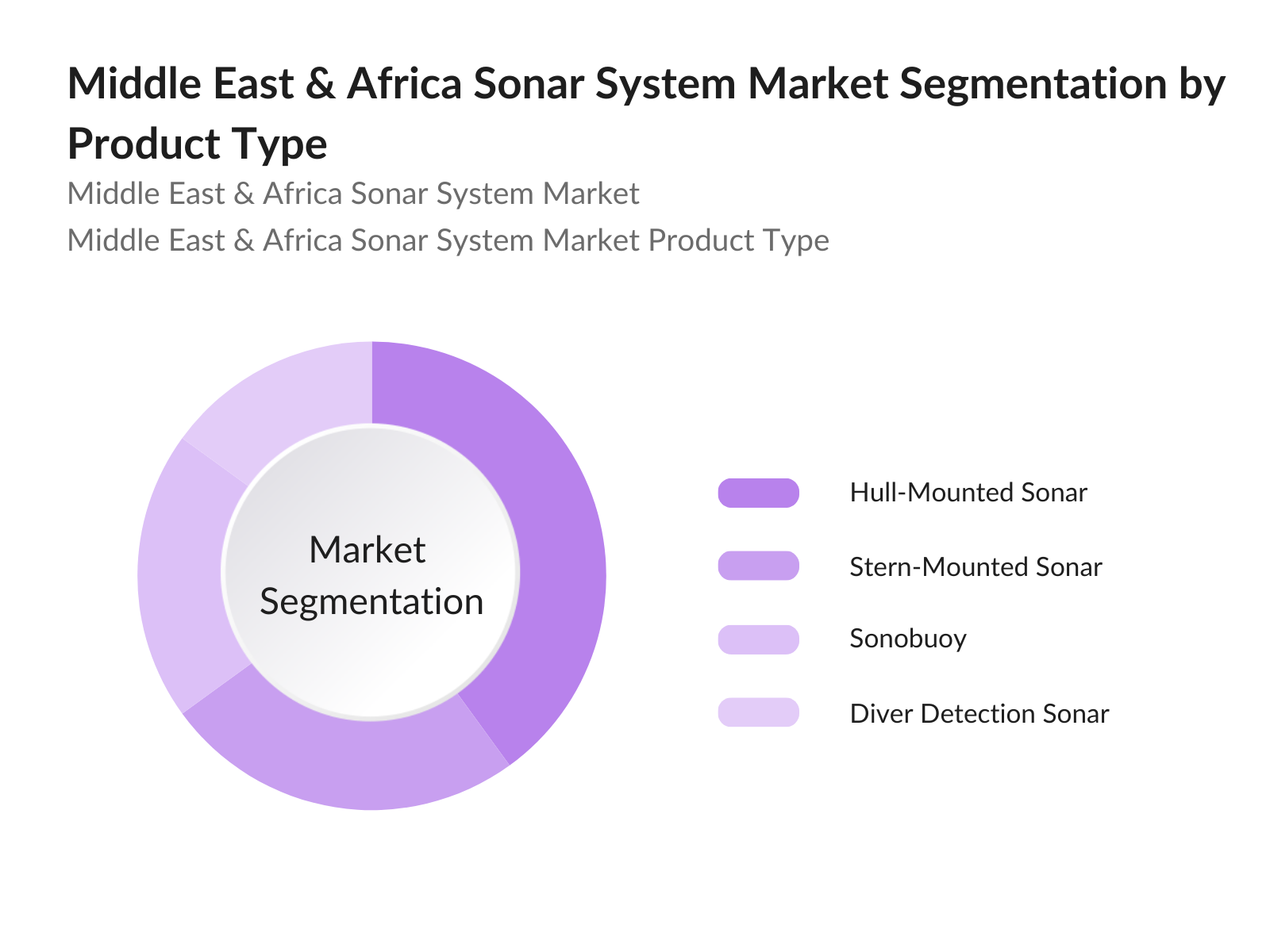
- By Product Type: The Middle East & Africa Sonar System Market is segmented by product type into hull-mounted sonar, stern-mounted sonar, sonobuoy, and diver detection sonar. Hull-mounted sonar holds a dominant market share due to its widespread use in naval defense applications, providing efficient underwater detection capabilities essential for military operations. Hull-mounted sonar is the preferred choice for countries focused on enhancing maritime security, with government investments supporting this technology's adoption.
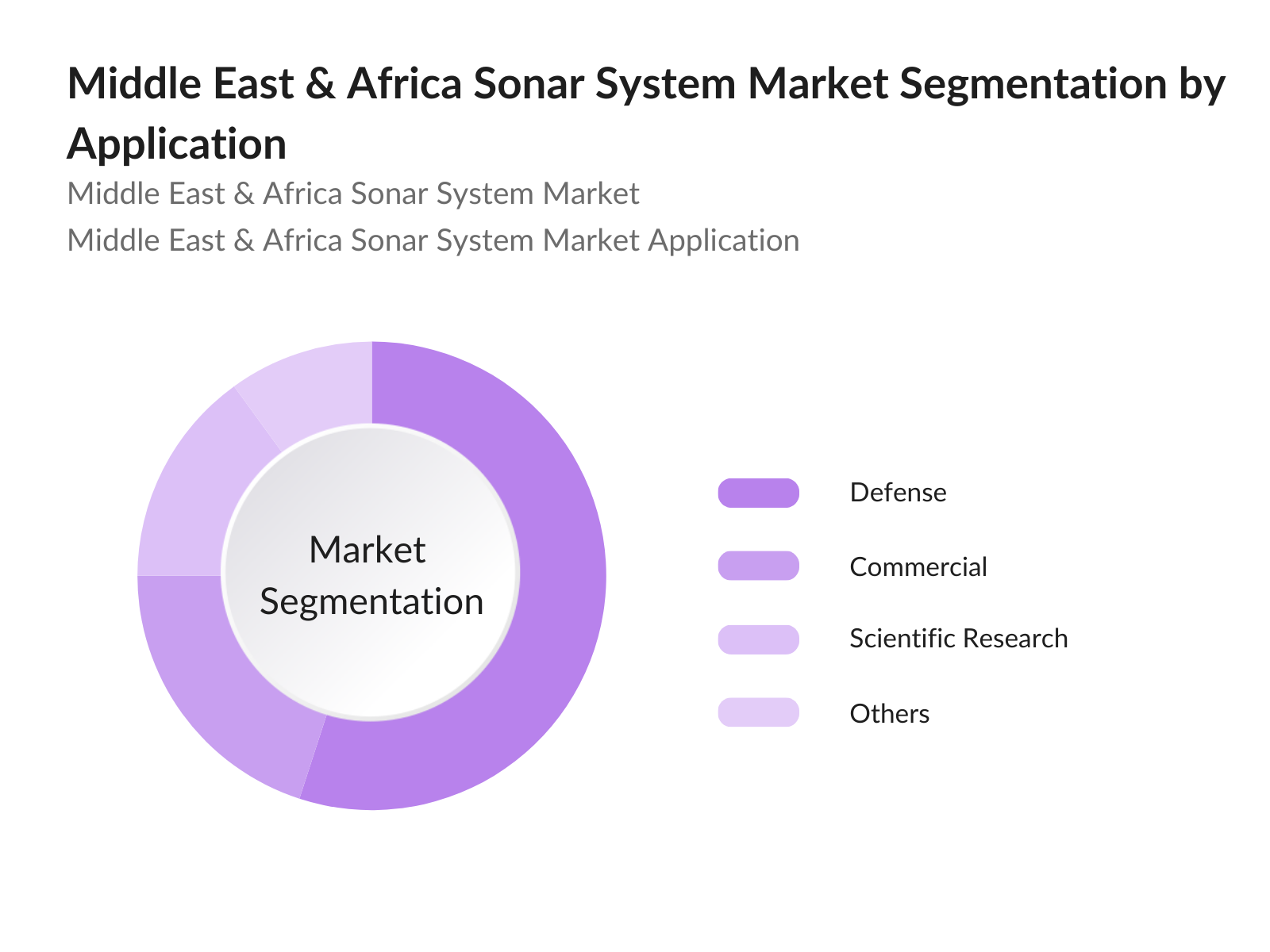
 By Application: The market segmentation by application includes defense, commercial, scientific research, and others. The defense segment leads due to heightened security concerns and a focus on protecting economic zones and infrastructure. With the expansion of naval capabilities in the Middle East, defense applications for sonar systems are experiencing high demand as countries seek to secure their coastlines and prevent unauthorized activities in sensitive waters.
Middle East & Africa Sonar System Market Competitive Landscape
The Middle East & Africa Sonar System Market is highly competitive, with leading global and regional players investing in R&D and partnerships to enhance sonar technologies. Key companies, such as Thales Group and L3Harris Technologies, benefit from technological innovation and established relationships with government and defense agencies in the region.

Middle East & Africa Sonar System Industry Analysis
Market Growth Drivers
-
Increasing Maritime Security Concerns: Maritime security remains a top priority for Middle Eastern and African nations due to piracy and territorial disputes, particularly in the Red Sea, Gulf of Aden, and Gulf of Guinea. In 2023, the region reported over 100 piracy incidents, highlighting the demand for effective sonar systems for threat detection and naval patrol. The growing frequency of maritime threats has led to significant government investments in sonar technology to safeguard territorial waters and protect commercial shipping lanes.
- Expansion of Offshore Oil and Gas Exploration: With large oil and gas reserves in the Middle East and Africa, offshore exploration has expanded rapidly. The UAE and Saudi Arabia alone have invested over $20 billion in offshore projects since 2022, increasing demand for sonar systems used in underwater exploration, mapping, and resource identification. Countries like Nigeria and Angola have also boosted investments in offshore oil and gas, driving the need for advanced sonar systems to ensure safe and efficient exploration.
- Technological Advancements in Sonar Systems: Recent advancements in sonar technology, such as synthetic aperture sonar and high-resolution imaging, enhance detection and data accuracy. By 2024 of sonar systems deployed in the Middle East and Africa included high-frequency sonar technology, improving underwater visibility in complex terrains. These technological upgrades are particularly valuable for the naval and offshore sectors, where accurate detection and mapping are essential.
Market Challenges:
-
High Initial Investment Costs: Sonar systems are capital-intensive, with advanced systems costing upwards of $500,000 each. The high cost can deter smaller countries and private companies from adopting the technology. Despite growing interest, the cost of purchase and maintenance limits wider adoption of sonar systems, especially in nations with constrained defense budgets or limited access to foreign funding.
- Environmental Concerns Related to Sonar Usage: Environmental concerns are mounting over the potential impacts of sonar technology on marine life, particularly on species like whales and dolphins sensitive to sound waves. Studies from regional environmental organizations indicate an increase in behavioral disturbances among marine species, prompting regulations that may restrict sonar usage in certain areas. These environmental concerns challenge the unrestricted use of sonar technology, particularly for offshore exploration.
Middle East & Africa Sonar System Market Future Outlook
The Middle East & Africa Sonar System Market is expected to grow substantially over the next five years, supported by advancements in sonar technology, increased government spending on naval defense, and the expansion of offshore oil and gas activities. The regions strategic location and security priorities are anticipated to drive demand for innovative sonar systems, such as synthetic aperture sonar and AUV-integrated systems.
Market Opportunities:
-
Development of Autonomous Underwater Vehicles (AUVs): The development of Autonomous Underwater Vehicles (AUVs) presents significant opportunities for the sonar system market. In 2023, approximately $500 million was invested in AUV research across the Middle East and Africa. AUVs, equipped with sonar technology, can conduct underwater surveys for extended periods without human intervention, increasing efficiency for military and commercial applications. This development aligns with the regions interest in enhancing surveillance and exploration capabilities through autonomous solutions.
- Integration of AI and Machine Learning in Sonar Systems: AI and machine learning integration in sonar systems allow for advanced data analysis, improving detection accuracy and reducing false alarms. In 2023, AI-enabled sonar systems were increasingly adopted by naval forces in the UAE and Israel, enhancing threat identification capabilities. This technological integration offers opportunities for real-time data processing and predictive analysis, meeting the demands of governments and industries that require precise underwater mapping and monitoring.
Scope of the Report
|
By Product Type |
Hull-Mounted Sonar Stern-Mounted Sonar Sonobuoy Diver Detection Sonar |
|
By Application |
Defense Commercial Scientific Research Others |
|
By Platform |
Ship Type |
|
By Installation |
Fixed |
|
By Region |
North-East Midwest West Coast Southern States |
Products
Key Target Audience
Naval Defense Agencies
Maritime Security Companies
Offshore Oil & Gas Operators
Scientific Research Institutions
Investments and Venture Capitalist Firms
Government and Regulatory Bodies(e.g., UAE Ministry of Defense, South African Department of Defense)
Aerospace & Defense Contractors
Environmental Protection Agencies
Companies
Players mentioned in the Market
Thales Group
L3Harris Technologies, Inc.
Kongsberg Gruppen
Raytheon Technologies Corporation
Atlas Elektronik GmbH
Lockheed Martin Corporation
Ultra Electronics Holdings plc
Teledyne Technologies Incorporated
Northrop Grumman Corporation
Aselsan A.S.
Edge Group
Denel SOC Ltd
Elbit Systems Ltd.
Saab AB
Bharat Electronics Limited
Table of Contents
1. Middle East & Africa Sonar System Market Overview
1.1. Definition and Scope
1.2. Market Taxonomy
1.3. Market Growth Rate
1.4. Market Segmentation Overview
2. Middle East & Africa Sonar System Market Size (In USD Million)
2.1. Historical Market Size
2.2. Year-On-Year Growth Analysis
2.3. Key Market Developments and Milestones
3. Middle East & Africa Sonar System Market Analysis
3.1. Growth Drivers
3.1.1. Increasing Maritime Security Concerns
3.1.2. Expansion of Offshore Oil and Gas Exploration
3.1.3. Technological Advancements in Sonar Systems
3.1.4. Government Investments in Naval Defense
3.2. Market Challenges
3.2.1. High Initial Investment Costs
3.2.2. Limited Skilled Workforce
3.2.3. Environmental Concerns Related to Sonar Usage
3.3. Opportunities
3.3.1. Development of Autonomous Underwater Vehicles (AUVs)
3.3.2. Integration of AI and Machine Learning in Sonar Systems
3.3.3. Expansion into Unexplored Marine Territories
3.4. Trends
3.4.1. Adoption of Synthetic Aperture Sonar
3.4.2. Miniaturization of Sonar Components
3.4.3. Increased Use in Marine Environmental Monitoring
3.5. Government Regulation
3.5.1. Maritime Safety Regulations
3.5.2. Environmental Protection Guidelines
3.5.3. Defense Procurement Policies
3.6. SWOT Analysis
3.7. Stakeholder Ecosystem
3.8. Porters Five Forces
3.9. Competitive Landscape
4. Middle East & Africa Sonar System Market Segmentation
4.1. By Product Type (In Value %)
4.1.1. Hull-Mounted Sonar
4.1.2. Stern-Mounted Sonar
4.1.3. Sonobuoy
4.1.4. Diver Detection Sonar
4.2. By Application (In Value %)
4.2.1. Defense
4.2.2. Commercial
4.2.3. Scientific Research
4.2.4. Others
4.3. By Platform (In Value %)
4.3.1. Ship Type
4.3.2. Airborne
4.3.3. Unmanned Underwater Vehicles (UUVs)
4.4. By Installation (In Value %)
4.4.1. Fixed
4.4.2. Deployable
4.5. By Country (In Value %)
4.5.1. Saudi Arabia
4.5.2. United Arab Emirates
4.5.3. South Africa
4.5.4. Egypt
4.5.5. Nigeria
4.5.6. Rest of Middle East & Africa
5. Middle East & Africa Sonar System Market Competitive Analysis
5.1. Detailed Profiles of Major Companies
5.1.1. Thales Group
5.1.2. L3Harris Technologies, Inc.
5.1.3. Kongsberg Gruppen
5.1.4. Raytheon Technologies Corporation
5.1.5. Atlas Elektronik GmbH
5.1.6. Lockheed Martin Corporation
5.1.7. Ultra Electronics Holdings plc
5.1.8. Teledyne Technologies Incorporated
5.1.9. Northrop Grumman Corporation
5.1.10. Aselsan A.S.
5.1.11. Edge Group
5.1.12. Denel SOC Ltd
5.1.13. Elbit Systems Ltd.
5.1.14. Saab AB
5.1.15. Bharat Electronics Limited
5.2. Cross Comparison Parameters (Revenue, Headquarters, Inception Year, R&D Investment, Manufacturing Capacity, Regional Presence, Product Portfolio, Strategic Partnerships)
5.3. Market Share Analysis
5.4. Strategic Initiatives
5.5. Mergers and Acquisitions
5.6. Investment Analysis
5.7. Venture Capital Funding
5.8. Government Grants
5.9. Private Equity Investments
6. Middle East & Africa Sonar System Market Regulatory Framework
6.1. Maritime Safety Standards
6.2. Environmental Compliance Requirements
6.3. Defense Acquisition Regulations
7. Middle East & Africa Sonar System Future Market Size (In USD Million)
7.1. Future Market Size Projections
7.2. Key Factors Driving Future Growth
8. Middle East & Africa Sonar System Future Market Segmentation
8.1. By Product Type (In Value %)
8.2. By Application (In Value %)
8.3. By Platform (In Value %)
8.4. By Installation (In Value %)
8.5. By Country (In Value %)
9. Middle East & Africa Sonar System Market Analysts Recommendations
9.1. TAM/SAM/SOM Analysis
9.2. Customer Cohort Analysis
9.3. Key Market Positioning Recommendations
9.4. White Space Opportunity Analysis
Disclaimer Contact UsResearch Methodology
Step 1: Identification of Key Variables
The first step involves constructing an ecosystem map of the Middle East & Africa Sonar System Market. Extensive desk research, leveraging secondary and proprietary databases, is used to identify key variables such as technological advancements, defense priorities, and regulatory standards.
Step 2: Market Analysis and Construction
In this phase, historical data on sonar system applications in defense, commercial, and scientific research is analyzed. Factors like regional defense budgets, offshore exploration activities, and market penetration are assessed for accurate revenue estimates.
Step 3: Hypothesis Validation and Expert Consultation
Market hypotheses are validated through in-depth interviews with industry experts, providing insights into technology adoption, procurement policies, and strategic needs in the sonar system market.
Step 4: Research Synthesis and Final Output
The final phase synthesizes research findings into a comprehensive report. Industry insights are incorporated to create a validated and detailed analysis of the Middle East & Africa Sonar System Market, ensuring a high level of accuracy and relevance.
Frequently Asked Questions
01. How big is the Middle East & Africa Sonar System Market?
The Middle East & Africa Sonar System Market is valued at USD 310.7 million, driven by rising investments in maritime security and offshore oil and gas exploration.
02. What are the challenges in the Middle East & Africa Sonar System Market?
Challenges include high initial costs, environmental concerns related to sonar usage, and limited skilled personnel for operation and maintenance of sonar systems.
03. Who are the major players in the Middle East & Africa Sonar System Market?
Key players include Thales Group, L3Harris Technologies, Kongsberg Gruppen, Atlas Elektronik GmbH, and Raytheon Technologies, with a strong presence due to advanced technologies and defense sector partnerships.
04. What are the growth drivers of the Middle East & Africa Sonar System Market?
Growth is driven by increased government investments in naval defense, expansion of offshore activities, and advancements in sonar technologies that offer enhanced detection capabilities.
Why Buy From Us?

What makes us stand out is that our consultants follows Robust, Refine and Result (RRR) methodology. i.e. Robust for clear definitions, approaches and sanity checking, Refine for differentiating respondents facts and opinions and Result for presenting data with story

We have set a benchmark in the industry by offering our clients with syndicated and customized market research reports featuring coverage of entire market as well as meticulous research and analyst insights.

While we don't replace traditional research, we flip the method upside down. Our dual approach of Top Bottom & Bottom Top ensures quality deliverable by not just verifying company fundamentals but also looking at the sector and macroeconomic factors.

With one step in the future, our research team constantly tries to show you the bigger picture. We help with some of the tough questions you may encounter along the way: How is the industry positioned? Best marketing channel? KPI's of competitors? By aligning every element, we help maximize success.

Our report gives you instant access to the answers and sources that other companies might choose to hide. We elaborate each steps of research methodology we have used and showcase you the sample size to earn your trust.

If you need any support, we are here! We pride ourselves on universe strength, data quality, and quick, friendly, and professional service.