
Middle East & Africa Unmanned Surface Vehicle (USV) Market Outlook to 2030
Region:Middle East
Author(s):Yogita Sahu
Product Code:KROD5471
November 2024
90
About the Report
Middle East & Africa USV Market Overview
- The Middle East & Africa Unmanned Surface Vehicle (USV) market, valued at USD 101 million, is driven by the region's rising investment in maritime defense and security. Countries in this region are focusing on strengthening their naval capabilities to combat piracy, secure trade routes, and ensure national security. The markets growth is underpinned by technological advancements in autonomous systems and increased spending on defense by both public and private entities.
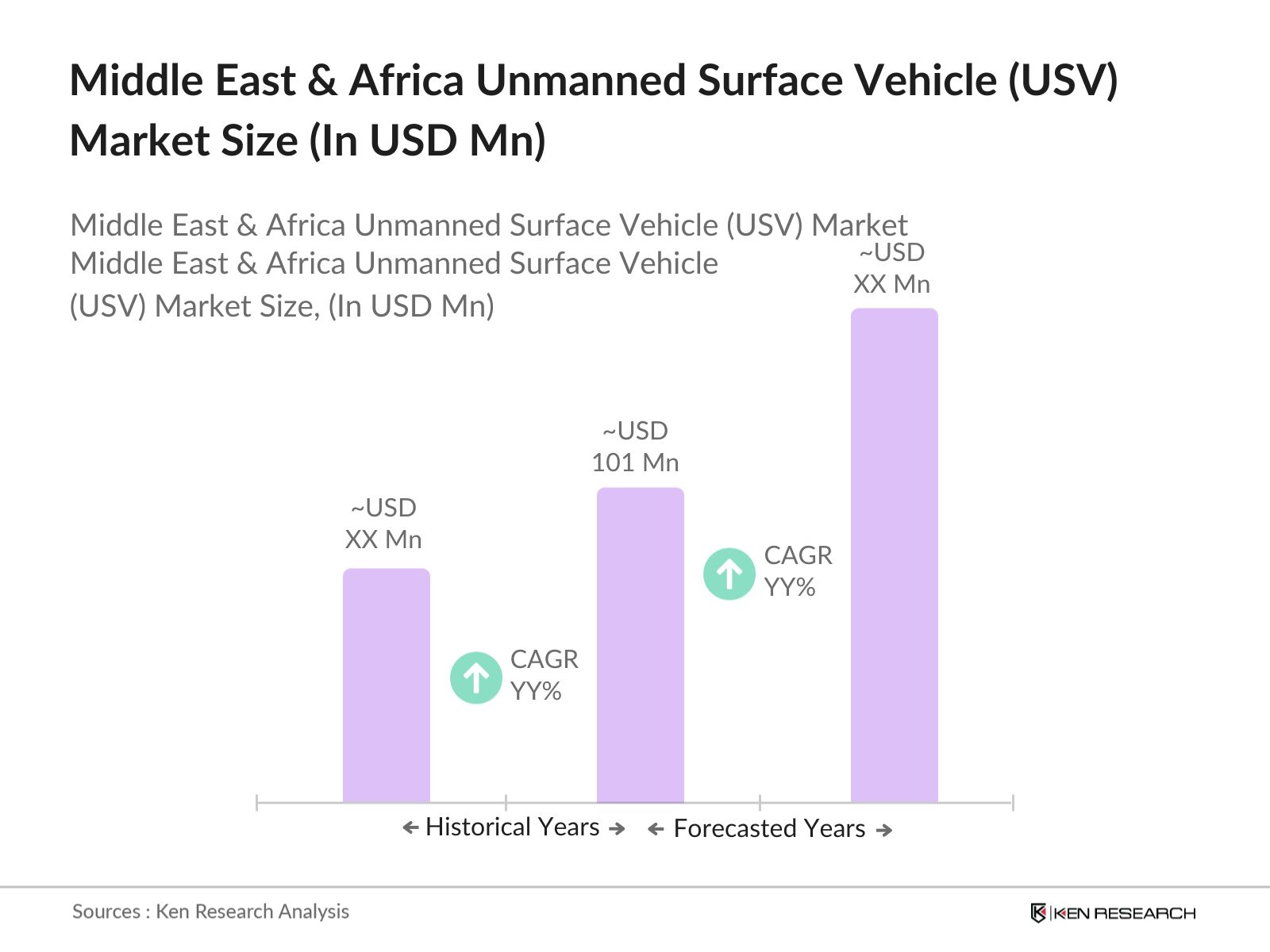
- In terms of dominance, countries like the UAE, Saudi Arabia, and South Africa lead the market due to their strategic importance in maritime defense and proximity to critical waterways such as the Strait of Hormuz and the Red Sea. The dominance of these countries is attributed to their substantial defense budgets, high demand for advanced surveillance and reconnaissance systems, and growing interest in developing unmanned naval capabilities to monitor vast maritime zones.
- The UAE government has invested heavily in bolstering maritime security through autonomous systems. The UAE Maritime Security Strategy 2024 allocated $1.5 billion to procure USVs to strengthen its naval forces, including developing an indigenous production line for unmanned vehicles to enhance self-reliance in defense manufacturing.
Middle East & Africa USV Market Segmentation
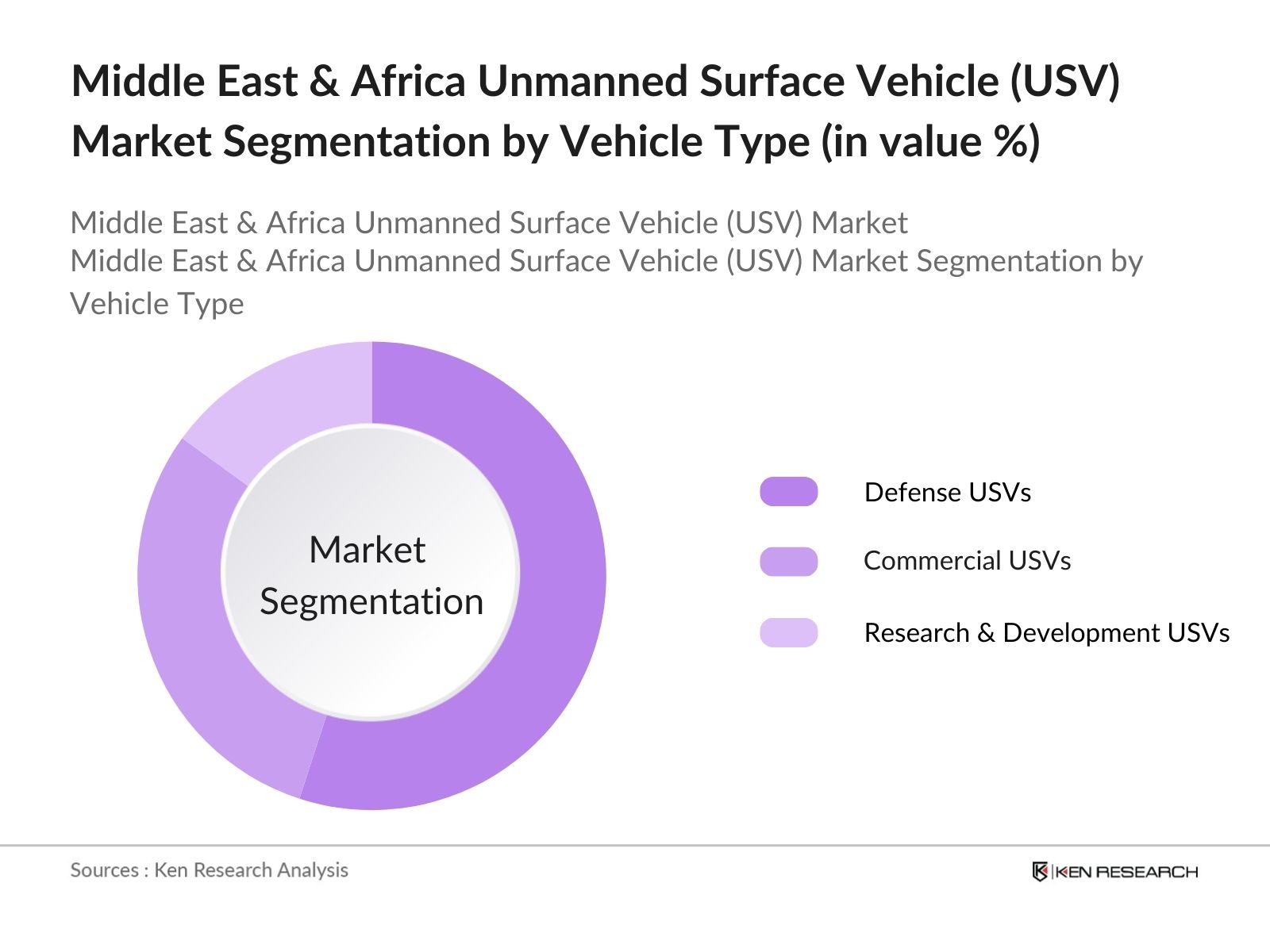
By Vehicle Type: The market is segmented by vehicle type into Defense USVs, Commercial USVs, and Research & Development USVs. Defense USVs dominate the market, primarily due to increasing defense expenditure by governments in the region. The high demand for surveillance, mine countermeasures, and anti-submarine warfare capabilities has led to the wide adoption of defense USVs. These vehicles offer superior capabilities in terms of mission autonomy, endurance, and reduced operational risks for manned vessels.
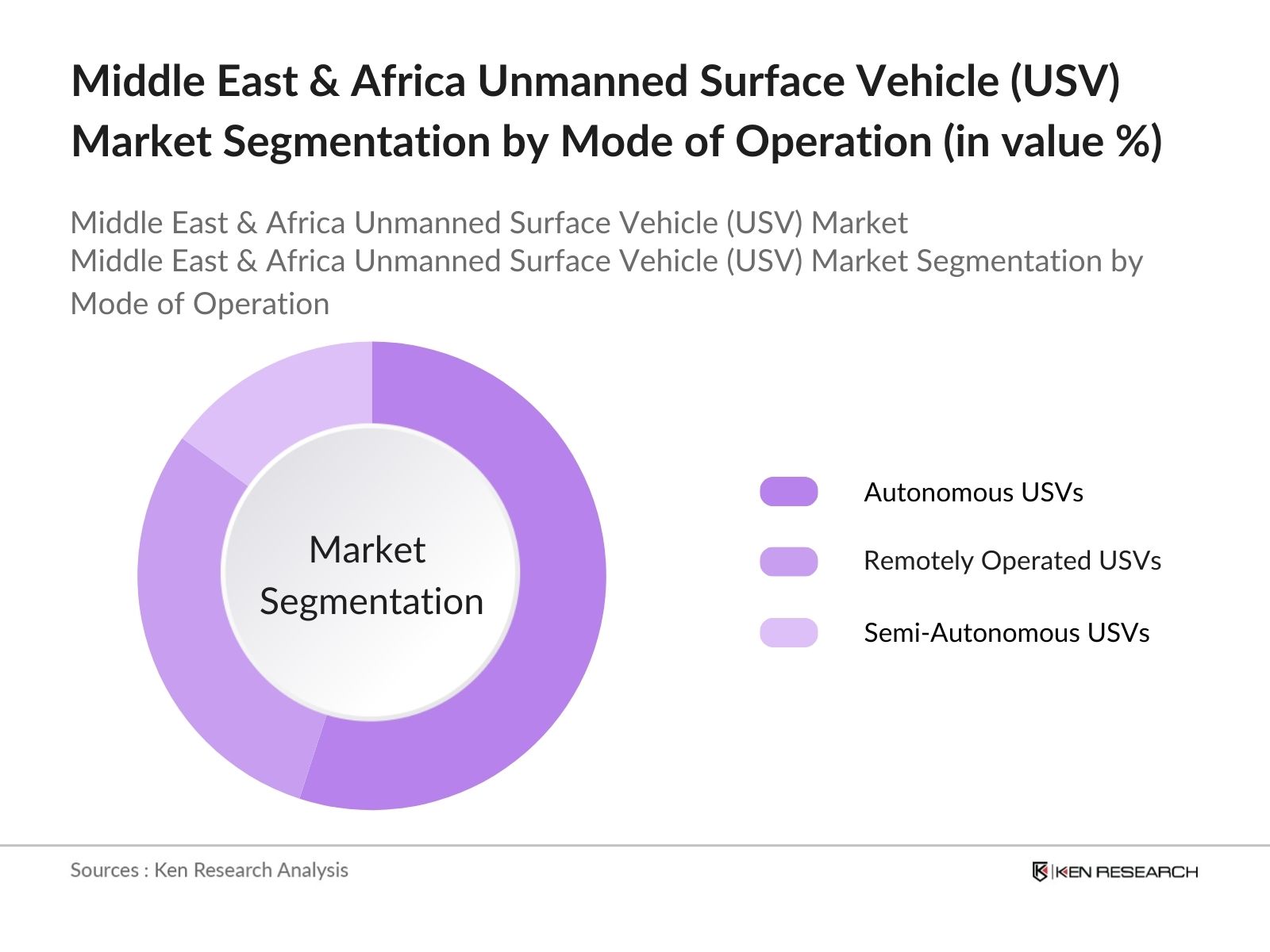
By Mode of Operation: The market is segmented by mode of operation into Autonomous USVs, Remotely Operated USVs, and Semi-Autonomous USVs. Autonomous USVs hold the dominant market share in this segment. This is due to the technological shift toward full autonomy, reducing the need for constant human oversight. These vehicles are increasingly preferred by defense forces for complex missions where real-time decision-making and navigation in unpredictable environments are required.
Middle East & Africa USV Market Competitive Landscape
The market is characterized by the presence of both global and regional players. The market is dominated by key companies engaged in defense technology, offering advanced USV solutions.
|
Company Name |
Establishment Year |
Headquarters |
Product Portfolio |
Regional Presence |
Technological Innovation |
Defense Collaborations |
Fleet Size |
|
L3Harris Technologies |
1895 |
Melbourne, USA |
|||||
|
Kongsberg Maritime |
1814 |
Kongsberg, Norway |
|||||
|
Rafael Advanced Defense Systems |
1948 |
Haifa, Israel |
|||||
|
ASV Global |
1998 |
Portsmouth, UK |
|||||
|
Elbit Systems |
1966 |
Haifa, Israel |
Middle East & Africa USV Market Analysis
Market Growth Drivers
- Increased Maritime Security Requirements: The Middle East & Africa region faces significant maritime security challenges, including piracy, illegal fishing, and territorial disputes. Unmanned Surface Vehicles (USVs) are increasingly adopted by defense agencies to patrol and secure coastal areas. For instance, Saudi Arabia has invested in the development of USVs to enhance their maritime border security. In 2024, over 150 incidents of maritime piracy were reported in the Gulf of Aden and the Horn of Africa, driving demand for autonomous vehicles to ensure consistent maritime surveillance.
- Growing Offshore Oil and Gas Exploration: The Middle East & Africa region is a major hub for oil and gas exploration. USVs are being used to inspect and monitor offshore oil rigs and underwater pipelines, offering lower operational costs compared to manned vessels. In 2024, there were around 500 active offshore rigs in the region. The use of USVs for these operations has resulted in a significant reduction in maintenance downtime, thereby supporting the growth of this market.
- Environmental Monitoring and Research Applications: There is a rising need for monitoring environmental changes, such as oil spills, water quality, and marine biodiversity, especially in the Gulf region and around the West African coastline. In 2024, an estimated 10,000 km of coastline in the Middle East & Africa was actively monitored using unmanned systems for ecological preservation and environmental risk management. USVs offer reliable and cost-effective solutions for long-duration environmental missions, thus driving adoption.
Market Challenges
- High Operational Costs for Advanced USV Models: While the technology provides benefits, the acquisition, maintenance, and operational costs of highly advanced USV models remain a barrier to widespread adoption, especially among smaller nations in Africa. The average cost of an advanced military USV in 2024 is reported to be around $3 million, limiting its adoption to wealthier nations like Saudi Arabia and the UAE.
- Limited Infrastructure for Remote Operations: The regions lack of developed maritime infrastructure to support autonomous operations, particularly in less wealthy African nations, poses a challenge. Countries such as Nigeria and Kenya are in the process of upgrading coastal facilities, but as of 2024, only 20% of their coastal borders are equipped with the necessary command and control infrastructure to deploy USVs effectively, which hampers regional market growth.
Middle East & Africa USV Market Future Outlook
Over the next five years, the Middle East & Africa Unmanned Surface Vehicle (USV) industry is expected to show growth driven by increasing defense expenditure, advancements in autonomous technologies, and the need for enhanced maritime security in the region. The expansion of commercial activities such as offshore oil and gas exploration and environmental monitoring will further stimulate demand for advanced USVs.
Future Market Opportunities
- Increased Adoption of AI-Powered USVs: In the next five years, AI-powered USVs will become more prevalent in the Middle East & Africa, with many governments planning to integrate these systems into their naval forces. By 2029, it is expected that at least 30% of the USV fleet in the region will be equipped with AI-driven capabilities, significantly enhancing autonomous operations and reducing the need for human intervention.
- Rising Demand for Commercial USVs in Offshore Industries: The offshore oil and gas industry in the Middle East & Africa will increasingly adopt USVs for inspections and maintenance by 2029. As operational safety becomes more stringent, it is projected that over 300 USVs will be employed for offshore activities in the region, particularly in areas like the Persian Gulf and the Gulf of Guinea, where oil exploration is prominent.
Scope of the Report
|
Vehicle Type |
Defense USVs Commercial USVs Research & Development USVs |
|
Mode of Operation |
Autonomous USVs Remotely Operated USVs Semi-Autonomous USVs |
|
Application |
Defense & Security Scientific Research Commercial & Industrial Offshore Oil & Gas Environmental Monitoring |
|
Propulsion System |
Diesel/Gasoline Engines Electric Propulsion Hybrid Systems |
|
Region |
Israel United Arab Emirates Jordan Morocco South Africa Rest of MEA |
Products
Key Target Audience Organizations and Entities Who Can Benefit by Subscribing This Report:
Banks and Financial Institution
Offshore Oil & Gas Companies
Private Equity Frims
Autonomous Technology Providers
Investment and Venture Capitalist Firms
Government and Regulatory Bodies (e.g., GCC Security Councils)
Companies
Players Mentioned in the Report:
L3Harris Technologies
Kongsberg Maritime
Rafael Advanced Defense Systems
ASV Global
Elbit Systems
Sea Robotics
Textron Systems
Teledyne Marine
Atlas Elektronik
Oceanalpha
Saab AB
ThyssenKrupp Marine Systems
Maritime Robotics
Seebyte
ECA Group
Table of Contents
Middle East & Africa Unmanned Surface Vehicle (USV) Market Overview
1.1. Definition and Scope
1.2. Market Taxonomy
1.3. Market Growth Rate
1.4. Market Segmentation Overview
Middle East & Africa Unmanned Surface Vehicle (USV) Market Size (In USD Mn)
2.1. Historical Market Size
2.2. Year-On-Year Growth Analysis
2.3. Key Market Developments and Milestones
Middle East & Africa Unmanned Surface Vehicle (USV) Market Analysis
3.1. Growth Drivers (Defense Spending, Surveillance Needs, Technological Advancements, Maritime Security)
3.2. Market Challenges (Regulatory Barriers, High Initial Costs, Maintenance Issues, Technology Integration)
3.3. Opportunities (Rising Defense Budgets, Commercial Sector Expansion, Technological Innovations, Blue Economy Growth)
3.4. Trends (Autonomous Operations, AI Integration, Modular USV Designs, Energy-efficient USVs)
3.5. Government Regulation (Defense Regulations, Import/Export Controls, Environmental Regulations, Maritime Policies)
3.6. SWOT Analysis
3.7. Stakeholder Ecosystem
3.8. Porters Five Forces Analysis
3.9. Competitive Ecosystem
Middle East & Africa Unmanned Surface Vehicle (USV) Market Segmentation
4.1. By Vehicle Type (In Value %)
4.1.1. Defense USVs
4.1.2. Commercial USVs
4.1.3. Research & Development USVs
4.2. By Mode of Operation (In Value %)
4.2.1. Autonomous USVs
4.2.2. Remotely Operated USVs
4.2.3. Semi-Autonomous USVs
4.3. By Application (In Value %)
4.3.1. Defense & Security
4.3.2. Scientific Research
4.3.3. Commercial & Industrial
4.3.4. Offshore Oil & Gas
4.3.5. Environmental Monitoring
4.4. By Propulsion System (In Value %)
4.4.1. Diesel/Gasoline Engines
4.4.2. Electric Propulsion
4.4.3. Hybrid Systems
4.5. By Region (In Value %)
4.5.1. Israel
4.5.2. United Arab Emirates
4.5.3. Jordan
4.5.4. Morocco
4.5.5. South Africa
4.5.6. Rest of MEA
Middle East & Africa Unmanned Surface Vehicle (USV) Market Competitive Analysis
5.1. Detailed Profiles of Major Companies
5.1.1. L3Harris Technologies
5.1.2. Textron Systems
5.1.3. Rafael Advanced Defense Systems
5.1.4. Sea Robotics
5.1.5. ECA Group
5.1.6. Teledyne Marine
5.1.7. ASV Global
5.1.8. Elbit Systems
5.1.9. Kongsberg Maritime
5.1.10. Saab AB
5.1.11. Oceanalpha
5.1.12. Atlas Elektronik
5.1.13. Seebyte
5.1.14. Maritime Robotics
5.1.15. ThyssenKrupp Marine Systems
5.2. Cross Comparison Parameters (Product Portfolio, Global Reach, Technological Innovation, Strategic Partnerships, Fleet Size, Annual Revenue, Customer Base, Regional Operations)
5.3. Market Share Analysis
5.4. Strategic Initiatives
5.5. Mergers & Acquisitions
5.6. Investment & Funding Analysis
5.7. Joint Ventures & Collaborations
5.8. Research & Development Expenditure
Middle East & Africa Unmanned Surface Vehicle (USV) Market Regulatory Framework
6.1. Maritime and Naval Defense Regulations
6.2. Autonomous Navigation Standards
6.3. Environmental and Emission Regulations
6.4. Import/Export Regulations for Defense Equipment
Middle East & Africa Unmanned Surface Vehicle (USV) Future Market Size (In USD Mn)
7.1. Future Market Size Projections
7.2. Key Factors Driving Future Market Growth
Middle East & Africa Unmanned Surface Vehicle (USV) Future Market Segmentation
8.1. By Vehicle Type (In Value %)
8.2. By Mode of Operation (In Value %)
8.3. By Application (In Value %)
8.4. By Propulsion System (In Value %)
8.5. By Region (In Value %)
Middle East & Africa Unmanned Surface Vehicle (USV) Market Analysts' Recommendations
9.1. Total Addressable Market (TAM) Analysis
9.2. Serviceable Available Market (SAM) Analysis
9.3. Serviceable Obtainable Market (SOM) Analysis
9.4. White Space Opportunity Analysis
9.5. Strategic Positioning and Growth Opportunities
Disclaimer Contact UsResearch Methodology
Step 1: Identification of Key Variables
The first phase involves constructing a stakeholder ecosystem of the Middle East & Africa USV Market, leveraging secondary research from defense reports, maritime industry journals, and proprietary databases. The goal is to identify and define critical market variables such as the technological landscape, regulatory environment, and defense expenditure.
Step 2: Market Analysis and Construction
This step involves analyzing historical data related to the USV market, with a focus on vehicle penetration, applications, and defense contracts in the region. The analysis considers both defense and commercial segments to compile accurate revenue estimations.
Step 3: Hypothesis Validation and Expert Consultation
The market hypotheses are validated through interviews with industry experts, including representatives from defense contractors and regional security forces. These consultations provide valuable insights into operational and financial dynamics directly from key market players.
Step 4: Research Synthesis and Final Output
In the final phase, multiple sources of primary and secondary research are consolidated to verify and synthesize data, ensuring the accuracy and comprehensiveness of the Middle East & Africa USV market analysis.
Frequently Asked Questions
01. How big is the Middle East & Africa Unmanned Surface Vehicle (USV) market?
The Middle East & Africa USV market is valued at USD 101 million, primarily driven by increased defense spending and advancements in autonomous vehicle technologies across the region.
02. What are the challenges in the Middle East & Africa USV market?
Challenges in the Middle East & Africa USV market include regulatory hurdles related to the use of autonomous systems, high operational costs, and technical issues regarding vehicle maintenance and mission reliability in complex maritime environments.
03. Who are the major players in the Middle East & Africa USV market?
Major players in the Middle East & Africa USV market include L3Harris Technologies, Kongsberg Maritime, Rafael Advanced Defense Systems, ASV Global, and Elbit Systems. These companies dominate due to their technological innovation, strong defense ties, and extensive regional presence.
04. What are the growth drivers of the Middle East & Africa USV market?
Key drivers in the Middle East & Africa USV market include increasing defense budgets, the growing demand for maritime security, technological advancements in autonomy and artificial intelligence, and the need for unmanned solutions in hostile and dangerous environments.
05. What is the future outlook of the Middle East & Africa USV market?
The Middle East & Africa USV market is expected to grow over the next five years, driven by the expansion of both defense and commercial applications, including offshore oil exploration and environmental monitoring.
Why Buy From Us?

What makes us stand out is that our consultants follows Robust, Refine and Result (RRR) methodology. i.e. Robust for clear definitions, approaches and sanity checking, Refine for differentiating respondents facts and opinions and Result for presenting data with story

We have set a benchmark in the industry by offering our clients with syndicated and customized market research reports featuring coverage of entire market as well as meticulous research and analyst insights.

While we don't replace traditional research, we flip the method upside down. Our dual approach of Top Bottom & Bottom Top ensures quality deliverable by not just verifying company fundamentals but also looking at the sector and macroeconomic factors.

With one step in the future, our research team constantly tries to show you the bigger picture. We help with some of the tough questions you may encounter along the way: How is the industry positioned? Best marketing channel? KPI's of competitors? By aligning every element, we help maximize success.

Our report gives you instant access to the answers and sources that other companies might choose to hide. We elaborate each steps of research methodology we have used and showcase you the sample size to earn your trust.

If you need any support, we are here! We pride ourselves on universe strength, data quality, and quick, friendly, and professional service.