
Middle East and Africa Aircraft Engine MRO Market Outlook to 2030
Region:Middle East
Author(s):Abhinav kumar
Product Code:KROD3511
Region:Middle East
Author(s):Abhinav kumar
Product Code:KROD3511
December 2024
83

Middle East and Africa Aircraft Engine MRO Market Segmentation
By Service Type: The Middle East and Africa aircraft engine MRO market is segmented by service type into maintenance, repair, and overhaul. Maintenance Services holds a dominant share of 45% in the market due to the constant need for periodic checks and servicing of aircraft engines to ensure safety and optimal performance. Maintenance services include preventive maintenance and basic upkeep, which airlines prioritize to minimize flight disruptions.

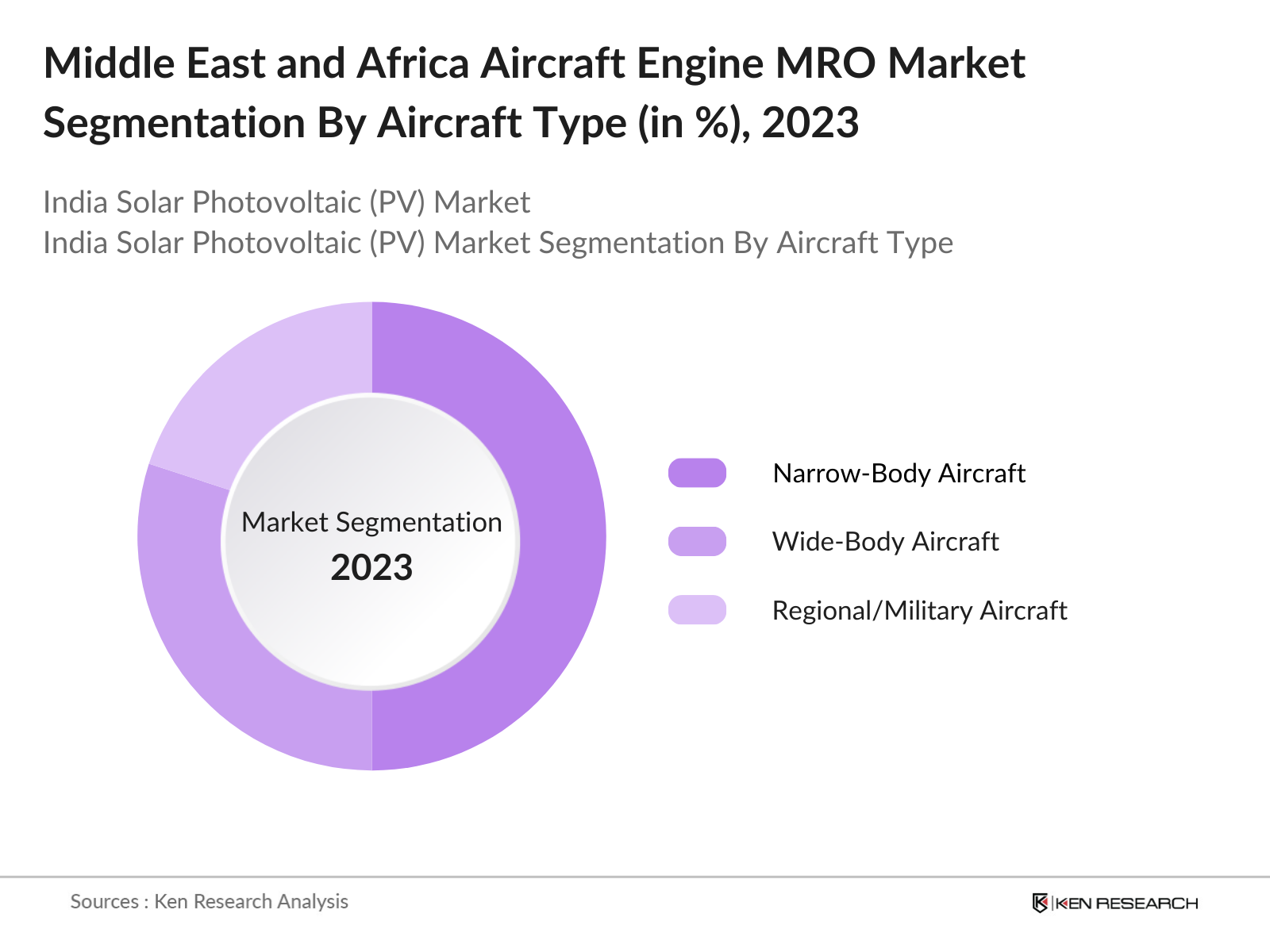
By Aircraft Type: The market is further segmented by aircraft type into narrow-body aircraft, wide-body aircraft, regional aircraft, and military aircraft. Holding a market share of 50%, narrow-body aircraft dominate the aircraft engine MRO market in the Middle East and Africa. This is driven by the large fleet of single-aisle aircraft operating on short and medium-haul routes. Airlines like Emirates and Qatar Airways have significant narrow-body fleets, leading to high demand for engine MRO services.
The Middle East and Africa aircraft engine MRO market is dominated by a mix of global and regional players. Many of these companies have set up joint ventures and partnerships with local service providers to meet the growing demand for engine MRO services. The competitive landscape highlights the major players, with companies like Rolls-Royce and Safran Aircraft Engines playing pivotal roles due to their strong regional presence and advanced service offerings.
|
Company |
Establishment Year |
Headquarters |
Revenue (USD Billion) |
Market Focus |
No. of Employees |
Key Service Area |
R&D Investment |
Regional Service Centers |
|
Rolls-Royce |
1906 |
London, UK |
_ |
_ |
_ |
_ |
_ |
_ |
|
GE Aviation |
1917 |
Ohio, USA |
_ |
_ |
_ |
_ |
_ |
_ |
|
Safran Aircraft Engines |
2005 |
Paris, France |
_ |
_ |
_ |
_ |
_ |
_ |
|
MTU Aero Engines |
1934 |
Munich, Germany |
_ |
_ |
_ |
_ |
_ |
_ |
|
Emirates Engineering |
1959 |
Dubai, UAE |
_ |
_ |
_ |
_ |
_ |
_ |
Over the next five years, the Middle East and Africa aircraft engine MRO market is expected to grow substantially. The market will be driven by an expanding fleet size, particularly in countries like Saudi Arabia and the UAE, alongside increasing investments in aviation infrastructure. The rise in air travel demand across Africa, coupled with the gradual recovery of international travel, is set to fuel market growth further.
|
Engine Type |
Turbofan Turboprop Turboshaft Piston Engine |
|
Aircraft Type |
Commercial Aviation Military Aviation Business Aviation General Aviation |
|
Service Type |
Engine Overhaul Engine Repair Engine Replacement Component Services |
|
End User |
Airlines Independent MRO Providers OEMs |
|
Region |
Middle East North Africa Sub-Saharan Africa |
1.1. Definition and Scope
1.2. Market Taxonomy
1.3. Market Growth Rate
1.4. Market Segmentation Overview (Engine Type, Aircraft Type, Service Type, End User, Region)
2.1. Historical Market Size
2.2. Year-On-Year Growth Analysis
2.3. Key Market Developments and Milestones
3.1. Growth Drivers
3.1.1. Expansion of Aviation Sector
3.1.2. Government Initiatives in Aviation Infrastructure
3.1.3. Rise in Aircraft Fleet Size
3.1.4. Technological Innovations
3.2. Market Challenges
3.2.1. High Operational Costs
3.2.2. Dependence on OEMs (Original Equipment Manufacturers) for Spare Parts
3.2.3. Regulatory and Compliance Burdens
3.2.4. Shortage of Skilled MRO Workforce
3.3. Opportunities
3.3.1. Strategic Alliances Between Airlines and MRO Service Providers
3.3.2. Rising Demand for Low-Cost Carriers in the Region
3.3.3. Growth in Aircraft Leasing
3.3.4. Aftermarket Services Expansion
3.4. Trends
3.4.1. Shift to Predictive Maintenance Using Big Data Analytics
3.4.2. Outsourcing of MRO Services to Lower-Cost Regions
3.4.3. Increased Investment in MRO Software and Digitalization
3.5. Government Regulation
3.5.1. Regulations from Aviation Safety Authorities
3.5.2. Certification and Licensing Requirements for MRO Providers
3.5.3. Import Tariffs on Spare Parts and Components
3.6. SWOT Analysis
3.7. Stakeholder Ecosystem (OEMs, Airlines, MRO Providers, Technology Partners)
3.8. Porters Five Forces
3.9. Competition Ecosystem
4.1. By Engine Type (In Value %)
4.1.1. Turbofan
4.1.2. Turboprop
4.1.3. Turboshaft
4.1.4. Piston Engine
4.2. By Aircraft Type (In Value %)
4.2.1. Commercial Aviation
4.2.2. Military Aviation
4.2.3. Business Aviation
4.2.4. General Aviation
4.3. By Service Type (In Value %)
4.3.1. Engine Overhaul
4.3.2. Engine Repair
4.3.3. Engine Replacement
4.3.4. Component Services
4.4. By End User (In Value %)
4.4.1. Airlines
4.4.2. Independent MRO Providers
4.4.3. OEMs
4.5. By Region (In Value %)
4.5.1. Middle East (Saudi Arabia, UAE, Qatar)
4.5.2. North Africa (Egypt, Morocco, Algeria)
4.5.3. Sub-Saharan Africa (South Africa, Nigeria, Kenya)
5.1. Detailed Profiles of Major Companies
5.1.1. Lufthansa Technik AG
5.1.2. Rolls-Royce Holdings PLC
5.1.3. GE Aviation
5.1.4. Safran Aircraft Engines
5.1.5. MTU Aero Engines AG
5.1.6. Emirates Engineering
5.1.7. Air France Industries KLM Engineering & Maintenance
5.1.8. Turkish Technic Inc.
5.1.9. Etihad Airways Engineering
5.1.10. Jordan Airmotive
5.1.11. South African Airways Technical (SAAT)
5.1.12. Ethiopian Airlines MRO
5.1.13. TAP M&E
5.1.14. Egmont Aviation Services
5.1.15. Ameco Beijing
5.2. Cross Comparison Parameters (Headquarters, No. of Employees, Regional Presence, Capabilities, Partnerships, Certifications, Market Share, Strategic Initiatives)
5.3. Market Share Analysis
5.4. Strategic Initiatives
5.5. Mergers and Acquisitions
5.6. Investment Analysis
5.7. Venture Capital Funding
5.8. Government Grants
5.9. Private Equity Investments
6.1. Regional Aviation Safety Standards
6.2. Environmental and Emission Regulations (Green Initiatives)
6.3. Certification and Compliance for MRO Operations
7.1. Future Market Size Projections
7.2. Key Factors Driving Future Market Growth (Fleet Expansion, Advancements in MRO Technology, Fuel Efficiency Targets)
8.1. By Engine Type (In Value %)
8.2. By Aircraft Type (In Value %)
8.3. By Service Type (In Value %)
8.4. By End User (In Value %)
8.5. By Region (In Value %)
9.1. TAM/SAM/SOM Analysis
9.2. Competitive Landscape Mapping
9.3. Investment Opportunities
9.4. Market Entry Strategies
Disclaimer Contact UsThis phase involves mapping the MRO ecosystem, identifying all key stakeholders, and understanding the dynamic relationships between aircraft operators, MRO providers, OEMs, and component suppliers. Comprehensive desk research was conducted using proprietary databases and industry reports.
Historical data on market penetration, fleet composition, and MRO service demand was analyzed to understand the market's growth trajectory. The assessment also includes analyzing MRO service demand by aircraft type and engine category to form the basis of market sizing.
Key market hypotheses were validated through in-depth interviews with industry experts from major airlines, OEMs, and MRO service providers. These insights helped refine the market forecast and understand emerging trends in engine MRO services.
The final stage included detailed engagement with airlines and MRO providers across the Middle East and Africa to gain insights into engine performance, maintenance schedules, and service delivery. This allowed for a more accurate estimation of market size and growth potential.
The Middle East and Africa aircraft engine MRO market is valued at USD 6.82 billion, driven by increasing air travel, a growing fleet size, and a focus on cost-effective maintenance solutions.
Key challenges include the high cost of advanced repair technologies, a lack of skilled technicians in certain regions, and fluctuating oil prices, which impact airline profitability and MRO expenditure.
Major players include Rolls-Royce, GE Aviation, Safran Aircraft Engines, MTU Aero Engines, and Emirates Engineering. These companies dominate the market due to their comprehensive service offerings and long-term partnerships with airlines.
Growth drivers include expanding fleet sizes, increasing international travel, and advancements in engine technology that require specialized MRO services. The recovery of tourism and business travel post-pandemic is also boosting demand for MRO services.
The market is expected to witness significant growth over the next five years, driven by increasing fleet size, technological advancements in engine repair, and a rise in defense budgets, especially in the Gulf region.

What makes us stand out is that our consultants follows Robust, Refine and Result (RRR) methodology. i.e. Robust for clear definitions, approaches and sanity checking, Refine for differentiating respondents facts and opinions and Result for presenting data with story

We have set a benchmark in the industry by offering our clients with syndicated and customized market research reports featuring coverage of entire market as well as meticulous research and analyst insights.

While we don't replace traditional research, we flip the method upside down. Our dual approach of Top Bottom & Bottom Top ensures quality deliverable by not just verifying company fundamentals but also looking at the sector and macroeconomic factors.

With one step in the future, our research team constantly tries to show you the bigger picture. We help with some of the tough questions you may encounter along the way: How is the industry positioned? Best marketing channel? KPI's of competitors? By aligning every element, we help maximize success.

Our report gives you instant access to the answers and sources that other companies might choose to hide. We elaborate each steps of research methodology we have used and showcase you the sample size to earn your trust.

If you need any support, we are here! We pride ourselves on universe strength, data quality, and quick, friendly, and professional service.