
Middle East Complementary & Alternative Medicine Market Outlook to 2030
Region:Middle East
Author(s):Sanjna Verma
Product Code:KROD8097
November 2024
96
About the Report
Middle East Complementary & Alternative Medicine Market Overview
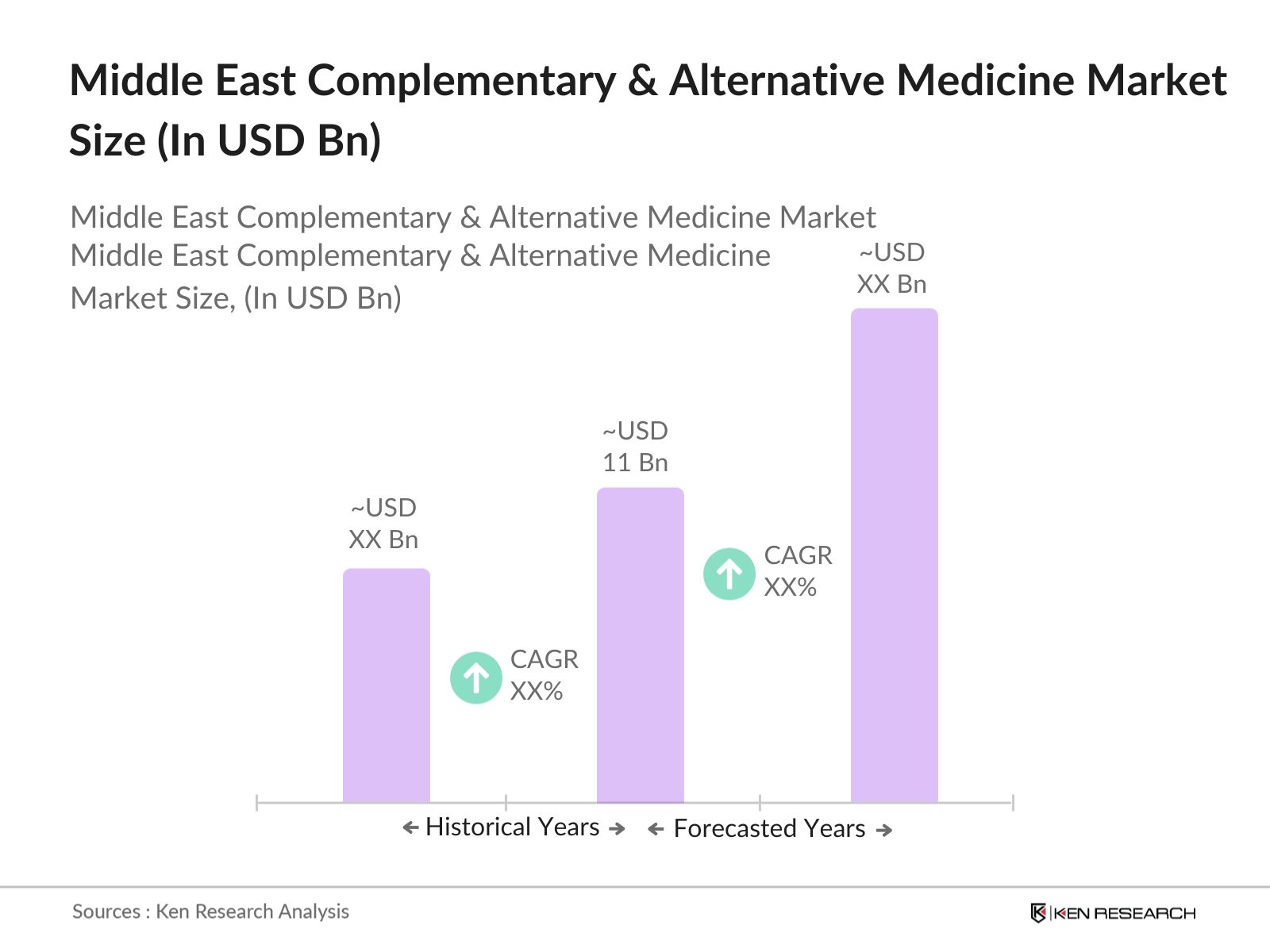
- The Middle East Complementary & Alternative Medicine (CAM) market is valued at USD 11 billion, driven by the rising demand for natural and non-invasive therapies, especially in GCC countries. This growth has been fostered by the increasing prevalence of chronic diseases, where conventional treatments often fail to provide long-term relief, pushing patients towards alternative options. The market's expansion is also supported by greater awareness of preventive care and wellness, further promoted by national health programs encouraging CAM usage, especially in UAE and Saudi Arabia.
- The dominant regions in the Middle East CAM market include the United Arab Emirates and Saudi Arabia. These countries lead the market due to strong government support, public awareness campaigns, and an increasing number of wellness centers that provide CAM services. In the UAE, the integration of CAM with conventional healthcare has been widely promoted, while Saudi Arabias Vision 2030 has set policies encouraging alternative medicine practices, which explains their dominance. Additionally, countries like Qatar and Bahrain are rapidly adopting complementary therapies due to a rise in demand for holistic treatments.
- Government bodies across the Middle East are implementing licensing frameworks to regulate CAM practices. In the UAE, the Ministry of Health and Prevention issued over 400 CAM practitioner licenses in 2023, ensuring the quality and safety of alternative treatments. Similar frameworks are being developed in Saudi Arabia and Qatar, where healthcare authorities are working to formalize the certification process for CAM practitioners. These regulations aim to standardize the industry, making it safer for consumers to explore alternative treatments .
Middle East Complementary & Alternative Medicine Market Segmentation
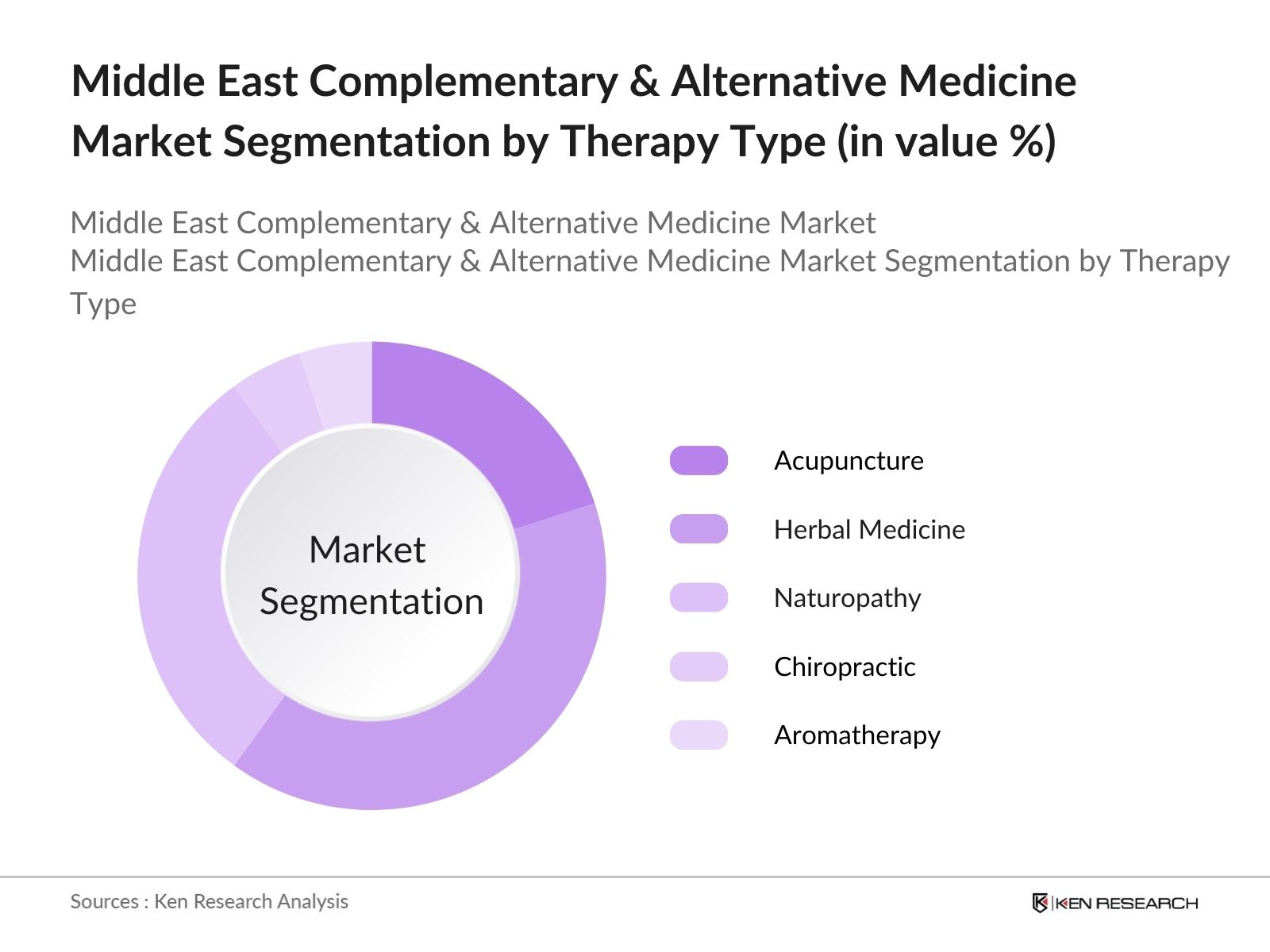
By Therapy Type: The Middle East CAM market is segmented by therapy type into Acupuncture, Herbal Medicine, Naturopathy, Chiropractic, and Aromatherapy. Herbal Medicine dominates the therapy type segment as it is deeply rooted in the region's culture and history, making it widely accepted among local populations. Traditional remedies, derived from herbs and natural sources, have long been used for treating various ailments. The cultural acceptance, combined with recent scientific validation of some herbal treatments, has kept this sub-segment at the forefront of CAM in the region.
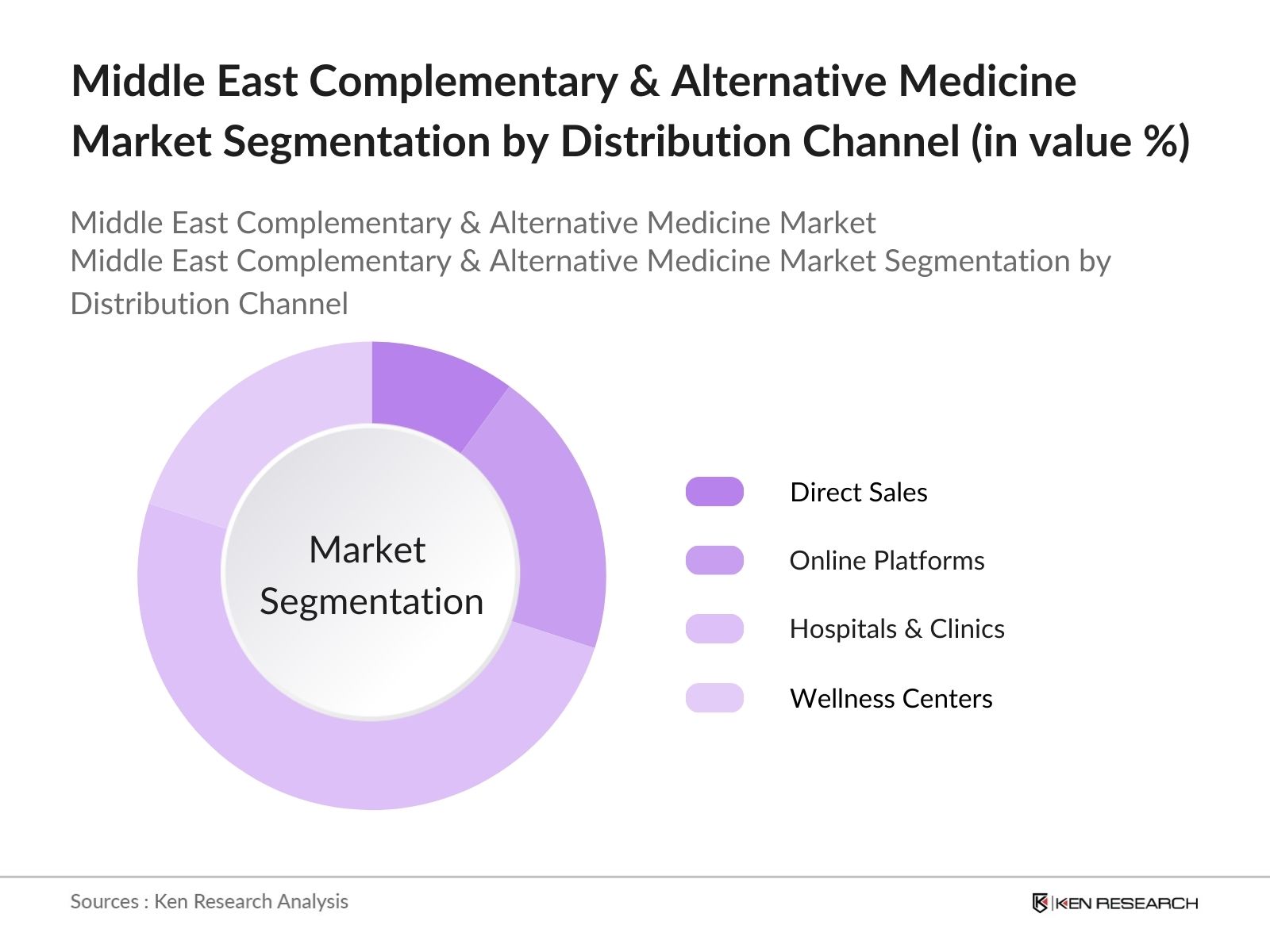
By Distribution Channel: The distribution channels for CAM in the Middle East are divided into Direct Sales, Online Platforms, Hospitals and Clinics, and Wellness Centers. Hospitals and Clinics dominate the market due to their credibility and integration with conventional healthcare services. Patients often trust certified medical institutions to provide alternative treatments in a controlled and regulated environment, ensuring safety and efficacy. Moreover, hospitals in the UAE and Saudi Arabia are increasingly incorporating CAM into their mainstream healthcare services, which is boosting this sub-segment.
Middle East Complementary & Alternative Medicine Market Competitive Landscape
The Middle East CAM market is dominated by a few prominent players, with a mix of local and international companies. The market is highly competitive due to a growing number of specialized wellness centers and the increasing integration of CAM into hospitals and clinics. Local players hold a competitive edge due to their understanding of regional preferences and cultural norms, while international players bring in advanced technologies and global best practices.
|
Company Name |
Establishment Year |
Headquarters |
Therapy Focus |
No. of Practitioners |
Revenue (USD Mn) |
Market Share |
Geographical Presence |
Strategic Initiatives |
|
Al Ain Center for CAM |
2003 |
UAE |
- |
- |
- |
- |
- |
- |
|
Dubai Herbal & Treatment |
1999 |
UAE |
- |
- |
- |
- |
- |
- |
|
Zulekha Healthcare Group |
1992 |
UAE |
- |
- |
- |
- |
- |
- |
|
Life Natural Healing |
2005 |
UAE |
- |
- |
- |
- |
- |
- |
|
Hamad Medical Corporation |
1998 |
Qatar |
- |
- |
- |
- |
- |
- |
Middle East Complementary & Alternative Medicine Market Analysis
Growth Drivers
- Rising Demand for Non-Traditional Therapies: According to the World Health Organization (WHO), 45% of the population in Gulf Cooperation Council (GCC) countries have shown interest in complementary and alternative medicine (CAM) therapies. This shift is driven by a growing preference for holistic approaches to healthcare, especially in regions like the UAE, where wellness tourism is gaining traction. In 2023, the wellness tourism market contributed $12.8 billion to the economy, further reflecting the rising demand for non-traditional therapies.
- Government Support for Alternative Medicine: Governments in the Middle East have begun to officially recognize and regulate CAM practices, offering a supportive environment for market growth. For example, the UAE Ministry of Health and Prevention has licensed over 400 practitioners specializing in alternative medicine in 2023. Similarly, Saudi Arabia's Vision 2030 initiative has incorporated CAM into its health strategy to provide more diverse treatment options to its citizens. These government-led initiatives are designed to boost consumer trust and ensure safer practices, significantly contributing to market growth .
- Growing Awareness of Wellness and Preventive Care: Public awareness surrounding the benefits of wellness and preventive care is also fueling the growth of CAM in the Middle East. In 2024, consumer spending on wellness products and services is expected to hit $10.5 billion in the UAE alone. This increase in expenditure is primarily due to a growing middle class with higher disposable income, and the rising prevalence of chronic diseases. Governments are also launching awareness campaigns, such as Dubai's "Wellness Days," promoting preventive care and CAM options for long-term health.
Challenges
- Lack of Standardized Regulations: The absence of standardized regulations governing CAM practices poses significant challenges to the market's development in the Middle East. While countries like the UAE have established regulatory frameworks, others lag behind. For instance, Bahrain and Oman lack comprehensive laws governing the certification of CAM practitioners, leading to inconsistent quality in services. The gap in legislation across the region limits the growth potential of CAM, with only 25% of CAM practitioners being fully certified according to 2023 statistics.
- Limited Scientific Backing for CAM Therapies: Many CAM treatments face skepticism due to a lack of robust scientific research validating their efficacy. In the Middle East, clinical trials for CAM therapies are scarce, making it difficult for healthcare providers to recommend these treatments. For instance, a 2022 report by the WHO noted that less than 10% of CAM treatments in the region had undergone randomized control trials. This limited scientific backing hampers the growth of the market as consumers and healthcare professionals remain wary of unproven treatments.
Middle East Complementary & Alternative Medicine Market Future Outlook
Over the next five years, the Middle East CAM market is expected to show significant growth driven by increasing government support, a growing trend towards preventive healthcare, and expanding consumer demand for non-invasive and natural treatment options. This growth is further propelled by increasing integration between conventional healthcare services and CAM practices in hospitals, making them more accessible and credible. Wellness tourism, especially in the UAE, is expected to contribute significantly to market growth as it becomes a global hub for holistic treatments and wellness retreats.
Market Opportunities
- Integration of CAM with Conventional Healthcare: There is a growing opportunity for the integration of CAM with conventional healthcare systems across the Middle East. In countries like Saudi Arabia, 45% of hospitals now offer CAM therapies as part of their treatment plans. This integration is largely driven by patient demand for holistic care and the government's Vision 2030 initiative to diversify healthcare offerings. In 2024, public hospitals in the region are expected to invest an additional $120 million into developing CAM-related infrastructure .
- Expansion in Urban and High-Income Populations: Urbanization and rising incomes in cities like Dubai, Riyadh, and Doha provide fertile ground for the growth of CAM. In the UAE, the urban population has grown to 8.91 million in 2023, with a significant portion of high-income consumers actively seeking wellness and preventive care solutions. This urban demographic is more likely to explore CAM as part of their health regime, offering significant growth opportunities for CAM providers. High-income consumers spent $1.2 billion on wellness products and services in the UAE alone in 2023 .
Scope of the Report
|
Segment |
Sub-segment |
|
By Therapy Type |
Acupuncture Herbal Medicine Naturopathy Chiropractic Aromatherapy |
|
By Distribution Channel |
Direct Sales Online Platforms Hospitals and Clinics Wellness Centers |
|
By End-User |
Hospitals Private Clinics Home Care Corporate Wellness Programs |
|
By Application |
Chronic Disease Management Pain Management Mental Health & Wellness General Wellness |
|
By Region |
Gulf Cooperation Council (GCC) North Africa Levant Rest of Middle East |
Products
Key Target Audience
Hospitals and Medical Institutions
Wellness Centers
Herbal Medicine Manufacturers
Acupuncture and Naturopathy Clinics
Chiropractic Associations
Aromatherapy Product Distributors
Investors and Venture Capitalist Firms
Government and Regulatory Bodies (Ministry of Health, GCC Health Council)
Companies
Major Players Mentioned in the Report
Al Ain Center for Complementary Medicine
Dubai Herbal & Treatment Centre
Zulekha Healthcare Group
Al Manar Herbal Medicines
Life Natural Healing and Therapy Center
Hamad Medical Corporation
Emirates Integrated Medicine
Dar Al Shifa Medical Center
Bahrain Wellness Resort
BioAlternatives FZ LLC
Table of Contents
1. Middle East Complementary & Alternative Medicine Market Overview
1.1. Definition and Scope
1.2. Market Taxonomy
1.3. Market Growth Rate
1.4. Market Segmentation Overview
2. Middle East Complementary & Alternative Medicine Market Size (In USD Bn)
2.1. Historical Market Size
2.2. Year-On-Year Growth Analysis
2.3. Key Market Developments and Milestones
3. Middle East Complementary & Alternative Medicine Market Analysis
3.1. Growth Drivers (Regulatory landscape, Consumer Awareness, Integrative Medicine Acceptance)
3.1.1. Rising Demand for Non-Traditional Therapies
3.1.2. Government Support for Alternative Medicine
3.1.3. Growing Awareness of Wellness and Preventive Care
3.1.4. Increasing Prevalence of Chronic Diseases
3.2. Market Challenges (Legislation Gaps, Trust Deficit in Efficacy, Training Limitations)
3.2.1. Lack of Standardized Regulations
3.2.2. Limited Scientific Backing for CAM Therapies
3.2.3. Shortage of Qualified Practitioners
3.2.4. Cultural Barriers in Market Penetration
3.3. Opportunities (Technological Integration, Expanding Urban Demographics, Medical Tourism)
3.3.1. Integration of CAM with Conventional Healthcare
3.3.2. Expansion in Urban and High-Income Populations
3.3.3. Potential in Medical Tourism
3.3.4. Digitalization and Telemedicine in CAM
3.4. Trends (Digital Wellness Platforms, Traditional Herbal Medicine, Personalized CAM Therapies)
3.4.1. Adoption of Digital Wellness Solutions
3.4.2. Revival of Traditional Herbal Remedies
3.4.3. Personalized and Holistic CAM Treatments
3.4.4. Increasing Preference for Non-Invasive Treatments
3.5. Government Regulation (Licensing and Certification, Compliance, Insurance Coverage)
3.5.1. Complementary Medicine Licensing Framework
3.5.2. Mandatory Certification for CAM Practitioners
3.5.3. CAM Inclusion in National Health Insurance Programs
3.5.4. Regional Regulation Harmonization for CAM Practices
3.6. SWOT Analysis
3.7. Stakeholder Ecosystem
3.8. Porters Five Forces Analysis
3.9. Competition Landscape
4. Middle East Complementary & Alternative Medicine Market Segmentation
4.1. By Therapy Type (In Value %)
4.1.1. Acupuncture
4.1.2. Herbal Medicine
4.1.3. Naturopathy
4.1.4. Chiropractic
4.1.5. Aromatherapy
4.2. By Distribution Channel (In Value %)
4.2.1. Direct Sales
4.2.2. Online Platforms
4.2.3. Hospitals and Clinics
4.2.4. Wellness Centers
4.3. By End-User (In Value %)
4.3.1. Hospitals and Medical Institutions
4.3.2. Private Clinics
4.3.3. Home Care Settings
4.3.4. Corporate Wellness Programs
4.4. By Application (In Value %)
4.4.1. Chronic Disease Management
4.4.2. Pain Management
4.4.3. Mental Health & Wellness
4.4.4. General Wellness and Preventive Care
4.5. By Region (In Value %)
4.5.1. Gulf Cooperation Council (GCC)
4.5.2. North Africa
4.5.3. Levant
4.5.4. Rest of Middle East
5. Middle East Complementary & Alternative Medicine Market Competitive Analysis
5.1. Detailed Profiles of Major Companies
5.1.1. Al Ain Center for Alternative Medicine
5.1.2. Dubai Herbal & Treatment Centre
5.1.3. Zulekha Healthcare Group
5.1.4. Al Manar Herbal Medicines
5.1.5. Dar Al Shifa Medical Center
5.1.6. Emirates Integrated Medicine
5.1.7. Life Natural Healing and Therapy Center
5.1.8. Bahrain Wellness Resort
5.1.9. Hamad Medical Corporation
5.1.10. BioAlternatives FZ LLC
5.2. Cross Comparison Parameters (Headquarters, Number of Practitioners, Revenue, Therapy Focus, Number of Clinics, Market Share, Market Presence, Research and Development Initiatives)
5.3. Market Share Analysis
5.4. Strategic Initiatives
5.5. Mergers and Acquisitions
5.6. Investment Analysis
5.7. Venture Capital Funding
5.8. Government Grants
5.9. Private Equity Investments
6. Middle East Complementary & Alternative Medicine Market Regulatory Framework
6.1. National Healthcare Standards for CAM
6.2. Mandatory Compliance and Licensing
6.3. CAM Practitioner Certification Processes
7. Middle East Complementary & Alternative Medicine Future Market Size (In USD Bn)
7.1. Future Market Size Projections
7.2. Key Factors Driving Future Market Growth
8. Middle East Complementary & Alternative Medicine Future Market Segmentation
8.1. By Therapy Type (In Value %)
8.2. By Distribution Channel (In Value %)
8.3. By End-User (In Value %)
8.4. By Application (In Value %)
8.5. By Region (In Value %)
9. Middle East Complementary & Alternative Medicine Market Analysts Recommendations
9.1. Total Addressable Market (TAM) Analysis
9.2. Customer Acquisition Strategies
9.3. Marketing Initiatives
9.4. Product Development Opportunities
Contact Us
Research Methodology
Step 1: Identification of Key Variables
The initial phase involves constructing an ecosystem map that includes key stakeholders within the Middle East CAM market. Extensive desk research is carried out, combining secondary sources such as government databases and industry publications, to gather information on the market's regulatory and operational landscape. This stage identifies critical factors influencing the market dynamics.
Step 2: Market Analysis and Construction
In this phase, historical data on the CAM market is collected and analyzed. This includes market penetration rates, growth drivers, and competitive landscapes. The analysis focuses on assessing the ratio of CAM practices to conventional healthcare services and their respective revenue contributions. This stage ensures data accuracy and reliability through thorough market scrutiny.
Step 3: Hypothesis Validation and Expert Consultation
Hypotheses on the market's growth potential and challenges are developed and validated through direct consultations with CAM practitioners, wellness center operators, and industry experts. These consultations provide in-depth insights into CAM service trends, consumer preferences, and operational challenges, which are essential for refining market insights.
Step 4: Research Synthesis and Final Output
The final step involves synthesizing the data gathered and conducting detailed engagements with market stakeholders to verify insights. This ensures that the final report provides an accurate and validated analysis of the Middle East CAM market, offering actionable insights for business decision-making.
Frequently Asked Questions
01. How big is the Middle East Complementary & Alternative Medicine market?
The Middle East CAM market is valued at USD 11 billion, driven by increasing consumer demand for non-traditional therapies and government support for integrating CAM into mainstream healthcare systems.
02. What are the challenges in the Middle East Complementary & Alternative Medicine market?
Middle East Complementary & Alternative Medicine market faces challenges including a lack of standardized regulations, limited scientific backing for some CAM therapies, and a shortage of qualified practitioners. These issues hinder the market's full integration with conventional medical systems.
03. Who are the major players in the Middle East Complementary & Alternative Medicine market?
Key players in Middle East Complementary & Alternative Medicine market include Al Ain Center for CAM, Dubai Herbal & Treatment Centre, Zulekha Healthcare Group, Hamad Medical Corporation, and Life Natural Healing and Therapy Center, with strong presences in the GCC region.
04. What are the growth drivers for the Middle East Complementary & Alternative Medicine market?
Growth in Middle East Complementary & Alternative Medicine market is driven by increasing consumer awareness of preventive care, rising incidences of chronic diseases, and government-backed initiatives to integrate CAM into national health systems, especially in the UAE and Saudi Arabia.
Why Buy From Us?

What makes us stand out is that our consultants follows Robust, Refine and Result (RRR) methodology. i.e. Robust for clear definitions, approaches and sanity checking, Refine for differentiating respondents facts and opinions and Result for presenting data with story

We have set a benchmark in the industry by offering our clients with syndicated and customized market research reports featuring coverage of entire market as well as meticulous research and analyst insights.

While we don't replace traditional research, we flip the method upside down. Our dual approach of Top Bottom & Bottom Top ensures quality deliverable by not just verifying company fundamentals but also looking at the sector and macroeconomic factors.

With one step in the future, our research team constantly tries to show you the bigger picture. We help with some of the tough questions you may encounter along the way: How is the industry positioned? Best marketing channel? KPI's of competitors? By aligning every element, we help maximize success.

Our report gives you instant access to the answers and sources that other companies might choose to hide. We elaborate each steps of research methodology we have used and showcase you the sample size to earn your trust.

If you need any support, we are here! We pride ourselves on universe strength, data quality, and quick, friendly, and professional service.