
North America Agricultural Equipment Market Outlook to 2030
Region:North America
Author(s):Naman Rohilla
Product Code:KROD9520
December 2024
93
About the Report
North America Agricultural Equipment Market Overview
- The North America Agricultural Equipment Market is valued at USD 61.2 billion, with this size driven by rising demand for advanced farming machinery and supportive government initiatives that encourage modernization in agriculture. Technological advancements, including precision farming tools and IoT-enabled equipment, are increasingly utilized, boosting market growth. Backed by extensive historical analysis, this demand is expected to shape the future market landscape as farming communities adopt these solutions for higher productivity.
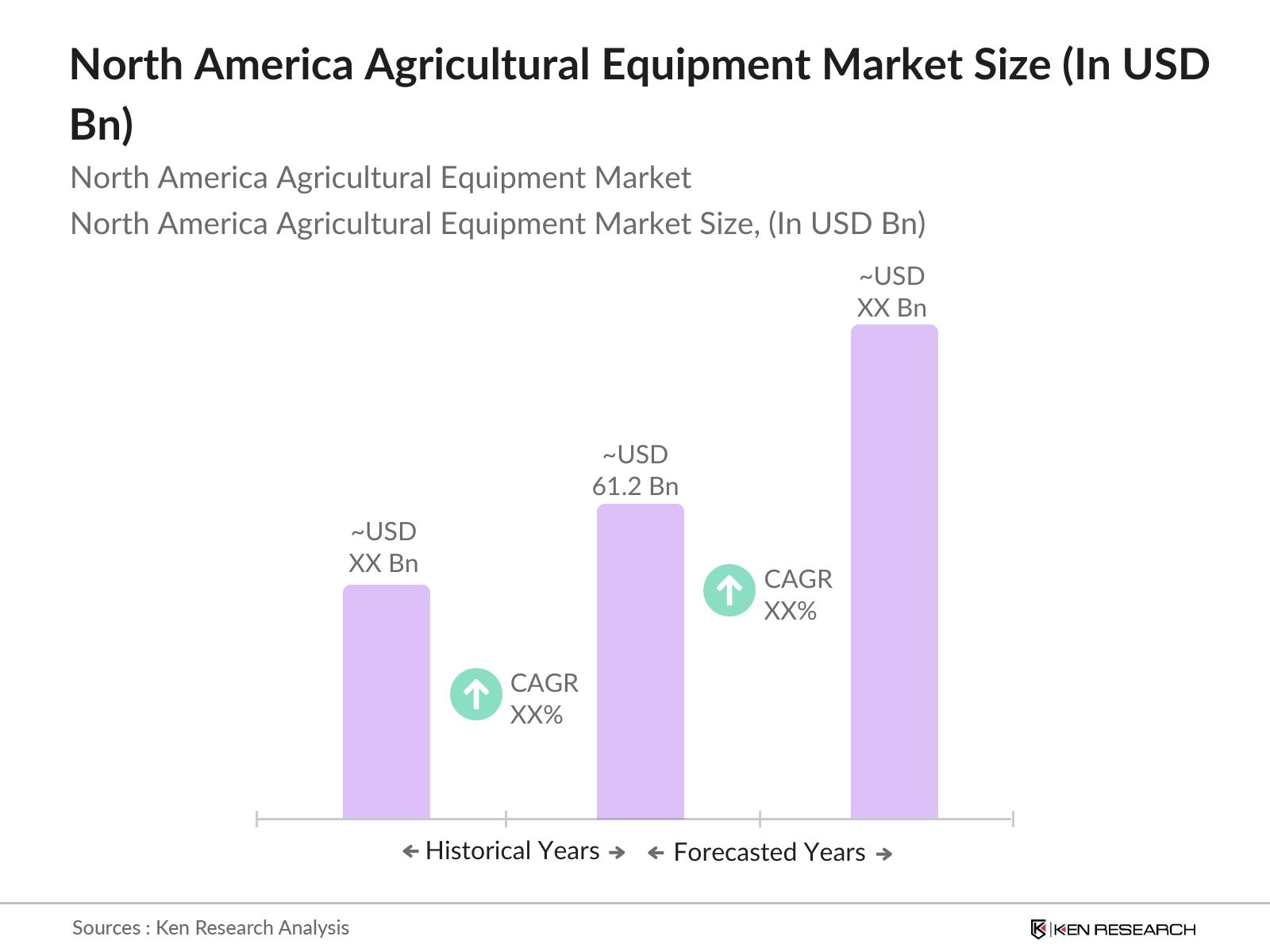
- The United States and Canada lead the North American Agricultural Equipment Market due to high mechanization rates, favourable agricultural policies, and access to cutting-edge technologies. The United States' dominant position is bolstered by substantial investment in research and development, while Canadas proactive sustainability measures enhance its equipment market presence, particularly in areas like precision farming and eco-friendly machinery.
- North American governments actively promote equipment upgrades through subsidy programs, with the USDA allocating $10 billion in 2023 for supporting sustainable agriculture technology. These subsidies are integral in encouraging equipment modernization, particularly for small farms facing high equipment costs, contributing to growth in the agricultural equipment market through increased adoption rates.
North America Agricultural Equipment Market Segmentation
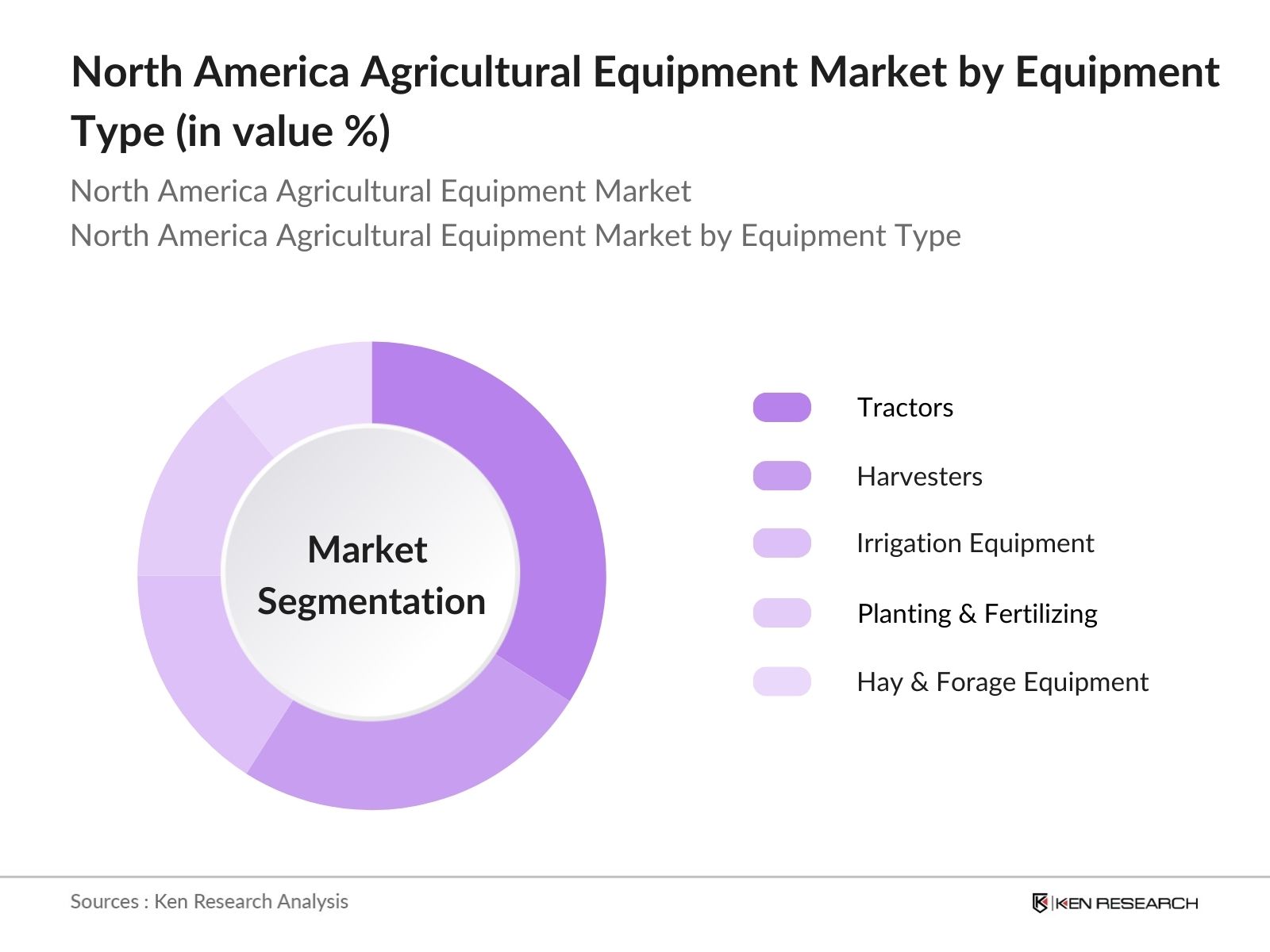
- By Equipment Type: The market is segmented by equipment type into tractors, harvesters, irrigation equipment, planting and fertilizing equipment, and hay and forage equipment. Tractors hold a dominant share within this segmentation, owing to their essential role in mechanized farming operations. These machines are integral across farming types, from row crops to specialty farms, solidifying their market share through widespread adaptability and usage frequency.
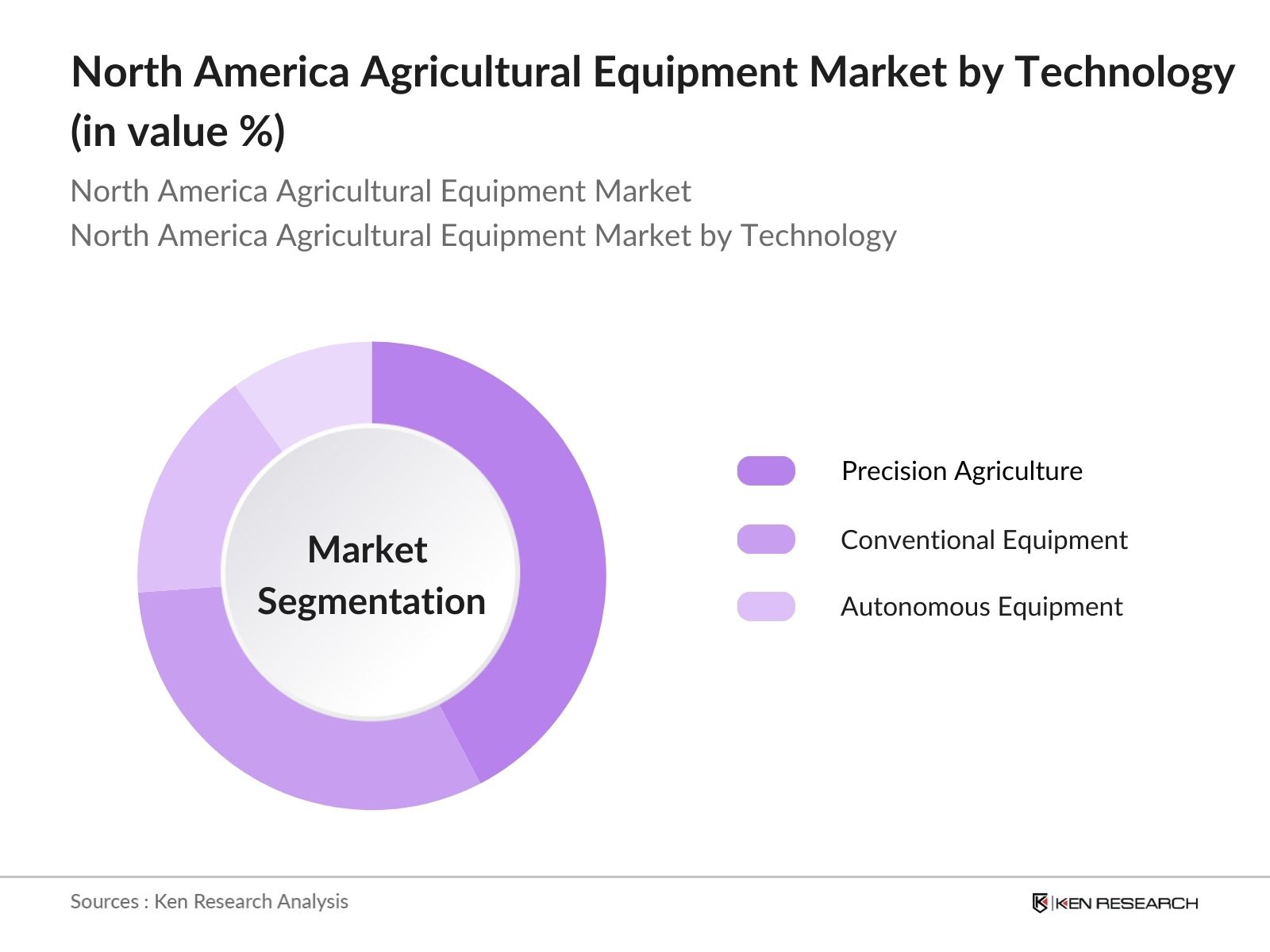
- By Technology: This market is further segmented by technology into precision agriculture technology, conventional equipment, and autonomous equipment. Precision agriculture technology dominates this segment due to increased demand for real-time data solutions that optimize crop yield and reduce waste. By enabling precision application of resources, this technology has gained traction, particularly among large-scale farms seeking to maximize efficiency and sustainability.
North America Agricultural Equipment Market Competitive Landscape
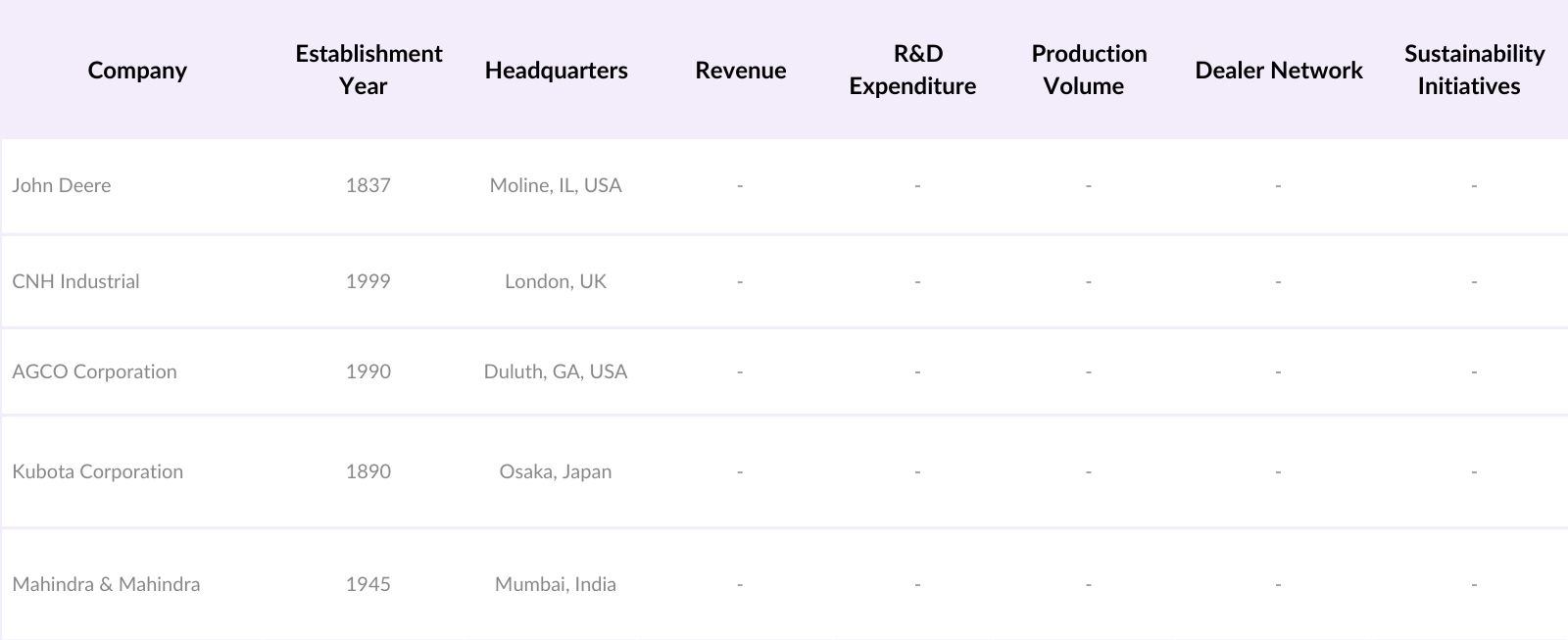
The North America Agricultural Equipment Market is characterized by the presence of major industry players focused on innovation and technology integration. These companies leverage strategic partnerships, R&D investments, and acquisitions to strengthen their positions.
North America Agricultural Equipment Market Analysis
Market Growth Drivers
- Increased Mechanization Rates: The adoption rate of mechanized agricultural equipment in North America has surged in recent years, with government data showing significant shifts. According to USDA, in 2023, 75% of U.S. crop farmers reported using mechanized equipment like tractors and harvesters, up from 68% in 2021. Additionally, increased mechanization supports labor efficiency, with labor availability dropping by 10% across the Midwest due to urban migration trends and an aging agricultural workforce. This rise in mechanization is expected to address labor shortages while driving farm productivity, thus underscoring a crucial growth driver in the North American agricultural equipment market.
- Demand for Precision Agriculture: Precision agriculture practices, which include satellite mapping, GPS-guided equipment, and variable rate technology, are becoming essential. In 2023, approximately 40% of North American farms reported integrating precision tools in their operations, reflecting a sharp rise from 30% in 2021, per USDA reports. Precision agriculture boosts efficiency and profitability, creating an increased demand for high-tech agricultural equipment that aligns with sustainable practices, which are further supported by government grants incentivizing precision tech adoption across farms.
- Climate Adaptation Solutions: North America faces notable climate challenges, including droughts, flooding, and changing weather patterns, prompting demand for climate-resilient equipment. In 2022, over $2.5 billion was allocated through U.S. Department of Agriculture climate adaptation funds, with a focus on equipment that mitigates soil erosion and improves water retention. This demand has driven the need for adaptive agricultural technologies, further advancing the agricultural equipment market by providing solutions tailored to increasingly unpredictable climate conditions.
Market Challenges
- Financial Barriers for Small Farms: In North America, financial challenges remain significant for small farms. The USDA reports that as of 2023, 60% of small-scale farmers are in debt, struggling to afford the latest machinery without financial aid. This debt burden limits smaller farms' access to advanced equipment, restricting overall market penetration and slowing modernization, particularly in the small farming segment where access to affordable financing remains a hurdle.
- Lack of Skilled Operators: A skills gap poses a challenge for the agricultural equipment market, with fewer young workers pursuing agricultural careers. In 2023, only 25% of North American farms reported having adequately trained equipment operators, according to U.S. Labor Statistics data. This shortage of skilled labor can impede the effective use of advanced machinery, creating a bottleneck in fully realizing equipment capabilities and impacting productivity gains that modernized equipment could otherwise facilitate.
North America Agricultural Equipment Market Future Outlook
Over the coming years, the North America Agricultural Equipment Market is expected to benefit from trends such as precision farming and increased automation. Rising consumer demand for sustainable agriculture, alongside innovations in technology and growing investments in R&D, will further drive market expansion. As government policies increasingly favor agricultural technology adoption, this market is set to grow in alignment with sustainability goals and productivity demands.
Market Opportunities
- Demand for Electric Equipment: Interest in electric agricultural machinery is rising across North America, supported by environmental standards and consumer demand for sustainable products. According to the U.S. Department of Energy, federal grants allocated over $1 billion in 2023 to promote electric vehicle infrastructure, including support for agricultural equipment. This funding has facilitated greater interest and investment in electric tractors and harvesters, offering substantial growth opportunities in transitioning towards a greener agricultural equipment landscape.
- Digital Agriculture Expansion: Digital agriculture is rapidly expanding, with North Americas agricultural technology market seeing increased integration of IoT-enabled devices for real-time data management. As of 2023, over 35% of large-scale farms utilize IoT technology in machinery, helping to optimize yield and reduce resource usage, per USDA reports. This trend is expected to further drive demand for high-tech agricultural equipment, with digital agriculture offering potential efficiency improvements in planting, monitoring, and harvesting.
Scope of the Report
|
Equipment Type |
Tractors, Harvesters, Irrigation Equipment, Planting & Fertilizing Equipment, Hay & Forage Equipment |
|
Technology |
Precision Agriculture Technology, Conventional Equipment, Autonomous Equipment |
|
Power Source |
Diesel-Powered, Electric-Powered, Hybrid Models |
|
Application |
Row Crop Farming, Livestock Farming, Orchard & Vineyard Farming |
|
Region |
United States, Canada, Mexico |
Products
Key Target Audience
Farming Cooperatives and Unions
Large-Scale Farming Enterprises
Banks and Financial Istitutions
Government and Regulatory Bodies (USDA, Environment Canada)
Agricultural Equipment Distributors
Precision Agriculture Solution Providers
Rural Financial Institutions
Investor and Venture Capitalist Firms
Technology Integrators in Agriculture
Companies
Players Mentioned in the Report
John Deere
CNH Industrial
AGCO Corporation
Kubota Corporation
Mahindra & Mahindra
CLAAS KGaA
Same Deutz-Fahr
Yanmar Holdings Co., Ltd.
Trimble Inc.
Topcon Positioning Systems
Table of Contents
1. North America Agricultural Equipment Market Overview
1.1. Definition and Scope
1.2. Market Taxonomy
1.3. Market Dynamics Overview
1.4. Market Segmentation Overview
2. North America Agricultural Equipment Market Size (in USD Bn)
2.1. Historical Market Size
2.2. Year-On-Year Growth Analysis
2.3. Key Market Developments and Milestones
3. North America Agricultural Equipment Market Analysis
3.1. Growth Drivers (e.g., Technological Advancements, Government Subsidies)
3.1.1. Increased Mechanization Rates
3.1.2. Government Support Programs
3.1.3. Demand for Precision Agriculture
3.1.4. Climate Adaptation Solutions
3.2. Market Challenges (e.g., High Equipment Costs, Labor Availability)
3.2.1. Financial Barriers for Small Farms
3.2.2. Lack of Skilled Operators
3.2.3. Supply Chain Constraints
3.3. Opportunities (e.g., Sustainable Farming Equipment, Automation Integration)
3.3.1. Demand for Electric Equipment
3.3.2. Digital Agriculture Expansion
3.3.3. Penetration into Small-Scale Farms
3.4. Trends (e.g., IoT Adoption, Autonomous Equipment)
3.4.1. Smart Irrigation Solutions
3.4.2. Growth in Precision Agriculture
3.4.3. Use of Drones in Crop Monitoring
3.5. Government Regulations (e.g., Environmental Standards, Emissions Control)
3.5.1. Subsidy Policies
3.5.2. Equipment Safety Standards
3.5.3. Fuel Emissions Regulations
3.6. SWOT Analysis
3.7. Stakeholder Ecosystem
3.8. Porters Five Forces Analysis
3.9. Competition Ecosystem
4. North America Agricultural Equipment Market Segmentation
4.1. By Equipment Type (in Value %)
4.1.1. Tractors
4.1.2. Harvesters
4.1.3. Irrigation Equipment
4.1.4. Planting & Fertilizing Equipment
4.1.5. Hay & Forage Equipment
4.2. By Technology (in Value %)
4.2.1. Precision Agriculture Technology
4.2.2. Conventional Equipment
4.2.3. Autonomous Equipment
4.3. By Power Source (in Value %)
4.3.1. Diesel-Powered
4.3.2. Electric-Powered
4.3.3. Hybrid Models
4.4. By Application (in Value %)
4.4.1. Row Crop Farming
4.4.2. Livestock Farming
4.4.3. Orchard & Vineyard Farming
4.5. By Region (in Value %)
4.5.1. United States
4.5.2. Canada
4.5.3. Mexico
5. North America Agricultural Equipment Market Competitive Analysis
5.1. Detailed Profiles of Major Companies
5.1.1. John Deere
5.1.2. CNH Industrial
5.1.3. AGCO Corporation
5.1.4. Kubota Corporation
5.1.5. Mahindra & Mahindra
5.1.6. CLAAS KGaA
5.1.7. Same Deutz-Fahr
5.1.8. Yanmar Holdings Co., Ltd.
5.1.9. Trimble Inc.
5.1.10. Topcon Positioning Systems
5.1.11. Valmont Industries
5.1.12. Buhler Industries
5.1.13. Lindsay Corporation
5.1.14. Raven Industries
5.1.15. JCB
5.2. Cross Comparison Parameters (Revenue, Regional Presence, Product Portfolio, Number of Patents, R&D Expenditure, Production Volume, Sustainability Initiatives, Dealer Network)
5.3. Market Share Analysis
5.4. Strategic Initiatives
5.5. Mergers & Acquisitions
5.6. Investment Analysis
5.7. Private Equity and Venture Capital Investments
5.8. Government Incentives and Grants
6. North America Agricultural Equipment Market Regulatory Framework
6.1. Compliance Requirements
6.2. Certification Processes
6.3. Import and Export Regulations
7. North America Agricultural Equipment Future Market Size (in USD Bn)
7.1. Key Factors Influencing Future Growth
7.2. Future Market Segmentation
8. North America Agricultural Equipment Future Market Segmentation
8.1. By Equipment Type (in Value %)
8.2. By Technology (in Value %)
8.3. By Power Source (in Value %)
8.4. By Application (in Value %)
8.5. By Region (in Value %)
9. North America Agricultural Equipment Market Analysts Recommendations
9.1. TAM/SAM/SOM Analysis
9.2. Strategic Market Entry Analysis
9.3. Customer Segment Analysis
9.4. Innovation and White Space Opportunity Analysis
Disclaimer Contact UsResearch Methodology
Step 1: Identification of Key Variables
This initial stage involves constructing a detailed map of all major stakeholders and dynamics within the North America Agricultural Equipment Market. Extensive secondary research and proprietary databases are used to identify influential variables in the market.
Step 2: Market Analysis and Construction
In this stage, historical data is aggregated and analyzed, including market penetration, equipment adoption rates, and revenue generation. Additional quality assessments ensure reliable estimates of market revenue and segmentation.
Step 3: Hypothesis Validation and Expert Consultation
Market hypotheses are formulated and validated through interviews with industry experts and representatives, providing critical financial and operational insights directly from market practitioners.
Step 4: Research Synthesis and Final Output
The final stage involves synthesizing information from various sources, including direct insights from manufacturers. This ensures a comprehensive, validated overview of the North America Agricultural Equipment Market for accurate analysis.
Frequently Asked Questions
01. How big is the North America Agricultural Equipment Market?
The North America Agricultural Equipment Market is valued at USD 61.2 billion, driven by increased mechanization and advanced technologies such as precision farming tools.
02. What are the challenges in the North America Agricultural Equipment Market?
Key challenges include high initial equipment costs, labor shortages, and supply chain constraints, which affect the accessibility and affordability of advanced machinery for farmers.
03. Who are the major players in the North America Agricultural Equipment Market?
Major players include John Deere, CNH Industrial, AGCO Corporation, and Kubota Corporation. These companies dominate due to their extensive dealer networks, innovation in product offerings, and strong brand presence.
04. What are the growth drivers of the North America Agricultural Equipment Market?
Growth drivers include government support for modern farming practices, the rise of digital agriculture, and increased investment in sustainable farming technologies.
Why Buy From Us?

What makes us stand out is that our consultants follows Robust, Refine and Result (RRR) methodology. i.e. Robust for clear definitions, approaches and sanity checking, Refine for differentiating respondents facts and opinions and Result for presenting data with story

We have set a benchmark in the industry by offering our clients with syndicated and customized market research reports featuring coverage of entire market as well as meticulous research and analyst insights.

While we don't replace traditional research, we flip the method upside down. Our dual approach of Top Bottom & Bottom Top ensures quality deliverable by not just verifying company fundamentals but also looking at the sector and macroeconomic factors.

With one step in the future, our research team constantly tries to show you the bigger picture. We help with some of the tough questions you may encounter along the way: How is the industry positioned? Best marketing channel? KPI's of competitors? By aligning every element, we help maximize success.

Our report gives you instant access to the answers and sources that other companies might choose to hide. We elaborate each steps of research methodology we have used and showcase you the sample size to earn your trust.

If you need any support, we are here! We pride ourselves on universe strength, data quality, and quick, friendly, and professional service.