
North America Agriculture Drone Market Outlook to 2030
Region:North America
Author(s):Sanjna
Product Code:KROD11230
Region:North America
Author(s):Sanjna
Product Code:KROD11230
November 2024
97
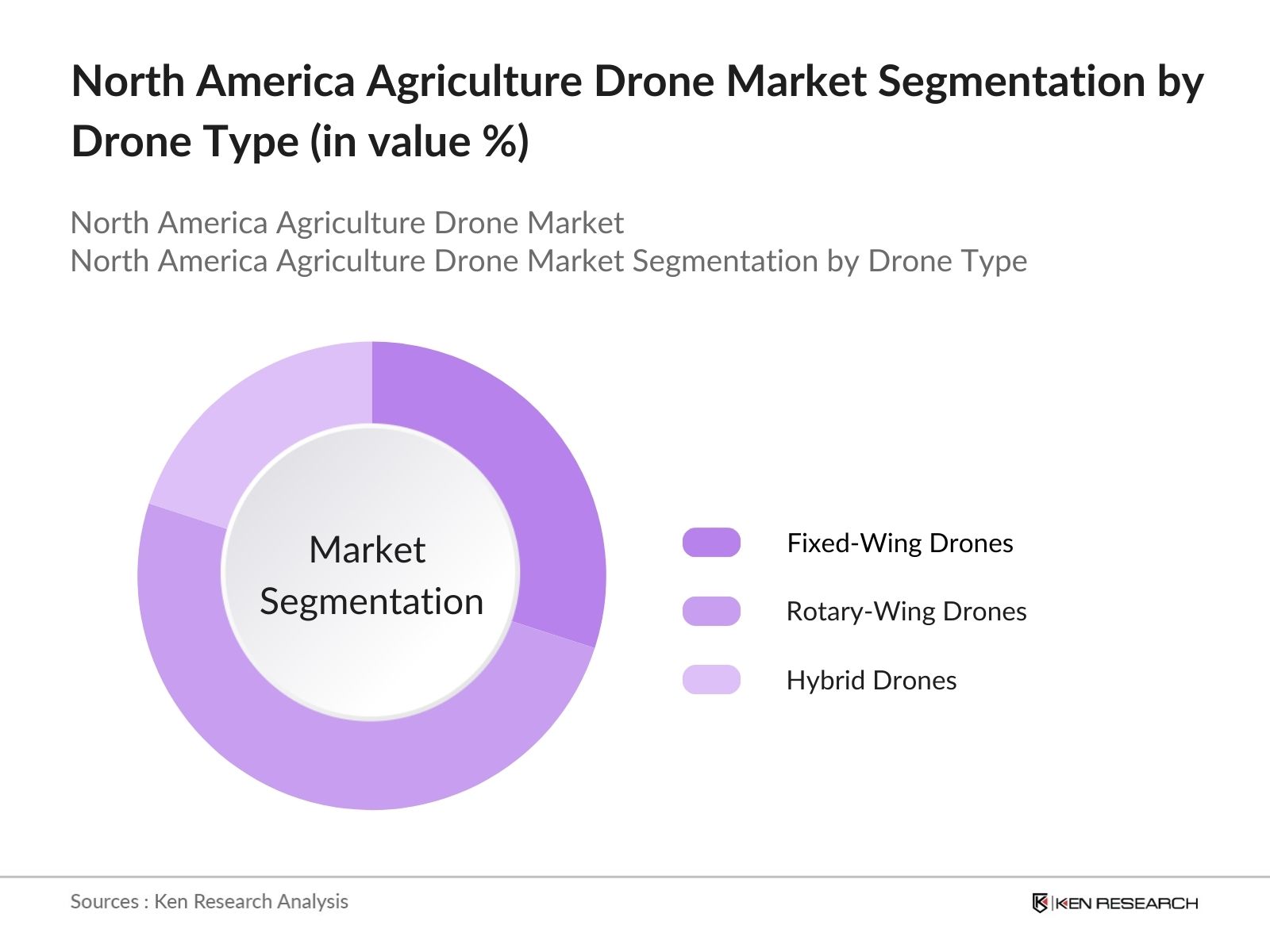
By Drone Type: The North America Agriculture Drone Market is segmented by drone type into fixed-wing drones, rotary-wing drones, and hybrid drones. Recently, rotary-wing drones have a dominant market share in this segment due to their enhanced maneuverability and ability to hover over specific points for precision spraying and data collection. This makes them highly adaptable for varied farm applications, especially in crop monitoring and soil analysis, where pinpoint accuracy is essential.
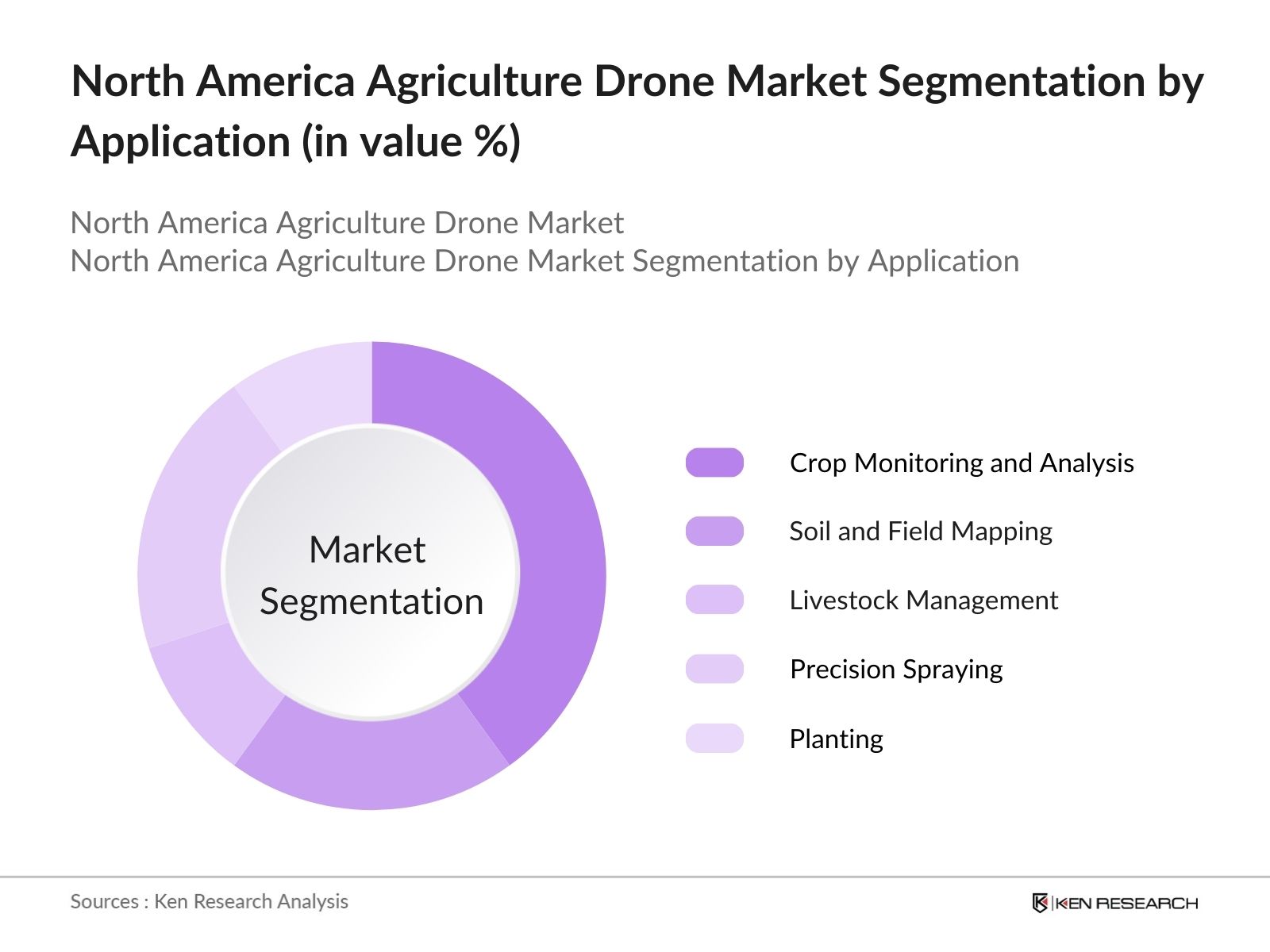
 By Application: The North America Agriculture Drone Market is also segmented by application into crop monitoring and analysis, soil and field mapping, livestock management, precision spraying, and planting. Crop monitoring and analysis hold the highest market share due to the essential role of drones in providing real-time, multispectral data to assess crop health. These capabilities enable farmers to optimize inputs and manage resources effectively, ensuring better crop yields and cost efficiency.
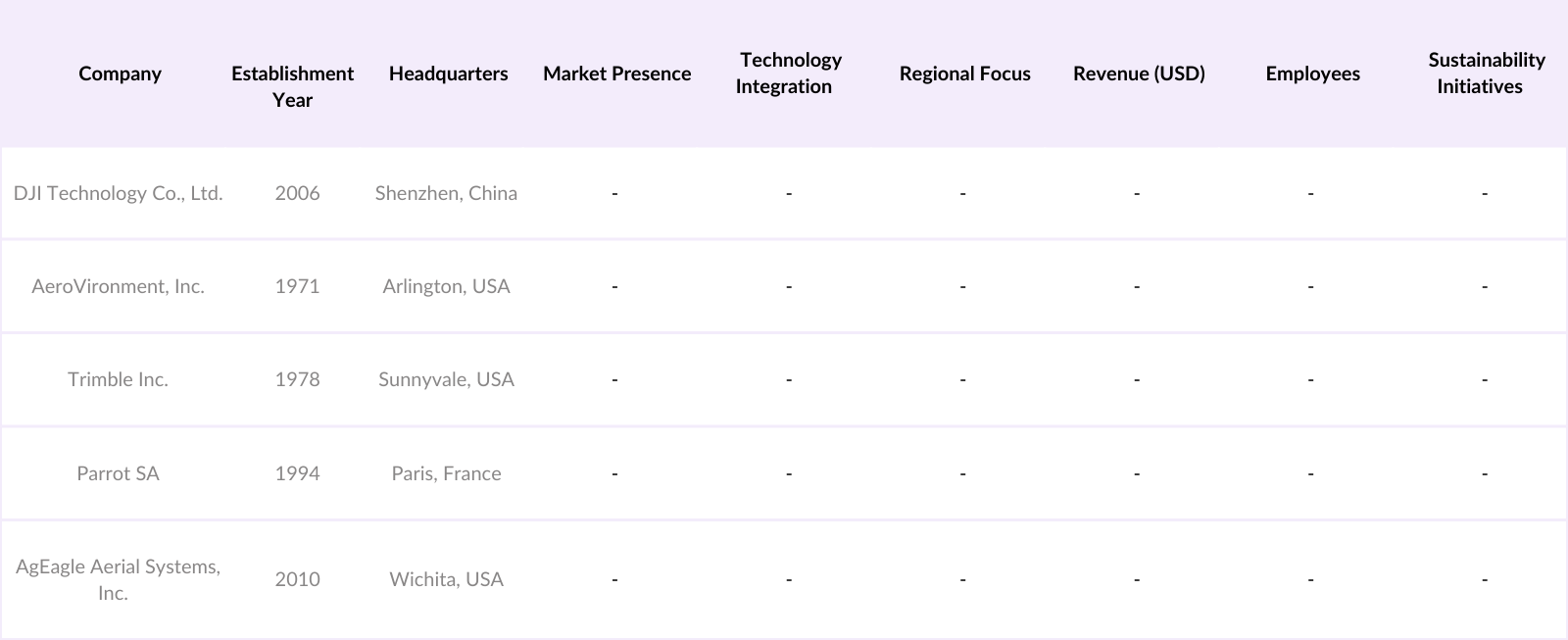
 North America Agriculture Drone Market Competitive Landscape
The North America Agriculture Drone Market is led by prominent players, including DJI Technology Co., Ltd., AeroVironment, Inc., and Trimble Inc. This competitive consolidation highlights these companies' influence due to their robust product portfolios, technological advancements, and established presence in agricultural drone applications.
Growth Drivers
Challenges
North America Agriculture Drone Market is expected to experience significant growth driven by the increasing adoption of AI-driven analytics, government support for precision agriculture, and enhanced drone technology. Drones are anticipated to play a crucial role in expanding food production to meet rising demand across North America, with advancements in autonomous flight and AI integration expected to make precision agriculture more accessible.
Market Opportunities
|
Segment |
Sub-Segments |
|
By Type |
Fixed-Wing Drones |
|
Rotary-Wing Drones |
|
|
Hybrid Drones |
|
|
By Application |
Crop Monitoring and Analysis |
|
Soil and Field Mapping |
|
|
Livestock Management |
|
|
Precision Spraying |
|
|
Planting and Seeding |
|
|
By Component |
Drones (Hardware) |
|
Sensors (LiDAR, Multispectral, Hyperspectral) |
|
|
Software (Data Analytics, Imaging) |
|
|
Services (Repair, Maintenance) |
|
|
By Operation Mode |
Remote Controlled |
|
Semi-Autonomous |
|
|
Fully Autonomous |
|
|
By Country |
United States |
|
Canada |
|
|
Mexico |
1.1 Definition and Scope
1.2 Market Taxonomy
1.3 Market Dynamics Overview
1.4 Market Segmentation Overview
2.1 Historical Market Size
2.2 Year-On-Year Growth Analysis
2.3 Key Developments and Milestones in Agriculture Drone Market
3.1 Growth Drivers
3.1.1 Demand for Precision Agriculture
3.1.2 Technological Advancements in Drone Imaging (NDVI, multispectral imaging)
3.1.3 Need for Yield Optimization
3.1.4 Labor Cost Reduction in Crop Monitoring
3.2 Market Challenges
3.2.1 Regulatory Compliance and Flight Restrictions
3.2.2 High Initial Investment Costs
3.2.3 Limited Knowledge and Training of Farmers
3.3 Opportunities
3.3.1 Increasing Adoption of IoT and Big Data in Agriculture
3.3.2 Support from Government Initiatives and Subsidies
3.3.3 Expanding Applications in Livestock Monitoring and Disease Detection
3.4 Trends
3.4.1 Integration of AI with Drone Analytics
3.4.2 Development of Autonomous Drones for Agriculture
3.4.3 Enhanced Software Platforms for Data Analytics
3.4.4 Growing Use of Hyperspectral Imaging in Agriculture
3.5 Regulatory Landscape
3.5.1 FAA Regulations for Agricultural Drone Usage
3.5.2 Environmental Compliance in Drone Spraying
3.5.3 Subsidy and Funding Programs for Drone Adoption
3.6 SWOT Analysis
3.7 Stakeholder Ecosystem
3.8 Porters Five Forces Analysis
3.9 Competitive Landscape and Market Concentration
4.1 By Type (In Value %)
4.1.1 Fixed-Wing Drones
4.1.2 Rotary-Wing Drones
4.1.3 Hybrid Drones
4.2 By Application (In Value %)
4.2.1 Crop Monitoring and Analysis
4.2.2 Soil and Field Mapping
4.2.3 Livestock Management
4.2.4 Precision Spraying
4.2.5 Planting and Seeding
4.3 By Component (In Value %)
4.3.1 Drones (Hardware)
4.3.2 Sensors (LiDAR, Multispectral, Hyperspectral)
4.3.3 Software (Data Analytics, Imaging Software)
4.3.4 Services (Repair, Maintenance)
4.4 By Operation Mode (In Value %)
4.4.1 Remote Controlled
4.4.2 Semi-Autonomous
4.4.3 Fully Autonomous
4.5 By Country (In Value %)
4.5.1 United States
4.5.2 Canada
4.5.3 Mexico
5.1 Detailed Profiles of Major Companies
5.1.1 DJI Technology Co., Ltd.
5.1.2 Parrot SA
5.1.3 AeroVironment, Inc.
5.1.4 Trimble Inc.
5.1.5 AgEagle Aerial Systems, Inc.
5.1.6 PrecisionHawk Inc.
5.1.7 Sentera LLC
5.1.8 DroneDeploy, Inc.
5.1.9 Yamaha Motor Co., Ltd.
5.1.10 Delair Tech
5.2 Cross Comparison Parameters (Revenue, Headquarters, No. of Patents, Product Range, Partnerships, Market Penetration, Key Applications, Drone Technology Focus)
5.3 Market Share Analysis
5.4 Strategic Initiatives
5.5 Mergers and Acquisitions
5.6 Investment Analysis
5.7 Government Grants and Funding
5.8 Private Equity and Venture Capital Investment
6.1 Airspace Regulations and Licensing
6.2 Certification and Compliance Standards
6.3 Environmental Compliance and Pesticide Usage
7.1 Future Market Size Projections
7.2 Key Factors Driving Future Market Growth
8.1 By Type (In Value %)
8.2 By Application (In Value %)
8.3 By Component (In Value %)
8.4 By Operation Mode (In Value %)
8.5 By Country (In Value %)
9.1 TAM/SAM/SOM Analysis
9.2 Customer Cohort Analysis
9.3 Product Differentiation and Innovation
9.4 White Space Opportunity Analysis
This step involves mapping the markets ecosystem to define stakeholders and key variables impacting the North America Agriculture Drone Market. Extensive secondary research and proprietary database access provide a comprehensive foundation to capture accurate data.
Historical data analysis is conducted to estimate market penetration and demand for drones in precision agriculture. This phase involves assessing service coverage, evaluating regional focus, and compiling revenue data to ensure reliable estimations.
Industry hypotheses are tested through expert interviews with stakeholders, providing real-world insights on market dynamics, product trends, and operational data. This feedback refines and validates market data.
Insights from key manufacturers are integrated to enrich our understanding of product segmentation, sales trends, and consumer preferences. The research synthesizes bottom-up data with field-level expertise for a comprehensive analysis of the North America Agriculture Drone Market.
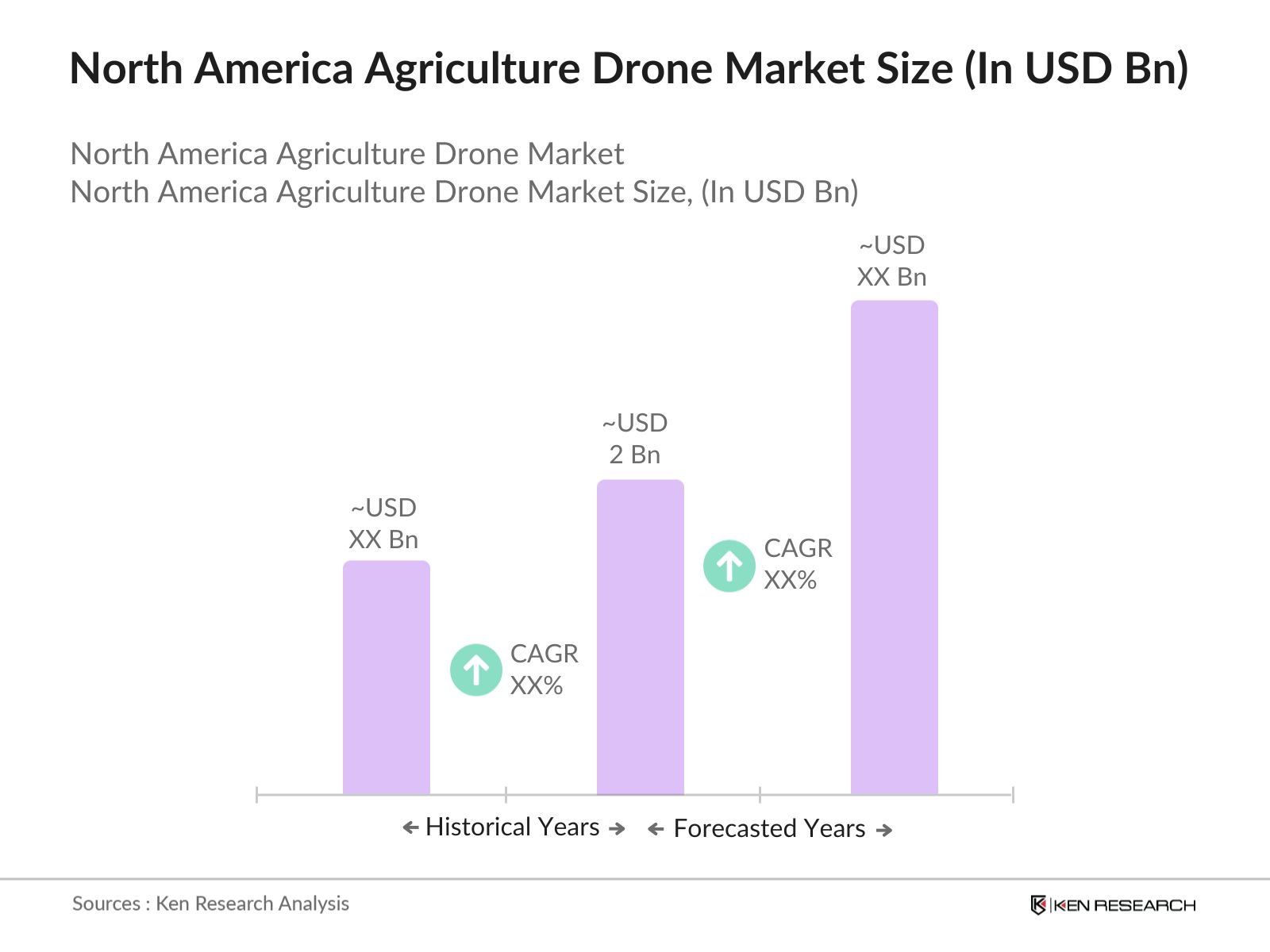
The North America Agriculture Drone Market is valued at USD 2 billion, driven by the increasing demand for precision agriculture and advanced data analytics in farming.
Challenges in North America Agriculture Drone Market include regulatory restrictions on drone operations, the high cost of drone technology, and the lack of skilled operators, which impact adoption rates.
Key players in North America Agriculture Drone Market include DJI Technology, AeroVironment, and Trimble, who dominate due to their advanced technology, strong distribution networks, and tailored agricultural solutions.
North America Agriculture Drone Market is driven by the need for increased agricultural productivity, labor shortages in farming, and technological advancements in drone imaging and AI-driven analytics.

What makes us stand out is that our consultants follows Robust, Refine and Result (RRR) methodology. i.e. Robust for clear definitions, approaches and sanity checking, Refine for differentiating respondents facts and opinions and Result for presenting data with story

We have set a benchmark in the industry by offering our clients with syndicated and customized market research reports featuring coverage of entire market as well as meticulous research and analyst insights.

While we don't replace traditional research, we flip the method upside down. Our dual approach of Top Bottom & Bottom Top ensures quality deliverable by not just verifying company fundamentals but also looking at the sector and macroeconomic factors.

With one step in the future, our research team constantly tries to show you the bigger picture. We help with some of the tough questions you may encounter along the way: How is the industry positioned? Best marketing channel? KPI's of competitors? By aligning every element, we help maximize success.

Our report gives you instant access to the answers and sources that other companies might choose to hide. We elaborate each steps of research methodology we have used and showcase you the sample size to earn your trust.

If you need any support, we are here! We pride ourselves on universe strength, data quality, and quick, friendly, and professional service.