















North America AI Camera Market Outlook to 2030
Region:North America
Author(s):Meenakshi Bisht
Product Code:KROD6588
December 2024
96
About the Report
North America AI Camera Market Overview
- The North America AI Camera Market, based on a comprehensive analysis, is valued at USD 3.97 billion, with rapid growth attributed to advancements in AI technology and its integration with security and surveillance systems. The increasing need for intelligent video analytics, especially for facial recognition, object detection, and real-time monitoring, has significantly boosted market demand.
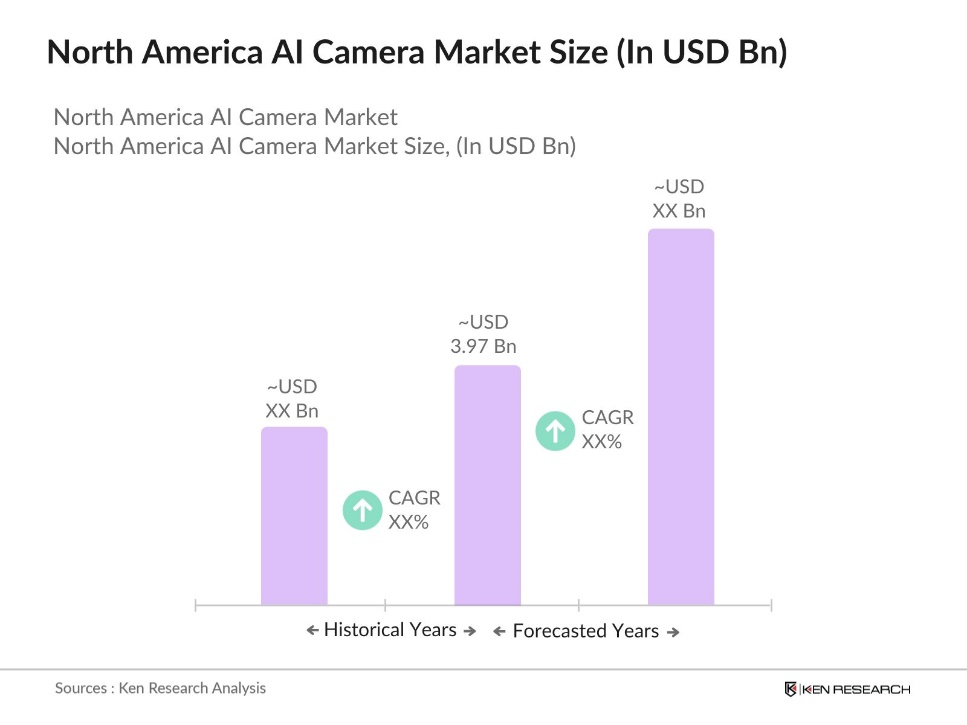
- The market is dominated by the United States, which leads due to its early adoption of AI technologies and a robust technological infrastructure. Key cities like New York, San Francisco, and Los Angeles have seen significant adoption of AI cameras in both public and private sectors, particularly in security surveillance for crime prevention and smart city development. Canada also plays a vital role, with cities such as Toronto and Vancouver implementing AI cameras in their smart city frameworks to enhance urban security and efficiency.
- In 2023, North American governments introduced guidelines to regulate AI camera use in public surveillance. The U.S. Department of Homeland Security issued rules focused on ethical AI-powered camera use, including restrictions on facial recognition and requirements for transparency in data collection. These regulations are vital for maintaining public trust, particularly as AI cameras become more prevalent in urban areas for crime prevention and traffic management.
North America AI Camera Market Segmentation
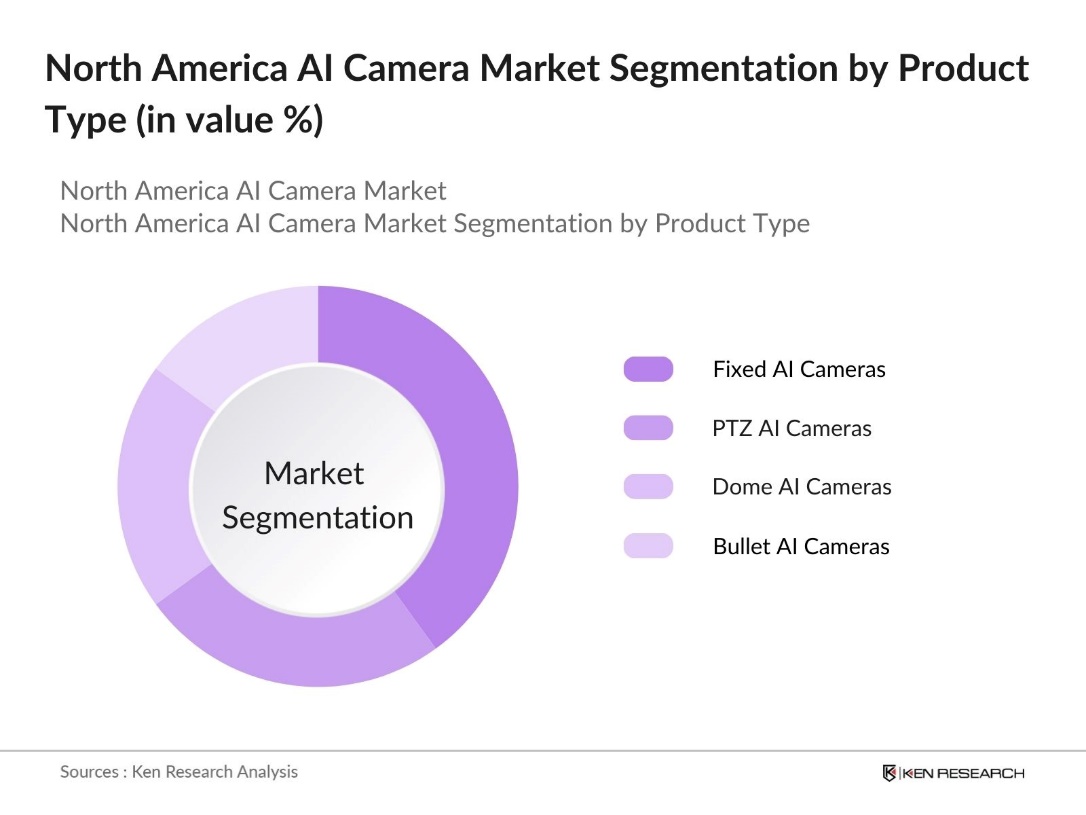
By Product Type: The North America AI Camera market is segmented by product type into fixed AI cameras, PTZ (Pan-Tilt-Zoom) AI cameras, dome AI cameras, and bullet AI cameras. Among these, fixed AI cameras hold the dominant market share due to their wide adoption in surveillance systems across industries such as retail, government buildings, and commercial establishments. Their ability to provide continuous monitoring without moving parts makes them reliable for long-term deployments, reducing maintenance costs. Fixed AI cameras are particularly favored for installations in high-security areas such as airports and financial institutions.
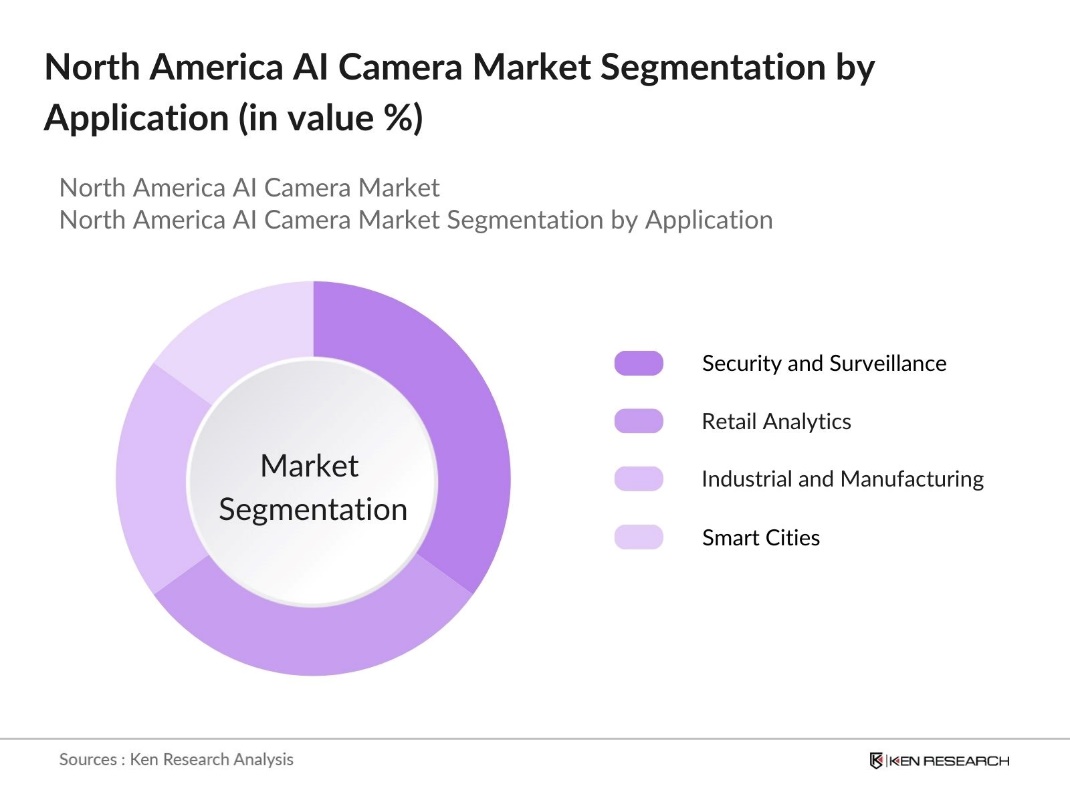
By Application: The North America AI Camera market is segmented by application into security and surveillance, retail analytics, industrial and manufacturing, and smart cities. Security and surveillance remain the largest sub-segment due to the widespread need for AI-enhanced monitoring systems across both private and public sectors. AI cameras are increasingly used to automate the detection of potential threats, improve incident response times, and provide actionable insights through video analytics. This has been critical in areas with high crime rates and in securing public infrastructure.
North America AI Camera Market Competitive Landscape
The market is dominated by several key players, each bringing unique innovations and strengths to the sector. The competitive landscape is characterized by high competition among these major companies, with a focus on innovation in AI algorithms, partnerships with cloud service providers, and large-scale deployment capabilities. The consolidation of the market through mergers and acquisitions has also played a role in shaping the competitive landscape.
|
Company |
Establishment Year |
Headquarters |
AI Software Integration |
Cloud Partnerships |
AI Camera Units Sold (2023) |
Global Market Presence |
AI Patents |
Security Certifications |
|
Axis Communications |
1984 |
Lund, Sweden |
||||||
|
Bosch Security Systems |
1886 |
Gerlingen, Germany |
||||||
|
Dahua Technology |
2001 |
Hangzhou, China |
||||||
|
Hikvision Digital Technology |
2001 |
Hangzhou, China |
||||||
|
Avigilon Corporation |
2004 |
Vancouver, Canada |
North America AI Camera Industry Analysis
Growth Drivers
- Growth in Cloud-Based Video Analytics: Cloud-based video analytics, integrated with AI cameras, has seen substantial growth in North America. For instance, the OceanStor A800 can achieve throughput of 500 GBps and support up to 24 million IOPS, making it suitable for demanding applications like AI and video processing. With governments and corporations pushing for more efficient surveillance systems, cloud-integrated AI camera solutions have gained prominence.
- Enhanced Processing Power of AI Cameras: AI cameras in North America are now equipped with more advanced GPUs and TPUs (Tensor Processing Units), which significantly increase their processing capabilities. This has led to enhanced real-time image recognition and data analytics. As of 2024, Google's upcoming products, like the Pixel 9 series, also emphasize AI-driven camera features, although these may not specifically highlight frame rates exceeding 1,000 fps. The increased processing power allows AI cameras to provide more accurate insights, which has spurred demand.
- Increasing Adoption of AI for Security and Surveillance: AI-powered cameras are becoming integral to security and surveillance across North America, with applications in facial recognition, anomaly detection, and real-time analysis. These systems enhance urban operations, including traffic management and law enforcement. Government initiatives focused on improving public safety are further driving AI adoption, making AI cameras essential in sectors like border security and emergency response, contributing to market growth.
Market Challenges
- High Costs of AI Camera Systems: AI camera systems, particularly those with advanced processors and cloud services, are significantly more expensive than traditional CCTV systems. These high upfront costs, including installation and software licensing, pose challenges for small businesses and municipalities with limited budgets. While larger cities and corporations can manage the expense, the cost remains a significant barrier to widespread adoption, particularly in rural and underdeveloped areas, where budgets are more constrained.
- Data Privacy Regulations and Concerns: Data privacy is a major concern in North America as AI-powered surveillance systems become more prevalent. Strict regulations, such as the California Consumer Privacy Act (CCPA), govern how AI cameras collect and store data. Public concerns over intrusive surveillance and unauthorized data access have led to increased scrutiny and legal challenges, creating regulatory hurdles that slow down the markets expansion. These regulations require compliance, making privacy management a key focus for organizations.
North America AI Camera Market Future Outlook
Over the next five years, the North America AI Camera market is expected to see significant growth, driven by continued advancements in AI technology, increasing demand for public safety, and the expansion of smart city projects. The integration of AI cameras with IoT devices and edge computing solutions will likely streamline real-time data processing, reducing latency and improving response times. Further, government initiatives aimed at improving surveillance systems across cities will provide additional impetus for market growth.
Market Opportunities
- Smart City Projects across North America: Smart city initiatives are driving AI camera adoption in North America, focusing on traffic management, public safety, and environmental monitoring. Cities are integrating AI cameras with infrastructure like traffic systems and emergency services, enhancing real-time data usage for better decision-making. Government support for these initiatives is fostering further growth in AI camera deployments, making them a crucial part of urban development.
- Integration with IoT Ecosystem: AI cameras are increasingly integrated into North America's IoT ecosystem, connecting with sensors, vehicles, and security systems. This integration enables real-time data exchange, driving innovations in smart homes, industrial automation, and transportation. AI cameras help provide predictive analytics and autonomous responses, revolutionizing sectors like manufacturing and logistics.
Scope of the Report
|
By Product Type |
Fixed AI Cameras PTZ AI Cameras Dome AI Cameras Bullet AI Cameras |
|
By Application |
Security and Surveillance Retail Analytics Industrial and Manufacturing Smart Cities |
|
By Technology |
Facial Recognition License Plate Recognition Real-time Object Detection |
|
By Connectivity |
Wired Wireless |
|
By Region |
United States Canada Mexico |
Products
Key Target Audience
Transportation and Logistics Companies
Entertainment Venues and Event Management Companies
Retail Analytics Companies
Property Management Firm
Investors and venture capital Firms
Banks and Financial Institutions
Government and Regulatory Bodies (Department of Homeland Security, Federal Communications Commission)
Companies
Players Mentioned in the Report
Axis Communications
Bosch Security Systems
Dahua Technology
Hikvision Digital Technology
Avigilon Corporation
Honeywell International Inc.
FLIR Systems
Panasonic i-Pro Sensing Solutions
Pelco (Motorola Solutions)
Canon Inc.
Table of Contents
1. North America AI Camera Market Overview
1.1. Definition and Scope
1.2. Market Taxonomy
1.3. Market Growth Rate
1.4. Market Segmentation Overview
2. North America AI Camera Market Size (In USD Bn)
2.1. Historical Market Size
2.2. Year-On-Year Growth Analysis
2.3. Key Market Developments and Milestones
3. North America AI Camera Market Analysis
3.1. Growth Drivers (AI Adoption, Cloud Integration, Enhanced Processing Power)
3.1.1. Increasing Adoption of AI for Security and Surveillance
3.1.2. Growth in Cloud-Based Video Analytics
3.1.3. Enhanced Processing Power of AI Cameras
3.1.4. Government Initiatives in Public Safety
3.2. Market Challenges (Technical Complexities, Data Privacy Concerns)
3.2.1. High Costs of AI Camera Systems
3.2.2. Data Privacy Regulations and Concerns
3.2.3. Lack of Skilled Personnel in AI Technologies
3.3. Opportunities (Smart City Initiatives, Integration with IoT)
3.3.1. Smart City Projects across North America
3.3.2. Integration with IoT Ecosystem
3.3.3. Increasing Demand for AI in Retail Analytics
3.4. Trends (Edge Computing, Real-time Analytics, 4K Video Processing)
3.4.1. Growth in Edge Computing for AI Cameras
3.4.2. Real-time Video Analytics in AI Cameras
3.4.3. Increased Adoption of 4K and Higher Video Resolutions
3.5. Regulatory Landscape (GDPR, AI in Surveillance)
3.5.1. Data Privacy Regulations Impacting AI Camera Use
3.5.2. AI Camera Guidelines for Public Surveillance
3.5.3. Industry Certifications and Compliance Standards
3.6. SWOT Analysis
3.7. Stakeholder Ecosystem
3.8. Porters Five Forces (Market Power of Buyers, Suppliers, Threat of Substitutes)
3.9. Competition Ecosystem
4. North America AI Camera Market Segmentation
4.1. By Product Type (In Value %)
4.1.1. Fixed AI Cameras
4.1.2. Pan-Tilt-Zoom (PTZ) AI Cameras
4.1.3. Dome AI Cameras
4.1.4. Bullet AI Cameras
4.2. By Application (In Value %)
4.2.1. Security and Surveillance
4.2.2. Retail Analytics
4.2.3. Industrial and Manufacturing
4.2.4. Smart Cities
4.3. By Technology (In Value %)
4.3.1. Facial Recognition
4.3.2. License Plate Recognition
4.3.3. Real-time Object Detection
4.4. By Connectivity (In Value %)
4.4.1. Wired
4.4.2. Wireless
4.5. By Region (In Value %)
4.5.1. United States
4.5.2. Canada
4.5.3. Mexico
5. North America AI Camera Market Competitive Analysis
5.1. Detailed Profiles of Major Companies
5.1.1. Axis Communications
5.1.2. Bosch Security Systems
5.1.3. Dahua Technology
5.1.4. Hanwha Techwin
5.1.5. Hikvision Digital Technology Co., Ltd.
5.1.6. Honeywell International Inc.
5.1.7. FLIR Systems
5.1.8. Avigilon Corporation
5.1.9. Panasonic i-Pro Sensing Solutions
5.1.10. Pelco (Motorola Solutions)
5.1.11. Canon Inc.
5.1.12. Vivotek Inc.
5.1.13. Sensetime Group
5.1.14. Dahua USA Inc.
5.1.15. Mobotix AG
5.2. Cross Comparison Parameters (No. of Employees, Headquarters, AI Camera Units Sold, AI Software Integration Capabilities, Revenue from AI Camera Segment, AI Patents, Partnership with Cloud Providers, Security Standards Certification)
5.3. Market Share Analysis
5.4. Strategic Initiatives
5.5. Mergers and Acquisitions
5.6. Investment Analysis
5.7. Venture Capital Funding
5.8. Government Grants and Initiatives
5.9. Private Equity Investments
6. North America AI Camera Market Regulatory Framework
6.1. Data Privacy Laws (GDPR, CCPA, PIPEDA)
6.2. Compliance Requirements for AI in Security
6.3. Certification Processes for AI Camera Manufacturers
7. North America AI Camera Future Market Size (In USD Bn)
7.1. Future Market Size Projections
7.2. Key Factors Driving Future Market Growth
8. North America AI Camera Future Market Segmentation
8.1. By Product Type (In Value %)
8.2. By Application (In Value %)
8.3. By Technology (In Value %)
8.4. By Connectivity (In Value %)
8.5. By Region (In Value %)
9. North America AI Camera Market Analysts Recommendations
9.1. TAM/SAM/SOM Analysis
9.2. Customer Cohort Analysis
9.3. Marketing Initiatives
9.4. White Space Opportunity Analysis
Disclaimer Contact UsResearch Methodology
Step 1: Identification of Key Variables
The initial step involves developing a comprehensive ecosystem map of stakeholders in the North America AI Camera Market. Key variables, including AI technology adoption rates, cloud integration levels, and regulatory frameworks, are identified through a mix of primary and secondary data collection.
Step 2: Market Analysis and Construction
In this stage, historical data related to AI camera market penetration and revenue generation across North America is compiled and analyzed. This involves examining AI-enabled camera deployments in major sectors like security, retail, and smart cities, backed by field reports.
Step 3: Hypothesis Validation and Expert Consultation
Our team validates initial hypotheses through direct consultations with AI camera industry experts using computer-assisted telephone interviews (CATI). These interviews provide critical financial and operational insights that enhance the accuracy of the research findings.
Step 4: Research Synthesis and Final Output
The final step involves synthesizing primary and secondary research findings. This process includes verifying statistical data from interviews and field reports, ensuring that the market analysis is grounded in both top-down and bottom-up research approaches.
Frequently Asked Questions
01. How big is the North America AI Camera Market?
The North America AI Camera Market is valued at USD 3.97 billion, driven by advancements in AI video analytics, security surveillance, and smart city deployments across major regions.
02. What are the challenges in the North America AI Camera Market?
Key challenges in North America AI Camera Market include the high costs of AI camera systems, concerns over data privacy, and a shortage of skilled professionals who can manage and maintain these advanced systems.
03. Who are the major players in the North America AI Camera Market?
Major players in North America AI Camera Market include Axis Communications, Bosch Security Systems, Dahua Technology, Hikvision Digital Technology, and Avigilon Corporation, each bringing unique innovations to the AI camera landscape.
04. What are the growth drivers of the North America AI Camera Market?
The North America AI Camera Market growth drivers include the increasing demand for intelligent security systems, advancements in edge computing, and growing adoption of AI in smart city projects and retail analytics.
Why Buy From Us?

What makes us stand out is that our consultants follows Robust, Refine and Result (RRR) methodology. i.e. Robust for clear definitions, approaches and sanity checking, Refine for differentiating respondents facts and opinions and Result for presenting data with story

We have set a benchmark in the industry by offering our clients with syndicated and customized market research reports featuring coverage of entire market as well as meticulous research and analyst insights.

While we don't replace traditional research, we flip the method upside down. Our dual approach of Top Bottom & Bottom Top ensures quality deliverable by not just verifying company fundamentals but also looking at the sector and macroeconomic factors.

With one step in the future, our research team constantly tries to show you the bigger picture. We help with some of the tough questions you may encounter along the way: How is the industry positioned? Best marketing channel? KPI's of competitors? By aligning every element, we help maximize success.

Our report gives you instant access to the answers and sources that other companies might choose to hide. We elaborate each steps of research methodology we have used and showcase you the sample size to earn your trust.

If you need any support, we are here! We pride ourselves on universe strength, data quality, and quick, friendly, and professional service.