















North America Anti-Lock Braking System Market Outlook to 2030
Region:North America
Author(s):Shreya Garg
Product Code:KROD6008
December 2024
86
About the Report
North America Anti-Lock Braking System (ABS) Market Overview
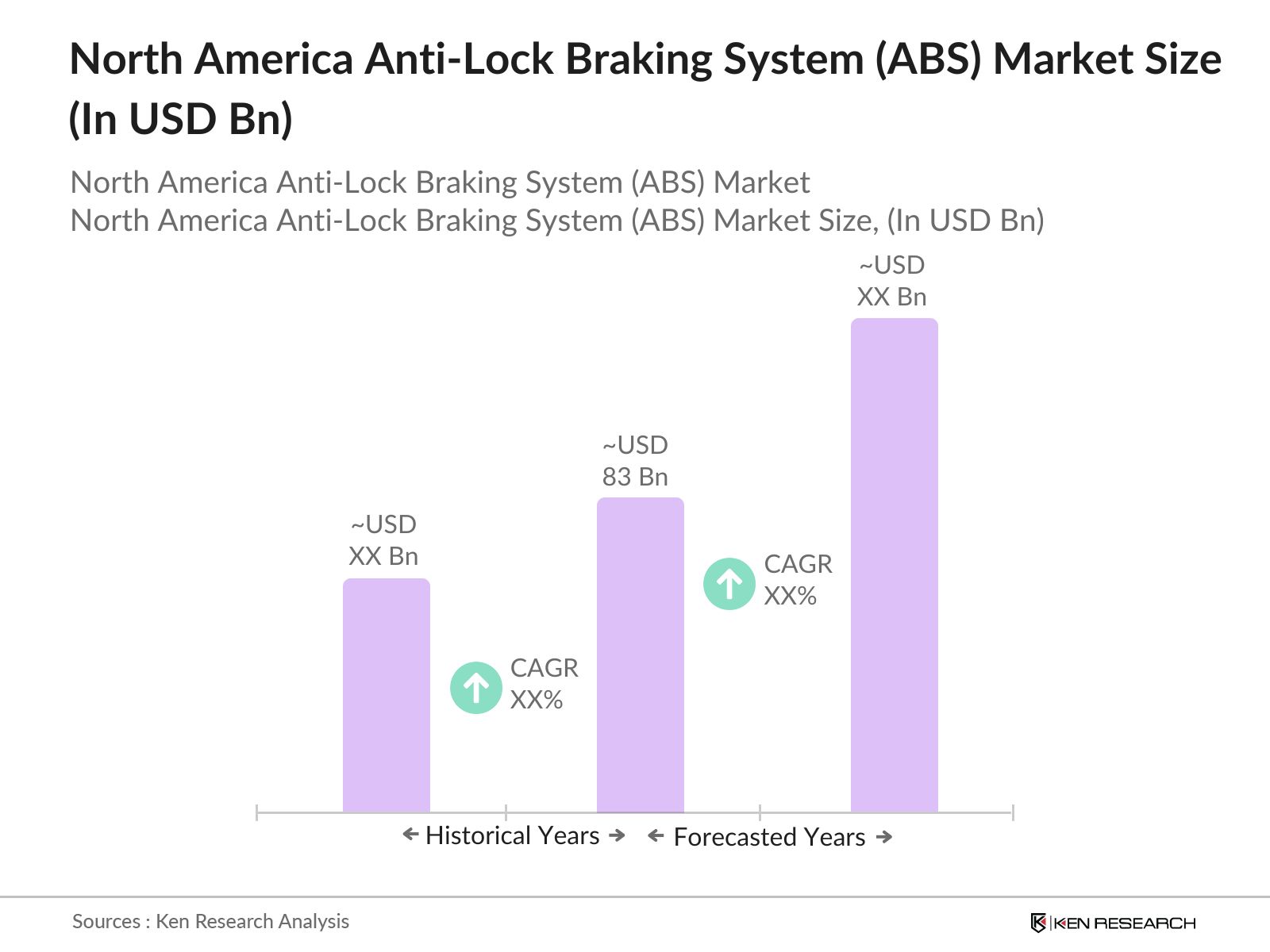
- The North America Anti-Lock Braking System (ABS) market is valued at USD 83 billion, based on a five-year historical analysis. The market is primarily driven by stringent safety regulations in the automotive industry, along with the increasing adoption of advanced driver assistance systems (ADAS). This has resulted in a significant demand for ABS technology, as it enhances vehicle safety by preventing wheel lock-up and maintaining steering control during emergency braking. With growing vehicle production in the region and advancements in braking technologies, the ABS market has witnessed continuous growth.
- In terms of dominance, the U.S. leads the North America ABS market due to its well-established automotive industry, extensive regulations focused on vehicle safety, and higher penetration of premium vehicles equipped with advanced safety features like ABS. Canada and Mexico also play significant roles, supported by increasing vehicle production and exports, with Mexico emerging as a key manufacturing hub for automakers, thereby driving the adoption of ABS systems in new vehicles.
- In 2024, the U.S. Department of Transportation continues to enforce stringent vehicle safety regulations, mandating ABS in all passenger and commercial vehicles. These mandates, coupled with incentives for safety system installations, are driving increased adoption of ABS across North America. Canada is following a similar regulatory approach, with Transport Canada implementing stricter ABS requirements for heavy-duty vehicles.
North America Anti-Lock Braking System (ABS) Market Segmentation
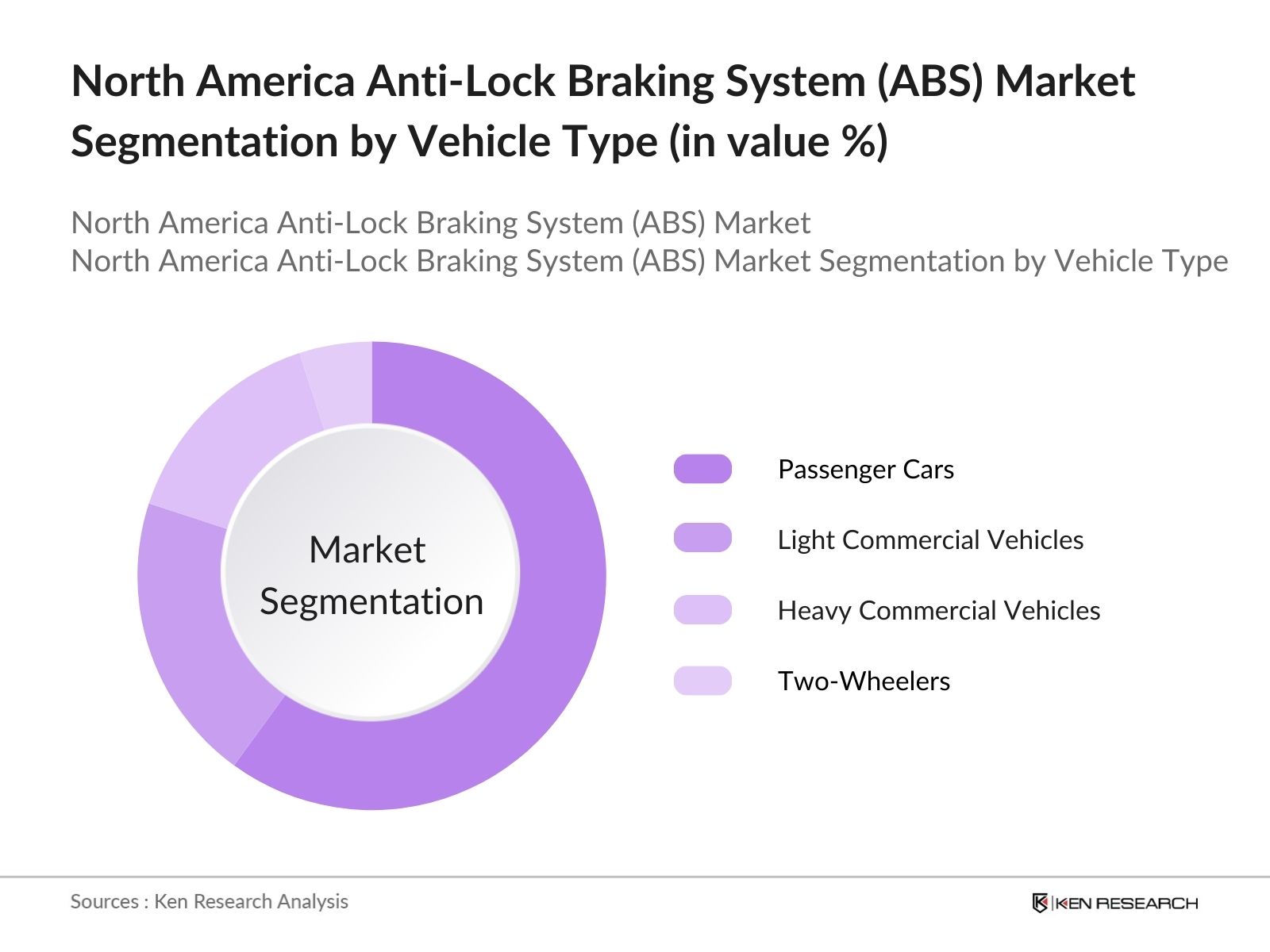
By Vehicle Type: The North America Anti-Lock Braking System (ABS) market is segmented by vehicle type into passenger cars, light commercial vehicles, heavy commercial vehicles, and two-wheelers. Passenger cars currently dominate the market due to high sales volumes and the growing adoption of advanced safety features, including ABS, which is now a standard feature in most modern vehicles. The preference for premium cars with safety technologies has driven this segment, especially in countries like the U.S., where safety regulations and consumer demand for enhanced driving experiences are robust.
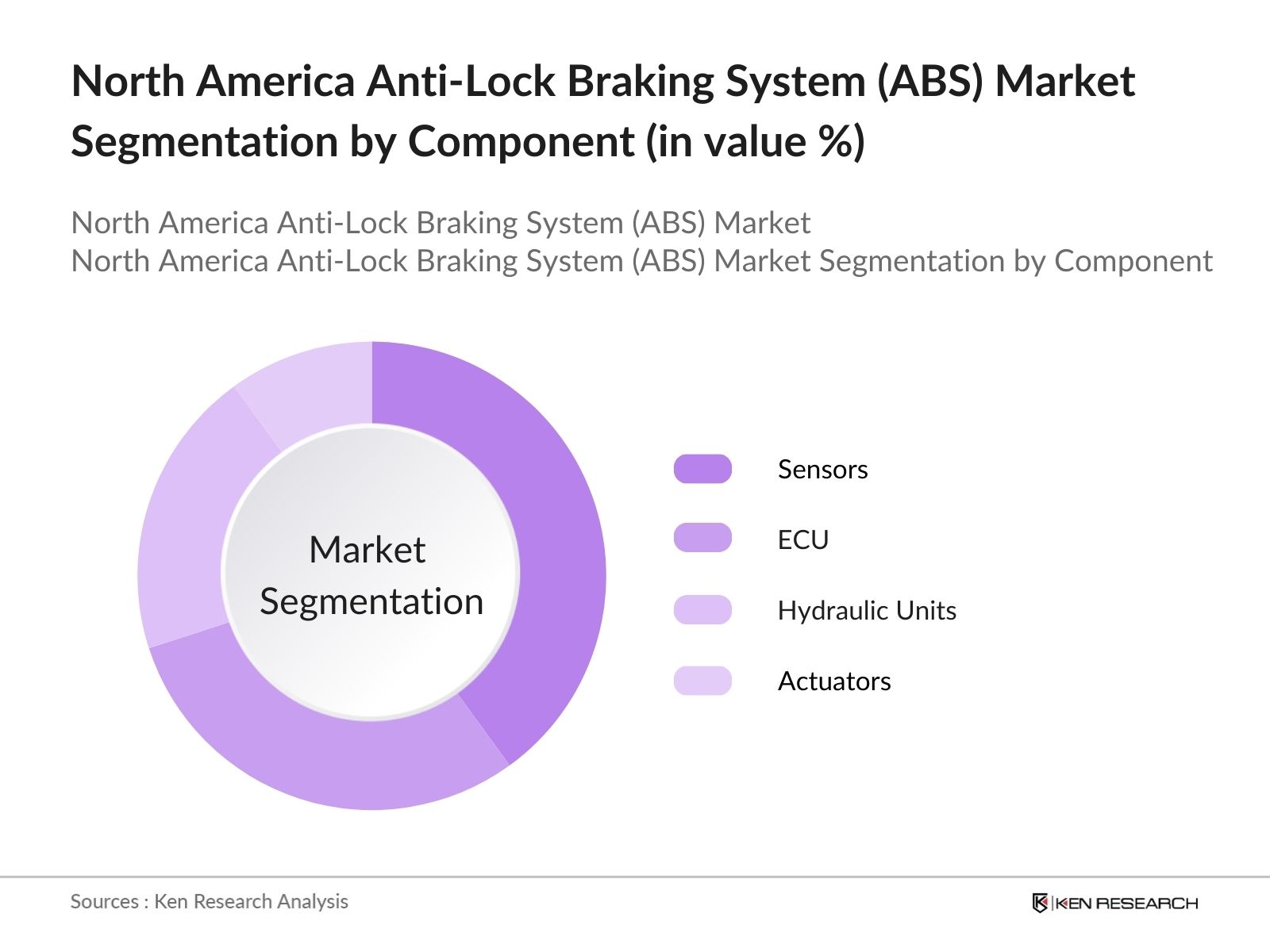
By Component Type: The market is further segmented by component type into sensors, electronic control units (ECU), hydraulic units, and actuators. Sensors lead the market, given their critical role in detecting wheel speed and relaying real-time data to the ABS system. The integration of advanced sensor technology in vehicles has improved the overall performance of ABS, making this sub-segment a key contributor to market growth. In addition, continuous innovations in sensor technology, aimed at enhancing accuracy and durability, have further propelled their dominance.
North America Anti-Lock Braking System (ABS) Market Competitive Landscape
The North American ABS market is dominated by several key players, including major global and regional automotive suppliers. These companies have established strong market positions through strategic partnerships, technological innovations, and mergers and acquisitions. The consolidation of key players in the region highlights the influence of a few large companies, which continue to shape the market dynamics.
|
Company Name |
Establishment Year |
Headquarters |
Employees |
Revenue (USD Bn) |
Key Clients |
Geographic Reach |
Product Offering |
R&D Investment |
|
Robert Bosch GmbH |
1886 |
Stuttgart, Germany |
||||||
|
Continental AG |
1871 |
Hanover, Germany |
||||||
|
ZF Friedrichshafen AG |
1915 |
Friedrichshafen, DE |
||||||
|
Denso Corporation |
1949 |
Aichi, Japan |
||||||
|
Autoliv Inc. |
1953 |
Stockholm, Sweden |
North America Anti-Lock Braking System (ABS) Industry Analysis
Growth Drivers
- Increasing Regulatory Mandates for Vehicle Safety: In 2024, governments across North America are emphasizing vehicle safety, with mandates that require the installation of anti-lock braking systems (ABS) in all newly manufactured vehicles. For instance, the National Highway Traffic Safety Administration (NHTSA) continues to set rigorous safety standards, promoting ABS technology as essential for reducing road accidents. This regulatory push is fueling the ABS market, particularly in light of the rising number of road accidents. According to the U.S. Department of Transportation, there were over 41,000 road fatalities in the U.S. in 2023, underscoring the importance of enhanced safety features in vehicles.
- Growing Demand for Advanced Driver Assistance Systems (ADAS): As of 2024, the integration of ADAS, which includes features like adaptive braking and lane-keeping assistance, is driving the need for advanced braking technologies like ABS. The increasing consumer preference for vehicles equipped with safety-enhancing features is boosting ABS adoption, as these systems are vital for enabling ADAS functionalities. According to industry reports, the adoption of ADAS in new vehicles across North America is expected to increase by over 10 million units annually, directly driving the demand for ABS systems.
- Increasing Vehicle Production and Sales: North America continues to be a significant automotive market, with over 15 million new vehicles sold in the U.S. alone in 2023. This growth in vehicle sales is a critical driver for the ABS market, as manufacturers integrate these systems to meet safety standards and consumer demand for better safety features. The ongoing recovery in the automotive sector, bolstered by favorable economic conditions in the U.S. and Canada, is further expected to support ABS demand in 2024.
Market Challenges
- High Costs of ABS Installation: The cost of integrating ABS into vehicles remains a barrier for many automakers, particularly for entry-level and budget vehicle models. ABS components, combined with labor costs for installation, significantly increase the overall production expenses. For smaller automakers or manufacturers of low-cost vehicles, this can be a substantial financial burden. In 2024, the average installation cost for ABS systems per vehicle ranges between $500 and $1,000, which limits its adoption in cost-sensitive markets.
- Complex Integration with Other Safety Systems: ABS needs to be seamlessly integrated with other vehicle safety systems, such as electronic stability control (ESC) and ADAS, to ensure optimal performance. However, achieving this integration is technically challenging, particularly in compact and electric vehicles where space constraints and electrical system limitations complicate the installation. The complexity of this integration is a challenge that automakers and suppliers are working to overcome in 2024.
North America Anti-Lock Braking System (ABS) Market Future Outlook
Over the next five years, the North America ABS market is projected to experience substantial growth driven by increasing vehicle production, advancements in braking technologies, and the growing demand for electric vehicles (EVs) that require specialized braking systems. Regulatory mandates emphasizing road safety, coupled with rising consumer awareness of vehicle safety features, are expected to fuel demand for ABS systems in both new and existing vehicles. Furthermore, as autonomous vehicles gain traction, ABS systems will play a pivotal role in ensuring optimal braking performance in automated driving scenarios.
Future Market Opportunities
- Expansion in the Electric Vehicle Segment: With the growing emphasis on sustainability, the electric vehicle (EV) market is expanding rapidly in North America. In 2024, more than 2 million electric vehicles are expected to be sold across the U.S. and Canada. This surge creates significant opportunities for ABS manufacturers, as electric vehicles require advanced braking systems that include ABS to ensure optimal safety performance. The rising penetration of EVs, combined with favorable government policies supporting clean energy vehicles, presents a lucrative growth opportunity for ABS suppliers.
- Growing Retrofit Market for Commercial Vehicles: The commercial vehicle segment, particularly fleets of trucks and buses, is a promising area for ABS retrofitting. In 2024, there are over 5 million commercial vehicles operating in North America, and a growing number of fleet operators are investing in retrofitting ABS into older vehicles to comply with regulatory standards and enhance safety. This retrofit market is expected to expand significantly as governments introduce stricter safety regulations for commercial vehicles.
Scope of the Report
|
Vehicle Type |
Passenger Cars, Light Commercial Vehicles, Heavy Commercial Vehicles, Two-Wheelers |
|
Component Type |
Sensors, Electronic Control Unit (ECU), Hydraulic Units, Actuators |
|
Technology Type |
Four-channel, Four-sensor ABS, Three-channel, Three-sensor ABS, Two-channel, Two-sensor ABS |
|
Sales Channel |
OEM, Aftermarket |
|
Region |
U.S., Canada, Mexico |
Products
Key Target Audience
Automotive Manufacturers
Aftermarket Suppliers
ABS Component Suppliers
Electric Vehicle Manufacturers
Government and Regulatory Bodies (National Highway Traffic Safety Administration - NHTSA)
Investors and Venture Capitalist Firms
Automotive Safety Associations
Original Equipment Manufacturers (OEMs)
Companies
Major Players
Robert Bosch GmbH
Continental AG
ZF Friedrichshafen AG
Denso Corporation
Autoliv Inc.
WABCO
Hyundai Mobis
Nissin Kogyo Co., Ltd.
Aisin Seiki Co., Ltd.
Hitachi Automotive Systems Ltd.
Table of Contents
North America ABS Market Overview
1.1. Definition and Scope
1.2. Market Taxonomy
1.3. Market Growth Rate
1.4. Market Segmentation Overview
North America ABS Market Size (in USD Bn)
2.1. Historical Market Size
2.2. Year-On-Year Growth Analysis
2.3. Key Market Developments and Milestones
North America ABS Market Analysis
3.1. Growth Drivers (Market-specific factors: Adoption of ADAS, Road Safety Regulations, Rising Vehicle Sales)
3.1.1. Increasing Regulatory Mandates for Vehicle Safety
3.1.2. Growing Demand for Advanced Driver Assistance Systems (ADAS)
3.1.3. Increasing Vehicle Production and Sales
3.1.4. Technological Advancements in Braking Systems
3.2. Market Challenges (Market-specific factors: Cost, Integration, and Technical Limitations)
3.2.1. High Costs of ABS Installation
3.2.2. Complex Integration with Other Safety Systems
3.2.3. Technical Challenges in Compact and Electric Vehicles
3.2.4. Lack of Awareness in Certain Vehicle Segments
3.3. Opportunities (Market-specific factors: Emerging Markets, Electric Vehicles, Retrofit Market)
3.3.1. Expansion in the Electric Vehicle Segment
3.3.2. Growing Retrofit Market for Commercial Vehicles
3.3.3. Collaborations for Autonomous Vehicle Technology
3.3.4. Opportunities in the Aftermarket for ABS Components
3.4. Trends (Market-specific factors: Lightweight Materials, Sensor Integration, Electrification)
3.4.1. Adoption of Lightweight Braking Systems
3.4.2. Integration with Vehicle Dynamics Control Systems
3.4.3. Rise of Electrification and Hybrid Vehicle Braking Systems
3.4.4. Increased Focus on Compact ABS for Two-wheelers
3.5. Government Regulation (Market-specific factors: Safety Standards, Emission Norms, Regulatory Compliance)
3.5.1. Federal Motor Vehicle Safety Standards (FMVSS) Compliance
3.5.2. NHTSA Regulations on Vehicle Safety
3.5.3. Environmental and Emission Control Norms Impacting ABS
3.5.4. Mandates for ABS in Commercial Vehicles
3.6. SWOT Analysis (Specific to ABS market)
3.7. Stakeholder Ecosystem (OEMs, Suppliers, Regulatory Bodies)
3.8. Porters Five Forces (Specific to ABS Industry Dynamics)
3.9. Competition Ecosystem (Tier 1 Suppliers, OEMs, Aftermarket Participants)
North America ABS Market Segmentation
4.1. By Component Type (in Value %)
4.1.1. Sensors
4.1.2. Electronic Control Unit (ECU)
4.1.3. Hydraulic Units
4.1.4. Actuators
4.2. By Vehicle Type (in Value %)
4.2.1. Passenger Cars
4.2.2. Light Commercial Vehicles
4.2.3. Heavy Commercial Vehicles
4.2.4. Two-Wheelers
4.3. By Technology Type (in Value %)
4.3.1. Four-channel, Four-sensor ABS
4.3.2. Three-channel, Three-sensor ABS
4.3.3. Two-channel, Two-sensor ABS
4.4. By Sales Channel (in Value %)
4.4.1. OEM
4.4.2. Aftermarket
4.5. By Region (in Value %)
4.5.1. U.S.
4.5.2. Canada
4.5.3. Mexico
North America ABS Market Competitive Analysis
5.1. Detailed Profiles of Major Companies
5.1.1. Robert Bosch GmbH
5.1.2. Continental AG
5.1.3. ZF Friedrichshafen AG
5.1.4. Denso Corporation
5.1.5. WABCO (now part of ZF Group)
5.1.6. Hyundai Mobis Co., Ltd.
5.1.7. Nissin Kogyo Co., Ltd.
5.1.8. Autoliv Inc.
5.1.9. Hitachi Automotive Systems Ltd.
5.1.10. Aisin Seiki Co., Ltd.
5.1.11. TRW Automotive
5.1.12. Mando Corporation
5.1.13. Delphi Automotive LLP
5.1.14. Brembo S.p.A
5.1.15. Knorr-Bremse AG
5.2. Cross Comparison Parameters (Employee Strength, Revenue, Product Offering, Market Share, R&D Investments, Key Clients, Geographic Reach, Growth Strategy)
5.3. Market Share Analysis
5.4. Strategic Initiatives
5.5. Mergers and Acquisitions
5.6. Investment Analysis
5.7. Venture Capital and Funding Activity
5.8. Partnerships and Collaborations
North America ABS Market Regulatory Framework
6.1. Safety Standards
6.2. Environmental Regulations
6.3. Compliance Requirements
North America ABS Future Market Size (in USD Bn)
7.1. Future Market Size Projections
7.2. Key Factors Driving Future Market Growth
North America ABS Future Market Segmentation
8.1. By Component Type
8.2. By Vehicle Type
8.3. By Technology Type
8.4. By Sales Channel
8.5. By Region
North America ABS Market Analysts' Recommendations
9.1. TAM/SAM/SOM Analysis
9.2. Market Penetration Strategies
9.3. Product Development Recommendations
9.4. White Space Opportunity Analysis
Disclaimer Contact UsResearch Methodology
Step 1: Identification of Key Variables
The first step of our research methodology involved identifying all key stakeholders in the North America Anti-Lock Braking System (ABS) market. This process involved extensive desk research utilizing multiple secondary databases to map the ecosystem and identify crucial variables influencing market trends, such as vehicle production rates, safety regulations, and ABS technology advancements.
Step 2: Market Analysis and Construction
During this phase, we analyzed historical data on ABS penetration in North American vehicles, especially focusing on passenger cars and commercial vehicles. Additionally, we assessed service providers and supplier chains that impact ABS installations and conducted revenue estimations based on service provider market shares.
Step 3: Hypothesis Validation and Expert Consultation
We conducted in-depth interviews with industry experts, including representatives from top ABS suppliers and automotive manufacturers. These consultations helped validate market projections and shed light on emerging technologies that could shape the future of ABS systems.
Step 4: Research Synthesis and Final Output
The final phase involved direct engagement with vehicle manufacturers and component suppliers to gain insights into ABS installations, advancements, and consumer trends. This feedback was integrated with our bottom-up research to produce the final validated market analysis.
Frequently Asked Questions
01 How big is the North America Anti-Lock Braking System (ABS) Market?
The North America ABS market is valued at USD 83 billion, driven by stringent government safety regulations, rising vehicle production, and consumer demand for safety-enhancing features.
02 What are the challenges in the North America ABS Market?
Challenges in the North America ABS market include the high cost of integrating ABS into vehicles, the complexity of systems for electric vehicles, and technical limitations in compact vehicles, which hinder market penetration.
03 Who are the major players in the North America ABS Market?
Major players in the North America ABS market include Robert Bosch GmbH, Continental AG, ZF Friedrichshafen AG, Denso Corporation, and Autoliv Inc. These companies dominate the market due to their long-term contracts with leading automakers and continuous investments in R&D.
04 What are the growth drivers of the North America ABS Market?
The market is driven by increasing regulatory mandates for vehicle safety, growing consumer awareness of ABS technology, and the rising adoption of ADAS. The expansion of electric vehicle manufacturing also presents new opportunities for ABS adoption.
Why Buy From Us?

What makes us stand out is that our consultants follows Robust, Refine and Result (RRR) methodology. i.e. Robust for clear definitions, approaches and sanity checking, Refine for differentiating respondents facts and opinions and Result for presenting data with story

We have set a benchmark in the industry by offering our clients with syndicated and customized market research reports featuring coverage of entire market as well as meticulous research and analyst insights.

While we don't replace traditional research, we flip the method upside down. Our dual approach of Top Bottom & Bottom Top ensures quality deliverable by not just verifying company fundamentals but also looking at the sector and macroeconomic factors.

With one step in the future, our research team constantly tries to show you the bigger picture. We help with some of the tough questions you may encounter along the way: How is the industry positioned? Best marketing channel? KPI's of competitors? By aligning every element, we help maximize success.

Our report gives you instant access to the answers and sources that other companies might choose to hide. We elaborate each steps of research methodology we have used and showcase you the sample size to earn your trust.

If you need any support, we are here! We pride ourselves on universe strength, data quality, and quick, friendly, and professional service.