
North America Artificial Turf Market Outlook to 2030
Region:Mexico
Author(s):Sanjna
Product Code:KROD10314
Region:Mexico
Author(s):Sanjna
Product Code:KROD10314
December 2024
92
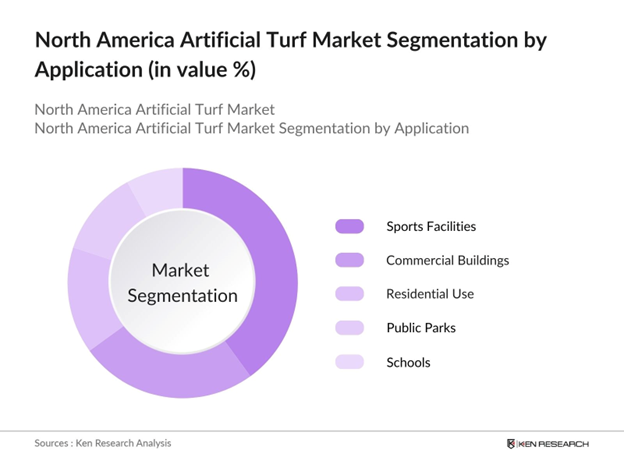
By Application: The North America Artificial Turf market is segmented by application into sports facilities, commercial buildings, residential use, public parks, and schools. Sports facilities hold a dominant market share, particularly driven by the increasing investments in sports arenas, stadiums, and training grounds. The preference for artificial turf in sports facilities is largely due to its durability, minimal maintenance, and the ability to withstand high usage without degradation, which makes it ideal for high-traffic areas. The growing interest in sports like soccer and football, especially in the U.S., further boosts the demand for artificial turf.
By Material Type: The market is further segmented by material type into polyethylene turf, polypropylene turf, and nylon turf. Polyethylene turf dominates the market, accounting for a significant share due to its soft texture, resilience, and affordability. This material is highly preferred for residential lawns, school playgrounds, and public parks, as it mimics the appearance and feel of natural grass while being easy to maintain. Its UV stability and water-resistant properties also contribute to its popularity in the North American market.

The North America artificial turf market is dominated by key players that have a significant influence on market trends, product innovations, and distribution networks. Large-scale sports infrastructure projects and growing demand from residential and commercial landscaping drive these companies to strengthen their market presence through new product developments and partnerships.
|
Company |
Establishment Year |
Headquarters |
Employees |
Product Portfolio |
Regional Presence |
Strategic Initiatives |
Market Share |
Innovation |
M&A Activity |
|
Shaw Sports Turf |
1946 |
Dalton, Georgia, USA |
- |
- |
- |
- |
- |
- |
- |
|
FieldTurf |
1988 |
Calhoun, Georgia, USA |
- |
- |
- |
- |
- |
- |
- |
|
SportGroup Holding |
1969 |
Burgheim, Germany |
- |
- |
- |
- |
- |
- |
- |
|
Act Global |
2004 |
Austin, Texas, USA |
- |
- |
- |
- |
- |
- |
- |
|
AstroTurf |
1965 |
Dalton, Georgia, USA |
- |
- |
- |
- |
- |
- |
- |
Growth Drivers
Challenges
North America Artificial Turf market is expected to see sustained growth driven by increasing investments in sports infrastructure, particularly in the U.S. Expansion in the residential and commercial sectors, driven by growing water conservation initiatives, will also continue to be a key factor. Furthermore, the introduction of eco-friendly and recyclable turf materials is anticipated to further strengthen the markets growth trajectory.
Market Opportunities
|
Application |
Sports Facilities Commercial Buildings Residential Use Public Parks and Recreation Areas Schools and Educational Facilities |
|
Material Type |
Polyethylene Turf Polypropylene Turf Nylon Turf |
|
Infill Material |
Sand Infill Rubber Infill Organic Infill |
|
Installation Type |
Outdoor Installation Indoor Installation |
|
Region |
U.S. Canada Mexico |
1.1. Definition and Scope
1.2. Market Taxonomy
1.3. Market Growth Rate
1.4. Market Segmentation Overview
2.1. Historical Market Size
2.2. Year-On-Year Growth Analysis
2.3. Key Market Developments and Milestones
3.1. Growth Drivers
3.1.1. Water Conservation Initiatives
3.1.2. Rise in Sports Facility Investments
3.1.3. Urbanization and Landscaping Trends
3.1.4. Durability and Low Maintenance
3.2. Market Challenges
3.2.1. High Initial Installation Costs
3.2.2. Environmental Concerns
3.2.3. Temperature Retention Issues
3.2.4. Limited Consumer Awareness in Non-Sports Sectors
3.3. Opportunities
3.3.1. Innovations in Eco-Friendly Turf Materials
3.3.2. Increasing Demand in Schools and Educational Institutions
3.3.3. Expansion into the Golf Industry
3.3.4. Government Subsidies for Sustainable Landscaping
3.4. Trends
3.4.1. Integration with Smart Irrigation Systems
3.4.2. Growth in Hybrid Turf Systems
3.4.3. Rising Popularity in Residential Backyards
3.4.4. Advances in Turf Technology
3.5. Government Regulation
3.5.1. Environmental Standards
3.5.2. Compliance Requirements
3.5.3. Certification Processes
3.6. SWOT Analysis
3.7. Stakeholder Ecosystem
3.8. Porters Five Forces
3.9. Competition Ecosystem
4.1. By Application (In Value %)
4.1.1. Sports Facilities
4.1.2. Commercial Buildings
4.1.3. Residential Use
4.1.4. Public Parks and Recreation Areas
4.1.5. Schools and Educational Facilities
4.2. By Material Type (In Value %)
4.2.1. Polyethylene Turf
4.2.2. Polypropylene Turf
4.2.3. Nylon Turf
4.3. By Infill Material (In Value %)
4.3.1. Sand Infill
4.3.2. Rubber Infill
4.3.3. Organic Infill
4.4. By Installation Type (In Value %)
4.4.1. Outdoor Installation
4.4.2. Indoor Installation
4.5. By Region (In Value %)
4.5.1. U.S.
4.5.2. Canada
4.5.3. Mexico
5.1. Detailed Profiles of Major Companies
5.1.1. Shaw Sports Turf
5.1.2. FieldTurf
5.1.3. SportGroup Holding
5.1.4. Act Global
5.1.5. AstroTurf
5.1.6. Synthetic Turf International (STI)
5.1.7. SIS Pitches
5.1.8. GreenFields USA
5.1.9. Hellas Construction
5.1.10. Controlled Products
5.2. Cross Comparison Parameters
5.3. Market Share Analysis
5.4. Strategic Initiatives
5.5. Mergers and Acquisitions
5.6. Investment Analysis
5.7. Venture Capital Funding
5.8. Government Grants
5.9. Private Equity Investments
6.1. Environmental Standards
6.2. Compliance Requirements
6.3. Certification Processes
7.1. Future Market Size Projections
7.2. Key Factors Driving Future Market Growth
8.1. By Application (In Value %)
8.2. By Material Type (In Value %)
8.3. By Infill Material (In Value %)
8.4. By Installation Type (In Value %)
8.5. By Region (In Value %)
9.1. TAM/SAM/SOM Analysis
9.2. Customer Cohort Analysis
9.3. Marketing Initiatives
9.4. White Space Opportunity Analysis
The initial step involves mapping all the stakeholders within the North America Artificial Turf Market ecosystem. This includes sports organizations, real estate developers, turf manufacturers, and water conservation agencies. Desk research is conducted using proprietary databases to collect industry-specific data and identify key variables influencing market growth
This phase compiles and analyzes historical market data on artificial turf installations across various sectors like sports, residential, and commercial. Market penetration and material usage statistics are assessed to ensure reliability and accuracy. Revenue generation and service quality metrics are also examined.
Through interviews and consultations with industry experts from companies like Shaw Sports Turf and FieldTurf, market hypotheses are validated. These discussions offer valuable insights into current trends, technological advancements, and material innovations, further corroborating the market data.
In the final phase, direct consultations with artificial turf manufacturers and distributors are conducted. These interviews provide deeper insights into the product mix, consumer preferences, and the performance of different turf materials. This information is used to validate and synthesize the market research.
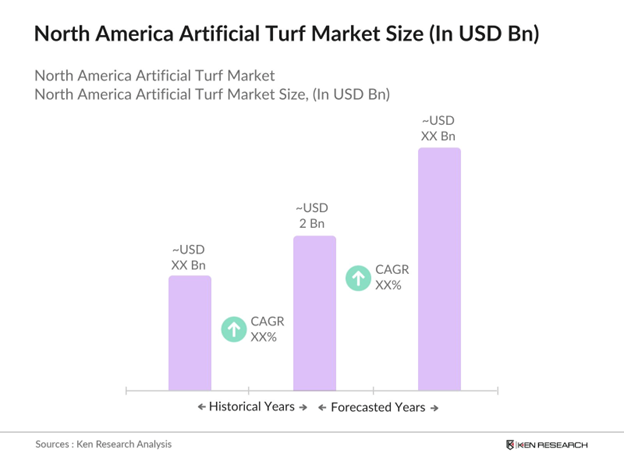
The North America Artificial Turf market is valued at USD 2 billion, driven by increasing investments in sports infrastructure, water conservation initiatives, and residential landscaping preferences.
Challenges in North America Artificial Turf market include high initial installation costs, environmental concerns regarding recycling, and temperature retention issues in hot climates. Additionally, there is limited consumer awareness outside the sports and commercial sectors.
Major players in North America Artificial Turf market include Shaw Sports Turf, FieldTurf, Act Global, SIS Pitches, and GreenFields USA. These companies dominate the market due to their innovative product offerings and strong relationships with key industry players.
Key growth drivers in North America Artificial Turf market include the demand for water conservation in landscaping, increased investments in sports infrastructure, and the rising popularity of low-maintenance landscaping solutions in residential areas.

What makes us stand out is that our consultants follows Robust, Refine and Result (RRR) methodology. i.e. Robust for clear definitions, approaches and sanity checking, Refine for differentiating respondents facts and opinions and Result for presenting data with story

We have set a benchmark in the industry by offering our clients with syndicated and customized market research reports featuring coverage of entire market as well as meticulous research and analyst insights.

While we don't replace traditional research, we flip the method upside down. Our dual approach of Top Bottom & Bottom Top ensures quality deliverable by not just verifying company fundamentals but also looking at the sector and macroeconomic factors.

With one step in the future, our research team constantly tries to show you the bigger picture. We help with some of the tough questions you may encounter along the way: How is the industry positioned? Best marketing channel? KPI's of competitors? By aligning every element, we help maximize success.

Our report gives you instant access to the answers and sources that other companies might choose to hide. We elaborate each steps of research methodology we have used and showcase you the sample size to earn your trust.

If you need any support, we are here! We pride ourselves on universe strength, data quality, and quick, friendly, and professional service.