
North America Big Data Analytics Market Outlook to 2030
Region:North America
Author(s):Meenakshi Bisht
Product Code:KROD9686
December 2024
83
About the Report
North America Big Data Analytics Market Overview
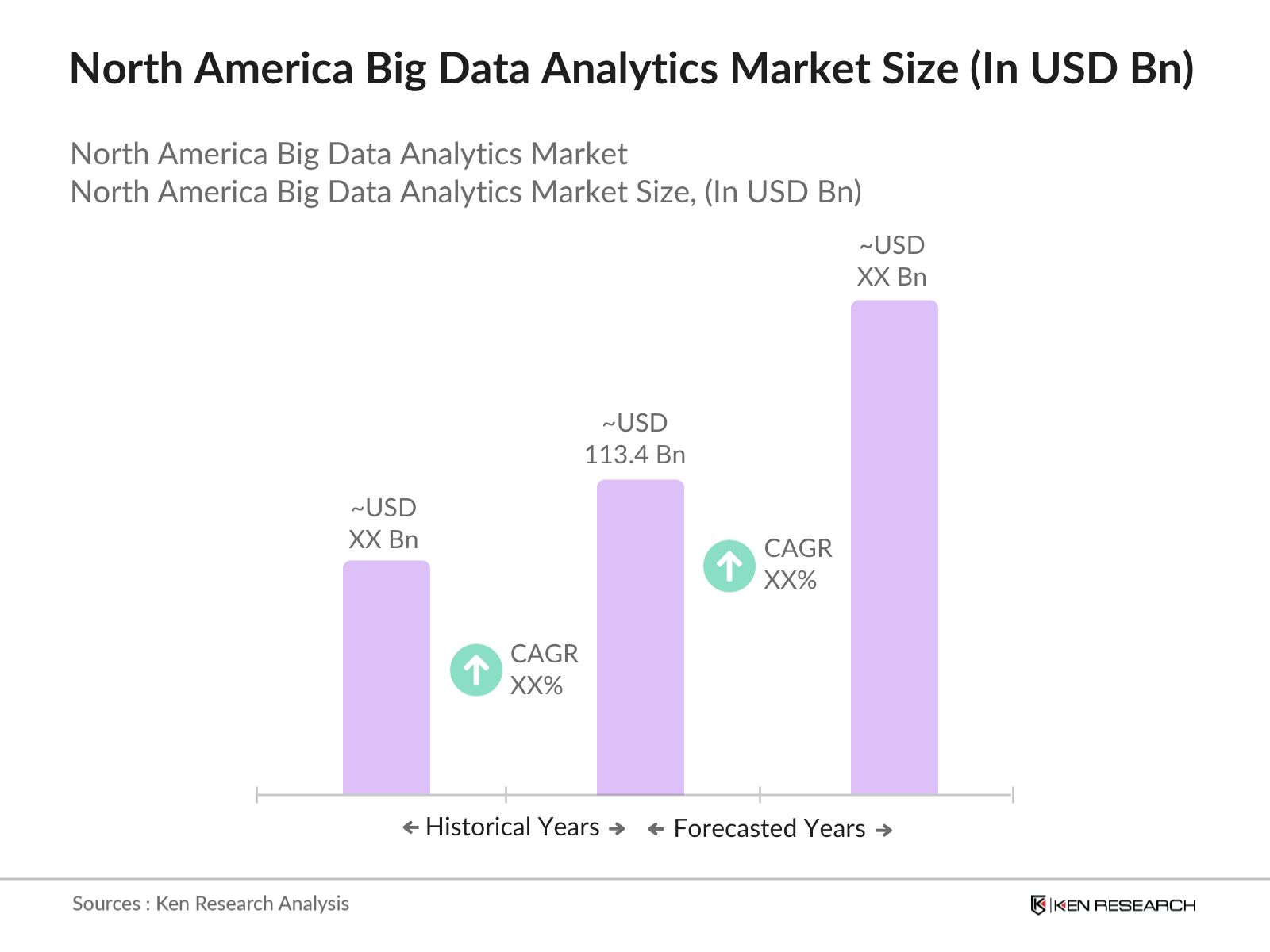
- The North America Big Data Analytics Market is valued at USD 113.4 billion, based on a five-year historical analysis. The market is driven by the rapid adoption of cloud-based solutions, growth in digital data, and the increasing importance of predictive analytics across various sectors, including BFSI, healthcare, and retail.
- In North America, the United States dominates the Big Data Analytics market, particularly in cities like San Francisco, New York, and Seattle, due to the presence of major tech companies, data centers, and innovation hubs. Canada is also a significant player, with Toronto and Vancouver emerging as key cities because of supportive government policies and a growing tech ecosystem.
- The U.S. government has implemented stringent cybersecurity requirements for companies operating Big Data platforms. According to the U.S. Department of Homeland Security in 2023, businesses are required to comply with guidelines for securing data storage, transmission, and processing. These regulations are designed to protect sensitive information from cyber threats and breaches. As a result, companies are investing in advanced security measures, such as encryption, multi-factor authentication, and continuous monitoring, to ensure compliance with these cybersecurity standards.
North America Big Data Analytics Market Segmentation
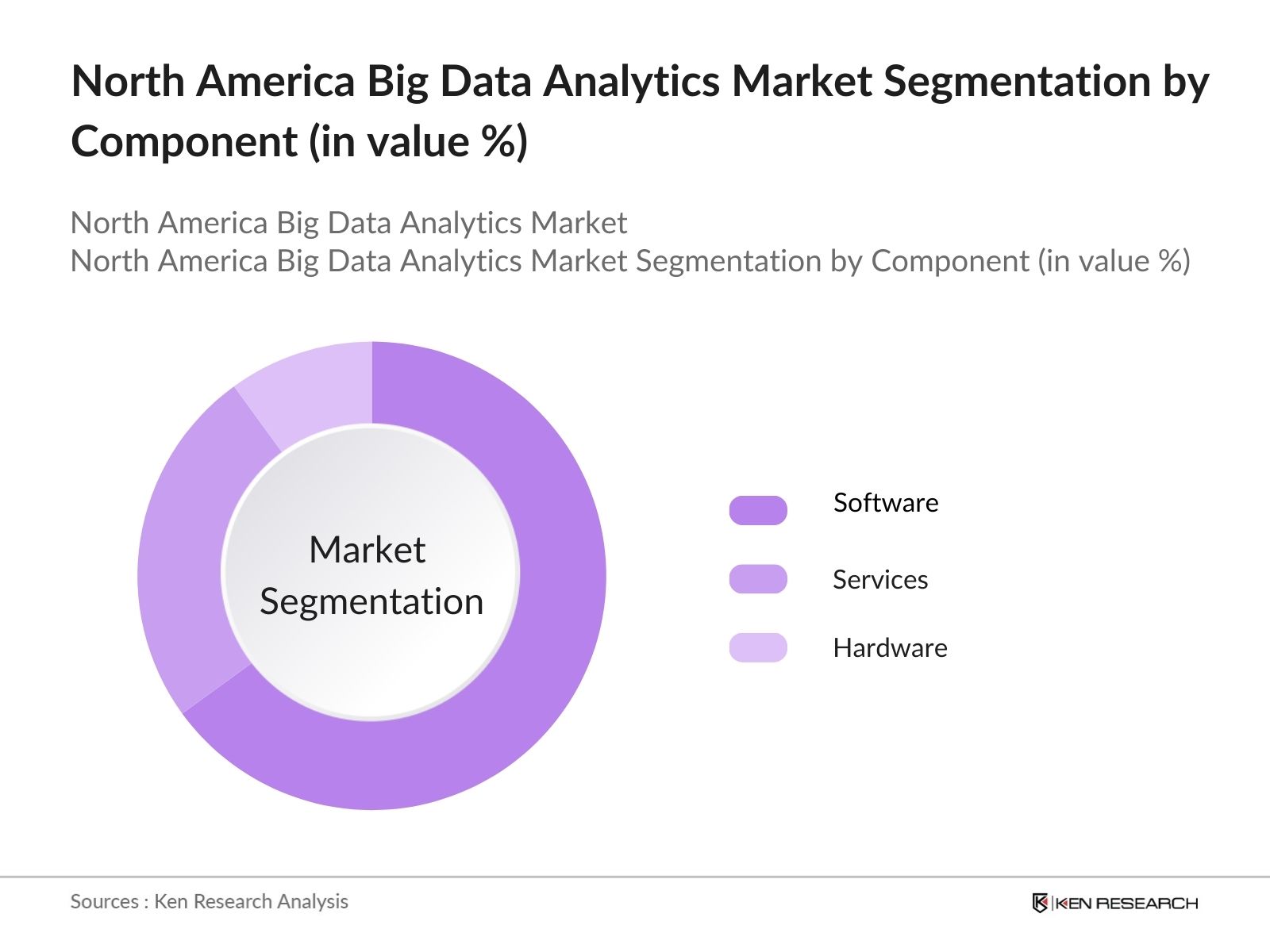
By Component: The North America Big Data Analytics market is segmented by component into software, services, and hardware. Recently, software holds the dominant market share due to the increasing demand for advanced analytics platforms and tools, which help businesses manage, analyze, and visualize large datasets. Software solutions like Hadoop, Spark, and cloud-based analytics platforms provide scalability and flexibility, essential for businesses dealing with expanding data volumes.
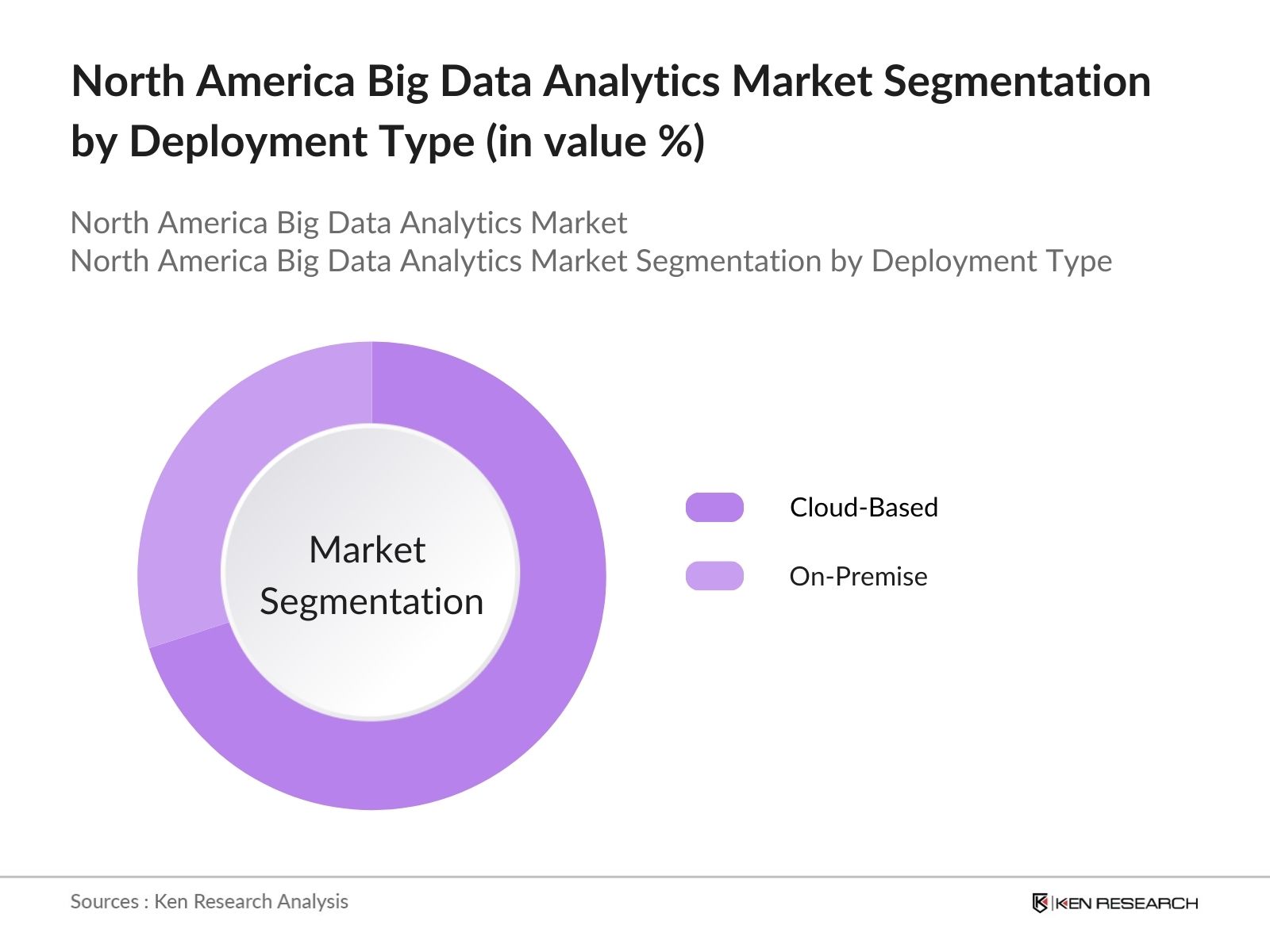
By Deployment Type: The North America Big Data Analytics market is segmented by deployment type into on-premise and cloud-based solutions. Cloud-based solutions have a dominant market share due to their cost-effectiveness, flexibility, and scalability. Businesses are increasingly moving towards cloud-based analytics to minimize infrastructure costs and gain real-time insights from vast amounts of data. Cloud platforms such as Amazon Web Services (AWS), Microsoft Azure, and Google Cloud have made it easier for organizations to deploy big data analytics on a large scale without the need for significant capital investment in hardware.
North America Big Data Analytics Market Competitive Landscape
The North America Big Data Analytics market is dominated by several key players who have established themselves through innovative solutions, strategic partnerships, and acquisitions. Major players such as IBM, Microsoft, and Oracle lead the market, offering comprehensive software and cloud-based solutions. The market also sees significant activity from companies like Google and Amazon, who have heavily invested in cloud-based big data analytics platforms.
|
Company |
Establishment Year |
Headquarters |
Cloud Infrastructure |
AI Integration |
Revenue (USD Bn) |
Key Partnerships |
Data Centers |
Customer Base |
|
IBM Corporation |
1911 |
Armonk, NY, USA |
||||||
|
Microsoft Corporation |
1975 |
Redmond, WA, USA |
||||||
|
Oracle Corporation |
1977 |
Redwood City, CA, USA |
||||||
|
Google LLC |
1998 |
Mountain View, CA, USA |
||||||
|
Amazon Web Services |
2006 |
Seattle, WA, USA |
North America Big Data Analytics Industry Analysis
Growth Drivers
- Rising Adoption of Cloud-Based Solutions: In 2024, the widespread adoption of cloud-based solutions has become a significant driver for the North America Big Data Analytics market. Approximately 94% of enterprises in the region have adopted cloud computing as part of their IT infrastructure, as per U.S. Census Bureau reports. Cloud services provide scalability and flexibility, allowing businesses to manage and analyze vast datasets more efficiently. Cloud-based Big Data platforms enable organizations to deploy predictive analytics, real-time data processing, and machine learning capabilities without investing heavily in physical infrastructure.
- Increasing Demand for Predictive Analytics: The demand for predictive analytics tools has grown exponentially in North America, with over 70% of companies leveraging these tools to gain competitive insights. By 2024, the region is experiencing a surge in the use of predictive analytics across industries such as healthcare, finance, and retail. The application of these tools is expected to accelerate business growth as organizations strive to stay ahead of market trends.
- Surge in Structured and Unstructured Data: North America is witnessing a significant rise in data creation due to the increased use of IoT devices, social media, and business applications. This growth encompasses both structured and unstructured data from various sources. The ability to manage and analyze this vast volume of information is critical, driving the adoption of Big Data analytics as organizations seek to extract valuable insights and improve decision-making.
Market Challenges
- Data Privacy and Security Concerns: Data privacy and security continue to be major challenges for the Big Data Analytics market in North America. As companies process increasing volumes of personal and financial data, they become more vulnerable to cyberattacks and breaches. Stricter regulations, such as GDPR and the California Consumer Privacy Act (CCPA), aim to protect consumer data, but many businesses still face difficulties in fully complying with these stringent data privacy standards.
- High Cost of Implementation: Implementing Big Data analytics solutions presents significant financial challenges, particularly for small and medium-sized enterprises (SMEs). The high costs of acquiring advanced analytics tools, skilled professionals, and necessary infrastructure can prevent smaller businesses from fully benefiting from Big Data technologies. This financial barrier limits their ability to compete effectively and leverage the insights Big Data can provide for growth and optimization.
North America Big Data Analytics Market Future Outlook
Over the next five years, the North America Big Data Analytics market is expected to grow significantly, driven by the increasing need for real-time data analysis, the adoption of AI and machine learning, and the expanding application of big data across various industries such as healthcare, finance, and government. Companies are likely to focus on data security and compliance, as regulations like GDPR and CCPA become increasingly stringent. The cloud-based analytics segment will continue to see high adoption rates due to its scalability and cost-efficiency.
Market Opportunities
- Expansion in IoT-Driven Data Analytics: The rapid growth of Internet of Things (IoT) devices is opening up new possibilities for Big Data analytics in North America. Businesses are increasingly using IoT-driven analytics to gain real-time insights into consumer behavior, operational efficiency, and supply chain management. This trend is helping companies across various industries, such as manufacturing, healthcare, and transportation, to optimize processes, reduce downtime, and improve decision-making, ultimately enhancing their overall performance.
- Increasing Penetration of SMEs: Small and medium-sized enterprises (SMEs) are steadily increasing their adoption of Big Data analytics in North America. These businesses are recognizing the potential of data analytics to drive growth by improving customer engagement, streamlining operations, and boosting competitive positioning. Support from government initiatives aimed at helping SMEs adopt digital technologies is further accelerating the penetration of data analytics solutions, creating new opportunities for growth and innovation in the market.
Scope of the Report
|
By Component |
Software Services Hardware |
|
By Deployment Type |
On-premise Cloud-based |
|
By Application |
Customer Analytics Risk & Fraud Analytics Operational Analytics Marketing Analytics Supply Chain Analytics |
|
By Industry Vertical |
BFSI IT & Telecom Retail & E-commerce Healthcare Government |
|
By Region |
United States Canada Mexico |
Products
Key Target Audience
Financial Technology (FinTech) Firms
Small and Medium Enterprises (SMEs)
Telecom Companies
Government and Regulatory Bodies (e.g., Federal Communications Commission)
Investors and venture capital Firms
Banks and Financial Institutions
Companies
Players Mentioned in the Report
IBM Corporation
Microsoft Corporation
Oracle Corporation
Google LLC
Amazon Web Services (AWS)
SAS Institute Inc.
Teradata Corporation
Dell Technologies
Splunk Inc.
Cloudera Inc.
Table of Contents
1. North America Big Data Analytics Market Overview
1.1. Definition and Scope
1.2. Market Taxonomy
1.3. Market Growth Rate
1.4. Market Segmentation Overview
2. North America Big Data Analytics Market Size (In USD Bn)
2.1. Historical Market Size
2.2. Year-On-Year Growth Analysis
2.3. Key Market Developments and Milestones
3. North America Big Data Analytics Market Analysis
3.1. Growth Drivers
3.1.1. Rising adoption of cloud-based solutions
3.1.2. Increasing demand for predictive analytics (Predictive analytics tools usage)
3.1.3. Surge in structured and unstructured data (Data volumes)
3.1.4. Growth in artificial intelligence and machine learning (AI & ML integration in Big Data)
3.2. Market Challenges
3.2.1. Data privacy and security concerns (Regulatory challenges for data privacy)
3.2.2. High cost of implementation
3.2.3. Shortage of skilled professionals (Skill gap in data science and analytics)
3.3. Opportunities
3.3.1. Expansion in IoT-driven data analytics
3.3.2. Increasing penetration of SMEs (SME adoption rates)
3.3.3. Growth in edge computing solutions
3.4. Trends
3.4.1. Real-time data processing (In-memory computing)
3.4.2. Integration of big data with blockchain (Blockchain adoption)
3.4.3. Increased focus on customer experience analytics
3.5. Government Regulations
3.5.1. GDPR and data compliance
3.5.2. US Federal Data Strategy (Government initiatives on big data)
3.5.3. Cybersecurity requirements for big data platforms
3.6. SWOT Analysis
3.7. Stakeholder Ecosystem (Manufacturers, healthcare providers, tech developers)
3.8. Porters Five Forces
3.9. Competition Ecosystem
4. North America Big Data Analytics Market Segmentation
4.1. By Component (In Value %)
4.1.1. Software
4.1.2. Services
4.1.3. Hardware
4.2. By Deployment Type (In Value %)
4.2.1. On-premise
4.2.2. Cloud-based
4.3. By Application (In Value %)
4.3.1. Customer Analytics
4.3.2. Risk & Fraud Analytics
4.3.3. Operational Analytics
4.3.4. Marketing Analytics
4.3.5. Supply Chain Analytics
4.4. By Industry Vertical (In Value %)
4.4.1. BFSI
4.4.2. IT & Telecom
4.4.3. Retail & E-commerce
4.4.4. Healthcare
4.4.5. Government
4.5. By Region (In Value %)
4.5.1. United States
4.5.2. Canada
4.5.3. Mexico
5. North America Big Data Analytics Market Competitive Analysis
5.1 Detailed Profiles of Major Companies
5.1.1. IBM Corporation
5.1.2. Microsoft Corporation
5.1.3. Oracle Corporation
5.1.4. Amazon Web Services (AWS)
5.1.5. SAS Institute Inc.
5.1.6. Teradata Corporation
5.1.7. Google LLC
5.1.8. Dell Technologies
5.1.9. Cloudera Inc.
5.1.10. Splunk Inc.
5.1.11. Alteryx Inc.
5.1.12. Tableau Software
5.1.13. Informatica
5.1.14. Palantir Technologies
5.1.15. Hortonworks Inc.
5.2 Cross Comparison Parameters (Revenue, Market Share, Key Partnerships, No. of Data Centers, AI Integration, Customer Base, Strategic Initiatives, Cloud Infrastructure)
5.3. Market Share Analysis
5.4. Strategic Initiatives
5.5. Mergers and Acquisitions
5.6. Investment Analysis
5.7. Venture Capital Funding
6. North America Big Data Analytics Market Regulatory Framework
6.1. Data Protection Laws
6.2. Compliance Requirements for Data Analytics Platforms
6.3. Certification Processes for Big Data Vendors
7. North America Big Data Analytics Future Market Size (In USD Bn)
7.1. Future Market Size Projections
7.2. Key Factors Driving Future Market Growth
8. North America Big Data Analytics Future Market Segmentation
8.1. By Component (In Value %)
8.2. By Deployment Type (In Value %)
8.3. By Application (In Value %)
8.4. By Industry Vertical (In Value %)
8.5. By Region (In Value %)
9. North America Big Data Analytics Market Analysts Recommendations
9.1. TAM/SAM/SOM Analysis
9.2. Customer Cohort Analysis
9.3. Marketing Initiatives
9.4. White Space Opportunity Analysis
Disclaimer Contact UsResearch Methodology
Step 1: Identification of Key Variables
In this phase, we map the entire ecosystem of the North America Big Data Analytics market, identifying major stakeholders such as software providers, cloud vendors, and service companies. Secondary research from trusted databases, such as Gartner and Forrester, forms the foundation of this analysis.
Step 2: Market Analysis and Construction
Historical data collection for the market includes reviewing past performance of key companies, identifying service adoption rates, and analyzing the overall revenue generated within the market. The emphasis is on understanding both on-premise and cloud-based deployments.
Step 3: Hypothesis Validation and Expert Consultation
Key industry insights are gathered through expert consultations, where top industry professionals provide qualitative insights. This ensures that the market data reflects current realities and future possibilities accurately.
Step 4: Research Synthesis and Final Output
Data synthesis is completed through top-down and bottom-up approaches, where information is verified by consulting with both major software vendors and cloud service providers. This stage ensures that the final market assessment is accurate and comprehensive.
Frequently Asked Questions
01. How big is the North America Big Data Analytics Market?
The North America Big Data Analytics Market is valued at USD 113.4 billion, driven by the rapid adoption of cloud-based analytics, increasing demand for AI and ML integration, and the growth of IoT-driven data.
02. What are the challenges in the North America Big Data Analytics Market?
Key challenges in North America Big Data Analytics Market include data security and privacy concerns, regulatory compliance issues, and the high cost of implementing advanced analytics platforms. Additionally, the market faces a shortage of skilled professionals in data science and analytics.
03. Who are the major players in the North America Big Data Analytics Market?
Major players in North America Big Data Analytics Market include IBM Corporation, Microsoft Corporation, Oracle Corporation, Amazon Web Services, and Google LLC. These companies dominate the market due to their large-scale cloud infrastructure and innovative data analytics solutions.
04. What are the growth drivers of the North America Big Data Analytics Market?
The North America Big Data Analytics Market is driven by increasing demand for real-time data analysis, AI and ML integration, the surge in digital data, and the need for predictive analytics across industries like healthcare, retail, and BFSI.
Why Buy From Us?

What makes us stand out is that our consultants follows Robust, Refine and Result (RRR) methodology. i.e. Robust for clear definitions, approaches and sanity checking, Refine for differentiating respondents facts and opinions and Result for presenting data with story

We have set a benchmark in the industry by offering our clients with syndicated and customized market research reports featuring coverage of entire market as well as meticulous research and analyst insights.

While we don't replace traditional research, we flip the method upside down. Our dual approach of Top Bottom & Bottom Top ensures quality deliverable by not just verifying company fundamentals but also looking at the sector and macroeconomic factors.

With one step in the future, our research team constantly tries to show you the bigger picture. We help with some of the tough questions you may encounter along the way: How is the industry positioned? Best marketing channel? KPI's of competitors? By aligning every element, we help maximize success.

Our report gives you instant access to the answers and sources that other companies might choose to hide. We elaborate each steps of research methodology we have used and showcase you the sample size to earn your trust.

If you need any support, we are here! We pride ourselves on universe strength, data quality, and quick, friendly, and professional service.