















North America Brain Computer Interfaces Market Outlook to 2030
Region:North America
Author(s):Shreya Garg
Product Code:KROD9736
December 2024
80
About the Report
North America Brain Computer Interfaces Market Overview
- The North America Brain Computer Interfaces (BCI) market is valued at USD 780 million, based on a comprehensive five-year historical analysis. This market is driven by several factors, including advancements in neural technologies, the rising demand for neurorehabilitation, and the integration of artificial intelligence into healthcare. Additionally, non-invasive BCI devices are gaining traction due to their potential in improving the quality of life for patients with neurodegenerative disorders. The market growth is also fueled by increasing investments in research and development, particularly in the areas of brain-to-computer communication and neuro prosthetics.
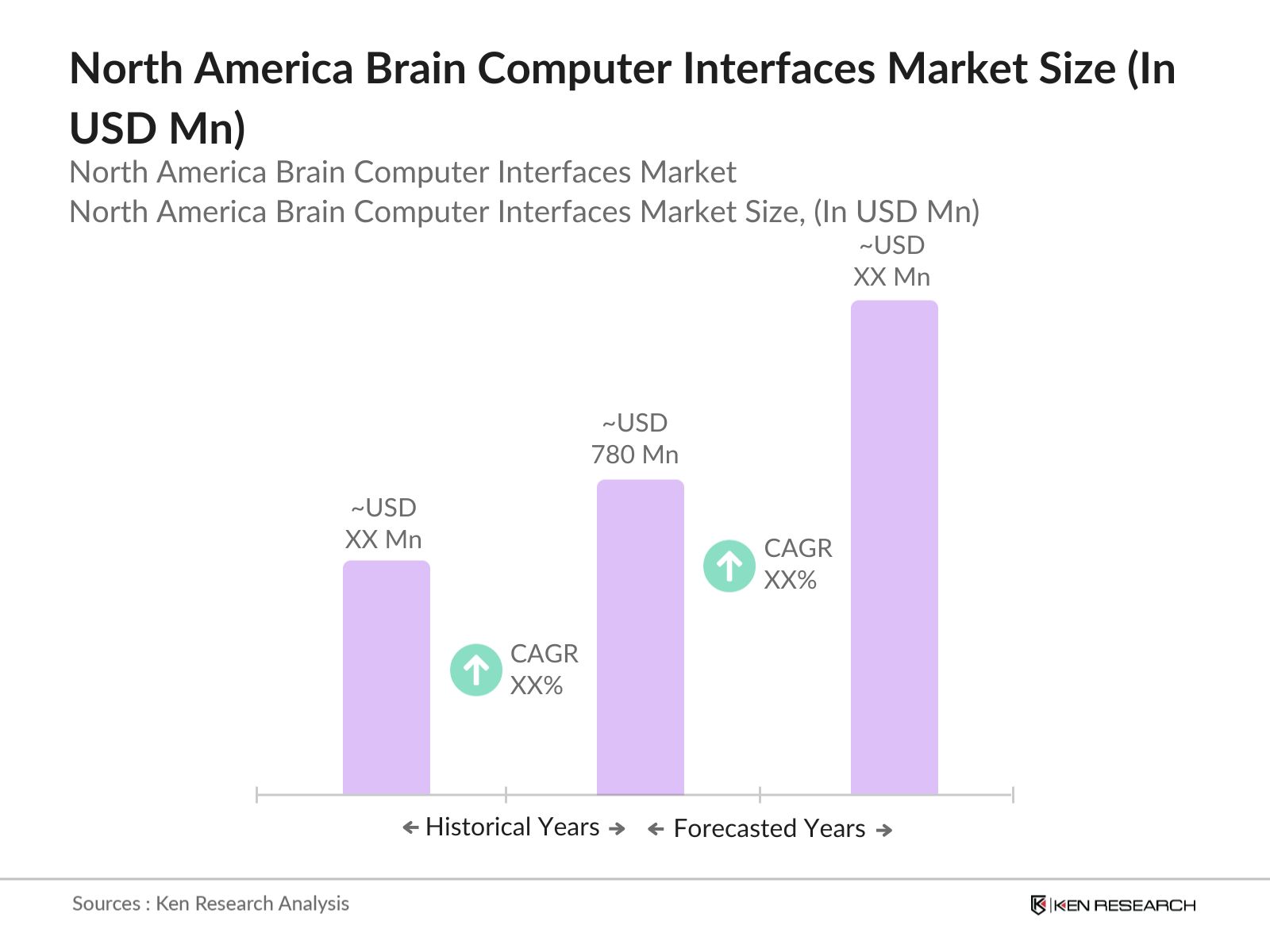
- The North American BCI market is dominated by the United States and Canada, with the U.S. being the leading hub due to its strong healthcare infrastructure and technological advancements. The presence of numerous leading BCI companies and a high concentration of research institutes engaged in neurotechnology innovation also contribute to the U.S.'s dominance. Canada follows closely, with strong government support and initiatives that promote research in assistive technologies and cognitive restoration for the aging population.
- The U.S. FDA has developed specific regulatory frameworks for BCIs, treating them as Class III medical devices that require rigorous testing and approval. As of 2023, the FDA cleared its first fully implantable BCI device for human trials, setting a precedent for future BCI technologies. The FDAs stringent process, which includes detailed clinical trial data and safety assessments, ensures that BCIs meet high standards before reaching the market. This regulatory oversight is essential for the safe and ethical deployment of BCI technologies.
North America Brain Computer Interfaces Market Segmentation
By Interface Type: The market is segmented by interface type into invasive, non-invasive, and semi-invasive BCIs. Non-invasive BCIs hold a dominant market share due to their ease of use and lower risk associated with surgical interventions. Non-invasive devices, such as EEG-based BCIs, are widely adopted in healthcare and consumer electronics applications like gaming and virtual reality, making them highly popular. Furthermore, the rapid advancements in brain-to-cloud technologies and growing research into wearable BCI devices are bolstering the dominance of non-invasive BCIs. 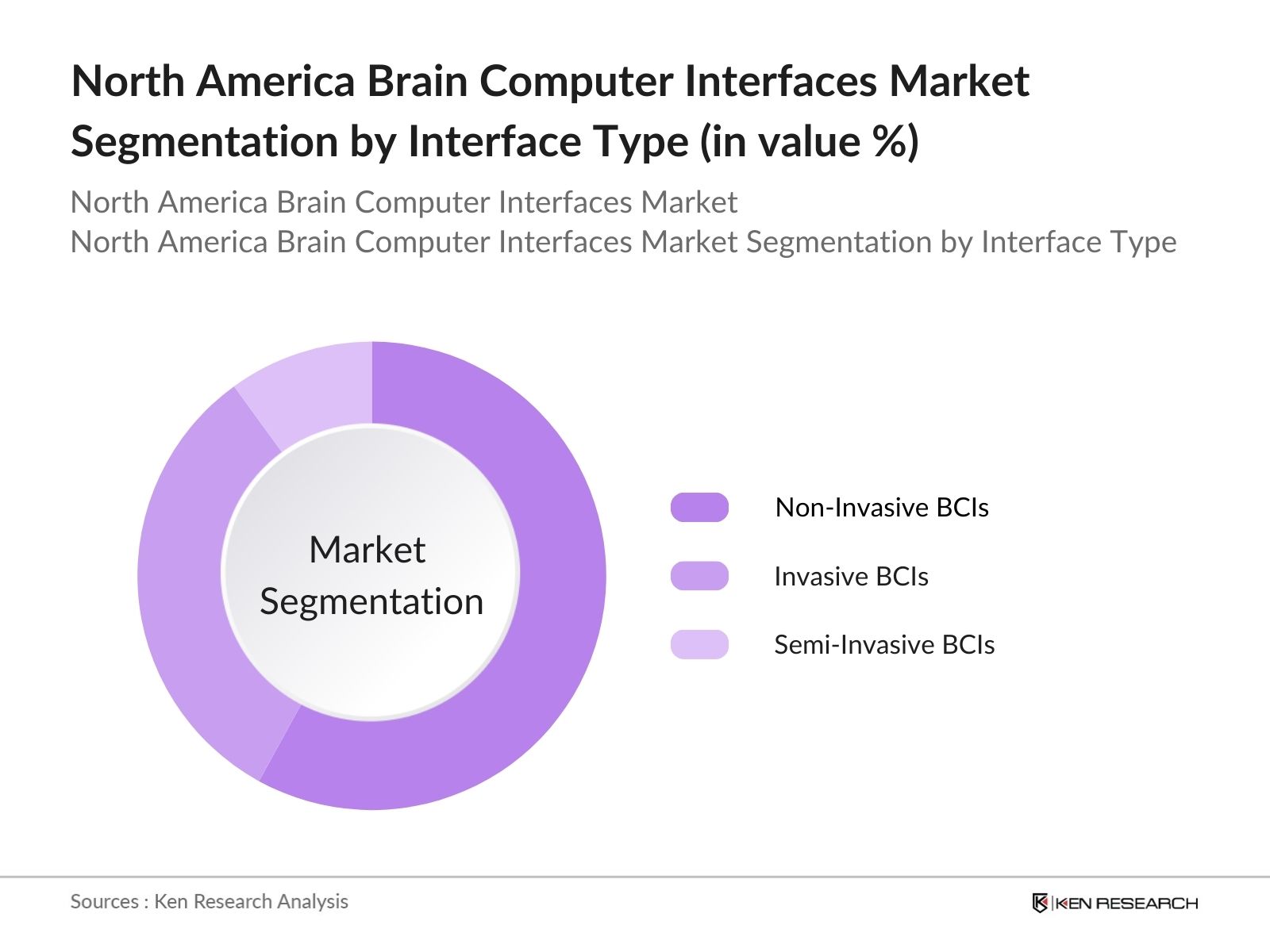
By End-User: The market is segmented by end-user into healthcare & rehabilitation centers, research institutions, military & defense, and consumer electronics. Healthcare & rehabilitation centers hold the highest market share, primarily due to the rising demand for neurorehabilitation therapies and neuro prosthetic applications for patients with paralysis, stroke, and spinal cord injuries. The application of BCI in assistive communication technologies for patients with motor impairments further drives its demand in this sector. 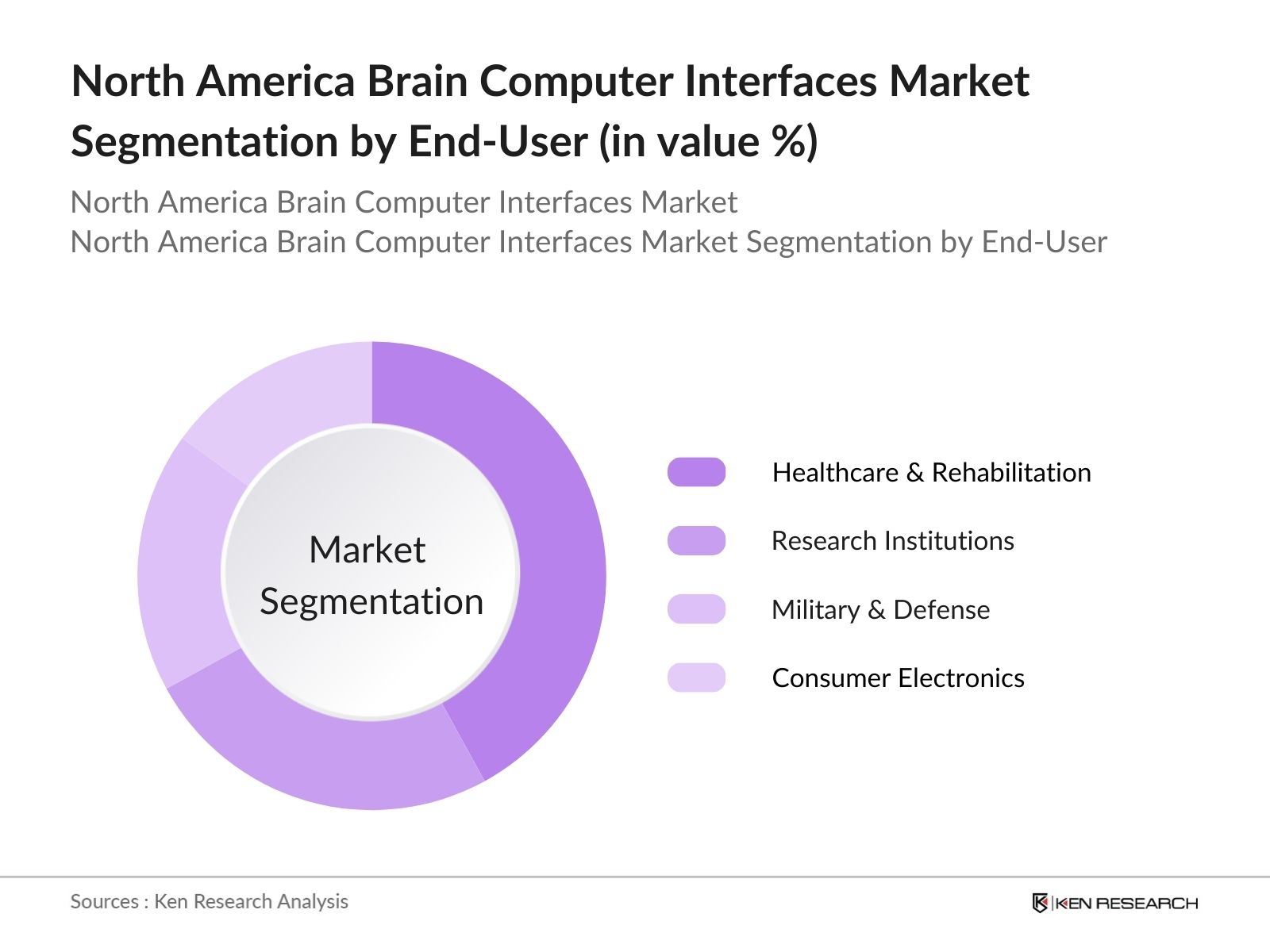
North America Brain Computer Interfaces Market Competitive Landscape
The North American BCI market is dominated by key players that are leading innovations in neural technology, R&D investments, and partnerships. These companies are focusing on non-invasive BCIs, neuro prosthetics, and brain-to-cloud communication technologies. The U.S. is home to most of the major players due to its advanced healthcare ecosystem and high-tech research capabilities.
|
Company |
Year Established |
Headquarters |
Revenue (USD Mn) |
Key Products |
Employees |
R&D Investment (%) |
Key Markets |
Partnerships |
Product Segments |
|
Neuralink Corp. |
2016 |
San Francisco, U.S. |
|||||||
|
OpenBCI |
2014 |
Brooklyn, U.S. |
|||||||
|
Emotiv |
2011 |
San Francisco, U.S. |
|||||||
|
Paradromics |
2015 |
Austin, U.S. |
|||||||
|
NeuroPace |
1997 |
Mountain View, U.S. |
North America Brain Computer Interfaces Industry Analysis
Growth Drivers
- Advancements in AI & Neural Networks: The integration of artificial intelligence (AI) with brain-computer interfaces (BCIs) has accelerated development in North America. The United States leads in AI research, with government investments reaching $1.2 billion in 2023, according to the U.S. National Artificial Intelligence Initiative Office. AI has been instrumental in enhancing the processing of neural signals, making BCIs more efficient and adaptive. These advancements are being supported by neural network models that facilitate real-time brain signal processing, crucial for applications like prosthetics and cognitive therapies. This is expected to push the adoption of AI-enabled BCIs in medical fields.
- Increasing Demand for Neurorehabilitation: Neurorehabilitation has seen an increased demand due to the rise in stroke and spinal cord injuries in North America. The CDC reported that in 2023, around 795,000 people in the U.S. suffer a stroke each year. BCIs are playing an essential role in aiding recovery by helping stroke patients regain motor functions. Moreover, the National Institute of Neurological Disorders and Stroke (NINDS) has allocated $60 million in 2023 toward research focusing on BCI applications in neurorehabilitation. This financial support is driving innovation and clinical use, expanding the market for BCIs.
- Expansion in Gaming and AR/VR Applications: Gaming and augmented reality (AR) technologies are becoming increasingly intertwined with BCIs, driving the market forward. The global gaming market reached $180 billion in 2023, with North America contributing a significant portion. Major tech firms like Facebook (Meta) are focusing on developing BCIs for AR/VR platforms, as seen in their Reality Labs investment of $13.7 billion in 2023. BCIs allow for a hands-free, immersive experience, enhancing user interaction in gaming environments. The U.S. government also announced plans to invest in virtual reality research for defense purposes, further bolstering the market for BCIs.
Market Challenges
- High R&D Costs: The high research and development (R&D) costs associated with BCIs remain a significant barrier. In 2023, the average cost for developing a new medical device, including BCIs, was reported to be over $100 million, according to the U.S. Food and Drug Administration (FDA). These costs encompass clinical trials, regulatory approvals, and product development, making it difficult for smaller firms to enter the market. The complexity of neural interfaces requires advanced materials and technology, adding to the financial burden for developers.
- Regulatory Barriers: FDA approval is a critical hurdle for BCI developers. As of 2023, the FDAs premarket approval (PMA) process for medical devices, including BCIs, can take several years and cost millions of dollars. For example, Neuralink's BCI device required extensive clinical trials costing over $50 million before obtaining investigational device exemption (IDE) approval in 2022. The lengthy and expensive regulatory procedures limit the speed of market entry for new players and technologies.
North America Brain Computer Interfaces Market Future Outlook
Over the next five years, the North American Brain Computer Interfaces market is poised for significant growth, driven by continuous advancements in neural technology, the expanding use of BCIs in neurorehabilitation, and increasing demand in the gaming and entertainment sectors. The integration of artificial intelligence in healthcare and assistive technologies will also fuel the development of more sophisticated non-invasive BCIs. As neurodegenerative disorders continue to rise, there will be a growing demand for cognitive restoration devices and neuro prosthetics, creating ample opportunities for industry players.
Future Market Opportunities
- Expansion into Healthcare Applications: The expansion of BCIs into healthcare, particularly for cognitive restoration and neurofeedback, presents vast opportunities. In 2023, healthcare accounted for nearly 18% of the U.S. GDP, according to the World Bank, with significant investments directed toward neuro technologies. BCIs are being used to monitor brain activity for mental health treatment, including depression and anxiety management. Neurofeedback therapy, which leverages BCIs, is gaining traction for cognitive rehabilitation, especially for veterans and those recovering from brain injuries.
- Growth in Wearable BCI Devices: Wearable BCIs are rapidly gaining attention in North America. The U.S. wearable technology market saw consumer spending of $81 billion in 2023, according to the International Trade Administration (ITA). Devices such as EEG headsets are being developed for both medical and non-medical uses, allowing users to control devices with brain signals. Wearable BCIs have also found use in personal wellness applications like meditation and focus enhancement, driving further growth. Their portability and user-friendly interfaces are making them more accessible to the general public.
Scope of the Report
|
Interface Type |
Invasive BCIs Non-Invasive BCIs Semi-Invasive BCIs |
|
End-User |
Healthcare & Rehabilitation Centers Research Institutions Military & Defense Consumer Electronics (Gaming, AR/VR) |
|
Technology |
EEG-Based ECoG-Based MRI-Based fNIRS-Based |
|
Application |
Neuromonitoring Neuroprosthetics Cognitive RestorationGaming and Entertainment |
|
Region |
U.S. Canada Mexico |
Products
Key Target Audience
Healthcare Providers and Hospitals
Neurotechnology Companies
Gaming and AR/VR Developers
Medical Device Manufacturers
Government and Regulatory Bodies (FDA, NIH)
Investor and Venture Capitalist Firms
Military and Defense Contractors
Research and Development Institutes
Companies
Major Players
Neuralink Corporation
OpenBCI
Paradromics
Emotiv
NeuroPace
Kernel
Cognixion
Neurable
BrainCo
Control Labs (Meta)
NeuroSky
Blackrock Neurotech
MindMaze
Guger Technologies OG
BitBrain
Table of Contents
1. North America Brain Computer Interfaces Market Overview
1.1. Definition and Scope
1.2. Market Taxonomy (Applications, Interface Type, End-User, Technology, Region)
1.3. Market Growth Rate (Adoption Rate, Industry Use Cases, Neurological Research Integration)
1.4. Market Segmentation Overview (By Interface Type, By End-User, By Technology, By Region)
2. North America Brain Computer Interfaces Market Size (In USD Bn)
2.1. Historical Market Size (Market Dynamics, Evolution of BCIs)
2.2. Year-On-Year Growth Analysis (Market Penetration, Application Growth)
2.3. Key Market Developments and Milestones (Product Innovations, Collaborations)
3. North America Brain Computer Interfaces Market Analysis
3.1. Growth Drivers
3.1.1. Advancements in AI & Neural Networks
3.1.2. Increasing Demand for Neurorehabilitation
3.1.3. Expansion in Gaming and AR/VR Applications
3.1.4. Rising Prevalence of Neurodegenerative Disorders
3.2. Market Challenges
3.2.1. High R&D Costs
3.2.2. Regulatory Barriers (FDA Approvals, Clinical Trials)
3.2.3. Limited Adoption in Emerging Markets
3.2.4. Ethical and Privacy Concerns
3.3. Opportunities
3.3.1. Expansion into Healthcare Applications (Cognitive Restoration, Neurofeedback)
3.3.2. Growth in Wearable BCI Devices
3.3.3. Integration with Assistive Technologies (Prosthetics, Smart Homes)
3.4. Trends
3.4.1. Development of Non-Invasive BCIs
3.4.2. Brain-to-Cloud Computing
3.4.3. Use of BCIs in Mental Health Applications
3.4.4. Increase in Military and Defense Applications
3.5. Government Regulations
3.5.1. US FDA BCI Regulatory Framework
3.5.2. HIPAA Compliance for BCI Data
3.5.3. Government Funding in Neurotechnologies
3.6. SWOT Analysis
3.7. Stakeholder Ecosystem (Developers, Medical Institutes, Regulatory Bodies, End-Users)
3.8. Porters Five Forces
3.9. Competition Ecosystem (Market Disruptors, Established Players)
4. North America Brain Computer Interfaces Market Segmentation
4.1. By Interface Type (In Value %) 4.1.1. Invasive BCIs
4.1.2. Non-Invasive BCIs
4.1.3. Semi-Invasive BCIs
4.2. By End-User (In Value %) 4.2.1. Healthcare & Rehabilitation Centers
4.2.2. Research Institutions
4.2.3. Military & Defense
4.2.4. Consumer Electronics (Gaming, AR/VR)
4.3. By Technology (In Value %) 4.3.1. EEG-Based
4.3.2. ECoG-Based
4.3.3. MRI-Based
4.3.4. fNIRS-Based
4.4. By Application (In Value %) 4.4.1. Neuromonitoring
4.4.2. Neuroprosthetics
4.4.3. Cognitive Restoration
4.4.4. Gaming and Entertainment
4.5. By Region (In Value %) 4.5.1. U.S.
4.5.2. Canada
4.5.3. Mexico
5. North America Brain Computer Interfaces Market Competitive Analysis
5.1. Detailed Profiles of Major Companies
5.1.1. Neuralink Corporation
5.1.2. OpenBCI
5.1.3. Paradromics
5.1.4. Emotiv
5.1.5. Kernel
5.1.6. NeuroPace
5.1.7. Neurable
5.1.8. Cognixion
5.1.9. BrainCo
5.1.10. Control Labs (acquired by Meta)
5.1.11. NeuroSky
5.1.12. Blackrock Neurotech
5.1.13. MindMaze
5.1.14. Guger Technologies OG
5.1.15. BitBrain
5.2. Cross Comparison Parameters
Company Inception Year
Headquarters
No. of Employees
Revenue (In USD Mn)
Interface Types Developed
End-User Segments Targeted
Geographical Presence
R&D Focus Areas
5.3. Market Share Analysis
5.4. Strategic Initiatives
5.5. Mergers and Acquisitions
5.6. Investment Analysis
5.7. Venture Capital Funding
5.8. Government Grants and Public-Private Partnerships
5.9. Private Equity Investments
6. North America Brain Computer Interfaces Market Regulatory Framework
6.1. BCI Safety Standards (FDA, IEC Standards)
6.2. Compliance Requirements (HIPAA, Data Security)
6.3. Certification Processes (Device Approvals, Clinical Testing)
7. North America Brain Computer Interfaces Future Market Size (In USD Bn)
7.1. Future Market Size Projections (Increased Consumer Adoption, Medical Advancements)
7.2. Key Factors Driving Future Market Growth (AI Integration, Healthcare, Gaming)
8. North America Brain Computer Interfaces Future Market Segmentation
8.1. By Interface Type (In Value %)
8.2. By End-User (In Value %)
8.3. By Technology (In Value %)
8.4. By Application (In Value %)
8.5. By Region (In Value %)
9. North America Brain Computer Interfaces Market Analysts Recommendations
9.1. TAM/SAM/SOM Analysis
9.2. Customer Cohort Analysis
9.3. Marketing Initiatives
9.4. White Space Opportunity Analysis
Research Methodology
Step 1: Identification of Key Variables
The first step involved constructing an ecosystem map of stakeholders in the North American Brain Computer Interfaces market, utilizing secondary and proprietary databases. Key variables influencing the market, such as technological advancements and end-user adoption rates, were identified during this phase.
Step 2: Market Analysis and Construction
This phase involved gathering and analyzing historical data to assess the BCI market size, market penetration, and growth trends. Primary research with industry experts and secondary research through credible publications and reports were utilized to ensure data reliability.
Step 3: Hypothesis Validation and Expert Consultation
Hypotheses about market dynamics were developed and validated through interviews with leading industry experts and stakeholders. These consultations provided detailed insights into technological developments, adoption trends, and key challenges within the BCI market.
Step 4: Research Synthesis and Final Output
The final phase included synthesizing research findings, validating data with additional primary and secondary sources, and ensuring accuracy and comprehensiveness in the final analysis. This process involved integrating bottom-up and top-down approaches for precise market forecasting and segmentation.
Frequently Asked Questions
01 How big is the North American Brain Computer Interfaces Market?
The North American BCI market is valued at USD 780 million, driven by advancements in neurotechnologies, increased R&D investments, and expanding applications in healthcare and consumer electronics.
02 What are the challenges in the North American BCI market?
Key challenges in the North American BCI market include high R&D costs, regulatory hurdles, and ethical concerns regarding privacy and data security in brain-to-computer communication.
03 Who are the major players in the North American BCI market?
Key players in the North American BCI market include Neuralink Corporation, OpenBCI, Paradromics, Emotiv, and NeuroPace. These companies are leading innovations in invasive and non-invasive BCIs.
04 What are the growth drivers of the North American BCI market?
The North American BCI market is driven by factors such as increasing demand for neurorehabilitation, advancements in AI, and the growing adoption of BCIs in gaming and virtual reality.
05 What opportunities exist in the North American BCI market?
Opportunities in the North American BCI market include the expansion of non-invasive BCIs, increased use in military and defense applications, and the integration of BCIs with wearable devices and brain-to-cloud technologies.
Why Buy From Us?

What makes us stand out is that our consultants follows Robust, Refine and Result (RRR) methodology. i.e. Robust for clear definitions, approaches and sanity checking, Refine for differentiating respondents facts and opinions and Result for presenting data with story

We have set a benchmark in the industry by offering our clients with syndicated and customized market research reports featuring coverage of entire market as well as meticulous research and analyst insights.

While we don't replace traditional research, we flip the method upside down. Our dual approach of Top Bottom & Bottom Top ensures quality deliverable by not just verifying company fundamentals but also looking at the sector and macroeconomic factors.

With one step in the future, our research team constantly tries to show you the bigger picture. We help with some of the tough questions you may encounter along the way: How is the industry positioned? Best marketing channel? KPI's of competitors? By aligning every element, we help maximize success.

Our report gives you instant access to the answers and sources that other companies might choose to hide. We elaborate each steps of research methodology we have used and showcase you the sample size to earn your trust.

If you need any support, we are here! We pride ourselves on universe strength, data quality, and quick, friendly, and professional service.