















North America Data Integration Market Outlook to 2030
Region:North America
Author(s):Sanjna
Product Code:KROD11174
November 2024
81
About the Report
North America Data Integration Market Overview
- The North America data integration market is valued at USD 5.1 billion, based on a five-year historical analysis. This growth is driven by the increasing adoption of cloud-based solutions, the proliferation of big data analytics, and the necessity for seamless data management across enterprises. The surge in digital transformation initiatives and the need for real-time data access have further propelled market expansion.
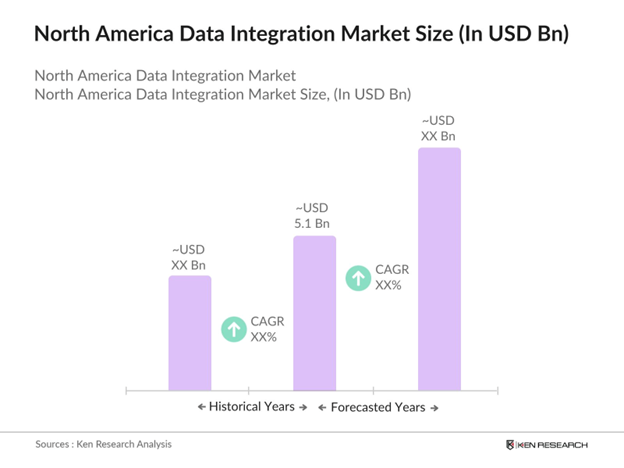
- The United States stands as the dominant country in the North American data integration market. This dominance is attributed to the presence of major technology firms, a robust IT infrastructure, and a high rate of technological adoption among businesses. Additionally, stringent regulatory requirements regarding data management and security have compelled organizations to invest in advanced data integration solutions.
- In 2024, North American organizations must comply with stringent data privacy laws, such as the California Consumer Privacy Act (CCPA) and the Health Insurance Portability and Accountability Act (HIPAA). The official California Department of Justice page outlines the rights granted to consumers under the CCPA, including the right to know about personal information collection, the right to delete that information. The page also discusses the amendments made by the California Privacy Rights Act (CPRA) that took effect on January 1, 2023, enhancing consumer protections further.
North America Data Integration Market Segmentation
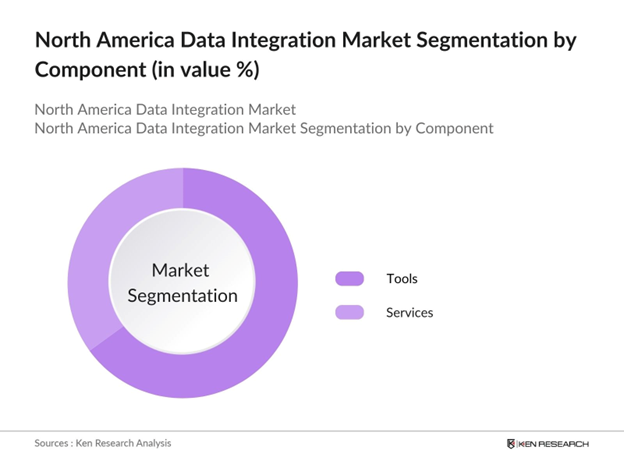
By Component: The North America data integration market is segmented by component into tools and services. Tools hold a dominant market share under this segmentation, primarily due to their ability to facilitate efficient data extraction, transformation, and loading (ETL) processes. Organizations prioritize these tools to streamline data workflows and ensure data consistency across various platforms.
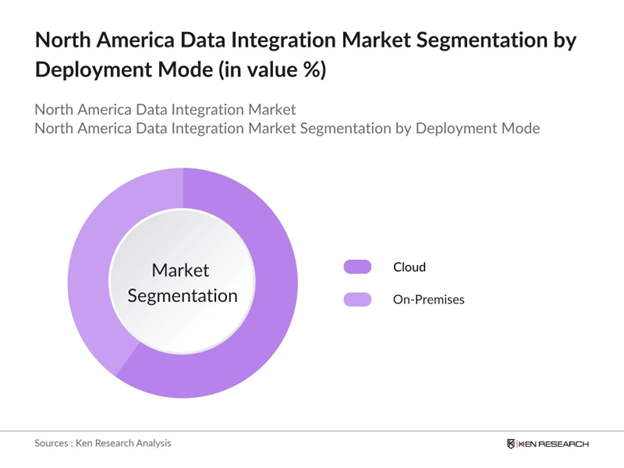
By Deployment Mode: The market is also segmented by deployment mode into on-premises and cloud. Cloud deployment mode has emerged as the leading segment, driven by its scalability, cost-effectiveness, and flexibility. Businesses are increasingly migrating to cloud-based data integration solutions to accommodate growing data volumes and to leverage advanced analytics capabilities.
North America Data Integration Market Competitive Landscape
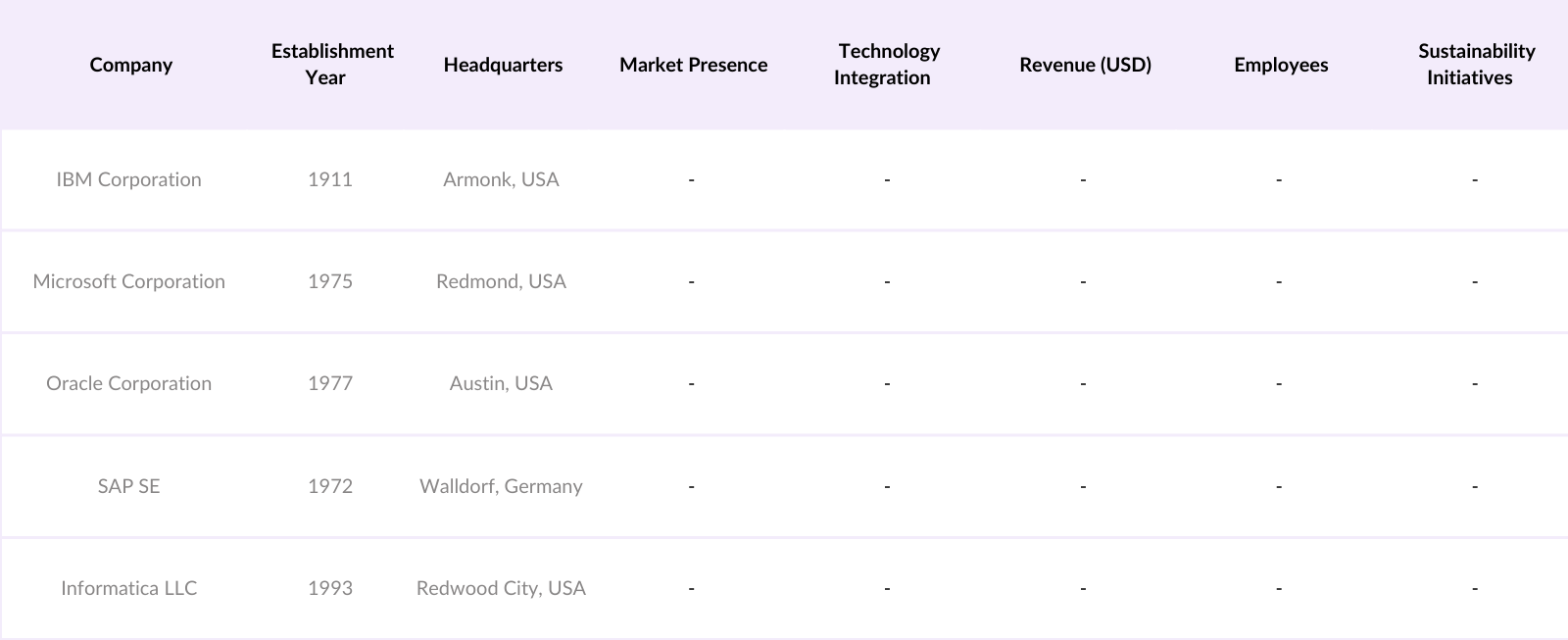
The North America data integration market is characterized by the presence of several key players, each contributing to the market's growth through innovation and strategic initiatives.
North America Data Integration Market Analysis
Growth Drivers
- Increasing Volume and Variety of Data: In 2024, North America is experiencing an unprecedented surge in data generation. The United States alone is projected to produce approximately 8.5 zettabytes of data this year, driven by the proliferation of digital devices and the expansion of internet services. This massive influx of data necessitates robust data integration solutions to consolidate diverse datasets, enabling organizations to derive actionable insights and maintain a competitive edge.
- Adoption of Cloud Computing: The adoption of cloud computing in North America continues to accelerate, with over 90% of enterprises utilizing cloud services in 2024. This widespread adoption facilitates scalable and flexible data storage and processing capabilities, making cloud-based data integration solutions increasingly vital for businesses aiming to streamline operations and enhance data accessibility.
- Demand for Real-Time Data Integration: In 2024, the demand for real-time data integration has intensified, particularly in sectors such as finance and healthcare. For instance, the financial industry requires instantaneous data processing to manage transactions and mitigate risks effectively. Similarly, healthcare providers rely on real-time data integration to monitor patient health metrics and improve care delivery. This growing need underscores the importance of advanced data integration technologies capable of handling real-time data streams.
Challenges
- High Implementation Costs: Implementing comprehensive data integration solutions involves significant financial investment. In 2024, the average cost for deploying such systems in large enterprises in North America is estimated to exceed $1 million, encompassing expenses related to software licensing, hardware infrastructure, and skilled personnel. These substantial costs can be prohibitive for small and medium-sized enterprises, limiting widespread adoption.
- Data Security Concerns: With the increasing complexity of data integration processes, ensuring data security has become a paramount concern. In 2024, North America has witnessed a rise in data breaches, with over 1,000 reported incidents affecting millions of records. These security challenges necessitate robust data integration solutions that incorporate advanced security measures to protect sensitive information.
North America Data Integration Market Future Outlook
Over the next five years, the North America data integration market is expected to experience significant growth. This expansion will be driven by advancements in artificial intelligence and machine learning, the increasing adoption of Internet of Things (IoT) devices, and the continuous evolution of big data analytics. Organizations are anticipated to invest more in data integration solutions to enhance decision-making processes and maintain a competitive edge in the market.
Market Opportunities
- Technological Advancements in AI and ML: Advancements in Artificial Intelligence (AI) and Machine Learning (ML) are revolutionizing data integration processes. In 2024, over 70% of North American enterprises are leveraging AI and ML technologies to automate data integration tasks, enhance data quality, and derive predictive insights. This trend presents significant opportunities for the development of intelligent data integration solutions that can adapt to evolving business needs.
- Expansion of Big Data Analytics: The expansion of big data analytics is driving the demand for sophisticated data integration solutions. In 2024, North American organizations are analyzing vast datasets to inform strategic decisions, with the big data analytics market expected to reach $50 billion. Effective data integration is crucial for consolidating disparate data sources, enabling comprehensive analysis and fostering innovation.
Scope of the Report
|
Segment |
Sub-Segments |
|
By Component |
- Tools |
|
By Deployment Mode |
- On-Premises |
|
By Organization Size |
- Large Enterprises |
|
By Business Application |
- Marketing |
|
By End-Use Industry |
- BFSI |
Products
Key Target Audience
Data Integration Solution Providers
Cloud Service Providers
Large Enterprises
Small and Medium Enterprises (SMEs)
Government and Regulatory Bodies (e.g., Federal Trade Commission)
Investors and Venture Capitalist Firms
IT Consultants and System Integrators
Industry Associations and Trade Bodies
Companies
Players Mentioned in the Report
IBM Corporation
Microsoft Corporation
Oracle Corporation
SAP SE
Informatica LLC
SAS Institute Inc.
Salesforce, Inc.
Talend S.A.
QlikTech International AB
TIBCO Software Inc.
Table of Contents
1. North America Data Integration Market Overview
1.1 Definition and Scope
1.2 Market Taxonomy
1.3 Market Growth Rate
1.4 Market Segmentation Overview
2. North America Data Integration Market Size (In USD Million)
2.1 Historical Market Size
2.2 Year-On-Year Growth Analysis
2.3 Key Market Developments and Milestones
3. North America Data Integration Market Analysis
3.1 Growth Drivers
3.1.1 Increasing Volume and Variety of Data
3.1.2 Adoption of Cloud Computing
3.1.3 Demand for Real-Time Data Integration
3.1.4 Regulatory Compliance Requirements
3.2 Market Challenges
3.2.1 High Implementation Costs
3.2.2 Data Security Concerns
3.2.3 Integration of Legacy Systems
3.3 Opportunities
3.3.1 Technological Advancements in AI and ML
3.3.2 Expansion of Big Data Analytics
3.3.3 Growth in IoT Applications
3.4 Trends
3.4.1 Shift Towards Hybrid Data Integration
3.4.2 Rise of Data Virtualization
3.4.3 Increased Use of APIs for Integration
3.5 Government Regulations
3.5.1 Data Privacy Laws
3.5.2 Industry-Specific Compliance Standards
3.5.3 Cross-Border Data Transfer Policies
3.6 SWOT Analysis
3.7 Stakeholder Ecosystem
3.8 Porters Five Forces Analysis
3.9 Competitive Landscape
4. North America Data Integration Market Segmentation
4.1 By Component (In Value %)
4.1.1 Tools
4.1.2 Services
4.2 By Deployment Mode (In Value %)
4.2.1 On-Premises
4.2.2 Cloud
4.3 By Organization Size (In Value %)
4.3.1 Large Enterprises
4.3.2 Small and Medium Enterprises (SMEs)
4.4 By Business Application (In Value %)
4.4.1 Marketing
4.4.2 Sales
4.4.3 Operations and Supply Chain
4.4.4 Finance
4.4.5 Human Resources
4.5 By End-Use Industry (In Value %)
4.5.1 BFSI
4.5.2 IT and Telecom
4.5.3 Healthcare
4.5.4 Manufacturing
4.5.5 Retail and E-commerce
4.5.6 Government and Defense
4.5.7 Others
5. North America Data Integration Market Competitive Analysis
5.1 Detailed Profiles of Major Companies
5.1.1 IBM Corporation
5.1.2 Microsoft Corporation
5.1.3 Oracle Corporation
5.1.4 SAP SE
5.1.5 SAS Institute Inc.
5.1.6 Salesforce, Inc.
5.1.7 Informatica LLC
5.1.8 Talend S.A.
5.1.9 QlikTech International AB
5.1.10 TIBCO Software Inc.
5.2 Cross Comparison Parameters (Revenue, Market Share, Product Portfolio, Regional Presence, Strategic Initiatives, Number of Employees, Headquarters, Inception Year)
5.3 Market Share Analysis
5.4 Strategic Initiatives
5.5 Mergers and Acquisitions
5.6 Investment Analysis
5.7 Venture Capital Funding
5.8 Government Grants
5.9 Private Equity Investments
6. North America Data Integration Market Regulatory Framework
6.1 Data Privacy Regulations
6.2 Compliance Requirements
6.3 Certification Processes
7. North America Data Integration Future Market Size (In USD Million)
7.1 Future Market Size Projections
7.2 Key Factors Driving Future Market Growth
8. North America Data Integration Future Market Segmentation
8.1 By Component (In Value %)
8.2 By Deployment Mode (In Value %)
8.3 By Organization Size (In Value %)
8.4 By Business Application (In Value %)
8.5 By End-Use Industry (In Value %)
9. North America Data Integration Market Analysts Recommendations
9.1 Total Addressable Market (TAM), Serviceable Available Market (SAM), and Serviceable Obtainable Market (SOM) Analysis
9.2 Customer Cohort Analysis
9.3 Marketing Initiatives
9.4 White Space Opportunity Analysis
Research Methodology
Step 1: Identification of Key Variables
The initial phase involves constructing an ecosystem map encompassing all major stakeholders within the North America Data Integration Market. This step is underpinned by extensive desk research, utilizing a combination of secondary and proprietary databases to gather comprehensive industry-level information. The primary objective is to identify and define the critical variables that influence market dynamics.
Step 2: Market Analysis and Construction
In this phase, we compile and analyze historical data pertaining to the North America Data Integration Market. This includes assessing market penetration, the ratio of marketplaces to service providers, and the resultant revenue generation. Furthermore, an evaluation of service quality statistics is conducted to ensure the reliability and accuracy of the revenue estimates.
Step 3: Hypothesis Validation and Expert Consultation
Market hypotheses are developed and subsequently validated through computer-assisted telephone interviews (CATIs) with industry experts representing a diverse array of companies. These consultations provide valuable operational and financial insights directly from industry practitioners, which are instrumental in refining and corroborating the market data.
Step 4: Research Synthesis and Final Output
The final phase involves direct engagement with multiple data integration solution providers to acquire detailed insights into product segments, sales performance, consumer preferences, and other pertinent factors. This interaction serves to verify and complement the statistics derived from the bottom-up approach, thereby ensuring a comprehensive, accurate, and validated analysis of the North America Data Integration Market.
Frequently Asked Questions
01. How big is the North America Data Integration Market?
The North America data integration market is valued at USD 5.1 billion, based on a five-year historical analysis. This growth is driven by the increasing adoption of cloud-based solutions, the proliferation of big data analytics, and the necessity for seamless data management across enterprises.
02. What are the challenges in the North America Data Integration Market?
Challenges in North America data integration market include high implementation costs, data security concerns, and the complexity of integrating legacy systems with modern data integration solutions.
03. Who are the major players in the North America Data Integration Market?
Key players in North America data integration market include IBM Corporation, Microsoft Corporation, Oracle Corporation, SAP SE, and Informatica LLC. The surge in digital transformation initiatives and the need for real-time data access have further propelled market expansion.
04. What are the growth drivers of the North America Data Integration Market?
North America Data Integration Market is propelled by the growing adoption of cloud-based solutions, the need for real-time data processing, and the increasing importance of data analytics in strategic decision-making processes.
Why Buy From Us?

What makes us stand out is that our consultants follows Robust, Refine and Result (RRR) methodology. i.e. Robust for clear definitions, approaches and sanity checking, Refine for differentiating respondents facts and opinions and Result for presenting data with story

We have set a benchmark in the industry by offering our clients with syndicated and customized market research reports featuring coverage of entire market as well as meticulous research and analyst insights.

While we don't replace traditional research, we flip the method upside down. Our dual approach of Top Bottom & Bottom Top ensures quality deliverable by not just verifying company fundamentals but also looking at the sector and macroeconomic factors.

With one step in the future, our research team constantly tries to show you the bigger picture. We help with some of the tough questions you may encounter along the way: How is the industry positioned? Best marketing channel? KPI's of competitors? By aligning every element, we help maximize success.

Our report gives you instant access to the answers and sources that other companies might choose to hide. We elaborate each steps of research methodology we have used and showcase you the sample size to earn your trust.

If you need any support, we are here! We pride ourselves on universe strength, data quality, and quick, friendly, and professional service.