
North America Digital Business Transformation Market Outlook to 2030
Region:Global
Author(s):Sanjna
Product Code:KROD6852
November 2024
92
About the Report
North America Digital Business Transformation Market Overview
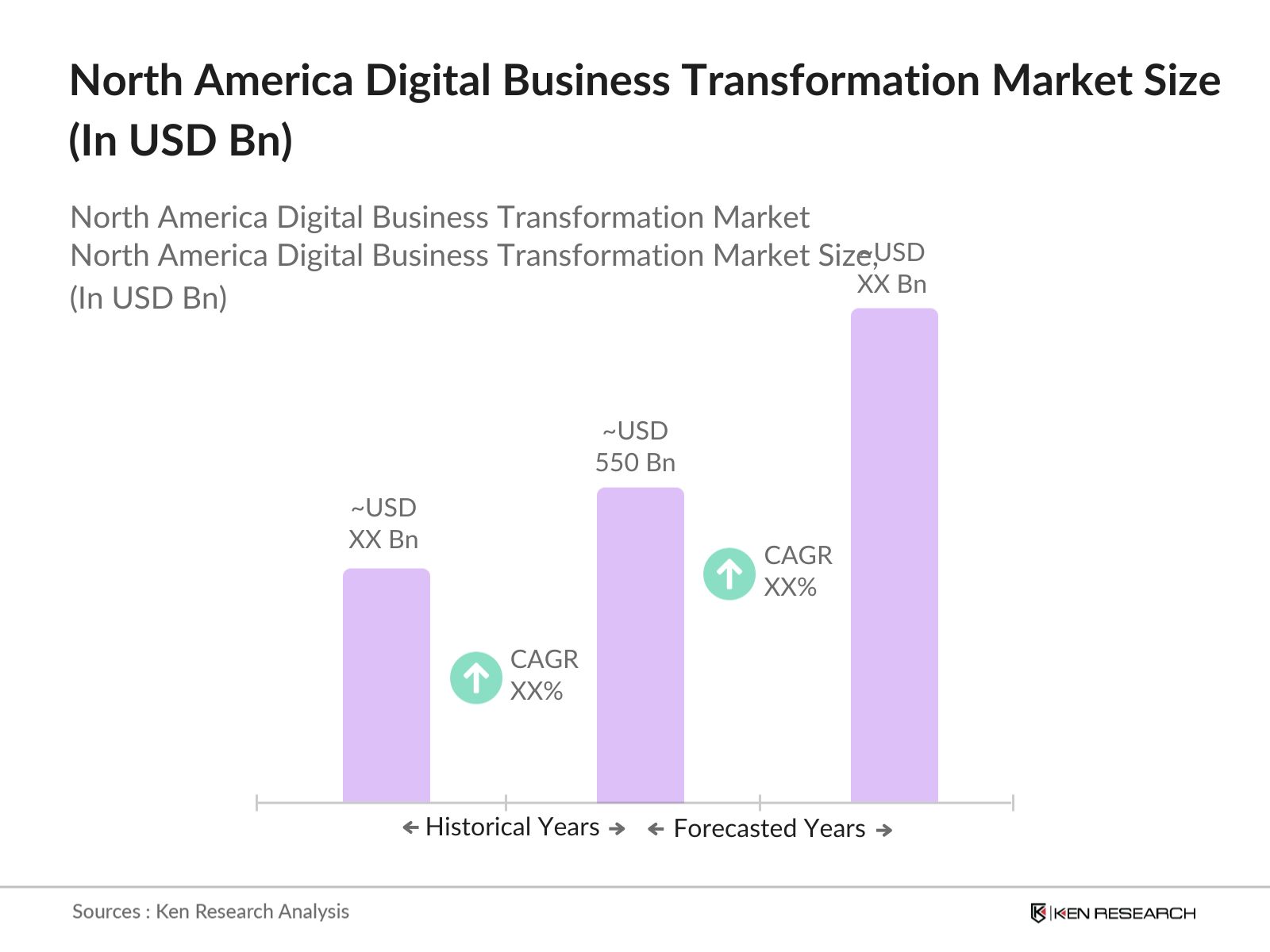
- The North America Digital Business Transformation market is valued at USD 550 billion, primarily driven by the rapid adoption of digital technologies across various sectors, including healthcare, finance, retail, and manufacturing. Businesses are increasingly implementing cloud computing, AI, and big data analytics to enhance operational efficiency and customer engagement. This demand for digital transformation has accelerated due to heightened competition and an increased focus on remote and hybrid work models.
- The United States dominates the North America Digital Business Transformation market, attributed to its high concentration of technology firms, advanced infrastructure, and substantial investments in R&D. Canada also plays a significant role, driven by government-backed digitalization initiatives and a growing number of technology-driven businesses. Both countries benefit from strong financial support for tech advancements, fostering innovation and adoption across industries.
- Data protection regulations are becoming stricter across North America, impacting all digital business operations. The U.S. introduced federal privacy frameworks in 2023 to secure consumer data amid increased digitization. This regulatory shift affects businesses by requiring adherence to standardized data handling, influencing the ways organizations store and manage data to prevent breaches and ensure compliance with data protection laws
North America Digital Business Transformation Market Segmentation
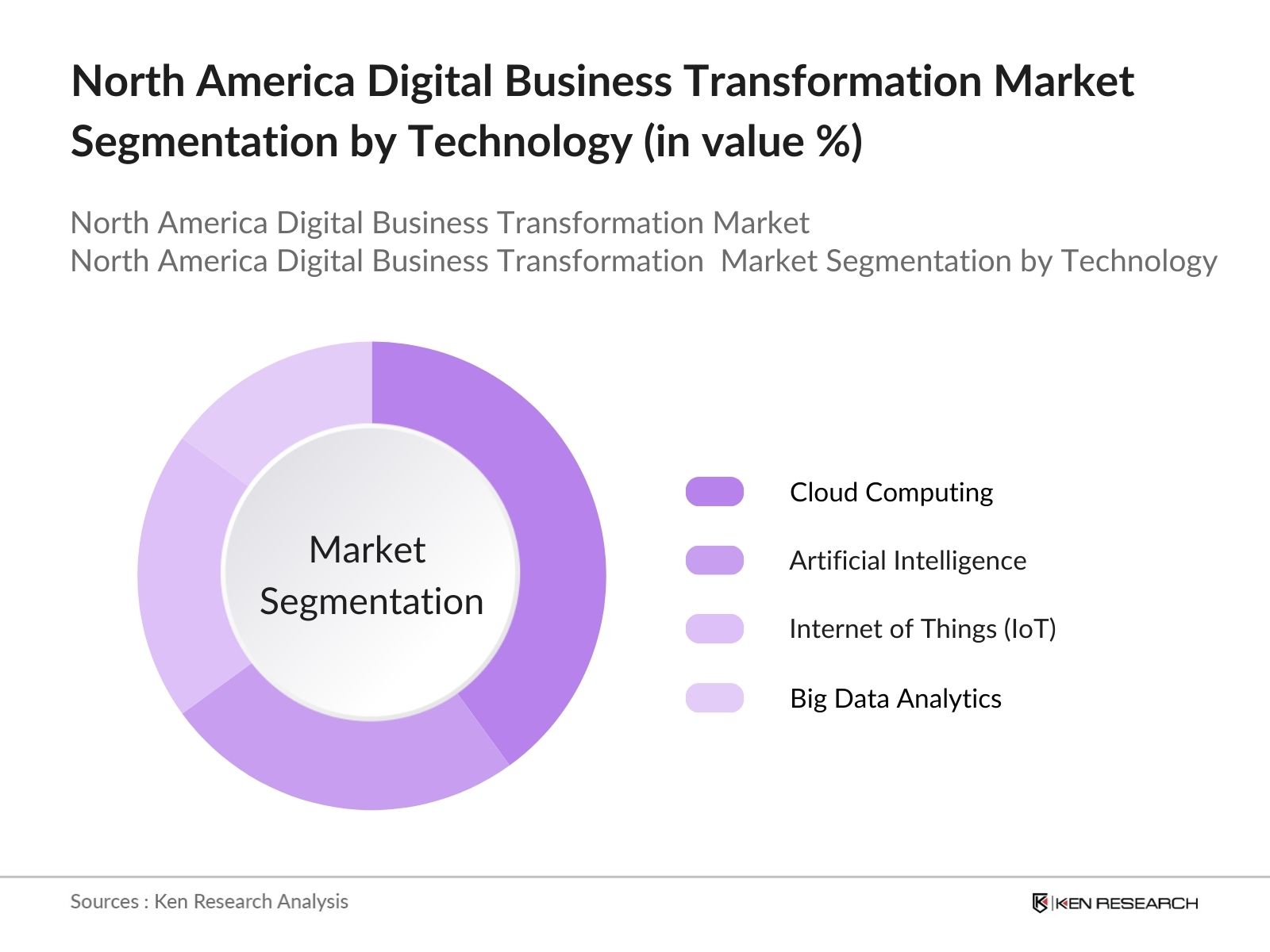
By Technology: The North America Digital Business Transformation market is segmented by technology into cloud computing, artificial intelligence, Internet of Things (IoT), and big data analytics. Currently, cloud computing holds a dominant market share within this segment, largely due to its role in facilitating remote operations and its scalability. Businesses across sectors leverage cloud services for data storage, processing, and security, which enhances flexibility and operational efficiency, particularly in the era of hybrid work.
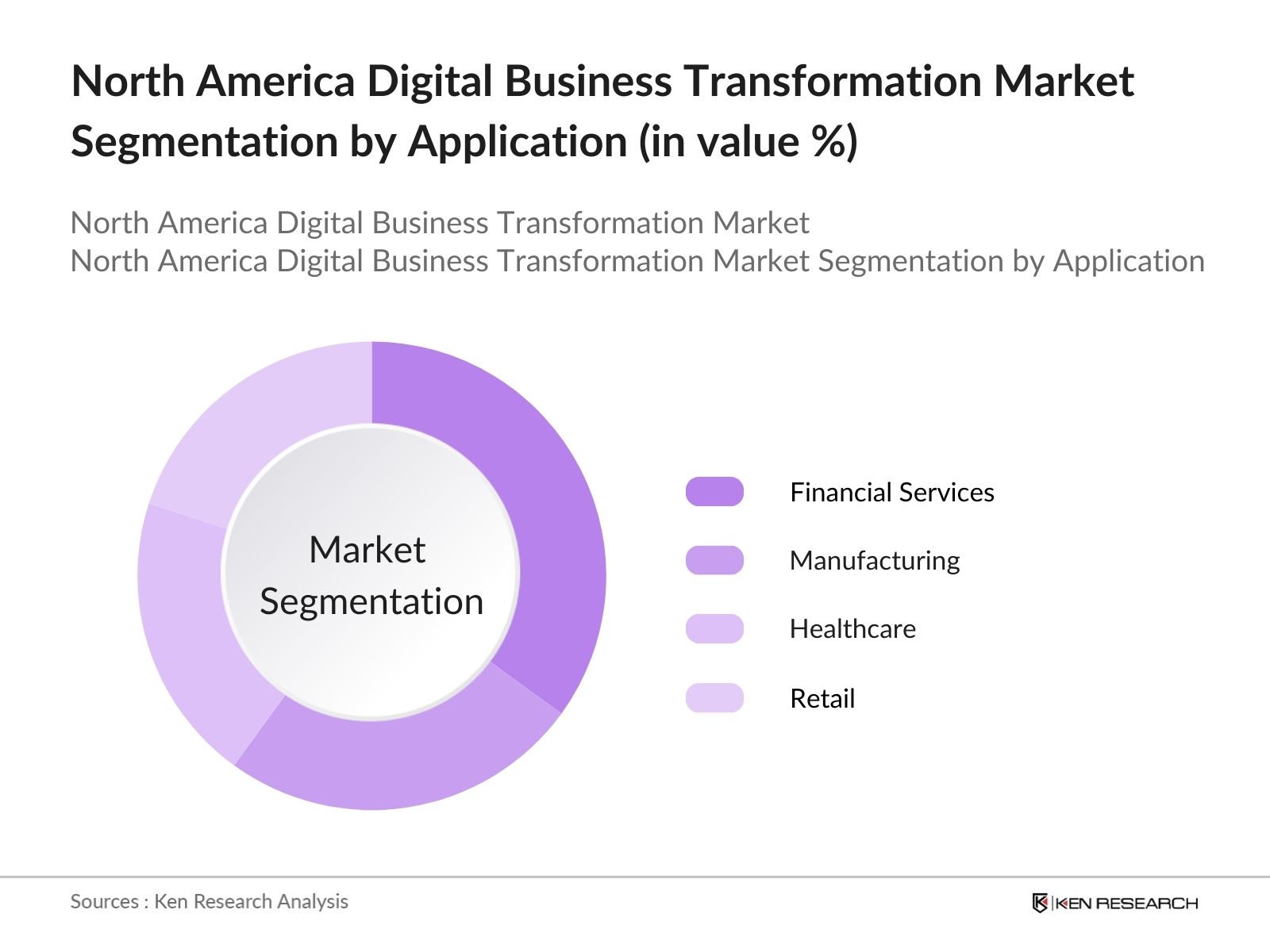
 By Application: The market is also segmented by application into manufacturing, healthcare, financial services, and retail. Financial services are leading within this application segment, with a strong emphasis on security, real-time data analytics, and customer personalization. Financial institutions increasingly rely on digital transformation to secure data, enhance customer experiences, and ensure regulatory compliance. Firms are adopting AI-powered tools to improve fraud detection and streamline customer service processes, securing a robust position for financial services within the market.
North America Digital Business Transformation Market Competitive Landscape
The North America Digital Business Transformation market is dominated by prominent players, leveraging technological innovations and strategic acquisitions to maintain their market presence. Notable companies include Microsoft, Amazon Web Services, and IBM, who contribute to significant advancements in AI, cloud, and IoT solutions, further strengthening their market positions.

North America Digital Business Transformation Market Analysis
Growth Drivers
- Increasing Digital Infrastructure: North Americas digital infrastructure expansion is critical, particularly as investments in broadband and 5G networks enhance digital connectivity for businesses. For instance, the U.S. allocated $65 billion in broadband expansion in 2022, aiming to reduce digital disparities, thus facilitating smoother digital business transitions. Similarly, Canada invested $2.75 billion under its Universal Broadband Fund to connect rural areas by 2025, increasing overall internet accessibility and digital transformation readiness across sectors.
- Growing Demand for Cloud Solutions: With over 90% of U.S. enterprises using cloud computing as of 2023, demand continues to surge due to the flexibility and scalability it offers in business operations. Enhanced cloud adoption supports data storage, collaboration, and remote access essential for digital transformation. The U.S. government invested in cloud services as part of its IT modernization strategy, contributing to the broad shift across both public and private sectors.
- Governmental Digital Initiatives: The U.S. and Canadian governments are pushing for digital transformation, with policies such as the U.S. Digital Services strategy and Canadas Digital Charter aiming to boost productivity through technology integration. The U.S. allocated $58 billion for digital service improvements in government sectors in 2023, enhancing digital access and process automation for businesses and citizens alike. Canadas Digital Operations Strategic Plan also set forth guidelines for digital governance and transparency, driving increased business digitization.
Challenges
- Security and Privacy Risks: Security and privacy risks remain among the most significant challenges in the digital business transformation journey across North America. The U.S. experienced over 2,000 high-impact cyber incidents in 2023, causing an estimated economic loss of $6 billion due to breaches in critical sectors like finance, healthcare, and government operations. Cyberattacks, including ransomware, increased by 30% from the previous year, prompting government and businesses to invest heavily in cybersecurity measures.
- Compliance Challenges: Adhering to complex regulations around data privacy, particularly with the introduction of new frameworks similar to GDPR, poses considerable challenges for North American companies. In 2023, non-compliance incidents cost firms an average of $4 million per breach in legal fees, penalties, and remediation efforts. Businesses are increasingly compelled to adopt robust governance frameworks to ensure compliance, especially with stricter rules on customer data protection and cross-border data transfers.
North America Digital Business Transformation Market Future Outlook
North America Digital Business Transformation market is projected to continue its expansion, driven by consistent technological advancements, the increasing adoption of AI and machine learning, and a growing demand for seamless customer experiences. The evolution of digital ecosystems and focus on cloud infrastructure will further bolster market development as companies prioritize agility and resilience in business operations.
Market Opportunities
- AI and ML-Based Solutions: AI and machine learning (ML) are driving innovation in North America, providing significant opportunities for predictive analytics, automation, and operational efficiency across sectors. In 2023, the U.S. government allocated over $1.5 billion to AI-focused research and development, particularly in healthcare and manufacturing. This funding has spurred private-sector investment in AI-powered solutions, helping companies automate workflows, enhance data analysis, and make strategic decisions informed by advanced machine learning models.
- Data Analytics and Insights: North American enterprises are increasingly leveraging big data and analytics for informed decision-making, with data-driven strategies becoming a critical component of digital transformation. As of 2023, 72% of companies in the region are actively using big data analytics, a trend supported by government programs designed to expand access to data technology. By adopting advanced data analytics tools, organizations can better understand consumer behavior, optimize operations, and gain competitive advantages, thereby positioning themselves favorably within their industries.
Scope of the Report
|
Segment |
Sub-Segment |
|
By Technology |
Cloud Computing Artificial Intelligence (AI) Internet of Things (IoT) Big Data Analytics, Blockchain |
|
By Application |
Manufacturing Healthcare Retail Financial Services Public Sector |
|
By Deployment Mode |
On-Premises Cloud Hybrid |
|
By Organization Size |
Large Enterprises Small and Medium Enterprises (SMEs) |
|
By Region |
United States Canada Mexico |
Products
Key Target Audience
Technology Solution Providers
Digital Consulting Firms
IT Infrastructure Providers
Financial Services Companies
Retail and E-Commerce Companies
Healthcare Institutions
Investors and Venture Capitalist Firms
Government and Regulatory Bodies (e.g., Federal Communications Commission, National Institute of Standards and Technology)
Companies
Players Mentioned in the Report
Microsoft Corporation
Amazon Web Services
IBM Corporation
Cisco Systems Inc.
Oracle Corporation
Google Cloud
SAP SE
Accenture
Deloitte
Cognizant
Table of Contents
1. North America Digital Business Transformation Market Overview
1.1. Definition and Scope
1.2. Market Taxonomy
1.3. Market Growth Rate
1.4. Market Segmentation Overview
2. North America Digital Business Transformation Market Size (In USD Mn)
2.1. Historical Market Size
2.2. Year-On-Year Growth Analysis
2.3. Key Market Developments and Milestones
3. North America Digital Business Transformation Market Analysis
3.1. Growth Drivers (Economic Digitization, Cloud Adoption, Government Initiatives, Industry 4.0) 3.1.1. Increasing Digital Infrastructure
3.1.2. Growing Demand for Cloud Solutions
3.1.3. Governmental Digital Initiatives
3.1.4. Adoption of Industry 4.0 Technologies
3.2. Market Challenges (Cybersecurity, Workforce Readiness, Data Privacy Concerns, Interoperability Issues) 3.2.1. Security and Privacy Risks
3.2.2. Talent and Skill Gaps
3.2.3. Compliance Challenges
3.2.4. Integration Complexities
3.3. Opportunities (AI Integration, Data-Driven Decisions, Remote Work Solutions, SaaS Expansion) 3.3.1. AI and ML-Based Solutions
3.3.2. Data Analytics and Insights
3.3.3. Remote Workforce Enablement
3.3.4. Expansion of SaaS Solutions
3.4. Trends (Edge Computing, Hybrid Cloud, Platform-as-a-Service, Augmented Reality in Operations) 3.4.1. Rise of Edge Computing
3.4.2. Growth of Hybrid Cloud Solutions
3.4.3. Adoption of Platform-as-a-Service (PaaS)
3.4.4. Augmented Reality in Digital Workflows
3.5. Government Regulations (Data Compliance, Privacy Acts, Cybersecurity Frameworks, Digital Strategy Policies) 3.5.1. Data Protection Regulations
3.5.2. National Cybersecurity Standards
3.5.3. Digital Transformation Policies
3.5.4. Public-Private Collaborations
3.6. SWOT Analysis
3.7. Stakeholder Ecosystem
3.8. Porters Five Forces Analysis
3.9. Competition Landscape Overview
4. North America Digital Business Transformation Market Segmentation
4.1. By Technology (In Value %)
4.1.1. Cloud Computing
4.1.2. Artificial Intelligence (AI)
4.1.3. Internet of Things (IoT)
4.1.4. Big Data Analytics
4.1.5. Blockchain
4.2. By Application (In Value %)
4.2.1. Manufacturing
4.2.2. Healthcare
4.2.3. Retail
4.2.4. Financial Services
4.2.5. Public Sector
4.3. By Deployment Mode (In Value %)
4.3.1. On-Premises
4.3.2. Cloud
4.3.3. Hybrid
4.4. By Organization Size (In Value %)
4.4.1. Large Enterprises
4.4.2. Small and Medium Enterprises (SMEs)
4.5. By Region (In Value %) 4.5.1. United States
4.5.2. Canada
4.5.3. Mexico
5. North America Digital Business Transformation Market Competitive Analysis
5.1. Detailed Profiles of Major Competitors
5.1.1. Accenture
5.1.2. IBM Corporation
5.1.3. Microsoft Corporation
5.1.4. Amazon Web Services
5.1.5. Cisco Systems Inc.
5.1.6. Google Cloud
5.1.7. Oracle Corporation
5.1.8. SAP SE
5.1.9. Deloitte
5.1.10. Cognizant
5.2. Cross Comparison Parameters (Revenue, Employee Count, Service Portfolio, Industry Focus, R&D Investment, Cloud Partnerships, Digital Initiatives, Cybersecurity Strength)
5.3. Market Share Analysis
5.4. Strategic Initiatives
5.5. Mergers and Acquisitions
5.6. Investment Analysis
5.7. Venture Capital Funding
5.8. Government Grants and Subsidies
5.9. Private Equity Investments
6. North America Digital Business Transformation Market Regulatory Framework
6.1. Digital Compliance Standards
6.2. Data Privacy Regulations
6.3. Certification and Security Requirements
7. North America Digital Business Transformation Future Market Size (In USD Mn)
7.1. Future Market Size Projections
7.2. Key Factors Driving Future Growth
8. North America Digital Business Transformation Future Market Segmentation
8.1. By Technology (In Value %)
8.2. By Application (In Value %)
8.3. By Deployment Mode (In Value %)
8.4. By Organization Size (In Value %)
8.5. By Region (In Value %)
9. North America Digital Business Transformation Market Analyst's Recommendations
9.1. TAM/SAM/SOM Analysis
9.2. Customer Cohort Analysis
9.3. White Space Opportunity Analysis
9.4. Strategic Market Positioning
Research Methodology
Step 1: Identification of Key Variables
The first step involves mapping the digital business transformation ecosystem, focusing on identifying critical market drivers, key segments, and industry challenges. Desk research combined with secondary and proprietary databases establishes a foundational understanding of the market.
Step 2: Market Analysis and Data Compilation
This phase involves gathering historical data specific to the North America Digital Business Transformation market, covering market penetration, industry adoption, and sector-specific revenue. Quality checks ensure accuracy and reliability of the data compiled.
Step 3: Hypothesis Validation and Expert Consultation
Market hypotheses are formulated based on initial findings and validated through expert interviews. These consultations with industry professionals provide insight into operational trends and help refine market estimates.
Step 4: Data Synthesis and Final Output
The final stage combines all findings into a comprehensive market report, verifying the statistics through cross-referencing. This ensures a detailed, validated view of the North America Digital Business Transformation market, with insights ready for stakeholder review.
Frequently Asked Questions
01. How big is the North America Digital Business Transformation Market?
The North America Digital Business Transformation Market is valued at USD 550 billion, supported by a growing demand for AI, cloud computing, and big data analytics.
02. What are the key drivers of the North America Digital Business Transformation Market?
Key drivers in North America Digital Business Transformation Market include the adoption of AI, demand for cloud-based solutions, and an increased focus on remote and hybrid work models across multiple sectors.
03. Who are the major players in the North America Digital Business Transformation Market?
Major players in North America Digital Business Transformation Market include Microsoft Corporation, Amazon Web Services, IBM Corporation, Cisco Systems Inc., and Oracle Corporation.
Why Buy From Us?

What makes us stand out is that our consultants follows Robust, Refine and Result (RRR) methodology. i.e. Robust for clear definitions, approaches and sanity checking, Refine for differentiating respondents facts and opinions and Result for presenting data with story

We have set a benchmark in the industry by offering our clients with syndicated and customized market research reports featuring coverage of entire market as well as meticulous research and analyst insights.

While we don't replace traditional research, we flip the method upside down. Our dual approach of Top Bottom & Bottom Top ensures quality deliverable by not just verifying company fundamentals but also looking at the sector and macroeconomic factors.

With one step in the future, our research team constantly tries to show you the bigger picture. We help with some of the tough questions you may encounter along the way: How is the industry positioned? Best marketing channel? KPI's of competitors? By aligning every element, we help maximize success.

Our report gives you instant access to the answers and sources that other companies might choose to hide. We elaborate each steps of research methodology we have used and showcase you the sample size to earn your trust.

If you need any support, we are here! We pride ourselves on universe strength, data quality, and quick, friendly, and professional service.