
North America Digital Camera Market Outlook to 2030
Region:North America
Author(s):Shubham Kashyap
Product Code:KROD4271
December 2024
94
About the Report
North America Digital Camera Market Overview
- The North America Digital Camera Market has witnessed a steady demand, currently valued at USD 2.6 Bn, driven by advancements in imaging technology, increased consumer interest in high-quality photography, and the growing trend of professional content creation for social media platforms. With the proliferation of social media influencers, bloggers, and content creators, the demand for high-performance digital cameras is expected to continue growing over the forecast period.
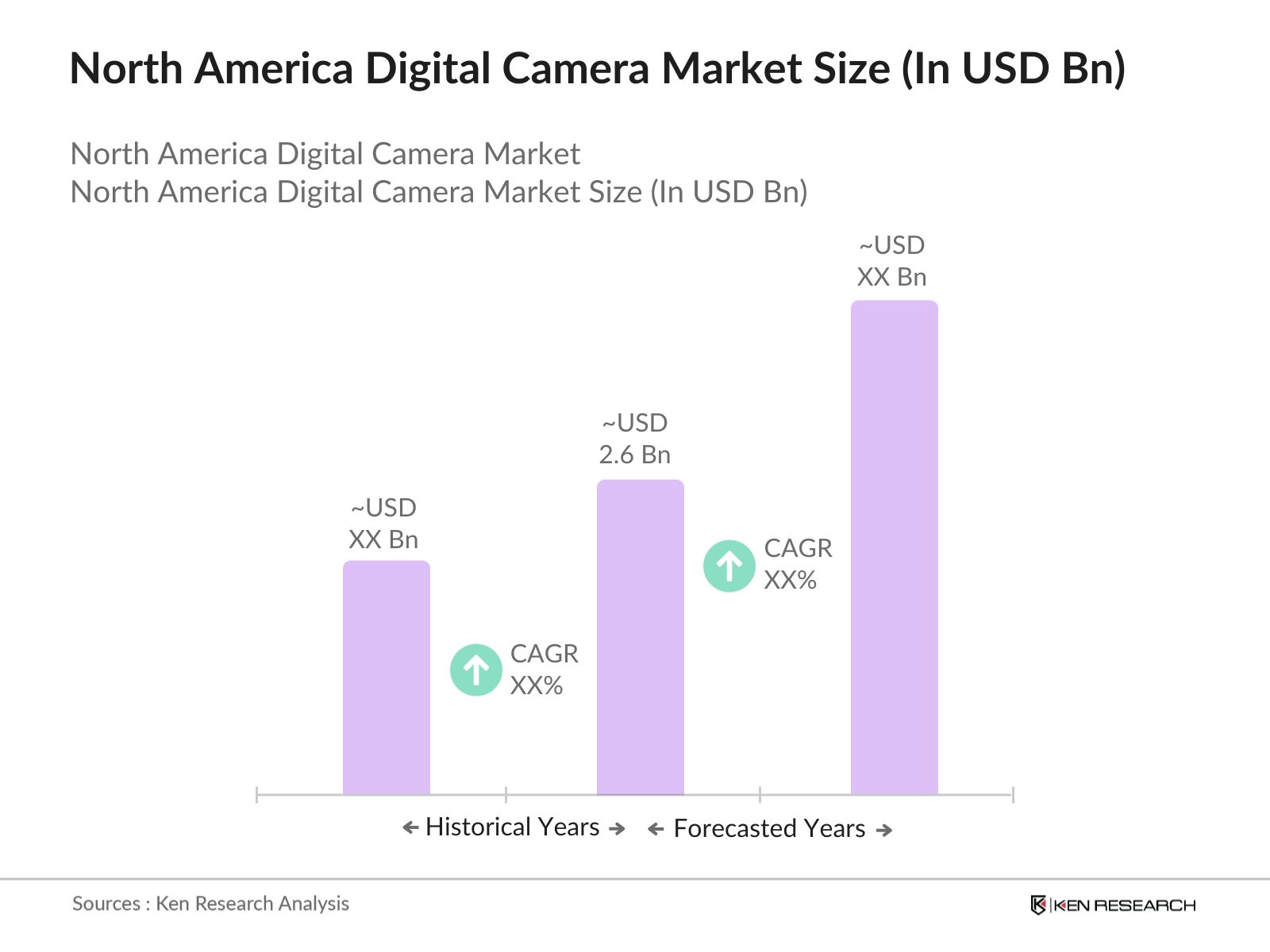
- The United States and Canada dominate the North American digital camera market, with cities like Los Angeles, New York, and Toronto being major hubs for the entertainment, advertising, and media industries. These regions are centers for professional photography and videography, which further boosts the demand for advanced digital cameras. Additionally, the presence of several leading global camera manufacturers in the United States contributes to the market's robust growth, as it remains a key consumer base for high-end digital cameras.
- Certification standards for camera safety and quality are crucial for ensuring that digital cameras sold in North America meet regulatory requirements. Cameras and their components must comply with standards set by organizations like the Federal Communications Commission (FCC) and Underwriters Laboratories (UL) to ensure safety in terms of electrical emissions, radiation, and product durability. These certifications help ensure that products are safe for consumer use and free from defects.
North America Digital Camera Market Segmentation
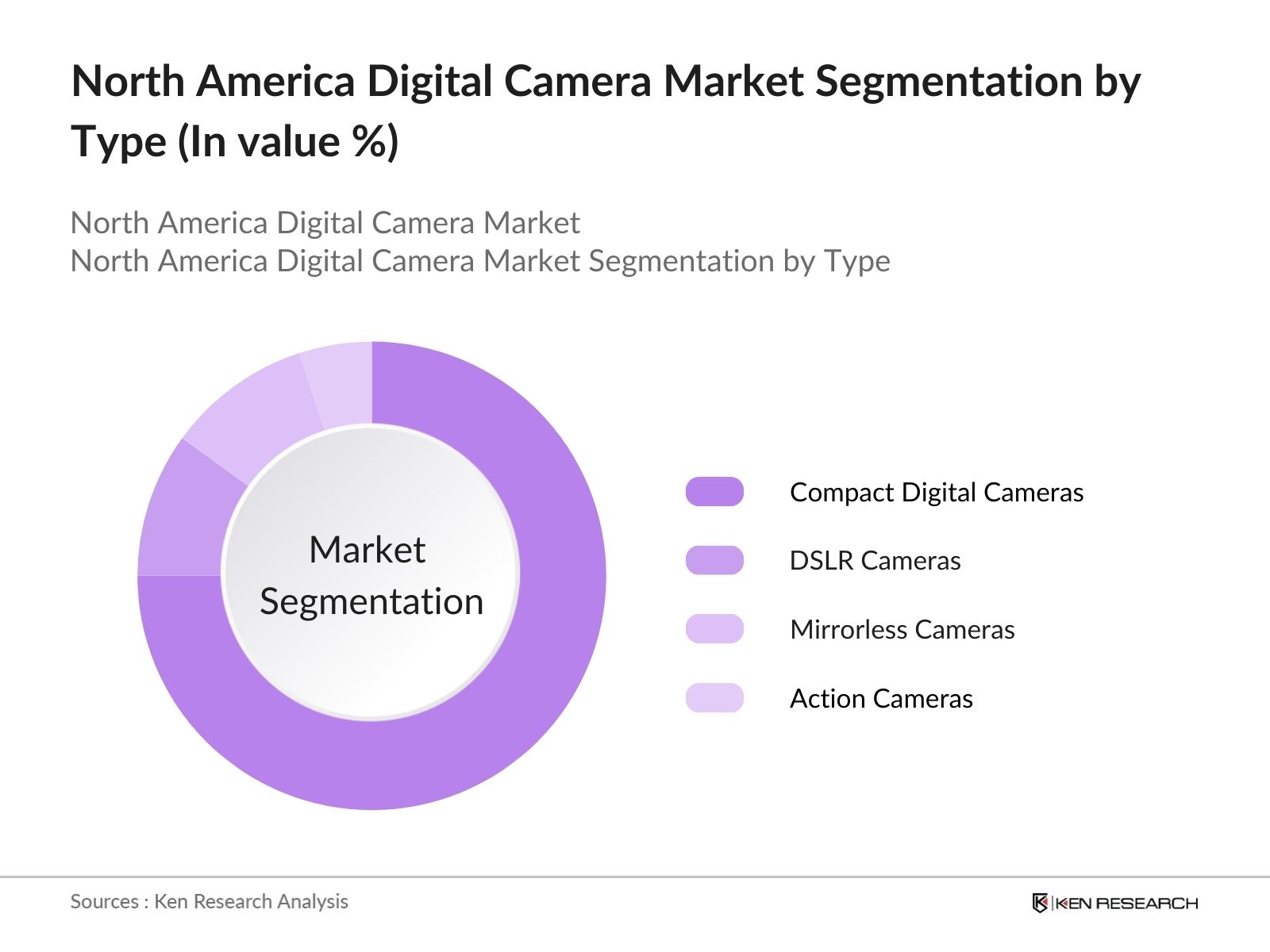
- By Type: The market is segmented into compact digital cameras, DSLRs, mirrorless cameras, and action cameras. The mirrorless camera segment accounted for the largest market share in 2023, driven by the increasing preference for lightweight and high-performance cameras with advanced autofocus systems and interchangeable lenses. With major brands like Sony, Canon, and Nikon continuing to innovate in this segment, the adoption of mirrorless cameras is expected to grow among both professional photographers and hobbyists.
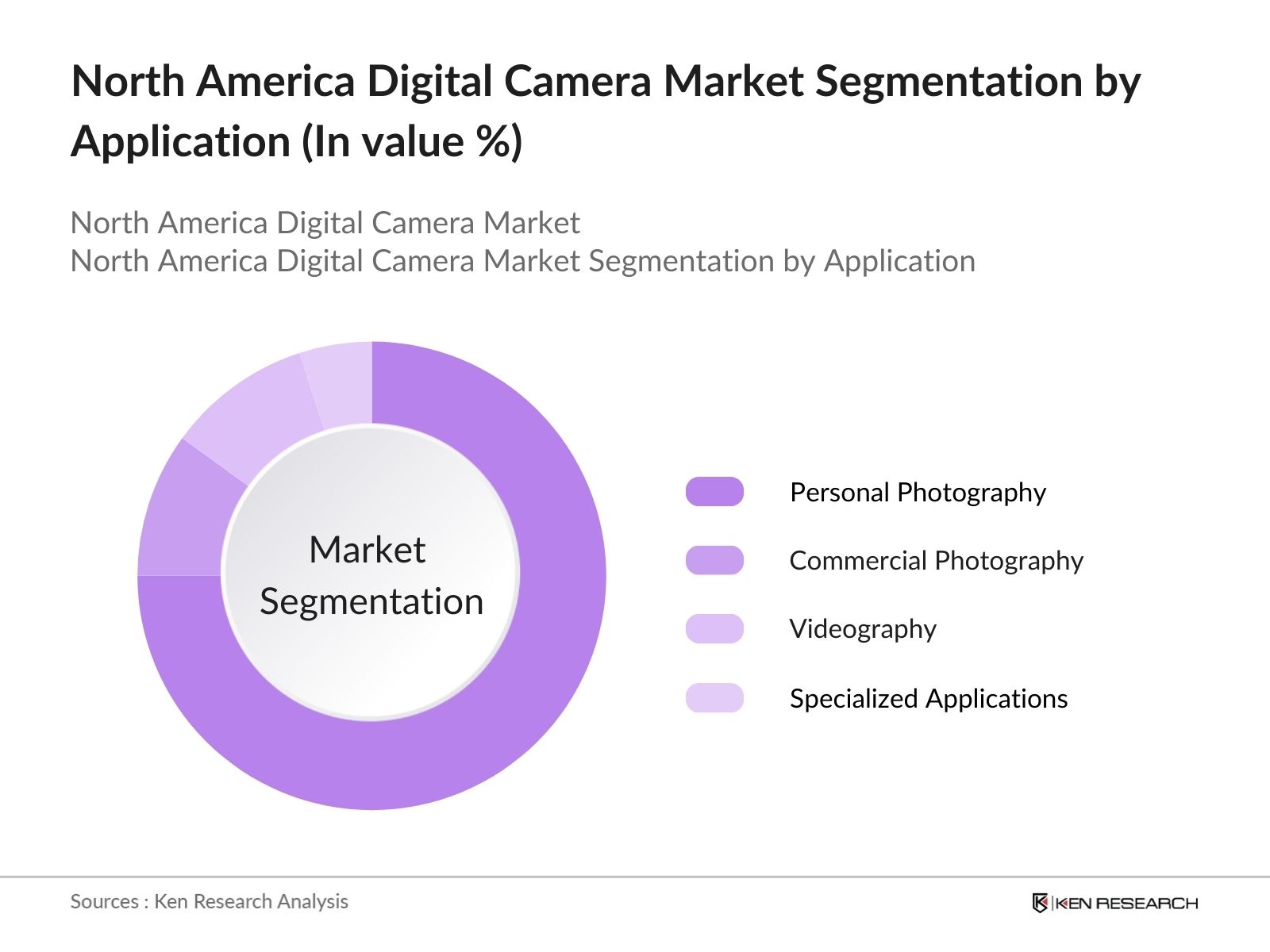
- By Application: The market is segmented into personal photography, commercial photography, videography, and others. The commercial photography segment dominated the market in 2023, supported by the increasing demand for high-resolution images and videos in sectors such as advertising, real estate, and e-commerce. As more businesses recognize the importance of professional-quality visuals for marketing and promotion, the demand for digital cameras catering to commercial use is expected to rise significantly over the forecast period.
North America Digital Camera Market Competitive Landscape
The North America Digital Camera Market is highly competitive, with several key players holding significant market shares. These companies are investing heavily in research and development to bring new, innovative products to the market and improve customer experiences.
|
Company Name |
Establishment Year |
Headquarters |
Revenue |
Market Innovation |
Major Contracts |
No. of Employees |
R&D Expenditure |
Product Portfolio |
|
Canon Inc. |
1937 |
Tokyo, Japan |
||||||
|
Nikon Corporation |
1917 |
Tokyo, Japan |
||||||
|
Sony Corporation |
1946 |
Tokyo, Japan |
||||||
|
Panasonic |
1918 |
Osaka, Japan |
||||||
|
Fujifilm Holdings |
1934 |
Tokyo, Japan |
North America Digital Camera Market Analysis
Growth Drivers
- Increasing Popularity of social media and Content Creation: Content creation across platforms like Instagram, TikTok, and YouTube has fueled digital camera sales as more creators opt for professional-quality video and photography equipment. Over 90 million people globally identify as content creators, with North America accounting for a large share. In 2022, 80% of U.S. adults used at least one social media platform, driving increased adoption of high-quality digital cameras for content creation. Influencers and professionals in media increasingly rely on features like 4K video and advanced stabilization found in modern digital cameras.
- Technological Advancements in Camera Features: Technological advancements in digital camera sensors, such as higher resolution sensors and AI-based image processing, are driving demand in North America. In 2023, Sony announced that its latest image sensors would support ultra-high definition 8K resolution, enhancing professional and consumer-grade photography. Furthermore, the AI-driven autofocus technology has made significant strides, with Canon's EOS R5 utilizing deep learning for advanced object tracking. Americas investment in R&D, reached USD 692 billion in 2022, a substantial portion of this was allocated to AI technologies, supporting further development in camera technology.
- Expansion of Photography and Videography Applications in Business Sectors: The use of photography and videography in commercial sectors such as real estate, e-commerce, and marketing is another significant growth driver. According to a U.S. Department of Commerce report, e-commerce sales in the U.S. hit USD 1.03 trillion in 2022, with high-quality visual content being crucial for online retailers. In real estate, the demand for professional photography services grew by 18% in 2023, with businesses opting for high-end cameras to create immersive, high-resolution visuals for property listings.
Challenges
- High Competition from Smartphone Cameras: Smartphone cameras have significantly improved in recent years, offering advanced features such as higher megapixel sensors and 8K video recording, which make them strong competitors to digital cameras. Premium smartphones are increasingly incorporating AI-enhanced image processing, providing a viable alternative to point-and-shoot digital cameras. These advancements appeal to casual photographers who prefer the convenience of smartphones for everyday photography, contributing to a declining interest in standalone entry-level cameras. As a result, manufacturers of digital cameras face increased competition, especially in the consumer market segment.
- Expensive High-End Equipment: High-end digital cameras, particularly those designed for professional use, are associated with high costs, which can deter average consumers. Professional-grade DSLR and mirrorless cameras, with their advanced features and superior quality, come at a premium price, often limiting their accessibility to hobbyists or non-professional users. This price barrier has contributed to slower adoption rates among consumers who are more likely to opt for less expensive alternatives, such as smartphones or lower-tier camera models. The rising costs of electronic goods also exacerbate this challenge, making high-end cameras a significant investment for potential buyers.
North America Digital Camera Market Future Outlook
The North America Digital Camera Market is expected to see moderate growth over the next five years, supported by continuous technological advancements, the rising popularity of content creation, and the expansion of professional photography services. The market is projected to benefit from innovations in AI-based camera features, enhanced image quality, and the growing demand for specialized cameras for commercial applications.
Increased connectivity with smart devices and seamless integration with social media platforms will likely enhance the functionality of digital cameras, making them more attractive to a broader audience. However, competition from smartphones and the high cost of professional-grade cameras may temper overall market growth.
Future Market Opportunities
Growing Demand for High-Resolution 4K and 8K Video Recording: The demand for high-resolution video recording, particularly 4K and 8K, is rising in North America due to the popularity of online streaming platforms and professional videography. As of 2022, 78% of U.S. households owned at least one 4K-enabled device, driving the demand for cameras that can produce matching high-resolution content. Canons EOS R5, with its 8K video capability, is a popular choice among professional filmmakers, with sales of 4K and 8K-capable cameras increasing substantially in 2023.
Expansion of Commercial Photography for E-commerce and Real Estate: the e-commerce and real estate sectors, there is a growing demand for high-quality photography and videography to showcase products and properties. According to a report from the U.S. Census Bureau, the U.S. e-commerce sector accounted for USD 1.03 trillion in sales in 2022, requiring high-quality imagery to boost online visibility. Additionally, real estate businesses reported a substantial growth in demand for professional photography services, as clients seek immersive virtual tours and high-resolution images.
Scope of the Report
|
By Type |
Compact Digital Cameras |
|
By Application |
Personal Photography |
|
By Distribution Channel |
Online Retail |
|
By End User |
Professional Photographers |
|
By Region |
United States |
Products
Key Target Audience
Professional Photographers and Videographers
Camera Manufacturers and Distributors
Commercial Photography Studios
Content Creators and Influencers
Corporate and Enterprise Clients (Advertising and E-commerce)
Investors and Venture Capitalist Firms
Government and Regulatory Bodies (Federal Communications Commission, US Trade Commission)
Camera Accessories and Lens Manufacturers
Banks and Financial Institutions
Companies
Major Players Mentioned in the Report
Canon Inc.
Nikon Corporation
Sony Corporation
Panasonic Corporation
GoPro Inc.
Olympus Corporation
Fujifilm Holdings Corporation
Leica Camera AG
DJI Innovations
Sigma Corporation
Phase One
Ricoh Imaging Company Ltd.
Hasselblad
Blackmagic Design Pty Ltd.
RED Digital Cinema
Table of Contents
1. North America Digital Camera Market Overview
1.1. Definition and Scope
1.2. Market Taxonomy
1.3. Market Growth Rate
1.4. Market Segmentation Overview
2. North America Digital Camera Market Size (In USD Bn)
2.1. Historical Market Size
2.2. Year-On-Year Growth Analysis
2.3. Key Market Developments and Milestones
3. North America Digital Camera Market Analysis
3.1. Growth Drivers
3.1.1. Technological Advancements in Camera Sensors and AI Features (Innovation & Product Features)
3.1.2. Increased Popularity of Social Media Influencers and Content Creation (Content & Media)
3.1.3. Expansion of Photography and Videography Applications in Business Sectors (Commercial Applications)
3.1.4. Shift Towards Professional Quality in Consumer Devices (Consumer Preferences)
3.2. Market Challenges
3.2.1. High Competition from Smartphone Cameras (Competitive Landscape)
3.2.2. Expensive High-End Equipment (Cost Constraints)
3.2.3. Declining Sales of Entry-Level Cameras (Consumer Behavior Shift)
3.2.4. Limited Growth Among Non-Professional Users (Market Saturation)
3.3. Opportunities
3.3.1. Growing Demand for High-Resolution 4K and 8K Video Recording (Video Trends)
3.3.2. Expansion of Commercial Photography for E-commerce and Real Estate (Business Demand)
3.3.3. Growth in Action Cameras for Adventure Sports (Niche Markets)
3.3.4. Increasing Demand for Mirrorless Cameras (Innovation & Adoption)
3.4. Trends
3.4.1. Integration of AI in Autofocus and Image Processing (AI & Machine Learning)
3.4.2. Rising Use of Cloud Storage for Photography (Digital Storage Trends)
3.4.3. Increased Connectivity with Smartphones via Wi-Fi and Bluetooth (Tech Integration)
3.4.4. Preference for Lightweight and Compact Camera Models (Portability)
3.5. Government Regulation
3.5.1. Import and Export Tariffs on Digital Camera Components (Trade Policies)
3.5.2. Certification Standards for Camera Safety and Quality (Regulatory Compliance)
3.5.3. Environmental Policies Affecting Camera Manufacturing (Sustainability Policies)
3.5.4. Tax Benefits for Research and Development in Camera Technologies (R&D Incentives)
3.6. SWOT Analysis
3.7. Stakeholder Ecosystem
3.8. Porters Five Forces Analysis
3.9. Competitive Landscape
4. North America Digital Camera Market Segmentation
4.1. By Type (In Value %)
4.1.1. Compact Digital Cameras
4.1.2. Digital Single Lens Reflex (DSLR) Cameras
4.1.3. Mirrorless Cameras
4.1.4. Action Cameras
4.2. By Application (In Value %)
4.2.1. Personal Photography
4.2.2. Commercial Photography
4.2.3. Videography
4.2.4. Specialized Applications (Surveillance, Medical, and Others)
4.3. By Distribution Channel (In Value %)
4.3.1. Online Retail
4.3.2. Offline Retail
4.3.3. Direct Sales
4.4. By End User (In Value %)
4.4.1. Professional Photographers
4.4.2. Amateur/Hobbyist Photographers
4.4.3. Corporate and Commercial Clients
4.5. By Region (In Value %)
4.5.1. United States
4.5.2. Canada
4.5.3. Mexico
5. North America Digital Camera Market Competitive Analysis
5.1 Detailed Profiles of Major Companies
5.1.1. Canon Inc.
5.1.2. Nikon Corporation
5.1.3. Sony Corporation
5.1.4. Panasonic Corporation
5.1.5. Fujifilm Holdings Corporation
5.1.6. GoPro Inc.
5.1.7. Olympus Corporation
5.1.8. Leica Camera AG
5.1.9. Ricoh Imaging Company Ltd.
5.1.10. Blackmagic Design Pty Ltd.
5.1.11. Hasselblad
5.1.12. Phase One
5.1.13. DJI
5.1.14. RED Digital Cinema
5.1.15. Sigma Corporation
5.2 Cross Comparison Parameters (Revenue, Headquarters, Inception Year, No. of Employees, Camera Model Range, R&D Investment, Key Partnerships, Geographical Presence)
5.3. Market Share Analysis
5.4. Strategic Initiatives
5.5. Mergers and Acquisitions
5.6. Investment Analysis
5.7 Venture Capital Funding
5.8. Government Grants
5.9. Private Equity Investments
6. North America Digital Camera Market Regulatory Framework
6.1. Import/Export Regulations
6.2. Environmental Compliance Standards
6.3. Product Safety Certification
6.4. R&D Tax Incentives
7. North America Digital Camera Future Market Size (In USD Bn)
7.1. Future Market Size Projections
7.2. Key Factors Driving Future Market Growth
8. North America Digital Camera Future Market Segmentation
8.1. By Type (In Value %)
8.2. By Application (In Value %)
8.3. By Distribution Channel (In Value %)
8.4. By End User (In Value %)
8.5. By Region (In Value %)
9. North America Digital Camera Market Analysts Recommendations
9.1. TAM/SAM/SOM Analysis
9.2. Customer Cohort Analysis
9.3. Marketing Initiatives
9.4. White Space Opportunity Analysis
Research Methodology
Step 1: Identification of Key Variables
The research begins with the identification of key market variables, such as consumer behavior, product innovation trends, and market penetration rates in the North America Digital Camera market. This stage involves an in-depth review of secondary sources like industry reports, trade publications, and regulatory documents.
Step 2: Market Analysis and Construction
Historical data on digital camera sales, price trends, and technological advancements are compiled and analyzed. This analysis includes segment-wise performance data to understand the key market drivers and obstacles faced by digital camera manufacturers in North America.
Step 3: Hypothesis Validation and Expert Consultation
Consultations with industry experts, including manufacturers and retailers, are conducted to validate the market hypotheses. Insights from these interviews help in assessing the latest developments in camera technology and consumer preferences.
Step 4: Research Synthesis and Final Output
In this final phase, all collected data is synthesized into comprehensive market insights. The data is further cross-referenced with insights obtained through expert consultations to ensure the accuracy and relevancy of the report.
Frequently Asked Questions
01. How big is the North America Digital Camera Market?
The North America Digital Camera market is valued at USD 2.6 billion, driven by the increasing demand for professional-grade imaging solutions across personal, commercial, and specialized applications.
02. What are the challenges in the North America Digital Camera Market?
Challenges in the North America Digital Camera market include competition from advanced smartphone cameras, high costs of high-end equipment, and declining sales of entry-level cameras, which are making it harder for manufacturers to maintain growth in non-professional segments.
03. Who are the major players in the North America Digital Camera Market?
Key players in the North America Digital Camera market include Canon Inc., Nikon Corporation, Sony Corporation, Panasonic Corporation, and GoPro Inc. These companies maintain a strong foothold due to their continuous innovation and robust distribution networks.
04. What are the growth drivers of the North America Digital Camera Market?
The North America Digital Camera market is driven by the rising demand for high-quality visuals in content creation, advancements in camera technology such as AI-based autofocus, and the growing use of professional cameras in commercial photography and videography.
Why Buy From Us?

What makes us stand out is that our consultants follows Robust, Refine and Result (RRR) methodology. i.e. Robust for clear definitions, approaches and sanity checking, Refine for differentiating respondents facts and opinions and Result for presenting data with story

We have set a benchmark in the industry by offering our clients with syndicated and customized market research reports featuring coverage of entire market as well as meticulous research and analyst insights.

While we don't replace traditional research, we flip the method upside down. Our dual approach of Top Bottom & Bottom Top ensures quality deliverable by not just verifying company fundamentals but also looking at the sector and macroeconomic factors.

With one step in the future, our research team constantly tries to show you the bigger picture. We help with some of the tough questions you may encounter along the way: How is the industry positioned? Best marketing channel? KPI's of competitors? By aligning every element, we help maximize success.

Our report gives you instant access to the answers and sources that other companies might choose to hide. We elaborate each steps of research methodology we have used and showcase you the sample size to earn your trust.

If you need any support, we are here! We pride ourselves on universe strength, data quality, and quick, friendly, and professional service.