
North America Electric Wheelchair Market Outlook to 2030
Region:United States
Author(s):Yogita Sahu
Product Code:KROD4076
Region:United States
Author(s):Yogita Sahu
Product Code:KROD4076
October 2024
82
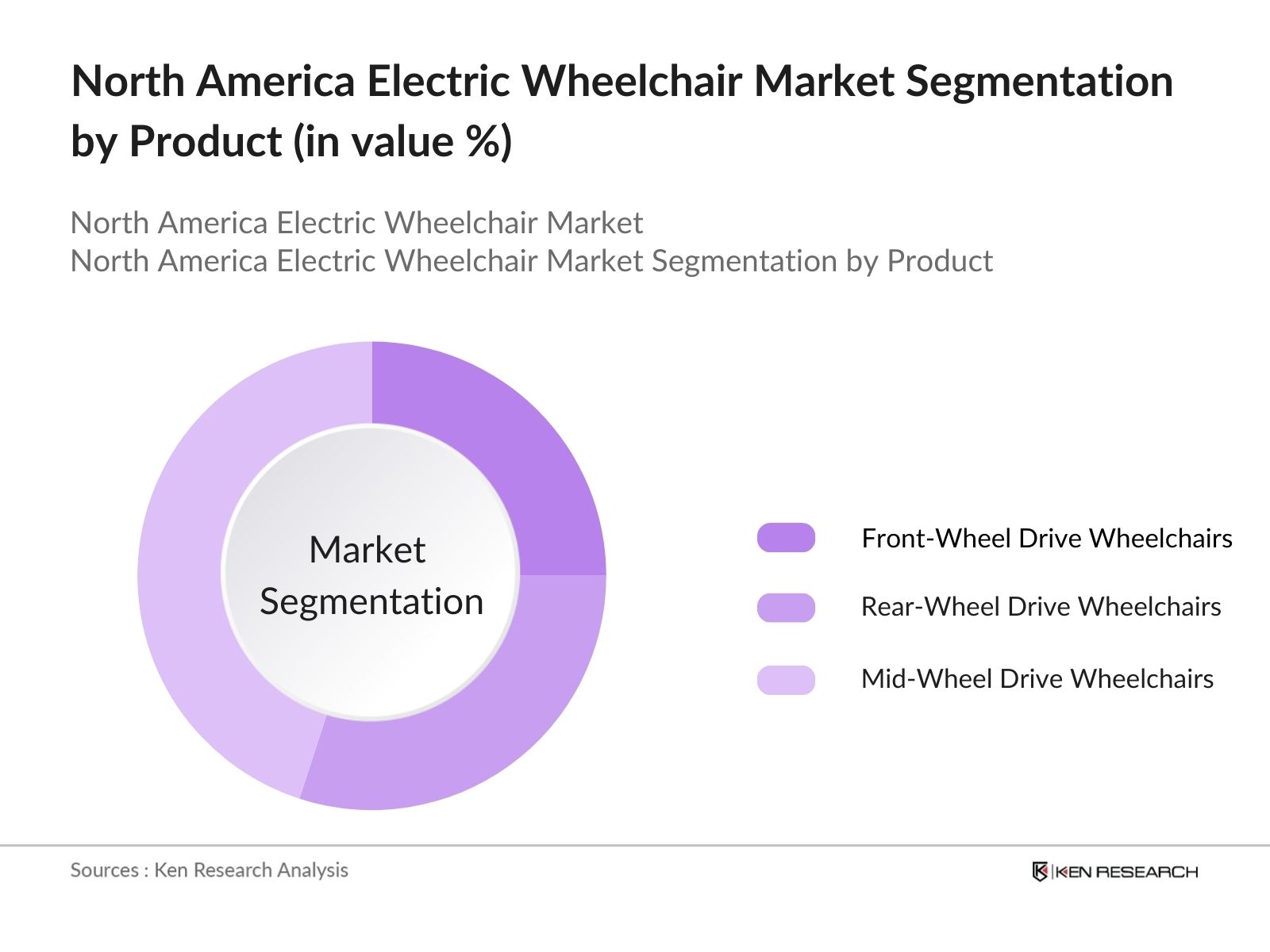
By Product Type: The market is segmented by product type into Front-Wheel Drive, Rear-Wheel Drive, and Mid-Wheel Drive electric wheelchairs. Mid-Wheel Drive wheelchairs held the dominant market share due to their superior maneuverability and stability, which makes them suitable for both indoor and outdoor use. These wheelchairs are preferred by users seeking enhanced control and ease of navigation, especially in tight spaces such as homes and clinics.
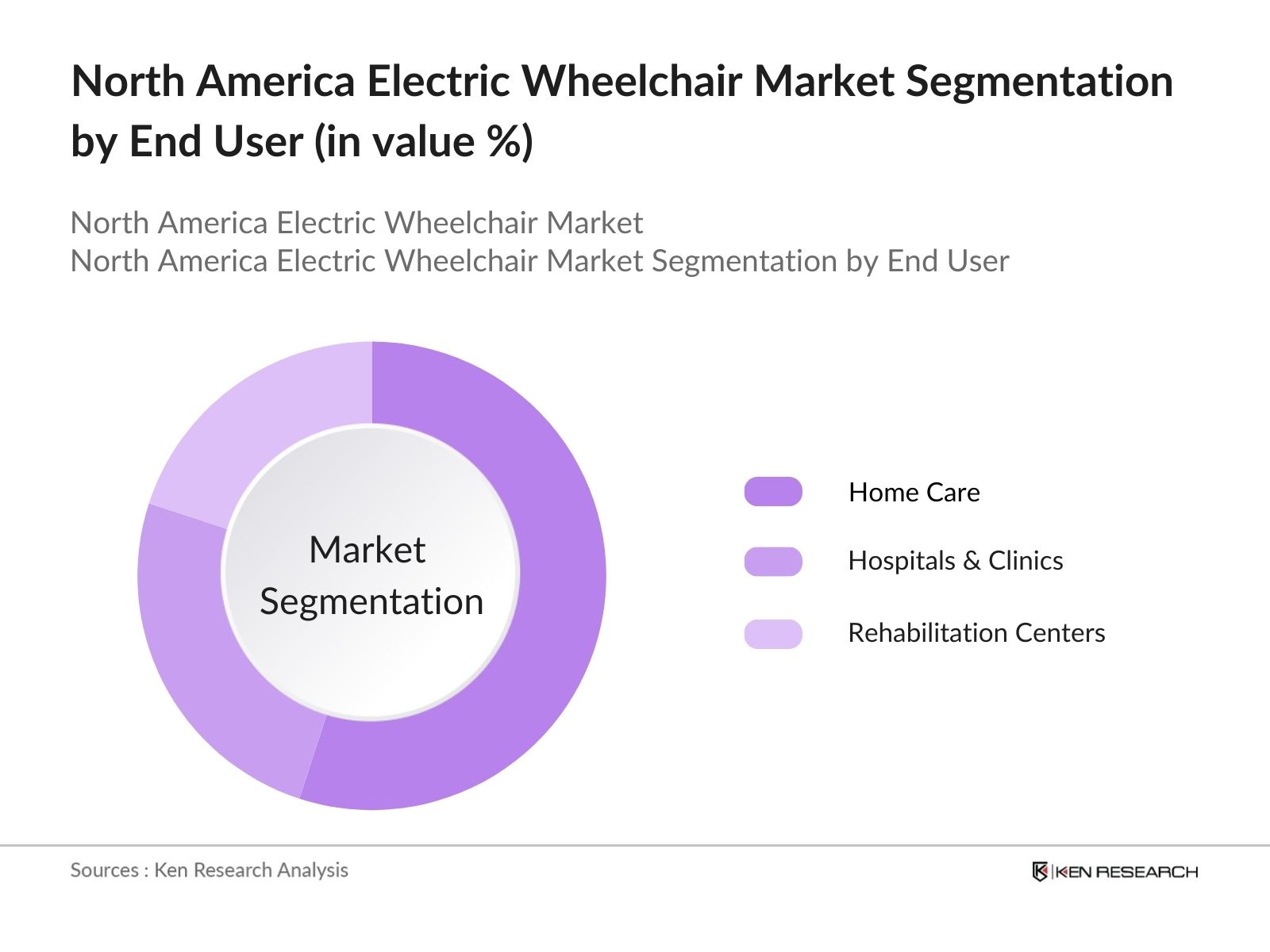
By End User: The market is also segmented by end user into Home Care, Hospitals & Clinics, and Rehabilitation Centers. Home Care segment led the market due to an increasing preference for aging-in-place solutions. The rise of home healthcare services and growing independence of elderly and disabled individuals contribute to the dominance of this segment. Electric wheelchairs designed for home use are lightweight, foldable, and easy to store, making them highly desirable for users who prioritize convenience and mobility within their residences.
The market is competitive, with key players leveraging product innovations and extensive distribution networks to maintain their positions. The market is dominated by both local manufacturers and global brands that offer a wide range of products catering to various user needs.
|
Company |
Establishment Year |
Headquarters |
Revenue (USD) |
R&D Investment |
Product Range |
Global Presence |
Patents |
Distribution Network |
Partnerships |
|
Invacare Corporation |
1885 |
Elyria, Ohio, U.S. |
|||||||
|
Permobil AB |
1967 |
Timr, Sweden |
|||||||
|
Pride Mobility Products Corp |
1986 |
Exeter, Pennsylvania, U.S. |
|||||||
|
Drive DeVilbiss Healthcare |
2000 |
Port Washington, New York, U.S. |
|||||||
|
Sunrise Medical |
1983 |
Fresno, California, U.S. |
Over the next five years, the North America Electric Wheelchair industry is expected to see growth driven by continuous advancements in electric mobility technology, increasing consumer demand for compact and lightweight designs, and the rising aging population. Additionally, government initiatives aimed at providing better healthcare support for individuals with disabilities will further propel market expansion.
|
By Product Type |
Front-Wheel Drive Wheelchairs |
|
Rear-Wheel Drive Wheelchairs |
|
|
Mid-Wheel Drive Wheelchairs |
|
|
By End User |
Home Care |
|
Hospitals & Clinics |
|
|
Rehabilitation Centers |
|
|
By Battery Type |
Sealed Lead Acid (SLA) Batteries |
|
Lithium-Ion Batteries |
|
|
Nickel Metal Hydride (NiMH) Batteries |
|
|
By Drive Type |
Manual |
|
Fully Electric |
|
|
Hybrid |
|
|
By Country |
United States |
|
Canada |
1.1. Definition and Scope
1.2. Market Taxonomy
1.3. Market Growth Rate
1.4. Market Segmentation Overview
2.1. Historical Market Size
2.2. Year-On-Year Growth Analysis
2.3. Key Market Developments and Milestones
3.1. Growth Drivers
3.1.1. Aging Population
3.1.2. Increased Disability Rates
3.1.3. Technological Advancements
3.1.4. Government Support and Insurance Coverage
3.2. Market Challenges
3.2.1. High Initial Costs
3.2.2. Lack of Awareness in Rural Areas
3.2.3. Limited Battery Life
3.3. Opportunities
3.3.1. Integration of Smart Technologies (IoT in Wheelchairs)
3.3.2. Expansion into Home Care Services
3.3.3. Customizable Wheelchair Solutions
3.4. Trends
3.4.1. Lightweight Electric Wheelchairs
3.4.2. Foldable and Portable Wheelchairs
3.4.3. Use of AI and Sensors for Mobility Assistance
3.5. Government Regulations
3.5.1. ADA (Americans with Disabilities Act) Compliance
3.5.2. Medicare and Medicaid Reimbursement Policies
3.5.3. Import Tariffs on Electric Components
3.6. SWOT Analysis
3.7. Stakeholder Ecosystem
3.8. Porters Five Forces Analysis
3.9. Competition Ecosystem
4.1. By Product Type (In Value %)
4.1.1. Front-Wheel Drive Wheelchairs
4.1.2. Rear-Wheel Drive Wheelchairs
4.1.3. Mid-Wheel Drive Wheelchairs
4.2. By End User (In Value %)
4.2.1. Home Care
4.2.2. Hospitals & Clinics
4.2.3. Rehabilitation Centers
4.3. By Battery Type (In Value %)
4.3.1. Sealed Lead Acid (SLA) Batteries
4.3.2. Lithium-Ion Batteries
4.3.3. Nickel Metal Hydride (NiMH) Batteries
4.4. By Drive Type (In Value %)
4.4.1. Manual
4.4.2. Fully Electric
4.4.3. Hybrid
4.5. By Region (In Value %)
4.5.1. United States
4.5.2. Canada
5.1. Detailed Profiles of Major Companies
5.1.1. Invacare Corporation
5.1.2. Permobil AB
5.1.3. Sunrise Medical
5.1.4. Pride Mobility Products Corp.
5.1.5. Drive DeVilbiss Healthcare
5.1.6. Hoveround Corporation
5.1.7. Ottobock SE & Co. KGaA
5.1.8. GF Health Products, Inc.
5.1.9. 21st Century Scientific Inc.
5.1.10. Meyra GmbH
5.1.11. Karman Healthcare
5.1.12. Merits Health Products
5.1.13. Quantum Rehab
5.1.14. Levo AG
5.1.15. Tzora Active Systems Ltd.
5.2. Cross Comparison Parameters (Market Share, Product Innovation, Distribution Network, Geographical Presence, Revenue, Employee Count, Patent Portfolio, R&D Investment)
5.3. Market Share Analysis
5.4. Strategic Initiatives
5.5. Mergers and Acquisitions
5.6. Investment Analysis
5.7. Government Grants and Incentives
5.8. Venture Capital and Private Equity Investments
6.1. Safety Standards for Medical Devices
6.2. FDA Approval Process
6.3. Compliance with Energy Efficiency Standards
6.4. Import and Export Regulations
7.1. Future Market Size Projections
7.2. Key Factors Driving Future Market Growth
8.1. By Product Type (In Value %)
8.2. By End User (In Value %)
8.3. By Battery Type (In Value %)
8.4. By Drive Type (In Value %)
8.5. By Region (In Value %)
9.1. TAM/SAM/SOM Analysis
9.2. Customer Segmentation and Cohort Analysis
9.3. Product Innovation and Development
9.4. Market Entry Strategy
9.5. White Space Opportunities
This phase begins with mapping the entire ecosystem of the North America Electric Wheelchair Market. Comprehensive desk research is conducted to gather key information from proprietary databases and secondary sources. The focus is on identifying variables such as product types, demand drivers, and the competitive landscape.
In this stage, historical market data is compiled and analyzed. Key market indicators such as electric wheelchair sales, product launches, and customer demographics are examined. Revenue estimates are derived based on product adoption trends and end-user demand.
Market hypotheses are developed and validated through consultations with industry experts via CATI (Computer-Assisted Telephone Interviews). These interviews provide operational insights, allowing for the refinement of market estimates and forecasts.
This phase involves synthesizing data obtained from interviews and secondary research to produce a final comprehensive market report. Direct engagement with electric wheelchair manufacturers is used to validate findings and ensure accuracy.
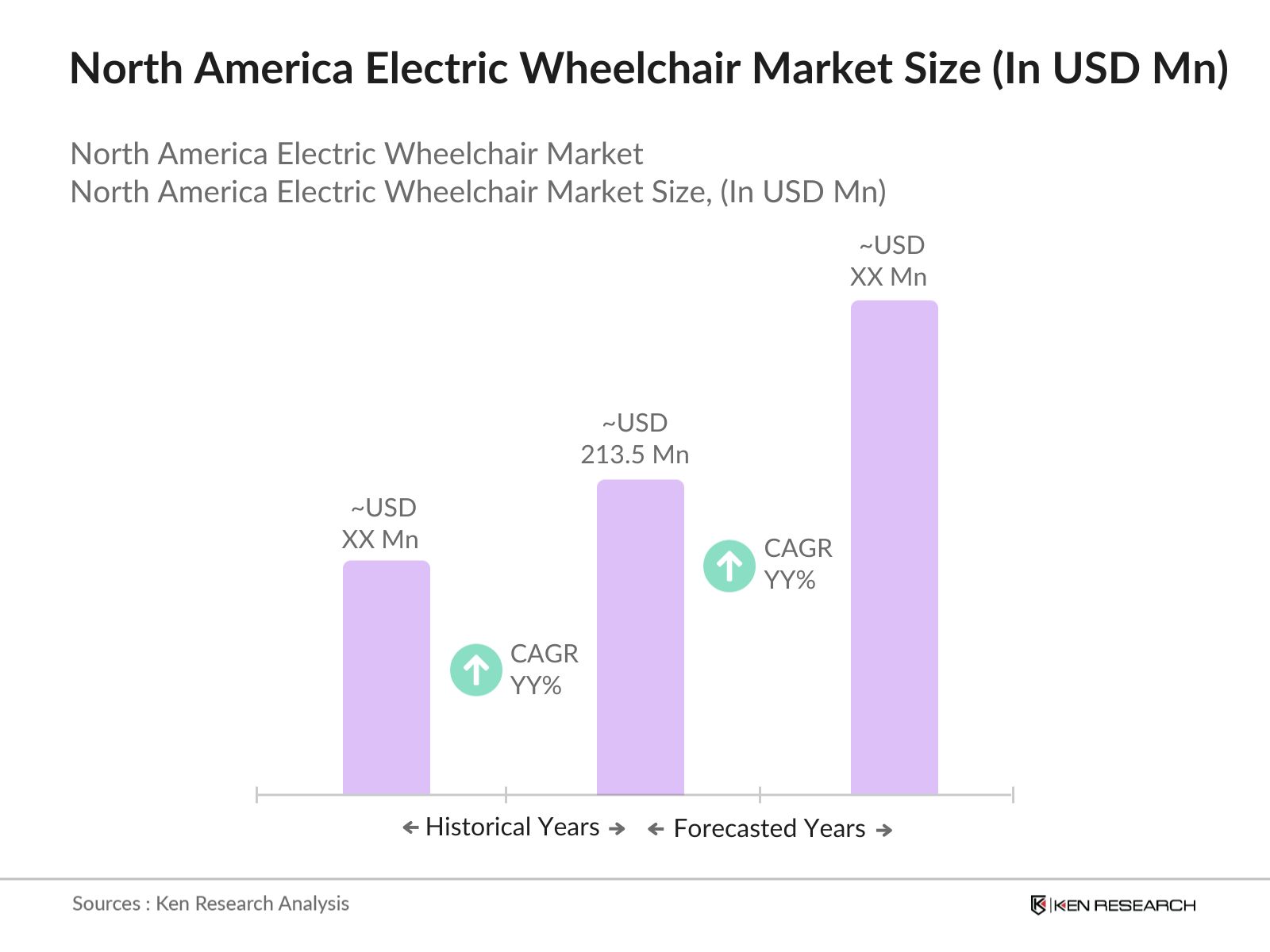
The North America Electric Wheelchair market is valued at USD 213.5 million, driven by the increasing adoption of home healthcare solutions and technological innovations.
Challenges in the North America Electric Wheelchair market include high costs associated with electric wheelchairs, limited battery life, and a lack of awareness in rural regions, which affects market penetration.
Key players in the North America Electric Wheelchair market include Permobil AB, Invacare Corporation, Pride Mobility Products, Sunrise Medical, and Drive DeVilbiss Healthcare, all of which have established strong brand loyalty and distribution networks.
Key growth drivers in the North America Electric Wheelchair market include the increasing aging population, rising disability rates, and government initiatives aimed at providing better access to mobility aids for the elderly and disabled.
The North America Electric Wheelchair market is expected to grow over the next five years due to continuous advancements in mobility technology, including AI and IoT integration in electric wheelchairs.

What makes us stand out is that our consultants follows Robust, Refine and Result (RRR) methodology. i.e. Robust for clear definitions, approaches and sanity checking, Refine for differentiating respondents facts and opinions and Result for presenting data with story

We have set a benchmark in the industry by offering our clients with syndicated and customized market research reports featuring coverage of entire market as well as meticulous research and analyst insights.

While we don't replace traditional research, we flip the method upside down. Our dual approach of Top Bottom & Bottom Top ensures quality deliverable by not just verifying company fundamentals but also looking at the sector and macroeconomic factors.

With one step in the future, our research team constantly tries to show you the bigger picture. We help with some of the tough questions you may encounter along the way: How is the industry positioned? Best marketing channel? KPI's of competitors? By aligning every element, we help maximize success.

Our report gives you instant access to the answers and sources that other companies might choose to hide. We elaborate each steps of research methodology we have used and showcase you the sample size to earn your trust.

If you need any support, we are here! We pride ourselves on universe strength, data quality, and quick, friendly, and professional service.