
North America Essential Oils Market Outlook to 2030
Region:North America
Author(s):Yogita Sahu
Product Code:KROD3964
October 2024
81
About the Report
North America Essential Oils Market Overview
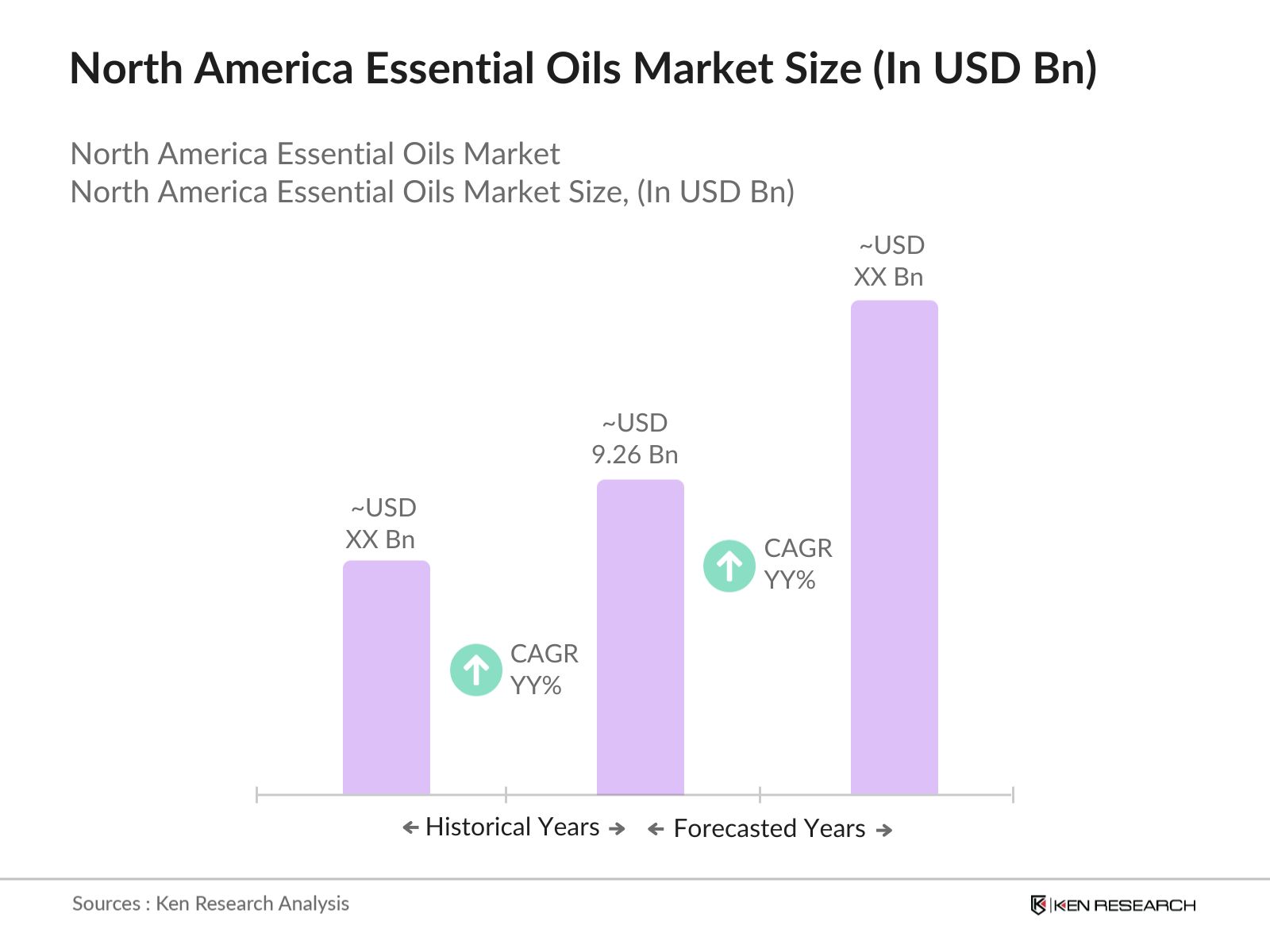
- The North America Essential Oils Market is valued at USD 9.26 billion, based on a five-year historical analysis. The market is primarily driven by increasing consumer preference for natural and organic products in sectors like personal care, pharmaceuticals, and food & beverages. Growing awareness around the health benefits of essential oils, such as their antimicrobial, antifungal, and antioxidant properties, is contributing to the rising demand.
- In North America, the market due to its advanced healthcare sector, strong consumer inclination towards natural products, and the presence of leading essential oil brands. Cities such as Los Angeles, New York, and Chicago are key demand centers, driven by high disposable incomes and the influence of wellness and personal care trends.
- The U.S. Department of Agriculture (USDA) has launched several initiatives to promote organic farming practices, which directly benefit the essential oils market by encouraging the cultivation of pesticide-free crops. In 2024, the USDA allocated in subsidies to organic farmers, including those cultivating plants for essential oil extraction.
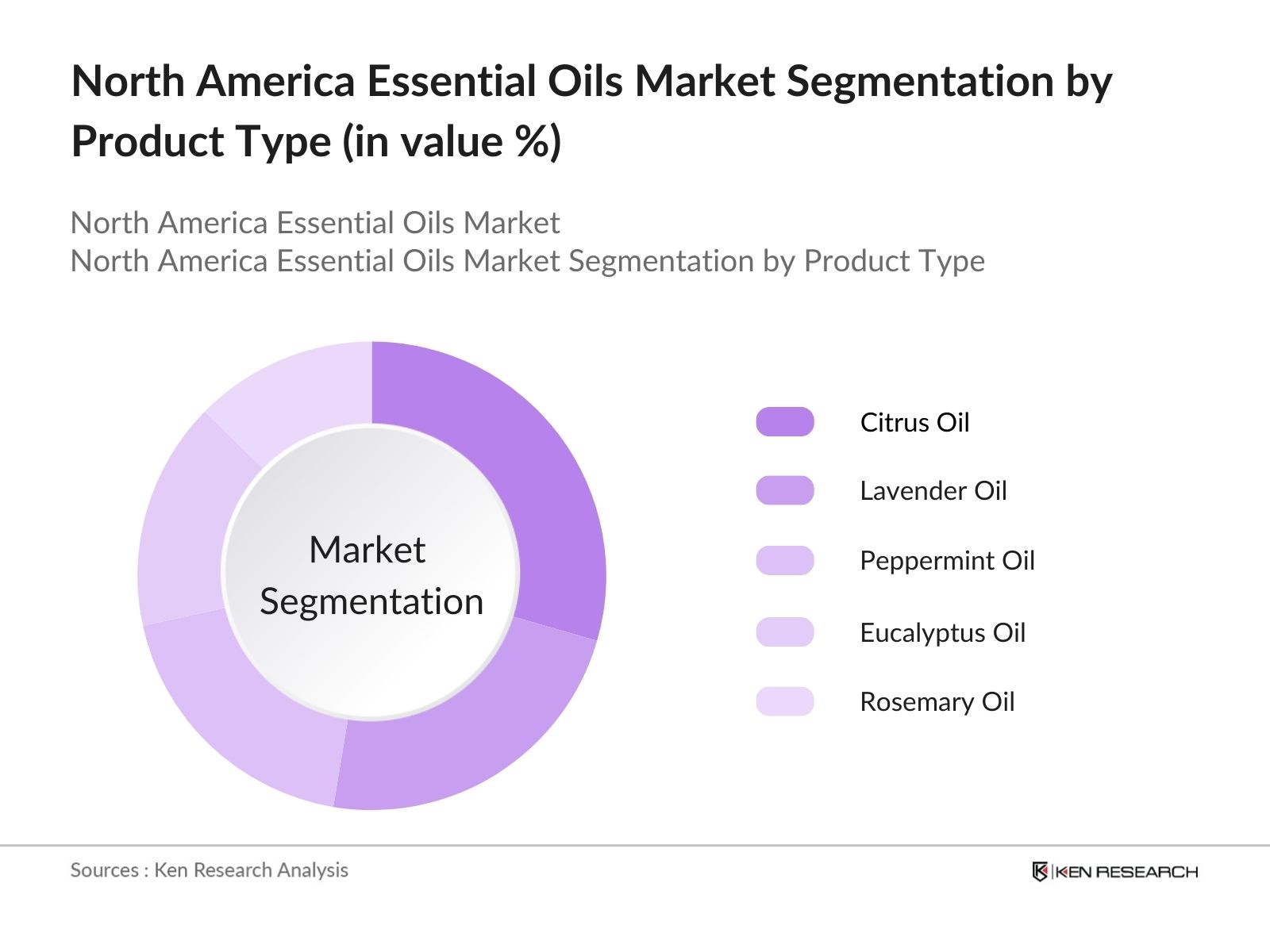
North America Essential Oils Market Segmentation
By Product Type: The market is segmented by product type into citrus oil, lavender oil, peppermint oil, eucalyptus oil, and rosemary oil. Citrus oils, including orange and lemon oils, have a dominant market share due to their widespread use in food & beverage products, cleaning products, and personal care items. Their refreshing scent and natural cleansing properties make them a popular choice for household applications.
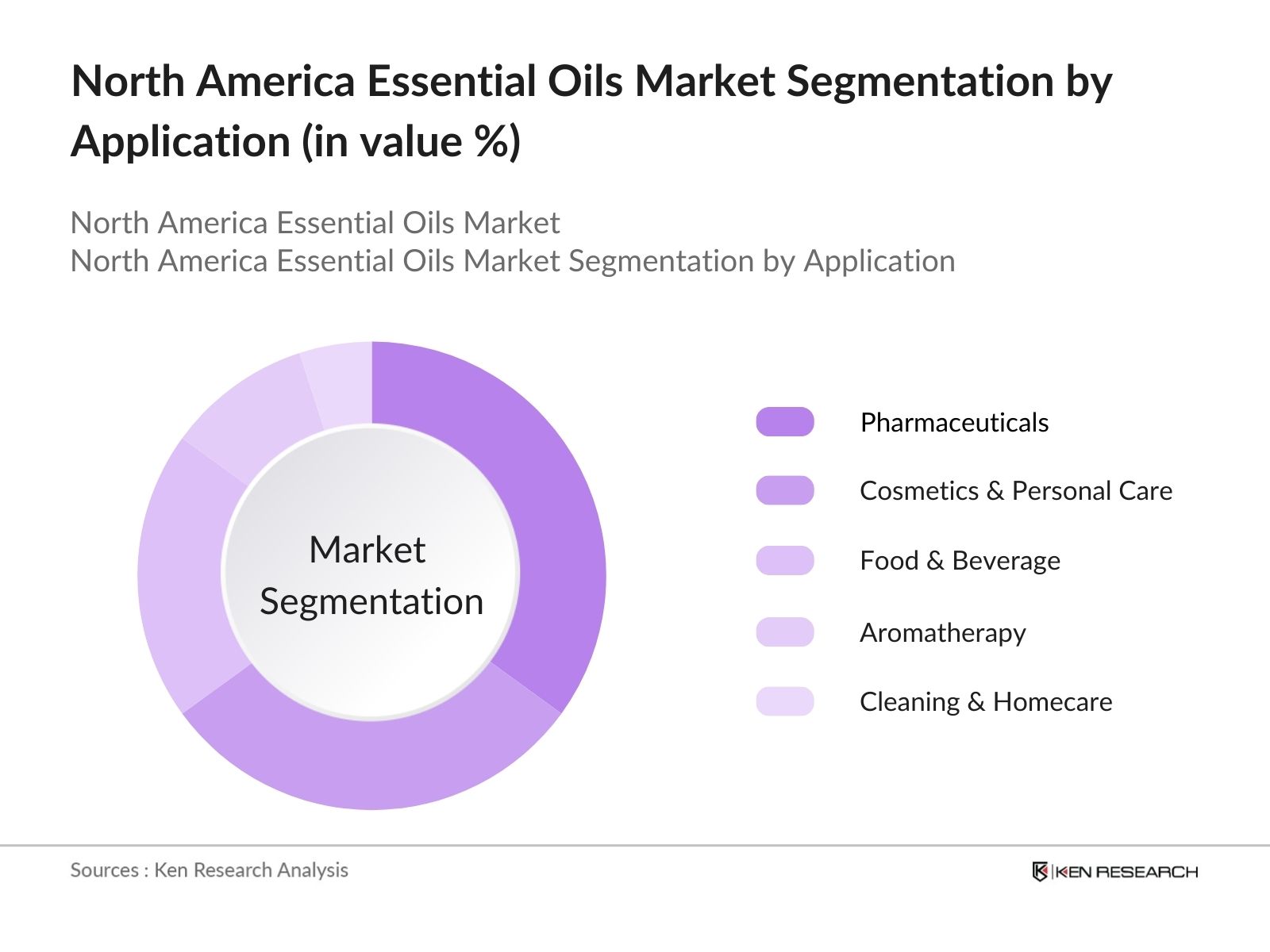
By Application: The market is also segmented by application into pharmaceuticals, cosmetics & personal care, food & beverage, aromatherapy, and cleaning & homecare. The pharmaceuticals and cosmetics segments dominate the market due to increasing consumer demand for natural ingredients in health and beauty products. Essential oils are frequently used in these sectors due to their natural therapeutic benefits, such as their antimicrobial and anti-inflammatory properties, which make them valuable in treating skin conditions and boosting general well-being.
North America Essential Oils Market Competitive Landscape
The market is characterized by the presence of both domestic and international players, creating a competitive landscape driven by innovation, sustainable practices, and expansion into niche product segments. Leading players in the market are expanding their product portfolios to cater to increasing demand for organic and therapeutic-grade essential oils.
|
Company |
Establishment Year |
Headquarters |
Key Products |
Sustainability Initiatives |
Revenue (USD) |
Number of Employees |
Geographical Presence |
Certifications |
|
Young Living Essential Oils |
1993 |
Lehi, Utah, USA |
||||||
|
doTERRA International |
2008 |
Pleasant Grove, Utah, USA |
||||||
|
Plant Therapy Essential Oils |
2011 |
Twin Falls, Idaho, USA |
||||||
|
Eden Botanicals |
1990 |
Petaluma, California, USA |
||||||
|
Now Foods |
1968 |
Bloomingdale, Illinois, USA |
North America Essential Oils Market Analysis
Market Growth Drivers
- Increasing Demand for Natural Products: In 2024, there has been a notable rise in consumer interest toward natural and organic products, leading to increased demand for essential oils. The natural personal care product market is a key area driving the growth of essential oils. For instance, the natural personal care market in North America is projected to grow by more than 200 million units annually due to rising concerns over the use of synthetic chemicals in cosmetics, directly influencing the demand for essential oils used as natural ingredients.
- Health and Wellness Industry Expansion: The North American wellness industry is seeing growth, with consumer spending on health-related products and services exceeding $1 trillion in 2024. Essential oils are being increasingly used in aromatherapy, home healthcare products, and stress-relief applications, driven by consumers seeking alternative health solutions. In particular, lavender and tea tree essential oils are seeing high demand, contributing to the expansion of this market segment.
- Growing Consumer Awareness of Eco-friendly Products: The growing eco-consciousness in North America is pushing industries to adopt greener practices. Essential oils are now being utilized in a range of eco-friendly cleaning products, which has gained traction among consumers. The demand for green household products has grown by over 50 million units annually in the U.S. alone, and essential oils such as eucalyptus and peppermint are increasingly replacing synthetic chemicals in these formulations.
Market Challenges
- High Cost of Production: The cost of producing essential oils remains a challenge in 2024. With raw materials being dependent on agricultural output, adverse weather conditions and fluctuating agricultural yields have led to volatility in essential oil production costs. For example, the cost of peppermint essential oil production in North America has increased by over $2,000 per ton in recent years due to supply chain disruptions and rising labor costs.
- Sustainability Concerns: There are growing concerns over the environmental impact of essential oil production. Large-scale farming of plants used for essential oil extraction, such as sandalwood and frankincense, is leading to deforestation and biodiversity loss. In 2024, reports indicate that over 100,000 acres of forest land in the U.S. have been cleared for the cultivation of these crops, leading to mounting pressure from environmental agencies and activists.
North America Essential Oils Market Future Outlook
Over the next five years, the North America Essential Oils Industry is expected to experience growth driven by rising consumer awareness about the benefits of natural products, the expansion of aromatherapy, and increasing applications in the food & beverage and pharmaceutical industries. Moreover, advancements in extraction techniques and growing demand for sustainable and organic products are likely to further fuel market expansion.
Future Market Opportunities
- Increased Use in Pharmaceuticals: Over the next five years, essential oils are expected to see expanded usage in pharmaceuticals, driven by ongoing research into their medicinal properties. The U.S. National Institutes of Health (NIH) is expected to publish comprehensive studies by 2025 on the antimicrobial properties of essential oils like eucalyptus, which could lead to more widespread use in over-the-counter medicinal products.
- Technological Advancements in Extraction Methods: Technological innovations in extraction methods, such as supercritical CO2 extraction, are anticipated to improve the efficiency and purity of essential oils over the next five years. This will allow manufacturers to increase production output, with projections suggesting an additional 50,000 tons of high-purity essential oils produced by 2029.
Scope of the Report
|
By Product Type |
Citrus Oil Eucalyptus Oil Lavender Oil Peppermint Oil Rosemary Oil |
|
By Application |
Pharmaceuticals Cosmetics & Personal Care Food & Beverage Aromatherapy Cleaning & Homecare |
|
By Distribution Channel |
Online Retail Direct Selling Supermarkets & Hypermarkets Specialty Stores Drug Stores & Pharmacies |
|
By End-User |
Individual Consumers Commercial Buyers Industrial |
|
By Country |
United States Canada |
Products
Key Target Audience Organizations and Entities Who Can Benefit by Subscribing This Report:
Essential Oil Manufacturers
Aromatherapy Service Providers
Pharmaceutical and Cosmetic Companies
Food & Beverage Manufacturers
Cleaning Product Manufacturers
Investments and Venture Capitalist Firms
Government and Regulatory Bodies (FDA, USDA)
Companies
Players Mentioned in the Report:
Young Living Essential Oils
doTERRA International
Plant Therapy Essential Oils
Eden Botanicals
Now Foods
Mountain Rose Herbs
Rocky Mountain Oils
Florihana
Lebermuth Co.
Biolandes
Essential Oils of New Zealand
Farotti Essenze
Sydney Essential Oil Co.
Berje Inc.
Ultra International BV
Table of Contents
1. North America Essential Oils Market Overview
1.1 Definition and Scope
1.2 Market Taxonomy
1.3 Market Growth Rate (CAGR, YOY Growth)
1.4 Market Segmentation Overview
2. North America Essential Oils Market Size (In USD Bn)
2.1 Historical Market Size
2.2 Year-on-Year Growth Analysis
2.3 Key Market Developments and Milestones
3. North America Essential Oils Market Analysis
3.1 Growth Drivers
3.1.1 Rising Demand for Natural Ingredients (Consumer Preference for Organic Products)
3.1.2 Expanding Applications in Pharmaceuticals, Cosmetics, and Food & Beverages
3.1.3 Increasing Popularity of Aromatherapy (Holistic Wellness Trends)
3.1.4 Supportive Government Regulations (USDA and FDA Guidelines)
3.1.5 Rise in Natural Health Product Usage (Shift from Synthetic to Plant-Based Products)
3.2 Market Challenges
3.2.1 High Cost of Essential Oil Extraction (Raw Material Availability)
3.2.2 Stringent Quality Standards (Regulatory Framework for Purity)
3.2.3 Supply Chain Disruptions (Dependence on Imports for Raw Materials)
3.2.4 Consumer Misconceptions Regarding Safety
3.3 Opportunities
3.3.1 Innovation in Extraction Techniques (Supercritical CO2 Extraction, Cold Pressing)
3.3.2 Growing Popularity in Emerging Applications (Cleaning, Personal Care)
3.3.3 Expansion into Emerging Markets (Mexico, Latin America, Canada)
3.3.4 E-commerce as a Growing Sales Channel (Online Marketplaces)
3.4 Trends
3.4.1 Growth in Custom Formulations (Consumer-Centric Product Development)
3.4.2 Increased Adoption of Sustainable and Ethical Sourcing (Eco-Friendly Farming Practices)
3.4.3 Technological Advancements in Extraction and Distillation Techniques
3.4.4 Emergence of Organic and Therapeutic Grade Essential Oils
3.5 Government Regulations
3.5.1 Organic Certification Standards (USDA Organic, Canada Organic)
3.5.2 Trade and Tariff Regulations (NAFTA, USMCA)
3.5.3 Labeling and Safety Guidelines (FDA Regulations, IFRA Guidelines)
3.5.4 Industry-Specific Incentives (Government Grants for Sustainable Agriculture)
3.6 SWOT Analysis (Strengths, Weaknesses, Opportunities, Threats)
3.7 Stakeholder Ecosystem (Raw Material Suppliers, Manufacturers, Distributors, End-Users)
3.8 Porters Five Forces Analysis (Supplier Power, Buyer Power, Threat of New Entrants, Threat of Substitutes, Industry Rivalry)
3.9 Competition Ecosystem (Competitive Landscape, Market Share of Key Players)
4. North America Essential Oils Market Segmentation
4.1 By Product Type (In Value %)
4.1.1 Citrus Oil
4.1.2 Eucalyptus Oil
4.1.3 Lavender Oil
4.1.4 Peppermint Oil
4.1.5 Rosemary Oil
4.2 By Application (In Value %)
4.2.1 Pharmaceuticals
4.2.2 Cosmetics & Personal Care
4.2.3 Food & Beverage
4.2.4 Aromatherapy
4.2.5 Cleaning & Homecare
4.3 By Distribution Channel (In Value %)
4.3.1 Online Retail
4.3.2 Direct Selling
4.3.3 Supermarkets & Hypermarkets
4.3.4 Specialty Stores
4.3.5 Drug Stores & Pharmacies
4.4 By End-User (In Value %)
4.4.1 Individual Consumers
4.4.2 Commercial Buyers (Spas, Wellness Centers, Hotels)
4.4.3 Industrial (Food Processing, Pharmaceuticals)
4.5 By Country (In Value %)
4.5.1 United States
4.5.2 Canada
5. North America Essential Oils Market Competitive Analysis
5.1 Detailed Profiles of Major Companies
5.1.1 Young Living Essential Oils
5.1.2 doTERRA International
5.1.3 Plant Therapy Essential Oils
5.1.4 Eden Botanicals
5.1.5 Now Foods
5.1.6 Mountain Rose Herbs
5.1.7 Rocky Mountain Oils
5.1.8 Florihana
5.1.9 Lebermuth Co.
5.1.10 Biolandes
5.1.11 Essential Oils of New Zealand
5.1.12 Farotti Essenze
5.1.13 Sydney Essential Oil Co.
5.1.14 Berje Inc.
5.1.15 Ultra International BV
5.2 Cross Comparison Parameters (No. of Employees, Headquarters, Inception Year, Revenue, Product Range, Market Presence, Certifications, Organic Certification Status)
5.3 Market Share Analysis (Top Competitors by Market Share)
5.4 Strategic Initiatives (Product Launches, Brand Collaborations)
5.5 Mergers and Acquisitions (Recent Deals in the Industry)
5.6 Investment Analysis (Investment Trends, New Market Entries)
5.7 Venture Capital Funding (Startups and Innovations)
5.8 Government Grants (Funding for Research and Development)
5.9 Private Equity Investments (Recent Investments in the Sector)
6. North America Essential Oils Market Regulatory Framework
6.1 Environmental Standards (Sustainable Sourcing and Farming Practices)
6.2 Compliance Requirements (Quality Control, Purity Standards)
6.3 Certification Processes (USDA Organic, Non-GMO Project)
7. North America Essential Oils Future Market Size (In USD Bn)
7.1 Future Market Size Projections
7.2 Key Factors Driving Future Market Growth
8. North America Essential Oils Future Market Segmentation
8.1 By Product Type (In Value %)
8.2 By Application (In Value %)
8.3 By Distribution Channel (In Value %)
8.4 By End-User (In Value %)
8.5 By Country (In Value %)
9. North America Essential Oils Market Analysts Recommendations
9.1 TAM/SAM/SOM Analysis
9.2 Customer Cohort Analysis (Consumer Segmentation)
9.3 Marketing Initiatives (Effective Channels for Consumer Engagement)
9.4 White Space Opportunity Analysis (Untapped Markets and Niches)
Research Methodology
Step 1: Identification of Key Variables
This initial phase involves mapping the entire essential oils ecosystem in North America, identifying critical market dynamics such as demand-supply factors, consumption patterns, and major market drivers. Extensive desk research and use of proprietary databases helped in understanding key variables that influence the market.
Step 2: Market Analysis and Construction
At this stage, historical data on essential oil production, import-export trends, and end-user applications was analyzed to assess revenue patterns. The focus was on determining the major revenue contributors by analyzing consumer preferences across multiple sectors like pharmaceuticals, cosmetics, and food & beverages.
Step 3: Hypothesis Validation and Expert Consultation
Market hypotheses were validated through direct consultations with key industry experts, such as essential oil manufacturers, distributors, and aromatherapy practitioners. These consultations provided actionable insights into the market's operational structure and strategic growth areas.
Step 4: Research Synthesis and Final Output
The final phase involved synthesizing primary and secondary research findings to provide a comprehensive analysis of the North America Essential Oils Market. This synthesis included validating market size, segment contributions, competitive analysis, and the future growth trajectory of the market.
Frequently Asked Questions
01. How big is the North America Essential Oils Market?
The North America Essential Oils Market was valued at USD 9.26 billion, driven by the growing demand for natural ingredients in personal care, pharmaceuticals, and food products.
02. What are the major challenges in the North America Essential Oils Market?
Challenges in the North America Essential Oils Market include high extraction costs, stringent quality control regulations, and supply chain disruptions. Sourcing raw materials sustainably remains a key concern for many market players.
03. Who are the major players in the North America Essential Oils Market?
Key players in the North America Essential Oils Market include Young Living Essential Oils, doTERRA International, Plant Therapy, Eden Botanicals, and Now Foods. These companies lead due to their strong distribution networks and innovative product portfolios.
04. What are the growth drivers of the North America Essential Oils Market?
The North America Essential Oils Market is propelled by rising consumer preference for organic and natural products, advancements in essential oil extraction technologies, and increased applications in aromatherapy, pharmaceuticals, and food & beverages.
05. What are the trends in the North America Essential Oils Market?
Key trends in the North America Essential Oils Market include the rising adoption of aromatherapy for holistic wellness, increasing demand for therapeutic-grade oils, and the emphasis on sustainable and ethical sourcing practices in the production of essential oils.
Why Buy From Us?

What makes us stand out is that our consultants follows Robust, Refine and Result (RRR) methodology. i.e. Robust for clear definitions, approaches and sanity checking, Refine for differentiating respondents facts and opinions and Result for presenting data with story

We have set a benchmark in the industry by offering our clients with syndicated and customized market research reports featuring coverage of entire market as well as meticulous research and analyst insights.

While we don't replace traditional research, we flip the method upside down. Our dual approach of Top Bottom & Bottom Top ensures quality deliverable by not just verifying company fundamentals but also looking at the sector and macroeconomic factors.

With one step in the future, our research team constantly tries to show you the bigger picture. We help with some of the tough questions you may encounter along the way: How is the industry positioned? Best marketing channel? KPI's of competitors? By aligning every element, we help maximize success.

Our report gives you instant access to the answers and sources that other companies might choose to hide. We elaborate each steps of research methodology we have used and showcase you the sample size to earn your trust.

If you need any support, we are here! We pride ourselves on universe strength, data quality, and quick, friendly, and professional service.