
North America Forklift Truck Market Outlook to 2030
Region:North America
Author(s):Shreya Garg
Product Code:KROD8038
December 2024
87
About the Report
North America Forklift Truck Market Overview
- The North America forklift truck market reached an estimated value of USD 13.3 billion. This market's growth is primarily driven by increased warehousing demands, especially from the expanding e-commerce sector and the surge in automation in logistics operations. Additionally, growing investment in infrastructure development and the popularity of electric forklift trucks, which are known for their low emissions and operational efficiency, have further accelerated demand. This markets robust performance is sustained by technological advancements in battery solutions, enabling longer operational hours and reduced maintenance costs.
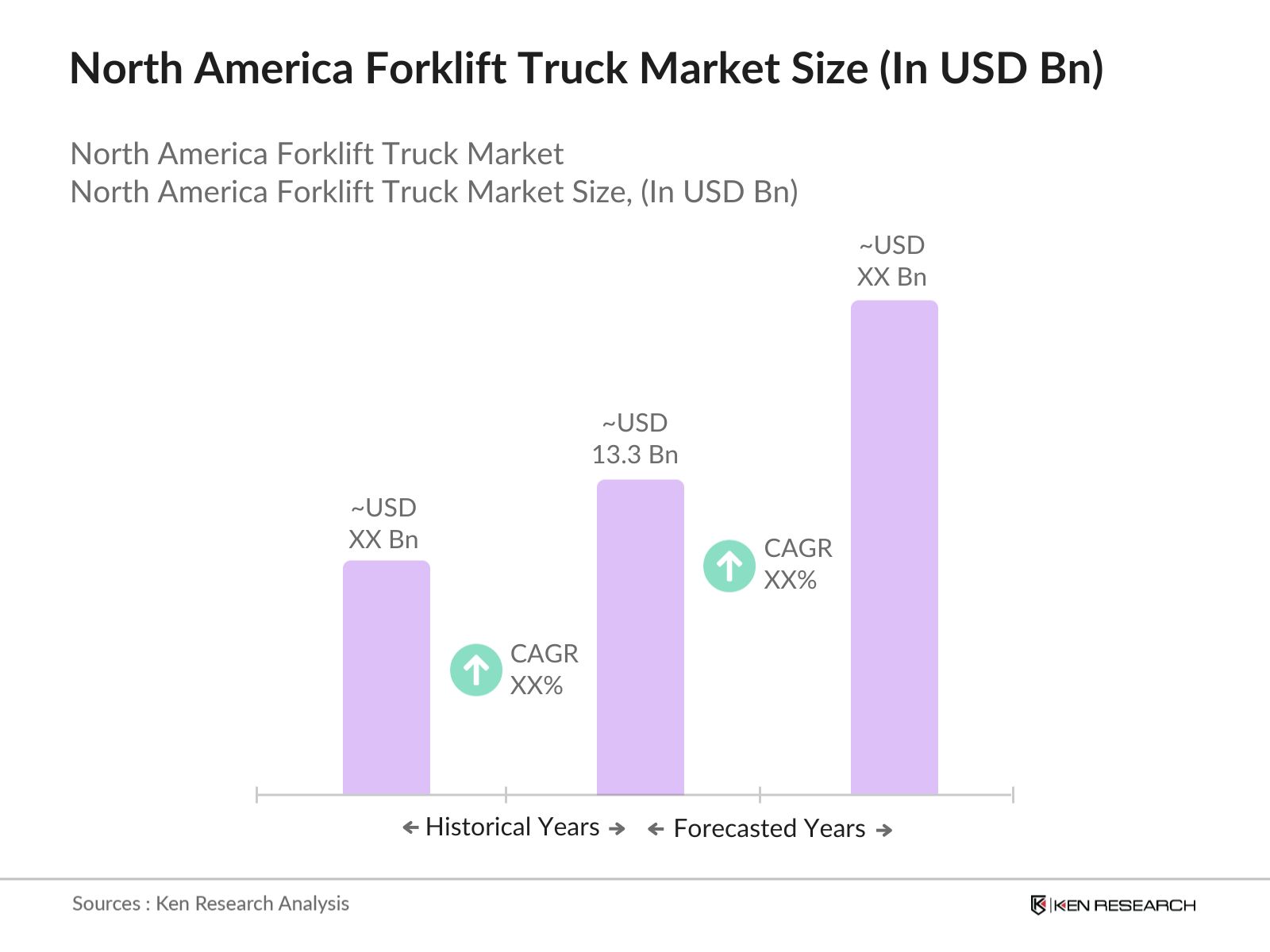
- The United States leads the North America forklift truck market, largely due to its extensive warehousing infrastructure, high industrial output, and strong adoption of advanced manufacturing and supply chain automation. Major logistics hubs such as California and Texas significantly contribute to the dominance of this region. Canada also exhibits considerable growth potential due to its thriving retail and logistics sectors. Together, these regions benefit from government support for sustainability practices, pushing for higher adoption of electric forklifts in compliance with strict emission standards.
- The U.S. government, through the EPA,tringent emissions regulations for forklifts, particularly diesel models, to minimize air pollution. These regulations compel manufacturers to innovate cleaner technologies, with a noticeable shift towards electric models in 2024. Companies that do not comply face penalties, urging a broader shift in the industry to align with these environmental standards.
North America Forklift Truck Market Segmentation
By Type: The market is segmented by type into electric forklift trucks, internal combustion (IC) engine forklifts, and fuel cell-powered forklifts. Recently, electric forklift trucks have dominated the market share in this segmentation. This is attributed to the shift toward sustainable solutions and the operational benefits that electric models provide, such as reduced noise levels, lower maintenance needs, and compliance with stringent emission regulations. Moreover, electric forklift trucks are increasingly favored in warehousing and indoor applications, where zero emissions are essential to meet indoor air quality standards. 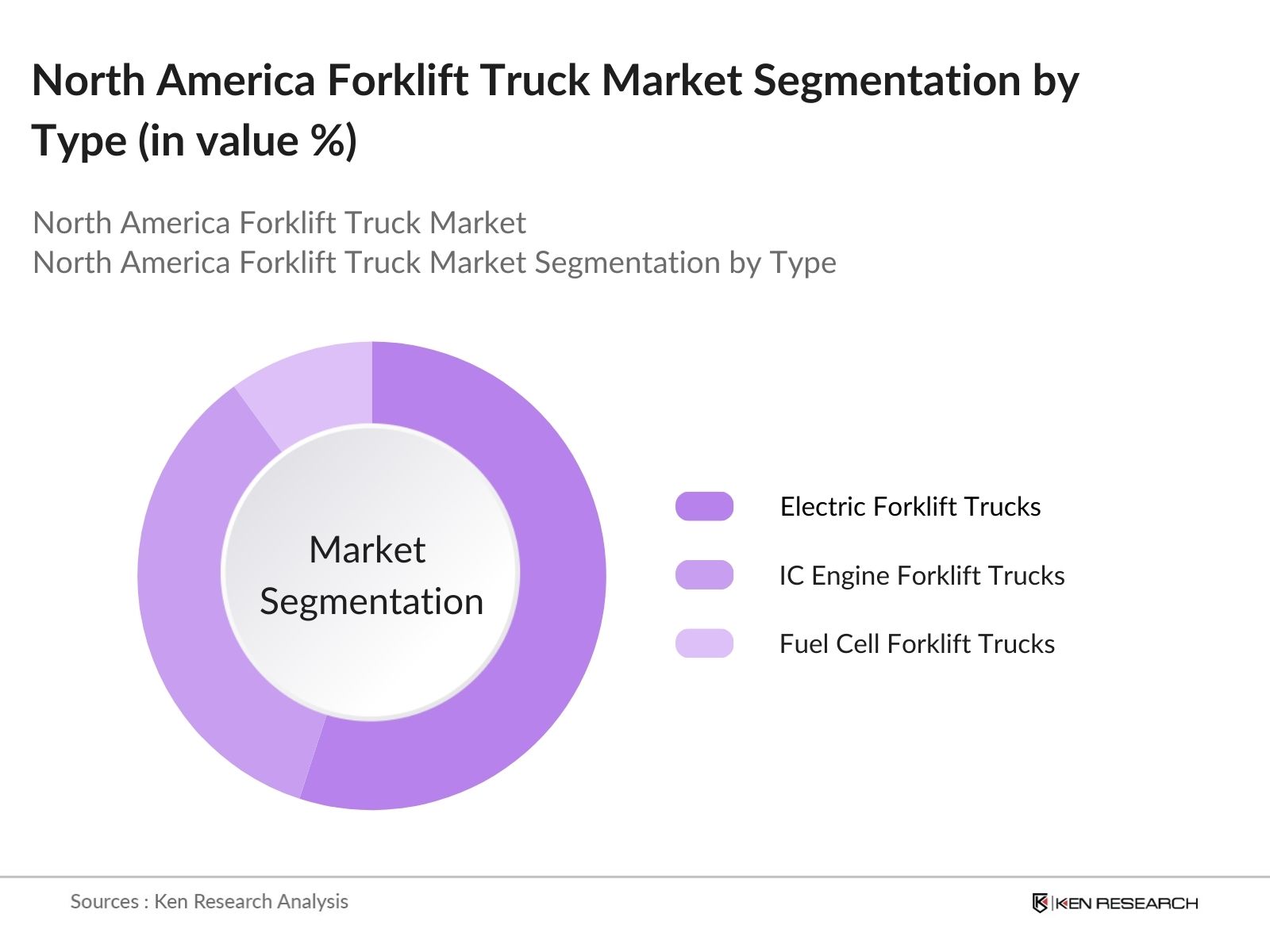
By Capacity: The market is further segmented by capacity, with classifications of less than 2 tons, 25 tons, and above 5 tons. Forklifts with a capacity of 25 tons hold the dominant market share, primarily due to their versatility and suitability for various applications, from warehouse logistics to light industrial operations. Their capacity allows these forklifts to handle a broad range of materials, from packaged goods to medium-sized pallets, making them an ideal choice for the warehousing and distribution sectors. 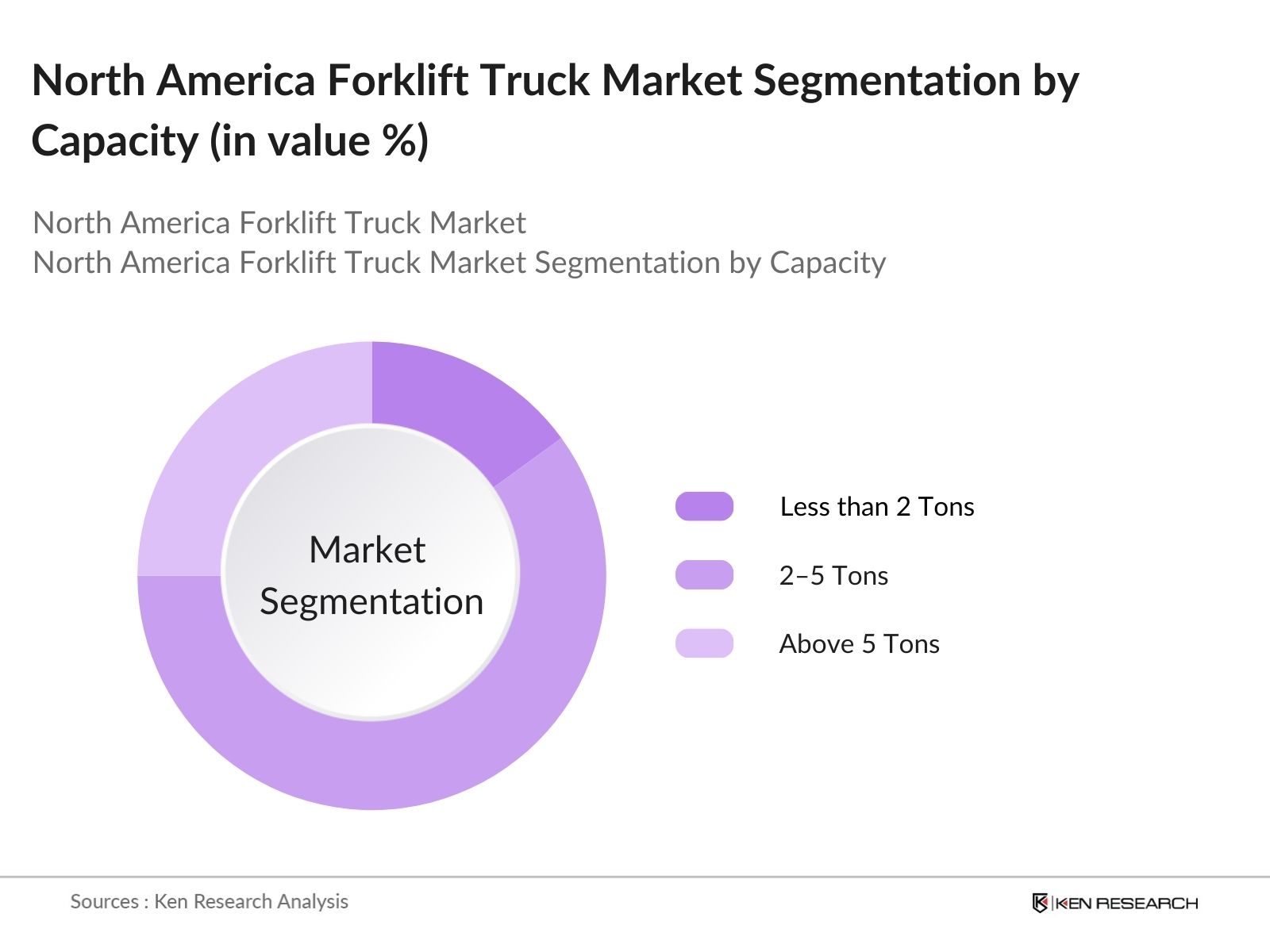
North America Forklift Truck Market Competitive Landscape
The North America forklift truck market is dominated by a few major players, including globally recognized brands like Toyota Industries, KION Group, and Hyster-Yale Materials Handling. This market structure highlights the influence of these key companies due to their extensive product ranges, robust distribution networks, and established relationships with large-scale clients in the logistics and manufacturing sectors.
|
Company |
Establishment Year |
Headquarters |
Annual Revenue |
R&D Expenditure |
Production Capacity |
Market Reach |
Pricing Strategies |
Distribution Network |
|
Toyota Industries Corp |
1926 |
Japan |
||||||
|
KION Group AG |
2006 |
Germany |
||||||
|
Hyster-Yale Materials Inc. |
1985 |
United States |
||||||
|
Jungheinrich AG |
1953 |
Germany |
||||||
|
Crown Equipment Corporation |
1945 |
United States |
North America Forklift Truck Industry Analysis
Growth Drivers
- Expansion Of E-Commerce: The forklift truck market in North America has benefited from the rapid expansion of e-commerce, with the U.S. e-commerce sector alone reaching 1,100 million shipments daily in 2023, largely driving warehouse and logistics demands. The growth of e-commerce has fueled the need for efficient handling equipment, leading to an increased reliance on forklift trucks. This market has seen increased investment in logistics infrastructure, with warehouses adding up to 1,000,000 square meters monthly. Government-backed logistics expansion funding under initiatives like the U.S. Logistics Efficiency Act supports these advancements, contributing to forklift truck demand.
- Increasing Warehouse Automation: Warehouse automation in the North American market has accelerated forklift usage, particularly for automated and semi-automated trucks. As of 2024, 450,000 facilities were upgraded with automated material handling systems, with forklift trucks representing a critical component. This surge is in response to higher consumer demand, particularly in metropolitan hubs like Los Angeles, which saw logistics sector employment rise by 8,000 workers in 2023 to manage increased automation. This trend supports forklift utilization across diverse industries as automation progresses.
- Advancements in Battery Technology: The transition to lithium-ion battery-powered forklift trucks has proven pivotal for North Americas logistics and material handling sectors, particularly as battery capacity has increased by up to 45% in recent years. In 2023, approximately 60% of newly purchased forklifts in the region operated on lithium-ion batteries, with this shift driven by enhanced energy efficiency and lower operational costs. Such improvements have been linked to federal support, including grants under the U.S. Clean Energy Act, encouraging the adoption of sustainable and high-performing equipment.
Market Challenges
- High Capital Expenditure: Forklift trucks represent a high capital expenditure, which can be a barrier for small to medium enterprises. In 2024, the average acquisition cost of a new forklift truck in North America remains high due to inflation in manufacturing costs, driven by the rising prices of steel and other raw materials used in production. This cost factor impacts smaller businesses, which may opt for rentals or second-hand equipment instead. Consequently, high upfront costs challenge market growth, especially among cost-sensitive sectors.
- Shortage of Skilled Operation: A shortage of skilled labor capable of operating advanced forklifts continues to be a challenge in the North American market. In 2023, the U.S. reported a shortfall of over 500,000 skilled trade workers, according to the Bureau of Labor Statistics, impacting sectors such as warehousing and logistics. This labor gap is particularly notable in the operation of advanced forklifts with automation features, as employees often require specific training and certification. This shortage hinders operational efficiency in facilities relying heavily on material handling solutions.
North America Forklift Truck Market Future Outlook
The North America forklift truck market is anticipated to experience robust growth as industries increasingly adopt automated solutions for material handling. The demand is set to be further boosted by continuous technological advancements, especially in electric and autonomous forklift technologies. Growing regulatory support for eco-friendly practices will likely accelerate the shift toward electric forklift trucks, enhancing the market's expansion potential.
Future Market Opportunities
- Growth of Logistics: Cold chain logistics, essential for handling temperature-sensitive products, is expanding rapidly in North America. In 2024, U.S. cold storage capacity reached approximately 4 billion cubic feet, accommodating the growing demand from sectors like pharmaceuticals and food processing. This growth has created a robust demand for specialized forklifts capable of operating in sub-zero temperatures, driving the forklift truck market. With an increase in cold storage investments, the requirement for durable and efficient forklifts is growing.
- Emerging Markets for Forklift Rentals: Forklift e gaining popularity in North America as businesses seek cost-effective options for material handling. In 2024, the U.S. rental equipment industry recorded over USD 55 billion in revenues, with material handling equipment rentals constituting a notable share. This trend enables companies, especially smaller firms, to access advanced forklifts without incurring the full cost of ownership. Rental services are expanding, providing businesses with flexible solutions, particularly in peak demand seasons.
Scope of the Report
|
By Type |
Electric Forklift Trucks |
|
By Class |
Class I: Electric Motor Riders |
|
By Application |
Warehousing and Distribution |
|
By Capacity |
Less than 2 Tons |
|
By Region |
United States |
Products
Key Target Audience
Investor and venture capitalist firms
Government and regulatory bodies (e.g., U.S. Department of Transportation, Environmental Protection Agency)
Warehouse operators and logistics companies
Industrial automation and material handling companies
Forklift rental service providers
Electric vehicle battery manufacturers
Large retail corporations with distribution centers
Sustainable construction and manufacturing companies
Companies
Major Players
Toyota Industries Corporation
KION Group AG
Hyster-Yale Materials Handling, Inc.
Jungheinrich AG
Crown Equipment Corporation
Mitsubishi Logisnext Co., Ltd.
Doosan Corporation Industrial Vehicle
Komatsu Ltd.
Clark Material Handling Company
Hangcha Group Co., Ltd.
Lonking Holdings Limited
Hyundai Heavy Industries Co., Ltd.
Manitou Group
Raymond Corporation
Anhui Heli Co., Ltd.
Table of Contents
1. North America Forklift Truck Market Overview
1.1. Definition and Scope
1.2. Market Taxonomy
1.3. Market Growth Rate
1.4. Market Segmentation Overview
2. North America Forklift Truck Market Size (In USD Mn)
2.1. Historical Market Size
2.2. Year-On-Year Growth Analysis
2.3. Key Market Developments and Milestones
3. North America Forklift Truck Market Analysis
3.1. Growth Drivers
3.1.1. Expansion of E-commerce Sector
3.1.2. Increasing Warehouse Automation
3.1.3. Rise in Industrial Output
3.1.4. Advancements in Battery Technology (e.g., Lithium-Ion)
3.2. Market Challenges
3.2.1. High Capital Expenditure
3.2.2. Shortage of Skilled Labor for Operation
3.2.3. Compliance with Emission Standards
3.3. Opportunities
3.3.1. Growth of Cold Chain Logistics
3.3.2. Emerging Markets for Forklift Rentals
3.3.3. Adoption of IoT in Fleet Management
3.4. Trends
3.4.1. Adoption of Electric Forklifts
3.4.2. Incorporation of AI and Automation
3.4.3. Enhanced Safety Features
3.5. Government Regulation
3.5.1. Emission Regulations
3.5.2. Safety Compliance Standards
3.5.3. Environmental Sustainability Initiatives
3.6. SWOT Analysis
3.7. Stakeholder Ecosystem
3.8. Porters Five Forces
3.9. Competition Ecosystem
4. North America Forklift Truck Market Segmentation
4.1. By Type (In Value %)
4.1.1. Electric Forklift Trucks
4.1.2. Internal Combustion (IC) Engine Forklift Trucks
4.1.3. Fuel Cell Forklift Trucks
4.2. By Class (In Value %)
4.2.1. Class I: Electric Motor Riders
4.2.2. Class II: Electric Narrow Aisle Trucks
4.2.3. Class III: Electric Hand or Hand-Rider Trucks
4.3. By Application (In Value %)
4.3.1. Warehousing and Distribution
4.3.2. Manufacturing
4.3.3. Construction
4.3.4. Logistics
4.4. By Capacity (In Value %)
4.4.1. Less than 2 Tons
4.4.2. 25 Tons
4.4.3. Above 5 Tons
4.5. By Region (In Value %)
4.5.1. United States
4.5.2. Canada
4.5.3. Mexico
5. North America Forklift Truck Market Competitive Analysis
5.1. Detailed Profiles of Major Companies
5.1.1. Toyota Industries Corporation
5.1.2. KION Group AG
5.1.3. Jungheinrich AG
5.1.4. Mitsubishi Logisnext Co., Ltd.
5.1.5. Crown Equipment Corporation
5.1.6. Hyster-Yale Materials Handling, Inc.
5.1.7. Doosan Corporation Industrial Vehicle
5.1.8. Clark Material Handling Company
5.1.9. Komatsu Ltd.
5.1.10. Hangcha Group Co., Ltd.
5.1.11. Lonking Holdings Limited
5.1.12. Hyundai Heavy Industries Co., Ltd.
5.1.13. Anhui Heli Co., Ltd.
5.1.14. Manitou Group
5.1.15. Raymond Corporation
5.2. Cross Comparison Parameters (Market Share, Annual Revenue, R&D Expenditure, Production Capacity, Market Reach, Technological Capabilities, Pricing Strategies, Distribution Network)
5.3. Market Share Analysis
5.4. Strategic Initiatives
5.5. Mergers and Acquisitions
5.6. Investment Analysis
5.7. Venture Capital Funding
5.8. Government Grants
5.9. Private Equity Investments
6. North America Forklift Truck Market Regulatory Framework
6.1. Environmental Standards
6.2. Compliance Requirements
6.3. Certification Processes
7. North America Forklift Truck Future Market Size (In USD Mn)
7.1. Future Market Size Projections
7.2. Key Factors Driving Future Market Growth
8. North America Forklift Truck Future Market Segmentation
8.1. By Type (In Value %)
8.2. By Class (In Value %)
8.3. By Application (In Value %)
8.4. By Capacity (In Value %)
8.5. By Region (In Value %)
9. North America Forklift Truck Market Analysts Recommendations
9.1. TAM/SAM/SOM Analysis
9.2. Customer Cohort Analysis
9.3. Marketing Initiatives
9.4. White Space Opportunity Analysis
Research Methodology
Step 1: Identification of Key Variables
In the initial phase, an ecosystem map was constructed to encompass all primary stakeholders in the North America forklift truck market. Extensive desk research, combined with proprietary databases, identified critical variables shaping the market, including manufacturing processes and technological trends.
Step 2: Market Analysis and Construction
Historical data was analyzed to gauge the market penetration of forklift truck types across various capacities and applications. Key metrics, such as market reach and product adoption rates, were compiled to build a solid foundation for revenue estimation and segment analysis.
Step 3: Hypothesis Validation and Expert Consultation
Market hypotheses were developed and validated through expert consultations conducted with industry stakeholders, including manufacturers and logistics operators. This stage provided nuanced insights into operational and financial aspects of the industry, which helped refine the market estimates.
Step 4: Research Synthesis and Final Output
The final phase involved direct engagement with forklift manufacturers and industry experts to corroborate product segment insights, sales performance, and consumer preferences. This stage ensured the accuracy and comprehensiveness of the report, validating the findings from bottom-up analysis.
Frequently Asked Questions
01. How big is the North America Forklift Truck Market?
The North America forklift truck market was valued at USD 13.3 billion, driven by the rise in e-commerce, warehousing automation, and the adoption of electric forklifts due to their sustainability and efficiency.
02. What are the challenges in the North America Forklift Truck Market?
The North America forklift truck market faces challenges such as high capital expenditure requirements, skilled labor shortages, and stringent emission standards that necessitate costly technological updates and compliance strategies.
03. Who are the major players in the North America Forklift Truck Market?
Leading players in the North America forklift truck market include Toyota Industries Corporation, KION Group AG, Hyster-Yale Materials Handling, Inc., Jungheinrich AG, and Crown Equipment Corporation, whose market dominance is due to their extensive portfolios and strong distribution networks.
04. What are the growth drivers of the North America Forklift Truck Market?
Key drivers in the North America forklift truck market include the demand for automation in warehouses, the surge in industrial output, and the preference for sustainable material handling solutions, notably electric forklift trucks.
05. How is government regulation impacting the North America Forklift Truck Market?
Government regulations promoting sustainability and reducing emissions are significantly shaping the market, especially through incentives for electric forklifts and adherence to environmental standards across sectors in the North America forklift truck market.
Why Buy From Us?

What makes us stand out is that our consultants follows Robust, Refine and Result (RRR) methodology. i.e. Robust for clear definitions, approaches and sanity checking, Refine for differentiating respondents facts and opinions and Result for presenting data with story

We have set a benchmark in the industry by offering our clients with syndicated and customized market research reports featuring coverage of entire market as well as meticulous research and analyst insights.

While we don't replace traditional research, we flip the method upside down. Our dual approach of Top Bottom & Bottom Top ensures quality deliverable by not just verifying company fundamentals but also looking at the sector and macroeconomic factors.

With one step in the future, our research team constantly tries to show you the bigger picture. We help with some of the tough questions you may encounter along the way: How is the industry positioned? Best marketing channel? KPI's of competitors? By aligning every element, we help maximize success.

Our report gives you instant access to the answers and sources that other companies might choose to hide. We elaborate each steps of research methodology we have used and showcase you the sample size to earn your trust.

If you need any support, we are here! We pride ourselves on universe strength, data quality, and quick, friendly, and professional service.