















North America Gaming Simulator Market Outlook to 2030
Region:North America
Author(s):Sanjna
Product Code:KROD11078
November 2024
93
About the Report
North America Gaming Simulator Market Overview
- The North America gaming simulator market is valued at USD 2.5 billion, driven by rapid advancements in virtual reality (VR) and augmented reality (AR) technologies. The increased realism and immersive experience offered by VR and AR attract a wide range of users, from casual gamers to competitive esports players. In addition to hardware innovations, software developments, such as AI-powered personalization and real-time multiplayer gaming, contribute to market growth.

- The United States dominates the North American gaming simulator market due to its well-established gaming industry, high disposable income, and early adoption of new technologies. The U.S. also has a robust infrastructure for esports, with numerous tournaments, sponsorships, and dedicated arenas attracting global audiences. This infrastructure provides an ideal environment for gaming simulator growth, especially in high-adrenaline segments such as racing and shooting games.
- The integration of the Internet of Things (IoT) in gaming simulators is transforming the user experience by enabling real-time data exchange and enhanced interactivity. In 2023, North America had approximately 2 billion IoT-connected devices, according to the U.S. Federal Communications Commission. This growing IoT infrastructure allows gaming simulators to gather and analyze user data, offering customized gaming environments and improving system maintenance. The U.S. Department of Commerce highlighted that IoT contributed $450 billion to the tech sector, supporting advancements in gaming simulators with smart features and dynamic content.
North America Gaming Simulator Market Segmentation
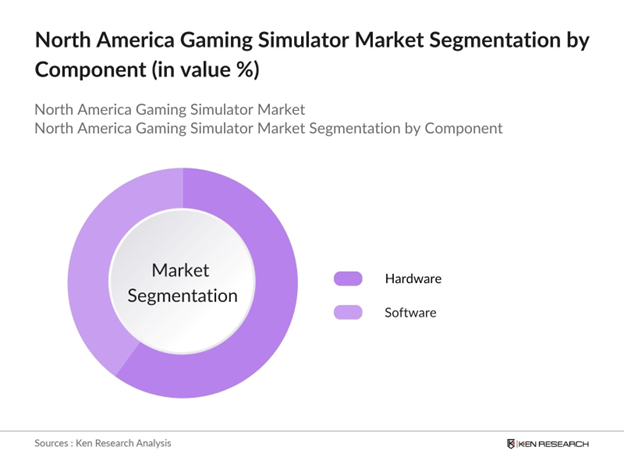
By Component: The North America gaming simulator market is segmented into hardware and software components. Hardware components currently dominate the market. This segment includes VR headsets, gaming consoles, motion-sensing devices, and advanced control systems that provide a realistic and immersive gaming experience. The high demand for advanced hardware is driven by consumers desire for life-like interactions and increased immersion, as well as the growth in dedicated gaming spaces, esports venues, and high-tech gaming arcades.
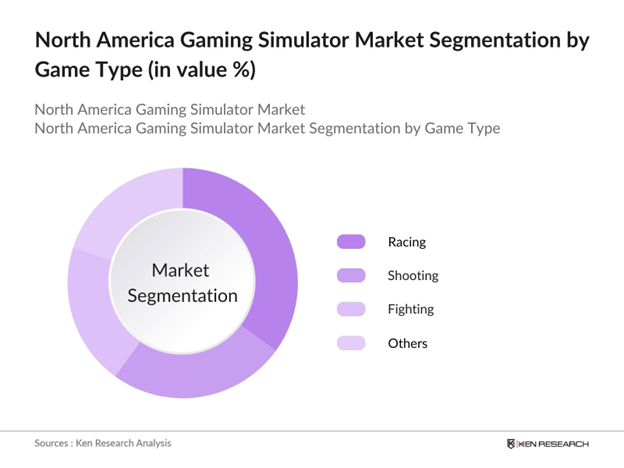
By Game Type: The market is further categorized by game type into racing, shooting, fighting, and other game types. Racing games hold a dominant position. Racing simulators are widely popular due to the realistic and thrilling experience they offer, replicating real-world driving dynamics and track environments. Many gaming simulators are outfitted with force-feedback wheels, hydraulic motion bases, and pedal controls that mimic real driving, making racing simulators a favorite among enthusiasts and esports competitors.
North America Gaming Simulator Market Competitive Landscape
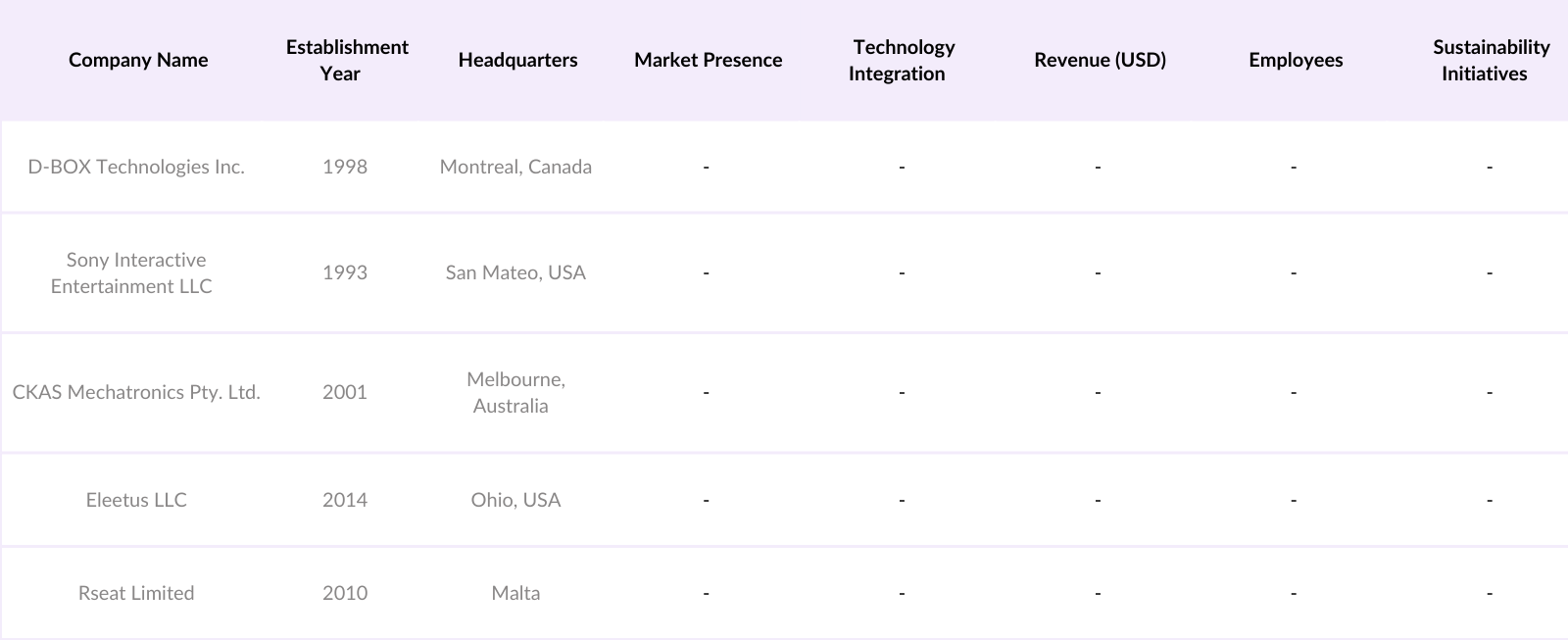
The North America gaming simulator market is characterized by the presence of key players who drive innovation and competition.
North America Gaming Simulator Market Analysis
Growth Drivers
- Technological Advancements in VR and AR: The North American gaming simulator market is experiencing significant growth due to advancements in Virtual Reality (VR) and Augmented Reality (AR) technologies. In 2023, the United States allocated approximately $1.2 billion to VR and AR research and development, reflecting a strong commitment to these technologies. This investment has led to the creation of more immersive gaming experiences, attracting a larger user base. The U.S. Department of Commerce reported that the tech sector, including VR and AR, contributed over $1.6 trillion to the national economy in 2023, underscoring the sector's economic significance.
- Rising Popularity of eSports: The eSports industry in North America has seen substantial growth; This surge is driven by increased viewership and participation, with over 30 million active eSports participants in the United States alone. The U.S. Bureau of Labor Statistics notes that the entertainment sector, including eSports, employed over 2 million individuals in 2023, highlighting its economic impact. The rising popularity of eSports has led to a higher demand for gaming simulators, as players seek to enhance their skills and experience realistic training environments.
- Increasing Disposable Income: In 2023, the median household income in the United States was approximately $70,000, reflecting a steady increase over the past decade. This rise in disposable income has enabled consumers to spend more on entertainment and leisure activities, including gaming simulators. The U.S. Bureau of Economic Analysis reported that personal consumption expenditures on recreational goods and services reached $1.2 trillion in 2023, indicating a robust market for gaming-related products. This financial capacity allows consumers to invest in high-quality gaming experiences, driving the growth of the gaming simulator market.
Challenges
- High Initial Costs: The initial investment required for high-quality gaming simulators remains a significant barrier for many consumers. In 2023, the average cost of a comprehensive gaming simulator setup, including VR equipment and compatible hardware, ranged from $1,500 to $3,000. The U.S. Census Bureau reported that approximately 13% of households had incomes below $25,000 in 2023, limiting their ability to afford such luxury items. This high cost restricts market growth, as a substantial portion of the population cannot access these advanced gaming experiences.
- Technical Challenges: Technical issues, such as software compatibility and hardware malfunctions, pose challenges to the gaming simulator market. In 2023, the Consumer Product Safety Commission received over 5,000 complaints related to gaming hardware malfunctions. Additionally, the rapid pace of technological advancement can render existing systems obsolete, requiring consumers to invest in frequent upgrades. These technical challenges can deter potential customers and affect the overall user experience, hindering market growth.
North America Gaming Simulator Market Future Outlook
Over the next five years, the North America gaming simulator market is expected to experience significant growth, driven by continuous technological advancements, increasing consumer demand for immersive gaming experiences, and the expansion of esports. The integration of AI and machine learning to personalize gaming experiences and the rise of cloud gaming are anticipated to open new avenues for market expansion.
Market Opportunities
- Technological Advancements: Ongoing technological innovations present significant opportunities for the gaming simulator market. The U.S. National Science Foundation allocated $500 million in 2023 for research in immersive technologies, including VR and AR. These advancements can lead to more affordable and user-friendly gaming simulators, attracting a broader audience. The integration of artificial intelligence and machine learning can also enhance the gaming experience by providing personalized content and adaptive gameplay.
- International Collaborations: Collaborations between North American gaming companies and international partners can drive market growth. In 2023, the U.S. Department of Commerce reported that exports of gaming software and equipment reached $2 billion, indicating strong international demand. Partnerships can lead to the development of culturally diverse gaming content and the sharing of technological expertise, enhancing the global appeal of gaming simulators.
Scope of the Report
|
Segment |
Sub-Segments |
|
By Component |
- Hardware |
|
By Game Type |
- Racing |
|
By End-User |
- Residential |
|
By Motion Technology |
- Hydraulic |
|
By Degree of Freedom (DOF) |
- 1-DOF |
Products
Key Target Audience
Gaming Console Manufacturers
VR and AR Technology Developers
Esports Organizations
Gaming Software Developers
Motion Simulation Equipment Suppliers
Entertainment Centers and Arcades
Investors and Venture Capitalist Firms
Government and Regulatory Bodies (e.g., Federal Communications Commission)
Companies
Players Mentioned in the Report
D-BOX Technologies Inc.
Sony Interactive Entertainment LLC
CKAS Mechatronics Pty. Ltd.
Eleetus LLC
Rseat Limited
Vesaro Limited
GTR Simulators (Abtivan)
Cruden B.V.
CXC Simulations
3D Perception Inc.
Table of Contents
1. North America Gaming Simulator Market Overview
1.1 Definition and Scope
1.2 Market Taxonomy
1.3 Market Growth Rate
1.4 Market Segmentation Overview
2. North America Gaming Simulator Market Size (In USD Billion)
2.1 Historical Market Size
2.2 Year-On-Year Growth Analysis
2.3 Key Market Developments and Milestones
3. North America Gaming Simulator Market Analysis
3.1 Growth Drivers
3.1.1 Technological Advancements in VR and AR
3.1.2 Rising Popularity of eSports
3.1.3 Increasing Disposable Income
3.1.4 Expansion of Gaming Platforms
3.2 Market Challenges
3.2.1 High Initial Costs
3.2.2 Technical Challenges
3.2.3 Limited Accessibility
3.3 Opportunities
3.3.1 Technological Advancements
3.3.2 International Collaborations
3.3.3 Expansion into Rural Areas
3.4 Trends
3.4.1 Adoption of IoT
3.4.2 Integration with Smart City Projects
3.4.3 Increased Use of Mobile Monitoring Units
3.5 Government Regulation
3.5.1 National Air Quality Monitoring Program
3.5.2 Emission Reduction Targets
3.5.3 Clean Air Initiative
3.5.4 Public-Private Partnerships
3.6 SWOT Analysis
3.7 Stake Ecosystem
3.8 Porter’s Five Forces
3.9 Competition Ecosystem
4. North America Gaming Simulator Market Segmentation
4.1 By Component (In Value %)
4.1.1 Hardware
4.1.2 Software
4.2 By Game Type (In Value %)
4.2.1 Racing
4.2.2 Shooting
4.2.3 Fighting
4.2.4 Others
4.3 By End-User (In Value %)
4.3.1 Residential
4.3.2 Commercial
4.4 By Motion Technology (In Value %)
4.4.1 Hydraulic
4.4.2 Electric
4.4.3 Pneumatic
4.5 By Degree of Freedom (DOF) (In Value %)
4.5.1 1-DOF
4.5.2 2-DOF
4.5.3 3-DOF
4.5.4 6-DOF
5. North America Gaming Simulator Market Competitive Analysis
5.1 Detailed Profiles of Major Companies
5.1.1 D-BOX Technologies Inc.
5.1.2 Sony Corporation (Sony Interactive Entertainment LLC)
5.1.3 CKAS Mechatronics Pty. Ltd.
5.1.4 Eleetus LLC
5.1.5 Rseat Limited
5.1.6 Vesaro Limited
5.1.7 GTR Simulators (Abtivan)
5.1.8 Cruden B.V.
5.1.9 CXC Simulations
5.1.10 3D Perception Inc.
5.2 Cross Comparison Parameters (No. of Employees, Headquarters, Inception Year, Revenue, Product Portfolio, Market Share, R&D Investment, Regional Presence)
5.3 Market Share Analysis
5.4 Strategic Initiatives
5.5 Mergers and Acquisitions
5.6 Investment Analysis
5.7 Venture Capital Funding
5.8 Government Grants
5.9 Private Equity Investments
6. North America Gaming Simulator Market Regulatory Framework
6.1 Environmental Standards
6.2 Compliance Requirements
6.3 Certification Processes
7. North America Gaming Simulator Future Market Size (In USD Billion)
7.1 Future Market Size Projections
7.2 Key Factors Driving Future Market Growth
8. North America Gaming Simulator Future Market Segmentation
8.1 By Component (In Value %)
8.2 By Game Type (In Value %)
8.3 By End-User (In Value %)
8.4 By Motion Technology (In Value %)
8.5 By Degree of Freedom (DOF) (In Value %)
9. North America Gaming Simulator Market Analysts’ Recommendations
9.1 TAM/SAM/SOM Analysis
9.2 Customer Cohort Analysis
9.3 Marketing Initiatives
9.4 White Space Opportunity Analysis
Disclaimer
Contact Us
Research Methodology
Step 1: Identification of Key Variables
The initial phase involves constructing an ecosystem map encompassing all major stakeholders within the North America Gaming Simulator Market. This step is underpinned by extensive desk research, utilizing a combination of secondary and proprietary databases to gather comprehensive industry-level information. The primary objective is to identify and define the critical variables that influence market dynamics.
Step 2: Market Analysis and Construction
In this phase, we compile and analyze historical data pertaining to the North America Gaming Simulator Market. This includes assessing market penetration, the ratio of marketplaces to service providers, and the resultant revenue generation. Furthermore, an evaluation of service quality statistics is conducted to ensure the reliability and accuracy of the revenue estimates.
Step 3: Hypothesis Validation and Expert Consultation
Market hypotheses are developed and subsequently validated through computer-assisted telephone interviews (CATIs) with industry experts representing a diverse array of companies. These consultations provide valuable operational and financial insights directly from industry practitioners, which are instrumental in refining and corroborating the market data.
Step 4: Research Synthesis and Final Output
The final phase involves direct engagement with multiple gaming simulator manufacturers to acquire detailed insights into product segments, sales performance, consumer preferences, and other pertinent factors. This interaction serves to verify and complement the statistics derived from the bottom-up approach, thereby ensuring a comprehensive, accurate, and validated analysis of the North America Gaming Simulator Market.
Frequently Asked Questions
01. How big is the North America Gaming Simulator Market?
The North America gaming simulator market is valued at USD 2.5 billion, driven by technological advancements and the increasing popularity of immersive gaming experiences. The increased realism and immersive experience offered by VR and AR attract a wide range of users, from casual gamers to competitive esports players.
02. What are the challenges in the North America Gaming Simulator Market?
Challenges in North America gaming simulator market include high initial costs, technical complexities, and limited accessibility for some consumers. Additionally, the rapid pace of technological change requires continuous investment in research and development.
03. Who are the major players in the North America Gaming Simulator Market?
Key players in North America gaming simulator market include D-BOX Technologies Inc., Sony Interactive Entertainment LLC, CKAS Mechatronics Pty. Ltd., Eleetus LLC, and Rseat Limited. These companies lead the market through innovation and extensive product offerings.
04. What are the growth drivers of the North America Gaming Simulator Market?
North America gaming simulator market is propelled by advancements in VR and AR technologies, the rising popularity of esports, increasing disposable incomes, and the expansion of gaming platforms.
Why Buy From Us?

What makes us stand out is that our consultants follows Robust, Refine and Result (RRR) methodology. i.e. Robust for clear definitions, approaches and sanity checking, Refine for differentiating respondents facts and opinions and Result for presenting data with story

We have set a benchmark in the industry by offering our clients with syndicated and customized market research reports featuring coverage of entire market as well as meticulous research and analyst insights.

While we don't replace traditional research, we flip the method upside down. Our dual approach of Top Bottom & Bottom Top ensures quality deliverable by not just verifying company fundamentals but also looking at the sector and macroeconomic factors.

With one step in the future, our research team constantly tries to show you the bigger picture. We help with some of the tough questions you may encounter along the way: How is the industry positioned? Best marketing channel? KPI's of competitors? By aligning every element, we help maximize success.

Our report gives you instant access to the answers and sources that other companies might choose to hide. We elaborate each steps of research methodology we have used and showcase you the sample size to earn your trust.

If you need any support, we are here! We pride ourselves on universe strength, data quality, and quick, friendly, and professional service.