















North America Glycerol Monostearate (GMS) Market Outlook to 2030
Region:North America
Author(s):Vijay Kumar
Product Code:KROD10264
November 2024
89
About the Report
North America Glycerol Monostearate (GMS) Market Overview
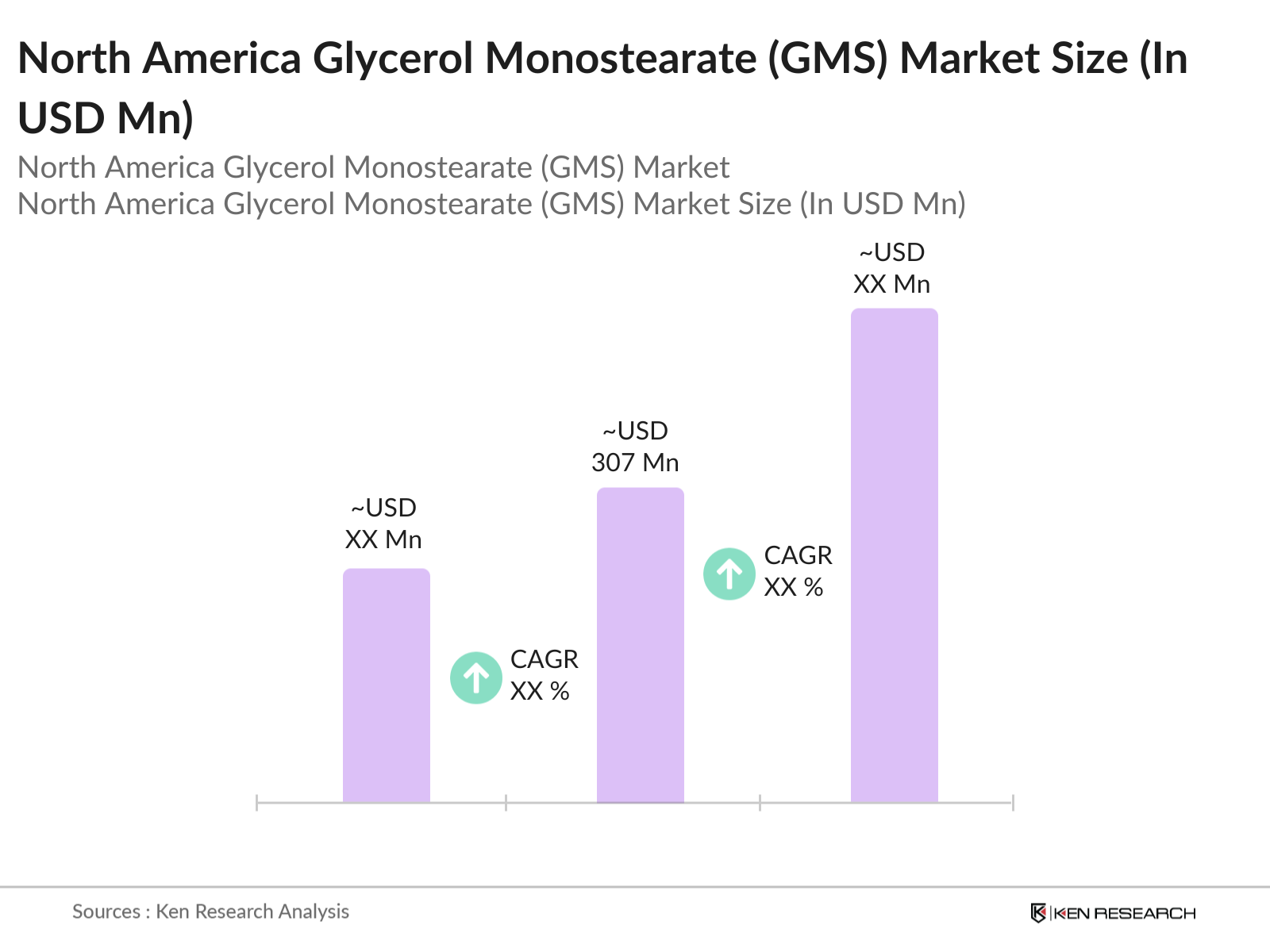
- The North America Glycerol Monostearate market is valued at USD 307 million, based on a five-year historical analysis. This market is primarily driven by high demand from the food and beverage, personal care, and pharmaceutical industries, where GMS functions as a stabilizer, emulsifier, and thickening agent. With increasing applications in processed foods, skincare products, and medical formulations, GMS has become essential for ensuring product stability, consistency, and longer shelf life, particularly in high-demand markets like the United States and Canada.
- The United States is the leading market for GMS in North America due to its extensive food processing, cosmetics, and pharmaceutical sectors, which rely on high-quality emulsifiers and stabilizers. Canada also plays a significant role, with a focus on food production and processing, alongside stringent quality regulations in pharmaceuticals that make GMS a vital additive. Both countries benefit from established regulatory frameworks and consumer preferences for processed food and personal care products.
- In North America, GMS is regulated by the FDA, which classifies it as Generally Recognized as Safe (GRAS) for use in food products. Manufacturers must adhere to specific usage limits and labeling requirements to ensure compliance. In Canada, GMS is regulated under the Food and Drugs Act, with similar safety and labeling standards.
North America Glycerol Monostearate (GMS) Market Segmentation
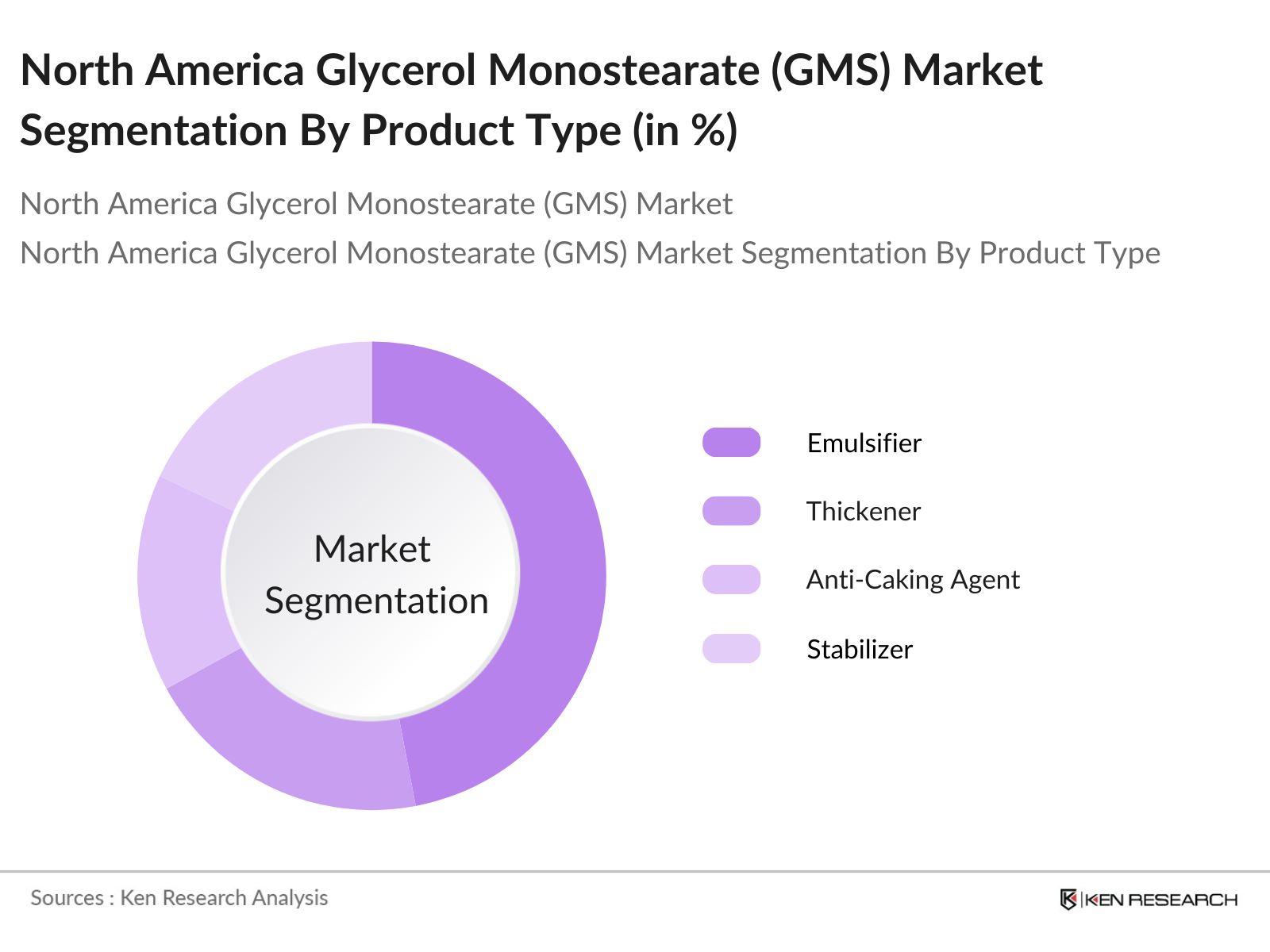
By Product Type: The North America GMS market is segmented by product type into emulsifier, thickening agent, anti-caking agent, stabilizer, and lubricant. Among these, emulsifiers hold a dominant market share due to their essential role in processed foods, cosmetics, and pharmaceuticals, which demand stable emulsions. The food industry uses emulsifiers to improve texture and shelf-life, while the cosmetic sector benefits from enhanced stability in lotions and creams.
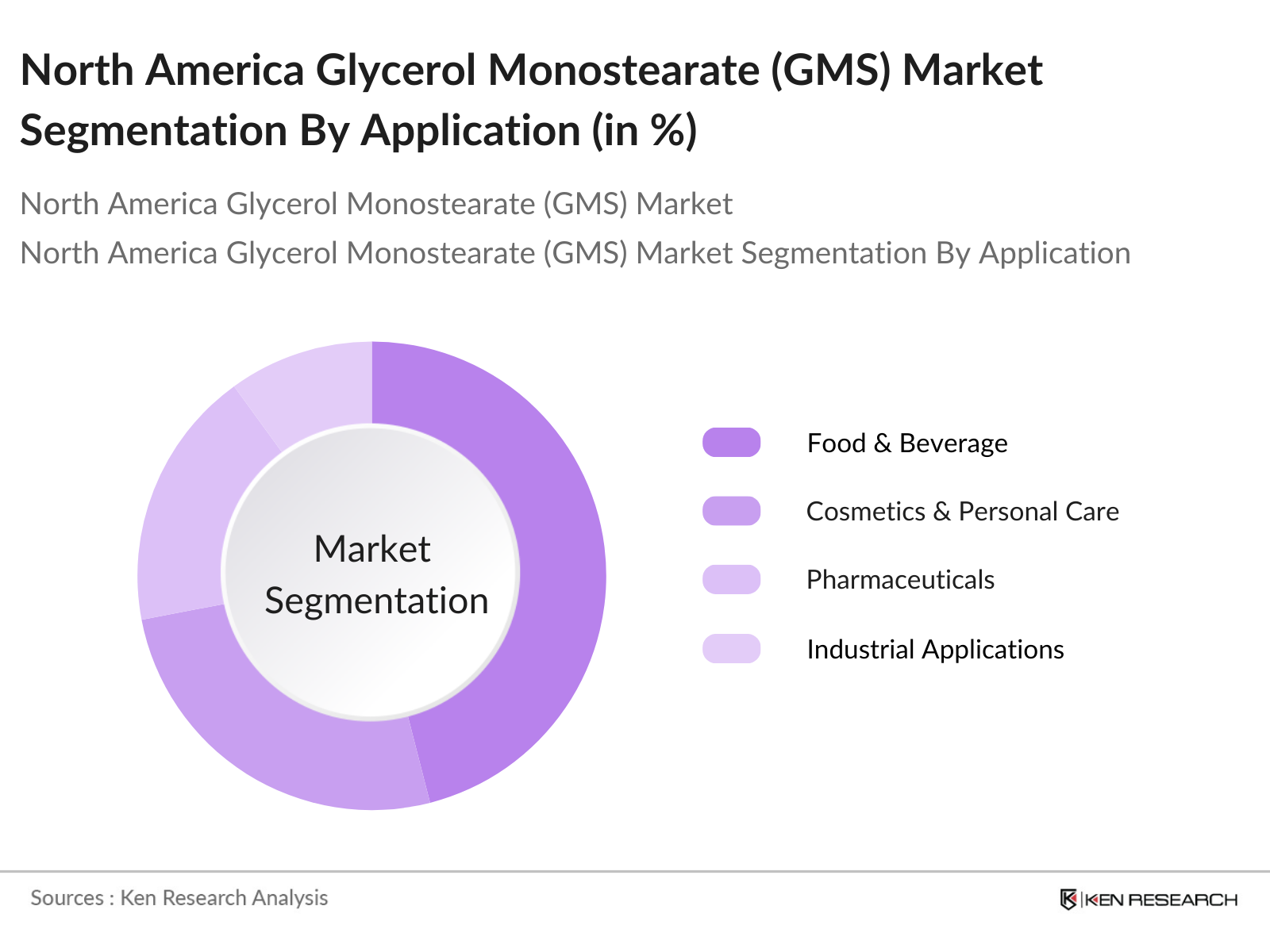
By Application: The North America GMS market by application includes food & beverage, cosmetics & personal care, pharmaceuticals, industrial applications, and plastics & polymers. The food & beverage segment leads, largely due to consumer preferences for processed foods that require emulsifying agents for texture and consistency. Cosmetics & personal care products follow, using GMS in moisturizers and lotions to improve hydration and stability.
North America Glycerol Monostearate (GMS) Market Competitive Landscape
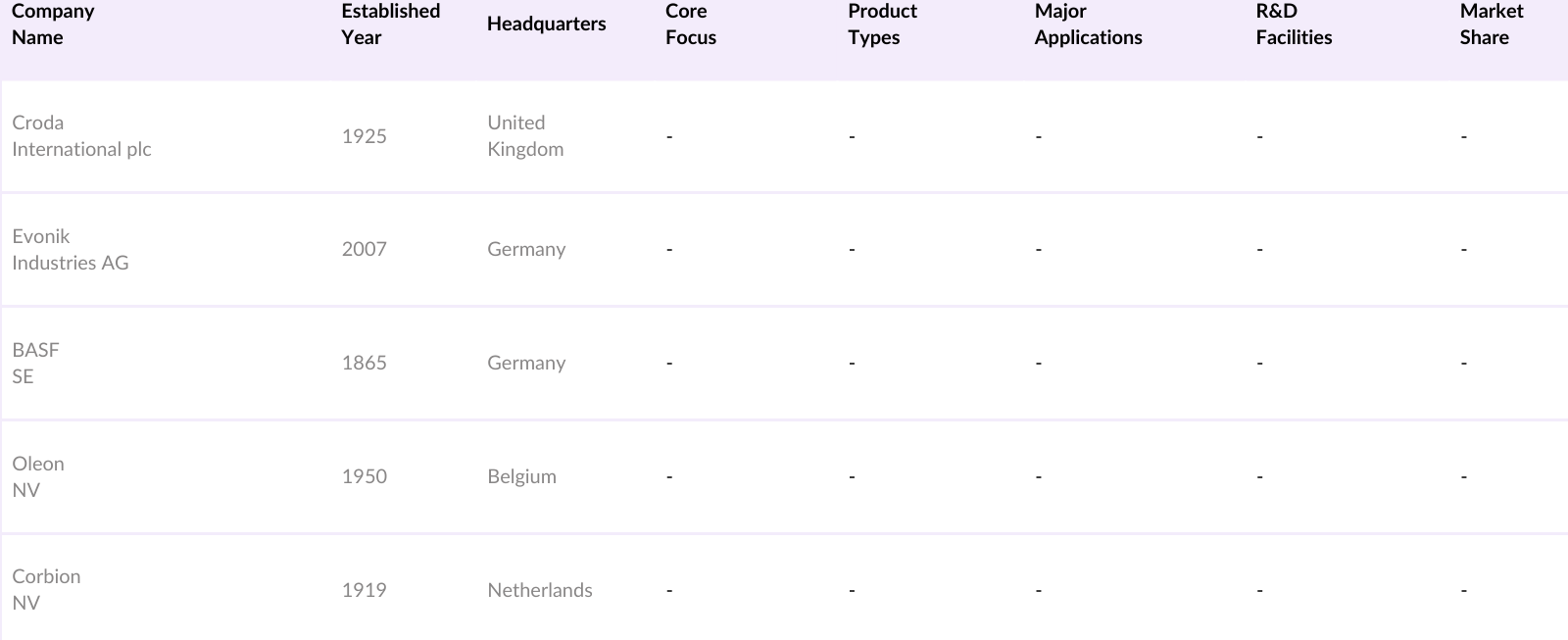
The North America Glycerol Monostearate market features several key players with a strong presence across the value chain, particularly in food and pharmaceutical applications. Major players actively pursue strategic partnerships and innovation to enhance market reach and product quality, highlighting the competitive nature of this market segment.
North America Glycerol Monostearate (GMS) Industry Analysis
Growth Drivers
- Rising Demand in Processed Food and Pharmaceuticals: The global processed food industry has seen substantial growth, with the World Bank reporting that food manufacturing value added reached approximately $1.5 trillion in 2022. This expansion has increased the need for emulsifiers like glycerol monostearate (GMS) to enhance product texture and shelf life. In the pharmaceutical sector, the global pharmaceutical market was valued at over $1.4 trillion in 2022, according to the International Federation of Pharmaceutical Manufacturers & Associations.
- Growth in Personal Care and Cosmetic Applications: The personal care and cosmetics industry has experienced significant growth, with global revenues reaching approximately $500 billion in 2022, as reported by the World Bank. GMS is widely used as an emulsifying agent in creams, lotions, and other cosmetic products, contributing to its increased demand. The rising consumer focus on skincare and grooming products has further propelled the use of GMS in this sector.
- Advancements in GMS Manufacturing Processes: Technological advancements have improved the efficiency and quality of GMS production. Innovations in esterification processes have led to higher purity levels of GMS, enhancing its functionality in various applications. These advancements have reduced production costs and increased the availability of high-quality GMS for industrial use.
Market Challenges
- Health Regulations and Standards: The food and pharmaceutical industries are subject to stringent health regulations to ensure consumer safety. Compliance with standards set by agencies such as the U.S. Food and Drug Administration (FDA) and the European Food Safety Authority (EFSA) requires continuous monitoring and adaptation by GMS manufacturers. Non-compliance can lead to product recalls and legal challenges, posing a significant challenge to market players.
- Impact of Veganism and Health-Conscious Trends: The rise in veganism and health-conscious consumer behavior has influenced ingredient choices in food and cosmetics. Consumers are increasingly seeking plant-based and natural ingredients, which may affect the demand for GMS, especially if it is derived from animal sources. Manufacturers need to adapt to these trends to maintain market relevance.
North America Glycerol Monostearate (GMS) Market Future Outlook
Over the coming years, the North America Glycerol Monostearate market is projected to experience continued growth fueled by rising consumer demand for processed foods and high-quality personal care products. Additionally, advancements in food processing and pharmaceutical formulations are likely to drive the adoption of GMS, as industries increasingly seek emulsifying and stabilizing agents for product stability and shelf-life improvement.
Market Opportunities
- Expansion in Emerging Sectors (Agrochemicals, Oilfield): GMS has potential applications in emerging sectors such as agrochemicals and oilfield services. In agrochemicals, GMS can act as an emulsifier in pesticide formulations, enhancing product stability. The global agrochemical market was valued at approximately $235 billion in 2022, indicating a substantial opportunity for GMS integration. In the oilfield industry, GMS can be used as a surfactant in drilling fluids, with the global oilfield chemicals market valued at around $28 billion in 2022.
- Technological Innovations in Production: Ongoing research and development efforts are focused on improving GMS production methods, such as enzymatic esterification, which offers higher specificity and efficiency. These innovations can lead to cost reductions and enhanced product quality, providing a competitive edge to manufacturers.
Scope of the Report
|
Product Type |
Emulsifier Thickener Anti-Caking Stabilizer Lubricant |
|
Application |
Food & Beverage Cosmetics & Personal Care Pharmaceuticals Industrial Plastics & Polymers |
|
Content |
Below 90% 90-95% 95-98% Above 98% |
|
End-User |
Manufacturers Retailers Research Institutions |
|
Country |
United States Canada Mexico |
Products
Key Target Audience
Processed Food Manufacturers
Cosmetic & Personal Care Product Developers
Pharmaceutical Companies
Industrial Chemical Suppliers
Plastic and Polymer Manufacturers
Investments and Venture Capitalist Firms
Government and Regulatory Bodies (e.g., FDA, Health Canada)
Agricultural and Agrochemical Firms
Companies
Players Mentioned in the Report
Croda International plc
Evonik Industries AG
BASF SE
Oleon NV
Corbion NV
Stepan Company
Alpha Chemicals Pvt. Ltd.
Musim Mas Holdings
Vantage Specialty Ingredients
Kao Corporation
Table of Contents
1. Market Overview
1.1 Definition and Scope
1.2 Market Taxonomy
1.3 Key Market Indicators
1.4 Growth Rate and Market Potential
2. North America Glycerol Monostearate Market Size (USD Million)
2.1 Historical Market Size
2.2 Current Market Size
2.3 Year-On-Year Growth Analysis
2.4 Market Developments and Key Milestones
3. Market Dynamics and Analysis
3.1 Growth Drivers
3.1.1 Rising Demand in Processed Food and Pharmaceuticals
3.1.2 Growth in Personal Care and Cosmetic Applications
3.1.3 Advancements in GMS Manufacturing Processes
3.2 Market Challenges
3.2.1 Health Regulations and Standards
3.2.2 Competition from Alternative Ingredients
3.2.3 Impact of Veganism and Health-Conscious Trends
3.3 Opportunities
3.3.1 Expansion in Emerging Sectors (Agrochemicals, Oilfield)
3.3.2 Technological Innovations in Production
3.3.3 Rising R&D in Cosmetic Applications
3.4 Key Trends
3.4.1 Increased Use as an Emulsifier and Stabilizer
3.4.2 Use in Nutraceuticals and Specialty Supplements
3.4.3 Demand for Plant-Based Ingredients
3.5 Regulatory Landscape
3.5.1 North American Regulatory Standards
3.5.2 Product Compliance and Certifications
3.5.3 Key Government Initiatives
4. North America Glycerol Monostearate Market Segmentation
4.1 By Product Type (In Market Share %)
4.1.1 Emulsifier
4.1.2 Thickener
4.1.3 Anti-Caking Agent
4.1.4 Stabilizer
4.1.5 Lubricant
4.2 By Application (In Market Share %)
4.2.1 Food & Beverage
4.2.2 Cosmetics & Personal Care
4.2.3 Pharmaceuticals
4.2.4 Industrial Applications
4.2.5 Plastics & Polymers
4.3 By Content (Purity Level)
4.3.1 Below 90%
4.3.2 90-95%
4.3.3 95-98%
4.3.4 Above 98%
4.4 By End-User (In Market Share %)
4.4.1 Manufacturers
4.4.2 Retailers
4.4.3 Research Institutions
4.5 By Country
4.5.1 United States
4.5.2 Canada
4.5.3 Mexico
5. Competitive Landscape
5.1 Market Share Analysis
5.2 Strategic Analysis of Major Competitors
5.2.1 Croda International plc
5.2.2 Oleon NV
5.2.3 Estelle Chemicals Pvt. Ltd.
5.2.4 BASF SE
5.2.5 Evonik Industries AG
5.2.6 Kao Corporation
5.2.7 Corbion NV
5.2.8 Alpha Chemicals Pvt. Ltd.
5.2.9 Stepan Company
5.2.10 Palsgaard
5.2.11 Riken Vitamin Co., Ltd.
5.2.12 Fine Organics
5.2.13 Vantage Specialty Ingredients
5.2.14 Musim Mas Holdings
5.2.15 KLK OLEO
5.3 Cross Comparison Parameters (Employees, Headquarters, Revenue, Market Focus, Key Products, Strategic Alliances, Recent Developments, Innovations)
6. Investment and Financial Analysis
6.1 Venture Capital and Private Equity Investments
6.2 Strategic Partnerships and Alliances
6.3 Mergers & Acquisitions
6.4 Government Grants and Subsidies
6.5 Funding Analysis by Application and End-User
7. North America Glycerol Monostearate Market Projections (Future Market Size in USD Million)
7.1 Market Size Projections by Segment
7.2 Key Drivers of Future Market Expansion
8. Future Market Segmentation
8.1 By Type (In Value %)
8.2 By Application (In Value %)
8.3 By Content (Purity Level)
8.4 By End-User
8.5 By Region (In Value %)
9. Analysts Recommendations
9.1 Total Addressable Market (TAM) and Serviceable Market Analysis
9.2 Customer Cohort and Usage Analysis
9.3 Marketing Strategies and Growth Opportunities
9.4 White Space and Expansion Opportunities
Disclaimer Contact UsResearch Methodology
Step 1: Identification of Key Variables
This initial phase involved mapping the North America Glycerol Monostearate ecosystem, considering stakeholders such as manufacturers, distributors, and end-users across major applications. Extensive desk research and database analysis were conducted to determine relevant market variables that influence GMS demand.
Step 2: Market Analysis and Construction
Historical data on market growth, industry penetration, and product adoption was gathered to construct a robust analysis of the North America GMS market. This included detailed evaluations of product usage by type and application, offering a data-backed view of revenue generation and consumer demand.
Step 3: Hypothesis Validation and Expert Consultation
Key hypotheses were developed based on initial research and subsequently validated through interviews with industry experts. These interviews provided insights into operational challenges, revenue models, and trends within GMS manufacturing, further refining the markets data accuracy.
Step 4: Research Synthesis and Final Output
The research synthesis stage involved the integration of quantitative data and expert opinions to produce a comprehensive analysis of the North America GMS market. The final report includes verified insights into product segments, industry usage, and market potential to ensure a holistic and reliable market view.
Frequently Asked Questions
01. How big is the North America Glycerol Monostearate Market?
The North America Glycerol Monostearate market is valued at USD 307 million, based on a five-year historical analysis. This market is primarily driven by high demand from the food and beverage, personal care, and pharmaceutical industries, where GMS functions as a stabilizer, emulsifier, and thickening agent.
02. What are the key challenges in the North America Glycerol Monostearate Market?
Challenges include regulatory hurdles in food and pharma applications, consumer preference shifts, and competition from alternative ingredients, which can impact market growth.
03. Who are the major players in the North America Glycerol Monostearate Market?
Key players include Croda International, Evonik Industries, BASF SE, Oleon NV, and Corbion, all recognized for their strong presence in food and personal care markets.
04. What drives demand for Glycerol Monostearate in North America?
Demand is primarily driven by the need for stabilizers and emulsifiers in processed foods, pharmaceuticals, and cosmetic formulations, where product consistency and stability are essential.
Why Buy From Us?

What makes us stand out is that our consultants follows Robust, Refine and Result (RRR) methodology. i.e. Robust for clear definitions, approaches and sanity checking, Refine for differentiating respondents facts and opinions and Result for presenting data with story

We have set a benchmark in the industry by offering our clients with syndicated and customized market research reports featuring coverage of entire market as well as meticulous research and analyst insights.

While we don't replace traditional research, we flip the method upside down. Our dual approach of Top Bottom & Bottom Top ensures quality deliverable by not just verifying company fundamentals but also looking at the sector and macroeconomic factors.

With one step in the future, our research team constantly tries to show you the bigger picture. We help with some of the tough questions you may encounter along the way: How is the industry positioned? Best marketing channel? KPI's of competitors? By aligning every element, we help maximize success.

Our report gives you instant access to the answers and sources that other companies might choose to hide. We elaborate each steps of research methodology we have used and showcase you the sample size to earn your trust.

If you need any support, we are here! We pride ourselves on universe strength, data quality, and quick, friendly, and professional service.