















North America Golf Cart Market Outlook to 2030
Region:North America
Author(s):Vijay Kumar
Product Code:KROD8929
November 2024
89
About the Report
North America Golf Cart Market Overview
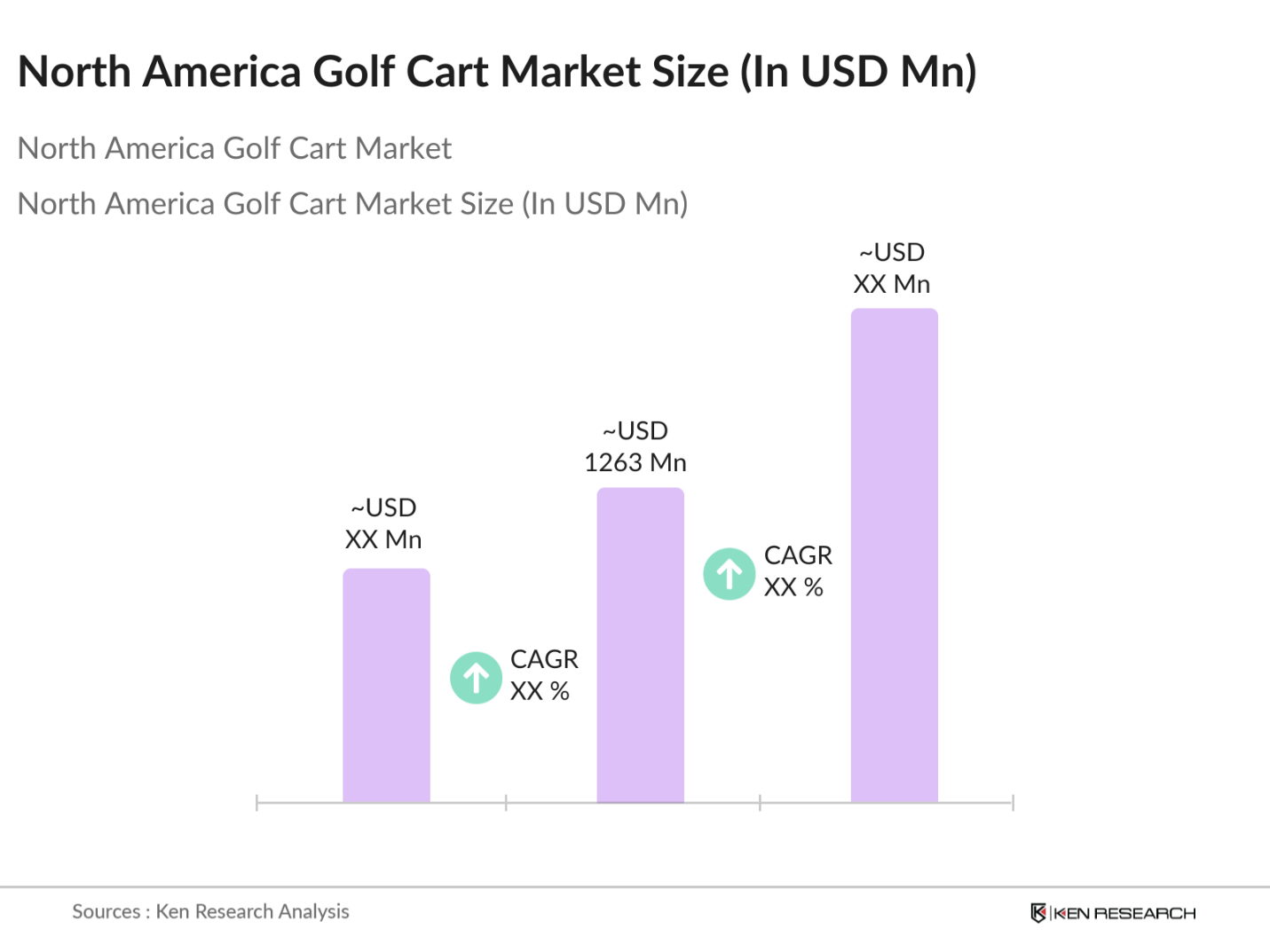
- The North America Golf Cart market is valued at USD 1263 million, based on a five-year historical analysis. This market is primarily driven by the adoption of electric vehicles, especially within the tourism, real estate, and commercial sectors, where eco-friendly transportation solutions are in demand. With the growing preference for sustainable transport options, electric golf carts are widely favored in retirement communities, resorts, and large campuses, contributing significantly to market growth.
- The United States dominates the North American golf cart market due to its extensive network of golf courses, retirement communities, and resorts that utilize golf carts for transportation. Additionally, the country's emphasis on sustainable and green transportation solutions has bolstered the adoption of electric golf carts across various sectors.
- Governments in North America are implementing emission standards to support clean energy goals. The U.S. Environmental Protection Agency has set new emission targets for low-speed electric vehicles, encouraging golf cart manufacturers to adopt cleaner technologies. These regulations aim to lower CO2 emissions in transportation, reinforcing the market shift towards electric and eco-friendly golf carts.
North America Golf Cart Market Segmentation
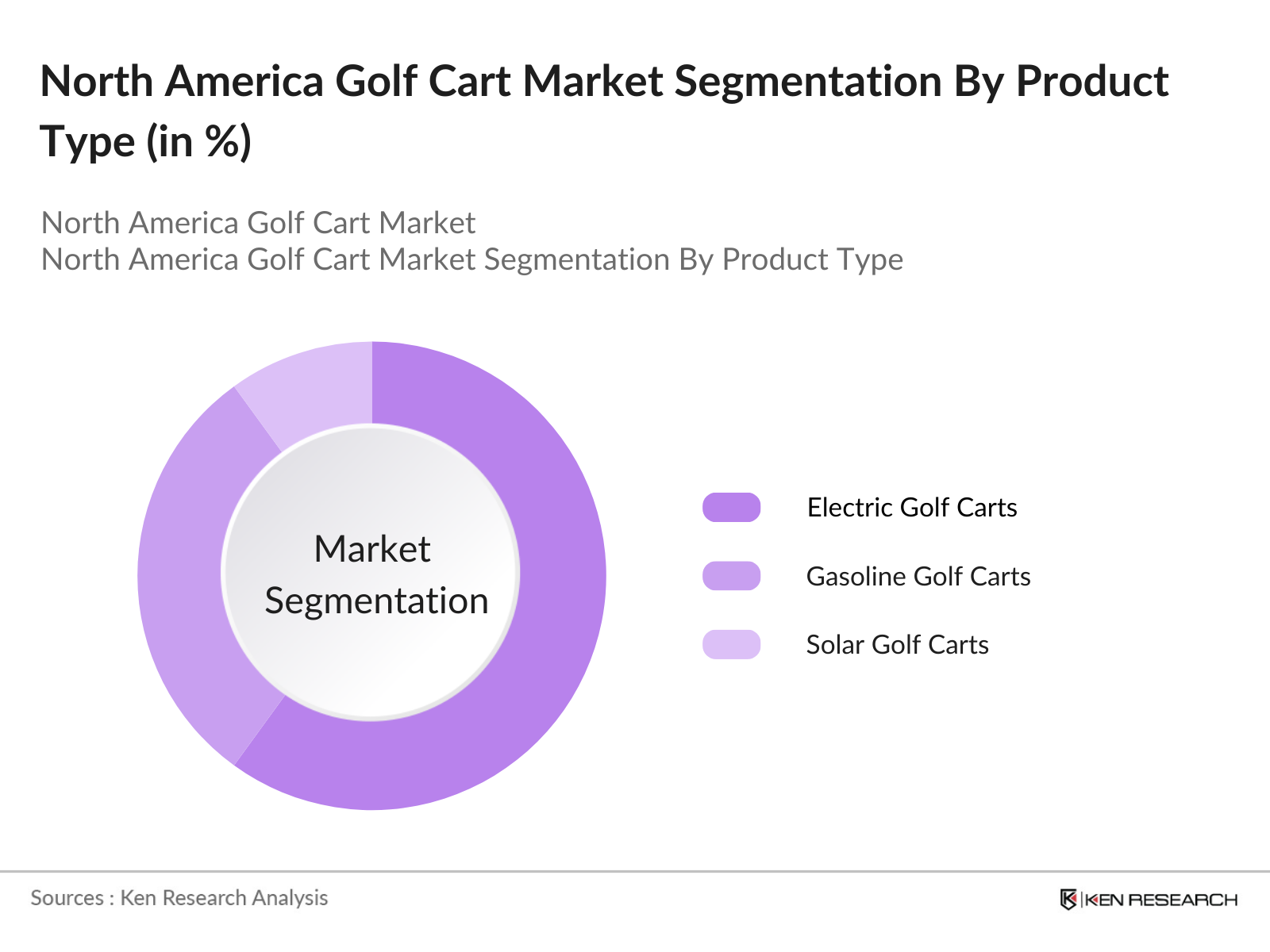
By Product Type: The market is segmented by product type into electric golf carts, gasoline golf carts, and solar golf carts. Electric golf carts hold a dominant market share under this segmentation, primarily due to their environmental benefits, lower operational costs, and compliance with stringent emission regulations. The increasing focus on sustainable transportation solutions has further propelled the demand for electric golf carts in the region.
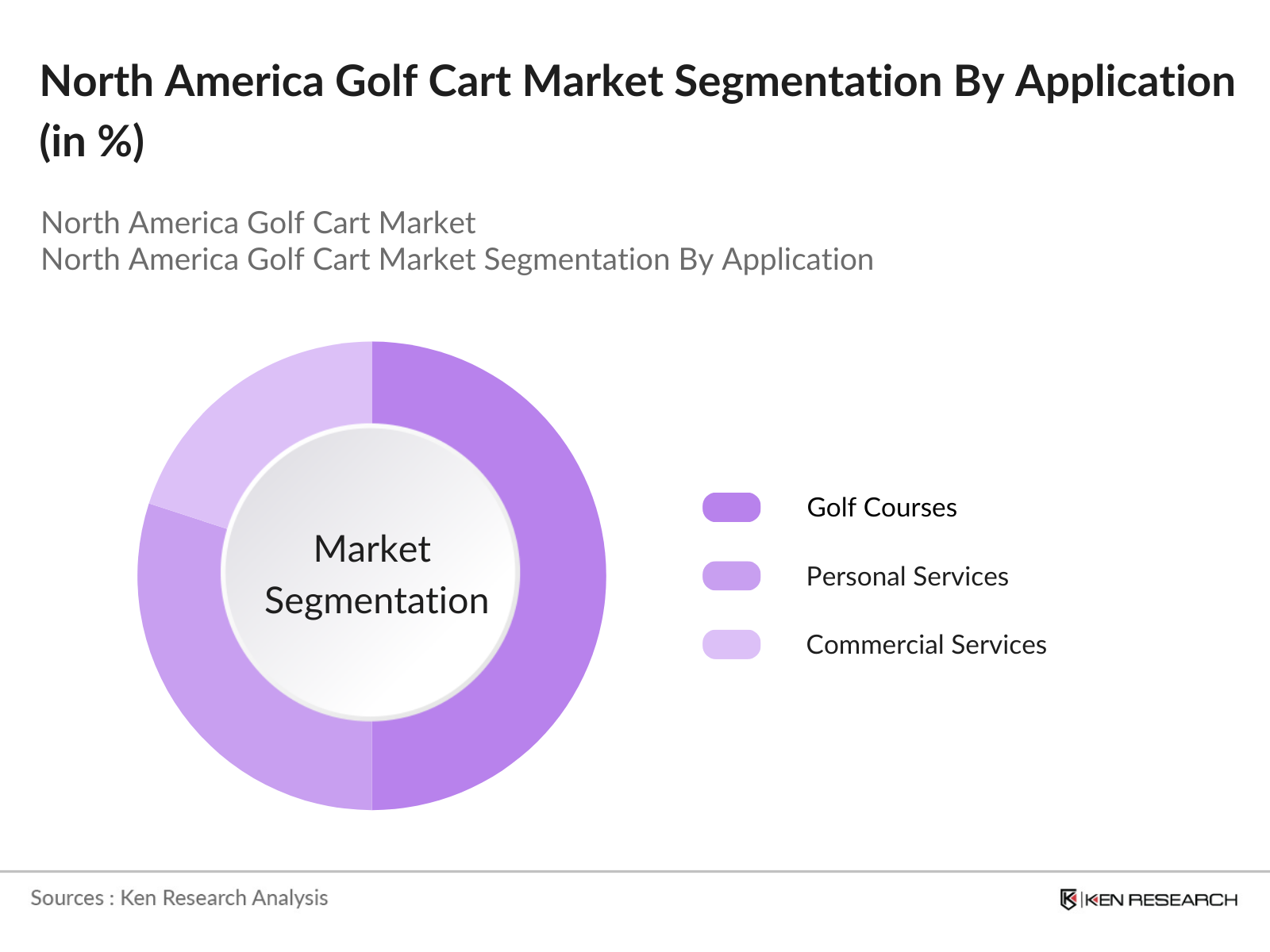
By Application: The market is also segmented by application into golf courses, personal services, and commercial services. Golf courses represent the largest market share within this segmentation, as golf carts are integral to the operation of these facilities, enhancing player convenience and course efficiency. The continuous development and maintenance of golf courses across North America sustain the demand for golf carts in this segment.
North America Golf Cart Market Competitive Landscape
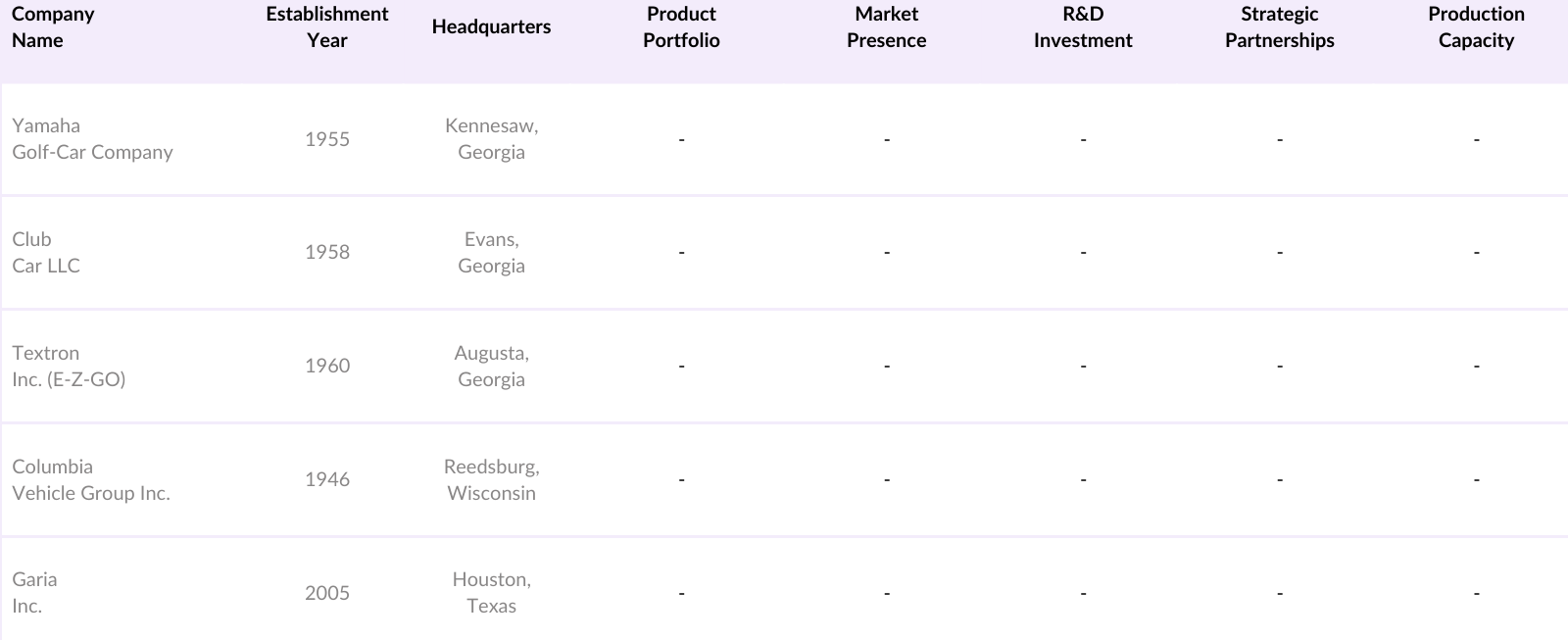
The North America golf cart market is characterized by the presence of several key players who contribute to the market's competitive dynamics. These companies are engaged in continuous innovation and strategic initiatives to maintain their market positions.
North America Golf Cart Industry Analysis
Growth Drivers
- Expansion of Golf Courses: North America has seen consistent growth in the number of golf courses, driven by both recreational interest and tourism. According to the National Golf Foundation, there are approximately 16,000 golf courses in the U.S. alone, providing ample opportunity for golf cart usage and replacements. This expansion is particularly prevalent in states like Florida and Arizona, where tourism and retirement communities bolster demand. Additionally, the U.S. leisure sector reported over 2 billion domestic tourist visits in 2023, supporting the growth of golf courses and associated facilities.
- Rising Tourism Activities: Tourism in North America, particularly in the U.S. and Mexico, contributes significantly to golf cart demand. The U.S. reported 80 million international visitors in 2023, many of whom engage in golf and resort activities, increasing the need for efficient transport solutions like golf carts within tourist complexes. In Canada, the tourism industry generated over CAD 100 billion in revenue, much of which comes from recreational activities such as golf.
- Adoption in Commercial and Residential Complexes: Golf carts are increasingly used in commercial and residential areas for eco-friendly and convenient intra-complex transportation. Data from the U.S. Census Bureau indicates that over 200,000 residential gated communities use golf carts as a primary transport mode within complexes. Further, numerous commercial complexes in urban areas are deploying golf carts for intra-campus mobility, logistics, and maintenance activities.
Market Challenges
- Regulatory Compliance and Safety Standards: Strict regulations govern the use of low-speed vehicles, including golf carts, particularly on public roads and in certain states. Compliance with U.S. federal and state safety standards can increase manufacturing costs, impacting affordability. In the U.S., the National Highway Traffic Safety Administration mandates various safety features for golf carts used in public spaces, such as speed limiters and seat belts, which add to production complexity and expense.
- Competition from Alternative Transportation Modes: Golf carts face competition from other low-emission vehicles, such as e-scooters and electric bicycles, which are more affordable and increasingly accepted for urban commuting. These alternatives often offer faster speeds and greater versatility, making them popular in urban and suburban settings. For example, urban e-bike sales in North America have surged by 40% over recent years, presenting a challenge to golf cart adoption in non-golf applications.
North America Golf Cart Market Future Outlook
Over the next five years, the North America golf cart market is expected to show significant growth driven by continuous advancements in electric vehicle technology, increasing adoption in non-golf sectors, and a growing emphasis on sustainable transportation solutions. The expansion of smart city projects and the integration of golf carts into urban mobility plans are anticipated to further propel market growth.
Market Opportunities
- Integration with Smart City Initiatives: As cities in North America adopt smart city frameworks, golf carts are increasingly incorporated into low-speed transport systems within smart campuses and green zones. For instance, the U.S. Department of Transportations Smart City Challenge has promoted such applications, where autonomous and connected electric vehicles, including golf carts, facilitate short-distance transit.
- Development of Solar-Powered Golf Carts: Solar-powered golf carts are gaining traction as a sustainable solution. The U.S. Environmental Protection Agency has reported increased adoption of solar technology, with over 1 million solar installations recorded in 2023. Golf cart manufacturers are now integrating solar panels to extend battery life and reduce the need for charging infrastructure, particularly in sunny regions like the Southwestern U.S. This trend aligns with rising interest in renewable energy solutions and environmentally friendly transport.
Scope of the Report
|
Product Type |
Electric Golf Carts |
|
Application |
Golf Courses |
|
Seating Capacity |
Small (24-seater) |
|
Ownership Model |
Ownership |
|
Region |
United States |
Products
Key Target Audience
Golf Course Operators
Residential Community Developers
Resort and Hotel Management Companies
Urban Mobility Planners
Corporate Fleet Managers
Event Management Companies
Government and Regulatory Bodies (e.g., U.S. Environmental Protection Agency)
Investment and Venture Capitalist Firms
Companies
Players Mentioned in the Report
Yamaha Golf-Car Company
Club Car LLC
Textron Inc. (E-Z-GO)
Columbia Vehicle Group Inc.
Garia Inc.
Polaris Industries Inc.
American Custom Golf Cars Inc.
Bintelli Electric Vehicles
HDK Electric Vehicle
JH Global Services Inc. (Star EV)
Table of Contents
1. North America Golf Cart Market Overview
1.1. Definition and Scope
1.2. Market Taxonomy
1.3. Market Growth Rate
1.4. Market Segmentation Overview
2. North America Golf Cart Market Size (In USD Billion)
2.1. Historical Market Size
2.2. Year-On-Year Growth Analysis
2.3. Key Market Developments and Milestones
3. North America Golf Cart Market Analysis
3.1. Growth Drivers
3.1.1. Expansion of Golf Courses
3.1.2. Rising Tourism Activities
3.1.3. Adoption in Commercial and Residential Complexes
3.1.4. Technological Advancements in Electric Vehicles
3.2. Market Challenges
3.2.1. High Initial Investment Costs
3.2.2. Regulatory Compliance and Safety Standards
3.2.3. Competition from Alternative Transportation Modes
3.3. Opportunities
3.3.1. Integration with Smart City Initiatives
3.3.2. Development of Solar-Powered Golf Carts
3.3.3. Expansion into Emerging Markets
3.4. Trends
3.4.1. Customization and Personalization of Golf Carts
3.4.2. Increased Use in Non-Golf Applications
3.4.3. Leasing and Rental Services Growth
3.5. Government Regulations
3.5.1. Emission Standards for Electric Vehicles
3.5.2. Safety Regulations for Low-Speed Vehicles
3.5.3. Incentives for Electric Vehicle Adoption
3.6. SWOT Analysis
3.7. Stakeholder Ecosystem
3.8. Porters Five Forces Analysis
3.9. Competitive Landscape
4. North America Golf Cart Market Segmentation
4.1. By Product Type (In Value %)
4.1.1. Electric Golf Carts
4.1.2. Gasoline Golf Carts
4.1.3. Solar Golf Carts
4.2. By Application (In Value %)
4.2.1. Golf Courses
4.2.2. Personal Services
4.2.3. Commercial Services
4.3. By Seating Capacity (In Value %)
4.3.1. Small (24-seater)
4.3.2. Medium (68-seater)
4.3.3. Large (Above 8 Seats)
4.4. By Ownership Model (In Value %)
4.4.1. Ownership
4.4.2. Rental
4.4.3. Leasing
4.5. By Region (In Value %)
4.5.1. United States
4.5.2. Canada
4.5.3. Mexico
4.5.4. Rest of North America
5. North America Golf Cart Market Competitive Analysis
5.1. Detailed Profiles of Major Companies
5.1.1. Yamaha Golf-Car Company
5.1.2. Club Car LLC
5.1.3. Textron Inc. (E-Z-GO)
5.1.4. Columbia Vehicle Group Inc.
5.1.5. Garia Inc.
5.1.6. Polaris Industries Inc.
5.1.7. American Custom Golf Cars Inc.
5.1.8. Bintelli Electric Vehicles
5.1.9. HDK Electric Vehicle
5.1.10. JH Global Services Inc. (Star EV)
5.1.11. Suzhou Eagle Electric Vehicle Manufacturing Co., Ltd.
5.1.12. Marshell Green Power Co., Ltd.
5.1.13. Guangdong Lvtong New Energy Electric Vehicle Technology Co., Ltd.
5.1.14. Evolution Electric Vehicles
5.1.15. Icon Electric Vehicles
5.2. Cross Comparison Parameters (Revenue, Market Share, Product Portfolio, Geographic Presence, R&D Investment, Strategic Initiatives, Production Capacity, Distribution Network)
5.3. Market Share Analysis
5.4. Strategic Initiatives
5.5. Mergers and Acquisitions
5.6. Investment Analysis
5.7. Venture Capital Funding
5.8. Government Grants
5.9. Private Equity Investments
6. North America Golf Cart Market Regulatory Framework
6.1. Environmental Standards
6.2. Compliance Requirements
6.3. Certification Processes
7. North America Golf Cart Future Market Size (In USD Billion)
7.1. Future Market Size Projections
7.2. Key Factors Driving Future Market Growth
8. North America Golf Cart Future Market Segmentation
8.1. By Product Type (In Value %)
8.2. By Application (In Value %)
8.3. By Seating Capacity (In Value %)
8.4. By Ownership Model (In Value %)
8.5. By Region (In Value %)
9. North America Golf Cart Market Analysts Recommendations
9.1. Total Addressable Market (TAM), Serviceable Available Market (SAM), Serviceable Obtainable Market (SOM) Analysis
9.2. Customer Cohort Analysis
9.3. Marketing Initiatives
9.4. White Space Opportunity Analysis
Disclaimer Contact UsResearch Methodology
Step 1: Identification of Key Variables
The initial phase involves constructing an ecosystem map encompassing all major stakeholders within the North America Golf Cart Market. This step is underpinned by extensive desk research, utilizing a combination of secondary and proprietary databases to gather comprehensive industry-level information. The primary objective is to identify and define the critical variables that influence market dynamics.
Step 2: Market Analysis and Construction
In this phase, we compile and analyze historical data pertaining to the North America Golf Cart Market. This includes assessing market penetration, the ratio of marketplaces to service providers, and the resultant revenue generation. Furthermore, an evaluation of service quality statistics is conducted to ensure the reliability and accuracy of the revenue estimates.
Step 3: Hypothesis Validation and Expert Consultation
Market hypotheses are developed and subsequently validated through computer-assisted telephone interviews (CATIs) with industry experts representing a diverse array of companies. These consultations provide valuable operational and financial insights directly from industry practitioners, which are instrumental in refining and corroborating the market data.
Step 4: Research Synthesis and Final Output
The final phase involves direct engagement with multiple golf cart manufacturers to acquire detailed insights into product segments, sales performance, consumer preferences, and other pertinent factors. This interaction serves to verify and complement the statistics derived from the bottom-up approach, thereby ensuring a comprehensive, accurate, and validated analysis of the North America Golf Cart market.
Frequently Asked Questions
01. How big is the North America Golf Cart Market?
The North America Golf Cart market is valued at USD 1263 million, based on a five-year historical analysis. This market is primarily driven by the adoption of electric vehicles, especially within the tourism, real estate, and commercial sectors, where eco-friendly transportation solutions are in demand.
02. What are the challenges in the North America Golf Cart Market?
Challenges include high initial investment costs, regulatory compliance and safety standards, and competition from alternative transportation modes.
03. Who are the major players in the North America Golf Cart Market?
The major players in the North America golf cart market include Yamaha Golf-Car Company, Club Car LLC, Textron Inc. (E-Z-GO), Columbia Vehicle Group Inc., and Garia Inc. These companies dominate due to their extensive product portfolios, strategic partnerships, and focus on innovation.
04. What are the growth drivers of the North America Golf Cart Market?
Growth in this market is driven by the expansion of golf courses, increasing adoption of golf carts for personal and commercial purposes, and technological advancements in electric vehicle technology. Additionally, environmental concerns are encouraging the adoption of electric and solar-powered carts.
Why Buy From Us?

What makes us stand out is that our consultants follows Robust, Refine and Result (RRR) methodology. i.e. Robust for clear definitions, approaches and sanity checking, Refine for differentiating respondents facts and opinions and Result for presenting data with story

We have set a benchmark in the industry by offering our clients with syndicated and customized market research reports featuring coverage of entire market as well as meticulous research and analyst insights.

While we don't replace traditional research, we flip the method upside down. Our dual approach of Top Bottom & Bottom Top ensures quality deliverable by not just verifying company fundamentals but also looking at the sector and macroeconomic factors.

With one step in the future, our research team constantly tries to show you the bigger picture. We help with some of the tough questions you may encounter along the way: How is the industry positioned? Best marketing channel? KPI's of competitors? By aligning every element, we help maximize success.

Our report gives you instant access to the answers and sources that other companies might choose to hide. We elaborate each steps of research methodology we have used and showcase you the sample size to earn your trust.

If you need any support, we are here! We pride ourselves on universe strength, data quality, and quick, friendly, and professional service.