















North America Handgun Market Outlook to 2030
Region:North America
Author(s):Meenakshi Bisht
Product Code:KROD5945
December 2024
84
About the Report
North America Handgun Market Overview
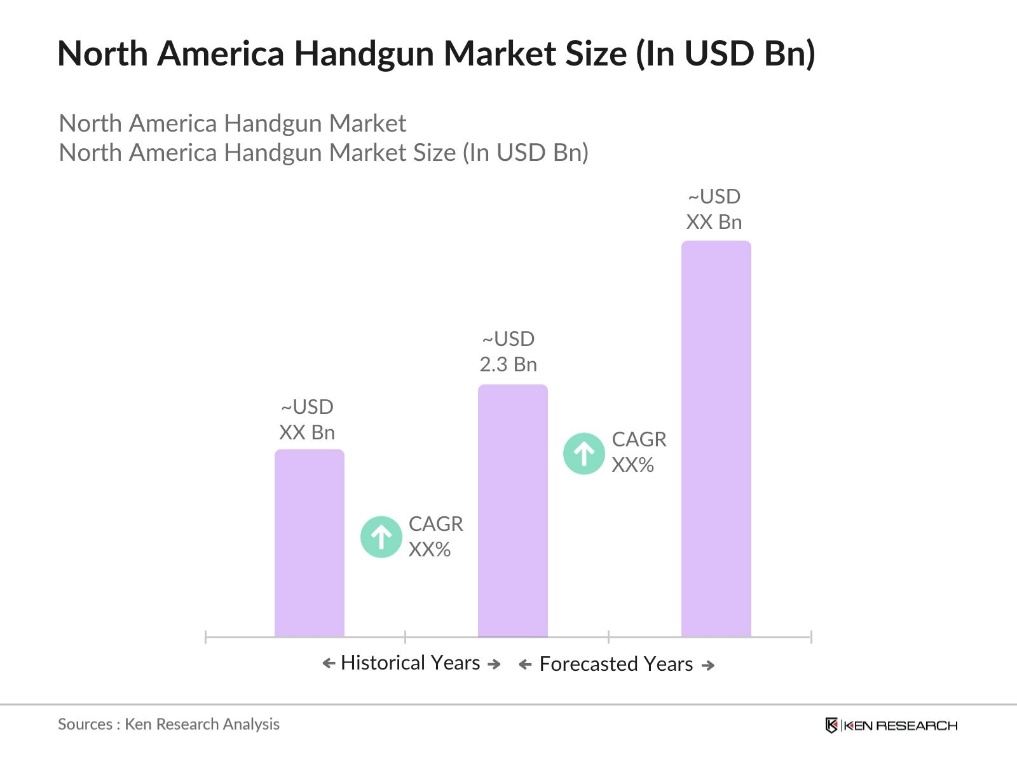
- The North America handgun market is valued at USD 2.3 billion, driven primarily by increasing civilian demand, particularly for self-defense and sporting purposes. This valuation reflects significant growth backed by technological advancements, such as enhanced ergonomics and improved firing mechanisms, making handguns more accessible to consumers. In recent years, supportive licensing policies have also contributed to market expansion.
- The U.S. dominates the North America handgun market due to well-established firearm culture, a strong network of licensed distributors, and large-scale firearm manufacturers. Urban areas, such as Los Angeles, New York, and Dallas, exhibit high demand due to personal security concerns and a larger law enforcement presence.
- Enhanced background checks are a core component of firearm policy, with additional measures introduced in recent years. The Federal Bureau of Investigation's National Instant Criminal Background Check System (NICS) processed over 30 million checks in 2024, ensuring thorough vetting for handgun purchasers. These enhancements aim to maintain public safety while accommodating responsible handgun ownership.
North America Handgun Market Segmentation
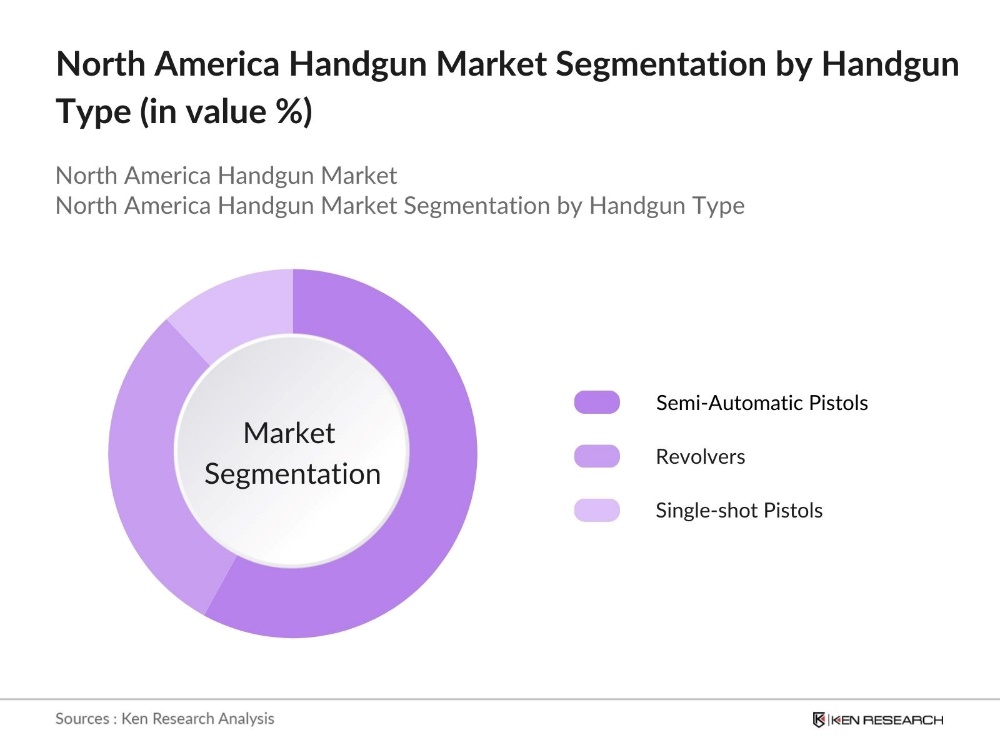
By Handgun Type: The market is segmented by handgun type into revolvers, semi-automatic pistols, and single-shot pistols. Semi-automatic pistols hold the dominant market share due to their ease of use, reliability, and growing popularity among civilians and law enforcement. The lightweight design and higher magazine capacity make semi-automatics the preferred choice, particularly for personal security. Additionally, major brands like Glock and Smith & Wesson have strengthened consumer loyalty by consistently innovating with improved safety features and customizable options.
By Caliber Type: The market is segmented by caliber type into small-caliber, medium-caliber, and large-caliber handguns. Medium-caliber handguns lead this segment, as they offer a balanced combination of manageable recoil, sufficient stopping power, and compatibility with commonly available ammunition types. Their versatility makes them suitable for both recreational and defensive purposes, cementing their preference among civilian and law enforcement users.

North America Handgun Market Competitive Landscape
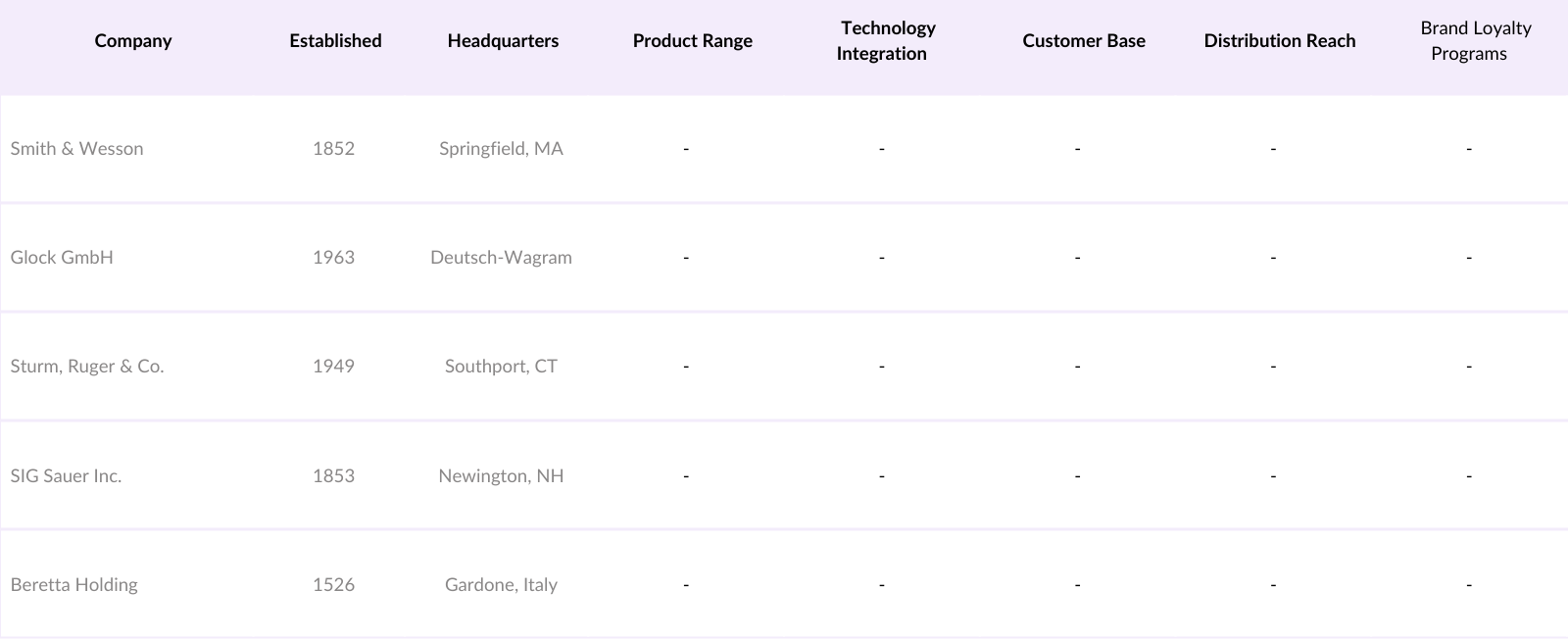
The North America handgun market is dominated by several key players, each contributing to market consolidation through product innovation, extensive distribution networks, and adherence to regulatory standards. Major players in the market include established brands with a strong reputation in quality and reliability, contributing to the continued growth of the market.
North America Handgun Industry Analysis
Growth Drivers
- Rising Civilian Demand (Ownership and Usage): Gun ownership rates vary by race and gender, with 38% of White Americans, 24% of Black Americans, and 20% of Hispanic Americans reporting ownership. Additionally, 40% of men own guns compared to 25% of women, reflecting a strong interest in civilian firearm ownership for self-defense and recreational use. The U.S. maintains one of the highest civilian gun ownership rates globally, contributing to sustained demand.
- Advancements in Firearm Technology: Technological innovations, including modular handgun systems and advanced ergonomics, are bolstering the North American handgun market. For instance, the adoption of polymer-frame materials has enhanced durability and reduced handgun weight, making them more appealing to civilians. Industry data from 2024 highlights that 65% of new handguns manufactured feature such advancements, reflecting a substantial shift toward user-friendly designs and customization options.
- Self-Defense Awareness: Self-defense awareness significantly influences handgun ownership in North America. Increasing numbers of civilians seek handguns for personal protection, leading to a rise in concealed carry permits. This trend is particularly strong in states with high permit issuance, where self-defense remains a primary motivator. As concerns for safety grow, the demand for handguns continues to rise, solidifying self-defense awareness as a key market driver.
Market Challenges
- Regulatory and Compliance Barriers: Strict regulations, such as those under the National Firearms Act, add significant compliance costs for handgun manufacturers and sellers, creating hurdles for market entry and growth. These requirements vary by state, with stricter regulations in states like California and New York, which enforce rigorous background checks and storage mandates. Such compliance demands place operational burdens on manufacturers and impact overall market expansion.
- Import-Export Restrictions: The North American handgun market faces challenges due to import-export restrictions that limit access to certain foreign-made firearms. Regulations overseeing firearm imports create bottlenecks in distribution channels, particularly affecting manufacturers that rely on foreign components. These restrictions influence market dynamics by reducing the availability of specific firearms, impacting the diversity of options for buyers and limiting manufacturers' expansion efforts.
North America Handgun Market Future Outlook
Over the next five years, the North America handgun market is expected to continue its steady growth, driven by increasing consumer demand for personal protection, technological advancements in handgun safety features, and rising interest in recreational shooting sports. While regulatory measures may pose challenges, continued innovation by key manufacturers and improved access to online firearm training are likely to support market growth.
Market Opportunities
- Growth in Tactical and Sporting Segments: The tactical and sporting handgun segments offer significant growth potential as interest in shooting sports and tactical training continues to rise. The popularity of recreational firearm use has increased demand for handguns specifically designed for competitive and tactical applications. This trend positions the tactical and sporting segments as promising areas for market expansion, as more consumers explore firearms for sport and specialized training.
- Emerging Digital Sales Channels: Digital sales channels are transforming the handgun retail landscape, with online platforms making the purchase process more accessible. Despite strict verification and regulatory requirements, e-commerce platforms allow manufacturers to reach a wider audience, moving beyond traditional store-based sales. This shift towards online sales enables broader market access and provides a modernized approach to retail, enhancing market growth potential.
Scope of the Report
|
By Handgun Type |
Revolvers Semi-Automatic Pistols Single-shot Pistols |
|
By End User |
Civilian Law Enforcement Military |
|
By Caliber Type |
Small-Caliber Medium-Caliber Large-Caliber |
|
By Distribution Channel |
Online Retail Authorized Dealers Specialized Retail Stores |
|
By Country |
United States Canada Mexico |
Products
Key Target Audience
Firearm Manufacturers
Safety and Security Equipment Manufacturers
Defense and Law Enforcement Agencies
Government and Regulatory Bodies (Bureau of Alcohol, Tobacco, Firearms and Explosives - ATF, Canadian Firearms Program)
Investors and venture capital Firms
Banks and Financial Institutions
Companies
Players Mentioned in the Report
Smith & Wesson
Glock GmbH
Sturm, Ruger & Co.
SIG Sauer Inc.
Beretta Holding
FN Herstal
Taurus Holdings
Springfield Armory, Inc.
Heckler & Koch
CZ-USA
Table of Contents
1. North America Handgun Market Overview
1.1. Definition and Scope
1.2. Market Taxonomy
1.3. Industry Value Chain Analysis
1.4. Market Lifecycle Analysis
1.5. Key Success Factors (Market Trends, Consumer Demand)
2. North America Handgun Market Size (In USD Mn)
2.1. Historical Market Size
2.2. Year-on-Year Growth Analysis
2.3. Market Value Chain Impact
2.4. Key Milestones and Developments
3. North America Handgun Market Analysis
3.1. Growth Drivers
3.1.1. Rising Civilian Demand (Ownership and Usage)
3.1.2. Advancements in Firearm Technology
3.1.3. Self-Defense Awareness
3.1.4. Government Licensing Policies
3.2. Market Challenges
3.2.1. Regulatory and Compliance Barriers
3.2.2. Import-Export Restrictions
3.2.3. Liability and Insurance Costs
3.3. Opportunities
3.3.1. Growth in Tactical and Sporting Segments
3.3.2. Emerging Digital Sales Channels
3.3.3. Women and Youth Market Expansion
3.4. Trends
3.4.1. Customization and Personalization Demand
3.4.2. Technological Integration (Smart Guns)
3.4.3. Growth in Online Firearm Training
3.5. Government Regulations
3.5.1. National Firearms Act (NFA) Compliance
3.5.2. Federal Licensing Regulations
3.5.3. State-Specific Ownership Regulations
3.5.4. Background Check Enhancements
3.6. SWOT Analysis
3.7. Stakeholder Ecosystem
3.8. Porters Five Forces Analysis
3.9. Competitive Landscape
4. North America Handgun Market Segmentation
4.1. By Handgun Type (In Value %)
4.1.1. Revolvers
4.1.2. Semi-Automatic Pistols
4.1.3. Single-shot Pistols
4.2. By End User (In Value %)
4.2.1. Civilian
4.2.2. Law Enforcement
4.2.3. Military
4.3. By Caliber Type (In Value %)
4.3.1. Small-Caliber
4.3.2. Medium-Caliber
4.3.3. Large-Caliber
4.4. By Distribution Channel (In Value %)
4.4.1. Online Retail
4.4.2. Authorized Dealers
4.4.3. Specialized Retail Stores
4.5. By Country (In Value %)
4.5.1. United States
4.5.2. Canada
4.5.3. Mexico
5. North America Handgun Market Competitive Analysis
5.1. Detailed Profiles of Major Companies
5.1.1. Smith & Wesson
5.1.2. Glock GmbH
5.1.3. Sturm, Ruger & Co.
5.1.4. SIG Sauer Inc.
5.1.5. Beretta Holding
5.1.6. Heckler & Koch
5.1.7. FN Herstal
5.1.8. Taurus Holdings
5.1.9. Springfield Armory, Inc.
5.1.10. CZ-USA
5.1.11. Walther Arms
5.1.12. Kahr Arms
5.1.13. Kimber Mfg., Inc.
5.1.14. Colts Manufacturing Company
5.1.15. B&T AG
5.2. Cross Comparison Parameters (Revenue, Headquarters, Product Range, Technology Integration, Innovation Index, Customer Base, Regional Reach, Warranty Policies)
5.3. Market Share Analysis
5.4. Strategic Initiatives and Collaborations
5.5. Mergers and Acquisitions
5.6. Investment and Funding Analysis
5.7. Venture Capital Interest
5.8. Private Equity Involvement
6. North America Handgun Market Regulatory Framework
6.1. Federal Firearm Regulations
6.2. State-Specific Gun Control Policies
6.3. Import/Export Guidelines
6.4. Compliance Certification
7. North America Handgun Future Market Size (In USD Mn)
7.1. Future Market Projections
7.2. Key Factors Influencing Future Growth
8. North America Handgun Market Future Segmentation
8.1. By Handgun Type (In Value %)
8.2. By End User (In Value %)
8.3. By Caliber Type (In Value %)
8.4. By Distribution Channel (In Value %)
8.5. By Country (In Value %)
9. North America Handgun Market Analysts Recommendations
9.1. TAM/SAM/SOM Analysis
9.2. Consumer Preferences Analysis
9.3. Digital and E-commerce Initiatives
9.4. Emerging White Space Opportunities
Disclaimer Contact UsResearch Methodology
Step 1: Identification of Key Variables
The initial step involves defining the ecosystem and mapping key stakeholders in the North America handgun market. Secondary and proprietary research sources help in gathering baseline information on the handgun industrys dynamics.
Step 2: Market Analysis and Construction
This stage involves evaluating historical market data, handgun sales trends, and consumer behavior to understand revenue generation. Data validation is ensured through accuracy checks with verified sales records and quality metrics.
Step 3: Hypothesis Validation and Expert Consultation
Hypotheses about market trends, consumer preferences, and regulatory impacts are developed and validated through consultations with industry experts. These insights provide a ground-level perspective, enhancing the credibility of the market analysis.
Step 4: Research Synthesis and Final Output
The final stage includes synthesizing insights obtained from firearm manufacturers and distributors to verify and supplement findings from secondary research. This ensures a well-rounded, validated report that accurately reflects the current market scenario.
Frequently Asked Questions
01. How big is the North America Handgun Market?
The North America handgun market is valued at USD 2.3 billion, driven by strong consumer demand and supportive licensing policies across the region.
02. What are the primary growth drivers for the North America Handgun Market?
Growth in this North America handgun market is supported by increasing consumer interest in self-defense, advancements in firearm technology, and expanding law enforcement requirements.
03. Who are the major players in the North America Handgun Market?
Key players in North America handgun market include Smith & Wesson, Glock GmbH, Sturm, Ruger & Co., SIG Sauer Inc., and Beretta Holding, all of which have strong market influence due to their extensive distribution and innovation in firearm technology.
04. What challenges does the North America Handgun Market face?
The North America handgun market faces regulatory challenges, high insurance and liability costs, and competition from illegal firearm channels, impacting growth and market dynamics.
Why Buy From Us?

What makes us stand out is that our consultants follows Robust, Refine and Result (RRR) methodology. i.e. Robust for clear definitions, approaches and sanity checking, Refine for differentiating respondents facts and opinions and Result for presenting data with story

We have set a benchmark in the industry by offering our clients with syndicated and customized market research reports featuring coverage of entire market as well as meticulous research and analyst insights.

While we don't replace traditional research, we flip the method upside down. Our dual approach of Top Bottom & Bottom Top ensures quality deliverable by not just verifying company fundamentals but also looking at the sector and macroeconomic factors.

With one step in the future, our research team constantly tries to show you the bigger picture. We help with some of the tough questions you may encounter along the way: How is the industry positioned? Best marketing channel? KPI's of competitors? By aligning every element, we help maximize success.

Our report gives you instant access to the answers and sources that other companies might choose to hide. We elaborate each steps of research methodology we have used and showcase you the sample size to earn your trust.

If you need any support, we are here! We pride ourselves on universe strength, data quality, and quick, friendly, and professional service.