
North America High Speed Camera Market Outlook to 2030
Region:North America
Author(s):Naman Rohilla
Product Code:KROD7040
December 2024
99
About the Report
North America High Speed Camera Market Overview
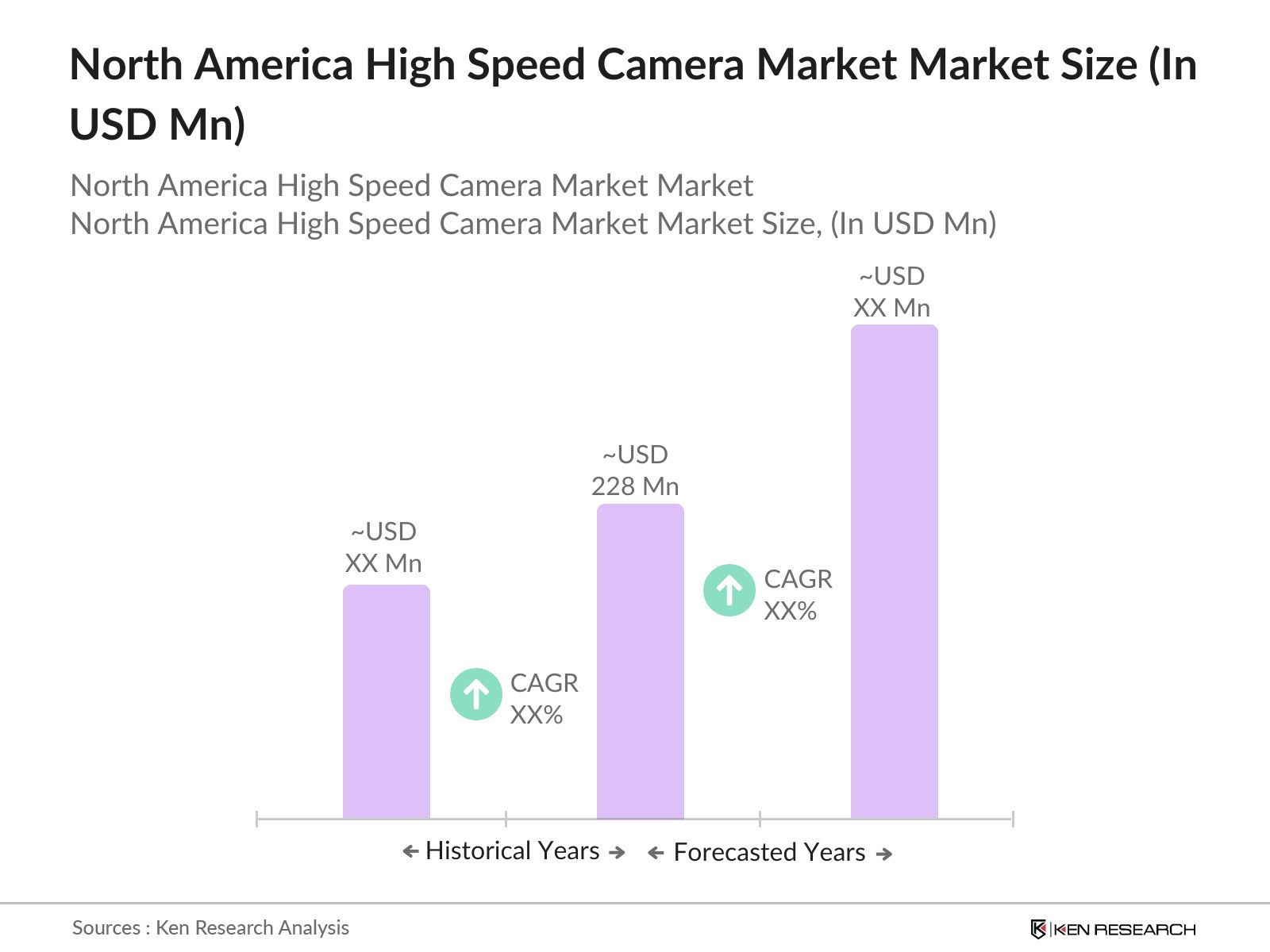
- The North America High Speed Camera market is valued at USD 228 million, based on a detailed five-year historical analysis. The markets expansion is primarily driven by the growing demand in research and development, particularly in sectors such as automotive, aerospace, and defence, which require high-speed imaging for testing and analysis. This need for precision, alongside the rising adoption of high-speed cameras in entertainment and media production, is significantly pushing the market forward.
- The United States dominates the North America High Speed Camera market due to its advanced technological infrastructure and high investments in research and development across several industries, including automotive and aerospace. Cities like Los Angeles and New York play a pivotal role in driving demand for high-speed cameras in film production and broadcasting. Additionally, the presence of key industry players headquartered in the U.S. contributes to the countrys leadership in this market.
- The U.S. government has imposed export restrictions on high-speed cameras due to their potential use in military applications, particularly in missile and weapons testing. These cameras, classified under dual-use goods, require specific licensing for export to certain countries. In 2023, over 50 licenses were issued for the export of high-speed cameras for defense purposes, indicating the stringent regulatory landscape governing their distribution.
North America High Speed Camera Market Segmentation
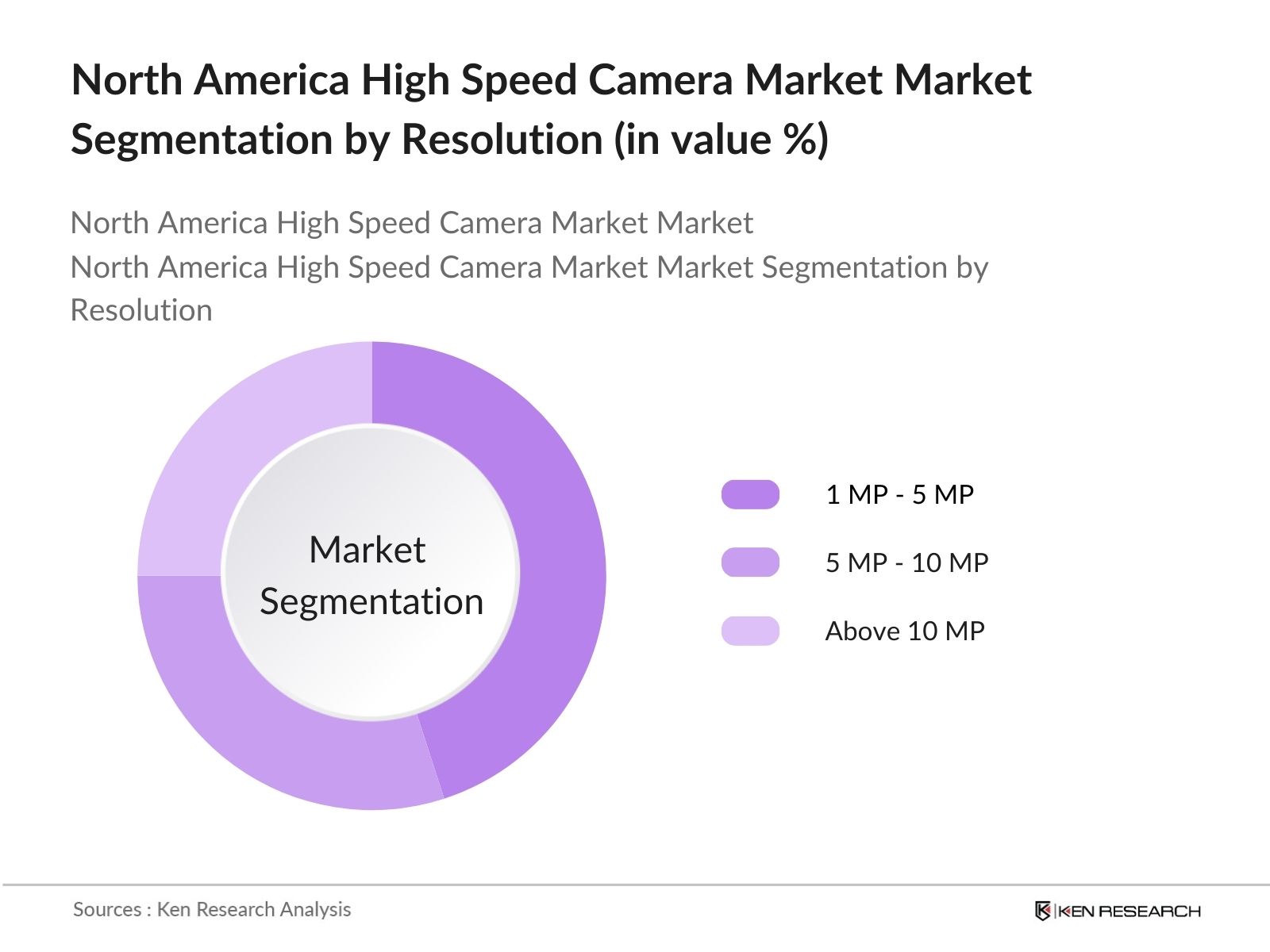
- By Resolution: North America High Speed Camera market is segmented by resolution into 1 MP - 5 MP, 5 MP - 10 MP, and above 10 MP. Among these, the 1 MP - 5 MP category holds a dominant market share due to its affordability and widespread application across industries such as automotive testing and industrial manufacturing. This segments versatility in providing high-speed footage at a lower cost compared to higher-resolution cameras makes it the preferred choice for a variety of testing environments.
- By Frame Rate: North America High Speed Camera market is segmented by frame rate into 1,000 - 10,000 FPS, 10,000 - 100,000 FPS, and above 100,000 FPS. The 10,000 - 100,000 FPS category holds the highest market share due to its use in a wide range of industrial applications such as automotive crash testing, where precise, high-frame-rate imaging is critical for safety assessments and performance evaluations.

North America High Speed Camera Market Competitive Landscape
The North America High Speed Camera market is dominated by several key players with a strong presence in the region. Companies like Vision Research (AMETEK) and Photron lead the market, benefiting from their extensive experience, technological advancements, and comprehensive product portfolios tailored to industry-specific needs.
|
Company |
Establishment Year |
Headquarters |
Product Portfolio |
No. of Employees |
Key Clients |
Revenue |
Technological Advancements |
|
Vision Research (AMETEK) |
1958 |
Wayne, NJ, USA |
- |
- |
- |
- |
- |
|
Photron |
1974 |
San Diego, CA, USA |
- |
- |
- |
- |
- |
|
iX Cameras |
2016 |
Woburn, MA, USA |
- |
- |
- |
- |
- |
|
Mikrotron |
1976 |
Unterschleiheim, GER |
- |
- |
- |
- |
- |
|
Integrated Design Tools (IDT) |
1997 |
Pasadena, CA, USA |
- |
- |
- |
- |
- |
North America High Speed Camera Market Analysis
North America High Speed Camera Market Growth Drivers
- Increasing Demand for High-Speed Imaging in Research and Development: The North America High-Speed Camera market is seeing increasing demand across sectors like automotive, aerospace, and military due to the necessity of capturing fast-moving objects in research and testing environments. For instance, the U.S. automotive R&D industry, with over 120,000 patents filed in the last five years, uses high-speed cameras extensively in crash testing to analyze impact in microseconds. Additionally, aerospace research agencies like NASA continue to invest heavily in high-speed imaging for missile tracking and jet engine testing, where speeds can exceed 2,500 km/h. The military sectors budget allocation for R&D also contributes to this growth.
- Expansion of Applications in Consumer Electronics and Entertainment: In consumer electronics and entertainment, high-speed cameras are becoming increasingly integrated into film production and broadcasting, where slow-motion scenes require ultra-high-definition footage. The U.S. film industry, valued at over USD 80 billion, regularly employs high-speed cameras for scenes requiring over 1,000 frames per second (fps). Broadcasting companies are also leveraging high-speed technology during live sports events, with some high-speed cameras operating at up to 10,000 fps. With over 600 feature films produced annually in North America, this expansion in the entertainment sector provides a substantial demand for high-speed cameras.
- Rising Adoption in Quality Control and Manufacturing: High-speed cameras are increasingly being used in manufacturing sectors, particularly in quality control processes that require real-time analysis of fast-moving production lines. The U.S. manufacturing industry, with an output of USD 2.3 trillion, heavily relies on high-speed cameras to detect errors in packaging, assembly, and materials processing. For instance, automotive manufacturing facilities use high-speed cameras to capture minute details at a rate of over 10,000 fps, aiding in defect detection and improving operational efficiency. This adoption is critical in maintaining the stringent quality standards required in various industries.
North America High Speed Camera Market Challenges
- High Initial Costs of High-Speed Cameras: One of the main challenges in the North America High-Speed Camera market is the high initial cost, with advanced high-speed cameras priced anywhere from USD 50,000 to over USD 150,000 per unit. This cost is often prohibitive for small-scale industries and research facilities, limiting their ability to invest in high-speed imaging technology. Additionally, the total cost of ownership, including maintenance and software upgrades, further adds to the financial burden, making these systems accessible primarily to large corporations and government agencies with substantial budgets.
- Limited Skilled Workforce for Operations: The operation and maintenance of high-speed cameras require specialized skills, including knowledge of advanced imaging technologies and data interpretation. The U.S. workforce has seen a decline in manufacturing and technical expertise, with fewer than 10,000 new graduates annually entering fields related to high-tech manufacturing and research. The limited availability of a skilled workforce poses a significant challenge for companies looking to integrate high-speed camera technology into their operations, particularly in industries requiring advanced diagnostic tools.
North America High Speed Camera Market Future Outlook
Over the next five years, the North America High Speed Camera market is expected to exhibit strong growth driven by increasing demand from new application areas such as sports analytics, medical diagnostics, and advanced manufacturing. Rapid advancements in camera resolution, frame rate, and integration with automation technologies, coupled with growing investments in research and development, will likely foster sustained market expansion. The trend of miniaturization of high-speed cameras is also expected to open new growth avenues in the consumer electronics and drone imaging sectors.
North America High Speed Camera Market Opportunities
- Growing Use in Sports Analytics: The application of high-speed cameras in sports analytics is rapidly growing, particularly in professional leagues such as the NFL and NBA, where detailed motion analysis is crucial for player performance optimization. High-speed cameras capture movements at over 1,000 fps, enabling coaches and analysts to dissect player mechanics in real-time. In 2023, the U.S. sports analytics industry was valued at over USD 2 billion, with high-speed cameras playing a key role in areas such as injury prevention and biomechanical analysis.
- Emerging Applications in Medical Diagnostics and Healthcare: In healthcare, high-speed cameras are increasingly being utilized in medical diagnostics, particularly in capturing high-resolution images for surgical applications and research. For example, high-speed imaging is used in cardiovascular research to study blood flow dynamics in real-time. The U.S. medical device industry, valued at USD 180 billion, is seeing a growing integration of high-speed cameras in diagnostic tools, enhancing the precision of surgical procedures and patient outcomes. This provides significant growth potential for high-speed camera manufacturers.
Scope of the Report
|
By Resolution |
1 MP - 5 MP 5 MP - 10 MP Above 10 MP |
|
By Frame Rate |
1,000 - 10,000 FPS 10,000 - 100,000 FPS Above 100,000 FPS |
|
By End User |
Automotive and Transportation Aerospace and Defense Media and Entertainment Industrial Manufacturing Others (Healthcare, Consumer Electronics) |
|
By Component |
Image Sensors Lenses Memory Systems Software |
|
By Region |
United States Canada Mexico |
Products
Key Target Audience
Automotive Manufacturers
Aerospace and Defense Companies
Media Production Companies
Research Institutes and Universities
Government and Regulatory Bodies (U.S. Department of Defense)
Industrial Manufacturing Companies
Sports Analytics Firms
Investor and Venture Capitalist Firms
Companies
Players Mentioned in the Report:
Vision Research (AMETEK)
Photron
iX Cameras
Mikrotron
Integrated Design Tools (IDT)
Optronis
Fastec Imaging
NAC Image Technology
PCO AG
DEL Imaging Systems
Table of Contents
1. North America High Speed Camera Market Overview
1.1 Definition and Scope
1.2 Market Taxonomy
1.3 Market Growth Rate
1.4 Market Segmentation Overview
2. North America High Speed Camera Market Size (In USD Bn)
2.1 Historical Market Size
2.2 Year-On-Year Growth Analysis
2.3 Key Market Developments and Milestones
3. North America High Speed Camera Market Analysis
3.1 Growth Drivers
3.1.1 Increasing Demand for High-Speed Imaging in Research and Development (Automotive, Aerospace, Military)
3.1.2 Expansion of Applications in Consumer Electronics and Entertainment (Film Production, Broadcasting)
3.1.3 Rising Adoption in Quality Control and Manufacturing
3.1.4 Technological Advancements in Image Sensors and Resolution
3.2 Market Challenges
3.2.1 High Initial Costs of High Speed Cameras
3.2.2 Limited Skilled Workforce for Operations
3.2.3 Complexity in High-Resolution Image Processing
3.3 Opportunities
3.3.1 Growing Use in Sports Analytics
3.3.2 Emerging Applications in Medical Diagnostics and Healthcare
3.3.3 Integration with Artificial Intelligence and Automation
3.4 Trends
3.4.1 Rising Focus on Compact and Lightweight Cameras
3.4.2 Integration with 5G and Wireless Technologies
3.4.3 Increasing Use in Drone Imaging
3.5 Government Regulation
3.5.1 Export Restrictions on High-Speed Cameras (National Security, Defense Applications)
3.5.2 Standards for Imaging Resolution and Accuracy (Industrial Applications)
3.6 SWOT Analysis
3.7 Stakeholder Ecosystem
3.8 Porters Five Forces
3.9 Competition Ecosystem
4. North America High Speed Camera Market Segmentation
4.1 By Resolution (In Value %)
4.1.1 1 MP - 5 MP
4.1.2 5 MP - 10 MP
4.1.3 Above 10 MP
4.2 By Frame Rate (In Value %)
4.2.1 1,000 - 10,000 FPS
4.2.2 10,000 - 100,000 FPS
4.2.3 Above 100,000 FPS
4.3 By End User (In Value %)
4.3.1 Automotive and Transportation
4.3.2 Aerospace and Defense
4.3.3 Media and Entertainment
4.3.4 Industrial Manufacturing
4.3.5 Others (Healthcare, Consumer Electronics)
4.4 By Component (In Value %)
4.4.1 Image Sensors
4.4.2 Lenses
4.4.3 Memory Systems
4.4.4 Software
4.5 By Region (In Value %)
4.5.1 United States
4.5.2 Canada
4.5.3 Mexico
5. North America High Speed Camera Market Competitive Analysis
5.1 Detailed Profiles of Major Companies
5.1.1 Vision Research (AMETEK)
5.1.2 Photron
5.1.3 iX Cameras
5.1.4 Mikrotron
5.1.5 Optronis
5.1.6 Fastec Imaging
5.1.7 Integrated Design Tools (IDT)
5.1.8 AOS Technologies
5.1.9 PCO AG
5.1.10 DEL Imaging Systems
5.1.11 NAC Image Technology
5.1.12 Weisscam
5.1.13 Xcitex Inc.
5.1.14 Photonic Science
5.1.15 Chronos
5.2 Cross Comparison Parameters
5.3 Market Share Analysis
5.4 Strategic Initiatives
5.5 Mergers and Acquisitions
5.6 Investment Analysis
5.7 Venture Capital Funding
5.8 Government Grants
5.9 Private Equity Investments
6. North America High Speed Camera Market Regulatory Framework
6.1 Compliance Standards for Defense and Industrial Applications
6.2 Export Controls (ITAR, EAR Regulations)
6.3 Certification Processes for Industrial Use
7. North America High Speed Camera Future Market Size (In USD Bn)
7.1 Future Market Size Projections
7.2 Key Factors Driving Future Market Growth
8. North America High Speed Camera Future Market Segmentation
8.1 By Resolution (In Value %)
8.2 By Frame Rate (In Value %)
8.3 By End User (In Value %)
8.4 By Component (In Value %)
8.5 By Region (In Value %)
9. North America High Speed Camera Market Analysts Recommendations
9.1 TAM/SAM/SOM Analysis
9.2 Customer Cohort Analysis
9.3 Marketing Initiatives
9.4 White Space Opportunity Analysis
Disclaimer Contact UsResearch Methodology
Step 1: Identification of Key Variables
The research process begins by identifying critical market variables such as frame rate, resolution, and application areas within the North America High Speed Camera Market. Primary and secondary sources, including industry reports and proprietary databases, are used to gather relevant data.
Step 2: Market Analysis and Construction
The next step involves analyzing historical market trends and assessing the penetration of high-speed cameras in various sectors such as automotive, aerospace, and entertainment. Data on market performance and technological advancements is synthesized to establish reliable market estimates.
Step 3: Hypothesis Validation and Expert Consultation
Hypotheses regarding market growth drivers and challenges are validated through consultations with industry experts. These include interviews with stakeholders across sectors such as industrial manufacturing and media production to refine market insights.
Step 4: Research Synthesis and Final Output
The final step synthesizes all data and expert inputs into a cohesive analysis. This ensures that the report provides an accurate and comprehensive overview of the North America High Speed Camera Market, offering valuable insights to business professionals and stakeholders.
Frequently Asked Questions
01. How big is the North America High Speed Camera Market?
The North America High Speed Camera market is valued at USD 228 million, driven by high demand in automotive testing, aerospace research, and film production sectors.
02. What are the challenges in the North America High Speed Camera Market?
Challenges in the North America High Speed Camera market include the high initial costs of high-speed cameras, complexity in operating advanced systems, and limited skilled workforce for handling high-speed imaging equipment.
03. Who are the major players in the North America High Speed Camera Market?
Key playersin the North America High Speed Camera market include Vision Research (AMETEK), Photron, iX Cameras, Mikrotron, and Integrated Design Tools (IDT), known for their innovation and market presence.
04. What are the growth drivers of the North America High Speed Camera Market?
Growth drivers of the North America High Speed Camera market include technological advancements in image sensors, increasing demand for high-speed imaging in industrial applications, and growing use in media production.
Why Buy From Us?

What makes us stand out is that our consultants follows Robust, Refine and Result (RRR) methodology. i.e. Robust for clear definitions, approaches and sanity checking, Refine for differentiating respondents facts and opinions and Result for presenting data with story

We have set a benchmark in the industry by offering our clients with syndicated and customized market research reports featuring coverage of entire market as well as meticulous research and analyst insights.

While we don't replace traditional research, we flip the method upside down. Our dual approach of Top Bottom & Bottom Top ensures quality deliverable by not just verifying company fundamentals but also looking at the sector and macroeconomic factors.

With one step in the future, our research team constantly tries to show you the bigger picture. We help with some of the tough questions you may encounter along the way: How is the industry positioned? Best marketing channel? KPI's of competitors? By aligning every element, we help maximize success.

Our report gives you instant access to the answers and sources that other companies might choose to hide. We elaborate each steps of research methodology we have used and showcase you the sample size to earn your trust.

If you need any support, we are here! We pride ourselves on universe strength, data quality, and quick, friendly, and professional service.