
North America Landscape Lighting Market Outlook to 2030

Region:North America

Author(s):Shubham

Product Code:KROD5727

Published On

November 2024

Total pages

91

About the Report

North America Landscape Lighting Market Overview
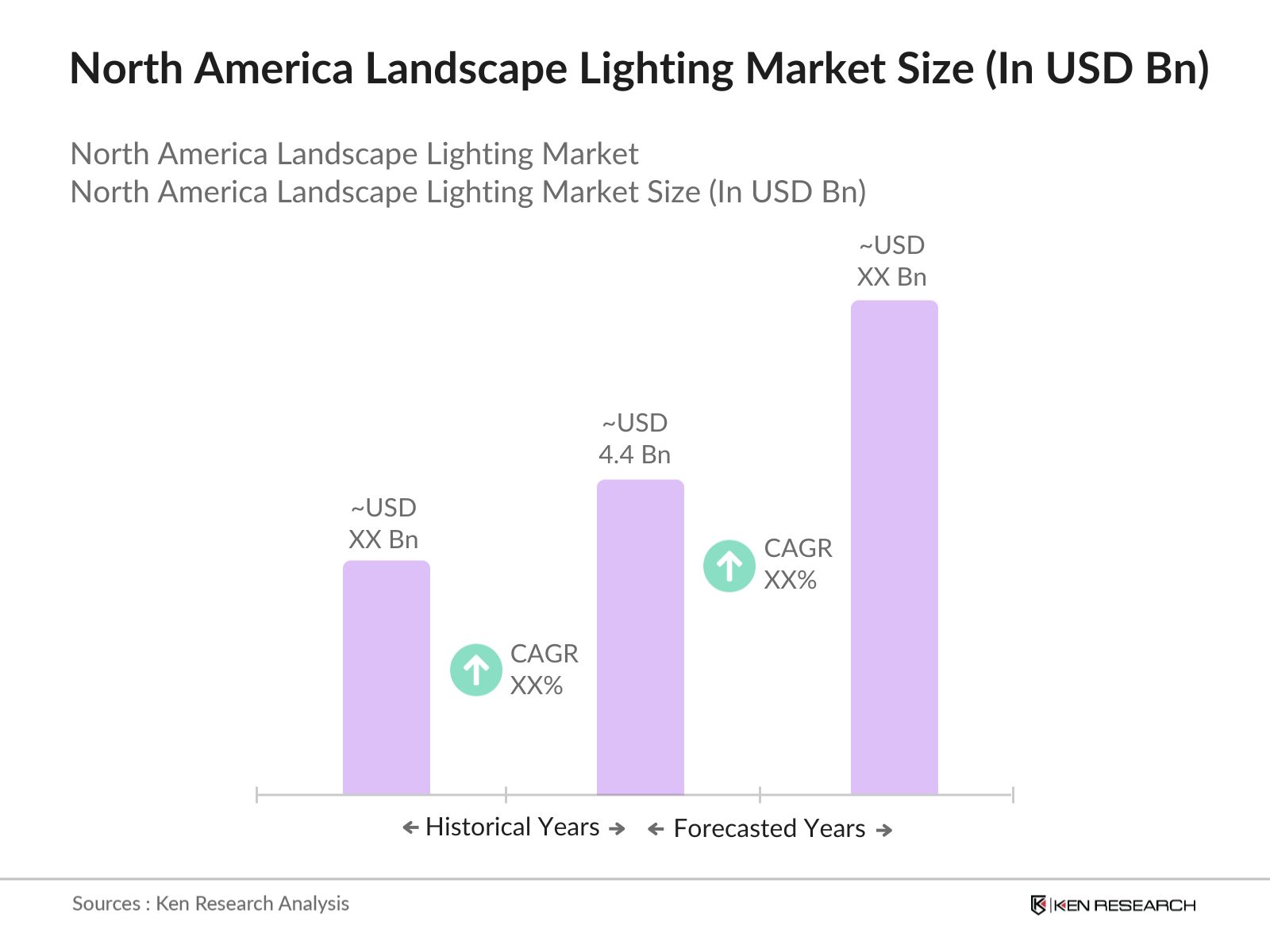
  • The North America Landscape Lighting Market is valued at USD 4.4 billion, based on a five-year historical analysis. This market growth is primarily driven by the rising demand for aesthetic outdoor environments in both residential and commercial spaces, with an increasing focus on energy-efficient lighting solutions, such as LED and solar-powered lighting. Growing investments in landscaping for residential areas, commercial complexes, and public parks, along with advancements in smart lighting technology, are key contributors to the markets expansion. market overviews
  • The United States and Canada lead the North American landscape lighting market due to their large urban populations, high spending on home improvement, and an increasing inclination toward aesthetic landscaping. Cities like New York, Los Angeles, and Toronto are pivotal in shaping the market because of higher disposable incomes, increased environmental consciousness, and the integration of sustainable lighting solutions in urban planning. These factors, coupled with government initiatives promoting energy efficiency, further strengthen the market presence in these regions.
  • North American regulations emphasize energy-efficient lighting, significantly impacting the landscape lighting market. The U.S. DOEs energy efficiency standards mandate that outdoor lighting fixtures meet strict performance criteria, pushing manufacturers to prioritize LED technology and other energy-saving solutions. Such standards encourage market adoption of eco-friendly products, aligning with North Americas commitment to reducing energy consumption annually in outdoor applications.

North America Landscape Lighting Market Segmentation
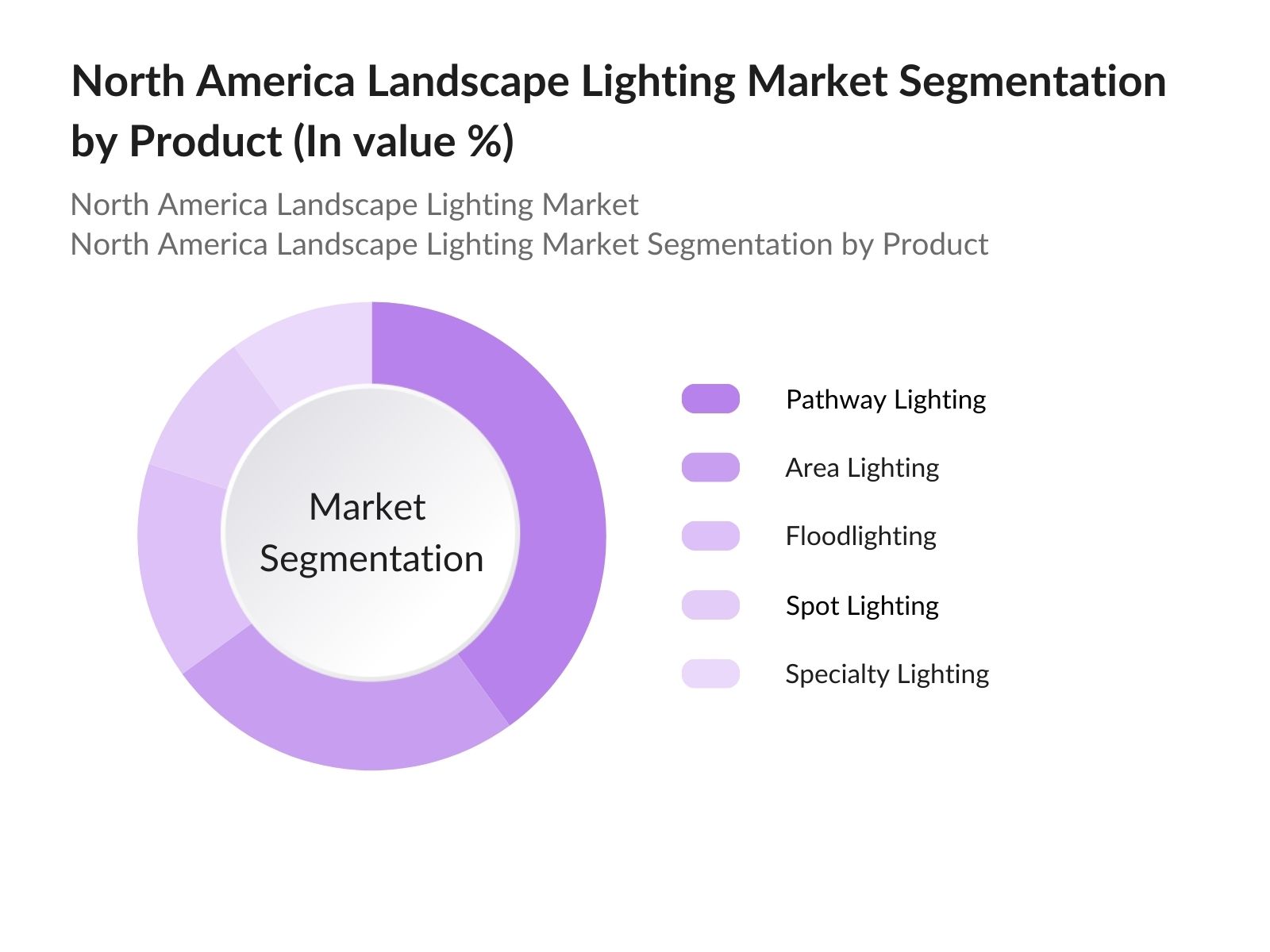
  • By Product Type: The Market is segmented by product type into pathway lighting, area lighting, floodlighting, spot lighting, and specialty lighting. Pathway lighting holds the dominant market share in this segment as it is extensively used in residential, commercial, and public areas to enhance safety and aesthetics. The high preference for pathway lighting is attributed to its functional role in improving nighttime visibility while accentuating landscape design. Additionally, advancements in solar and LED technologies have further boosted its adoption, as they offer energy savings and are environmentally friendly. market overviews
  • By Light Source: This market is also segmented by light source into LED, halogen, solar, and fluorescent. LED lighting dominates the light source segment, accounting for the highest market share due to its energy efficiency, longevity, and low maintenance costs. With consumers increasingly adopting eco-friendly lighting solutions, LED technology has gained traction as it significantly reduces energy consumption and offers superior brightness. Its versatility in outdoor settings, ranging from accent lighting to high-intensity floodlighting, further cements its popularity in the landscape lighting market.

North America Landscape Lighting Market Competitive Landscape

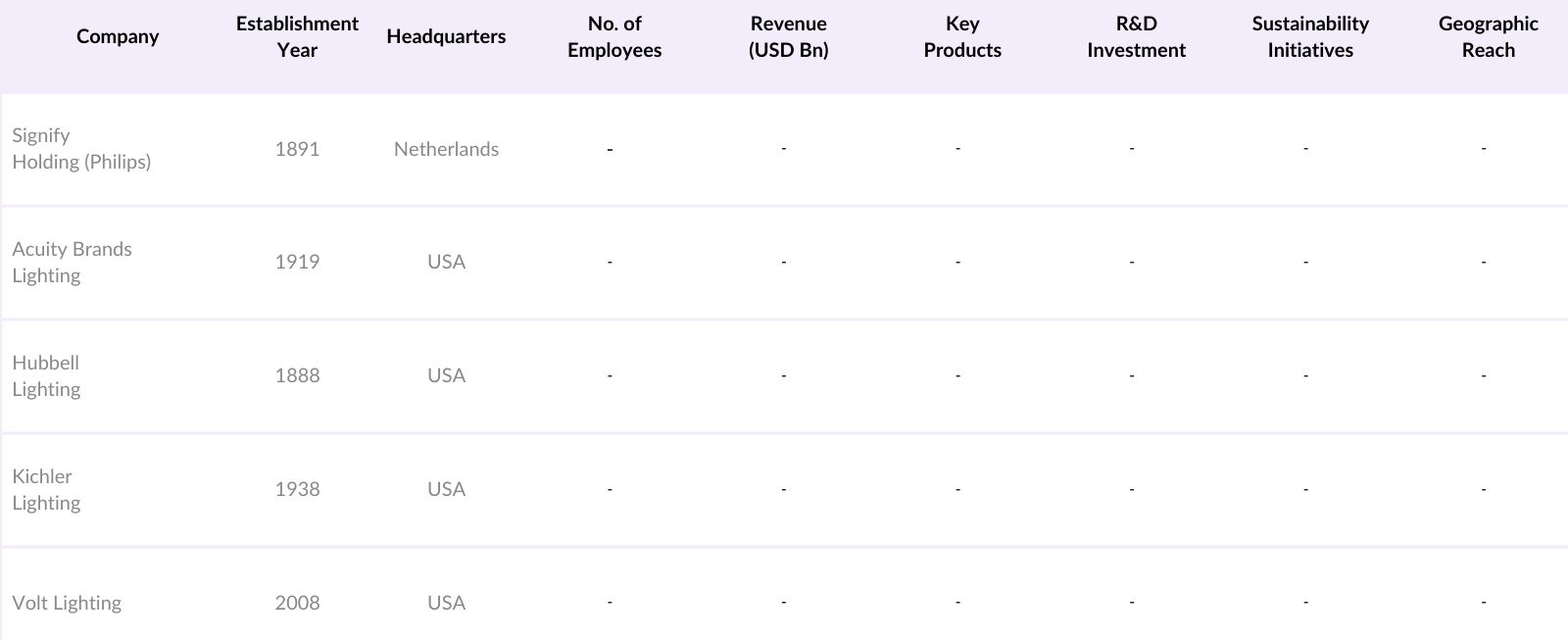
The North America Landscape Lighting Market is highly competitive, dominated by a blend of regional and international players focusing on innovation and sustainability. These companies prioritize expanding their product portfolios with energy-efficient and aesthetically appealing options, catering to the growing demand for landscape lighting in urban and suburban areas. The competitive landscape is shaped by investments in sustainable lighting solutions, IoT integration, and smart lighting technologies, which enhance functionality and offer consumers increased control over lighting systems. market overviews
 

North America Landscape Lighting Market Industry Analysis

Growth Drivers

  • Increasing Focus on Outdoor Aesthetic Appeal: The rising emphasis on aesthetic appeal across urban regions in North America has propelled the landscape lighting market forward, particularly in areas with high-value real estate. In 2024, nearly 79 million households in the U.S. have reported investments in home beautification projects, including outdoor lighting installations, significantly enhancing neighborhood value (U.S. Census Bureau). This trend reflects a growing homeowner preference for visually appealing outdoor spaces that increase property valuation and curb appeal, driving demand in residential landscape lighting.
  • Advancements in LED and Smart Lighting Technologies: In North America, advancements in energy-efficient lighting have spurred growth in landscape lighting, particularly with the adoption of LED technology. By 2024, 77% of lighting installations utilize LED, which can reduce electricity use by up to 85% compared to traditional incandescent lighting, according to the U.S. Department of Energy (DOE). Such energy savings align with government initiatives aimed at reducing national energy consumption and carbon footprint, making energy-efficient lighting solutions appealing to environmentally conscious consumers.
  • Rising Demand in Residential and Commercial Sectors: In 2023, the North American residential and commercial sectors collectively accounted for substantial growth in landscape lighting adoption, driven by urban development and property enhancement projects. The residential sectors adoption, estimated at over 40 million installations, represents a steady increase in demand for lighting fixtures that improve both outdoor ambiance and security, particularly in suburban regions.

Market Challenges

  • Limited Awareness in Certain Regions: Despite growing adoption in urban centers, awareness and demand for landscape lighting are limited in certain rural regions. The disparity in adoption rates between urban and rural households highlights the need for greater outreach and targeted marketing by industry players to increase product visibility. Educating potential customers in these less penetrated areas is essential to encourage broader adoption of landscape lighting, particularly as aesthetic and security benefits gain traction nationwide.
  • Complex Installation Process: Landscape lighting installations often require technical expertise due to wiring and layout complexities, with a significant number of projects involving professional installers. This reliance on skilled labor can drive up costs, limiting accessibility for homeowners seeking more budget-friendly options. Simplifying installation methods or enhancing product offerings that support DIY installations could help address this challenge, making landscape lighting solutions more widely accessible.

North America Landscape Lighting Market Future Outlook

The North America Landscape Lighting Market is anticipated to experience substantial growth through 2028, propelled by a rising focus on aesthetic landscaping, advancements in LED and smart lighting technologies, and increased adoption of energy-efficient solutions. As urbanization continues and disposable incomes rise, the market will witness further expansion, with innovations in IoT-enabled lighting offering users enhanced control and customization. The trend toward sustainable energy sources, such as solar-powered lighting, will play a critical role in shaping the future landscape lighting market.

Future Market Opportunities

  • Expansion of Smart Lighting Technology: Smart landscape lighting has significant potential in North America, where IoT device ownership is on the rise. By 2024, around 50 million homes in the U.S. have adopted at least one smart home device, according to the Federal Communications Commission (FCC). Integrating lighting with these systems offers enhanced convenience, automated control, and energy savings, meeting consumer demand for technologically advanced solutions. This expanding smart home ecosystem creates a fertile ground for growth in smart landscape lighting applications.
  • Growth in DIY Installations: There is a notable increase in DIY landscape lighting installations, particularly in suburban areas, where homeowners are looking to improve their properties without incurring high labor costs. In 2023, millions of DIY outdoor lighting projects were recorded in the U.S., driven by product innovations like plug-and-play lighting kits that simplify setup (U.S. Bureau of Labor Statistics). This trend opens up opportunities for product lines designed for self-installation, appealing to budget-conscious consumers.

Scope of the Report

Segment

Sub-segments

By Product Type

Pathway Lighting
Area Lighting
Floodlighting
Spot Lighting
Specialty Lighting

By Light Source

LED
Halogen
Solar
Fluorescent

By Application

Residential
Commercial
Public Spaces
Hospitality and Entertainment Venues
Sports Grounds and Stadiums

By Distribution Channel

Offline (Retail, Specialized Stores)
Online (E-commerce Platforms, Company Websites)

By Region

United States
Canada
Mexico

Products


Key Target Audience

  • Landscape Architects and Designers

  • Urban Planners and Municipalities

  • Outdoor Lighting Installers and Contractors

  • Real Estate Developers

  • Homeowners Associations

  • Hospitality and Resort Operators

  • Government and Regulatory Bodies (U.S. Department of Energy, Environment Canada)

  • Investors and Venture Capitalist Firms

  • Banks and Financial Institutions

Companies

Players Mentioned in the Report

  • Signify Holding (Philips Lighting)

  • Acuity Brands Lighting

  • Hubbell Lighting

  • Kichler Lighting

  • Cooper Lighting (Eaton Corporation)

  • Cast Lighting

  • FX Luminaire

  • Landscape Forms

  • WAC Lighting

  • Unique Lighting Systems

  • Volt Lighting

  • VISTA Professional Outdoor Lighting

  • Bega North America

  • Osram GmbH

  • Hinkley Lighting

Table of Contents

1. North America Landscape Lighting Market Overview

1.1 Definition and Scope

1.2 Market Taxonomy

1.3 Market Growth Rate

1.4 Market Segmentation Overview

2. North America Landscape Lighting Market Size (In USD Mn)

2.1 Historical Market Size

2.2 Year-On-Year Growth Analysis

2.3 Key Market Developments and Milestones

3. North America Landscape Lighting Market Analysis

3.1 Growth Drivers

3.1.1 Increasing Focus on Outdoor Aesthetic Appeal

3.1.2 Technological Advancements in Energy Efficiency

3.1.3 Rising Demand in Residential and Commercial Sectors

3.1.4 Enhanced Focus on Security and Safety (Outdoor Lighting)

3.2 Market Challenges

3.2.1 High Initial Installation Costs

3.2.2 Limited Awareness in Certain Regions

3.2.3 Complex Installation Process

3.3 Opportunities

3.3.1 Expansion of Smart Lighting Technology

3.3.2 Growth in DIY Installations

3.3.3 Integration with Sustainable Energy Solutions

3.4 Trends

3.4.1 Surge in Solar-powered Landscape Lighting

3.4.2 Adoption of LED Technology

3.4.3 Integration with IoT and Smart Homes

3.5 Government Regulation

3.5.1 Energy Efficiency Standards

3.5.2 Environmental Compliance Policies

3.5.3 Building and Safety Codes

3.5.4 Local Lighting Ordinances

3.6 SWOT Analysis

3.7 Stake Ecosystem

3.8 Porters Five Forces Analysis

3.9 Competition Ecosystem

4. North America Landscape Lighting Market Segmentation

4.1 By Product Type (In Value %)

4.1.1 Pathway Lighting

4.1.2 Area Lighting

4.1.3 Floodlighting

4.1.4 Spot Lighting

4.1.5 Specialty Lighting

4.2 By Light Source (In Value %)

4.2.1 LED

4.2.2 Halogen

4.2.3 Solar

4.2.4 Fluorescent

4.3 By Application (In Value %)

4.3.1 Residential

4.3.2 Commercial

4.3.3 Public Spaces

4.3.4 Hospitality and Entertainment Venues

4.3.5 Sports Grounds and Stadiums

4.4 By Distribution Channel (In Value %)

4.4.1 Offline (Retail, Specialized Stores)

4.4.2 Online (E-commerce Platforms, Company Websites)

4.5 By Region (In Value %)

4.5.1 United States

4.5.2 Canada

4.5.3 Mexico

4.5.4 Rest of North America

5. North America Landscape Lighting Market Competitive Analysis

5.1 Detailed Profiles of Major Companies

5.1.1 Signify Holding (Philips Lighting)

5.1.2 Acuity Brands Lighting

5.1.3 Hubbell Lighting

5.1.4 Osram GmbH

5.1.5 Kichler Lighting

5.1.6 Cooper Lighting (Eaton Corporation)

5.1.7 Landscape Forms

5.1.8 Cast Lighting

5.1.9 FX Luminaire

5.1.10 Hinkley Lighting

5.1.11 WAC Lighting

5.1.12 Unique Lighting Systems

5.1.13 Volt Lighting

5.1.14 VISTA Professional Outdoor Lighting

5.1.15 Bega North America

5.2 Cross Comparison Parameters (Product Range, Key Technologies, Revenue, Geographical Presence, Customer Base, Sustainability Practices, Product Innovation, Warranty and Maintenance Services)

5.3 Market Share Analysis

5.4 Strategic Initiatives

5.5 Mergers and Acquisitions

5.6 Investment Analysis

5.7 Venture Capital Funding

5.8 Government Grants

5.9 Private Equity Investments

6. North America Landscape Lighting Market Regulatory Framework

6.1 Environmental Standards

6.2 Compliance Requirements

6.3 Certification Processes

7. North America Landscape Lighting Future Market Size (In USD Mn)

7.1 Future Market Size Projections

7.2 Key Factors Driving Future Market Growth

8. North America Landscape Lighting Future Market Segmentation

8.1 By Product Type (In Value %)

8.2 By Light Source (In Value %)

8.3 By Application (In Value %)

8.4 By Distribution Channel (In Value %)

8.5 By Region (In Value %)

9. North America Landscape Lighting Market Analysts Recommendations

9.1 TAM/SAM/SOM Analysis

9.2 Customer Cohort Analysis

9.3 Marketing Initiatives

9.4 White Space Opportunity Analysis

Disclaimer Contact Us

Research Methodology

Step 1: Identification of Key Variables


The initial phase involved mapping the ecosystem of the North America Landscape Lighting Market, identifying major stakeholders such as manufacturers, contractors, and end-users. Comprehensive desk research was conducted using secondary sources, including industry reports and proprietary databases, to pinpoint critical market drivers and inhibitors.

Step 2: Market Analysis and Construction


Historical data was compiled to assess market size, revenue generation, and penetration across the landscape lighting sector. This stage involved evaluating segment-wise revenue distribution, region-wise growth, and the prevalence of energy-efficient lighting solutions, ensuring accurate revenue and volume projections.

Step 3: Hypothesis Validation and Expert Consultation


A set of hypotheses on market dynamics was validated through expert interviews conducted via computer-assisted telephone interviews (CATI). These interviews provided real-world insights and feedback on operational trends, product adoption rates, and consumer preferences across North America.

Step 4: Research Synthesis and Final Output


The final phase involved synthesizing findings with input from industry players to ensure a holistic market analysis. Cross-referencing with bottom-up and top-down analysis validated our data, guaranteeing accurate market insights in the report.


Frequently Asked Questions

How big is the North America Landscape Lighting Market?

The North America Landscape Lighting Market was valued at USD 4.4 billion, supported by rising demand for outdoor aesthetics and energy-efficient solutions.

What are the challenges in the North America Landscape Lighting Market?

Key challenges in the North America Landscape Lighting Market include the high initial costs of installation, limited awareness in rural areas, and complex installation requirements, which can hinder market penetration.

Who are the major players in the North America Landscape Lighting Market?

Leading companies in the North America Landscape Lighting Market include Signify Holding (Philips Lighting), Acuity Brands Lighting, Hubbell Lighting, Kichler Lighting, and Cooper Lighting, who dominate through broad product portfolios and strong market reach.

What are the growth drivers of the North America Landscape Lighting Market?

North America Landscape Lighting Market growth is driven by increasing demand for energy-efficient outdoor lighting, advancements in LED and IoT-enabled lighting, and a rising trend toward outdoor aesthetic enhancement in residential and commercial spaces.

Why Buy From Us?

RRR
Refine Robust Result (RRR) Framework

What makes us stand out is that our consultants follows Robust, Refine and Result (RRR) methodology. i.e. Robust for clear definitions, approaches and sanity checking, Refine for differentiating respondents facts and opinions and Result for presenting data with story

Our Reach Is Unmatched

We have set a benchmark in the industry by offering our clients with syndicated and customized market research reports featuring coverage of entire market as well as meticulous research and analyst insights.

Research
Shifting the Research Paradigm

While we don't replace traditional research, we flip the method upside down. Our dual approach of Top Bottom & Bottom Top ensures quality deliverable by not just verifying company fundamentals but also looking at the sector and macroeconomic factors.

Insite
More Insights-Better Decisions

With one step in the future, our research team constantly tries to show you the bigger picture. We help with some of the tough questions you may encounter along the way: How is the industry positioned? Best marketing channel? KPI's of competitors? By aligning every element, we help maximize success.

Trust
Transparency and Trust

Our report gives you instant access to the answers and sources that other companies might choose to hide. We elaborate each steps of research methodology we have used and showcase you the sample size to earn your trust.

support
Round the Clock Support

If you need any support, we are here! We pride ourselves on universe strength, data quality, and quick, friendly, and professional service.

Why Client Choose Us?

400000+ Reports in repository
150+ Consulting project a year
100+ Analysts
8000+ Client Queries in 2022