
North America Lime Market Outlook to 2030
Region:Global
Author(s):Sanjna
Product Code:KROD10454
November 2024
85
About the Report
North America Lime Market Overview
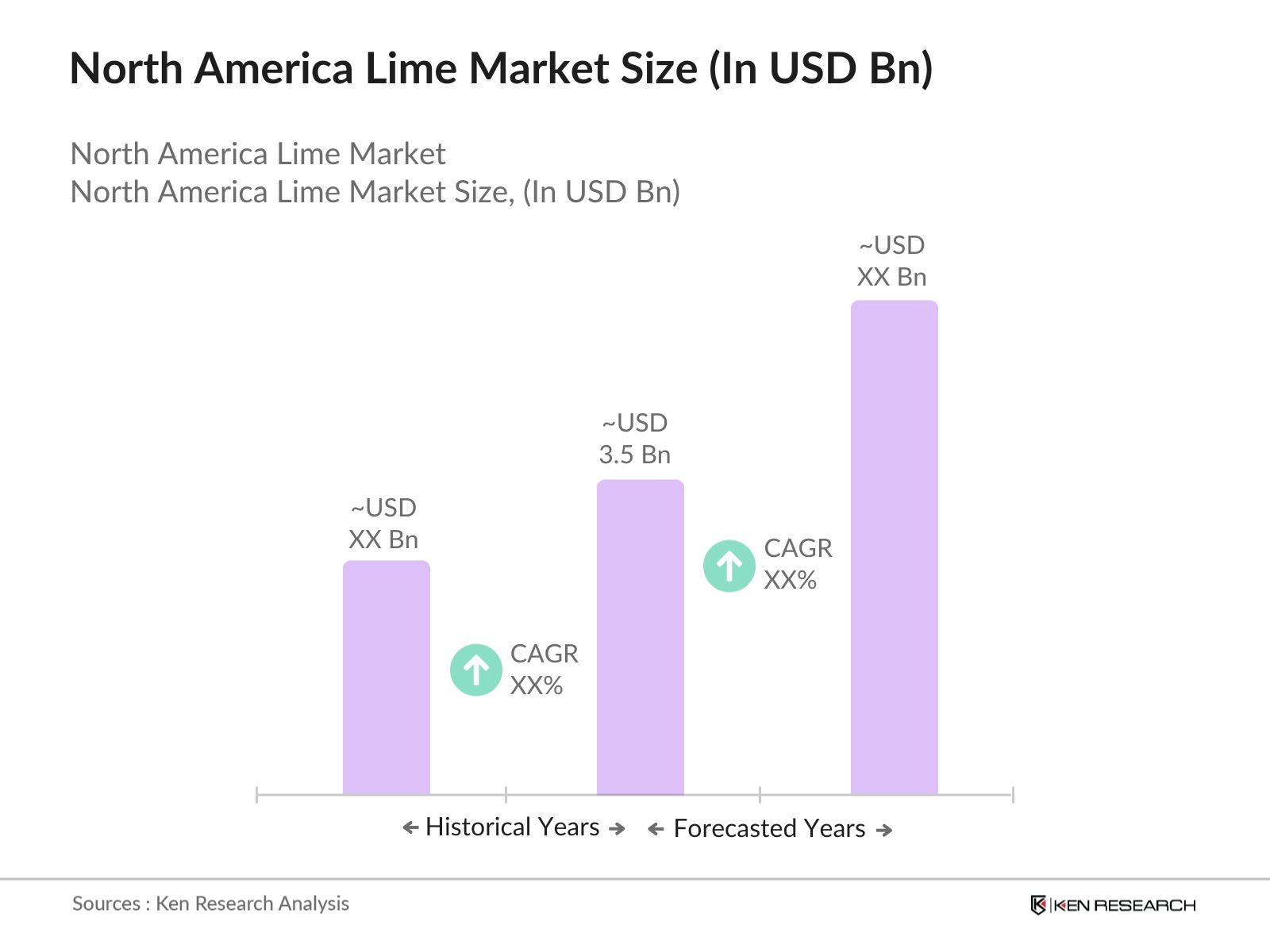
- The North America Lime Market is valued at USD 3.5 billion, driven by robust demand from various industries, such as steel manufacturing, construction, and water treatment. The steel industry, in particular, is a significant consumer of lime for metallurgical processes like desulfurization and slag production. Additionally, the growing focus on environmental regulations, particularly in flue gas treatment and water purification, is fueling lime consumption across North America. Data sourced from credible market studies confirms this market valuation.
- The United States and Canada dominate the North America Lime Market due to their vast industrial base, especially in steel production, construction, and environmental sectors. Both countries benefit from high infrastructural development and stringent environmental regulations, which necessitate large-scale lime usage. The availability of high-quality limestone deposits, particularly in the United States, enhances lime production capacity, making these countries leading contributors to market growth.
- Limestone mining, the primary source of lime, is subject to federal and state-level regulations aimed at minimizing environmental impact. In 2023, the U.S. Bureau of Land Management (BLM) revised its guidelines to limit the environmental footprint of limestone mining operations. Companies are now required to conduct comprehensive environmental impact assessments before commencing new mining projects, increasing compliance costs.
North America Lime Market Segmentation
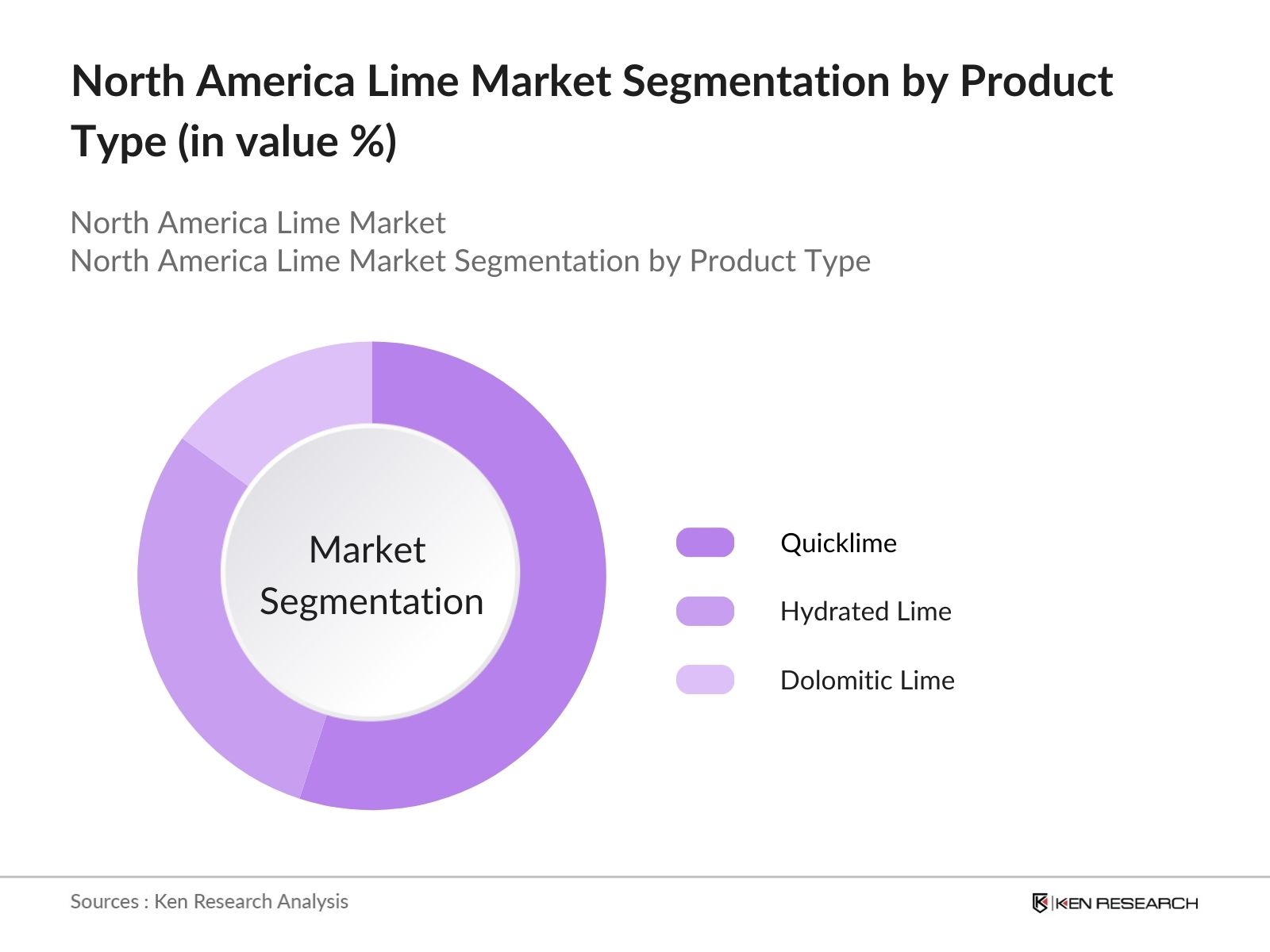
By Product Type: The North America Lime Market is segmented by product type into quicklime, hydrated lime, and dolomitic lime. Quicklime holds the dominant market share due to its widespread use in steel production and environmental treatment applications. The demand for quicklime in industries such as metallurgy, construction, and chemical manufacturing is driven by its high reactivity and cost-effectiveness. Quicklime is essential in the removal of sulfur from steel and is critical in water treatment plants for pH adjustment, solidifying its position in the market.
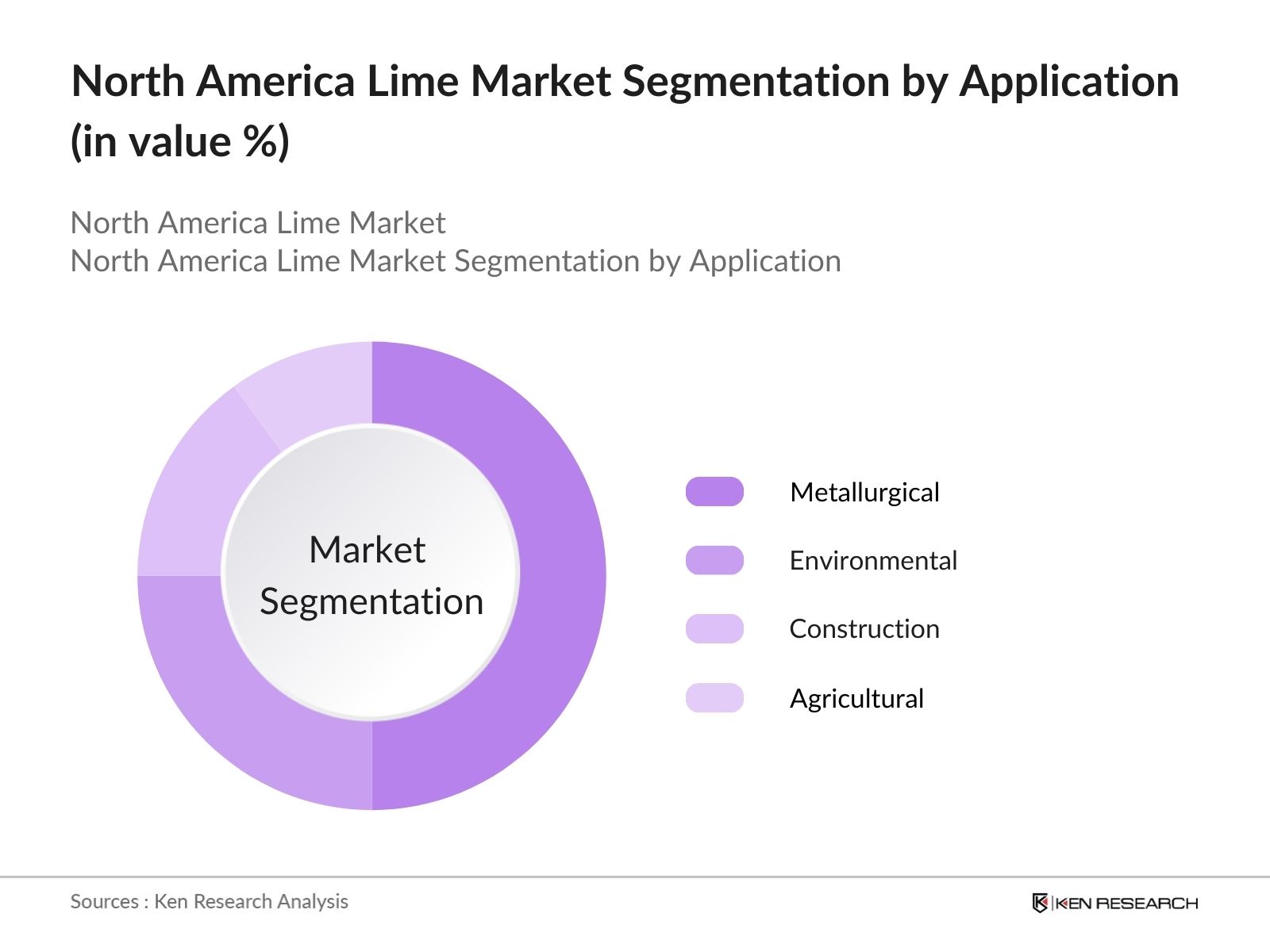
 By Application: The North America Lime Market is segmented by application into metallurgical, environmental, construction, and agricultural. Metallurgical applications, particularly in steel manufacturing, dominate the market due to the critical role lime plays in processes like slag formation and desulfurization. The use of lime in steel production ensures better quality and strength of the steel, making this sub-segment the leading contributor. Increasing demand for steel in construction and automotive industries further fuels this segment's dominance.
North America Lime Market Competitive Landscape
The North America Lime Market is dominated by a few major players, who hold significant influence over the industry through their extensive production capacities and geographic reach. Companies like Graymont and Lhoist North America have large limestone reserves and technologically advanced production facilities, enabling them to meet the growing demand across various industries. Other prominent players are focusing on sustainability initiatives and technological innovations to maintain competitive positions.
|
Company |
Established Year |
Headquarters |
Limestone Reserves |
Production Capacity |
Product Portfolio |
Geographical Reach |
Technological Capabilities |
Sustainability Initiatives |
R&D Investments |
|
Graymont |
1948 |
Richmond, Canada |
- |
- |
- |
- |
- |
- |
- |
|
Lhoist North America |
1889 |
Fort Worth, USA |
- |
- |
- |
- |
- |
- |
- |
|
Carmeuse |
1860 |
Pittsburgh, USA |
- |
- |
- |
- |
- |
- |
- |
|
United States Lime & Minerals |
1948 |
Dallas, USA |
- |
- |
- |
- |
- |
- |
- |
|
Mississippi Lime |
1907 |
St. Louis, USA |
- |
- |
- |
- |
- |
- |
- |
North America Lime Market Analysis
Growth Drivers
- Increase in Construction Sector: The North American lime market has seen significant growth due to the increasing demand from the construction sector. In 2024, over 1.5 billion tons of limestone-based construction material were utilized in the U.S. infrastructure projects, according to data from the U.S. Geological Survey. This growth is largely driven by urbanization and government initiatives to improve roadways and buildings. The Infrastructure Investment and Jobs Act (2021) has allocated $1.2 trillion for infrastructure improvements through 2026, further boosting lime demand for cement and concrete applications. Source.
- Demand for Steel: Lime plays a critical role in steel production as a fluxing agent. The U.S. steel industry consumed over 22 million metric tons of lime in 2023, as per the U.S. Census Bureau data. With U.S. steel output forecasted to reach 90 million metric tons in 2024, driven by demand in automotive and construction industries, the lime market is set to benefit from this upward trend. Lime aids in removing impurities such as sulfur and phosphorus from iron, a vital process for producing high-quality steel.
- Environmental Regulations on Sulfur Removal: Stricter sulfur dioxide (SO2) emissions regulations across North America have driven demand for lime in flue gas desulfurization (FGD) units in power plants. In 2024, FGD units are expected to consume over 10 million metric tons of lime across the region, as indicated by data from the U.S. Environmental Protection Agency (EPA). Regulations such as the Clean Air Act mandate the use of lime to capture sulfur in exhaust gases, significantly boosting demand from power generation and heavy industries.
Challenges
- Environmental Impact of Lime Production: Lime production is highly energy-intensive and contributes significantly to CO2 emissions. In 2023, the U.S. lime industry emitted approximately 12 million metric tons of CO2, according to the International Energy Agency (IEA). The industry's reliance on fossil fuels during calcination (the process of producing lime) creates sustainability concerns, with regulatory pressure increasing to reduce emissions. The high carbon footprint of lime production has led to calls for cleaner, more efficient production technologies.
- Regulatory Compliance Costs The lime industry faces stringent environmental regulations, particularly regarding emissions. Compliance with air quality standards, such as those enforced by the EPA, adds significant costs to lime producers. For example, On February 7, 2024, the EPA finalized a rule lowering the primary annual NAAQS for fine particulate matter (PM2.5) from 12 to 9 micrograms per cubic meter (g/m).
North America Lime Market Future Outlook
Over the next five years, the North America Lime Market is expected to witness steady growth driven by continuous demand from the steel industry, advancements in lime production technologies, and stringent environmental regulations aimed at emissions control. The market will also benefit from the expanding use of lime in agriculture for soil conditioning and in wastewater treatment applications, particularly with increased urbanization across key regions.
Market Opportunities
- Innovation in Energy Efficiency: The adoption of energy-efficient technologies offers a significant opportunity for lime manufacturers to reduce production costs. The introduction of more efficient kilns and carbon capture technologies can lower energy consumption by as much as 25%. In 2023, several U.S.-based lime producers, including Mississippi Lime, began investing in state-of-the-art kiln systems, leading to projected energy savings of 30 trillion BTUs annually across the industry. This technological shift presents opportunities for cost reductions and environmental compliance.
- Expanding Applications in Wastewater Treatment: Lime is increasingly used in water and wastewater treatment plants to adjust pH levels and remove impurities. In 2023, the U.S. wastewater treatment sector used over 3 million metric tons of lime, as reported by the U.S. Environmental Protection Agency (EPA). This figure is expected to rise as cities upgrade their water treatment facilities to comply with stricter water quality standards. The Clean Water Act's requirements for improved water treatment processes present a growing market opportunity for lime suppliers.
Scope of the Report
|
Segment |
Sub-segments |
|
By Product Type |
Quicklime Hydrated Lime Dolomitic Lime |
|
By Application |
Metallurgical Construction Environmental Agriculture |
|
By End-Use Industry |
Steel Agriculture Chemical Manufacturing Water Treatment Construction |
|
By Grade |
High Calcium Lime Dolomitic Lime Industrial Grade Lime Refractory Grade Lime |
|
By Region |
United States Canada Mexico |
Products
Key Target Audience
Lime Manufacturers
Steel Producers
Environmental Protection Agencies (EPA, Canadian Ministry of Environment)
Water Treatment Companies
Agriculture Sector (Farmers Associations, Agribusiness Firms)
Construction Firms
Investors and Venture Capitalist Firms
Government and Regulatory Bodies (OSHA, Environmental Protection Agency)
Companies
Players Mentioned in the Report
- Graymont
- Lhoist North America
- Carmeuse
- United States Lime & Minerals
- Mississippi Lime
- Cheney Lime & Cement Company
- Linwood Mining & Minerals Corporation
- Martin Marietta Materials
- Pete Lien & Sons, Inc.
- Minerals Technologies Inc.
Table of Contents
1. North America Lime Market Overview
1.1. Definition and Scope
1.2. Market Taxonomy
1.3. Market Growth Rate (Growth Drivers, Market Challenges, Opportunities)
1.4. Market Segmentation Overview (By Product Type, Application, End-Use Industry, Region, Grade)
2. North America Lime Market Size (In USD Mn)
2.1. Historical Market Size
2.2. Year-On-Year Growth Analysis
2.3. Key Market Developments and Milestones
3. North America Lime Market Analysis
3.1. Growth Drivers (Increase in Construction Sector, Demand for Steel, Environmental Regulations on Sulfur Removal, Growing Use in Agriculture)
3.2. Market Challenges (Environmental Impact of Lime Production, High Energy Consumption, Regulatory Compliance Costs, Market Saturation)
3.3. Opportunities (Innovation in Energy Efficiency, Expanding Applications in Wastewater Treatment, Carbon Capture Initiatives, Growth in Glass Manufacturing)
3.4. Trends (Technological Advancements in Lime Production, Increased Use of Hydrated Lime, Shift Toward High-Purity Lime, Sustainability Initiatives in Manufacturing)
3.5. Government Regulation (Emission Standards, Limestone Mining Regulations, Government Infrastructure Initiatives, Carbon Tax Policies)
3.6. SWOT Analysis
3.7. Stakeholder Ecosystem (Lime Producers, Distributors, End-Users, Government Regulatory Bodies)
3.8. Porters Five Forces (Supplier Power, Buyer Power, Competitive Rivalry, Threat of New Entrants, Threat of Substitutes)
3.9. Competition Ecosystem
4. North America Lime Market Segmentation
4.1. By Product Type (In Value %)
4.1.1. Quicklime
4.1.2. Hydrated Lime
4.1.3. Dolomitic Lime
4.2. By Application (In Value %)
4.2.1. Metallurgical (Steel Production, Non-Ferrous Metals)
4.2.2. Construction (Soil Stabilization, Asphalt)
4.2.3. Environmental (Water Treatment, Flue Gas Desulfurization, Air Pollution Control)
4.2.4. Agriculture (Soil Conditioning, Animal Waste Treatment)
4.3. By End-Use Industry (In Value %)
4.3.1. Steel
4.3.2. Agriculture
4.3.3. Chemical Manufacturing
4.3.4. Water Treatment
4.3.5. Construction
4.4. By Grade (In Value %)
4.4.1. High Calcium Lime
4.4.2. Dolomitic Lime
4.4.3. Industrial Grade Lime
4.4.4. Refractory Grade Lime
4.5. By Region (In Value %)
4.5.1. United States
4.5.2. Canada
4.5.3. Mexico
5. North America Lime Market Competitive Analysis
5.1. Detailed Profiles of Major Companies
5.1.1. Graymont
5.1.2. Lhoist North America
5.1.3. Carmeuse
5.1.4. United States Lime & Minerals
5.1.5. Mississippi Lime
5.1.6. Cheney Lime & Cement Company
5.1.7. Linwood Mining & Minerals Corporation
5.1.8. Martin Marietta Materials
5.1.9. Pete Lien & Sons, Inc.
5.1.10. Minerals Technologies Inc.
5.2. Cross Comparison Parameters (No. of Employees, Headquarters, Inception Year, Revenue, Product Offerings, Production Capacity, Geographical Presence, Technological Capabilities)
5.3. Market Share Analysis
5.4. Strategic Initiatives (Partnerships, Technological Investments, Capacity Expansions, Sustainability Initiatives)
5.5. Mergers and Acquisitions
5.6. Investment Analysis
5.7. Venture Capital Funding
5.8. Government Grants
5.9. Private Equity Investments
6. North America Lime Market Regulatory Framework
6.1. Environmental Standards (Emission Limits, Mining Licenses, Industrial Compliance)
6.2. Compliance Requirements (ISO Certifications, Environmental Impact Assessments, Occupational Safety Regulations)
6.3. Certification Processes (Government Approvals, Industry Certifications, Product Quality Standards)
7. North America Lime Future Market Size (In USD Mn)
7.1. Future Market Size Projections
7.2. Key Factors Driving Future Market Growth (Infrastructure Development, Industrial Expansion, Increased Environmental Regulations)
8. North America Lime Future Market Segmentation
8.1. By Product Type (In Value %)
8.2. By Application (In Value %)
8.3. By End-Use Industry (In Value %)
8.4. By Grade (In Value %)
8.5. By Region (In Value %)
9. North America Lime Market Analysts Recommendations
9.1. TAM/SAM/SOM Analysis
9.2. Customer Cohort Analysis
9.3. Marketing Initiatives
9.4. White Space Opportunity Analysis
Research Methodology
Step 1: Identification of Key Variables
The initial phase focuses on mapping out the North America Lime Market's ecosystem, covering all relevant stakeholders such as lime producers, distributors, and regulatory bodies. This involves a comprehensive desk review, leveraging both secondary data and proprietary databases to understand the critical variables affecting the market dynamics.
Step 2: Market Analysis and Construction
In this phase, historical data related to the North America Lime Market is collected and analyzed, particularly focusing on market penetration, supply chain dynamics, and revenue generation. Statistical analysis will be performed to validate the data and provide reliable market projections.
Step 3: Hypothesis Validation and Expert Consultation
To ensure the data's accuracy, market hypotheses are validated through interviews with industry experts. These interviews provide insights into operational aspects, financial performance, and technological advancements within the market, ensuring the reliability of the market data.
Step 4: Research Synthesis and Final Output
The final step involves direct engagement with lime producers and end-users to cross-validate data from a bottom-up perspective. This process ensures the accuracy of production data, consumer trends, and market growth forecasts, providing a comprehensive outlook for the North America Lime Market.
Frequently Asked Questions
1. How big is the North America Lime Market?
The North America Lime Market was valued at USD 3.5 billion, driven by demand from industries like steel production, construction, and environmental sectors.
2. What are the challenges in the North America Lime Market?
Key challenges in North America Lime Market include high energy consumption during lime production, environmental impact concerns, and compliance with increasingly stringent environmental regulations.
3. Who are the major players in the North America Lime Market?
Key players in North America Lime Market include Graymont, Lhoist North America, Carmeuse, United States Lime & Minerals, and Mississippi Lime. These companies dominate due to their extensive production capacities and technological innovations.
4. What are the growth drivers of the North America Lime Market?
North America Lime Market is driven by robust demand from the steel and construction sectors, environmental regulations requiring lime for flue gas desulfurization, and increasing use in water treatment and agricultural applications.
Why Buy From Us?

What makes us stand out is that our consultants follows Robust, Refine and Result (RRR) methodology. i.e. Robust for clear definitions, approaches and sanity checking, Refine for differentiating respondents facts and opinions and Result for presenting data with story

We have set a benchmark in the industry by offering our clients with syndicated and customized market research reports featuring coverage of entire market as well as meticulous research and analyst insights.

While we don't replace traditional research, we flip the method upside down. Our dual approach of Top Bottom & Bottom Top ensures quality deliverable by not just verifying company fundamentals but also looking at the sector and macroeconomic factors.

With one step in the future, our research team constantly tries to show you the bigger picture. We help with some of the tough questions you may encounter along the way: How is the industry positioned? Best marketing channel? KPI's of competitors? By aligning every element, we help maximize success.

Our report gives you instant access to the answers and sources that other companies might choose to hide. We elaborate each steps of research methodology we have used and showcase you the sample size to earn your trust.

If you need any support, we are here! We pride ourselves on universe strength, data quality, and quick, friendly, and professional service.