















North America Logistics Automation Market Outlook to 2030
Region:Global
Author(s):Shambhavi
Product Code:KROD3338
November 2024
88
About the Report
North America Logistics Automation Market Overview
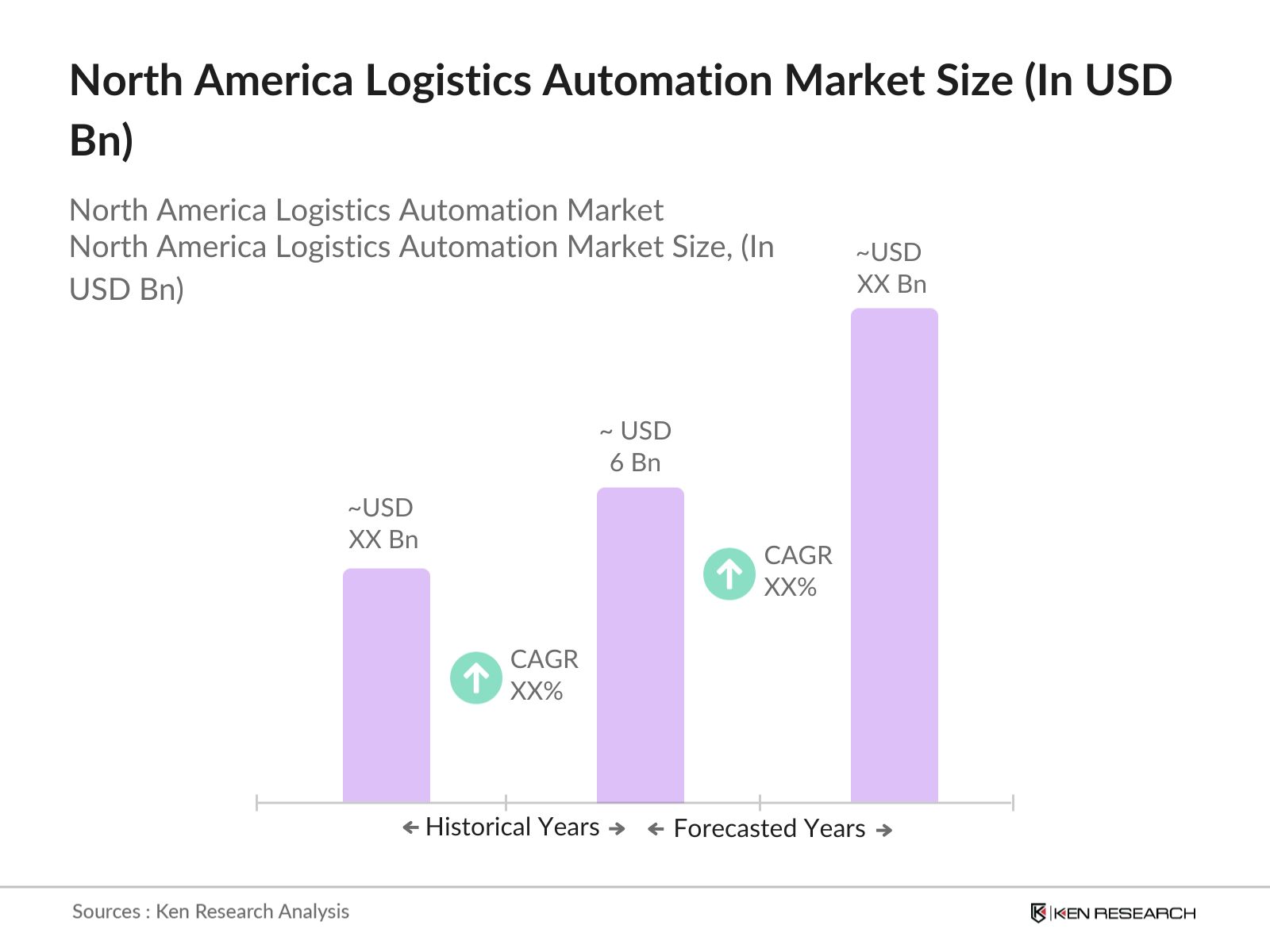
- The North America logistics automation market is valued at USD 6 billion, driven primarily by the rapid adoption of automation technologies in the e-commerce and retail sectors. The increasing need for operational efficiency in warehousing, inventory management, and transportation, along with labor shortages and rising wages, have accelerated the demand for logistics automation solutions. As companies aim to streamline operations and reduce costs, investments in automation technologies such as robotic systems, warehouse management software, and automated storage and retrieval systems have surged.
- In terms of geographical dominance, the United States leads the North America logistics automation market due to the presence of large retail and e-commerce companies, advanced infrastructure, and high investment in technology. Major cities such as Los Angeles, Chicago, and Dallas have become logistics hubs, benefiting from established supply chains, proximity to major ports, and access to capital. Additionally, Canada's key cities like Toronto and Vancouver contribute to the market with their focus on improving logistics infrastructure.
- The U.S. Occupational Safety and Health Administration (OSHA) has established strict safety standards for automated warehousing environments, affecting over 8,000 warehouses across the country. These regulations mandate regular safety checks for automated machinery, employee training programs for working alongside robots, and compliance with ergonomic standards to reduce workplace injuries. In 2023, OSHA reported a 15% decline in warehouse-related injuries due to the enforcement of these regulations. As automation expands, adherence to these safety guidelines is critical for operational compliance and worker safety.
North America Logistics Automation Market Segmentation
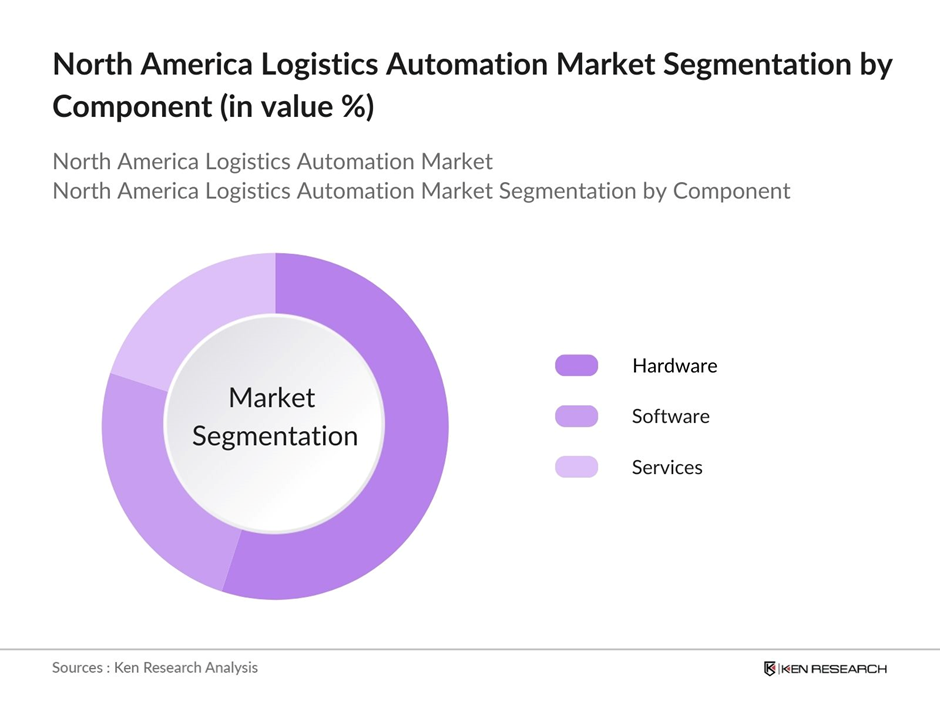
By Component: North America logistics automation market is segmented by component into hardware, software, and services. The hardware segment, comprising automated storage and retrieval systems (AS/RS), conveyor systems, and robotic pickers, dominates the market due to the increasing demand for physical automation in warehouses. The need for faster order fulfillment, error reduction, and scalability has driven the adoption of these systems in e-commerce and retail sectors, particularly during peak seasons. The widespread deployment of robotics in distribution centers further fuels the growth of the hardware segment.
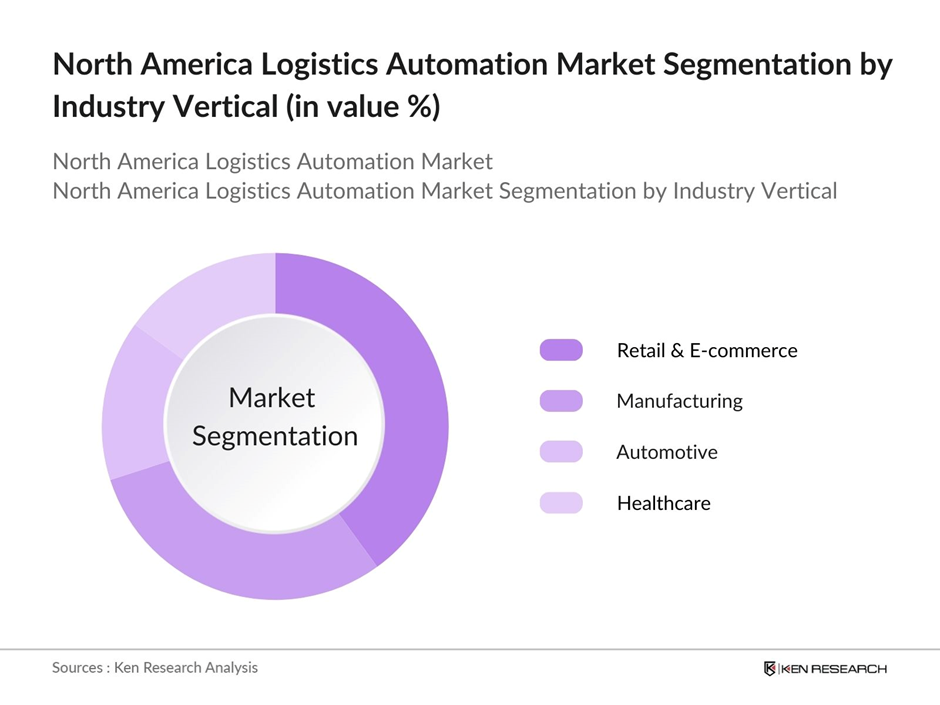
By Industry Vertical: The market is also segmented by industry vertical into retail & e-commerce, manufacturing, automotive, and healthcare. Retail & e-commerce holds the dominant share due to the industry's strong focus on optimizing warehouse operations and transportation management. The sector has witnessed tremendous growth, driven by the increasing demand for same-day and next-day deliveries, which necessitates the use of sophisticated logistics automation systems. The growing e-commerce giants in North America have heavily invested in these systems to stay competitive and meet consumer expectations.
North America Logistics Automation Market Competitive Landscape
The North America logistics automation market is characterized by the presence of global giants and specialized solution providers. The market is highly competitive, with companies vying to offer innovative technologies and scalable solutions to meet the evolving needs of various industries. The competitive landscape is shaped by large investments in research and development, strategic partnerships, and mergers and acquisitions. Global players like Dematic Corp., Honeywell Intelligrated, and Swisslog Holding AG dominate the market with their extensive product portfolios and strong customer relationships.
|
Company |
Established |
Headquarters |
Revenue |
Employees |
Product Portfolio |
R&D Expenditure |
Customer Base |
Global Presence |
|
Dematic Corp. |
1819 |
Atlanta, USA |
||||||
|
Honeywell Intelligrated |
2001 |
Mason, USA |
||||||
|
Swisslog Holding AG |
1900 |
Buchs, Switzerland |
||||||
|
Knapp AG |
1952 |
Graz, Austria |
||||||
|
SSI Schaefer AG |
1937 |
Neunkirchen, Germany |
North America Logistics Automation Market Analysis
Growth Drivers
- Adoption of AI and Robotics: The North America Logistics Automation Market is witnessing rapid growth in AI-driven solutions, with the adoption rate of AI-powered logistics expected to surpass 60% by the end of the decade. According to industry reports, over 35% of warehouses in North America have already integrated robotics for picking, packing, and sorting, significantly improving efficiency. Companies such as Amazon and Walmart are heavily investing in AI-driven automated guided vehicles (AGVs) and autonomous warehouse robots to enhance supply chain operations.
- Rise in E-commerce and Omnichannel Retailing: The rapid growth of e-commerce and omnichannel retailing is fueling logistics automation in North America. With U.S. e-commerce expanding by 7.5% in 2024 and penetration reaching 22.7%, retailers face increasing demand for faster fulfillment. Over 75% of shoppers expect same-day delivery, pushing companies to adopt AI-driven sorting, robotics, and automation. Industry leaders like FedEx and UPS are integrating AI to enhance supply chain efficiency.
- Increased Focus on Warehouse Automation: The North American logistics sector is undergoing significant transformation as companies prioritize warehouse automation to combat labor shortages and rising operational costs. With growing e-commerce volumes, businesses are implementing goods-to-person robotics, automated sorting, and AI-powered inventory management systems to streamline processes. The rise of micro-fulfillment centers in urban areas is also driving the demand for automated logistics, reducing order processing time and improving efficiency.
Market Challenges
- Complexity in Integration with Legacy Systems: Many logistics companies in North America still rely on outdated software and infrastructure, making it challenging to integrate advanced automation solutions. The lack of compatibility between modern automation technologies and legacy ERP or WMS systems leads to operational inefficiencies, increased implementation time, and higher costs for system upgrades.
- High Capital Expenditure: Implementing logistics automation requires significant upfront investment in robotics, AI-driven software, IoT-enabled tracking, and warehouse automation technologies. The high cost of automated storage & retrieval systems (AS/RS), AGVs (Automated Guided Vehicles), and smart sorting systems often discourages small and mid-sized logistics companies from adopting these solutions, slowing down industry-wide adoption.
North America Logistics Automation Market Future Outlook
Over the next five years, the North America logistics automation market is expected to experience significant growth driven by advancements in technology, increasing demand for faster order fulfillment, and the push for more efficient supply chain operations. The integration of artificial intelligence (AI), machine learning (ML), and the Internet of Things (IoT) into logistics automation will further enhance capabilities, offering predictive analytics, real-time monitoring, and automated decision-making processes. The shift towards autonomous mobile robots and automated transportation systems will likely revolutionize how goods are moved and managed, especially in high-demand sectors such as e-commerce and healthcare.
Market Opportunities
- Rising Demand for Autonomous Mobile Robots (AMRs): Autonomous Mobile Robots (AMRs) are rapidly being adopted across North American warehouses. With over 20,000 AMRs expected to be deployed in 2024, companies such as Amazon and FedEx are leading the charge in leveraging these robots for material handling and order picking. The AMRs ability to reduce picking time by 50% and labor costs by 30% makes them essential in addressing the labor shortages reported by the U.S. Bureau of Labor Statistics. These trends highlight a promising opportunity for further automation and increased efficiency across logistics networks.
- Increasing Investments in Machine Learning and IoT: Investments in machine learning and IoT technology are accelerating in the North American logistics sector, with IoT device shipments for supply chain applications projected to reach 25 million units by 2025. Machine learning algorithms, integrated into warehouse management systems, enable real-time predictive analytics, reducing stock shortages by 30%. The U.S. governments Smart Cities initiative, with an investment of $160 million, aims to advance IoT applications, including logistics optimization. These innovations present significant opportunities for enhanced operational efficiency and decision-making in logistics automation.
Scope of the Report
|
By Component |
Hardware Software Services |
|
By Function |
Warehouse Operations Inventory Management Transportation Management |
|
By Industry Vertical |
Retail & Ecommerce Manufacturing Automotive Healthcare |
|
By Deployment Mode |
On-premises Cloud based |
|
By Region |
United States Canada Mexico |
Products
Key Target Audience
Retail and E-commerce Companies
Third-Party Logistics Providers
Automotive Manufacturers
Healthcare Organizations
Warehouse and Distribution Centers
Government and Regulatory Bodies (U.S. Department of Transportation, Canada Border Services Agency)
Investors and Venture Capitalist Firms
Technology Solution Providers
Companies
Major Players
Dematic Corp.
Honeywell Intelligrated
Swisslog Holding AG
Knapp AG
SSI Schaefer AG
Murata Machinery Ltd.
Vanderlande Industries
Kion Group AG
Daifuku Co., Ltd.
TGW Logistics Group
JBT Corporation
Locus Robotics
GreyOrange
Manhattan Associates
Zebra Technologies
Table of Contents
1. North America Logistics Automation Market Overview
1.1. Definition and Scope
1.2. Market Taxonomy
1.3. Market Growth Rate
1.4. Market Segmentation Overview
2. North America Logistics Automation Market Size (In USD Bn)
2.1. Historical Market Size
2.2. Year-on-Year Growth Analysis
2.3. Key Market Developments and Milestones
3. North America Logistics Automation Market Analysis
3.1. Growth Drivers (Automation Adoption, E-commerce Boom, Labor Shortages, Efficiency Gains)
3.1.1. Adoption of AI and Robotics
3.1.2. Rise in E-commerce and Omnichannel Retailing
3.1.3. Increased Focus on Warehouse Automation
3.1.4. Demand for Real-Time Tracking Solutions
3.2. Market Challenges (High Initial Costs, System Integration Issues, Data Security Concerns)
3.2.1. Complexity in Integration with Legacy Systems
3.2.2. High Capital Expenditure
3.2.3. Data Privacy and Cybersecurity Risks
3.3. Opportunities (Technological Advancements, Expansion of Autonomous Vehicles, Growing SME Adoption)
3.3.1. Rising Demand for Autonomous Mobile Robots (AMRs)
3.3.2. Increasing Investments in Machine Learning and IoT
3.3.3. Expansion of Robotics as a Service (RaaS)
3.4. Trends (AI Integration, Use of Predictive Analytics, Rise in Cloud-based Solutions)
3.4.1. Integration of Machine Learning for Predictive Maintenance
3.4.2. Growing Adoption of Cloud Logistics Management
3.4.3. Surge in Demand for Predictive Analytics Tools
3.5. Government Regulation (Trade Policies, Labor Laws, Safety Standards)
3.5.1. National Safety Regulations for Automation in Warehousing
3.5.2. Compliance with Cross-border Trade Policies
3.5.3. Labor Union Impact on Automation
4. North America Logistics Automation Market Segmentation
4.1. By Component (In Value %)
4.1.1. Hardware
Automated Storage and Retrieval Systems (AS/RS)
Conveyor Systems
Robotic Pickers
4.1.2. Software
Warehouse Management Systems (WMS)
Transportation Management Systems (TMS)
4.1.3. Services
System Integration
Consulting
4.2. By Function (In Value %)
4.2.1. Warehouse Operations
4.2.2. Inventory Management
4.2.3. Transportation Management
4.3. By Industry Vertical (In Value %)
4.3.1. Retail & E-Commerce
4.3.2. Manufacturing
4.3.3. Automotive
4.3.4. Healthcare
4.4. By Deployment Mode (In Value %)
4.4.1. On-premises
4.4.2. Cloud-based
4.5. By Region (In Value %)
4.5.1. United States
4.5.2. Canada
4.5.3. Mexico
5. North America Logistics Automation Market Competitive Analysis
5.1. Detailed Profiles of Major Companies
5.1.1. Dematic Corp.
5.1.2. Honeywell Intelligrated
5.1.3. Swisslog Holding AG
5.1.4. Knapp AG
5.1.5. SSI Schaefer AG
5.1.6. Murata Machinery Ltd.
5.1.7. Vanderlande Industries
5.1.8. Kion Group AG
5.1.9. Daifuku Co., Ltd.
5.1.10. TGW Logistics Group
5.1.11. JBT Corporation
5.1.12. Locus Robotics
5.1.13. GreyOrange
5.1.14. Manhattan Associates
5.1.15. Zebra Technologies
5.2. Cross Comparison Parameters (Revenue, Headquarters, Market Share, Product Portfolio, R&D Expenditure, Customer Base, Partnership Ecosystem, Global Footprint)
5.3. Market Share Analysis
5.4. Strategic Initiatives
5.5. Mergers and Acquisitions
5.6. Investment Analysis
5.7. Venture Capital Funding
5.8. Government Grants
5.9. Private Equity Investments
6. North America Logistics Automation Market Regulatory Framework
6.1. Automation Standards for Warehouse Operations
6.2. Compliance with Safety and Environmental Regulations
6.3. Certification Processes
7. North America Logistics Automation Future Market Size (In USD Bn)
7.1. Future Market Size Projections
7.2. Key Factors Driving Future Market Growth
8. North America Logistics Automation Future Market Segmentation
8.1. By Component (In Value %)
8.2. By Function (In Value %)
8.3. By Industry Vertical (In Value %)
8.4. By Deployment Mode (In Value %)
8.5. By Region (In Value %)
9. North America Logistics Automation Market Analysts Recommendations
9.1. TAM/SAM/SOM Analysis
9.2. Customer Cohort Analysis
9.3. Marketing Initiatives
9.4. White Space Opportunity Analysis
Disclaimer
Contact Us
Research Methodology
Step 1: Identification of Key Variables
In the initial phase, key variables influencing the North America logistics automation market are identified through extensive desk research. This involves analyzing the supply chain ecosystem, automation trends, and technological advancements, supported by secondary data sources such as proprietary databases and industry reports.
Step 2: Market Analysis and Construction
Historical data related to market penetration, hardware and software adoption, and revenue generation is compiled to construct the market model. Special attention is given to shifts in industry demands, such as the growing e-commerce sector and the adoption of robotics in logistics.
Step 3: Hypothesis Validation and Expert Consultation
Market hypotheses are validated through consultations with industry experts and key stakeholders, ensuring that the data reflects real-world conditions. Insights from these interviews are integrated to refine the market projections and validate the analysis.
Step 4: Research Synthesis and Final Output
The final phase involves synthesizing the data and preparing the report. Input from various automation manufacturers is taken into consideration to ensure that the analysis is comprehensive and accurate, providing actionable insights for business professionals.
Frequently Asked Questions
1. How big is the North America Logistics Automation Market?
The North America logistics automation market is valued at USD 6 billion, driven by the rising adoption of advanced automation technologies in warehousing and transportation management.
2. What are the challenges in the North America Logistics Automation Market?
Key challenges in North America logistics automation market include the high initial costs associated with automation systems, the complexity of integrating these systems with existing infrastructure, and concerns over data privacy and cybersecurity.
3. Who are the major players in the North America Logistics Automation Market?
Major players in the North America logistics automation market include Dematic Corp., Honeywell Intelligrated, Swisslog Holding AG, Knapp AG, and SSI Schaefer AG. These companies dominate the market due to their innovative technologies and strong customer base.
4. What are the growth drivers of the North America Logistics Automation Market?
The North America logistics automation market is driven by factors such as increasing demand for efficient warehousing solutions, labor shortages, and the rising popularity of e-commerce, which necessitates automation to handle the growing volume of goods.
5. What are the trends in the North America Logistics Automation Market?
Notable trends in North America logistics automation market include the integration of artificial intelligence, machine learning, and the Internet of Things in logistics automation, as well as the increasing use of autonomous mobile robots for goods handling and transport.
Why Buy From Us?

What makes us stand out is that our consultants follows Robust, Refine and Result (RRR) methodology. i.e. Robust for clear definitions, approaches and sanity checking, Refine for differentiating respondents facts and opinions and Result for presenting data with story

We have set a benchmark in the industry by offering our clients with syndicated and customized market research reports featuring coverage of entire market as well as meticulous research and analyst insights.

While we don't replace traditional research, we flip the method upside down. Our dual approach of Top Bottom & Bottom Top ensures quality deliverable by not just verifying company fundamentals but also looking at the sector and macroeconomic factors.

With one step in the future, our research team constantly tries to show you the bigger picture. We help with some of the tough questions you may encounter along the way: How is the industry positioned? Best marketing channel? KPI's of competitors? By aligning every element, we help maximize success.

Our report gives you instant access to the answers and sources that other companies might choose to hide. We elaborate each steps of research methodology we have used and showcase you the sample size to earn your trust.

If you need any support, we are here! We pride ourselves on universe strength, data quality, and quick, friendly, and professional service.