















North America Magnesite Market Outlook to 2030
Region:North America
Author(s):Yogita Sahu
Product Code:KROD5751
November 2024
94
About the Report
North America Magnesite Market Overview
- The North America magnesite market is valued at USD 3.5 billion based on a five-year historical analysis. This market is driven by the increasing demand for magnesite in refractory products used in industries such as steel, cement, and glass. These industries rely on magnesite due to its high thermal resistance and durability, which has led to consistent demand over the years.
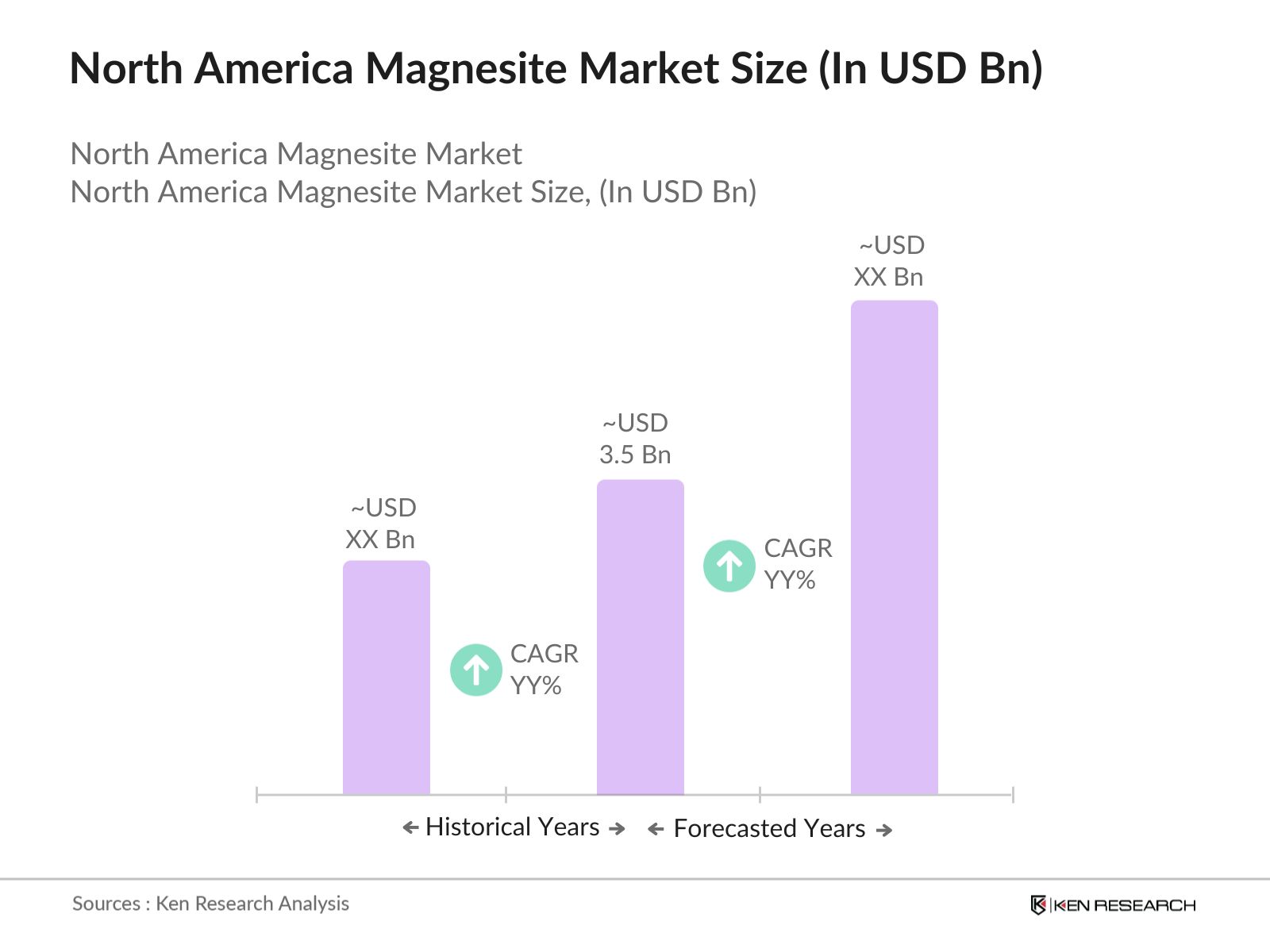
- In North America, the U.S. is the dominant country driving the magnesite market. This is primarily due to the U.S.'s large industrial base, particularly in steel production and environmental sustainability initiatives. The U.S. also benefits from having several well-established magnesite mining and processing companies, which enhances its competitive advantage in the region.
- The U.S. government allocated $700 million in 2024 for mineral exploration, including magnesite, under the Critical Minerals Strategy. This initiative aims to reduce dependence on imports and boost domestic production, providing long-term benefits to the North American magnesite market.
North America Magnesite Market Segmentation
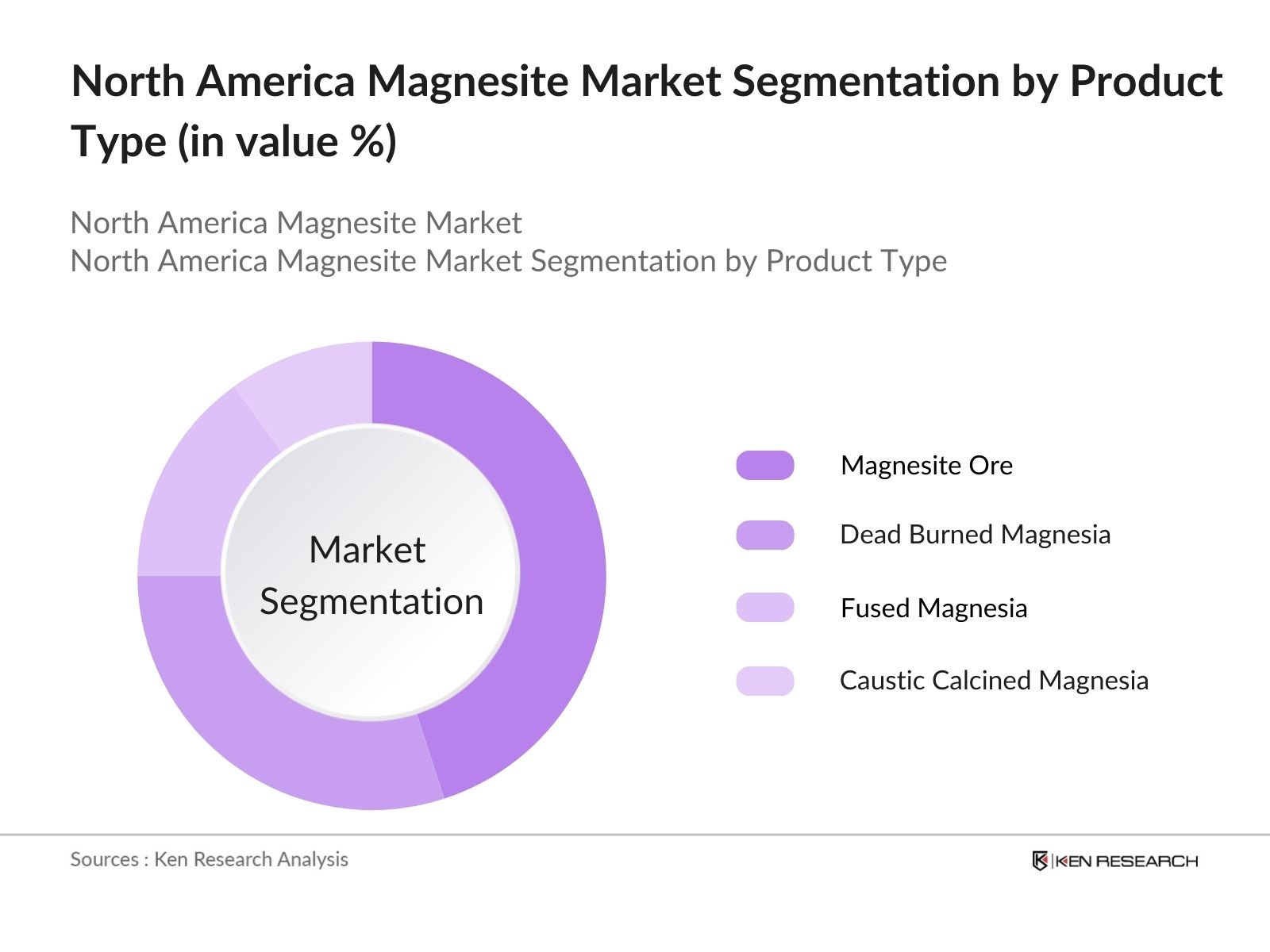
By Product Type: The market is segmented by product type into magnesite ore, dead burned magnesia, fused magnesia, and caustic calcined magnesia. Dead burned magnesia holds a dominant market share in North America under the product type segmentation, driven by its widespread use in refractory products for industries like steel and cement. Its high-temperature resistance and strength make it an essential component in furnace linings, which are critical in maintaining the efficiency of these high-energy processes.
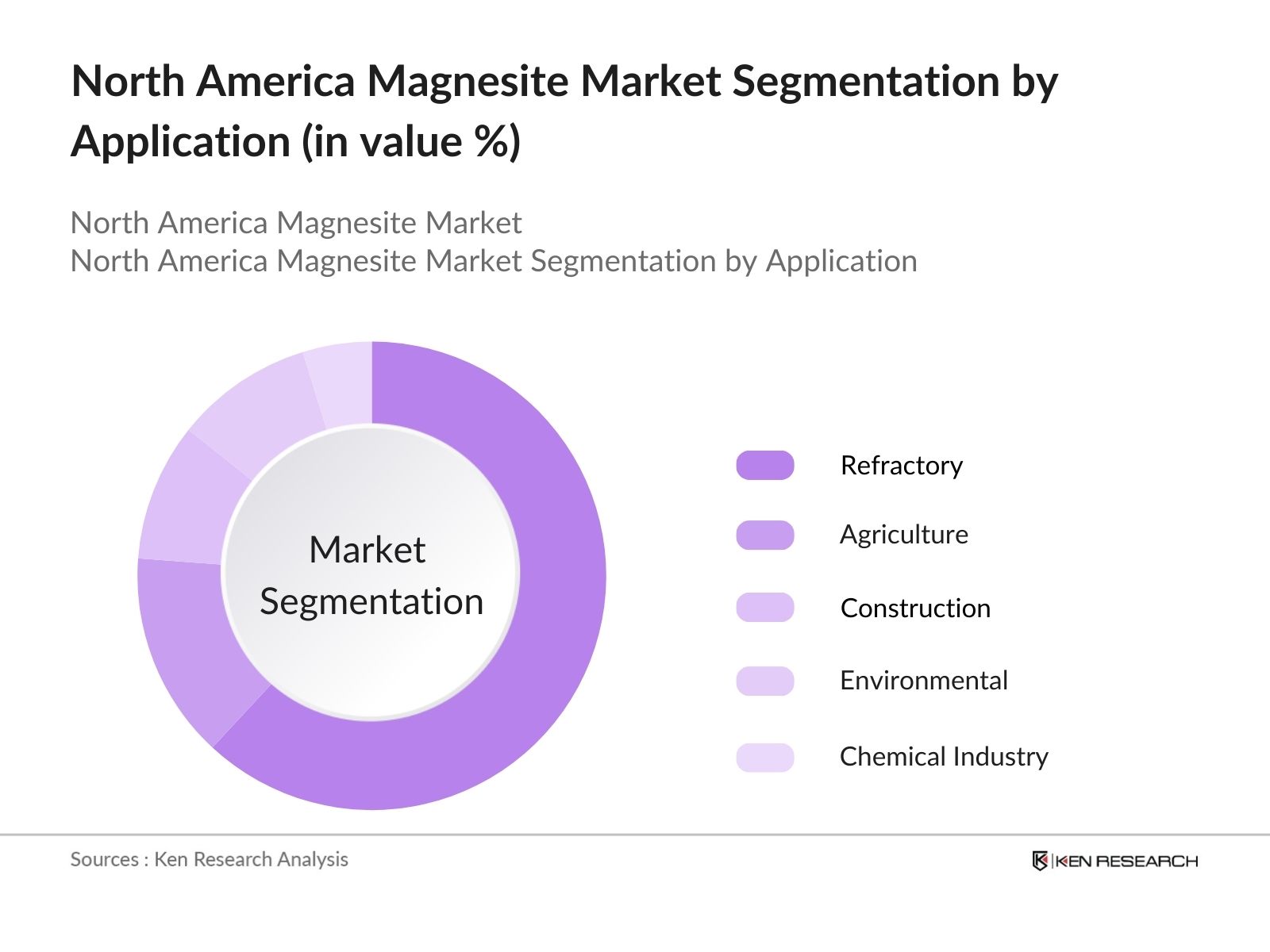
By Application: The market is segmented by application into refractory, agriculture, construction, environmental, and the chemical industry. The refractory segment dominates the market share due to its extensive use in high-temperature industrial applications, especially in the steel and cement sectors. These industries account for a substantial portion of magnesite demand, as refractory materials are crucial for ensuring the integrity and longevity of furnaces and kilns.
North America Magnesite Market Competitive Landscape
The market is dominated by several key players, with significant influence due to their extensive manufacturing capabilities, global supply chains, and product innovation. Companies such as RHI Magnesite and Magnezit Group lead the market due to their strong foothold in refractory materials and a robust network of distribution channels.
|
Company |
Establishment Year |
Headquarters |
No. of Employees |
Revenue |
Product Portfolio |
Market Share |
Innovation Capabilities |
Sustainability Initiatives |
|
RHI Magnesita N.V. |
1909 |
Vienna, Austria |
||||||
|
Magnezit Group |
1901 |
Russia |
||||||
|
Premier Magnesia, LLC |
1965 |
Gabbs, Nevada, USA |
||||||
|
Grecian Magnesite S.A. |
1959 |
Thessaloniki, Greece |
||||||
|
Sibelco |
1872 |
Antwerp, Belgium |
North America Magnesite Market Analysis
Market Growth Drivers
- Expanding Use in Fireproof and Insulation Materials: The construction industry in North America, which is forecasted to grow with a total construction spending of $1.85 trillion in 2024, relies on magnesite for fireproofing and insulation materials. With increasing fire safety regulations across residential and commercial buildings, the use of magnesite-based fireproofing solutions is expected to grow.
- Growing Application in Agriculture: Magnesite is also utilized in agriculture as a magnesium-rich fertilizer. The North American agricultural sector spent good amount on fertilizers in 2024, and the need for magnesium-based products is increasing due to soil nutrient depletion. As farming practices in North America move towards more sustainable and nutrient-rich fertilization methods, the demand for magnesite will continue to rise.
- Support for Refractory Materials Research: In 2024, the U.S. Department of Energy invested $150 million in research for advanced refractory materials, including magnesite-based products. This research is aimed at improving energy efficiency in industries like steel and cement, which will, in turn, boost demand for magnesite in these sectors.
Market Challenges
- Supply Chain Disruptions in Magnesite Mining: Magnesite mining is often affected by geopolitical tensions and supply chain disruptions. In 2024, many mines in Turkey and China, two major global magnesite producers, are facing operational delays due to environmental regulations. The North American market is dependent on imports, and the limited domestic production, coupled with these global challenges, is expected to result in irregular supply.
- Competition from Substitute Materials: The availability of substitute materials like calcium oxide in refractory and insulation applications is a major challenge for the magnesite market. In 2024, industries are exploring more cost-effective alternatives, particularly in the construction sector, where calcium-based products are easier to source and apply. This competition is likely to hinder the demand growth of magnesite.
North America Magnesite Market Future Outlook
Over the next five years, the North America magnesite industry is expected to show growth, driven by rising demand for high-quality refractory products and increasing applications in environmental sustainability efforts.
Future Market Opportunities
- Increased Domestic Magnesite Mining Output: Over the next five years, North America is expected to increase domestic magnesite mining output. The continued investment in mineral exploration and technology will lead to a projected increase in magnesite production by over 200,000 metric tons by 2029, reducing reliance on imports and stabilizing supply for key industries.
- Greater Adoption in Electric Vehicle Battery Production: By 2029, magnesite is expected to play a key role in the production of batteries for electric vehicles (EVs). With the North American EV market forecasted to expand dramaticallysurpassing 13 million vehicles annuallymagnesites magnesium compounds will be increasingly used in battery manufacturing processes, making it a critical material in this growing sector.
Scope of the Report
|
Product Type |
Magnesite Ore Dead Burned Magnesia Fused Magnesia Caustic Calcined Magnesia |
|
Application |
Refractory Agriculture Construction Environmental Chemical Industry |
|
End-User Industry |
Steel Cement Glass Automotive Pharmaceuticals |
|
Form |
Powder Granular Lump |
|
Region |
U.S. Canada Mexico |
Products
Key Target Audience Organizations and Entities Who Can Benefit by Subscribing This Report:
Refractory product manufacturers
Steel and cement producers
Banks and Financial Institution
Environmental sustainability companies
Agriculture and soil amendment firms
Chemical industry manufacturers
Government and regulatory bodies (U.S. Environmental Protection Agency, Natural Resources Canada)
Investment and venture capitalist firms
Companies
Players Mentioned in the Report:
RHI Magnesita N.V.
Magnezit Group
Grecian Magnesite
Premier Magnesia, LLC
Baymag Inc.
Sibelco
Kumas Manyezit Sanayi A.S.
Magnesita Refractories Company
Liaoning Jinding Magnesite Group
Haicheng Magnesite Refractory General Factory
Ramakrishna Magnesite Mines
Possehl Erzkontor GmbH
Martin Marietta Magnesia Specialties
Nedmag B.V.
Qatar Magnesium Co.
Table of Contents
North America Magnesite Market Overview
1.1. Definition and Scope
1.2. Market Taxonomy
1.3. Market Growth Rate
1.4. Market Segmentation Overview
North America Magnesite Market Size (In USD Bn)
2.1. Historical Market Size
2.2. Year-On-Year Growth Analysis
2.3. Key Market Developments and Milestones
North America Magnesite Market Analysis
3.1. Growth Drivers
3.1.1. Demand for Refractory Products (Steel Production, Cement Industry, Glass Manufacturing)
3.1.2. Increasing Use in Agriculture (Soil Amendments, Animal Feed Additives)
3.1.3. Expansion of Magnesium Metal Production (Automobile and Aerospace Sectors)
3.1.4. Rising Usage in Environmental Applications (Water Treatment, Carbon Capture)
3.2. Market Challenges
3.2.1. Volatile Prices of Raw Materials
3.2.2. Stringent Environmental Regulations
3.2.3. Supply Chain Disruptions (Mining Restrictions, Geopolitical Factors)
3.3. Opportunities
3.3.1. Innovation in Magnesia-based Products (Magnesium Oxide Nanoparticles, High Purity Magnesite)
3.3.2. Growth in Lightweight Materials for Electric Vehicles
3.3.3. Expansion in Asia-Pacific Export Markets
3.4. Trends
3.4.1. Increasing Adoption of Sustainable Mining Practices
3.4.2. Growth in Magnesia-based Construction Materials
3.4.3. Rising Demand for Eco-Friendly Refractory Products
3.5. Government Regulation
3.5.1. Mining and Export Restrictions (North America Region)
3.5.2. Environmental Protection Laws (Impact on Mining and Processing)
3.5.3. Safety and Compliance Regulations for Industrial Use
3.6. SWOT Analysis
3.7. Stakeholder Ecosystem
3.8. Porters Five Forces
3.9. Competition Ecosystem
North America Magnesite Market Segmentation
4.1. By Product Type (In Value %)
4.1.1. Magnesite Ore
4.1.2. Dead Burned Magnesia
4.1.3. Fused Magnesia
4.1.4. Caustic Calcined Magnesia
4.2. By Application (In Value %)
4.2.1. Refractory
4.2.2. Agriculture
4.2.3. Construction
4.2.4. Environmental
4.2.5. Chemical Industry
4.3. By End-User Industry (In Value %)
4.3.1. Steel
4.3.2. Cement
4.3.3. Glass
4.3.4. Automotive
4.3.5. Pharmaceuticals
4.4. By Form (In Value %)
4.4.1. Powder
4.4.2. Granular
4.4.3. Lump
4.5. By Region (In Value %)
4.5.1. U.S.
4.5.2. Canada
4.5.3. Mexico
North America Magnesite Market Competitive Analysis
5.1. Detailed Profiles of Major Companies
5.1.1. RHI Magnesita N.V.
5.1.2. Magnezit Group
5.1.3. Grecian Magnesite
5.1.4. Premier Magnesia, LLC
5.1.5. Sibelco
5.1.6. Kumas Manyezit Sanayi A.S.
5.1.7. Magnesita Refractories Company
5.1.8. Baymag Inc.
5.1.9. Liaoning Jinding Magnesite Group
5.1.10. Haicheng Magnesite Refractory General Factory
5.1.11. Ramakrishna Magnesite Mines
5.1.12. Possehl Erzkontor GmbH
5.1.13. Martin Marietta Magnesia Specialties
5.1.14. Nedmag B.V.
5.1.15. Qatar Magnesium Co.
5.2. Cross Comparison Parameters (Market Share, Product Portfolio, Supply Chain Reach, Innovation Capabilities, Manufacturing Capacity, Revenue)
5.3. Market Share Analysis
5.4. Strategic Initiatives
5.5. Mergers and Acquisitions
5.6. Investment Analysis
5.7. Joint Ventures and Partnerships
North America Magnesite Market Regulatory Framework
6.1. Mining Legislation
6.2. Environmental Compliance (Emission Standards, Waste Disposal)
6.3. Certification Requirements for Industrial Use
North America Magnesite Market Future Market Size (In USD Bn)
7.1. Future Market Size Projections
7.2. Key Factors Driving Future Market Growth
North America Magnesite Market Future Market Segmentation
8.1. By Product Type (In Value %)
8.2. By Application (In Value %)
8.3. By End-User Industry (In Value %)
8.4. By Form (In Value %)
8.5. By Region (In Value %)
North America Magnesite Market Analysts Recommendations
9.1. TAM/SAM/SOM Analysis
9.2. Market Penetration Strategies
9.3. Innovation Opportunities
9.4. Supply Chain Optimization
Research Methodology
Step 1: Identification of Key Variables
In the initial phase, an ecosystem map was developed, encompassing all stakeholders in the North America magnesite market. This process involved extensive desk research using secondary sources and proprietary databases. The objective was to identify key variables such as market demand, production capacities, and key raw material costs influencing the market.
Step 2: Market Analysis and Construction
Historical data was collected and analyzed to establish a baseline for the North America magnesite market. The data focused on market penetration, application use, and revenue generation within the industry. Particular attention was paid to the ratio of market supply to demand and the economic implications of price fluctuations.
Step 3: Hypothesis Validation and Expert Consultation
Consultations were held with industry experts through CATI surveys, providing insight into operational and financial performance. These consultations helped to refine market data and validate key assumptions regarding future market trends and projections.
Step 4: Research Synthesis and Final Output
In the final phase, insights from key magnesite manufacturers were gathered to complement data derived from the bottom-up approach. This synthesis allowed for a comprehensive and validated analysis of the North America magnesite market, ensuring that all market dynamics were accurately captured.
Frequently Asked Questions
01. How big is the North America Magnesite Market?
The North America magnesite market was valued at USD 3.5 billion in 2023, driven by the growing demand for refractory products in steel production, cement manufacturing, and environmental applications.
02. What are the challenges in the North America Magnesite Market?
Challenges in the North America magnesite market include volatile raw material prices, stringent environmental regulations affecting mining activities, and supply chain disruptions caused by geopolitical factors.
03. Who are the major players in the North America Magnesite Market?
Key players in the North America magnesite market include RHI Magnesita N.V., Magnezit Group, Grecian Magnesite, Premier Magnesia, LLC, and Baymag Inc., all of whom dominate the market due to their extensive product offerings and robust distribution networks.
04. What are the growth drivers of the North America Magnesite Market?
The North America magnesite market is driven by the increasing demand for magnesite in the steel and cement industries, as well as the rising use of magnesite in environmental applications such as water treatment and carbon capture.
05. What opportunities exist in the North America Magnesite Market?
Opportunities in the North America magnesite market include the development of high-purity magnesia products, increased adoption of magnesium in electric vehicle components, and growth in export markets, particularly in Asia-Pacific.
Why Buy From Us?

What makes us stand out is that our consultants follows Robust, Refine and Result (RRR) methodology. i.e. Robust for clear definitions, approaches and sanity checking, Refine for differentiating respondents facts and opinions and Result for presenting data with story

We have set a benchmark in the industry by offering our clients with syndicated and customized market research reports featuring coverage of entire market as well as meticulous research and analyst insights.

While we don't replace traditional research, we flip the method upside down. Our dual approach of Top Bottom & Bottom Top ensures quality deliverable by not just verifying company fundamentals but also looking at the sector and macroeconomic factors.

With one step in the future, our research team constantly tries to show you the bigger picture. We help with some of the tough questions you may encounter along the way: How is the industry positioned? Best marketing channel? KPI's of competitors? By aligning every element, we help maximize success.

Our report gives you instant access to the answers and sources that other companies might choose to hide. We elaborate each steps of research methodology we have used and showcase you the sample size to earn your trust.

If you need any support, we are here! We pride ourselves on universe strength, data quality, and quick, friendly, and professional service.