















North America Marine Propeller Market Outlook to 2030
Region:North America
Author(s):Meenakshi Bisht
Product Code:KROD5062
December 2024
94
About the Report
North America Marine Propeller Market Overview
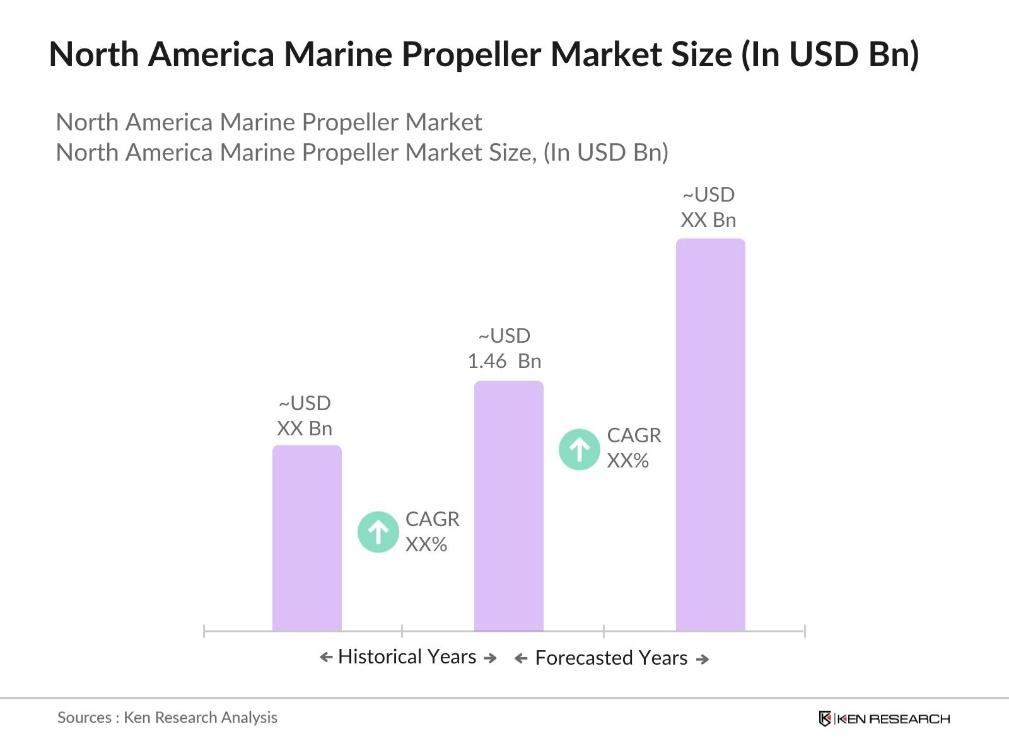
- The North America Marine Propeller Market is valued at USD 1.46 billion, has been driven primarily by the robust demand from the shipbuilding industry and naval expansion. The growing volume of maritime trade, especially between the U.S., Canada, and Mexico, alongside heightened investments in renewable offshore energy, particularly in offshore wind farms, has amplified the need for efficient and durable marine propulsion systems. Technological advancements in propeller design, such as energy-efficient and corrosion-resistant materials, further enhance market demand.
- The United States leads the North American marine propeller market, mainly due to its expansive naval fleet, high shipbuilding activity, and significant investments in offshore wind projects. Cities such as Seattle, New Orleans, and Houston are dominant due to their key port infrastructure and ship manufacturing hubs. Canada follows closely, benefiting from government investments in military vessel modernization and Arctic shipping routes.
- In June 2021, the IMO introduced the Energy Efficiency Existing Ship Index (EEXI) and the Carbon Intensity Indicator (CII) to reduce marine emissions. EEXI assesses energy consumption for vessels over 400 GT, while CII rates vessels over 5,000 GT on their carbon emissions. The latest MARPOL Annex VI amendments require ships to improve technical efficiency and reduce carbon intensity from 2022 to 2030, aligning older vessels with newbuild standards.
North America Marine Propeller Market Segmentation
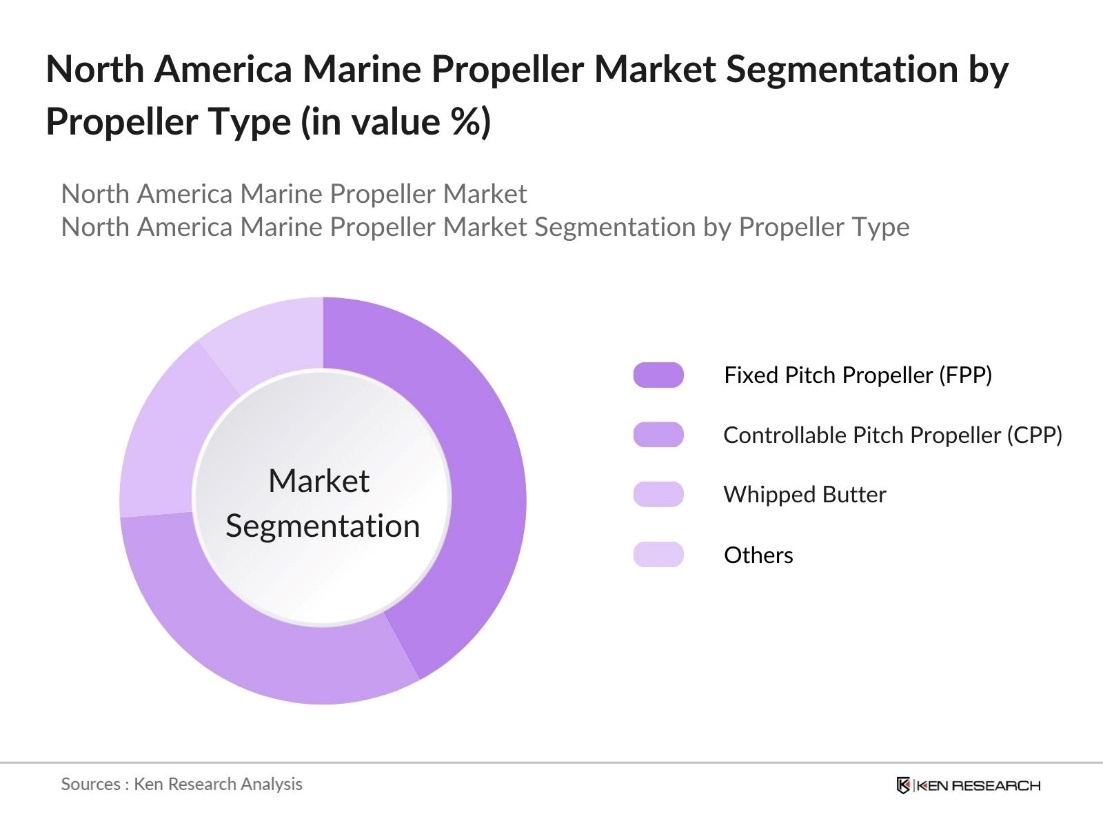
By Propeller Type: The North America Marine Propeller market is segmented by propeller type into Fixed Pitch Propellers (FPP), Controllable Pitch Propellers (CPP), Ducted Propellers, and others. Fixed Pitch Propellers (FPP) currently dominate the market share, largely due to their robust design and widespread usage in commercial vessels. FPPs are preferred in maritime transport as they offer higher efficiency in steady-speed operations and require less maintenance compared to CPPs. Ducted propellers are gaining traction, particularly in vessels needing better maneuverability, but FPPs remain the standard for most vessels due to their durability and cost-effectiveness.
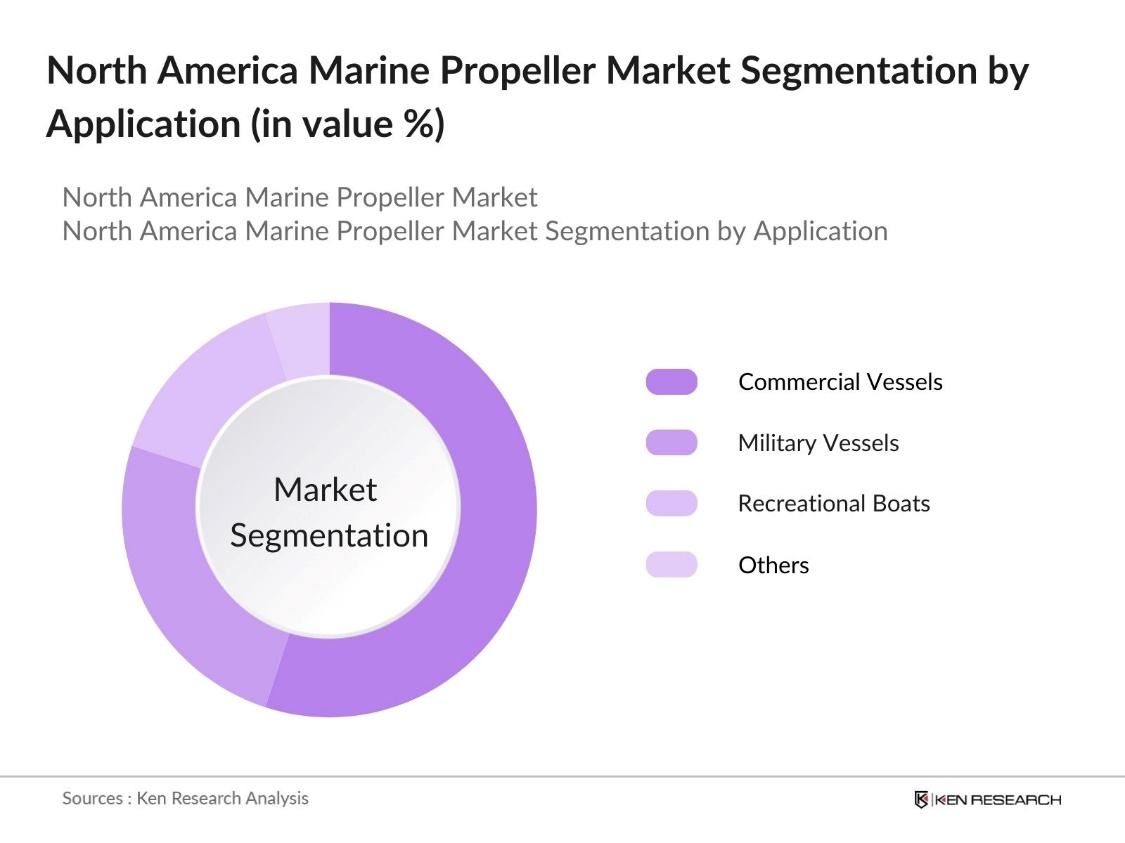
By Application: The market is further segmented by application into commercial vessels, military vessels, recreational boats, and others. Commercial vessels hold the dominant market share, driven by the high number of cargo ships, tankers, and bulk carriers operating in North American waters. The rise in global seaborne trade and the growing emphasis on green shipping initiatives are key factors supporting the demand for advanced marine propellers in commercial vessels. Recreational boats, although smaller in volume, represent a growing segment, especially in the U.S., where recreational boating activities are highly popular along the coastal areas.
North America Marine Propeller Market Competitive Landscape
The market is highly competitive, with leading companies driving technological advancements and expanding their production capacities. Companies like Rolls-Royce, Wrtsil, and MAN Energy Solutions dominate the market due to their expertise in manufacturing high-performance propellers and offering integrated propulsion systems. Additionally, strategic collaborations and acquisitions are commonplace as companies seek to enhance their product portfolios and extend their geographic reach.
|
Company |
Establishment Year |
Headquarters |
Propeller Type Expertise |
Key Clients |
Technology Focus |
Sustainability Initiatives |
Market Presence |
R&D Investments |
|
Rolls-Royce Holdings PLC |
1906 |
London, UK |
||||||
|
Wrtsil Corporation |
1834 |
Helsinki, Finland |
||||||
|
MAN Energy Solutions SE |
1758 |
Augsburg, Germany |
||||||
|
Schottel GmbH |
1921 |
Spay, Germany |
||||||
|
Nakashima Propeller Co., Ltd. |
1926 |
Okayama, Japan |
North America Marine Propeller Industry Analysis
Growth Drivers
- Increasing Maritime Trade: North America marine trade continues to expand with robust activity in its ports. For instance, ports on the East and Gulf Coasts are critical for U.S. trade, handling a large portion of containerized cargoover 40% of all containerized goods arrive through these ports. This rise in trade is pushing for larger and more efficient vessels, leading to a surge in demand for high-performance marine propellers.
- Growth in Defense and Naval Fleet Expansion: The expansion of naval fleets in North America has been a significant driver for the marine propeller market. The U.S. Navy, for instance, operates over 297 deployable battle force ships as of 2024, with plans for continued expansion. This growing fleet requires state-of-the-art propeller technology to enhance efficiency and performance in naval operations. These initiatives highlight the growing need for advanced propellers.
- Technological Advancements in Propeller Design: Innovations in propeller design, such as variable pitch and ducted propellers, have driven significant demand in the marine market. These advanced technologies improve fuel efficiency and reduce emissions, aligning with global environmental goals. Shipbuilders are increasingly adopting cutting-edge tools like computational fluid dynamics (CFD) software to optimize propeller designs, further enhancing the performance of marine propulsion systems. These advancements not only boost the efficiency of vessels but also contribute to meeting stringent environmental regulations, making them a critical focus for the industry.
Market Challenges
- High Costs of Advanced Propellers: The use of advanced materials like titanium and carbon-fiber composites in modern marine propellers leads to significantly higher costs. These materials and the specialized manufacturing processes required make advanced propellers a substantial investment for shipowners. Additionally, labor costs in regions like North America, particularly the U.S., are among the highest, which further increases installation and maintenance expenses. These high costs present a significant barrier to the widespread adoption of advanced propeller technologies, especially for smaller shipping companies looking to upgrade their fleets.
- Complex Installation and Maintenance: Advanced marine propellers, due to their complex design and materials, require precise installation and specialized maintenance. This complexity makes the process more challenging and often demands highly skilled professionals to handle both installation and ongoing upkeep. The need for specialized expertise adds to the overall costs, and the intricate maintenance process can deter shipping companies, particularly smaller operators, from adopting these advanced technologies. The technical difficulty and increased expenses involved may limit the broader implementation of these systems across the maritime industry.
North America Marine Propeller Market Future Outlook
Over the next few years, the North America Marine Propeller market is expected to experience steady growth, driven by investments in defense fleets, offshore wind projects, and advanced propulsion technologies. Government incentives for greener maritime transport and regulations aimed at reducing carbon emissions will also play a crucial role in shaping the future landscape of the marine propeller industry.
Market Opportunities
- Expansion of Offshore Wind Farms: The growing emphasis on renewable energy, particularly offshore wind farms, presents a significant opportunity for the marine propeller market. As offshore wind projects expand, the need for specialized vessels equipped with advanced propellers for installation and maintenance becomes critical. This trend is creating new opportunities for propeller manufacturers to develop products that meet the unique demands of the renewable energy sector, where efficiency, durability, and adaptability are key requirements for vessels operating in challenging offshore environments.
- Development of Environmentally Friendly Propellers: With increasing environmental regulations, there is a rising demand for eco-friendly marine propellers that minimize fuel consumption and reduce emissions. As sustainability becomes a priority, shipbuilders are seeking propellers that enhance energy efficiency and meet stricter emission standards. The development of propellers using biodegradable or more sustainable materials is gaining momentum, providing manufacturers with a valuable opportunity to create innovative, environmentally friendly solutions. This trend aligns with the industry's broader push towards greener and more sustainable technologies.
Scope of the Report
|
Propeller Type |
Fixed Pitch Propeller (FPP) Controllable Pitch Propeller (CPP) Ducted Propeller Others |
|
Material Type |
Aluminum Bronze Stainless Steel Composite Materials |
|
Application |
Commercial Vessels Military Vessels Recreational Boats Others |
|
Propeller Diameter |
Less than 5 meters 5-10 meters More than 10 meters |
|
Region |
United States Canada Mexico |
Products
Key Target Audience
Commercial shipping companies
Shipbuilding companies
Marine Engineering Firms
Marine Insurance Companies
Logistics and Freight Shipping Companies
Investments and venture capital firms
Banks and Financial Institutions
Government and regulatory bodies (IMO, U.S. Coast Guard)
Companies
Players Mentioned in the Report
Rolls-Royce Holdings PLC
Wrtsil Corporation
MAN Energy Solutions SE
Hyundai Heavy Industries
Caterpillar Marine
Schottel GmbH
Nakashima Propeller Co., Ltd.
Kongsberg Maritime
ZF Friedrichshafen AG
Michigan Wheel
Veem Ltd.
Brunvoll AS
Teignbridge Propellers International Limited
Helices y Suministros Navales S.L.
MJP Marine Jet Power AB
Table of Contents
1. North America Marine Propeller Market Overview
1.1. Definition and Scope
1.2. Market Taxonomy
1.3. Key Marine Propeller Types and Characteristics
1.4. Application Scope Across Marine Vessels
2. North America Marine Propeller Market Size (In USD Bn)
2.1. Historical Market Size
2.2. Key Milestones and Developments
2.3. Year-on-Year Growth Analysis
2.4. Regional Share in Market Size
3. North America Marine Propeller Market Analysis
3.1. Growth Drivers
3.1.1. Increasing Maritime Trade
3.1.2. Growth in Defense and Naval Fleet Expansion
3.1.3. Technological Advancements in Propeller Design
3.1.4. Shipbuilding and Repair Activity
3.2. Market Challenges
3.2.1. High Costs of Advanced Propellers
3.2.2. Complex Installation and Maintenance
3.2.3. Raw Material Price Volatility
3.3. Opportunities
3.3.1. Expansion of Offshore Wind Farms
3.3.2. Development of Environmentally Friendly Propellers
3.3.3. Adoption of Hybrid and Electric Propulsion Systems
3.4. Trends
3.4.1. Lightweight Material Adoption in Propeller Manufacturing
3.4.2. 3D Printing Technology in Propeller Production
3.4.3. Autonomous Vessels and Advanced Propulsion Systems
3.5. Government Regulation
3.5.1. IMO Regulations on Emissions and Energy Efficiency
3.5.2. Marine Safety Standards for Propeller Design
3.5.3. Regional Environmental Standards
3.6 SWOT Analysis
3.7 Stake Ecosystem
3.8 Porters Five Forces Analysis
3.9 Competition Ecosystem
4. North America Marine Propeller Market Segmentation
4.1. By Propeller Type (In Value %)
4.1.1. Fixed Pitch Propeller (FPP)
4.1.2. Controllable Pitch Propeller (CPP)
4.1.3. Ducted Propeller
4.1.4. Others
4.2. By Material Type (In Value %)
4.2.1. Aluminum
4.2.2. Bronze
4.2.3. Stainless Steel
4.2.4. Composite Materials
4.3. By Application (In Value %)
4.3.1. Commercial Vessels
4.3.2. Military Vessels
4.3.3. Recreational Boats
4.3.4. Others
4.4. By Propeller Diameter (In Value %)
4.4.1. Less than 5 meters
4.4.2. 5-10 meters
4.4.3. More than 10 meters
4.5. By Region (In Value %)
4.5.1. United States
4.5.2. Canada
4.5.3. Mexico
5. North America Marine Propeller Market Competitive Analysis
5.1. Detailed Profiles of Major Companies
5.1.1. Rolls-Royce Holdings PLC
5.1.2. Wrtsil Corporation
5.1.3. MAN Energy Solutions SE
5.1.4. Hyundai Heavy Industries
5.1.5. Caterpillar Marine
5.1.6. Schottel GmbH
5.1.7. Nakashima Propeller Co., Ltd.
5.1.8. Kongsberg Maritime
5.1.9. ZF Friedrichshafen AG
5.1.10. Michigan Wheel
5.1.11. Veem Ltd.
5.1.12. Brunvoll AS
5.1.13. Teignbridge Propellers International Limited
5.1.14. Helices y Suministros Navales S.L.
5.1.15. MJP Marine Jet Power AB
5.2. Cross Comparison Parameters (Propeller Type, Material Type, Regional Presence, Revenue)
5.3. Market Share Analysis
5.4. Strategic Initiatives
5.5. Mergers and Acquisitions
5.6. Investment Analysis
5.7. Joint Ventures and Partnerships
6. North America Marine Propeller Market Regulatory Framework
6.1. Maritime Safety and Certification Processes
6.2. Environmental Standards and Compliance
6.3. Propeller Material Certification
7. North America Marine Propeller Future Market Size (In USD Bn)
7.1. Future Market Size Projections
7.2. Key Factors Driving Future Market Growth
8. North America Marine Propeller Future Market Segmentation
8.1. By Propeller Type (In Value %)
8.2. By Material Type (In Value %)
8.3. By Application (In Value %)
8.4. By Propeller Diameter (In Value %)
8.5. By Region (In Value %)
9. North America Marine Propeller Market Analysts Recommendations
9.1. TAM/SAM/SOM Analysis
9.2. Target Customer Analysis
9.3. Business Model Optimization
9.4. White Space Opportunity Analysis
Research Methodology
Step 1: Identification of Key Variables
This phase involved mapping out the ecosystem of stakeholders within the North America Marine Propeller market, including manufacturers, shipbuilders, and end-users. Primary and secondary research was conducted using proprietary databases, government reports, and industry insights to gather comprehensive data on the market.
Step 2: Market Analysis and Construction
Historical data on marine propeller usage, trade volumes, and industry trends were analyzed to assess market performance. Propeller types, application segments, and geographical factors were evaluated to determine revenue patterns and market growth drivers.
Step 3: Hypothesis Validation and Expert Consultation
Telephone interviews with industry experts, including shipbuilders and propulsion engineers, were conducted to validate market data and refine projections. These experts provided insights into technological innovations and the impact of regulatory changes on the market.
Step 4: Research Synthesis and Final Output
The final phase involved consolidating the findings and verifying them against insights from major marine propeller manufacturers. This ensured a comprehensive and accurate analysis, which was then compiled into the final report for the North America Marine Propeller market.
Frequently Asked Questions
01. How big is the North America Marine Propeller Market?
The North America Marine Propeller Market was valued at USD 1.46 billion, driven by the growing shipbuilding industry and increased maritime trade. The rise in offshore wind energy projects has also contributed to the demand for efficient marine propellers.
02. What are the key challenges in the North America Marine Propeller Market?
Challenges in North America Marine Propeller Market include fluctuating raw material prices, which impact production costs, and the need for highly skilled labor for installation and maintenance. Additionally, strict environmental regulations on emissions have pushed manufacturers to develop greener propulsion technologies.
03. Who are the major players in the North America Marine Propeller Market?
Key players in North America Marine Propeller Market include Rolls-Royce Holdings PLC, Wrtsil Corporation, MAN Energy Solutions SE, Schottel GmbH, and Nakashima Propeller Co., Ltd. These companies dominate due to their extensive portfolios and expertise in both commercial and defense applications.
04. What are the growth drivers in the North America Marine Propeller Market?
The North America Marine Propeller Market is driven by increased demand for commercial vessels, naval fleet expansion, and technological advancements in propulsion systems. Government investments in renewable energy, particularly offshore wind farms, also support market growth.
Why Buy From Us?

What makes us stand out is that our consultants follows Robust, Refine and Result (RRR) methodology. i.e. Robust for clear definitions, approaches and sanity checking, Refine for differentiating respondents facts and opinions and Result for presenting data with story

We have set a benchmark in the industry by offering our clients with syndicated and customized market research reports featuring coverage of entire market as well as meticulous research and analyst insights.

While we don't replace traditional research, we flip the method upside down. Our dual approach of Top Bottom & Bottom Top ensures quality deliverable by not just verifying company fundamentals but also looking at the sector and macroeconomic factors.

With one step in the future, our research team constantly tries to show you the bigger picture. We help with some of the tough questions you may encounter along the way: How is the industry positioned? Best marketing channel? KPI's of competitors? By aligning every element, we help maximize success.

Our report gives you instant access to the answers and sources that other companies might choose to hide. We elaborate each steps of research methodology we have used and showcase you the sample size to earn your trust.

If you need any support, we are here! We pride ourselves on universe strength, data quality, and quick, friendly, and professional service.