















North America Polyisobutylene Market Outlook to 2030
Region:North America
Author(s):Yogita Sahu
Product Code:KROD3081
October 2024
98
About the Report
North America Polyisobutylene Market Overview
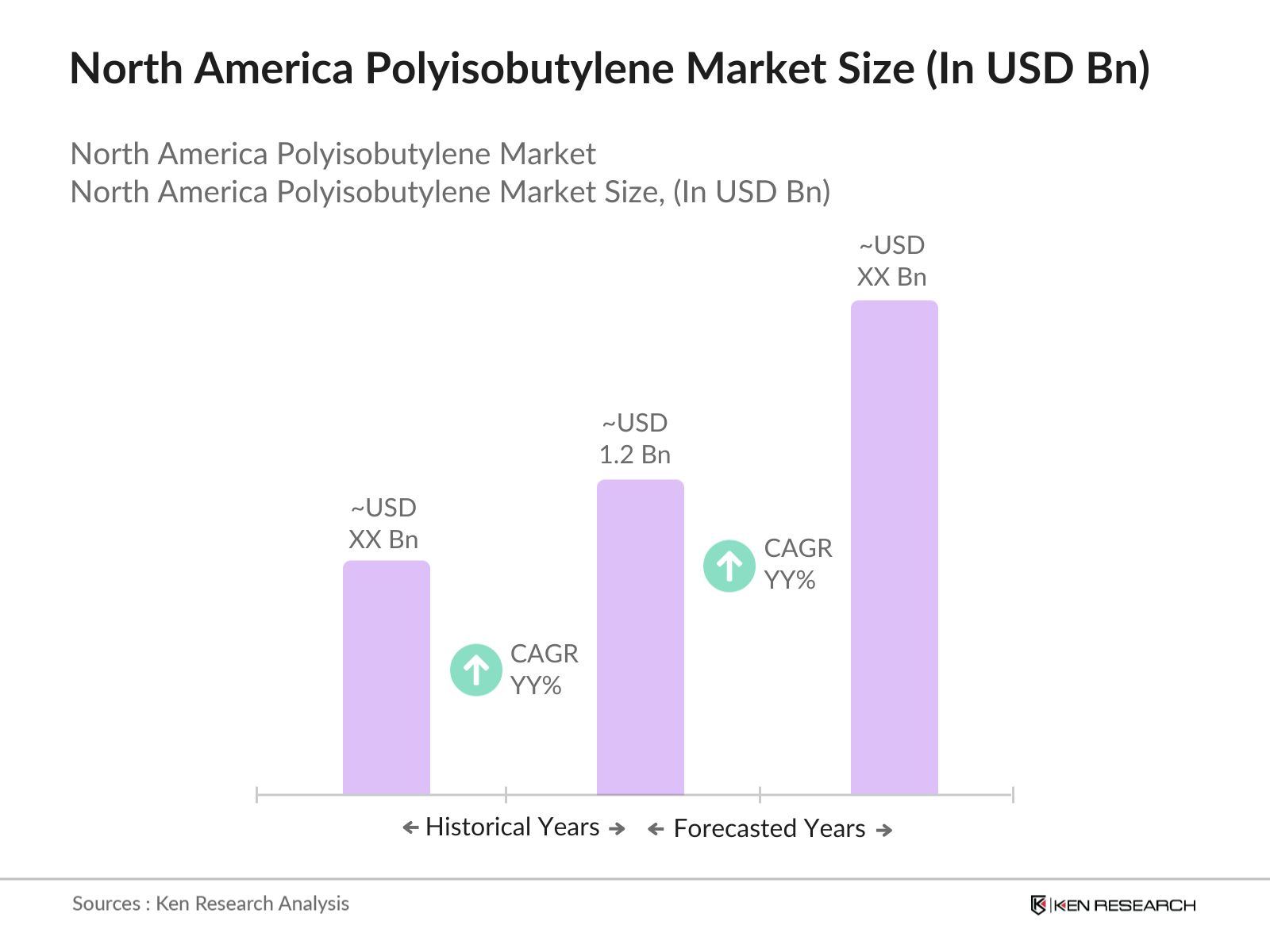
- The North America polyisobutylene market is valued at USD 1.2 billion, driven by the expanding demand in the automotive and construction sectors. Polyisobutylene (PIB) finds its applications in adhesives, sealants, and lubricants, particularly in automotive manufacturing, which has seen a consistent rise in demand.
- The United States leads the market due to its advanced industrial infrastructure and automotive and construction activities. The country has an edge in technological innovations and a strong regulatory framework, encouraging the production and use of PIB in eco-friendly solutions.
- The U.S. Environmental Protection Agency (EPA) estimated that fuel additives containing polyisobutylene (PIB) reduced vehicle emissions by over 1.5 million tons in 2023, making it a crucial material in achieving compliance with stricter air quality standards under the amended Clean Air Act. This initiative encourages the adoption of PIB in the fuel sector to lower emissions and improve air quality nationwide.
North America Polyisobutylene Market Segmentation
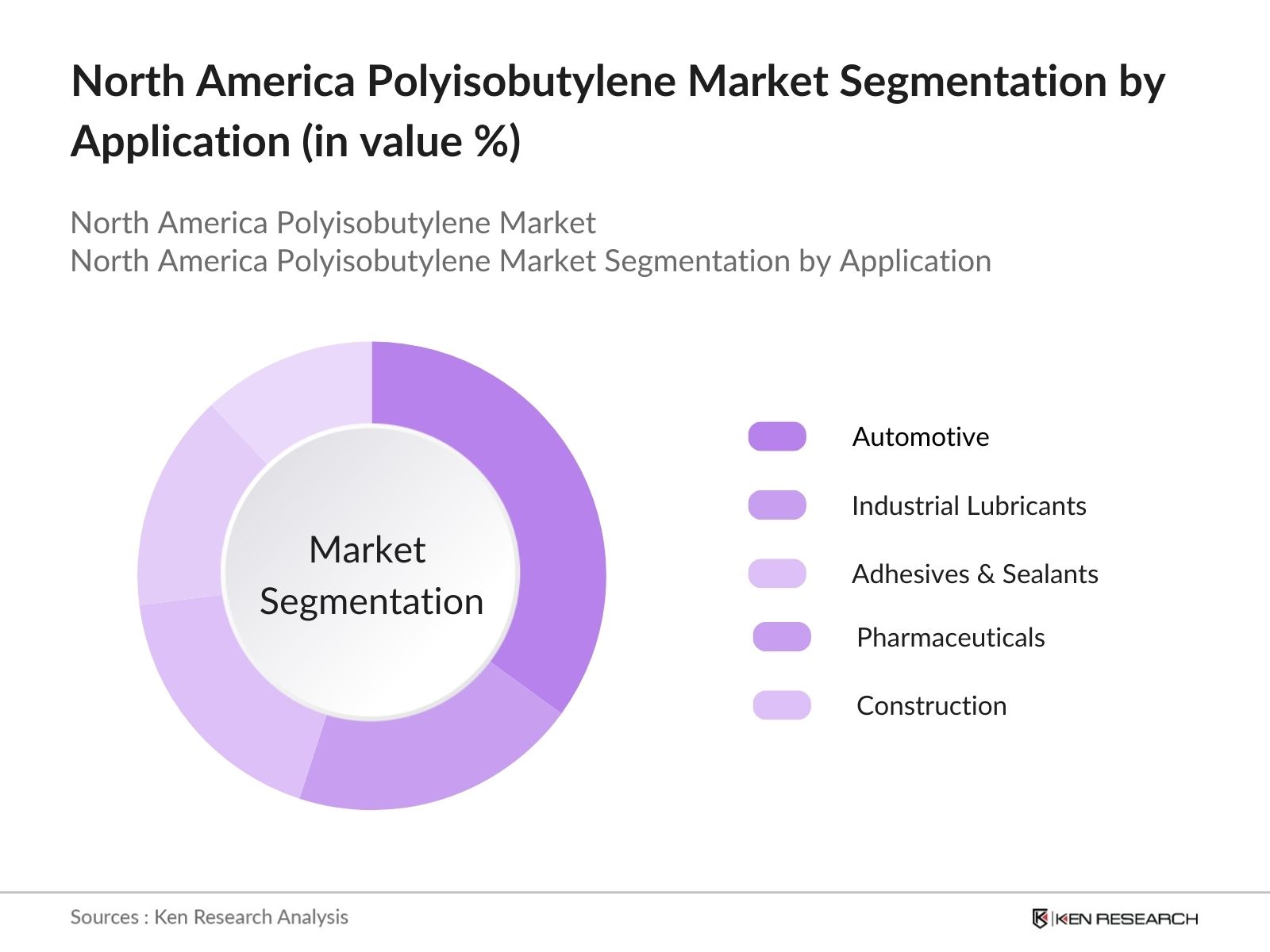
By Application: The market is segmented by application into automotive, industrial lubricants, adhesives & sealants, pharmaceuticals, and construction. The automotive segment holds a dominant position in the market, driven by the extensive use of PIB in the manufacturing of tires, seals, and gaskets.
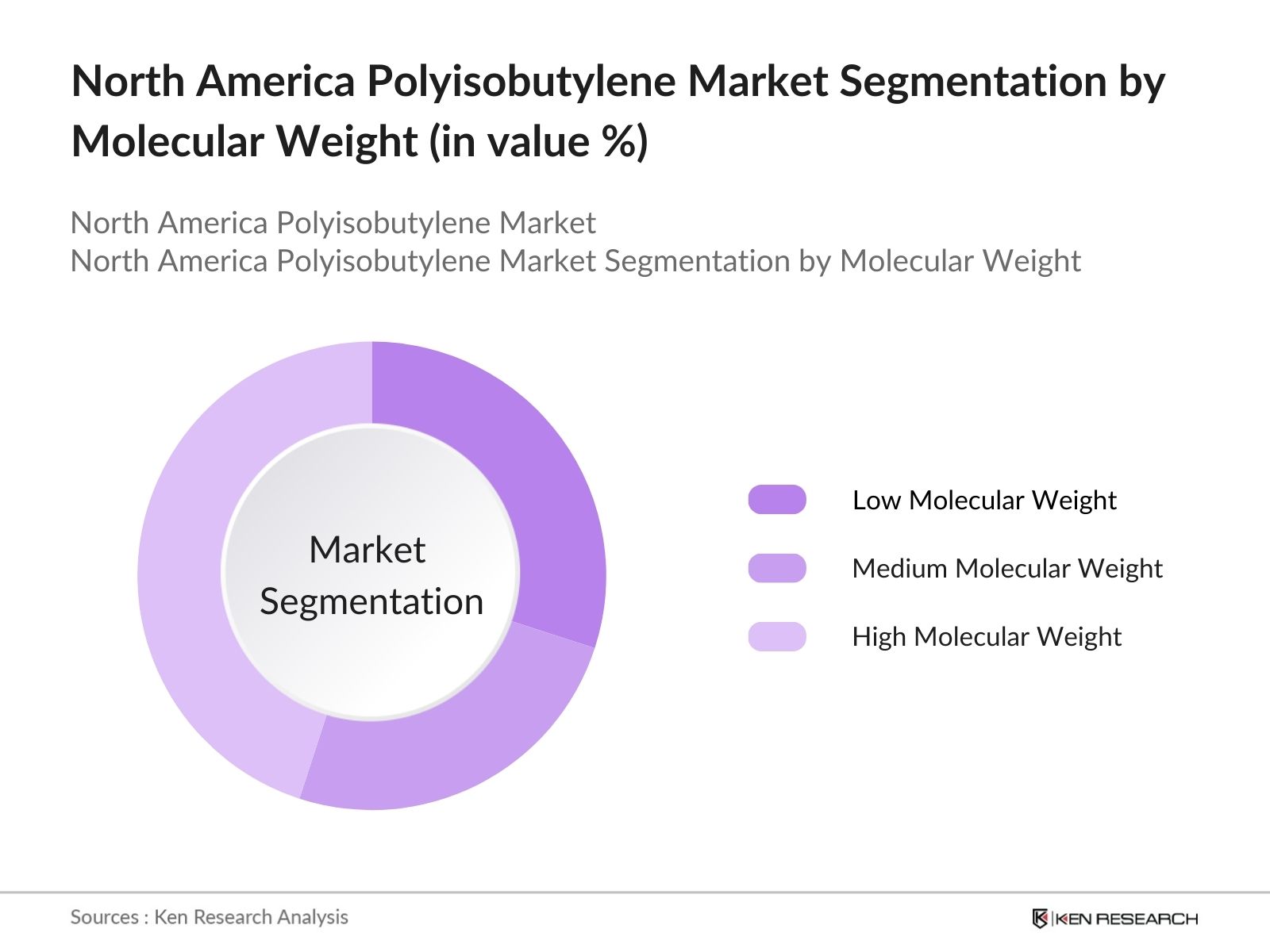
By Molecular Weight: The market is further segmented by molecular weight into low molecular weight, medium molecular weight, and high molecular weight polyisobutylene. High molecular weight PIB is currently dominating the market due to its widespread use in the automotive and industrial sectors, where its superior mechanical and thermal properties are in demand.
North America Polyisobutylene Market Competitive Landscape
The market is consolidated, with major players driving the competitive dynamics of the industry. These companies focus on continuous R&D investments, strategic collaborations, and product innovations to stay ahead in the market.
|
Company |
Establishment Year |
Headquarters |
Production Capacity (Tons) |
Product Portfolio |
Global Presence |
R&D Expenditure (USD Mn) |
Key Clients |
Strategic Initiatives |
|
BASF SE |
1865 |
Germany |
||||||
|
ExxonMobil Corporation |
1870 |
USA |
||||||
|
Lubrizol Corporation |
1928 |
USA |
||||||
|
Ineos Group AG |
1998 |
UK |
||||||
|
Chevron Phillips Chemical Company |
2000 |
USA |
North America Polyisobutylene Market Analysis
Market Growth Drivers
- Increasing Demand for Automotive Lubricants: The automotive industry in North America is a consumer of polyisobutylene (PIB), particularly in the production of lubricants. The U.S. automotive sector saw the high production, according to the U.S. Bureau of Economic Analysis. PIB is extensively used as a viscosity modifier in engine oils, which improves fuel efficiency and reduces emissions. As vehicle production continues to grow in 2024, the demand for PIB in the automotive lubricants sector will also increase.
- Demand in Pharmaceutical and Medical Applications: Polyisobutylene is increasingly being used in pharmaceutical applications, particularly in the production of medical devices and transdermal drug delivery systems due to its biocompatibility. The U.S. pharmaceutical industry is valued at more than USD 600 billion as of 2023, with medical devices contributing significantly to this figure, according to the U.S. Department of Commerce.
- Rising Use in Packaging and Adhesive Industries: The use of polyisobutylene in the packaging and adhesive sectors is also on the rise due to its barrier properties and flexibility. With North Americas packaging industry generating over $180 billion in 2023, PIB has become a key material in the production of food packaging, particularly for products that require airtight seals. The U.S. Environmental Protection Agency reported that packaging waste had reached 82.2 million tons by the end of 2023, indicating a growing need for efficient and recyclable packaging solutions, where PIB plays a critical role.
Market Challenges
- Technological Barriers in Production: The production of high-performance polyisobutylene requires advanced manufacturing technologies, which are not uniformly available across the market. The U.S. Department of Energy noted in 2023 that outdated equipment and technology in chemical manufacturing facilities limit the production efficiency of PIB.
- Health and Safety Regulations: Stringent health and safety regulations in North America pose a challenge to the growth of the polyisobutylene market. The U.S. Occupational Safety and Health Administration (OSHA) has increased its oversight of chemical processing plants, particularly focusing on air quality and emissions in the workplace.
North America Polyisobutylene Market Future Outlook
Over the next five years, the North America polyisobutylene industry is expected to show steady growth, driven by rising demand in the automotive, packaging, and construction sectors. As industries shift towards more sustainable and efficient materials, the demand for polyisobutylene will continue to increase, especially with the trend towards bio-based alternatives.
Future Market Opportunities
- Increasing Focus on Sustainable Packaging: The demand for sustainable packaging solutions will rise as consumers and regulatory bodies push for eco-friendly alternatives. By 2025, more than half of North American packaging companies are expected to adopt PIB-based biodegradable materials, according to the U.S. Environmental Protection Agency.
- Technological Advancements in Medical Applications: The next five years will see advancements in the use of PIB in medical applications. Research and development into PIB-based transdermal drug delivery systems will grow, with the U.S. healthcare industry projected to adopt these systems in large numbers by 2025.
Scope of the Report
|
Application |
Automotive Industrial Lubricants Adhesives & Sealants Pharmaceuticals Construction |
|
Molecular Weight |
Low Molecular Weight Medium Molecular Weight High Molecular Weight |
|
End-User |
Automotive Manufacturers Packaging Industry Industrial Equipment Producers |
|
Distribution Channel |
Direct Sales Distributor Sales |
|
Region |
United States Canada |
Products
Key Target Audience Organizations and Entities Who Can Benefit by Subscribing This Report:
Automotive Manufacturers
Industrial Lubricant Producers
Adhesive and Sealant Manufacturers
Pharmaceutical Manufacturers
Investment and Venture Capital Firms
Government and Regulatory Bodies (EPA, FDA)
Companies
Players Mentioned in the Report:
BASF SE
ExxonMobil Corporation
Lubrizol Corporation
Ineos Group AG
Chevron Phillips Chemical Company
TPC Group
Braskem SA
Shandong Hongrui Petrochemical Co. Ltd.
Daelim Industrial Co. Ltd.
Kothari Petrochemicals Ltd.
Reliance Industries Limited
Evonik Industries AG
JXTG Nippon Oil & Energy Corporation
SABIC
Zhejiang Cenway New Materials Co. Ltd.
Table of Contents
1. North America Polyisobutylene Market Overview
1.1 Definition and Scope
1.2 Market Taxonomy
1.3 Market Growth Rate
1.4 Market Segmentation Overview
2. North America Polyisobutylene Market Size (In USD Bn)
2.1 Historical Market Size
2.2 Year-On-Year Growth Analysis
2.3 Key Market Developments and Milestones
3. North America Polyisobutylene Market Analysis
3.1 Growth Drivers
3.1.1 Automotive Industry Expansion (Market-specific: Application in tire and sealant manufacturing)
3.1.2 Rising Demand for Adhesives (Market-specific: Growing demand in the packaging industry)
3.1.3 Increased Usage in Lubricants (Market-specific: Industrial and automotive lubricants)
3.1.4 Environmental Regulations (Market-specific: Use of eco-friendly polymers)
3.2 Market Challenges
3.2.1 Volatility in Raw Material Prices (Market-specific: Crude oil-derived inputs)
3.2.2 Technological Constraints (Market-specific: Innovations in polyisobutylene processing)
3.2.3 Competition from Substitutes (Market-specific: Alternatives like synthetic rubbers)
3.3 Opportunities
3.3.1 Expanding Bio-Based Polyisobutylene Market
3.3.2 Emerging Applications in Pharmaceuticals
3.3.3 Increasing Use in Construction Materials
3.4 Trends
3.4.1 Shift Towards Sustainable Polyisobutylene Production
3.4.2 Increasing Focus on High Molecular Weight Polyisobutylene
3.4.3 Growing Adoption in E-Mobility Solutions (Market-specific: Electric vehicle seals and insulation)
3.5 Government Regulations
3.5.1 Environmental Protection Agency (EPA) Guidelines (Market-specific: Emissions control regulations)
3.5.2 FDA Approvals (Market-specific: Use in food-grade packaging)
3.6 SWOT Analysis
3.7 Stakeholder Ecosystem
3.8 Porters Five Forces Analysis
3.9 Competitive Ecosystem
4. North America Polyisobutylene Market Segmentation
4.1 By Application (In Value %)
4.1.1 Automotive
4.1.2 Industrial Lubricants
4.1.3 Adhesives & Sealants
4.1.4 Pharmaceuticals
4.1.5 Construction
4.2 By Molecular Weight (In Value %)
4.2.1 Low Molecular Weight Polyisobutylene
4.2.2 Medium Molecular Weight Polyisobutylene
4.2.3 High Molecular Weight Polyisobutylene
4.3 By End-User (In Value %)
4.3.1 Automotive Manufacturers
4.3.2 Packaging Industry
4.3.3 Industrial Equipment Producers
4.4 By Distribution Channel (In Value %)
4.4.1 Direct Sales
4.4.2 Distributor Sales
4.5 By Region (In Value %)
4.5.1 United States
4.5.2 Canada
5. North America Polyisobutylene Market Competitive Analysis
5.1 Detailed Profiles of Major Companies
5.1.1 BASF SE
5.1.2 ExxonMobil Corporation
5.1.3 TPC Group
5.1.4 Lubrizol Corporation
5.1.5 Ineos Group AG
5.1.6 Chevron Phillips Chemical Company LLC
5.1.7 Kothari Petrochemicals Ltd.
5.1.8 Braskem SA
5.1.9 Daelim Industrial Co. Ltd.
5.1.10 Shandong Hongrui Petrochemical Co. Ltd.
5.1.11 Reliance Industries Limited
5.1.12 Evonik Industries AG
5.1.13 Zhejiang Cenway New Materials Co. Ltd.
5.1.14 JXTG Nippon Oil & Energy Corporation
5.1.15 SABIC
5.2 Cross Comparison Parameters (Revenue, Production Volume, Market Share, Key Product Offerings, No. of Employees, Headquarters, Global Presence, R&D Investments)
5.3 Market Share Analysis
5.4 Strategic Initiatives
5.5 Mergers and Acquisitions
5.6 Investment Analysis
5.7 Venture Capital Funding
5.8 Private Equity Investments
6. North America Polyisobutylene Market Regulatory Framework
6.1 Environmental Standards
6.2 Compliance Requirements
6.3 Certification Processes
7. North America Polyisobutylene Future Market Size (In USD Bn)
7.1 Future Market Size Projections
7.2 Key Factors Driving Future Market Growth
8. North America Polyisobutylene Future Market Segmentation
8.1 By Application (In Value %)
8.2 By Molecular Weight (In Value %)
8.3 By End-User (In Value %)
8.4 By Distribution Channel (In Value %)
8.5 By Region (In Value %)
9. North America Polyisobutylene Market Analysts Recommendations
9.1 TAM/SAM/SOM Analysis
9.2 Customer Cohort Analysis
9.3 Marketing Initiatives
9.4 White Space Opportunity Analysis
Disclaimer Contact UsResearch Methodology
Step 1: Identification of Key Variables
The research begins with mapping the North America polyisobutylene market's key variables, including the industrial applications, technological innovations, and regulatory environment. Secondary research, along with proprietary databases, are used to identify industry trends, market drivers, and challenges.
Step 2: Market Analysis and Construction
Historical data is analyzed to construct a comprehensive view of the market dynamics. This includes an assessment of industry penetration across applications such as automotive and construction. Data on product performance and customer feedback further enhance the analysis.
Step 3: Hypothesis Validation and Expert Consultation
Market assumptions are validated through consultations with industry experts, conducted via phone interviews and online surveys. Insights from these consultations are used to fine-tune market forecasts and projections.
Step 4: Research Synthesis and Final Output
Data from both primary and secondary research is synthesized to provide accurate and actionable insights. This ensures the report delivers a detailed understanding of the North America polyisobutylene market, including growth drivers, challenges, and opportunities.
Frequently Asked Questions
01. How big is the North America Polyisobutylene Market?
The North America polyisobutylene market is valued at USD 1.2 billion, driven by increased demand from the automotive, packaging, and construction industries.
02. What are the challenges in the North America Polyisobutylene Market?
Challenges in the North America polyisobutylene market include volatility in crude oil prices, technological limitations in processing polyisobutylene, and competition from substitute materials like synthetic rubbers.
03. Who are the major players in the North America Polyisobutylene Market?
Key players in the North America polyisobutylene market include BASF SE, ExxonMobil Corporation, Lubrizol Corporation, Ineos Group AG, and Chevron Phillips Chemical Company.
04. What are the growth drivers of the North America Polyisobutylene Market?
The North America polyisobutylene market is driven by increasing demand for high-performance materials in the automotive and industrial sectors, as well as advancements in polymer technologies that improve polyisobutylenes applications.
05. What are the future trends in the North America Polyisobutylene Market?
Future trends in the North America polyisobutylene market include the shift towards bio-based polyisobutylene and high molecular weight PIB, driven by the demand for more sustainable and efficient materials across various industries.
Why Buy From Us?

What makes us stand out is that our consultants follows Robust, Refine and Result (RRR) methodology. i.e. Robust for clear definitions, approaches and sanity checking, Refine for differentiating respondents facts and opinions and Result for presenting data with story

We have set a benchmark in the industry by offering our clients with syndicated and customized market research reports featuring coverage of entire market as well as meticulous research and analyst insights.

While we don't replace traditional research, we flip the method upside down. Our dual approach of Top Bottom & Bottom Top ensures quality deliverable by not just verifying company fundamentals but also looking at the sector and macroeconomic factors.

With one step in the future, our research team constantly tries to show you the bigger picture. We help with some of the tough questions you may encounter along the way: How is the industry positioned? Best marketing channel? KPI's of competitors? By aligning every element, we help maximize success.

Our report gives you instant access to the answers and sources that other companies might choose to hide. We elaborate each steps of research methodology we have used and showcase you the sample size to earn your trust.

If you need any support, we are here! We pride ourselves on universe strength, data quality, and quick, friendly, and professional service.