
North America Printer Market Outlook to 2030
Region:North America
Author(s):Shreya Garg
Product Code:KROD6709
November 2024
97
About the Report
North America Printer Market Overview
- The North America printer market is valued at USD 15.4 billion, based on a five-year historical analysis. This market is driven primarily by the increasing demand for high-speed digital printing across industries such as retail, healthcare, and logistics. The shift towards cloud-based printing solutions and the rising adoption of multi-function printers (MFPs) have also contributed to market growth. The demand for printers capable of producing high-quality graphics, particularly in packaging and advertising sectors, further bolsters this market.
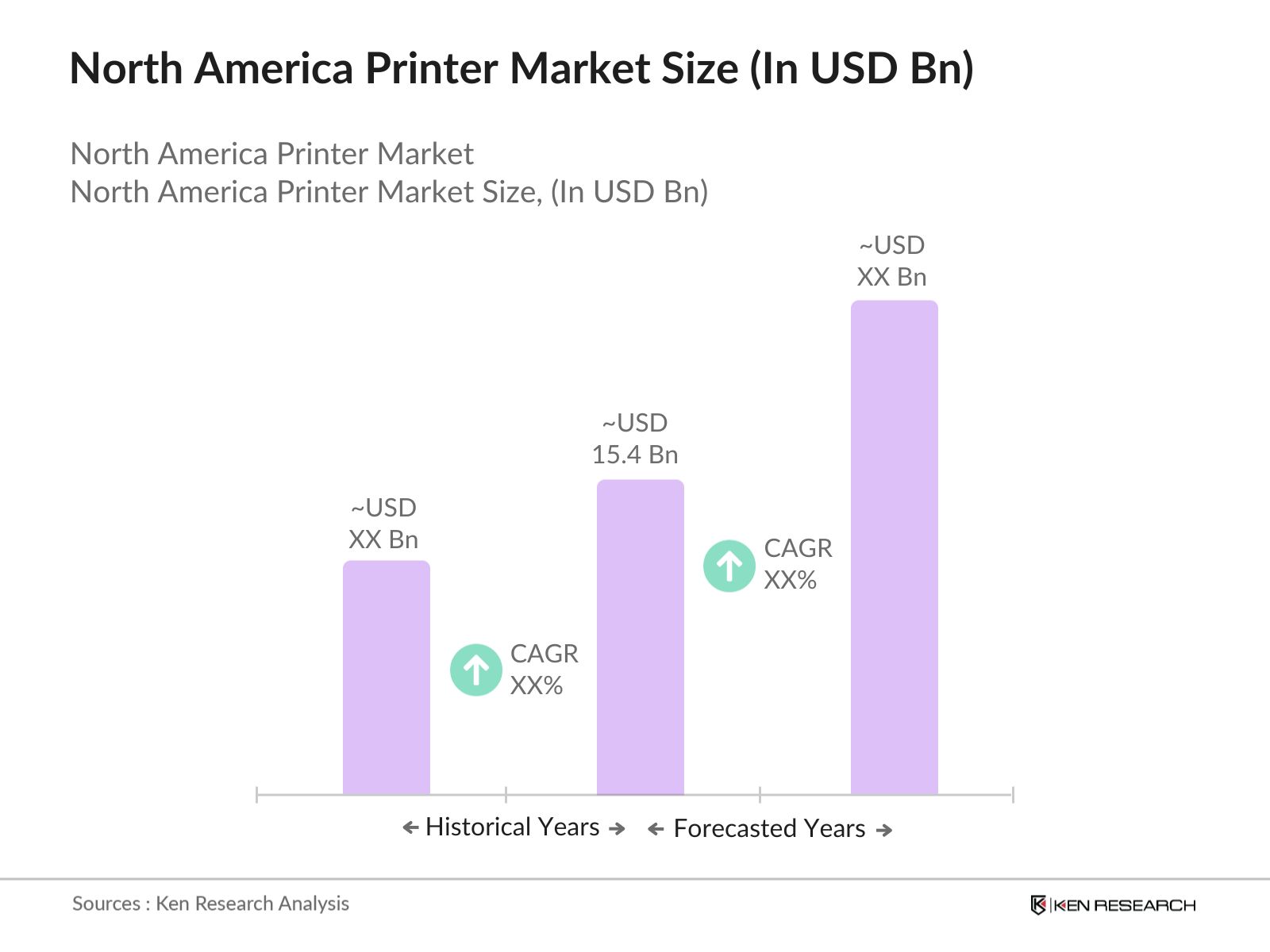
- Within North America, the United States dominates the printer market, followed closely by Canada. The dominance of the U.S. can be attributed to its advanced technological infrastructure, a higher adoption rate of digital printing technologies, and substantial investments in R&D by key market players. Canada, while smaller, benefits from a growing e-commerce sector that fuels demand for efficient printing solutions in logistics and warehousing. Both markets exhibit a preference for eco-friendly printing solutions, driving demand for energy-efficient printers.
- U.S. trade policies have had a impact on the import of printers, with tariffs and restrictions altering market dynamics. As part of the Section 301 tariffs imposed on Chinese goods, imports of printers from China faced an additional duty of up to 25%. This has prompted several companies to explore alternative supply chains and consider local manufacturing options. In 2023, the U.S. International Trade Commission noted that these tariffs led to a 10% reduction in printer imports from China, affecting overall supply availability in the North American market.
North America Printer Market Segmentation
By Product Type: The market is segmented by product type into inkjet printers, laser printers, dot matrix printers, and thermal printers. Inkjet printers hold a dominant market share under this segmentation, largely due to their versatile applications across both home and office settings. Their ability to deliver high-quality color prints at a lower initial investment makes them particularly attractive for small businesses and individual users. Additionally, the continuous improvement in inkjet technology has increased their efficiency, making them a preferred choice for commercial photo and graphic printing. 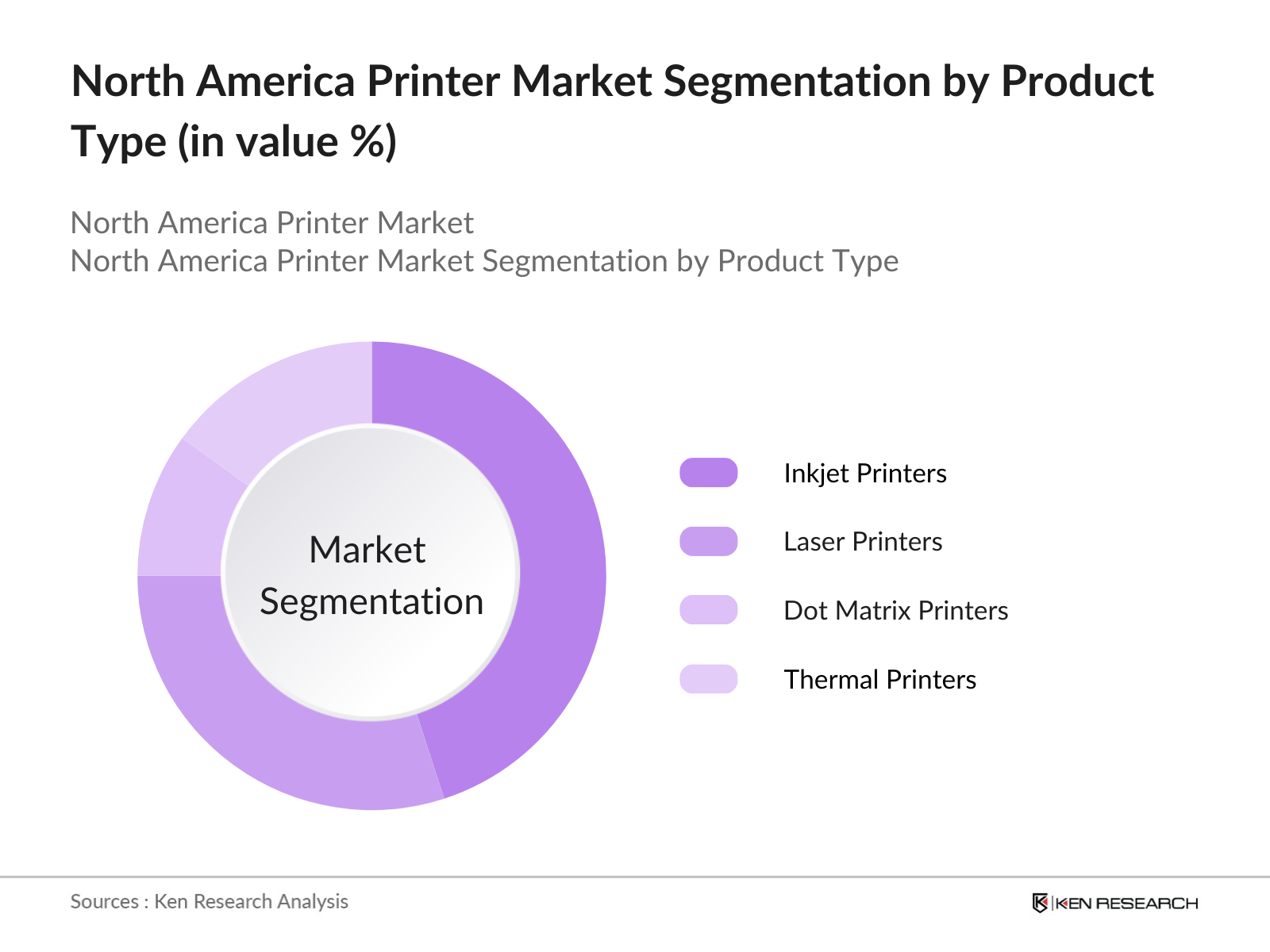
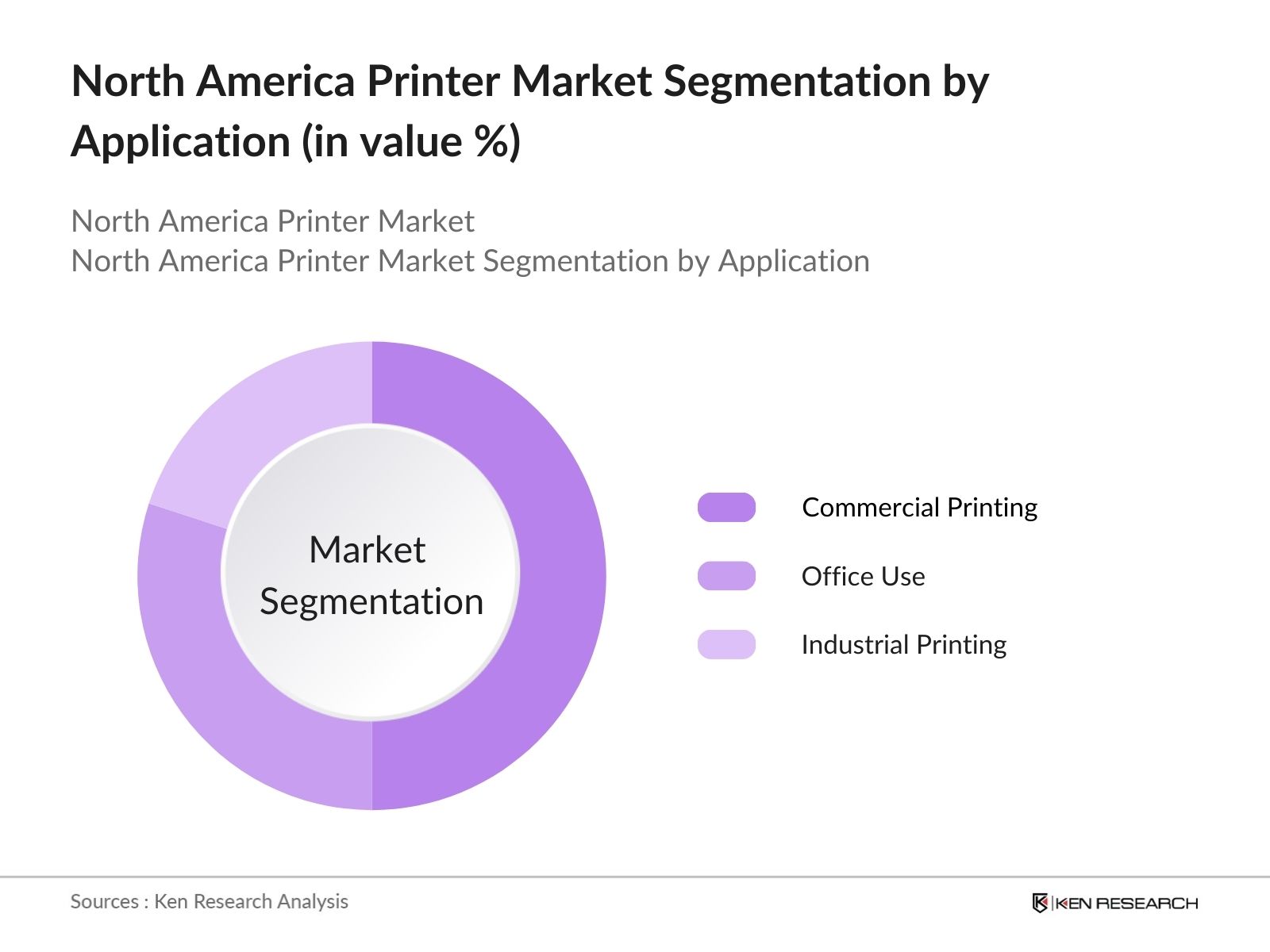
By Application: The North America printer market is segmented by application into commercial printing, office use, and industrial printing. Commercial printing dominates this segmentation due to the high demand for professional-grade printing solutions required by advertising agencies, publishers, and packaging companies. The rise of digital printing technologies has enabled faster production times, making commercial printing a key growth segment in the market. The preference for customized print solutions and short-run printing further strengthens the demand in this category.
North America Printer Market Competitive Landscape
The North America printer market is dominated by a few major players, including global giants such as HP Inc., Canon Inc., and Epson America, Inc. This consolidation highlights the influence of these key companies. The competitive landscape is characterized by frequent product launches, strategic partnerships, and investments in R&D aimed at developing next-generation printing technologies. The emphasis on sustainable and eco-friendly printing solutions has also driven competition, with many players focusing on energy-efficient products.
|
Company |
Establishment Year |
Headquarters |
Revenue (USD Bn) |
R&D Investment |
Product Range |
Market Penetration |
Sustainability Initiatives |
Customer Base |
Geographical Presence |
|
HP Inc. |
1939 |
Palo Alto, CA, USA |
|||||||
|
Canon Inc. |
1937 |
Tokyo, Japan |
|||||||
|
Epson America, Inc. |
1942 |
Suwa, Japan |
|||||||
|
Xerox Corporation |
1906 |
Norwalk, CT, USA |
|||||||
|
Brother International |
1908 |
Nagoya, Japan |
North America Printer Industry Analysis
Growth Drivers
- Adoption of High-Speed Printers: The adoption of high-speed printers in North America has been driven by the demand for faster turnaround times in printing operations, particularly within the e-commerce and packaging sectors. According to the International Trade Administration, the U.S. manufacturing sector, contributing over $2.3 trillion in 2023, has seen increasing reliance on high-speed printers to meet production deadlines. The Federal Reserve reported that industrial production in the United States increased by 0.7% in August 2024, indicating stronger manufacturing output that correlates with the need for advanced printing solutions.
- Shift Towards Sustainable Printing Solutions: The shift towards sustainable printing solutions is gaining traction in the North American market, spurred by regulatory mandates and environmental awareness. As of 2024, the U.S. Environmental Protection Agency has introduced stricter regulations on volatile organic compound (VOC) emissions from traditional printing inks, leading companies to adopt eco-friendly alternatives. For instance, over 4,200 tons of waste ink were reported to be managed under these regulations, promoting the adoption of water-based and biodegradable inks. Additionally, Canadas Greenhouse Gas Pollution Pricing Act has further incentivized businesses to shift towards sustainable practices.
- Rising Demand from E-commerce Sector: The booming e-commerce industry has driven the demand for advanced printing solutions in North America. According to the U.S. Census Bureau, e-commerce sales in the U.S. reached over $1 trillion in 2023, with a notable increase in packaging requirements. This surge has led to increased demand for high-quality, customizable packaging, which requires advanced digital printers capable of handling large volumes and diverse design requirements. The rise in digital printing solutions, including variable data printing, has been instrumental in meeting the packaging needs of the growing e-commerce sector.
Market Challenges
- High Competition from Asian Manufacturers: North American printer manufacturers face intense competition from Asian counterparts, particularly from China and Japan. In 2023, the U.S. Census Bureau recorded imports of printers and related equipment worth $5 billion from these countries. This influx has put pressure on domestic manufacturers to innovate and reduce production costs to remain competitive. According to the International Trade Administration, Asian manufacturers benefit from lower production costs, which has enabled them to dominate key segments of the global printer market, including high-volume printers.
- Environmental Regulations on Ink Usage: Strict environmental regulations in North America concerning the use of inks and chemicals in the printing industry have posed challenges for market players. The U.S. Environmental Protection Agency mandates strict limits on VOC emissions, impacting traditional solvent-based inks. In 2023, compliance with these regulations led to an additional operational cost of over $1 billion for U.S.-based printing companies. Similarly, Canada's Environmental Protection Act requires reporting and reduction of emissions from printing activities, leading to increased investment in compliant technologies.
North America Printer Market Future Outlook
Over the next five years, the North America printer market is expected to show steady growth driven by technological advancements in digital and 3D printing, rising demand for automated printing solutions, and increased adoption of multi-function printers. The shift towards cloud-based printing and remote work solutions is anticipated to play a crucial role in driving market demand. The growing focus on sustainability and energy-efficient products will further shape the competitive dynamics of this market as companies strive to meet stricter regulatory standards and consumer expectations.
Future Market Opportunities
- Integration with Smart Office Solutions: The growing integration of smart office solutions presents a key opportunity for the North American printer market. In 2023, the smart office market in North America reached $50 billion, with an increased emphasis on automation and IoT-enabled devices. Printers that can seamlessly connect with smart office ecosystemsoffering features like remote access, automatic paper ordering, and predictive maintenanceare increasingly preferred. This integration can enhance productivity, particularly in corporate environments, driving the demand for advanced, IoT-compatible printers.
- Increasing Investments in Print-on-Demand Services: Print-on-demand (POD) services are expanding rapidly in North America, with increasing investments from both large corporations and small businesses. According to the U.S. Bureau of Economic Analysis, the custom apparel industry, which heavily relies on POD services, contributed over $21 billion to the U.S. economy in 2023. The flexibility and reduced inventory costs associated with POD have attracted new market entrants, leading to higher demand for digital printers capable of producing small, customized print runs efficiently.
Scope of the Report
|
By Product Type |
Inkjet Printers Laser Printers Dot Matrix Printers Thermal Printers |
|
By Application |
Commercial Printing Office Use Industrial Printing |
|
By End-User |
SMEs Large Enterprises Government and Education Sector |
|
By Distribution Channel |
Online Retail Offline Retail |
|
By Region |
USA Canada Mexico |
Products
Key Target Audience
Printer Manufacturers
Investors and Venture Capitalist Firms
Government and Regulatory Bodies (U.S. Environmental Protection Agency, Canadian Standards Association)
Office Equipment Distributors
Commercial Printing Agencies
E-commerce and Retail Companies
Industrial Printing Solutions Providers
Smart Office Solution Providers
Banks and Financial Institutions
Companies
Major Players
HP Inc.
Canon Inc.
Epson America, Inc.
Brother International Corporation
Xerox Corporation
Ricoh USA, Inc.
Kyocera Document Solutions
Samsung Electronics Co., Ltd.
Dell Technologies Inc.
Sharp Corporation
Zebra Technologies Corporation
Toshiba TEC Corporation
Konica Minolta, Inc.
Pitney Bowes Inc.
Lexmark International, Inc.
Table of Contents
North America Printer Market Overview
1.1. Definition and Scope
1.2. Market Taxonomy
1.3. Market Growth Rate
1.4. Market Segmentation Overview
North America Printer Market Size (In USD Bn)
2.1. Historical Market Size
2.2. Year-On-Year Growth Analysis
2.3. Key Market Developments and Milestones
North America Printer Market Analysis
3.1. Growth Drivers (e.g., Digital Transformation, Increased Print-On-Demand)
3.2. Market Challenges (e.g., Shift Towards Paperless Solutions, High Operational Costs)
3.3. Opportunities (e.g., 3D Printing Expansion, Eco-Friendly Printers)
3.4. Trends (e.g., Cloud Printing, AI and Automation Integration)
3.5. Government Regulations (e.g., Environmental Compliance, E-Waste Management)
3.6. SWOT Analysis
3.7. Porters Five Forces Analysis
3.8. Stakeholder Ecosystem (e.g., OEMs, Distributors, Resellers)
3.9. Competition Ecosystem
North America Printer Market Segmentation
4.1. By Product Type (In Value %)
4.1.1. Laser Printers
4.1.2. Inkjet Printers
4.1.3. Dot Matrix Printers
4.1.4. 3D Printers
4.2. By Application (In Value %)
4.2.1. Commercial Printing
4.2.2. Industrial Printing
4.2.3. Home Office Use
4.3. By Technology (In Value %)
4.3.1. Continuous Ink Systems
4.3.2. Thermal Inkjet
4.3.3. Dye Sublimation
4.4. By Connectivity (In Value %)
4.4.1. Wireless Printers
4.4.2. Wired Printers
4.4.3. Network Printers
4.5. By End User (In Value %)
4.5.1. Government & Public Sector
4.5.2. Healthcare
4.5.3. Education
4.5.4. Retail & Consumer Goods
North America Printer Market Competitive Analysis
5.1. Detailed Profiles of Major Companies
5.1.1. HP Inc.
5.1.2. Canon Inc.
5.1.3. Xerox Corporation
5.1.4. Epson America, Inc.
5.1.5. Brother Industries, Ltd.
5.1.6. Lexmark International, Inc.
5.1.7. Ricoh USA, Inc.
5.1.8. Kyocera Document Solutions
5.1.9. Dell Inc.
5.1.10. Sharp Electronics Corporation
5.1.11. Samsung Electronics Co., Ltd.
5.1.12. OKI Data Americas
5.1.13. Toshiba TEC Corporation
5.1.14. Zebra Technologies
5.1.15. Konica Minolta, Inc.
5.2. Cross Comparison Parameters (Product Range, Market Share, No. of Employees, Headquarters, Revenue, Inception Year, R&D Investments, Sustainability Initiatives)
5.3. Market Share Analysis
5.4. Strategic Initiatives
5.5. Mergers and Acquisitions
5.6. Investment Analysis (Private Equity, Government Grants, Corporate Investments)
5.7. Venture Capital Funding
North America Printer Market Regulatory Framework
6.1. E-Waste Compliance Standards
6.2. Energy Efficiency Guidelines
6.3. Environmental Protection Laws
6.4. Certification Processes (EPA, ISO Standards)
North America Printer Future Market Size (In USD Bn)
7.1. Future Market Size Projections
7.2. Key Factors Driving Future Market Growth (3D Printing, Green Printing Technologies)
North America Printer Future Market Segmentation
8.1. By Product Type (In Value %)
8.2. By Application (In Value %)
8.3. By Technology (In Value %)
8.4. By Connectivity (In Value %)
8.5. By End User (In Value %)
North America Printer Market Analyst's Recommendations
9.1. TAM/SAM/SOM Analysis
9.2. Customer Cohort Analysis
9.3. Marketing Initiatives (Targeted Advertising, Omni-Channel Marketing)
9.4. White Space Opportunity Analysis
Disclaimer
Contact Us
Research Methodology
Step 1: Identification of Key Variables
The initial phase involves constructing an ecosystem map encompassing all major stakeholders within the North America Printer Market. This step is underpinned by extensive desk research, utilizing a combination of secondary and proprietary databases to gather comprehensive industry-level information. The primary objective is to identify and define the critical variables that influence market dynamics.
Step 2: Market Analysis and Construction
In this phase, we will compile and analyze historical data pertaining to the North America Printer Market. This includes assessing market penetration, the ratio of printers to commercial and residential users, and the resultant revenue generation. Furthermore, an evaluation of product quality statistics will be conducted to ensure the reliability and accuracy of the revenue estimates.
Step 3: Hypothesis Validation and Expert Consultation
Market hypotheses will be developed and subsequently validated through computer-assisted telephone interviews (CATIs) with industry experts representing a diverse array of companies. These consultations will provide valuable operational and financial insights directly from industry practitioners, which will be instrumental in refining and corroborating the market data.
Step 4: Research Synthesis and Final Output
The final phase involves direct engagement with multiple printer manufacturers to acquire detailed insights into product segments, sales performance, consumer preferences, and other pertinent factors. This interaction will serve to verify and complement the statistics derived from the bottom-up approach, thereby ensuring a comprehensive, accurate, and validated analysis of the North America Printer market.
Frequently Asked Questions
01. How big is the North America Printer Market?
The North America Printer Market is valued at USD 15.4 billion, driven by robust demand from the commercial printing sector and the increasing adoption of multi-function printers across various industries.
02. What are the challenges in the North America Printer Market?
Challenges in the North America Printer Market include supply chain disruptions due to geopolitical tensions, increasing environmental regulations, and competition from low-cost Asian manufacturers, which impact profitability and market dynamics.
03. Who are the major players in the North America Printer Market?
Key players in the North America Printer Market include HP Inc., Canon Inc., Epson America, Inc., Brother International Corporation, and Xerox Corporation. These companies dominate due to their extensive product portfolios and strong distribution networks.
04. What are the growth drivers of the North America Printer Market?
The North America Printer Market is propelled by factors such as technological advancements in digital printing, rising demand for eco-friendly printing solutions, and the increasing need for high-speed printing in logistics and e-commerce sectors.
05. Which product type is most popular in the North America Printer Market?
Inkjet printers are particularly popular due to their versatility, affordability, and suitability for both home and commercial use, making them a dominant choice among consumers in the North America Printer Market.
Why Buy From Us?

What makes us stand out is that our consultants follows Robust, Refine and Result (RRR) methodology. i.e. Robust for clear definitions, approaches and sanity checking, Refine for differentiating respondents facts and opinions and Result for presenting data with story

We have set a benchmark in the industry by offering our clients with syndicated and customized market research reports featuring coverage of entire market as well as meticulous research and analyst insights.

While we don't replace traditional research, we flip the method upside down. Our dual approach of Top Bottom & Bottom Top ensures quality deliverable by not just verifying company fundamentals but also looking at the sector and macroeconomic factors.

With one step in the future, our research team constantly tries to show you the bigger picture. We help with some of the tough questions you may encounter along the way: How is the industry positioned? Best marketing channel? KPI's of competitors? By aligning every element, we help maximize success.

Our report gives you instant access to the answers and sources that other companies might choose to hide. We elaborate each steps of research methodology we have used and showcase you the sample size to earn your trust.

If you need any support, we are here! We pride ourselves on universe strength, data quality, and quick, friendly, and professional service.