















North America Remote Desk Software Market Outlook to 2030
Region:North America
Author(s):Shreya
Product Code:KROD8472
November 2024
94
About the Report
North America Remote Desk Software Market Overview
The North America Remote Desk Software market is valued at USD 900 million, driven by the rapid shift towards remote work and robust cybersecurity demands across IT and other sectors. Recent years have seen increased adoption due to the necessity of remote accessibility, with enterprises investing in secure platforms to ensure productivity and data integrity. The markets growth is supported by the scalability of cloud-based solutions and integration with advanced cybersecurity protocols. 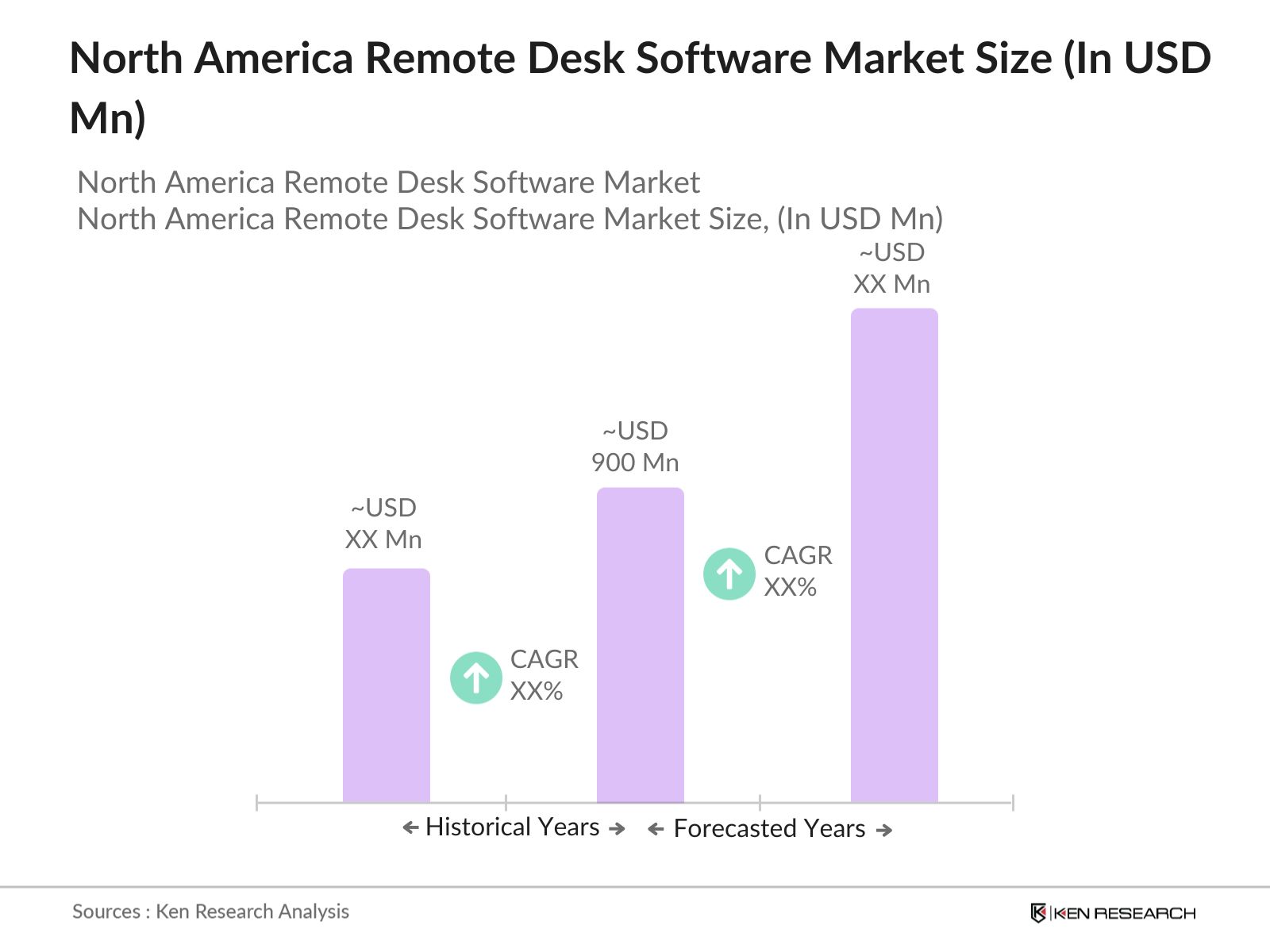
The United States dominates the North America Remote Desk Software market due to its advanced IT infrastructure, substantial number of SMEs and large corporations, and extensive cybersecurity requirements. Canada follows, with its robust adoption of cloud services and support from government initiatives aimed at digital transformation and remote accessibility enhancements.
The enforcement of data protection laws like GDPR and CCPA directly impacts the remote desk software market in North America. The U.S. Department of Justice reports over 1,500 cases involving data breaches in 2023, emphasizing the need for compliant remote access solutions. Remote desk software providers must ensure data protection measures are in place to comply with stringent regulations and avoid legal consequences.
North America Remote Desk Software Market Segmentation
By Deployment Type: The market is segmented by deployment type into Cloud-Based and On-Premise solutions. Recently, Cloud-Based solutions have gained a dominant market share due to their cost-effectiveness, scalability, and ease of integration with other enterprise software. Cloud deployment is also favored by organizations prioritizing flexibility and secure, remote access without heavy reliance on internal IT resources. 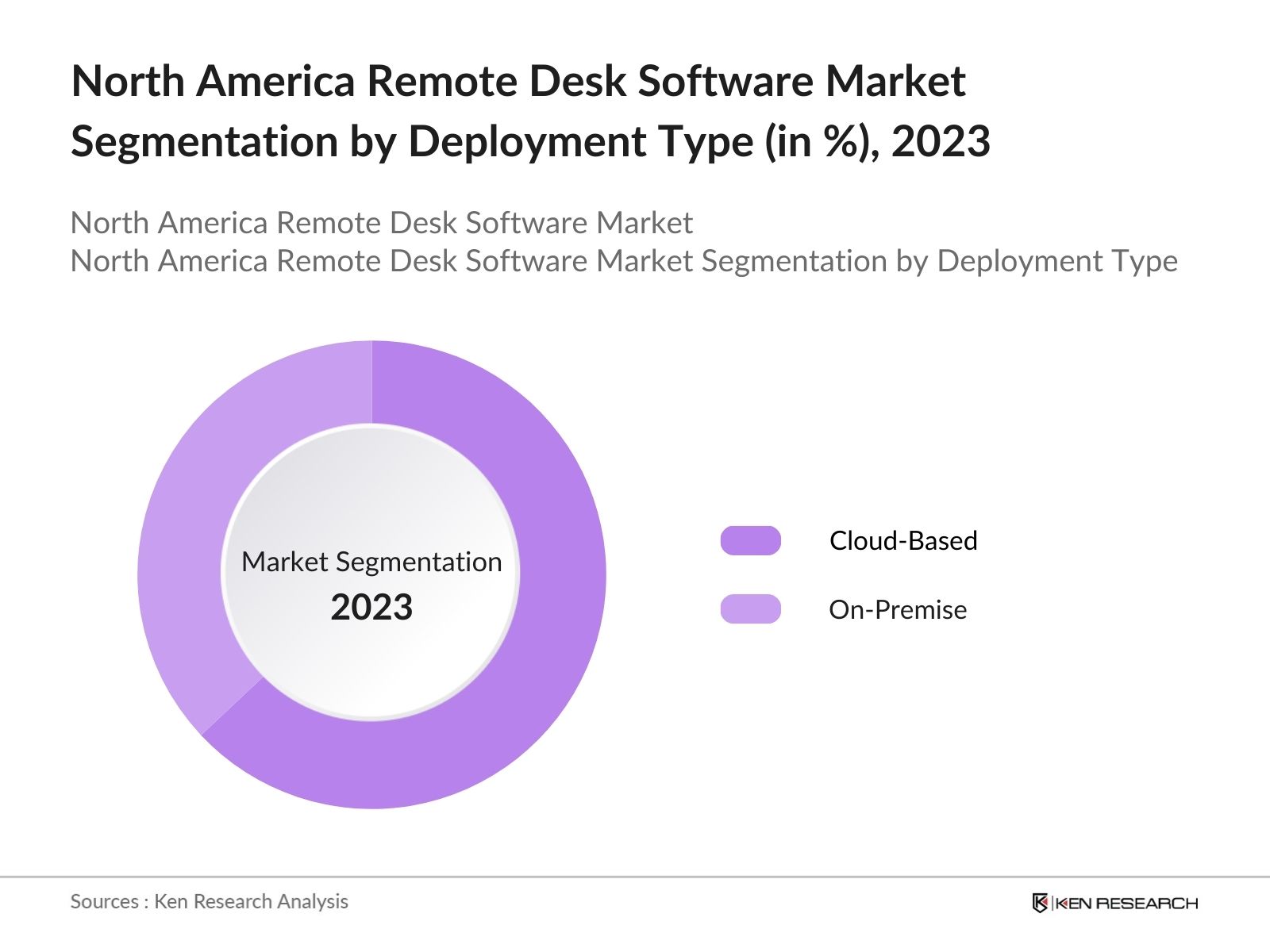
By Application: The market is segmented by application into IT & Telecom, Healthcare, Education, and BFSI (Banking, Financial Services, and Insurance). The IT & Telecom segment is predominant, driven by the sectors critical need for reliable and efficient remote access solutions. Companies in this sector leverage these tools for seamless IT support, reducing travel costs, and enhancing productivity in distributed teams. 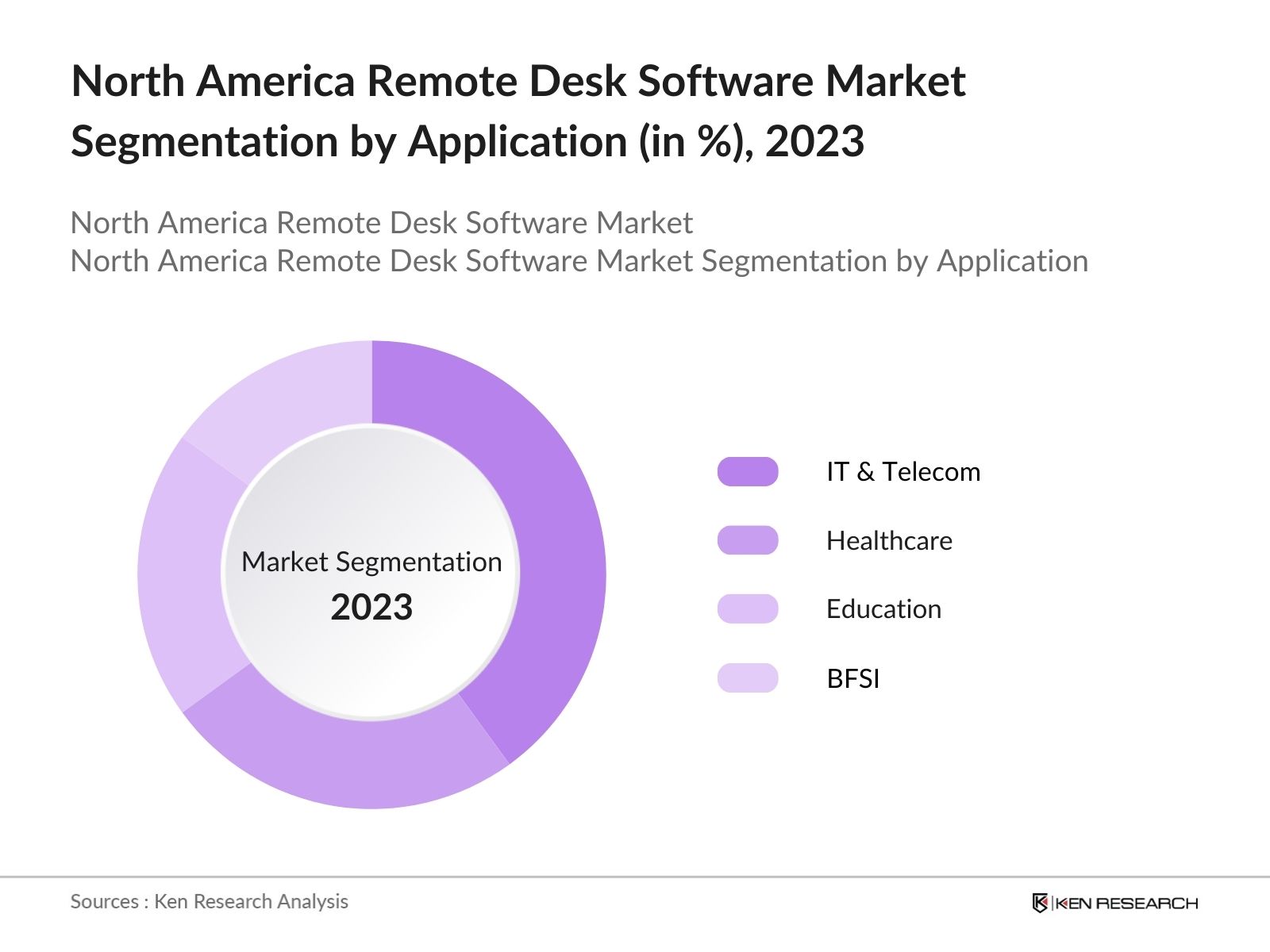
North America Remote Desk Software Market Competitive Landscape
The North America Remote Desk Software market is dominated by a few key players, reflecting the established presence and specialization required in this sector. These companies drive market innovation through a combination of advanced R&D, cybersecurity features, and seamless integration capabilities.
|
Company |
Establishment Year |
Headquarters |
Revenue |
Market Share |
R&D Spending |
Customer Base |
Security Compliance |
Deployment Options |
Key Innovation |
|
TeamViewer AG |
2005 |
Germany |
|||||||
|
Citrix Systems, Inc. |
1989 |
USA |
|||||||
|
AnyDesk Software GmbH |
2014 |
Germany |
|||||||
|
Microsoft Corporation |
1975 |
USA |
|||||||
|
Splashtop Inc. |
2006 |
USA |
North America Remote Desk Software Industry Analysis
Growth Drivers
Digital Transformation: The North America remote desk software market is being fueled by ongoing digital transformation initiatives, with a massive increase in remote work adoption post-2020. Reports from the U.S. Bureau of Labor Statistics reveal that over 25 million people work remotely in the U.S., representing a significant market demand for robust remote access software to support seamless productivity and workflow management. Additionally, the high adoption rate of cloud-based solutions enables remote work environments and secure collaboration across borders, which enhances demand for advanced remote desk software solutions.
Cybersecurity Demands: Cybersecurity demands are pushing enterprises to adopt secure remote access solutions, as shown by over 22,000 cybersecurity incidents reported in North America, according to the U.S. Federal Bureau of Investigations IC3 report. Remote desk software embedded with cybersecurity features, such as multi-factor authentication and encryption, meets these rising data security standards. The National Institute of Standards and Technology (NIST) further strengthens this trend by advocating for robust security protocols in remote work setups, urging enterprises to comply with cybersecurity standards.
Cloud Migration: The rapid adoption of cloud technology is driving the remote desk software market in North America. Data shows that over 80% of U.S. enterprises have already adopted cloud solutions, with significant migrations observed in key sectors such as IT, finance, and healthcare. Cloud-based remote desk software allows companies to leverage scalability, accessibility, and enhanced collaboration capabilities, which are increasingly required to support flexible work environments across geographically dispersed teams.
Market Challenges
High Initial Implementation Costs: A notable challenge facing the North American remote desk software market is the high initial costs associated with setting up secure and scalable remote access infrastructures. Data from the U.S. Small Business Administration shows that IT and software implementation costs can range from $10,000 to $50,000 for small businesses, impacting the adoption rate among smaller enterprises. This expenditure can be prohibitive, especially for small to medium-sized businesses looking to implement advanced remote access tools.
Limited IT Expertise: The lack of skilled IT professionals, especially within small and medium-sized enterprises (SMEs), has become a barrier to remote desk software adoption. According to data from CompTIA, there are over 2 million unfilled IT job openings in North America, with SMEs particularly affected due to limited resources to hire specialized staff. This skills gap hinders SMEs from efficiently implementing and managing remote desk software, resulting in limited adoption and increased outsourcing needs.
North America Remote Desk Software Market Future Outlook
The North America Remote Desk Software market is set to experience continued growth as enterprises adapt to a hybrid work model. Demand for secure, flexible, and cloud-enabled solutions will drive innovation, and advancements in cybersecurity will be integral to market expansion. Integration with AI, augmented reality, and zero-trust security architectures is expected to become more prominent, providing new opportunities for growth in the remote desk software domain.
Future Market Opportunities
Integration with AI: AI integration within remote desk software is a promising opportunity, as automation features drive efficiency in remote IT support. For example, the U.S. Bureau of Labor Statistics indicates that automation has improved service response times by up to 30% in tech support departments. AI-enhanced remote desk software supports predictive maintenance and efficient troubleshooting, meeting the growing demand for advanced IT solutions across North Americas diverse industries.
Rising Demand in Healthcare: In North Americas healthcare sector, demand for HIPAA-compliant remote desk software has surged, as shown by over 3,000 healthcare institutions adopting remote access to ensure secure, compliant workflows. According to the U.S. Department of Health and Human Services, healthcare entities require advanced software solutions to maintain compliance while supporting remote consultations, emphasizing the necessity of secure remote access software in this regulated sector.
Scope of the Report
|
Segment |
Sub-Segments |
|
Deployment Type |
Cloud-Based On-Premise |
|
Application |
IT & Telecom Healthcare Education BFSI |
|
Organization Size |
Small & Medium Enterprises (SMEs) Large Enterprises |
|
Device Type |
Desktop Mobile/Tablet |
|
Region |
United States Canada Mexico |
Products
Key Target Audience
Investor and Venture Capitalist Firms
Government and Regulatory Bodies (U.S. Department of Homeland Security, Canadian Center for Cyber Security)
Large Enterprises (Fortune 500 Companies)
Small & Medium Enterprises (SMEs)
IT & Telecom Sector
Healthcare Providers
Financial Services Institutions (Banks, Insurance Companies)
EdTech Platforms (Digital Learning Providers)
Companies
Major Players
TeamViewer AG
Citrix Systems, Inc.
AnyDesk Software GmbH
Splashtop Inc.
Microsoft Corporation
Zoho Corporation
RemotePC (IDrive Inc.)
BeyondTrust
LogMeIn, Inc.
ConnectWise
VNC Connect (RealVNC Limited)
Parallels International GmbH
Dameware Remote Support
BeyondTrust (Bomgar)
Cisco Systems, Inc.
Table of Contents
1. North America Remote Desk Software Market Overview
1.1 Definition and Scope
1.2 Market Taxonomy
1.3 Market Growth Rate
1.4 Market Segmentation Overview
2. North America Remote Desk Software Market Size (In USD Million)
2.1 Historical Market Size
2.2 Year-On-Year Growth Analysis
2.3 Key Market Developments and Milestones
3. North America Remote Desk Software Market Analysis
3.1 Growth Drivers
3.1.1 Digital Transformation (Shift to Remote Work)
3.1.2 Cybersecurity Demands (Data Security Requirements)
3.1.3 Cloud Migration (Cloud-Enabled Software Adoption)
3.1.4 IT Infrastructure Scaling (Increased Scalability Needs)
3.2 Market Challenges
3.2.1 High Initial Implementation Costs
3.2.2 Limited IT Expertise (Skill Gap in SMEs)
3.2.3 Data Privacy Concerns
3.2.4 Competition from Free Alternatives
3.3 Opportunities
3.3.1 Integration with AI (Automation in Remote Access)
3.3.2 Rising Demand in Healthcare (HIPAA Compliant Remote Access)
3.3.3 Small & Medium Business Growth (SMB Demand Surge)
3.3.4 Expanding Applications in Education (EdTech Integration)
3.4 Trends
3.4.1 Adoption of Zero-Trust Security Models
3.4.2 Growth in Cross-Platform Compatibility
3.4.3 Increased Usage of VPN Alternatives
3.4.4 Enhanced User Experience with Augmented Reality (AR) Integration
3.5 Government Regulations
3.5.1 Data Protection Laws (GDPR, CCPA)
3.5.2 Compliance Requirements for Healthcare and Finance
3.5.3 Cybersecurity Standards
3.5.4 Tax and Licensing Regulations
3.6 Competitive Landscape (SWOT)
3.7 Ecosystem Analysis
3.8 Porters Five Forces Analysis
3.9 Competitive Dynamics and Innovation
4. North America Remote Desk Software Market Segmentation
4.1 By Deployment Type (In Value %)
4.1.1 Cloud-Based
4.1.2 On-Premise
4.2 By Application (In Value %)
4.2.1 IT & Telecom
4.2.2 Healthcare
4.2.3 Education
4.2.4 BFSI (Banking, Financial Services, and Insurance)
4.3 By Organization Size (In Value %)
4.3.1 Small & Medium Enterprises (SMEs)
4.3.2 Large Enterprises
4.4 By Device Type (In Value %)
4.4.1 Desktop
4.4.2 Mobile/Tablet
4.5 By Region (In Value %)
4.5.1 United States
4.5.2 Canada
4.5.3 Mexico
5. North America Remote Desk Software Market Competitive Analysis
5.1 Detailed Profiles of Major Companies
5.1.1 TeamViewer AG
5.1.2 Citrix Systems, Inc.
5.1.3 AnyDesk Software GmbH
5.1.4 Splashtop Inc.
5.1.5 Microsoft Corporation
5.1.6 Zoho Corporation
5.1.7 RemotePC (IDrive Inc.)
5.1.8 BeyondTrust
5.1.9 LogMeIn, Inc.
5.1.10 ConnectWise
5.1.11 VNC Connect (RealVNC Limited)
5.1.12 Parallels International GmbH
5.1.13 Dameware Remote Support
5.1.14 BeyondTrust (Bomgar)
5.1.15 Cisco Systems, Inc.
5.2 Cross Comparison Parameters (Revenue, Market Share, R&D Spend, Customer Base, Support Features, Cybersecurity Compliance, Deployment Types, Innovation Index)
5.3 Market Share Analysis
5.4 Strategic Initiatives
5.5 Mergers and Acquisitions
5.6 Investment Analysis
5.7 Venture Capital Funding
5.8 Government Grants
5.9 Private Equity Investments
6. North America Remote Desk Software Market Regulatory Framework
6.1 Data Privacy and Security Standards
6.2 Compliance Requirements in Key Sectors (Healthcare, Finance)
6.3 Certification and Auditing Processes
7. North America Remote Desk Software Future Market Size (In USD Million)
7.1 Market Projections
7.2 Key Factors Driving Future Market Growth
8. North America Remote Desk Software Future Market Segmentation
8.1 By Deployment Type
8.2 By Application
8.3 By Organization Size
8.4 By Device Type
8.5 By Region
9. North America Remote Desk Software Market Analysts Recommendations
9.1 TAM/SAM/SOM Analysis
9.2 Customer Cohort Analysis
9.3 Marketing and Sales Strategies
9.4 White Space Opportunity Analysis
DisclaimerResearch Methodology
Step 1: Identification of Key Variables
The research begins with identifying critical stakeholders and establishing a framework that defines key market variables impacting the North America Remote Desk Software Market. Extensive desk research and analysis of proprietary databases provide foundational information for accurate market insights.
Step 2: Market Analysis and Construction
This step involves analyzing historical data on remote desk software adoption, mapping the competitive landscape, and evaluating technological advancements. The goal is to assess market penetration and service quality in North America.
Step 3: Hypothesis Validation and Expert Consultation
Market hypotheses are developed and validated via CATI (Computer Assisted Telephone Interviews) with industry experts. This step provides practical insights on software integration, industry challenges, and market growth dynamics.
Step 4: Research Synthesis and Final Output
The final stage synthesizes data gathered from primary and secondary research, supplemented with insights from industry experts. This ensures a comprehensive, validated analysis of the North America Remote Desk Software Market.
Frequently Asked Questions
01. How big is the North America Remote Desk Software Market?
The North America Remote Desk Software Market is valued at USD 900 million, driven by the rising adoption of hybrid work models and increasing demand for cybersecurity solutions across industries.
02. What are the main challenges in the North America Remote Desk Software Market?
Challenges in the North America Remote Desk Software Market include high initial costs for deployment, data privacy concerns, and limited IT expertise within smaller enterprises, which can affect software adoption.
03. Who are the key players in the North America Remote Desk Software Market?
Major players in the North America Remote Desk Software Market include TeamViewer AG, Citrix Systems, Inc., Microsoft Corporation, and AnyDesk Software GmbH. These companies have established their dominance due to comprehensive cybersecurity features and strong brand recognition.
04. What factors are driving growth in the North America Remote Desk Software Market?
Growth in the North America Remote Desk Software Market is driven by increased demand for flexible, secure remote solutions, integration with cloud-based services, and innovations in cybersecurity, especially within the IT and financial sectors.
05. How is the healthcare sector utilizing remote desk software in North America?
The healthcare sector uses remote desk software to maintain HIPAA-compliant remote access for telemedicine, record access, and administration, enhancing patient care and operational efficiency in the North America Remote Desk Software Market.
Why Buy From Us?

What makes us stand out is that our consultants follows Robust, Refine and Result (RRR) methodology. i.e. Robust for clear definitions, approaches and sanity checking, Refine for differentiating respondents facts and opinions and Result for presenting data with story

We have set a benchmark in the industry by offering our clients with syndicated and customized market research reports featuring coverage of entire market as well as meticulous research and analyst insights.

While we don't replace traditional research, we flip the method upside down. Our dual approach of Top Bottom & Bottom Top ensures quality deliverable by not just verifying company fundamentals but also looking at the sector and macroeconomic factors.

With one step in the future, our research team constantly tries to show you the bigger picture. We help with some of the tough questions you may encounter along the way: How is the industry positioned? Best marketing channel? KPI's of competitors? By aligning every element, we help maximize success.

Our report gives you instant access to the answers and sources that other companies might choose to hide. We elaborate each steps of research methodology we have used and showcase you the sample size to earn your trust.

If you need any support, we are here! We pride ourselves on universe strength, data quality, and quick, friendly, and professional service.