
North America Scar Treatment Market Outlook to 2030
Region:North America
Author(s):Yogita Sahu
Product Code:KROD5863
November 2024
91
About the Report
North America Scar Treatment Market Overview
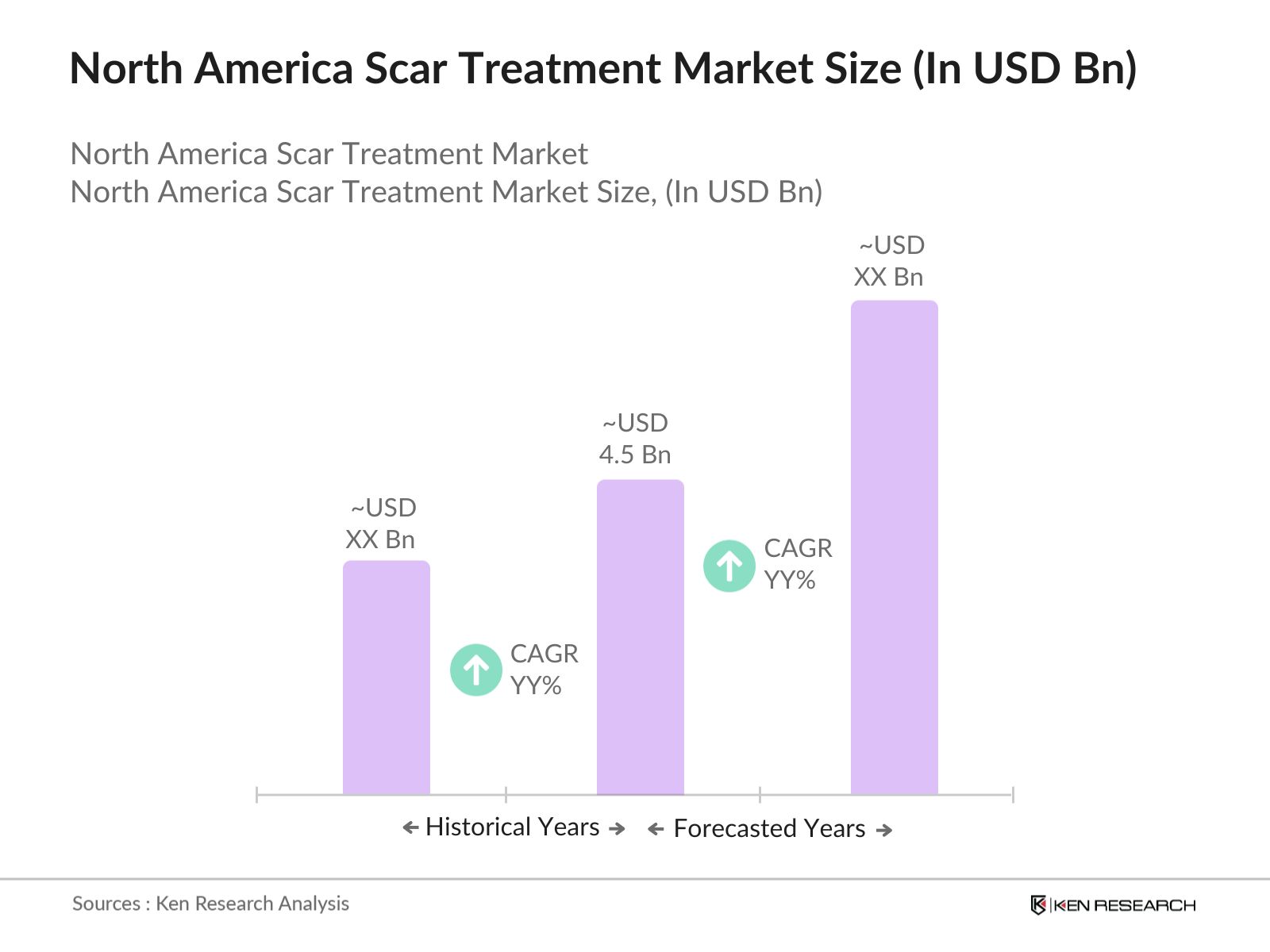
- The North America Scar Treatment Market is valued at USD 4.5 billion, based on a five-year historical analysis. This market is driven by the rising prevalence of skin injuries, surgical procedures, and the increasing demand for cosmetic treatments that aim to improve skin appearance. The development of advanced technologies, including laser treatments and injectables, has played a role in the markets growth.
- In terms of geography, the United States and Canada are the dominant players in the market. The dominance of the United States is largely due to the presence of key industry players, advanced healthcare infrastructure, and the high demand for cosmetic and dermatological treatments.
- The U.S. government, through agencies like the National Institutes of Health (NIH), has allocated over USD 500 million in research funding for skin-related conditions and dermatological treatments. This financial support has led to advancements in scar treatment therapies, including regenerative medicine and stem cell-based treatments for scar reduction, which are expected to hit the market in the coming years.
North America Scar Treatment Market Segmentation
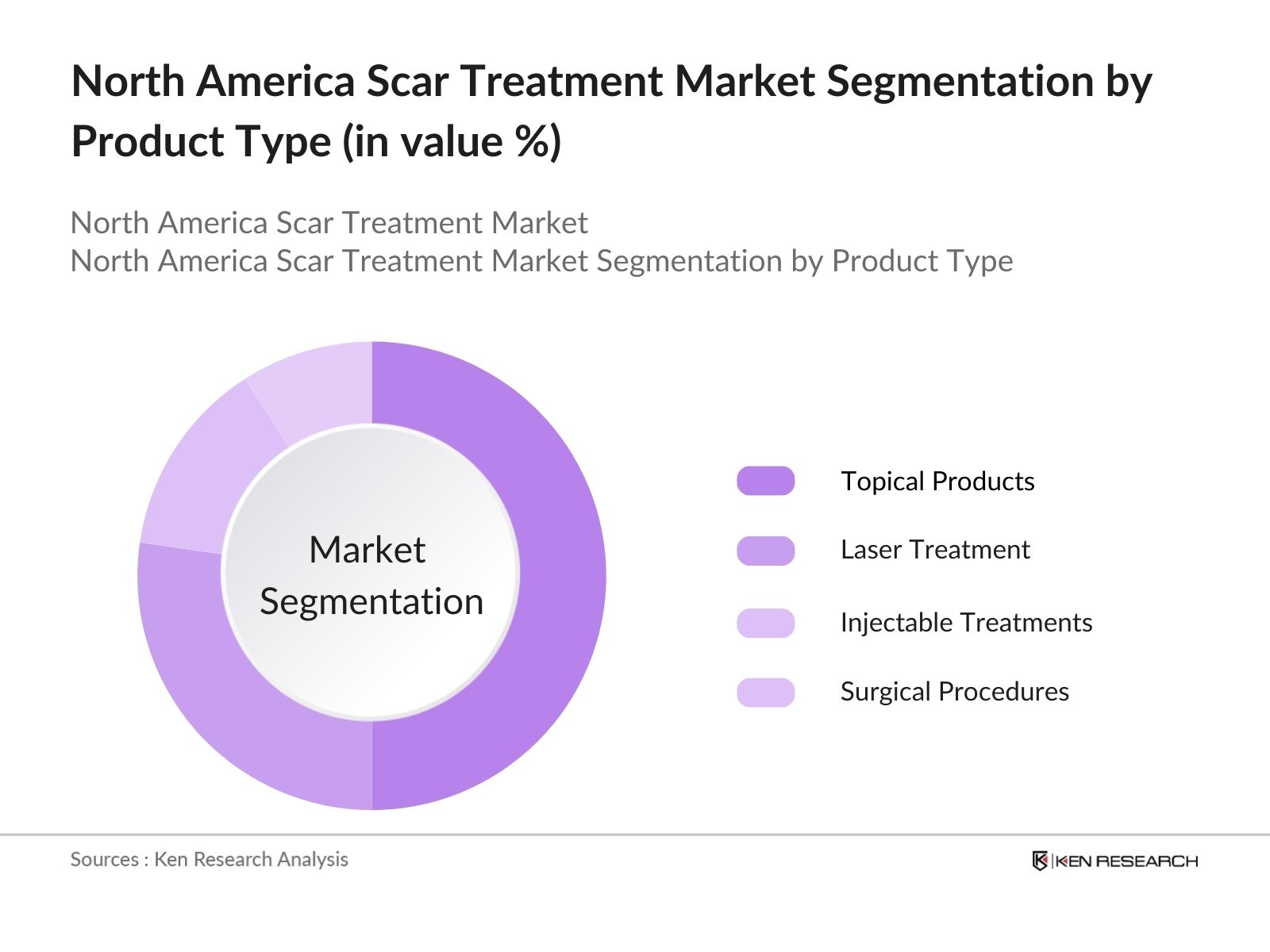
By Product Type: The market is segmented by product type into topical products, laser treatment, injectable treatments, and surgical procedures. Topical products hold the dominant market share under the product type segmentation, driven by their widespread availability, affordability, and ease of use. Products like scar creams, gels, and silicone sheets are preferred due to their non-invasive nature and effective results in treating minor scars, burns, and acne.
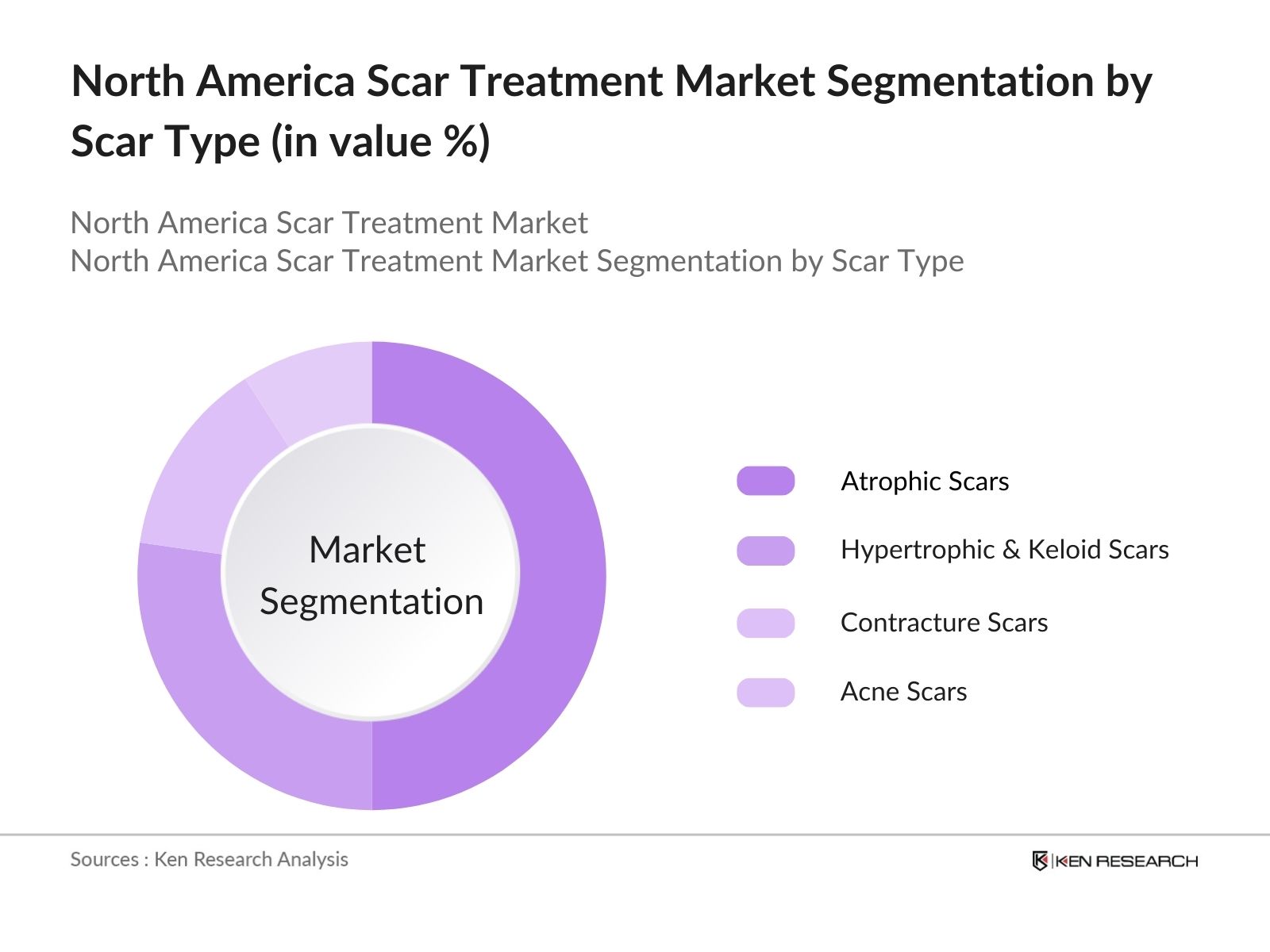
By Scar Type: The market is segmented by scar type into atrophic scars, hypertrophic and keloid scars, contracture scars, and acne scars. Atrophic scars, which are commonly associated with acne and chickenpox, currently dominate the market under this segmentation. This dominance is largely attributed to the high prevalence of acne, particularly among teenagers and young adults, and the growing demand for cosmetic solutions to improve skin texture and appearance. Various topical creams and minimally invasive treatments are widely used for atrophic scars due to their effectiveness.
North America Scar Treatment Market Competitive Landscape
The market is dominated by key players that control market share. These companies are known for their innovative product lines, extensive research and development investments, and strong market presence in dermatology and skincare.
|
Company Name |
Establishment Year |
Headquarters |
Product Portfolio |
R&D Spend |
Regional Presence |
Revenue (USD Bn) |
Mergers/Acquisitions |
Strategic Initiatives |
|
Smith & Nephew |
1856 |
London, UK |
||||||
|
Merz Pharmaceuticals |
1908 |
Frankfurt, Germany |
||||||
|
Cynosure (Hologic) |
1991 |
Massachusetts, USA |
||||||
|
Sonoma Pharmaceuticals |
1999 |
California, USA |
||||||
|
Lumenis |
1966 |
Yokneam, Israel |
North America Scar Treatment Market Analysis
Market Growth Drivers
- Increasing Cases of Skin Disorders: The rising number of individuals with skin conditions, such as acne, burns, and surgical scars, has contributed to the demand for scar treatment products. According to the American Academy of Dermatology, nearly 50 million Americans suffer from acne annually, leading to a large number of post-acne scarring cases, fueling demand for scar treatment products like gels and creams. Additionally, more than 6 million reconstructive surgery procedures are performed each year in the U.S., driving scar treatment needs.
- Aging Population Requiring Aesthetic Procedures: The North American population is aging rapidly, with over 54 million adults aged 65 and older in the U.S. alone. Many of these individuals seek cosmetic treatments to address age-related skin changes, including scar revision surgeries and topical treatments. The cosmetic surgery industry, valued at over $19 billion, is increasingly focusing on scar minimization, boosting the demand for innovative treatments such as laser therapy and dermal fillers.
- Rising Medical Tourism for Scar Revision: The U.S. and Canada are becoming key destinations for medical tourism, especially for cosmetic surgeries and post-surgical scar treatments. An estimated 1.9 million inbound medical tourists visit the U.S. every year, many of whom seek cosmetic treatments, including scar reduction. This influx of international patients has led to an increasing need for advanced scar treatment solutions in top-tier clinics, enhancing the market's growth.
Market Challenges
- Lack of Awareness in Rural Areas: While urban regions in North America have ample access to advanced scar treatments, rural populations often lack awareness of such products and services. In rural areas of the U.S. and Canada, the absence of dermatologists and specialized clinics reduces the availability and adoption of scar treatments. As of 2024, there are approximately 3,800 dermatologists in the U.S., but many are concentrated in urban centers, leaving gaps in rural healthcare infrastructure.
- Limited Insurance Coverage: A significant challenge in the North American market is the limited insurance coverage for scar treatment procedures, especially those considered cosmetic. Scar revision treatments are often categorized under elective surgeries, which many insurance plans do not cover. This creates financial barriers for patients seeking treatment for non-medical scars, thus constraining market growth.
North America Scar Treatment Market Future Outlook
Over the next five years, the North America Scar Treatment industry is expected to experience substantial growth driven by continuous advancements in laser and injectable technologies. Increasing consumer awareness about the availability of non-invasive and affordable scar treatments is further expected to drive demand.
Future Market Opportunities
- Growth in Regenerative Medicine for Scar Treatment: Over the next five years, the market in North America will witness increased adoption of regenerative medicine, including stem cell therapies and biologics. These treatments are expected to be available to over 1 million patients by 2028, providing faster recovery times and improved outcomes for individuals with severe scarring from burns or surgeries.
- Rising Demand for Non-Invasive Treatments: By 2028, non-invasive treatments such as laser therapy, cryotherapy, and chemical peels will dominate the scar treatment landscape in North America, particularly due to the growing preference for pain-free, outpatient procedures. It is estimated that over 4 million non-invasive scar treatments will be performed annually, making them the preferred option for patients seeking minimal downtime.
Scope of the Report
|
By Product Type |
Topical Products Laser Treatment Injectable Treatments Surgical Procedures |
|
By Scar Type |
Atrophic Scars Hypertrophic and Keloid Scars Contracture Scars Acne Scars |
|
By End-User |
Hospitals Dermatology Clinics Home-Use |
|
By Treatment Type |
Laser Treatments Injectable Solutions Topical Treatments Surgical Procedures |
|
By Region |
United States Canada Mexico |
Products
Key Target Audience Organizations and Entities Who Can Benefit by Subscribing This Report:
Banks and Financial Institution
Private Equity Firms
Skincare Product Manufacturers
Investment and Venture Capital Firms
Government and Regulatory Bodies (FDA, Health Canada)
Pharmaceuticals Companies
Companies
Players Mentioned in the Report:
Smith & Nephew
Merz Pharmaceuticals
Cynosure (Hologic)
Sonoma Pharmaceuticals
Lumenis
Sientra
Bausch Health Companies Inc.
Enaltus
CCA Industries
Scar Heal
Revitol
Mederma
Stratpharma
Syneron Medical Ltd.
Scarguard Labs LLC
Table of Contents
1. North America Scar Treatment Market Overview
1.1. Definition and Scope
1.2. Market Taxonomy
1.3. Market Growth Rate
1.4. Market Segmentation Overview
2. North America Scar Treatment Market Size (In USD Bn)
2.1. Historical Market Size
2.2. Year-On-Year Growth Analysis
2.3. Key Market Developments and Milestones
3. North America Scar Treatment Market Analysis
3.1. Growth Drivers (Market-specific: Rising incidence of skin injuries, increasing demand for cosmetic treatments, advancements in laser technology, and awareness of scar management)
3.1.1. Increased Incidence of Skin Injuries and Burns
3.1.2. Growing Demand for Minimally Invasive Cosmetic Procedures
3.1.3. Advances in Laser and Steroid Treatments
3.1.4. Public Awareness and Rising Self-Consciousness
3.2. Market Challenges (Market-specific: High cost of treatments, limited insurance coverage, side effects, and varying efficacy of treatments)
3.2.1. High Cost of Laser and Surgical Treatments
3.2.2. Lack of Comprehensive Insurance Coverage for Cosmetic Procedures
3.2.3. Side Effects and Risks Associated with Treatment
3.2.4. Varied Efficacy of Scar Treatment Solutions
3.3. Opportunities (Market-specific: Emergence of biologics, increasing focus on combination therapies, and expansion into untapped demographics)
3.3.1. Growth of Biologics in Scar Treatment
3.3.2. Innovation in Combination Therapies
3.3.3. Expansion in Male and Pediatric Demographics
3.3.4. Rise in Medical Tourism for Cosmetic Treatments
3.4. Trends (Market-specific: Non-invasive treatment popularity, home-use scar treatments, and rise of telemedicine in scar management)
3.4.1. Increasing Preference for Non-Invasive Treatments
3.4.2. Growth of At-Home Scar Treatment Products
3.4.3. Integration of Telemedicine in Scar Treatment
3.4.4. Personalized Treatment Plans Based on Skin Type
3.5. Government Regulations (Market-specific: FDA approvals, classification of treatments, safety protocols)
3.5.1. FDA Regulations on Scar Treatment Products
3.5.2. Regulatory Compliance for Medical Devices Used in Scar Treatment
3.5.3. Guidelines for Laser and Injectable Scar Treatments
3.5.4. Safety and Efficacy Standards
3.6. SWOT Analysis
3.7. Stake Ecosystem
3.8. Porters Five Forces
3.9. Competition Ecosystem
4. North America Scar Treatment Market Segmentation
4.1. By Product Type (In Value %)
4.1.1. Topical Products (Creams, Gels, Silicone Sheets)
4.1.2. Laser Treatment
4.1.3. Injectable Treatments (Steroid Injections, Fillers)
4.1.4. Surgical Procedures
4.2. By Scar Type (In Value %)
4.2.1. Atrophic Scars
4.2.2. Hypertrophic and Keloid Scars
4.2.3. Contracture Scars
4.2.4. Acne Scars
4.3. By End-User (In Value %)
4.3.1. Hospitals
4.3.2. Dermatology Clinics
4.3.3. Home-Use
4.4. By Treatment Type (In Value %)
4.4.1. Laser Treatments
4.4.2. Injectable Solutions
4.4.3. Topical Treatments
4.4.4. Surgical Procedures
4.5. By Region (In Value %)
4.5.1. United States
4.5.2. Canada
4.5.3. Mexico
5. North America Scar Treatment Market Competitive Analysis
5.1. Detailed Profiles of Major Companies
5.1.1. Smith & Nephew
5.1.2. Merz Pharmaceuticals
5.1.3. Sientra
5.1.4. Cynosure (A Hologic Company)
5.1.5. Sonoma Pharmaceuticals
5.1.6. Lumenis
5.1.7. Bausch Health Companies Inc.
5.1.8. Enaltus
5.1.9. CCA Industries
5.1.10. Scar Heal
5.1.11. Revitol
5.1.12. Mederma
5.1.13. Stratpharma
5.1.14. Syneron Medical Ltd.
5.1.15. Scarguard Labs LLC
5.2. Cross Comparison Parameters (No. of Employees, Headquarters, Product Portfolio, Research & Development Spend, Revenue, Regional Presence, Market Share, Recent Strategic Initiatives)
5.3. Market Share Analysis
5.4. Strategic Initiatives
5.5. Mergers and Acquisitions
5.6. Investment Analysis
5.7. Venture Capital Funding
5.8. Government Grants
5.9. Private Equity Investments
6. North America Scar Treatment Market Regulatory Framework
6.1. FDA Guidelines for Scar Treatment Products
6.2. Safety Standards for Laser and Injectable Treatments
6.3. Certification Processes for Topical Products
6.4. Compliance Requirements for Medical Devices
7. North America Scar Treatment Future Market Size (In USD Bn)
7.1. Future Market Size Projections
7.2. Key Factors Driving Future Market Growth
8. North America Scar Treatment Future Market Segmentation
8.1. By Product Type (In Value %)
8.2. By Scar Type (In Value %)
8.3. By End-User (In Value %)
8.4. By Treatment Type (In Value %)
8.5. By Region (In Value %)
9. North America Scar Treatment Market Analysts Recommendations
9.1. TAM/SAM/SOM Analysis
9.2. Customer Cohort Analysis
9.3. Marketing Initiatives
9.4. White Space Opportunity Analysis
Research Methodology
Step 1: Identification of Key Variables
The research process starts with constructing an ecosystem map of the North America Scar Treatment market, considering all key stakeholders. This involves secondary research using proprietary databases to gather detailed information on industry participants. The primary goal is to identify the most critical variables, such as technological advancements and consumer behavior, that influence market dynamics.
Step 2: Market Analysis and Construction
In this step, historical data related to scar treatment procedures and products is gathered to assess market penetration and revenue generation. Key factors such as product quality, treatment efficacy, and consumer feedback are analyzed to refine revenue estimates and understand market potential.
Step 3: Hypothesis Validation and Expert Consultation
Market hypotheses, including growth drivers and challenges, are tested through expert consultations with industry specialists from key companies. These discussions provide practical insights that help fine-tune market estimates and projections.
Step 4: Research Synthesis and Final Output
The final phase synthesizes findings from primary and secondary research to generate a comprehensive market analysis. Detailed insights from manufacturers, product performance, and consumer preferences are verified, ensuring accurate and reliable data in the final report.
Frequently Asked Questions
How big is the North America Scar Treatment Market?
The North America Scar Treatment market was valued at USD 4.5 billion, driven by the rising demand for cosmetic procedures and technological advancements in scar removal techniques.
What are the challenges in the North America Scar Treatment Market?
Challenges in the North America Scar Treatment market include high treatment costs, limited insurance coverage, and the varied efficacy of different scar treatment methods, such as topical products and laser procedures.
Who are the major players in the North America Scar Treatment Market?
Major players in the North America Scar Treatment market include Smith & Nephew, Cynosure, Merz Pharmaceuticals, Sonoma Pharmaceuticals, and Lumenis, which dominate due to their innovative products and strong market presence.
What are the growth drivers of the North America Scar Treatment Market?
Growth drivers in the North America Scar Treatment market include technological advancements in laser and injectable treatments, the increasing prevalence of skin injuries, and the rising demand for cosmetic solutions among consumers.
What are the dominant segments in the North America Scar Treatment Market?
Topical products and atrophic scars are the dominant segments, owing to their affordability, availability, and effectiveness in addressing common scar types like acne scars.
Why Buy From Us?

What makes us stand out is that our consultants follows Robust, Refine and Result (RRR) methodology. i.e. Robust for clear definitions, approaches and sanity checking, Refine for differentiating respondents facts and opinions and Result for presenting data with story

We have set a benchmark in the industry by offering our clients with syndicated and customized market research reports featuring coverage of entire market as well as meticulous research and analyst insights.

While we don't replace traditional research, we flip the method upside down. Our dual approach of Top Bottom & Bottom Top ensures quality deliverable by not just verifying company fundamentals but also looking at the sector and macroeconomic factors.

With one step in the future, our research team constantly tries to show you the bigger picture. We help with some of the tough questions you may encounter along the way: How is the industry positioned? Best marketing channel? KPI's of competitors? By aligning every element, we help maximize success.

Our report gives you instant access to the answers and sources that other companies might choose to hide. We elaborate each steps of research methodology we have used and showcase you the sample size to earn your trust.

If you need any support, we are here! We pride ourselves on universe strength, data quality, and quick, friendly, and professional service.