















North America Skin Lightening Products Market Outlook to 2030
Region:North America
Author(s):Yogita Sahu
Product Code:KROD7974
December 2024
88
About the Report
North America Skin Lightening Products Market Overview
- The North American skin lightening products market is valued at USD 1.9 billion, driven by several key factors. The increasing demand for skincare products that promise brighter and more even skin tones, as well as the influence of beauty standards and social media trends, plays a major role in the markets expansion. Additionally, the presence of prominent players offering diverse skin lightening product ranges further fuels market growth.
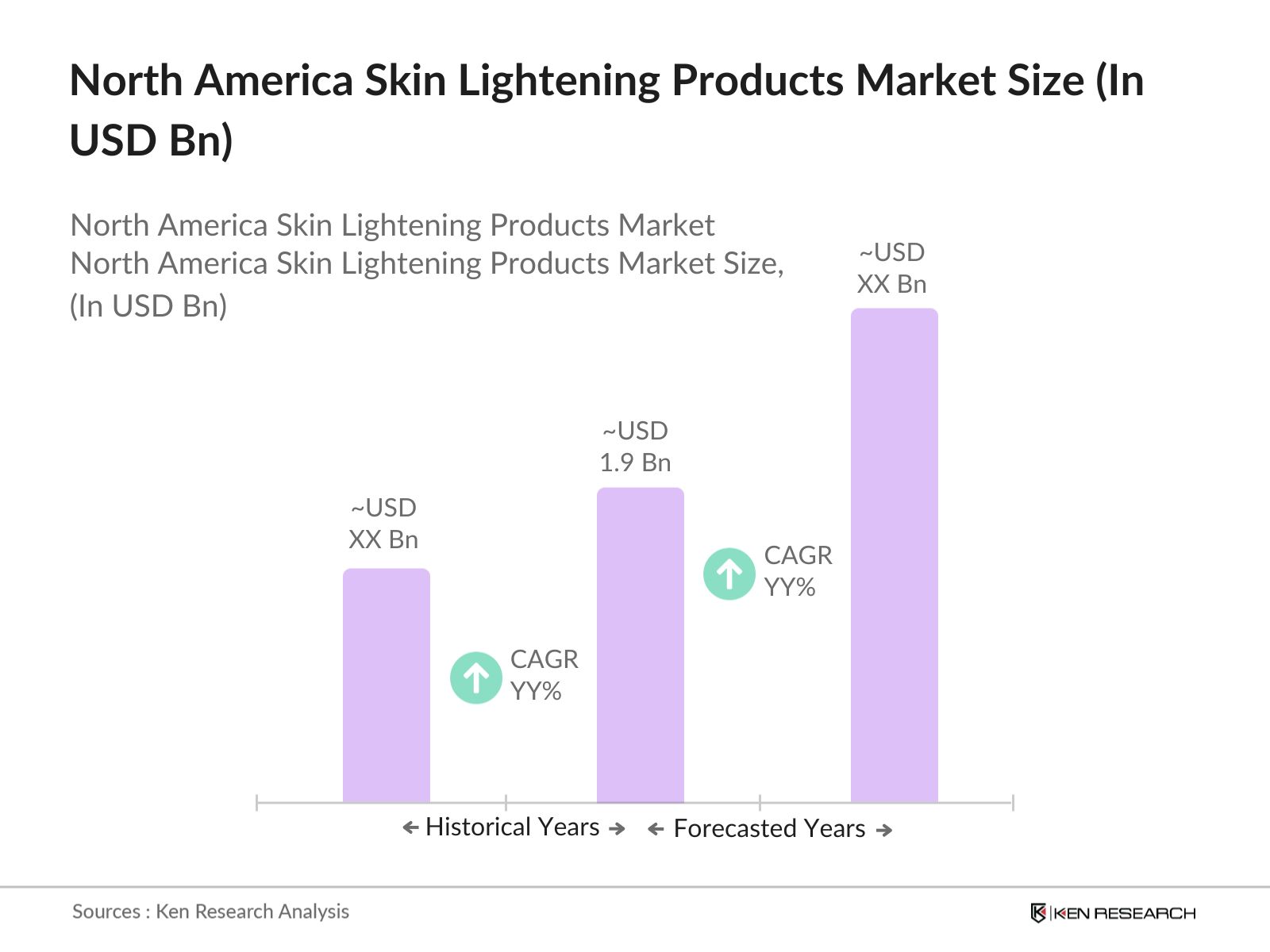
- In terms of market dominance, the United States leads, followed closely by Canada. The U.S. holds its position due to its well-developed retail infrastructure, increasing disposable income, and consumers willingness to invest in premium skincare products. Major cities like New York, Los Angeles, and Toronto have seen a surge in demand for advanced skin lightening solutions, owing to the rising trend of aesthetic consciousness and availability of dermatology services.
- The FDA has increased its regulatory oversight on ingredients used in skin lightening products, particularly those containing hydroquinone. In 2024, over 200 new regulations and guidelines were released to ensure product safety and prevent the use of harmful chemicals. These regulations are compelling manufacturers to invest in research and development for safer alternatives, ensuring compliance with stricter standards.
North America Skin Lightening Products Market Segmentation
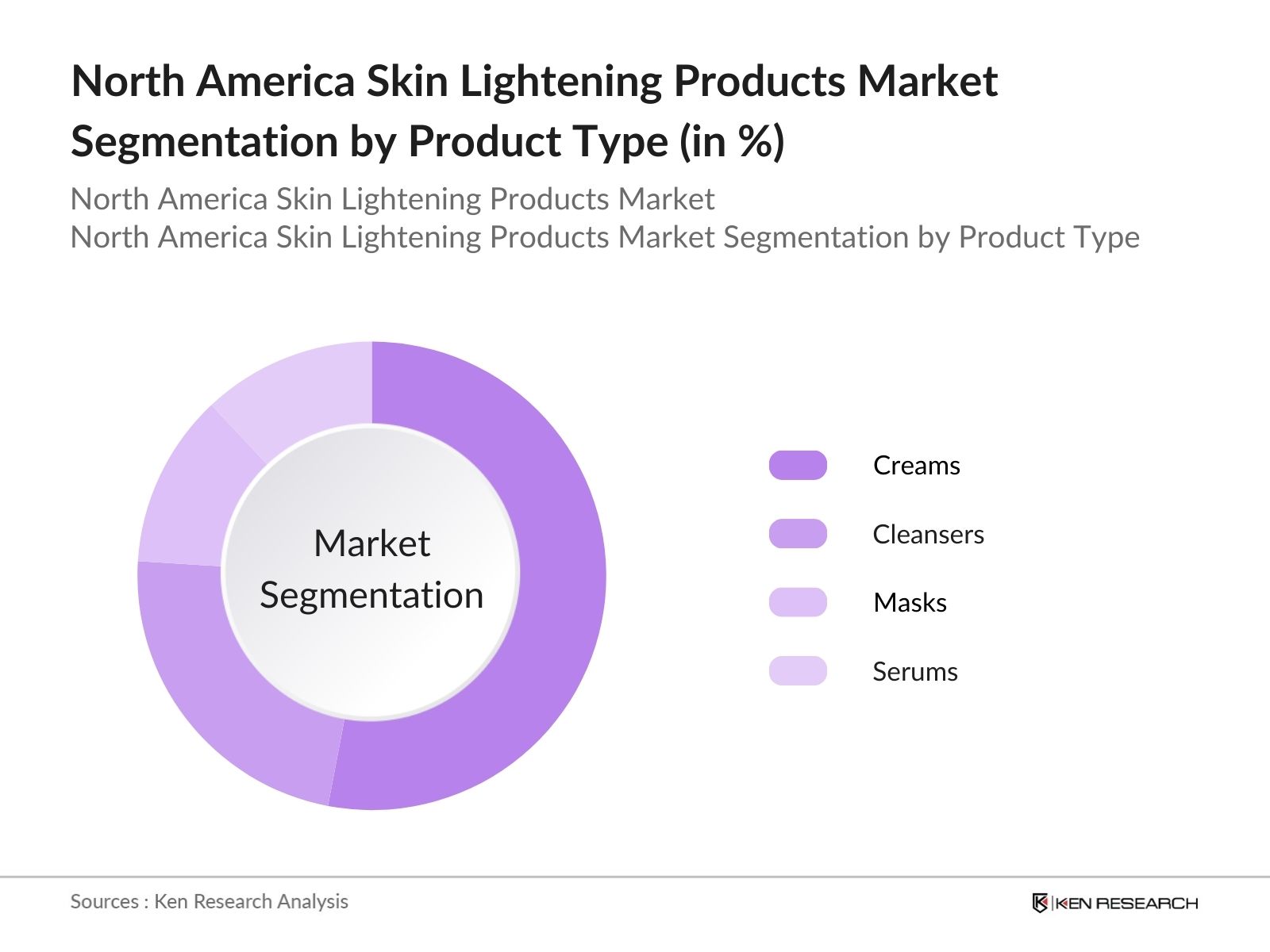
By Product Type: The market is segmented by product type into creams, cleansers, masks, and serums. Among these, creams dominate the market share, driven by their easy penetration into the skin, offering visible and lasting results. Brands such as Neutrogena and SkinCeuticals have gained traction by introducing creams infused with advanced ingredients like vitamin C, E, and kojic acid. These ingredients are known for their strong depigmentation properties, which cater to the region's high demand for brighter skin.
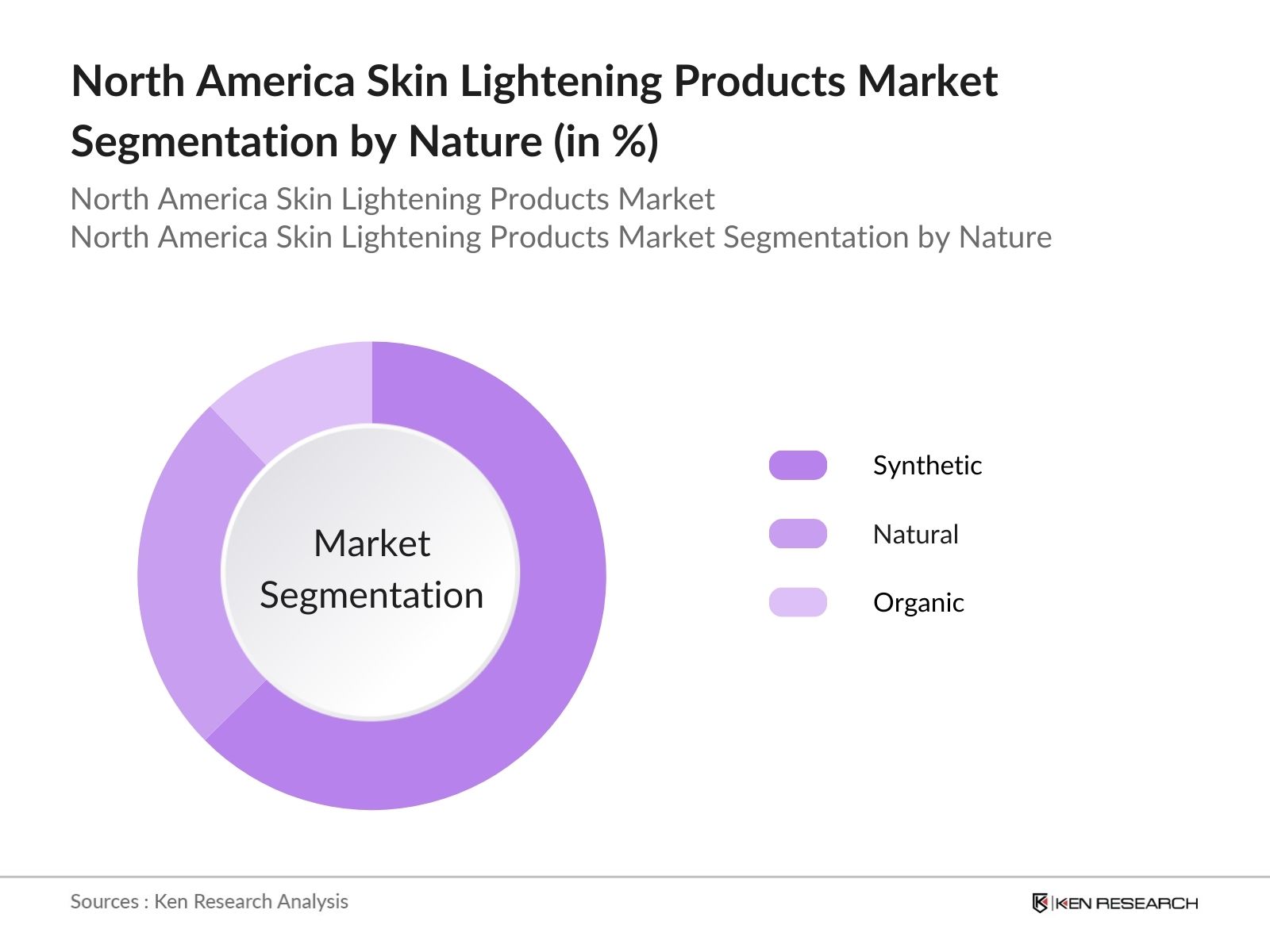
By Nature: The market is segmented into synthetic, natural, and organic products, with the synthetic category holding the largest share due to the faster results provided by chemical ingredients like hydroquinone and glycolic acid. However, the natural segment is rapidly gaining popularity as consumers shift towards products that are perceived to be safer and free from harmful chemicals. Products like Assure Natural have made a impact on this segment's growth, appealing to the growing eco-conscious consumer base.
North America Skin Lightening Products Market Competitive Landscape
The market is competitive, with both global and regional players making significant strides. Companies focus on innovative product formulations and effective marketing strategies to capture the growing demand.
|
Company Name |
Establishment Year |
Headquarters |
Product Range |
R&D Focus |
Innovation in Ingredients |
Key Market Initiatives |
Revenue (USD Bn) |
Sustainability Initiatives |
|
LOral S.A. |
1909 |
Paris, France |
||||||
|
Procter & Gamble |
1837 |
Cincinnati, USA |
||||||
|
Unilever PLC |
1929 |
London, UK |
||||||
|
Shiseido Co., Ltd. |
1872 |
Tokyo, Japan |
||||||
|
Himalaya Wellness Company |
1930 |
Bengaluru, India |
North America Skin Lightening Products Market Analysis
Market Growth Drivers
- Growing Demand for Skin Aesthetic Solutions: The demand for skin aesthetic solutions, including skin lightening products, has been growing in North America. According to 2024 macroeconomic indicators, the beauty and skincare industry saw an increase in sales of premium and specialized skincare products.
- Increase in Awareness of Skin Health and Care Regimes: Consumers in North America are increasingly focusing on skin health, prompting demand for skin lightening products that focus on reducing hyperpigmentation and evening skin tone. In 2024, skin conditions like melasma and dark spots were reported by nearly 18 million people across the region, supporting the demand for lightening products that target these conditions.
- Expansion of Distribution Channels: The rise in digital and omnichannel distribution has played a crucial role in increasing the accessibility and visibility of skin lightening products. In 2024, online skincare sales in North America exceeded 65 million transactions, with a substantial portion driven by brands that specialize in skin lightening and spot correction products.
Market Challenges
- Regulatory Scrutiny on Skin Lightening Ingredients: Increased regulatory scrutiny over ingredients like hydroquinone, a common component in skin lightening products, poses challenges to market growth. The U.S. FDA, in 2024, issued over 150 warnings related to the presence of unapproved or harmful ingredients in skin lightening products.
- Rising Consumer Skepticism on Product Safety: Consumer skepticism about the long-term effects and safety of skin lightening products has grown. In 2024, a survey found that nearly 10 million skincare product users in the U.S. were concerned about potential side effects such as skin damage and irritation, which has led to a decline in trust for certain skin lightening products.
North America Skin Lightening Products Market Future Outlook
Over the next five years, the North American skin lightening products industry is expected to witness consistent growth, driven by consumer shifts towards more natural and organic skincare products, advancements in skincare technologies, and the rise of personalized beauty solutions.
Future Market Opportunities
- Increased Focus on Clean Label Products: In the next five years, the market will witness a shift towards clean-label products that contain transparent, safe ingredients. By 2029, it is estimated that over 40 million consumers will specifically seek products labeled as clean or natural, leading to more brands reformulating their products to meet this demand.
- Growth in Dermatologist-Approved Products: There will be a rise in products that carry dermatologist endorsements, with consumers placing trust in clinically tested solutions. By 2029, an estimated 25 million consumers will exclusively purchase dermatologist-recommended skin lightening products, pushing brands to focus on safety, efficacy, and professional backing.
Scope of the Report
|
By Product Type |
Creams Cleansers Masks Serums Others |
|
By Nature |
Synthetic Natural Organic |
|
By Application |
Personal Use Commercial Use |
|
By Distribution Channel |
Retail Stores Online Platforms Beauty Stores |
|
By Region |
U.S. Canada Mexico |
Products
Key Target Audience Organizations and Entities Who Can Benefit by Subscribing This Report:
Investors and venture capital firms
Government and regulatory bodies (e.g., FDA)
Banks and Financial Institution
Private Equity Firms
Skincare product manufacturers
Companies
Players Mentioned in the Report:
L'Oral S.A.
Procter & Gamble
Unilever PLC
Shiseido Co., Ltd.
Beiersdorf AG
Himalaya Wellness Company
Kao Corporation
VLCC Healthcare Ltd.
Avon Products, Inc.
Revlon, Inc.
Table of Contents
North America Skin Lightening Products Market Overview
1.1. Definition and Scope
1.2. Market Taxonomy
1.3. Market Growth Rate
1.4. Market Segmentation Overview
North America Skin Lightening Products Market Size (In USD Bn)
2.1. Historical Market Size
2.2. Year-On-Year Growth Analysis
2.3. Key Market Developments and Milestones
North America Skin Lightening Products Market Analysis
3.1. Growth Drivers
3.1.1. Rising consumer preference for cosmetic treatments
3.1.2. Influence of social media and beauty influencers
3.1.3. Availability of diverse skin lightening product ranges
3.1.4. Increased awareness of dermatology treatments
3.2. Market Challenges
3.2.1. Health risks associated with chemical ingredients
3.2.2. Regulatory restrictions on certain chemicals
3.2.3. Growing criticism from advocacy groups
3.3. Opportunities
3.3.1. Shift towards natural and organic products
3.3.2. Technological innovations in product formulations
3.3.3. Expanding product availability via e-commerce
3.3.4. Celebrity endorsements and influencer marketing
3.4. Trends
3.4.1. Preference for clean and vegan beauty products
3.4.2. Increasing demand for multi-functional skincare products
3.4.3. Personalized skincare solutions based on AI diagnostics
3.4.4. Customizable skin lightening treatments
3.5. Government Regulations
3.5.1. FDA regulations on product ingredients
3.5.2. Ban on harmful chemicals like hydroquinone in certain regions
3.5.3. Labeling and marketing regulations for fairness products
3.5.4. Compliance with environmental standards
3.6. SWOT Analysis
3.7. Stake Ecosystem
3.8. Porters Five Forces
3.9. Competition Ecosystem
North America Skin Lightening Products Market Segmentation
4.1. By Product Type (In Value %)
4.1.1. Creams
4.1.2. Cleansers
4.1.3. Masks
4.1.4. Serums
4.2. By Nature (In Value %)
4.2.1. Synthetic
4.2.2. Natural
4.2.3. Organic
4.3. By Application (In Value %)
4.3.1. Personal Use
4.3.2. Commercial Use (e.g., dermatology clinics, spas)
4.4. By Distribution Channel (In Value %)
4.4.1. Retail Stores
4.4.2. Online Platforms
4.4.3. Specialized Beauty Stores
4.5. By Region (In Value %)
4.5.1. U.S.
4.5.2. Canada
4.5.3. Mexico
North America Skin Lightening Products Market Competitive Analysis
5.1 Detailed Profiles of Major Companies
5.1.1. LOral S.A.
5.1.2. Procter & Gamble
5.1.3. Unilever PLC
5.1.4. Shiseido Co., Ltd.
5.1.5. Beiersdorf AG
5.1.6. Himalaya Wellness Company
5.1.7. Avon Products, Inc.
5.1.8. Kao Corporation
5.1.9. VLCC Healthcare Ltd.
5.1.10. Revlon, Inc.
5.1.11. Este Lauder Companies Inc.
5.1.12. SkinCeuticals
5.1.13. Johnson & Johnson
5.1.14. Neutrogena
5.1.15. Astaberry Biosciences
5.2 Cross Comparison Parameters (Product Range, Innovation, Distribution Network, R&D Investment)
5.3. Market Share Analysis
5.4. Strategic Initiatives
5.5. Mergers and Acquisitions
5.6. Investment Analysis
5.7. Venture Capital Funding
5.8. Government Grants
5.9. Private Equity Investments
North America Skin Lightening Products Market Regulatory Framework
6.1. Regulatory Guidelines for Cosmetic Safety
6.2. Compliance Requirements for Product Ingredients
6.3. Certification Processes for Organic Products
North America Skin Lightening Products Future Market Size (In USD Bn)
7.1. Future Market Size Projections
7.2. Key Factors Driving Future Market Growth
North America Skin Lightening Products Future Market Segmentation
8.1. By Product Type (In Value %)
8.2. By Nature (In Value %)
8.3. By Application (In Value %)
8.4. By Distribution Channel (In Value %)
8.5. By Region (In Value %)
North America Skin Lightening Products Market Analysts Recommendations
9.1. TAM/SAM/SOM Analysis
9.2. Customer Cohort Analysis
9.3. Marketing Initiatives
9.4. White Space Opportunity Analysis
Disclaimer Contact UsResearch Methodology
Step 1: Identification of Key Variables
The research begins with identifying the key variables that influence the North America Skin Lightening Products Market. This involves extensive desk research and gathering data from secondary and proprietary databases. The aim is to understand the major players, product categories, and consumer behavior patterns that drive the market.
Step 2: Market Analysis and Construction
Historical data on market penetration, product offerings, and sales trends are analyzed to construct an accurate representation of the market landscape. This includes evaluating the adoption of synthetic versus natural products and analyzing the revenue generated by different distribution channels.
Step 3: Hypothesis Validation and Expert Consultation
To validate the research findings, consultations with industry experts, dermatologists, and beauty product manufacturers are conducted. This step helps to refine the research by integrating on-the-ground insights from market professionals.
Step 4: Research Synthesis and Final Output
The final step involves synthesizing the data and insights into a cohesive report. This includes validating sales performance, customer preferences, and market dynamics through direct engagement with key stakeholders in the beauty industry.
Frequently Asked Questions
01. How big is the North America Skin Lightening Products Market?
The North America Skin Lightening Products Market was valued at USD 1.9 billion, driven by consumer demand for brighter skin and the availability of advanced skincare products with depigmentation properties.
02. What are the challenges in the North America Skin Lightening Products Market?
Challenges in the North America Skin Lightening Products Market include regulatory restrictions on certain ingredients, such as hydroquinone, as well as rising consumer scrutiny over the safety of chemical-based products.
03. Who are the major players in the North America Skin Lightening Products Market?
Major players in the North America Skin Lightening Products Market include L'Oral, Procter & Gamble, Unilever, Shiseido, and Himalaya Wellness Company, dominating due to their strong product portfolios and advanced research in skincare formulations.
04. What are the growth drivers for the North America Skin Lightening Products Market?
The North America Skin Lightening Products Market is driven by factors such as rising consumer awareness of skincare, the influence of social media and beauty influencers, and the availability of premium skin lightening creams and cleansers.
05. How is the trend toward natural products impacting the market?
There is a growing demand for natural and organic skincare products, as consumers seek alternatives to chemical-based products. Brands offering clean, cruelty-free, and vegan formulations are increasingly gaining market share.
Why Buy From Us?

What makes us stand out is that our consultants follows Robust, Refine and Result (RRR) methodology. i.e. Robust for clear definitions, approaches and sanity checking, Refine for differentiating respondents facts and opinions and Result for presenting data with story

We have set a benchmark in the industry by offering our clients with syndicated and customized market research reports featuring coverage of entire market as well as meticulous research and analyst insights.

While we don't replace traditional research, we flip the method upside down. Our dual approach of Top Bottom & Bottom Top ensures quality deliverable by not just verifying company fundamentals but also looking at the sector and macroeconomic factors.

With one step in the future, our research team constantly tries to show you the bigger picture. We help with some of the tough questions you may encounter along the way: How is the industry positioned? Best marketing channel? KPI's of competitors? By aligning every element, we help maximize success.

Our report gives you instant access to the answers and sources that other companies might choose to hide. We elaborate each steps of research methodology we have used and showcase you the sample size to earn your trust.

If you need any support, we are here! We pride ourselves on universe strength, data quality, and quick, friendly, and professional service.