















North America Smart Factory Market Outlook to 2030
Region:North America
Author(s):Sanjna Verma
Product Code:KROD4915
December 2024
88
About the Report
North America Smart Factory Market Overview
- The North America Smart Factory market is valued at USD 45.6 billion, driven by the region's strong focus on automation, digitization, and efficient manufacturing processes. Industries such as automotive, aerospace, and electronics are leading the implementation of smart factory solutions, integrating artificial intelligence, IoT, and advanced robotics to enhance productivity and reduce operational costs. The demand for flexible, scalable, and automated manufacturing systems is the primary driver, with continuous investments in technological advancements propelling the market further.
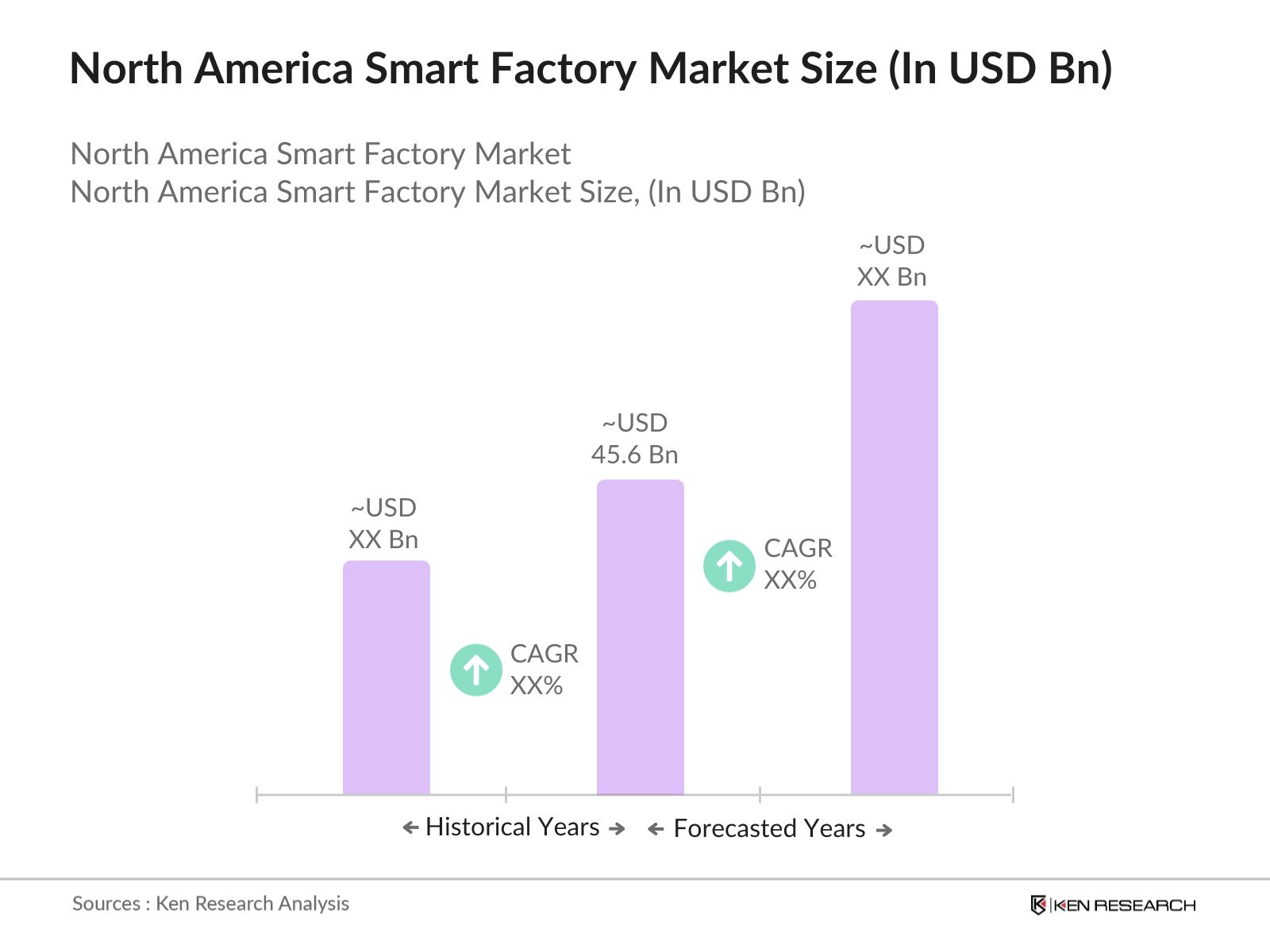
- The United States is the dominant country in the North America Smart Factory market, followed by Canada. The dominance of the U.S. can be attributed to the extensive industrial base, technological leadership, and large-scale adoption of smart factory technologies in key sectors like automotive and aerospace. Major cities like Detroit, known for its automotive hub, and Silicon Valley, with its high-tech manufacturing capabilities, further reinforce the dominance of the U.S. in the smart factory landscape.
- Governments in North America are offering substantial tax breaks and subsidies to encourage the adoption of automation and digitalization in manufacturing. In 2024, the U.S. government provided over $1.5 billion in tax credits to companies that invested in smart factory technologies. Canada also allocated more than $800 million in grants to support the transition to automated manufacturing processes. These financial incentives have significantly reduced the cost burden on manufacturers, promoting faster adoption of smart factory systems across industries such as automotive and consumer electronics.
North America Smart Factory Market Segmentation
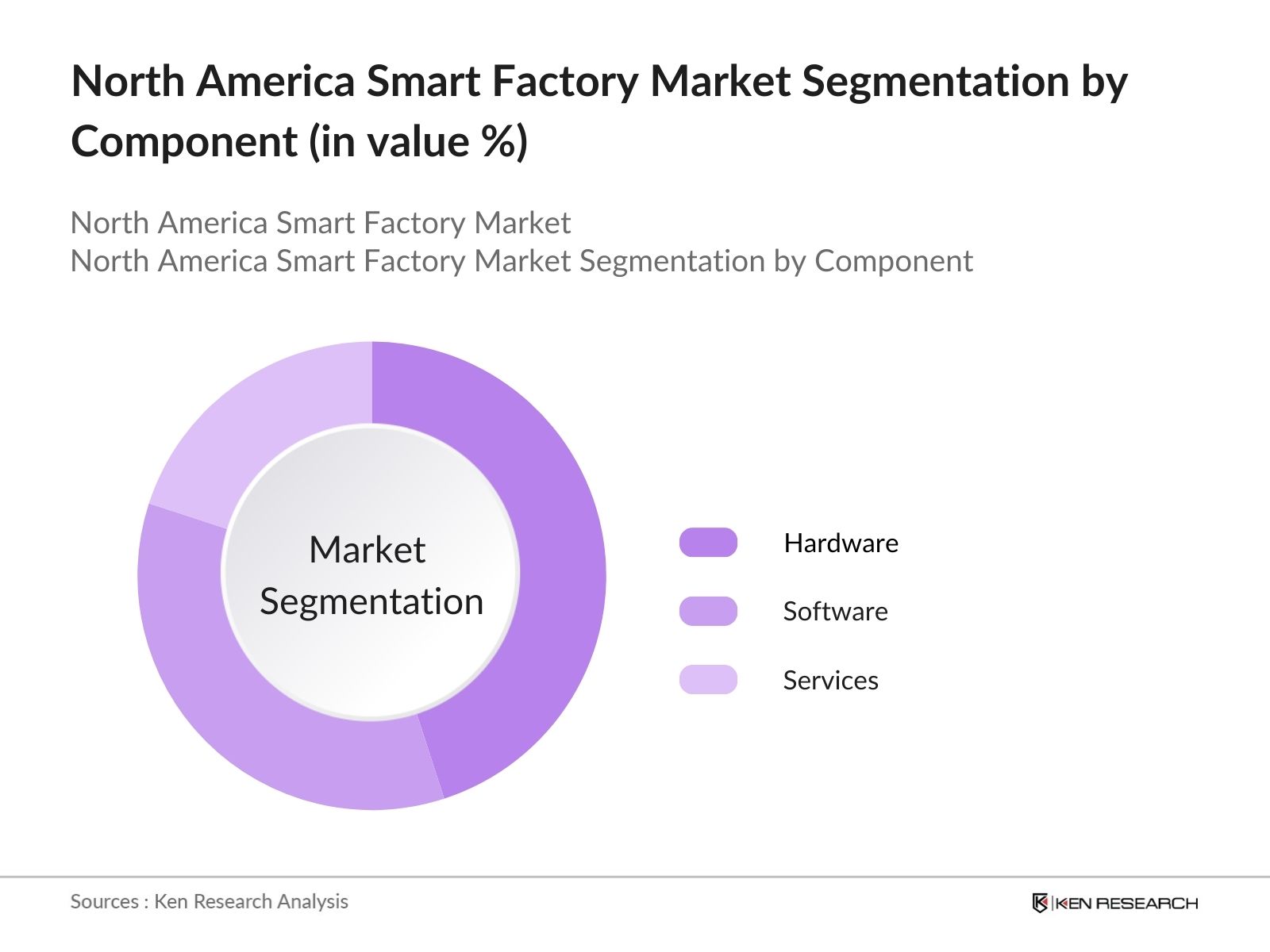
By Component: The North America Smart Factory market is segmented by component into hardware, software, and services. Hardware, which includes sensors, robotics, and automation tools, holds a significant market share due to the need for physical infrastructure in the implementation of smart factories. The rise of connected devices, industrial robots, and automated machinery has driven the dominance of hardware in the market. Software solutions such as SCADA and AI-based platforms are also witnessing significant adoption, as manufacturers increasingly rely on data-driven decision-making processes.
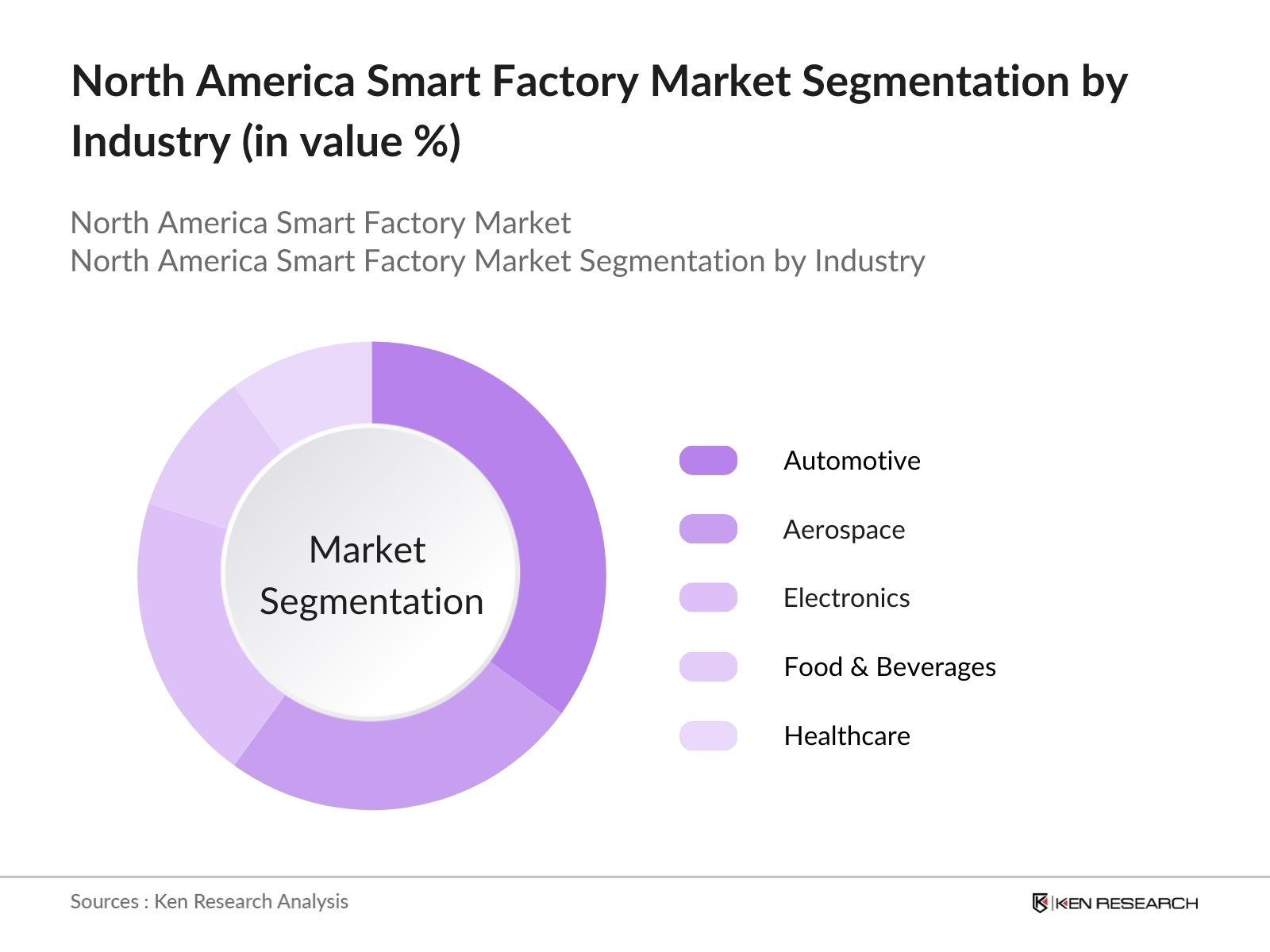
By Industry: The market is segmented by industry into automotive, aerospace, electronics, food and beverage, and healthcare. The automotive industry leads the market share under this segmentation, driven by the integration of automation and robotics in production lines. The need for precision, mass production, and cost-effectiveness has led to high adoption rates of smart factory technologies in the automotive sector, particularly in cities like Detroit, known as the hub of automotive manufacturing.
North America Smart Factory Market Competitive Landscape
The North America Smart Factory market is dominated by major players who have established themselves through technological advancements and strategic partnerships. Companies like Siemens AG, Rockwell Automation, and ABB Ltd. have become industry leaders, offering comprehensive smart factory solutions ranging from hardware to software platforms. These companies have benefited from extensive R&D investment, a global presence, and collaborations with industry leaders across various sectors.
|
Company Name |
Established Year |
Headquarters |
No. of Employees |
R&D Expenditure |
Smart Factory Solutions |
Market Cap |
Revenue |
Recent Innovations |
|
Siemens AG |
1847 |
Berlin, Germany |
- |
- |
- |
- |
- |
- |
|
Rockwell Automation |
1903 |
Milwaukee, USA |
- |
- |
- |
- |
- |
- |
|
ABB Ltd. |
1883 |
Zurich, Switzerland |
- |
- |
- |
- |
- |
- |
|
Emerson Electric Co. |
1890 |
Missouri, USA |
- |
- |
- |
- |
- |
- |
|
Honeywell International |
1906 |
North Carolina, USA |
- |
- |
- |
- |
- |
- |
North America Smart Factory Market
Growth Drivers
- Government Incentives: In 2024, government incentives across North America have been pivotal in accelerating the adoption of smart factories in the manufacturing sector. The U.S. government, for instance, has allocated over $2 billion in tax breaks and grants to companies that invest in digital transformation and automation initiatives under programs such as the Advanced Manufacturing Program. These incentives have facilitated greater adoption of robotics and automation across various industries, with the automotive and aerospace sectors being the largest beneficiaries.
- Demand for Process Optimization: Manufacturers in North America are increasingly investing in smart factory technologies to improve process optimization and reduce operational inefficiencies. In 2024, the adoption of robotics in manufacturing facilities increased significantly, with over 300,000 industrial robots deployed across the U.S. factories. The integration of automation and robotics has reduced production time by 20-25% and improved output quality.
- Industrial IoT and Cloud Integrations: In North America, the integration of Industrial IoT (IIoT) and cloud computing into smart factories is contributing significantly to enhanced operational efficiency. By 2024, over 40,000 factories across the region have integrated cloud-based platforms for real-time data analytics and equipment monitoring. This has resulted in a 12% improvement in overall equipment effectiveness (OEE). The U.S. manufacturing sector has particularly benefited, saving an estimated $10 billion annually by reducing unplanned downtime and improving supply chain visibility.
Challenges
- High Initial Investment: The high cost of adopting automation and robotics systems presents a significant barrier for manufacturers in North America. In 2024, the average cost of a single robotic arm is between $50,000 and $150,000, making it difficult for small and medium-sized enterprises (SMEs) to afford full-scale smart factory upgrades. While large corporations can justify the investment through long-term efficiency gains, nearly 70% of SMEs in the U.S. have cited upfront costs as a primary deterrent to adopting smart manufacturing technologies.
- Data Security Concerns: Data security concerns are becoming increasingly prominent as more factories in North America adopt IoT-based smart factory solutions. In 2024, the U.S. manufacturing sector experienced over 2,000 cyberattacks, resulting in financial losses exceeding $6 billion. The growing reliance on interconnected systems makes smart factories vulnerable to data breaches and ransomware attacks.
North America Smart Factory Market Future Outlook
North America Smart Factory market is expected to experience significant growth, driven by the adoption of AI, IoT, and machine learning technologies in industrial processes. The need for efficient, automated, and scalable manufacturing solutions will continue to fuel demand for smart factory implementations across various industries. Additionally, advancements in 5G technology, real-time data analytics, and edge computing will further enhance the operational efficiency of factories.
Market Opportunities
- Growth in AI-Powered Robotics: The increasing demand for AI-powered robotics presents significant opportunities for the North American smart factory market in 2024. AI-driven automation systems have reduced production errors by 40%, especially in the automotive and electronics industries. The U.S. and Canada have collectively invested over $5 billion in R&D for AI-enhanced manufacturing systems, leading to the rapid deployment of robots that can autonomously optimize production processes. The continued investment in AI for manufacturing is expected to lead to further efficiency gains and increased adoption of robotics across multiple sectors.
- Demand for Flexible Manufacturing: Flexible manufacturing systems are becoming a key requirement for North American manufacturers seeking to quickly adapt to changing market demands. In 2024, more than 30,000 factories in the U.S. have adopted flexible production lines that can be reconfigured to produce different products with minimal downtime. Flexible manufacturing is particularly critical in sectors such as consumer electronics and automotive, where demand for customization is high.
Scope of the Report
|
By Component |
Hardware Software Services |
|
By Industry |
Automotive Electronics and Semiconductor Aerospace and Defense Food and Beverage Healthcare and Pharmaceuticals |
|
By Technology |
Artificial Intelligence (AI) Industrial IoT (IIoT) Cloud Computing Big Data Analytics 5G Connectivity |
|
By Application |
Production and Assembly Quality Inspection Supply Chain and Logistics Maintenance and Asset Management |
|
By Region |
United States Canada Mexico |
Products
Key Target Audience
Smart manufacturing companies
Technology and IoT solution providers
Automotive manufacturers
Aerospace and defense companies
Healthcare and pharmaceutical manufacturers
Industrial automation and robotics companies
Government and regulatory bodies (e.g., U.S. Department of Commerce)
Investors and venture capitalists
Companies
Players Mentioned int he Report
Siemens AG
Rockwell Automation
ABB Ltd.
Emerson Electric Co.
Honeywell International
General Electric Co.
Mitsubishi Electric Corporation
Schneider Electric SE
Fanuc Corporation
Yokogawa Electric Corporation
Table of Contents
1. North America Smart Factory Market Overview
1.1 Definition and Scope
1.2 Market Taxonomy
1.3 Smart Factory Ecosystem in North America
1.4 Market Growth Rate
1.5 Smart Factory Implementation by Industry
2. North America Smart Factory Market Size (In USD Bn)
2.1 Historical Market Size
2.2 Year-On-Year Growth Analysis
2.3 Key Developments in Smart Factory Technologies
2.4 Smart Factory Adoption Milestones
3. North America Smart Factory Market Analysis
3.1 Growth Drivers
3.1.1 Government Incentives (Smart Factory Adoption in Manufacturing)
3.1.2 Demand for Process Optimization (Automation, Robotics Integration)
3.1.3 Industrial IoT and Cloud Integration (Operational Efficiency)
3.1.4 Workforce Efficiency (AI, ML Integration in Production Lines)
3.2 Market Challenges
3.2.1 High Initial Investment (Costs of Automation and Robotics)
3.2.2 Data Security Concerns (Cybersecurity in Smart Factory Systems)
3.2.3 Integration Complexity (Legacy System Compatibility)
3.2.4 Limited Skilled Workforce (Technicians for Smart Systems)
3.3 Opportunities
3.3.1 Growth in AI-Powered Robotics (Enhanced Automation Systems)
3.3.2 Demand for Flexible Manufacturing (Customizable Production Lines)
3.3.3 Expansion of 5G Technology (Real-time Communication in Factories)
3.3.4 Partnerships between IT and Manufacturing Sectors (Collaborative Solutions)
3.4 Trends
3.4.1 Adoption of Predictive Maintenance (AI-Powered Diagnostics)
3.4.2 Integration of Edge Computing in Smart Factories
3.4.3 Use of Digital Twins (Virtual Replicas for Optimization)
3.4.4 Autonomous Systems for Factory Management (AI-Based Decision Making)
3.5 Government Regulation
3.5.1 Government Support for Automation and Digitalization (Tax Breaks)
3.5.2 Industry 4.0 Compliance Standards (Regulatory Compliance)
3.5.3 Cybersecurity Standards for Smart Factory Systems (Data Protection)
3.5.4 Environmental and Safety Regulations (Sustainability in Smart Factories)
4. North America Smart Factory Market Segmentation
4.1 By Component (In Value %)
4.1.1 Hardware (Robotics, Sensors, Automation Tools)
4.1.2 Software (SCADA, MES, AI Solutions)
4.1.3 Services (Consulting, Implementation, Training)
4.2 By Industry (In Value %)
4.2.1 Automotive
4.2.2 Electronics and Semiconductor
4.2.3 Aerospace and Defense
4.2.4 Food and Beverage
4.2.5 Healthcare and Pharmaceuticals
4.3 By Technology (In Value %)
4.3.1 Artificial Intelligence (AI)
4.3.2 Industrial IoT (IIoT)
4.3.3 Cloud Computing
4.3.4 Big Data Analytics
4.3.5 5G Connectivity
4.4 By Application (In Value %)
4.4.1 Production and Assembly
4.4.2 Quality Inspection
4.4.3 Supply Chain and Logistics
4.4.4 Maintenance and Asset Management
4.5 By Region (In Value %)
4.5.1 United States
4.5.2 Canada
4.5.3 Mexico
5. North America Smart Factory Market Competitive Analysis
5.1 Detailed Profiles of Major Companies
5.1.1 Siemens AG
5.1.2 General Electric Co.
5.1.3 Rockwell Automation, Inc.
5.1.4 ABB Ltd.
5.1.5 Schneider Electric SE
5.1.6 Honeywell International Inc.
5.1.7 Emerson Electric Co.
5.1.8 Fanuc Corporation
5.1.9 Mitsubishi Electric Corporation
5.1.10 Yokogawa Electric Corporation
5.2 Cross Comparison Parameters (Revenue, Headquarters, No. of Employees, Market Cap, R&D Expenditure, Smart Factory Solutions, Recent Innovations, Market Share)
5.3 Strategic Initiatives
5.4 Mergers and Acquisitions
5.5 Investment Analysis
5.6 Venture Capital Funding
5.7 Private Equity Investments
6. North America Smart Factory Market Regulatory Framework
6.1 Environmental Compliance Standards (Energy Efficiency)
6.2 Data Protection and Privacy Regulations
6.3 Industry Standards for Automation and Robotics
6.4 Compliance Requirements for Manufacturing 4.0
7. North America Smart Factory Future Market Size (In USD Bn)
7.1 Future Market Size Projections
7.2 Key Factors Driving Future Market Growth
8. North America Smart Factory Future Market Segmentation
8.1 By Component (In Value %)
8.2 By Industry (In Value %)
8.3 By Technology (In Value %)
8.4 By Application (In Value %)
8.5 By Region (In Value %)
9. North America Smart Factory Market Analysts Recommendations
9.1 TAM/SAM/SOM Analysis
9.2 Customer Cohort Analysis
9.3 Marketing Initiatives
9.4 White Space Opportunity Analysis
Research Methodology
Step 1: Identification of Key Variables
This step involves mapping out all major stakeholders in the North America Smart Factory market. Desk research will be used to compile data from secondary sources and proprietary databases to establish the primary factors influencing market trends, including technological advancements, industry adoption rates, and economic drivers.
Step 2: Market Analysis and Construction
The next step will involve gathering and analyzing historical data on the North America Smart Factory market. This includes evaluating the penetration of automation solutions, industry-specific adoption rates, and the economic impact on production costs and output.
Step 3: Hypothesis Validation and Expert Consultation
In this phase, interviews with industry experts from key manufacturing sectors will be conducted. These insights will help validate the market data and provide a real-world perspective on the operational and financial challenges that manufacturers face in adopting smart factory solutions.
Step 4: Research Synthesis and Final Output
Finally, the research will culminate in synthesizing the data from various sources to produce a detailed analysis of the North America Smart Factory market. This step will include engagement with smart factory technology providers to gather insights on product innovation, customer preferences, and market dynamics.
Frequently Asked Questions
01. How big is the North America Smart Factory Market?
The North America Smart Factory market is valued at USD 45.6 billion, driven by advancements in automation, IoT, and AI technologies, primarily across industries like automotive and aerospace.
02. What are the key challenges in the North America Smart Factory Market?
Challenges of North America Smart Factory Market include the high initial investment for smart factory technologies, the integration of legacy systems with modern automation, and the shortage of skilled labor to operate and maintain advanced systems.
03. Who are the major players in the North America Smart Factory Market?
Key players of North America Smart Factory Market include Siemens AG, Rockwell Automation, ABB Ltd., Emerson Electric Co., and Honeywell International, leading the market through technological advancements and strategic partnerships.
04. What drives growth in the North America Smart Factory Market?
North America Smart Factory Market is propelled by the need for operational efficiency, advancements in industrial IoT, and increasing demand for real-time data analytics, especially in industries like automotive and electronics.
Why Buy From Us?

What makes us stand out is that our consultants follows Robust, Refine and Result (RRR) methodology. i.e. Robust for clear definitions, approaches and sanity checking, Refine for differentiating respondents facts and opinions and Result for presenting data with story

We have set a benchmark in the industry by offering our clients with syndicated and customized market research reports featuring coverage of entire market as well as meticulous research and analyst insights.

While we don't replace traditional research, we flip the method upside down. Our dual approach of Top Bottom & Bottom Top ensures quality deliverable by not just verifying company fundamentals but also looking at the sector and macroeconomic factors.

With one step in the future, our research team constantly tries to show you the bigger picture. We help with some of the tough questions you may encounter along the way: How is the industry positioned? Best marketing channel? KPI's of competitors? By aligning every element, we help maximize success.

Our report gives you instant access to the answers and sources that other companies might choose to hide. We elaborate each steps of research methodology we have used and showcase you the sample size to earn your trust.

If you need any support, we are here! We pride ourselves on universe strength, data quality, and quick, friendly, and professional service.