















North America Smart Trash Bin Market Outlook to 2030
Region:North America
Author(s):Yogita Sahu
Product Code:KROD6227
November 2024
88
About the Report
North America Smart Trash Bin Market Overview
- The North America Smart Trash Bin Market, valued at USD 9 billion, is primarily driven by the growing need for efficient waste management solutions, particularly in urban areas where waste generation is rising rapidly. The integration of Internet of Things (IoT) technology into trash bins has also contributed to market growth, as smart bins help optimize waste collection by monitoring fill levels and alerting waste management services.
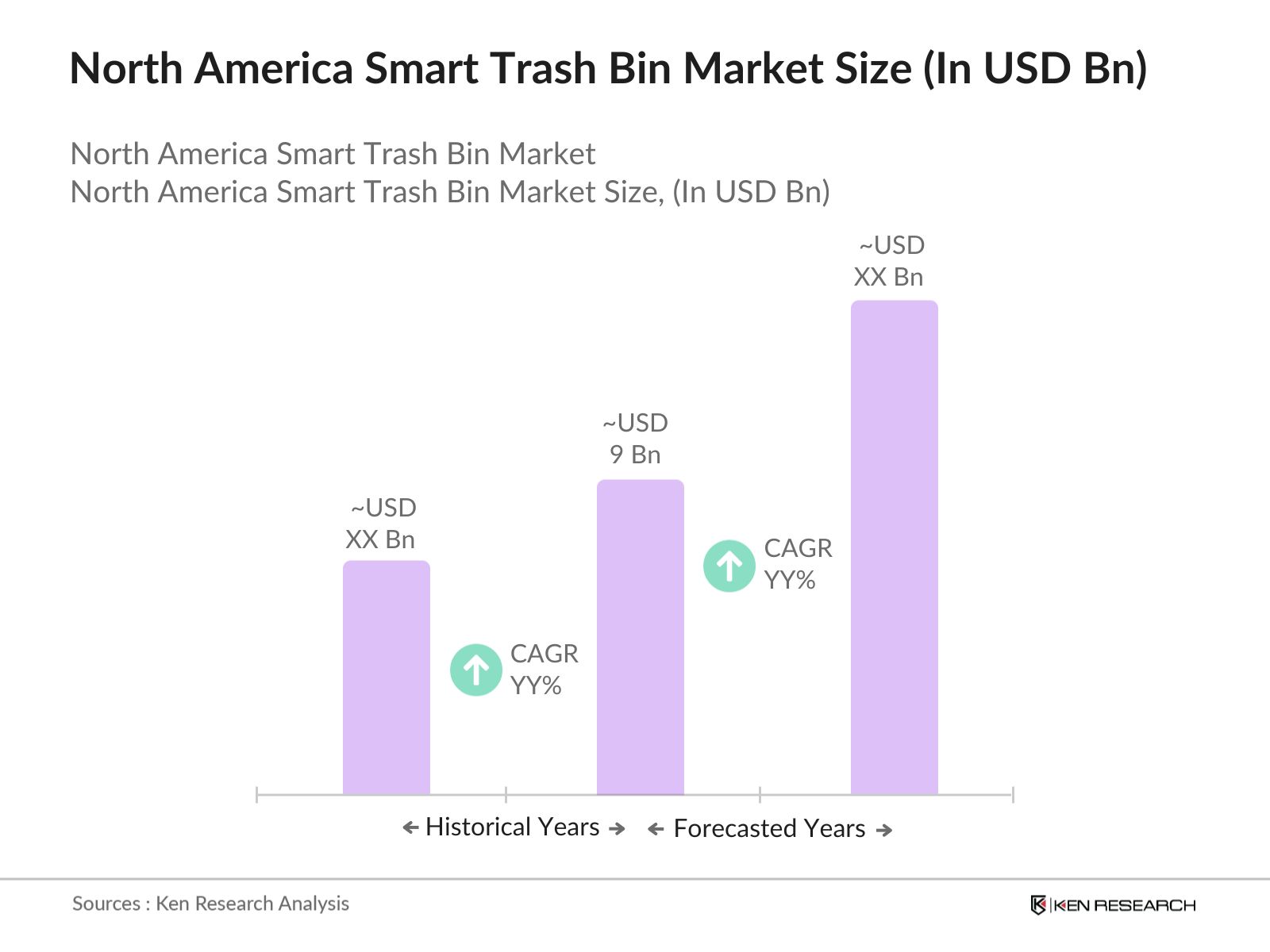
- The dominant regions in the market include the United States and Canada, which account for the largest share due to their high urbanization rates, advanced waste management systems, and strong governmental regulations supporting sustainable waste disposal practices. The market dominance of these regions can be attributed to their early adoption of smart city initiatives and their emphasis on integrating smart waste management solutions in both residential and commercial spaces.
- The Canadian government, through the Green Infrastructure Program, has allocated $100 million to municipalities for the installation of smart waste management systems, including smart trash bins. These funds are being used by major cities like Vancouver and Ottawa, with the goal of reducing municipal waste sent to landfills by 40% by 2027, providing substantial support for the markets growth.
North America Smart Trash Bin Market Segmentation
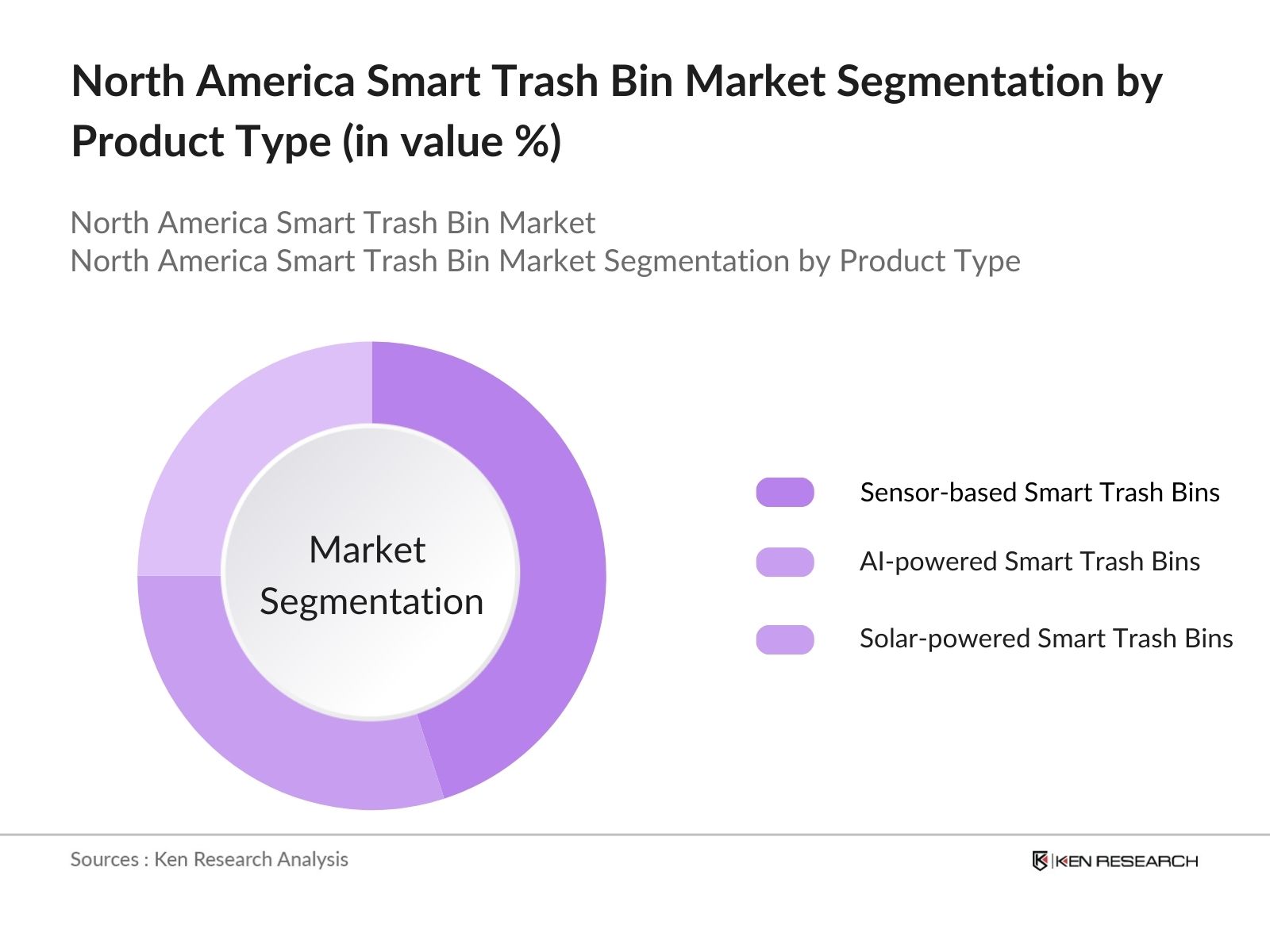
By Product Type: The market is segmented by product type into sensor-based smart trash bins, AI-powered smart trash bins, and solar-powered smart trash bins. Sensor-based smart trash bins dominate the product type segment due to their affordability and widespread adoption in residential and public areas. These bins are equipped with motion sensors that allow for contactless operation, reducing the spread of germs and improving overall hygiene.
By End-User: The market is also segmented by end-user into residential, commercial, and public infrastructure. The commercial sector holds major share of the market, largely due to the growing implementation of smart bins in shopping malls, office buildings, and restaurants. These businesses benefit from smart trash bins by reducing operational costs, as the bins notify staff when they are full, ensuring efficient waste collection without unnecessary trips.

North America Smart Trash Bin Market Competitive Landscape
The market is dominated by several key players, who drive innovation and product development. The market is characterized by both global companies and regional players, contributing to a highly competitive landscape.
|
Company Name |
Establishment Year |
Headquarters |
No. of Patents |
R&D Spending |
Product Offerings |
Key Markets |
Technology Adoption |
Revenue (USD bn) |
|
Bigbelly Solar, Inc. |
2003 |
United States |
||||||
|
Ecube Labs |
2011 |
South Korea |
||||||
|
Compology |
2013 |
United States |
||||||
|
EvoEco |
2016 |
United States |
||||||
|
SencorpWhite |
1947 |
United States |
North America Smart Trash Bin Market Analysis
Market Growth Drivers
- Increasing Adoption of Waste Management Solutions in Urban Areas: In 2024, smart trash bins are becoming integral to municipal waste management systems in large North American cities such as New York, Los Angeles, and Toronto, driven by government mandates to reduce landfill waste. By integrating IoT-enabled sensors, these bins report waste levels in real time, optimizing collection routes and reducing operational costs by over $200 million annually for large municipalities.
- Rising Environmental Awareness Leading to Higher Adoption Rates: Consumer demand for eco-friendly waste disposal solutions has spurred growth in the North American smart trash bin market. Around 65 million households in the region are prioritizing sustainable waste management solutions as environmental regulations become more stringent. Waste diversion initiatives in cities like San Francisco are expected to save over 2.5 million tons of waste from landfills annually by 2026.
- Corporate Initiatives for Sustainability Driving Market Expansion: Large corporations across North America are adopting smart trash bins as part of their corporate sustainability strategies. Companies such as Walmart and Amazon are deploying waste management technology in their distribution centers and corporate campuses, reducing waste transportation costs by $150 million in 2024 alone.
Market Challenges
- High Initial Costs of Smart Trash Bins Limiting Adoption in Small Municipalities: The high upfront cost of smart trash bins, averaging around $1,200 per unit in 2024, presents a financial barrier for smaller municipalities with limited budgets. While larger cities can justify these investments due to long-term cost savings, small towns in rural North America struggle to adopt this technology, which delays market penetration and limits overall adoption in non-urban regions.
- Technological Integration Issues with Existing Waste Management Systems: Despite advancements, many existing waste collection infrastructures across North America are not equipped to integrate with the new sensor-based smart bins. Outdated waste collection trucks and software systems result in inefficiencies, costing cities like Detroit and Philadelphia millions of dollars in reconfiguring their operations to accommodate smart waste technology. This challenge slows the adoption of these systems.
North America Smart Trash Bin Market Future Outlook
Over the next five years, the North America Smart Trash Bin industry is projected to experience robust growth driven by the increasing focus on smart city initiatives, stringent government regulations on waste management, and the rising adoption of IoT-enabled devices.
Future Market Opportunities
- Adoption of Smart Trash Bins in Suburban and Rural Areas: In the next five years, suburban and rural regions in North America will see an increased adoption of smart trash bins, supported by government subsidies. By 2028, over 20,000 smaller municipalities are expected to install these bins, improving waste management in non-urban areas and increasing market penetration.
- Sustainability-Driven Corporate Demand: Large North American corporations are projected to further drive demand for smart trash bins by 2029, as sustainability goals become more stringent. Businesses are expected to invest over $1 billion in smart waste management solutions, aiming to reduce operational waste and align with federal sustainability mandates.
Scope of the Report
|
Product Type |
Sensor-based Smart Trash Bins AI-powered Smart Trash Bins Solar-powered Smart Trash Bins |
|
End-User |
Residential Commercial Public Infrastructure |
|
Capacity |
Small (up to 10 liters) Medium (11-50 liters) Large (above 50 liters) |
|
Distribution Channel |
Online Sales Offline Sales |
|
Region |
United States Canada Mexico |
Products
Key Target Audience Organizations and Entities Who Can Benefit by Subscribing This Report:
Banks and Financial Institution
Municipal waste management departments (U.S. Environmental Protection Agency, Canadian Ministry of Environment and Climate Change)
Waste management solution providers
Private Equity Firms
Retail and hospitality businesses
Investor and venture capitalist firms
Government and regulatory bodies (Environmental Protection Agency, Canadian Waste Reduction Council)
Companies
Players Mentioned in the Report:
Bigbelly Solar, Inc.
Ecube Labs
Compology
EvoEco
SencorpWhite
Honeywell International Inc.
Nine Stars Group
Otto Environmental Systems
CleanRobotics
Simplehuman
Bin-e
iTouchless Housewares & Products, Inc.
Rubbermaid Commercial Products
Zero Waste Energy
Smartbin
Table of Contents
North America Smart Trash Bin Market Overview
1.1. Definition and Scope
1.2. Market Taxonomy
1.3. Market Growth Rate
1.4. Market Segmentation Overview
North America Smart Trash Bin Market Size (In USD Billion)
2.1. Historical Market Size
2.2. Year-On-Year Growth Analysis
2.3. Key Market Developments and Milestones
North America Smart Trash Bin Market Analysis
3.1. Growth Drivers
3.1.1. Rising adoption of IoT-enabled devices
3.1.2. Increasing demand for efficient waste management solutions
3.1.3. Growing government regulations for sustainable waste management
3.1.4. Integration with smart city initiatives
3.2. Market Challenges
3.2.1. High initial costs of smart bins
3.2.2. Limited adoption in developing regions
3.2.3. Maintenance and service requirements
3.2.4. Data privacy concerns related to smart technologies
3.3. Opportunities
3.3.1. Expansion in commercial and public spaces
3.3.2. Technological advancements in AI and automation
3.3.3. Smart waste sorting solutions
3.3.4. Growing demand from eco-conscious consumers
3.4. Trends
3.4.1. Integration with solar-powered technology
3.4.2. Increased use of AI and machine learning for waste monitoring
3.4.3. Contactless sensor-based waste management
3.4.4. Introduction of subscription-based models for smart bins
3.5. Government Regulations
3.5.1. Waste reduction and recycling policies
3.5.2. Energy-saving initiatives
3.5.3. Green technology promotion
3.5.4. Smart city programs
3.6. SWOT Analysis
3.7. Stakeholder Ecosystem
3.8. Porters Five Forces Analysis
3.9. Competition Ecosystem
North America Smart Trash Bin Market Segmentation
4.1. By Product Type (In Value %)
4.1.1. Sensor-based Smart Trash Bins
4.1.2. AI-powered Smart Trash Bins
4.1.3. Solar-powered Smart Trash Bins
4.2. By End-User (In Value %)
4.2.1. Residential
4.2.2. Commercial
4.2.3. Public Infrastructure
4.3. By Capacity (In Value %)
4.3.1. Small (up to 10 liters)
4.3.2. Medium (11-50 liters)
4.3.3. Large (above 50 liters)
4.4. By Distribution Channel (In Value %)
4.4.1. Online Sales
4.4.2. Offline Sales
4.5. By Region (In Value %)
4.5.1. United States
4.5.2. Canada
4.5.3. Mexico
North America Smart Trash Bin Market Competitive Analysis
5.1. Detailed Profiles of Major Companies
5.1.1. Ecube Labs
5.1.2. Bigbelly Solar, Inc.
5.1.3. CleanRobotics
5.1.4. Bin-e
5.1.5. Compology
5.1.6. Enevo
5.1.7. SencorpWhite
5.1.8. EvoEco
5.1.9. Nine Stars Group
5.1.10. Simplehuman
5.1.11. iTouchless Housewares & Products, Inc.
5.1.12. Honeywell International Inc.
5.1.13. Rubbermaid Commercial Products
5.1.14. Otto Environmental Systems
5.1.15. Zero Waste Energy
5.2. Cross Comparison Parameters (Market Share, Product Portfolio, Technology Adoption, Sales Channel, Distribution Network, Pricing Strategy, Product Innovation, Sustainability Initiatives)
5.3. Market Share Analysis
5.4. Strategic Initiatives
5.5. Mergers and Acquisitions
5.6. Investment Analysis
5.7. Venture Capital Funding
5.8. Government Grants
5.9. Private Equity Investments
North America Smart Trash Bin Market Regulatory Framework
6.1. Smart Waste Management Policies
6.2. Compliance Requirements for IoT Devices
6.3. Energy Efficiency Standards for Smart Devices
6.4. Environmental Impact Certifications
North America Smart Trash Bin Future Market Size (In USD Billion)
7.1. Future Market Size Projections
7.2. Key Factors Driving Future Market Growth
North America Smart Trash Bin Future Market Segmentation
8.1. By Product Type (In Value %)
8.2. By End-User (In Value %)
8.3. By Capacity (In Value %)
8.4. By Distribution Channel (In Value %)
8.5. By Region (In Value %)
North America Smart Trash Bin Market Analysts Recommendations
9.1. TAM/SAM/SOM Analysis
9.2. Customer Segmentation and Analysis
9.3. Marketing and Sales Initiatives
9.4. White Space Opportunity Identification
Research Methodology
Step 1: Identification of Key Variables
The first step in the research process involves mapping out the stakeholder ecosystem within the North America Smart Trash Bin Market. By utilizing secondary research from industry reports, government databases, and proprietary resources, we identify the key variables influencing market trends, such as waste generation rates, IoT adoption levels, and regulatory requirements.
Step 2: Market Analysis and Construction
In this phase, historical data related to the market's growth trajectory is collected and analyzed. This includes the assessment of smart bin adoption rates in key cities, the comparison of waste collection efficiencies pre- and post-smart bin implementation, and a review of market development milestones. Data from primary interviews with waste management companies is used to ensure reliability.
Step 3: Hypothesis Validation and Expert Consultation
To validate the market hypotheses, expert consultations are conducted through CATIS. These interviews with key stakeholders in the waste management industry provide operational insights and help refine the market model, particularly in terms of market growth drivers and competitive positioning.
Step 4: Research Synthesis and Final Output
In the final step, the data collected from primary and secondary research is synthesized to develop the market forecasts. This involves in-depth discussions with smart bin manufacturers to gain insights into product developments and adoption trends. The final market report includes comprehensive data validated through the bottom-up approach, ensuring an accurate representation of the market dynamics.
Frequently Asked Questions
How big is the North America Smart Trash Bin Market?
The North America Smart Trash Bin Market is valued at USD 9 billion, driven by increasing demand for efficient waste management solutions in urban areas and the adoption of smart city initiatives.
What are the challenges in the North America Smart Trash Bin Market?
Challenges in the North America Smart Trash Bin Market include high initial costs for smart bin installation, limited adoption in rural areas, and concerns around data privacy due to the integration of IoT technologies in public infrastructure.
Who are the major players in the North America Smart Trash Bin Market?
Key players in the North America Smart Trash Bin Market include Bigbelly Solar, Inc., Ecube Labs, Compology, EvoEco, and SencorpWhite, all of which are known for their technological innovations and advanced waste management solutions.
What are the growth drivers of the North America Smart Trash Bin Market?
The North America Smart Trash Bin Market is driven by the increasing focus on waste reduction and recycling, the growing adoption of IoT-enabled devices, and government regulations promoting sustainable waste management practices.
Which regions dominate the North America Smart Trash Bin Market?
The United States and Canada dominate the North America Smart Trash Bin Market due to their strong government support for waste management innovations and the presence of key players offering advanced solutions in these countries.
Why Buy From Us?

What makes us stand out is that our consultants follows Robust, Refine and Result (RRR) methodology. i.e. Robust for clear definitions, approaches and sanity checking, Refine for differentiating respondents facts and opinions and Result for presenting data with story

We have set a benchmark in the industry by offering our clients with syndicated and customized market research reports featuring coverage of entire market as well as meticulous research and analyst insights.

While we don't replace traditional research, we flip the method upside down. Our dual approach of Top Bottom & Bottom Top ensures quality deliverable by not just verifying company fundamentals but also looking at the sector and macroeconomic factors.

With one step in the future, our research team constantly tries to show you the bigger picture. We help with some of the tough questions you may encounter along the way: How is the industry positioned? Best marketing channel? KPI's of competitors? By aligning every element, we help maximize success.

Our report gives you instant access to the answers and sources that other companies might choose to hide. We elaborate each steps of research methodology we have used and showcase you the sample size to earn your trust.

If you need any support, we are here! We pride ourselves on universe strength, data quality, and quick, friendly, and professional service.