















North America SDR Market Outlook to 2030
Region:North America
Author(s):Sanjna
Product Code:KROD9999
November 2024
99
About the Report
North America Software-Defined Radio Market Overview
- The North America Software-Defined Radio (SDR) market is valued at USD 5 billion, driven by the increasing adoption of SDRs in defense, public safety, and telecommunication applications. The market benefits from technological advancements in adaptive communication protocols, rising demand for interoperability among communication devices, and the integration of 5G networks. These factors, coupled with government investments in modernizing defense infrastructure, underpin the substantial market valuation.
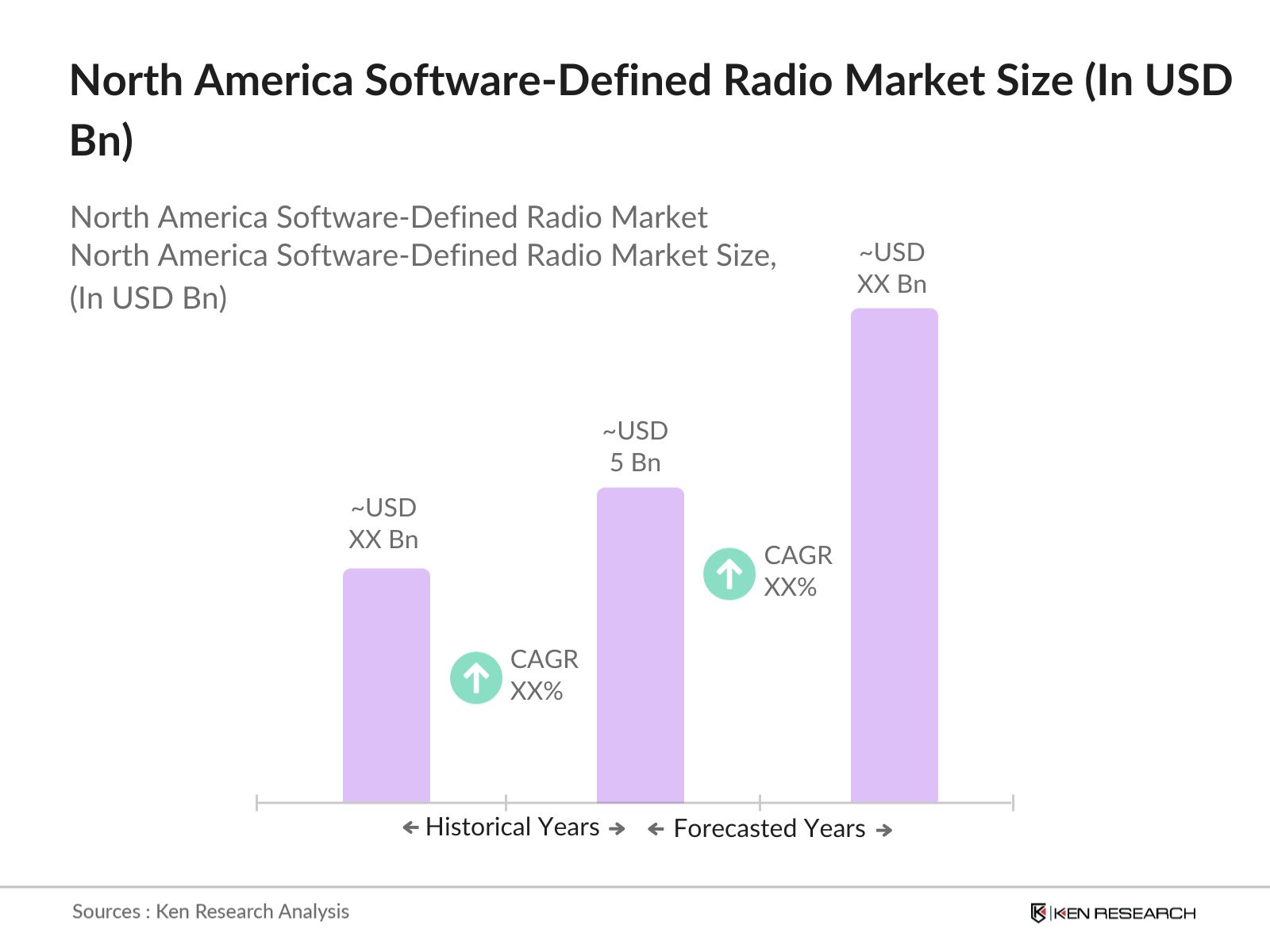
- The United States dominates the SDR market in North America, attributed to its high defense expenditure and technological leadership in communication systems. The countrys commitment to modernizing its military capabilities and advancing 5G deployment contributes significantly to its dominance. Canada follows, driven by its investments in public safety communication networks and increasing adoption of SDRs in commercial sectors.
- The FCC plays a pivotal role in regulating SDR deployments in North America, ensuring compliance with spectrum usage rules. According to the FCC, there are over 290,000 active spectrum licenses in the U.S. as of 2024, covering a wide range of frequencies critical to SDR operations. These guidelines aim to minimize interference and support seamless spectrum sharing across industries, safeguarding the efficiency and security of SDR-based communication systems.
North America Software-Defined Radio Market Segmentation
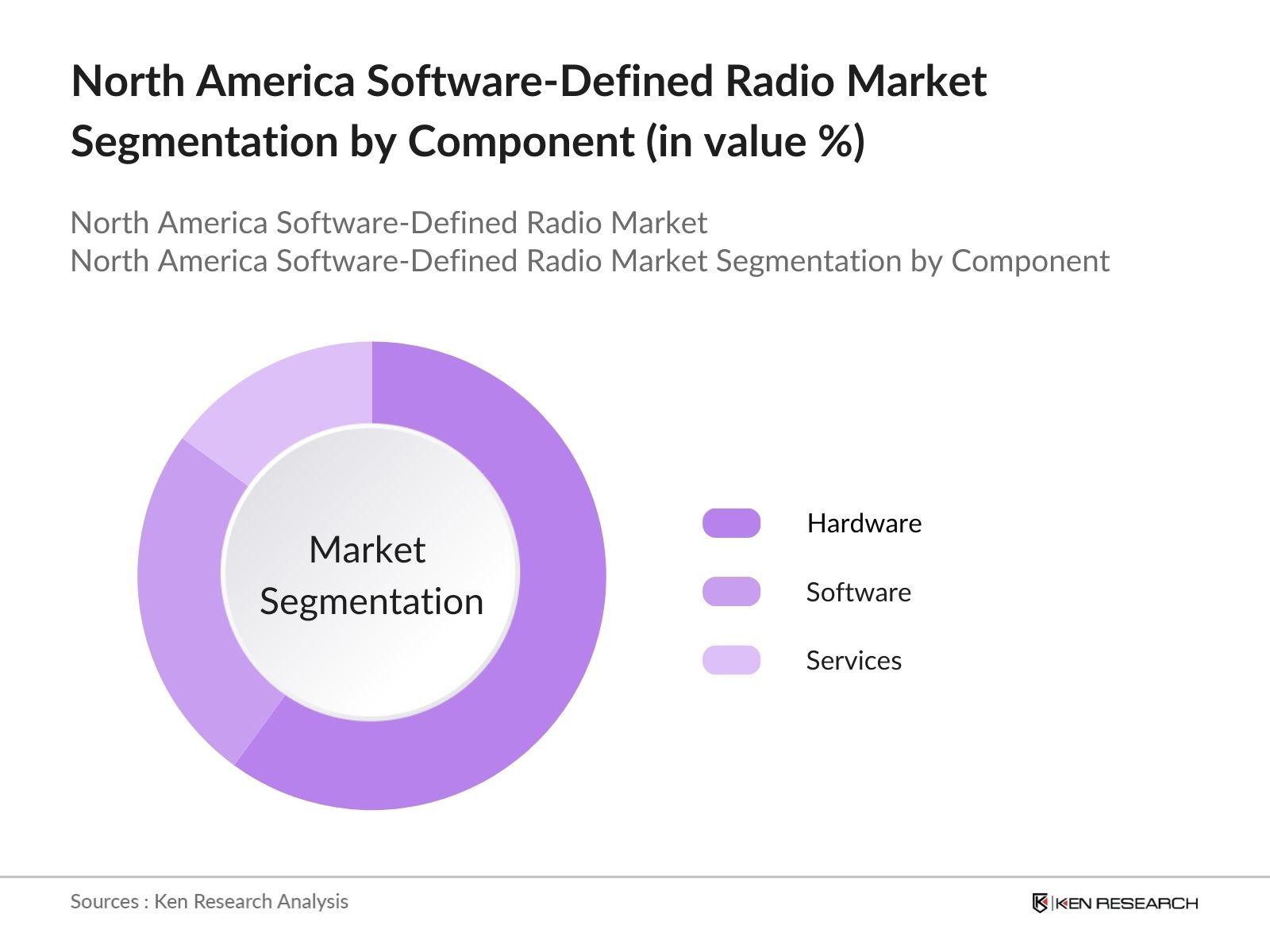
By Component: The North America SDR market is segmented by component into hardware, software, and services. Hardware dominates the market due to the critical role of SDR-enabled chips, amplifiers, and transceivers in modern communication devices. The demand for high-performance hardware to support advanced communication protocols propels this segment.
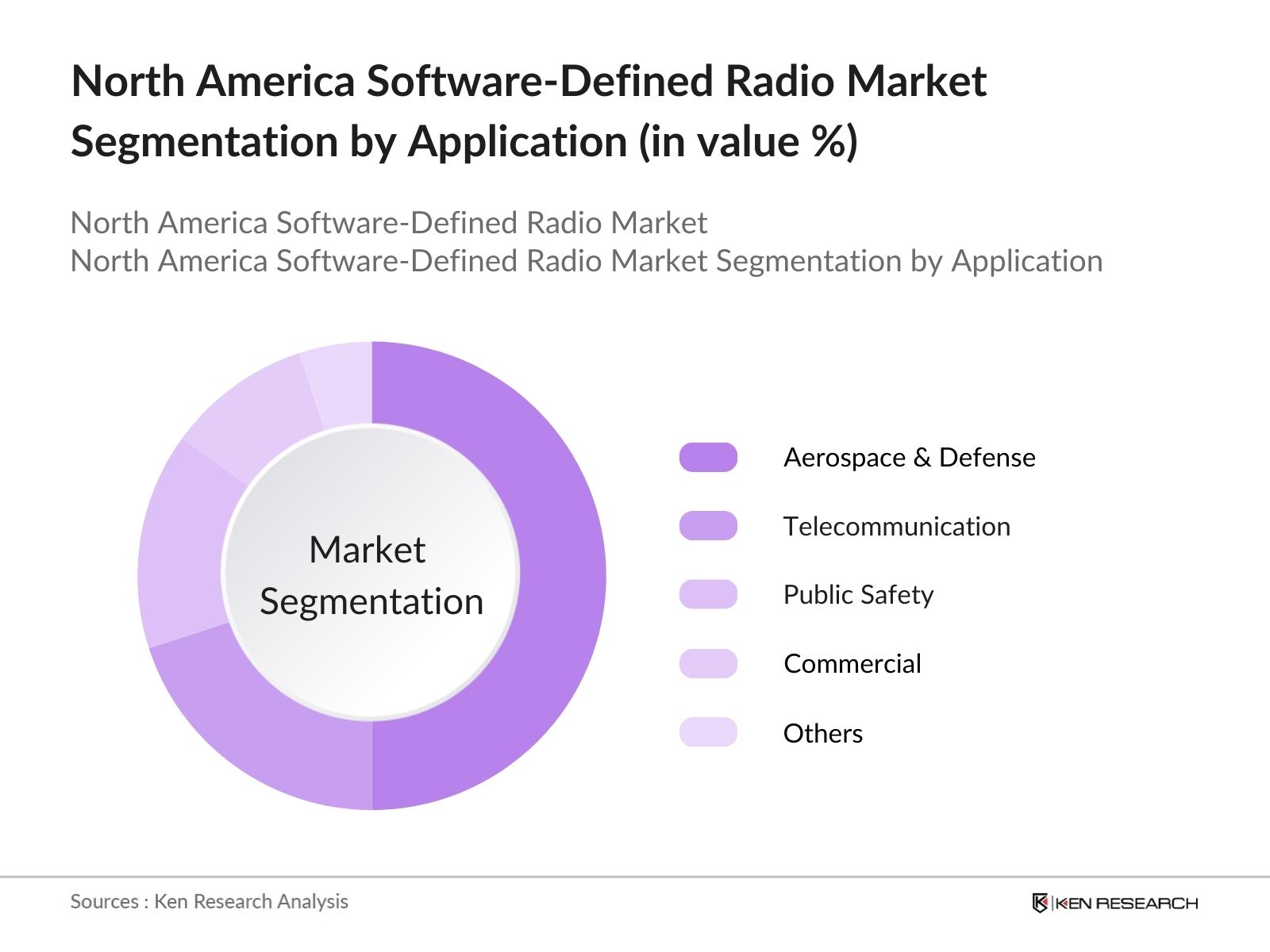
By Application: The North America SDR market is segmented by application into aerospace & defense, telecommunication, public safety, commercial, and others.
Aerospace & Defense leads the market due to extensive use in military communication and surveillance systems. SDRs enable seamless communication across multiple frequencies, critical for mission-critical operations.
North America Software-Defined Radio Market Competitive Landscape
The North America SDR market is dominated by a mix of established defense contractors and tech companies. These players focus on innovation, strategic partnerships, and investments in R&D to maintain their competitive edge. The North America SDR market is characterized by strong competition among leading players, including L3Harris Technologies, BAE Systems, and General Dynamics. The focus on interoperability, enhanced communication solutions, and strategic acquisitions shapes the competitive dynamics of the market."

North America Software-Defined Radio Market Analysis
Growth Drivers
- Technological Advancements in SDR: The North American Software Defined Radio (SDR) market is experiencing significant growth due to rapid technological advancements. The U.S. Department of Defense has invested heavily in SDR technologies to enhance communication capabilities across various platforms. For instance, the Joint Tactical Networking Center (JTNC) program provides technical support for wireless communication systems, facilitating interoperability among different military branches. This initiative underscores the commitment to advancing SDR technologies to meet evolving defense communication needs.
- Increasing Defense Expenditure: The United States has consistently increased its defense budget, allocating substantial funds toward modernizing communication systems, including SDRs. In 2023, the U.S. defense budget was approximately $858 billion, reflecting a commitment to enhancing military capabilities. A significant portion of this budget is directed toward upgrading communication infrastructure, with SDRs playing a pivotal role in ensuring secure and efficient information exchange across various defense platforms.
- Rising Demand for Advanced Communication Systems: The proliferation of advanced communication systems in North America is driving the adoption of SDRs. Industries such as telecommunications and public safety are increasingly relying on SDRs for their flexibility and adaptability. The ability of SDRs to support multiple communication standards and frequencies makes them indispensable in scenarios requiring seamless interoperability. This versatility is crucial for emergency response teams and commercial enterprises aiming to maintain robust communication networks.
Challenges
- High Development and Implementation Costs: Developing and implementing SDR technology involves significant financial investment. The complexity of designing flexible and adaptable systems requires substantial resources, which can be a barrier for smaller organizations. Additionally, the integration of SDRs into existing infrastructure may necessitate further expenditures, impacting the overall cost-effectiveness for some entities.
- Security Concerns and Vulnerabilities: The flexibility of SDRs, while advantageous, also introduces potential security vulnerabilities. The software-centric nature of SDRs makes them susceptible to cyber threats, necessitating robust security measures. Ensuring the integrity and confidentiality of communications is paramount, especially in defense and public safety applications where breaches can have severe consequences.
North America Software-Defined Radio Market Future Outlook
Over the next five years, the North America SDR market is poised to witness substantial growth, driven by advancements in artificial intelligence, increasing defense modernization programs, and the proliferation of 5G technology. Expanding use cases in public safety and commercial applications will further accelerate market development.
Market Opportunities
- Expansion into Commercial and Civil Sectors: Beyond defense, SDR technology presents significant opportunities in commercial and civil sectors. Industries such as telecommunications, broadcasting, and transportation can benefit from the adaptability of SDRs. For example, SDRs can facilitate seamless communication in smart transportation systems, enhancing efficiency and safety. The commercial adoption of SDRs is poised to drive innovation and improve communication infrastructures across various sectors.
- Development of Cognitive Radio Technologies: The evolution of cognitive radio technologies, which enable dynamic spectrum access and intelligent communication, offers promising prospects for the SDR market. These technologies allow SDRs to automatically detect available channels and adjust parameters to optimize performance. The development and integration of cognitive capabilities can enhance the efficiency and reliability of communication systems, addressing challenges related to spectrum scarcity and interference.
Scope of the Report
|
Segment |
Sub-segments |
|
By Component |
- Hardware |
|
By Application |
- Aerospace & Defense |
|
By Service Vertical |
- Joint Tactical Radio System |
|
By Frequency Band |
- HF Band |
|
By Country |
- United States |
Products
Key Target Audience
Defense Organizations (e.g., Department of Defense, Canadian Armed Forces)
Public Safety Agencies (e.g., Federal Emergency Management Agency)
Telecommunication Companies
Aerospace and Defense Manufacturers
System Integrators
SDR Component Manufacturers
Investors and Venture Capitalist Firms
Government and Regulatory Bodies (e.g., Federal Communications Commission, Canadian Radio-television and Telecommunications Commission)
Companies
Players Mentioned in the Report
L3Harris Technologies
BAE Systems
General Dynamics
Thales Group
Analog Devices
National Instruments Corporation
Leonardo SpA
Huawei Technologies Co., Ltd.
United Technologies Corporation
Elbit Systems Ltd.
Table of Contents
1. North America Software Defined Radio Market Overview
1.1 Definition and Scope
1.2 Market Taxonomy
1.3 Market Growth Rate
1.4 Market Segmentation Overview
2. North America Software Defined Radio Market Size (In USD Million)
2.1 Historical Market Size
2.2 Year-On-Year Growth Analysis
2.3 Key Market Developments and Milestones
3. North America Software Defined Radio Market Analysis
3.1 Growth Drivers
3.1.1 Technological Advancements in SDR
3.1.2 Increasing Defense Expenditure
3.1.3 Rising Demand for Advanced Communication Systems
3.1.4 Integration with 5G Networks
3.2 Market Challenges
3.2.1 High Development and Implementation Costs
3.2.2 Security Concerns and Vulnerabilities
3.2.3 Regulatory and Spectrum Allocation Issues
3.3 Opportunities
3.3.1 Expansion into Commercial and Civil Sectors
3.3.2 Development of Cognitive Radio Technologies
3.3.3 Collaborations and Partnerships
3.4 Trends
3.4.1 Adoption of AI and Machine Learning in SDR
3.4.2 Miniaturization and Portability
3.4.3 Software-Defined Networking Integration
3.5 Government Regulations
3.5.1 Federal Communications Commission (FCC) Guidelines
3.5.2 Defense Information Systems Agency (DISA) Standards
3.5.3 National Institute of Standards and Technology (NIST) Compliance
3.5.4 Export Control Regulations
3.6 SWOT Analysis
3.7 Stakeholder Ecosystem
3.8 Porter's Five Forces Analysis
3.9 Competitive Landscape
4. North America Software Defined Radio Market Segmentation
4.1 By Component (In Value %)
4.1.1 Hardware
4.1.2 Software
4.1.3 Services
4.2 By Application (In Value %)
4.2.1 Aerospace & Defense
4.2.2 Telecommunication
4.2.3 Public Safety
4.2.4 Commercial
4.2.5 Others
4.3 By Service Vertical (In Value %)
4.3.1 Joint Tactical Radio System
4.3.2 Cognitive Radio
4.3.3 General Purpose Radio
4.3.4 Others
4.4 By Frequency Band (In Value %)
4.4.1 HF Band
4.4.2 VHF Band
4.4.3 UHF Band
4.4.4 Others
4.5 By Country (In Value %)
4.5.1 United States
4.5.2 Canada
4.5.3 Mexico
4.5.4 Rest of North America
5. North America Software Defined Radio Market Competitive Analysis
5.1 Detailed Profiles of Major Companies
5.1.1 Analog Devices, Inc.
5.1.2 Huawei Technologies Co., Ltd.
5.1.3 L3Harris Technologies, Inc.
5.1.4 Elbit Systems Ltd.
5.1.5 BAE Systems PLC
5.1.6 United Technologies Corporation (Rockwell Collins, Inc.)
5.1.7 Thales Group S.A.
5.1.8 Leonardo SpA
5.1.9 National Instruments Corporation
5.1.10 General Dynamics Corporation
5.2 Cross Comparison Parameters (Number of Employees, Headquarters, Inception Year, Revenue, Market Share, Product Portfolio, R&D Investment, Regional Presence)
5.3 Market Share Analysis
5.4 Strategic Initiatives
5.5 Mergers and Acquisitions
5.6 Investment Analysis
5.7 Venture Capital Funding
5.8 Government Grants
5.9 Private Equity Investments
6. North America Software Defined Radio Market Regulatory Framework
6.1 Communication Standards
6.2 Compliance Requirements
6.3 Certification Processes
7. North America Software Defined Radio Future Market Size (In USD Million)
7.1 Future Market Size Projections
7.2 Key Factors Driving Future Market Growth
8. North America Software Defined Radio Future Market Segmentation
8.1 By Component (In Value %)
8.2 By Application (In Value %)
8.3 By Service Vertical (In Value %)
8.4 By Frequency Band (In Value %)
8.5 By Country (In Value %)
9. North America Software Defined Radio Market Analysts Recommendations
9.1 Total Addressable Market (TAM), Serviceable Available Market (SAM), Serviceable Obtainable Market (SOM) Analysis
9.2 Customer Cohort Analysis
9.3 Marketing Initiatives
9.4 White Space Opportunity Analysis
Research Methodology
Step 1: Identification of Key Variables
The research begins by mapping the key stakeholders in the North America SDR market, supported by comprehensive desk research. Proprietary databases and secondary sources are used to identify critical variables driving the market.
Step 2: Market Analysis and Construction
This phase includes historical data collection and segmentation analysis to construct a detailed market overview. A bottom-up approach ensures accuracy in estimating market size and penetration rates.
Step 3: Hypothesis Validation and Expert Consultation
Market hypotheses are validated through structured interviews with industry experts, providing firsthand insights into operational trends and market dynamics.
Step 4: Research Synthesis and Final Output
Insights from stakeholders are synthesized into a comprehensive report, supported by data triangulation to ensure reliability and consistency.
Frequently Asked Questions
01. How big is the North America SDR Market?
The North America SDR market is valued at USD 5 billion, driven by advancements in 5G infrastructure, defense communication systems, and public safety networks.
02. What are the challenges in the North America SDR Market?
Challenges in North America SDR market include high development costs, security vulnerabilities, and regulatory constraints related to spectrum allocation.
03. Who are the major players in the North America SDR Market?
Major players in North America SDR market include L3Harris Technologies, BAE Systems, General Dynamics, Thales Group, and Analog Devices, known for their innovative solutions and strategic investments.
04. What drives the growth of the North America SDR Market?
Key growth drivers in North America SDR market are the modernization of defense infrastructure, integration of AI in SDR systems, and increasing demand for interoperable communication networks.
Why Buy From Us?

What makes us stand out is that our consultants follows Robust, Refine and Result (RRR) methodology. i.e. Robust for clear definitions, approaches and sanity checking, Refine for differentiating respondents facts and opinions and Result for presenting data with story

We have set a benchmark in the industry by offering our clients with syndicated and customized market research reports featuring coverage of entire market as well as meticulous research and analyst insights.

While we don't replace traditional research, we flip the method upside down. Our dual approach of Top Bottom & Bottom Top ensures quality deliverable by not just verifying company fundamentals but also looking at the sector and macroeconomic factors.

With one step in the future, our research team constantly tries to show you the bigger picture. We help with some of the tough questions you may encounter along the way: How is the industry positioned? Best marketing channel? KPI's of competitors? By aligning every element, we help maximize success.

Our report gives you instant access to the answers and sources that other companies might choose to hide. We elaborate each steps of research methodology we have used and showcase you the sample size to earn your trust.

If you need any support, we are here! We pride ourselves on universe strength, data quality, and quick, friendly, and professional service.