
North America Tablet Market Outlook to 2030
Region:Mexico
Author(s):Paribhasha Tiwari
Product Code:KROD7659
Region:Mexico
Author(s):Paribhasha Tiwari
Product Code:KROD7659
December 2024
97


The North America Tablet market is dominated by a few key players, including global giants like Apple, Samsung, and Microsoft. These companies have consistently maintained their market positions through continuous innovation and a strong focus on customer experience. Local players also contribute to the market by offering specialized tablet solutions in specific sectors such as education and healthcare. The competition is characterized by the development of advanced features, superior user interfaces, and cutting-edge hardware integration.
|
Company Name |
Establishment Year |
Headquarters |
Operating System |
Battery Life |
Display Technology |
Processing Power |
Weight |
Enterprise Solutions |
Consumer Focus |
|---|---|---|---|---|---|---|---|---|---|
|
Apple Inc. |
1976 |
Cupertino, USA |
- | - | - | - | - | - | - |
|
Samsung Electronics |
1969 |
Suwon, South Korea |
- | - | - | - | - | - | - |
|
Microsoft Corporation |
1975 |
Redmond, USA |
- | - | - | - | - | - | - |
|
Lenovo Group Ltd. |
1984 |
Beijing, China |
- | - | - | - | - | - | - |
|
Amazon.com Inc. |
1994 |
Seattle, USA |
- | - | - | - | - | - | - |
Over the next five years, the North America Tablet market is expected to witness moderate growth, driven by increased adoption of tablets in enterprise solutions and educational institutions. The push for remote learning and hybrid work models is likely to sustain demand for tablets in both personal and professional settings. Additionally, advancements in 5G technology and artificial intelligence will further enhance the functionality of these devices, opening new opportunities for use in various sectors like healthcare, logistics, and creative industries.
|
By Product Type |
Consumer Tablets Enterprise Tablets Educational Tablets Rugged Tablets |
|
By Connectivity Type |
Wi-Fi Only Wi-Fi + Cellular 5G Tablets |
|
By Operating System |
Android iOS Windows Linux-based systems |
|
By Screen Size |
Below 7 inches 79 inches 10 inches and above |
|
By End User |
Individual Consumers Enterprises Educational Institutions Government Public Sector |
1.1. Definition and Scope
1.2. Market Taxonomy
1.3. Market Growth Rate
1.4. Market Segmentation Overview
2.1. Historical Market Size
2.2. Year-on-Year Growth Analysis
2.3. Key Market Developments and Milestones
3.1. Growth Drivers (Technological advancements, mobile penetration, digital transformation)
3.1.1. Increasing adoption of remote work
3.1.2. Rising demand for portable computing devices
3.1.3. Integration of tablets in educational systems
3.1.4. Expansion of cloud services supporting tablets
3.2. Market Challenges (Component shortages, competitive pricing, regulatory compliance)
3.2.1. Supply chain disruptions affecting component availability
3.2.2. Intense competition from smartphones and laptops
3.2.3. Limited innovation in tablet hardware
3.2.4. Regulatory standards for electronics manufacturing
3.3. Opportunities (Expansion in healthcare, vertical-specific solutions, AI integration)
3.3.1. Use of tablets in telemedicine and healthcare management
3.3.2. Increased demand for rugged tablets in industrial applications
3.3.3. Tablet solutions for creative professionals and digital artists
3.3.4. Integration of AI for personalized tablet experiences
3.4. Trends (Hybrid work models, 5G integration, eco-friendly materials)
3.4.1. Rise in hybrid work boosting tablet usage
3.4.2. Adoption of 5G-enabled tablets
3.4.3. Sustainable tablet manufacturing and eco-friendly materials
3.4.4. Growth in tablet gaming and entertainment applications
3.5. Government Regulation (Import duties, data privacy regulations, electronic waste management)
3.5.1. Impact of US-China trade tariffs on tablet pricing
3.5.2. Data privacy and security standards for mobile devices
3.5.3. Regulations around electronic waste recycling
3.5.4. Compliance with digital accessibility standards
3.6. SWOT Analysis
3.7. Stakeholder Ecosystem
3.8. Porters Five Forces
3.9. Competition Ecosystem
4.1. By Product Type (In Value %)
4.1.1. Consumer Tablets
4.1.2. Enterprise Tablets
4.1.3. Educational Tablets
4.1.4. Rugged Tablets
4.2. By Operating System (In Value %)
4.2.1. Android
4.2.2. iOS
4.2.3. Windows
4.2.4. Linux-based systems
4.3. By Screen Size (In Value %)
4.3.1. Below 7 inches
4.3.2. 79 inches
4.3.3. 10 inches and above
4.4. By Connectivity Type (In Value %)
4.4.1. Wi-Fi Only
4.4.2. Wi-Fi + Cellular
4.4.3. 5G Tablets
4.5. By End User (In Value %)
4.5.1. Individual Consumers
4.5.2. Enterprises
4.5.3. Educational Institutions
4.5.4. Government and Public Sector
5.1 Detailed Profiles of Major Companies
5.1.1. Apple Inc.
5.1.2. Samsung Electronics Co. Ltd.
5.1.3. Microsoft Corporation
5.1.4. Lenovo Group Ltd.
5.1.5. Amazon.com Inc.
5.1.6. Dell Technologies Inc.
5.1.7. HP Inc.
5.1.8. Huawei Technologies Co. Ltd.
5.1.9. ASUS Tek Computer Inc.
5.1.10. Acer Inc.
5.1.11. Xiaomi Corporation
5.1.12. Panasonic Corporation
5.1.13. LG Electronics Inc.
5.1.14. Sony Corporation
5.1.15. Zebra Technologies Corp.
5.2 Cross Comparison Parameters (Operating System, Battery Life, Display Technology, Processing Power, Weight, Durability, Enterprise Solutions, Consumer Focus)
5.3. Market Share Analysis
5.4. Strategic Initiatives
5.5. Mergers and Acquisitions
5.6. Investment Analysis
5.7. Venture Capital Funding
5.8. Government Grants
5.9. Private Equity Investments
6.1. Environmental Standards
6.2. Compliance Requirements
6.3. Certification Processes
7.1. Future Market Size Projections
7.2. Key Factors Driving Future Market Growth
8.1. By Product Type (In Value %)
8.2. By Operating System (In Value %)
8.3. By Screen Size (In Value %)
8.4. By Connectivity Type (In Value %)
8.5. By End User (In Value %)
9.1. TAM/SAM/SOM Analysis
9.2. Customer Cohort Analysis
9.3. Marketing Initiatives
9.4. White Space Opportunity Analysis
Disclaimer Contact UsThis step involved identifying the major stakeholders within the North America Tablet market, including manufacturers, enterprise clients, and educational users. The variables influencing market trends, such as hardware upgrades, software integration, and digital transformations, were analyzed.
In this phase, a comprehensive analysis of the historical market data was conducted, examining key trends in product innovation, tablet sales, and consumer demand. Market penetration rates were calculated based on device sales and application usage.
Market assumptions were validated by consulting industry experts and key opinion leaders. These interviews provided insights into consumer behavior and the strategic direction of major tablet manufacturers.
Finally, data from manufacturers, consumer reports, and industry databases were synthesized to form a coherent analysis of the tablet market. The final report includes both qualitative and quantitative data on market size, segmentation, and competitive landscape.
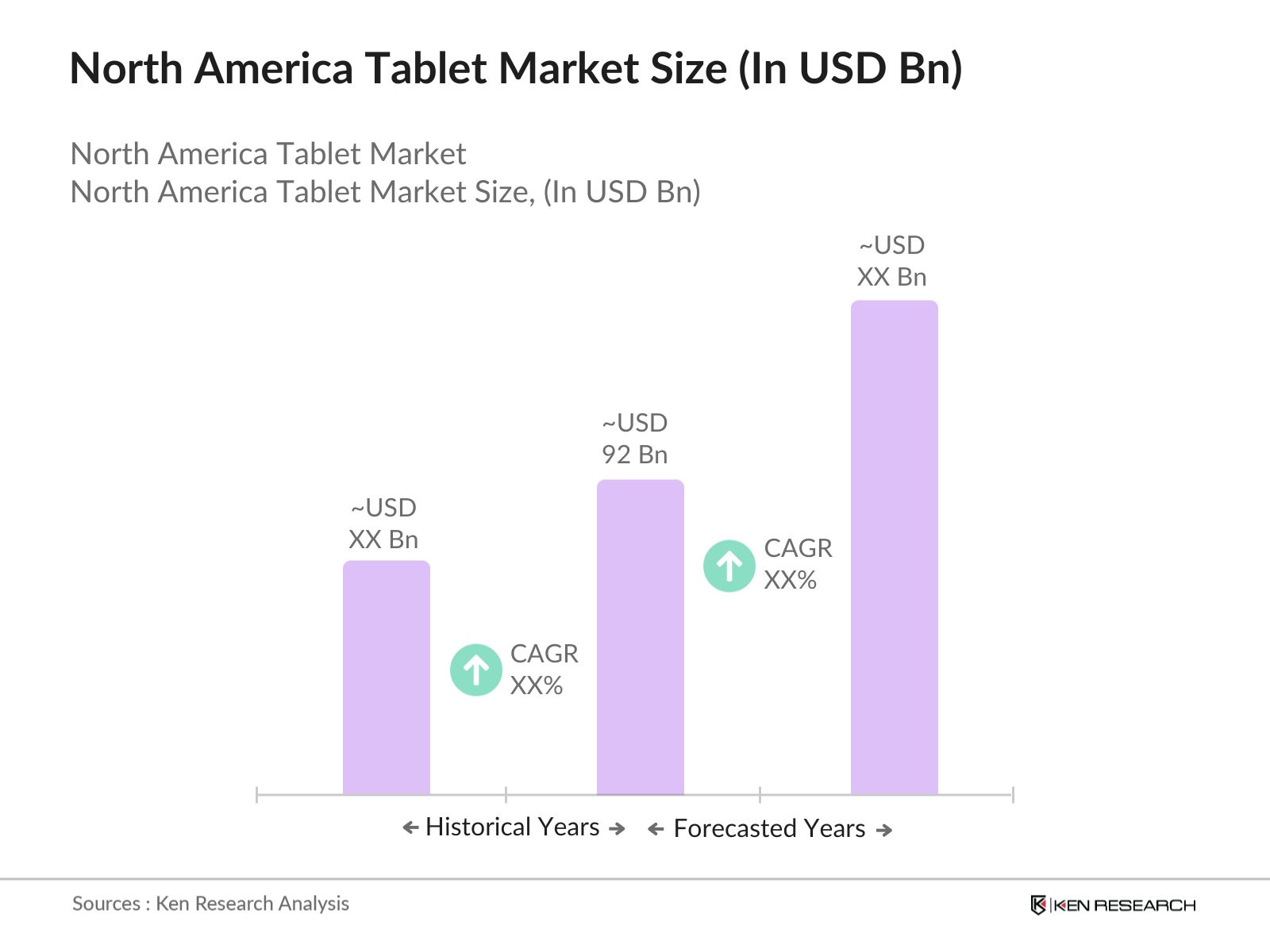
The North America Tablet Market is valued at USD 92 billion, driven by factors such as increased demand for remote work solutions, educational adoption, and advancements in portable technology.
Challenges in the North America Tablet Market include intense competition from smartphones and laptops, component shortages due to supply chain disruptions, and the regulatory hurdles surrounding electronic waste and recycling.
Key players in the North America Tablet Market include Apple Inc., Samsung Electronics Co. Ltd., Microsoft Corporation, Lenovo Group Ltd., and Amazon.com Inc., dominating due to their strong brand presence, innovative features, and extensive distribution networks.
The North America Tablet market is driven by the increased use of tablets in remote work, education, and healthcare, along with the advancements in 5G connectivity and integration with cloud services.

What makes us stand out is that our consultants follows Robust, Refine and Result (RRR) methodology. i.e. Robust for clear definitions, approaches and sanity checking, Refine for differentiating respondents facts and opinions and Result for presenting data with story

We have set a benchmark in the industry by offering our clients with syndicated and customized market research reports featuring coverage of entire market as well as meticulous research and analyst insights.

While we don't replace traditional research, we flip the method upside down. Our dual approach of Top Bottom & Bottom Top ensures quality deliverable by not just verifying company fundamentals but also looking at the sector and macroeconomic factors.

With one step in the future, our research team constantly tries to show you the bigger picture. We help with some of the tough questions you may encounter along the way: How is the industry positioned? Best marketing channel? KPI's of competitors? By aligning every element, we help maximize success.

Our report gives you instant access to the answers and sources that other companies might choose to hide. We elaborate each steps of research methodology we have used and showcase you the sample size to earn your trust.

If you need any support, we are here! We pride ourselves on universe strength, data quality, and quick, friendly, and professional service.