
North America Virtual Reality Headsets Market Outlook 2030
Region:North America
Author(s):Shivani Mehra
Product Code:KROD11435
November 2024
90
About the Report
North America Virtual Reality Headsets Market Overview
- The North American Virtual Reality (VR) Headsets market is currently valued at USD 5.04 billion, driven by strong consumer demand in sectors such as gaming, healthcare, and retail. With VR technology gaining traction, particularly among Gen Z and Millennials, the immersive experience offered by VR headsets has spurred growth in entertainment applications. Healthcare and training segments are also incorporating VR to enhance simulation-based learning, contributing significantly to the market's expansion. This data is grounded in recent industry analysis reports and consumer surveys.

- The United States and Canada dominate this market due to their advanced technological infrastructure and the presence of a tech-savvy population eager to adopt cutting-edge technology. The concentration of VR developers and gaming studios, along with high disposable incomes in these regions, further supports the dominance of these countries in VR headset adoption. Furthermore, substantial investments in the tech ecosystem bolster North Americas leading position in VR innovation.
- The U.S. governments Technology Modernization Fund (TMF) allocated over $1 billion in 2023 to advance technological integration, including VR, in public services. This fund is actively used to enhance sectors like healthcare, defense, and education, where VR applications improve training efficiency and patient outcomes. The Department of Health and Human Services, for example, received substantial TMF backing to implement VR training programs in over 50 hospitals nationwide.
North America Virtual Reality Headsets Market Segmentation
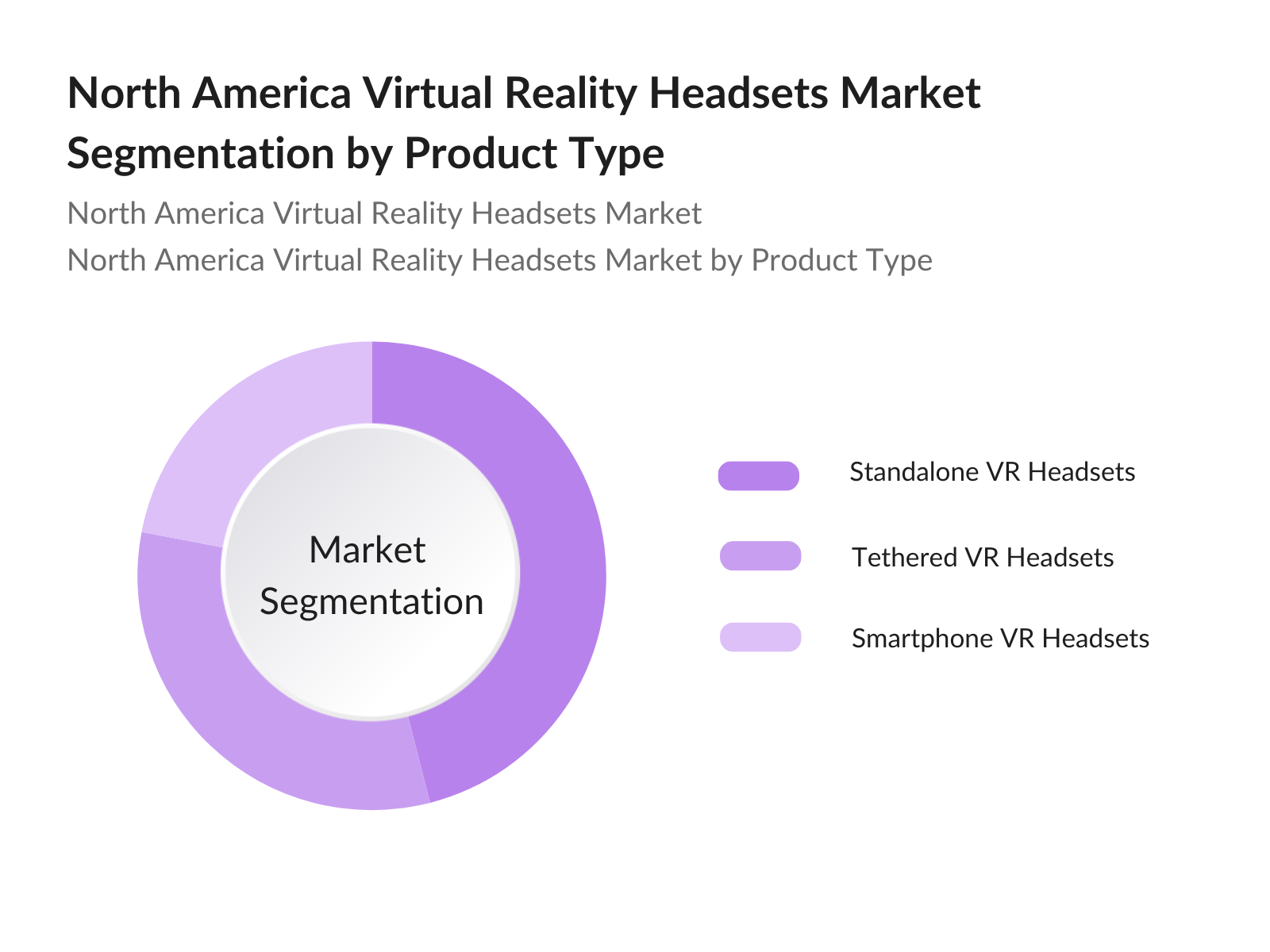
- By Product Type: The North America VR Headsets market is segmented by product type into Tethered VR Headsets, Standalone VR Headsets, and Smartphone VR Headsets. Currently, Standalone VR Headsets have a dominant market share within this segmentation. This dominance is attributed to the portability and convenience they offer, as these headsets do not require external hardware, such as a computer or smartphone, to operate. Major brands such as Oculus (Meta) and HTC offer standalone models with high resolution and reduced latency, making them popular for both consumers and enterprises seeking flexibility and ease of use.
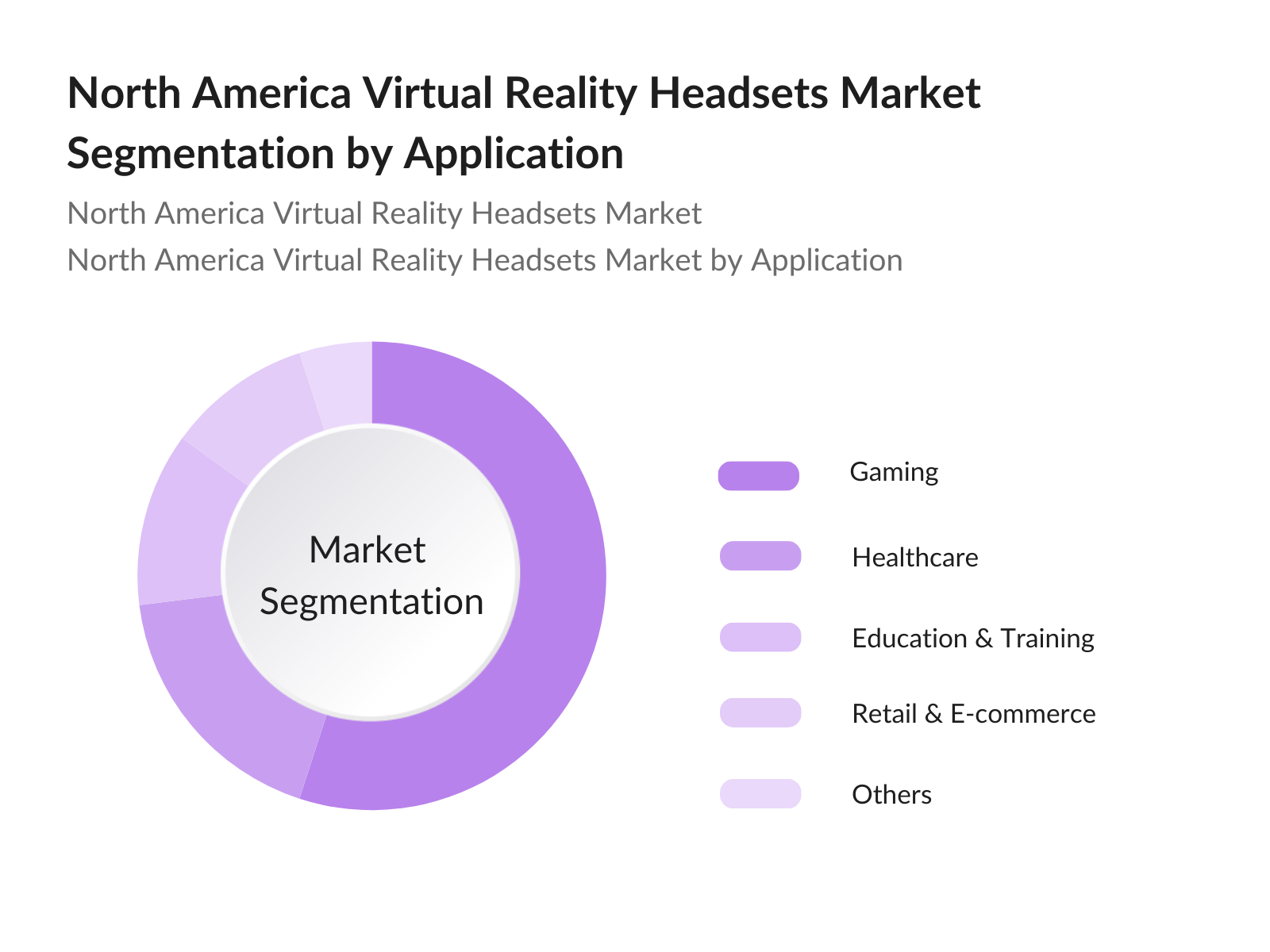
- By Application: The North America VR Headsets market is further segmented by application into Gaming, Healthcare, Education & Training, Retail & E-commerce, and Others (Military, Real Estate). The Gaming segment currently holds the largest market share, primarily due to the widespread popularity of VR gaming experiences, which have transformed traditional gaming by providing immersive worlds and enhanced player interactivity. Leading gaming companies are continuously developing VR-compatible games and content, attracting a large customer base for VR gaming devices in North America.
 North America Virtual Reality Headsets Market Competitive Landscape
The North America VR Headsets market is dominated by a few prominent players, who leverage strong brand recognition, technical innovation, and extensive distribution networks to maintain their market positions. Key players include Sony, Oculus, HTC, Samsung, and Microsoft. This consolidation indicates significant influence exerted by these companies, each investing heavily in research and development to stay ahead in technology and user experience advancements.
|
Company |
Establishment Year |
Headquarters |
Market Specialization |
R&D Investment |
Innovation Index |
Key Product Portfolio |
Strategic Partnerships |
Regional Presence |
|
Sony Corporation |
1946 |
Tokyo, Japan |
||||||
|
Oculus (Meta) |
2012 |
Menlo Park, USA |
||||||
|
HTC Corporation |
1997 |
Taipei, Taiwan |
||||||
|
Samsung |
1938 |
Seoul, South Korea |
||||||
|
Microsoft |
1975 |
Redmond, USA |
North America Virtual Reality Headsets Industry Analysis
Market Growth Drivers
- Increasing Demand for Immersive Entertainment Experiences (Consumer Preferences): The North American entertainment sector has seen a substantial rise in VR adoption, with nearly 10 million active users in the U.S. utilizing VR platforms for gaming, films, and interactive content as of 2024. The entertainment industry's revenue in the U.S. alone has surpassed $750 billion, reflecting the increased spending on immersive experiences. This trend is underpinned by consumer preferences shifting towards high-engagement platforms, with surveys from the U.S. Bureau of Economic Analysis showing of surveyed users expressing strong interest in enhanced reality experiences.
- Advancements in Hardware and Software (Technological Progress): Technological progress in VR hardware has enabled lighter, wireless, and more powerful headsets, making them more user-friendly. The U.S. technology sector invested $15 billion in VR research and development in 2023, resulting in a reduction in headset weight over previous generations. Software improvements include enhanced motion tracking and spatial audio, supported by hardware like Qualcomms XR platforms, which boost processing speeds for seamless VR experiences. These advancements cater to consumer demands for more immersive, lower-latency interactions.
- Expansion of Applications in Healthcare and Education (End-Use Innovation): The application of VR in healthcare for surgical training and mental health therapy has grown, with U.S. medical institutions allocating $3 billion for VR-based programs in 2023, marking a 15% increase in adoption rates across hospitals and clinics. Similarly, educational institutions have integrated VR for interactive learning, especially in STEM fields, with over 5,000 North American schools incorporating VR modules to aid in science education.
Market Challenges:
- High Initial Cost of VR Headsets (Cost Barrier): Despite increased consumer interest, the high cost of VR headsets remains a significant barrier to widespread adoption. In North America, the average price of advanced VR headsets remains above $600, a substantial expense for individual consumers and smaller enterprises. This limits accessibility, particularly in the education sector of public schools report the budget to incorporate such technology into curricula.
- Limited Content Availability (Content Ecosystem): The VR content ecosystem in North America remains underdeveloped, with only a fraction of major production studios regularly releasing VR-compatible media. A survey by the U.S. Bureau of Economic Analysis reveals that of video game developers are actively producing VR content due to the high production costs and specialized equipment required. Additionally, training and educational institutions highlight a lack of curriculum-aligned VR materials, constraining broader VR integration across industries.
North America Virtual Reality Headsets Market Future Outlook
Over the next five years, the North America VR Headsets market is expected to see substantial growth driven by technological advancements, the rising integration of VR in healthcare, education, and retail sectors, and the deployment of 5G connectivity. Increasing interest in virtual social platforms and virtual workplace solutions are also anticipated to provide significant opportunities for VR headset adoption. With ongoing investment in immersive content and hardware, the market outlook is positive for both consumer and enterprise applications.
Market Opportunities:
- Integration with AR Technologies (Augmented Reality Synergies): The integration of Augmented Reality (AR) with VR opens significant growth avenues, particularly in retail and tourism. In 2023, the U.S. retail sector allocated over $2.5 billion to AR-VR technologies to create immersive shopping experiences, such as virtual fitting rooms and interactive product showcases. This hybrid approach caters to the increasing demand for personalized shopping of surveyed U.S. consumers expressing interest in AR-enhanced VR shopping platforms. By blending AR with VR, companies can enhance the user experience and create diversified applications beyond entertainment.
- Expanding Use in Military and Simulation Training (Sector Expansion): VR technology in military and simulation training has gained momentum, with the U.S. Department of Defense investing approximately $1.1 billion in 2023 to enhance training programs with VR for better operational readiness. VR simulations allow for realistic, risk-free training scenarios in controlled environments, addressing limitations of traditional training methods. The increased adoption across various training academies reflects VR's effectiveness in boosting trainee retention and performance, with studies showing that soldiers trained with VR simulations demonstrate faster response times.
Scope of the Report
|
By Product Type |
Tethered VR Headsets Standalone VR Headsets Smartphone VR Headsets |
|
By Application |
Gaming, Healthcare Education & Training Retail & E-commerce Others (Military, Real Estate) |
|
By Technology |
Augmented Virtuality Fully Immersive VR Semi-Immersive VR |
|
By Distribution Channel |
Online Retailers Offline Retailers Specialty Stores |
|
By Region |
North-East Midwest West Coast Southern States |
Products
Key Target Audience
Virtual Reality Hardware Manufacturers
Healthcare Institutions (Medical Research Facilities)
Gaming and Entertainment Companies
Educational Institutions and Training Centers
Retailers and E-commerce Platforms
Investments and Venture Capitalist Firms
Government and Regulatory Bodies (U.S. Federal Trade Commission, Canadian Radio-television and Telecommunications Commission)
Telecommunication Companies (5G Network Providers)
Companies
Players mentioned in the market
Sony Corporation
Oculus (Meta Platforms, Inc.)
HTC Corporation
Samsung Electronics Co., Ltd.
Microsoft Corporation
Lenovo Group Ltd.
Google LLC
Pimax Technology (Shanghai) Co., Ltd.
Vuzix Corporation
Varjo Technologies Oy
Magic Leap, Inc.
Panasonic Corporation
Qualcomm Technologies, Inc.
HP Development Company, L.P.
ANTVR Technology Co., Ltd.
Table of Contents
1. North America Virtual Reality Headsets Market Overview
1.1 Definition and Scope
1.2 Market Taxonomy
1.3 Market Growth Rate
1.4 Market Segmentation Overview
2. North America Virtual Reality Headsets Market Size (In USD Bn)
2.1 Historical Market Size
2.2 Year-on-Year Growth Analysis
2.3 Key Market Developments and Milestones
3. North America Virtual Reality Headsets Market Analysis
3.1 Growth Drivers
3.1.1 Increasing Demand for Immersive Entertainment Experiences (Consumer Preferences)
3.1.2 Advancements in Hardware and Software (Technological Progress)
3.1.3 Expansion of Applications in Healthcare and Education (End-Use Innovation)
3.1.4 Supportive Government Initiatives for Tech Adoption (Policy Support)
3.2 Market Challenges
3.2.1 High Initial Cost of VR Headsets (Cost Barrier)
3.2.2 Limited Content Availability (Content Ecosystem)
3.2.3 Health Concerns Related to Extended Use (User Safety)
3.2.4 Technical Issues such as Latency (Technology Constraints)
3.3 Opportunities
3.3.1 Integration with AR Technologies (Augmented Reality Synergies)
3.3.2 Expanding Use in Military and Simulation Training (Sector Expansion)
3.3.3 Rise of 5G Connectivity (Connectivity Enhancement)
3.4 Trends
3.4.1 Adoption of Lightweight and Wireless VR Headsets (Design Evolution)
3.4.2 Growth of VR in Social Networking and Gaming (Social Integration)
3.4.3 Increased Use of VR in Remote Working Environments (Remote Collaboration)
3.5 Regulatory Landscape
3.5.1 Standards for Virtual Reality Hardware (Safety Compliance)
3.5.2 Intellectual Property Rights for Content (IP Regulations)
3.5.3 Data Privacy and Security Regulations (User Data Protection)
3.6 SWOT Analysis
3.7 Stakeholder Ecosystem
3.8 Porters Five Forces Analysis
3.9 Competition Ecosystem
4. North America Virtual Reality Headsets Market Segmentation
4.1 By Product Type (In Value %)
4.1.1 Tethered VR Headsets
4.1.2 Standalone VR Headsets
4.1.3 Smartphone VR Headsets
4.2 By Application (In Value %)
4.2.1 Gaming
4.2.2 Healthcare
4.2.3 Education & Training
4.2.4 Retail & E-commerce
4.2.5 Others (Military, Real Estate)
4.3 By Technology (In Value %)
4.3.1 Augmented Virtuality
4.3.2 Fully Immersive VR
4.3.3 Semi-Immersive VR
4.4 By Distribution Channel (In Value %)
4.4.1 Online Retailers
4.4.2 Offline Retailers
4.4.3 Specialty Stores
4.5 By End-User (In Value %)
4.5.1 Individual Consumers
4.5.2 Enterprises
4.5.3 Academic Institutions
5. North America Virtual Reality Headsets Market Competitive Analysis
5.1 Profiles of Major Companies
5.1.1 Sony Corporation
5.1.2 Oculus (Meta Platforms, Inc.)
5.1.3 HTC Corporation
5.1.4 Samsung Electronics Co., Ltd.
5.1.5 Microsoft Corporation
5.1.6 Lenovo Group Ltd.
5.1.7 Google LLC
5.1.8 Pimax Technology (Shanghai) Co., Ltd.
5.1.9 Vuzix Corporation
5.1.10 Varjo Technologies Oy
5.1.11 Magic Leap, Inc.
5.1.12 Panasonic Corporation
5.1.13 Qualcomm Technologies, Inc.
5.1.14 HP Development Company, L.P.
5.1.15 ANTVR Technology Co., Ltd.
5.2 Cross Comparison Parameters (Revenue, Market Share, Regional Presence, Core Technologies, Product Portfolio, Innovation Capabilities, Customer Base, Partnership Network)
5.3 Market Share Analysis
5.4 Strategic Initiatives
5.5 Mergers and Acquisitions
5.6 Investment Analysis
5.7 Venture Capital Funding
5.8 Government Grants
5.9 Private Equity Investments
6. North America Virtual Reality Headsets Market Regulatory Framework
6.1 Technology Certification Standards
6.2 Compliance Requirements for Hardware Manufacturing
6.3 Privacy Policies and User Data Protection
7. North America Virtual Reality Headsets Future Market Size (In USD Bn)
7.1 Future Market Size Projections
7.2 Key Factors Driving Future Market Growth
8. North America Virtual Reality Headsets Future Market Segmentation
8.1 By Product Type (In Value %)
8.2 By Application (In Value %)
8.3 By Technology (In Value %)
8.4 By Distribution Channel (In Value %)
8.5 By End-User (In Value %)
9. North America Virtual Reality Headsets Market Analysts Recommendations
9.1 TAM/SAM/SOM Analysis
9.2 Customer Cohort Analysis
9.3 Marketing Initiatives
9.4 White Space Opportunity Analysis
Disclaimer Contact UsResearch Methodology
Step 1: Identification of Key Variables
The initial phase involved mapping the ecosystem of the North America VR Headsets market. This included conducting thorough desk research using both secondary and proprietary databases to identify and define the main variables influencing the market, such as technology adoption rate, user demographics, and application-specific demand.
Step 2: Market Analysis and Construction
Historical data was compiled to analyze trends in market penetration and product preference within the VR headsets market. This stage included examining the markets growth trajectory, service quality metrics, and performance ratios to validate revenue estimates.
Step 3: Hypothesis Validation and Expert Consultation
Market hypotheses were formulated based on emerging trends and were validated through expert interviews with industry stakeholders, including VR manufacturers, tech innovators, and industry analysts, to gather valuable insights that supported and refined market assumptions.
Step 4: Research Synthesis and Final Output
The final step involved direct engagement with VR companies to verify data on product segments, sales performance, and emerging consumer preferences. This phase ensured the reliability and depth of the market analysis, resulting in a comprehensive and validated market report.
Frequently Asked Questions
01. How big is the North America Virtual Reality Headsets Market?
The North America Virtual Reality Headsets market is valued at USD 5.04 billion, driven by increasing consumer interest in immersive technology for gaming, healthcare, and training applications.
02. What are the challenges in the North America Virtual Reality Headsets Market?
Challenges include high initial costs, limited content availability, and technical issues like latency, which can impact the user experience and adoption rates.
03. Who are the major players in the North America Virtual Reality Headsets Market?
Key players in the market include Sony Corporation, Oculus (Meta), HTC Corporation, Samsung, and Microsoft. These companies dominate due to their innovation capabilities, extensive product portfolios, and strong market presence.
04. What are the growth drivers of the North America Virtual Reality Headsets Market?
The market is driven by advancements in VR technology, the popularity of immersive gaming, and the integration of VR in sectors such as healthcare and education, along with rising investments in 5G networks.
Why Buy From Us?

What makes us stand out is that our consultants follows Robust, Refine and Result (RRR) methodology. i.e. Robust for clear definitions, approaches and sanity checking, Refine for differentiating respondents facts and opinions and Result for presenting data with story

We have set a benchmark in the industry by offering our clients with syndicated and customized market research reports featuring coverage of entire market as well as meticulous research and analyst insights.

While we don't replace traditional research, we flip the method upside down. Our dual approach of Top Bottom & Bottom Top ensures quality deliverable by not just verifying company fundamentals but also looking at the sector and macroeconomic factors.

With one step in the future, our research team constantly tries to show you the bigger picture. We help with some of the tough questions you may encounter along the way: How is the industry positioned? Best marketing channel? KPI's of competitors? By aligning every element, we help maximize success.

Our report gives you instant access to the answers and sources that other companies might choose to hide. We elaborate each steps of research methodology we have used and showcase you the sample size to earn your trust.

If you need any support, we are here! We pride ourselves on universe strength, data quality, and quick, friendly, and professional service.