
North America Wind Turbine Market Outlook to 2030
Region:North America
Author(s):Vijay Kumar
Product Code:KROD3606
December 2024
82
About the Report
North America Wind Turbine Market Overview
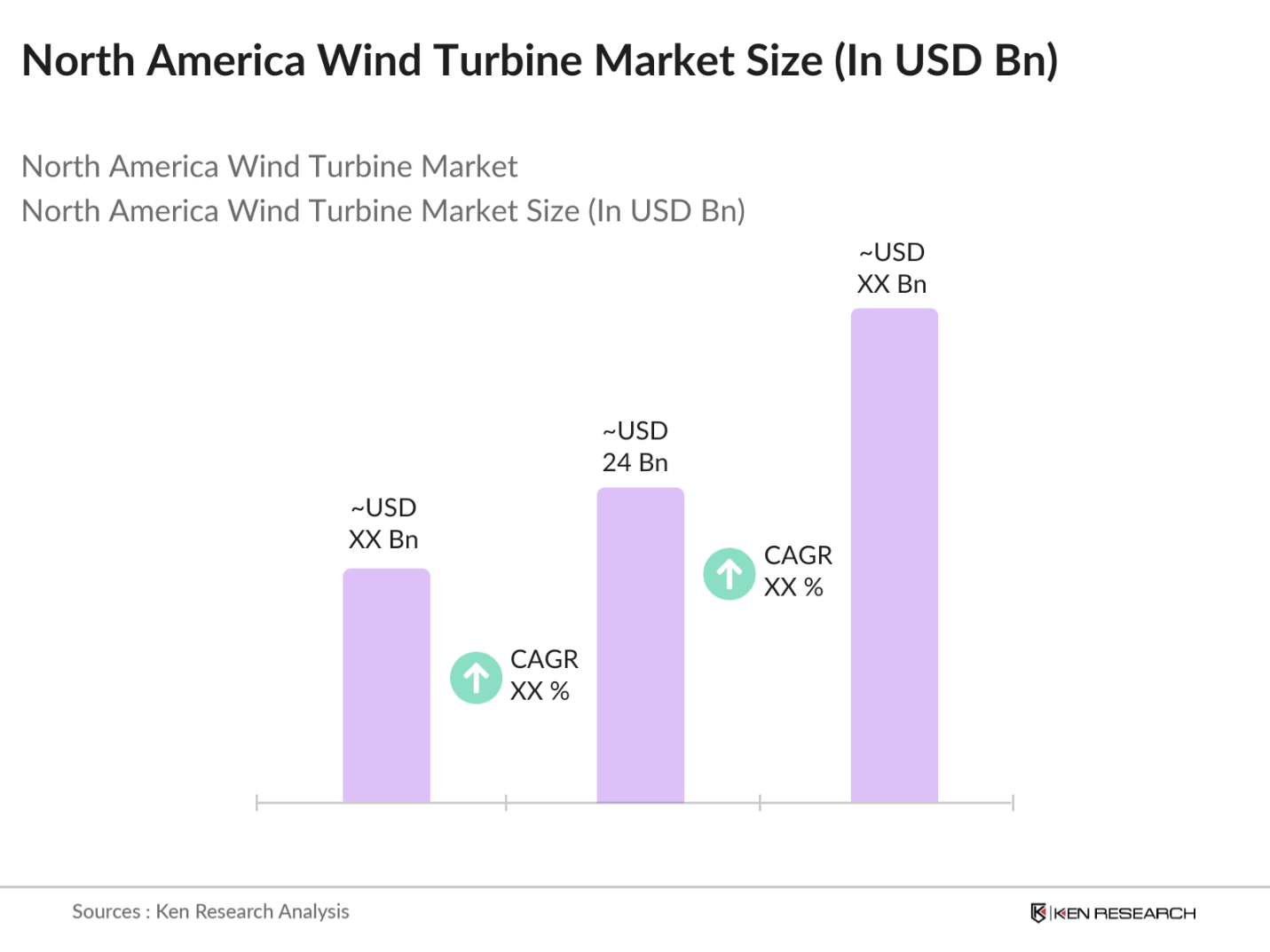
- The North America Wind Turbine Market is valued at USD 24 billion, based on a five-year historical analysis. This market is primarily driven by advancements in wind turbine technology, including increased efficiency and durability, along with strong government incentives aimed at supporting renewable energy development. With an emphasis on reducing carbon emissions and diversifying the energy mix, wind energy is becoming a crucial component of North Americas energy infrastructure, especially as utility-scale projects expand and offshore installations gain momentum.
- The United States leads the North America Wind Turbine Market due to favorable government policies, substantial investment in wind energy projects, and its substantial wind resource potential. The U.S. has achieved this market dominance by prioritizing both onshore and offshore wind developments, supported by initiatives such as the Production Tax Credit (PTC) and Renewable Portfolio Standards (RPS) in various states.
- Government policies play a crucial role in promoting wind energy development. In the United States, the Production Tax Credit (PTC) provides financial incentives for wind energy projects, offering a per-kilowatt-hour tax credit for electricity generated by qualified facilities. Additionally, Renewable Portfolio Standards (RPS) mandate that a certain percentage of electricity sold by utilities comes from renewable sources. As of 2024, 29 states and the District of Columbia have implemented RPS policies, driving demand for wind energy and supporting market growth.
North America Wind Turbine Market Segmentation
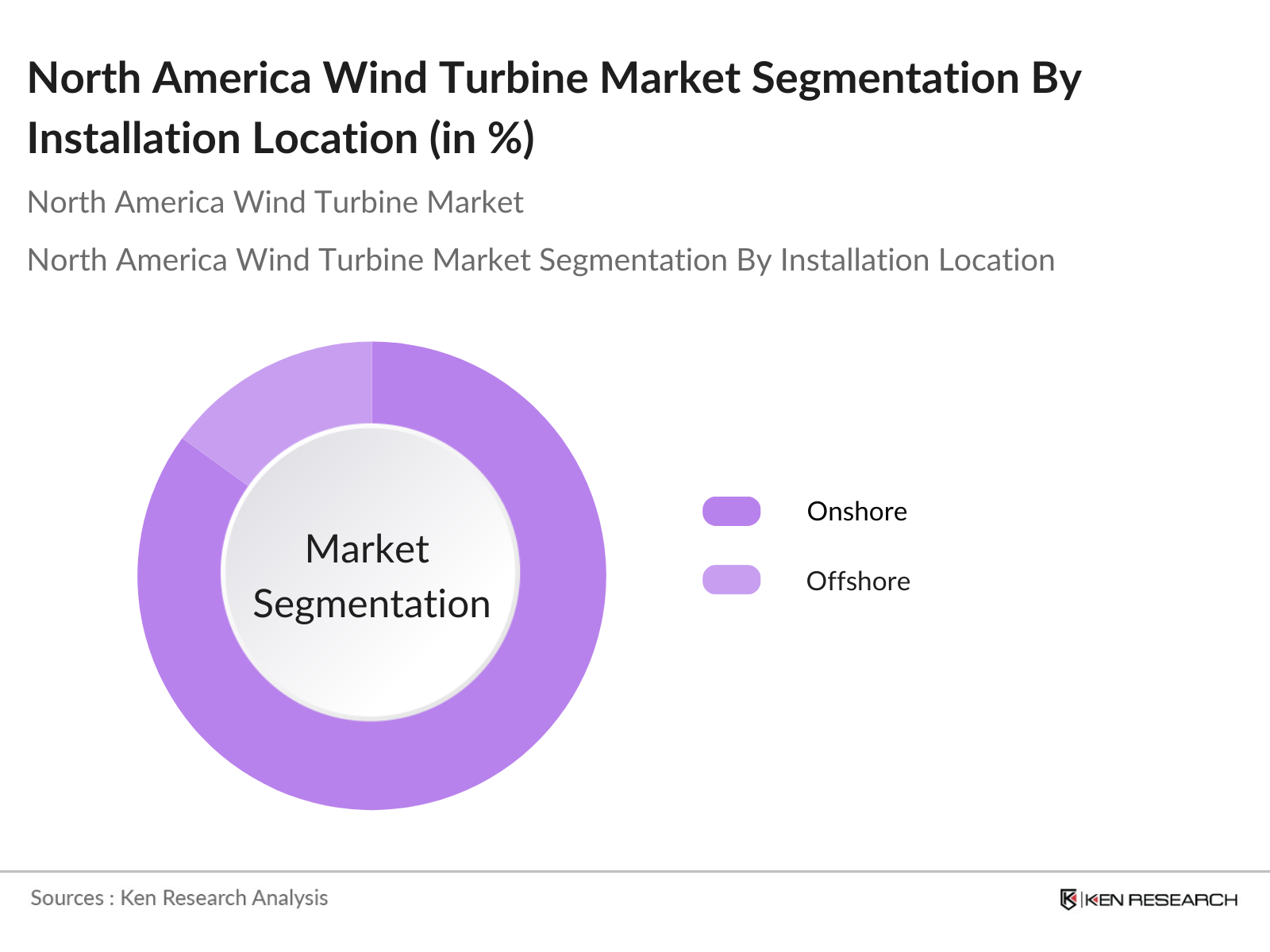
By Installation Location: The market is segmented by installation location into onshore and offshore. Onshore installations dominate the market due to lower costs and established infrastructure, making them more accessible and economically viable.
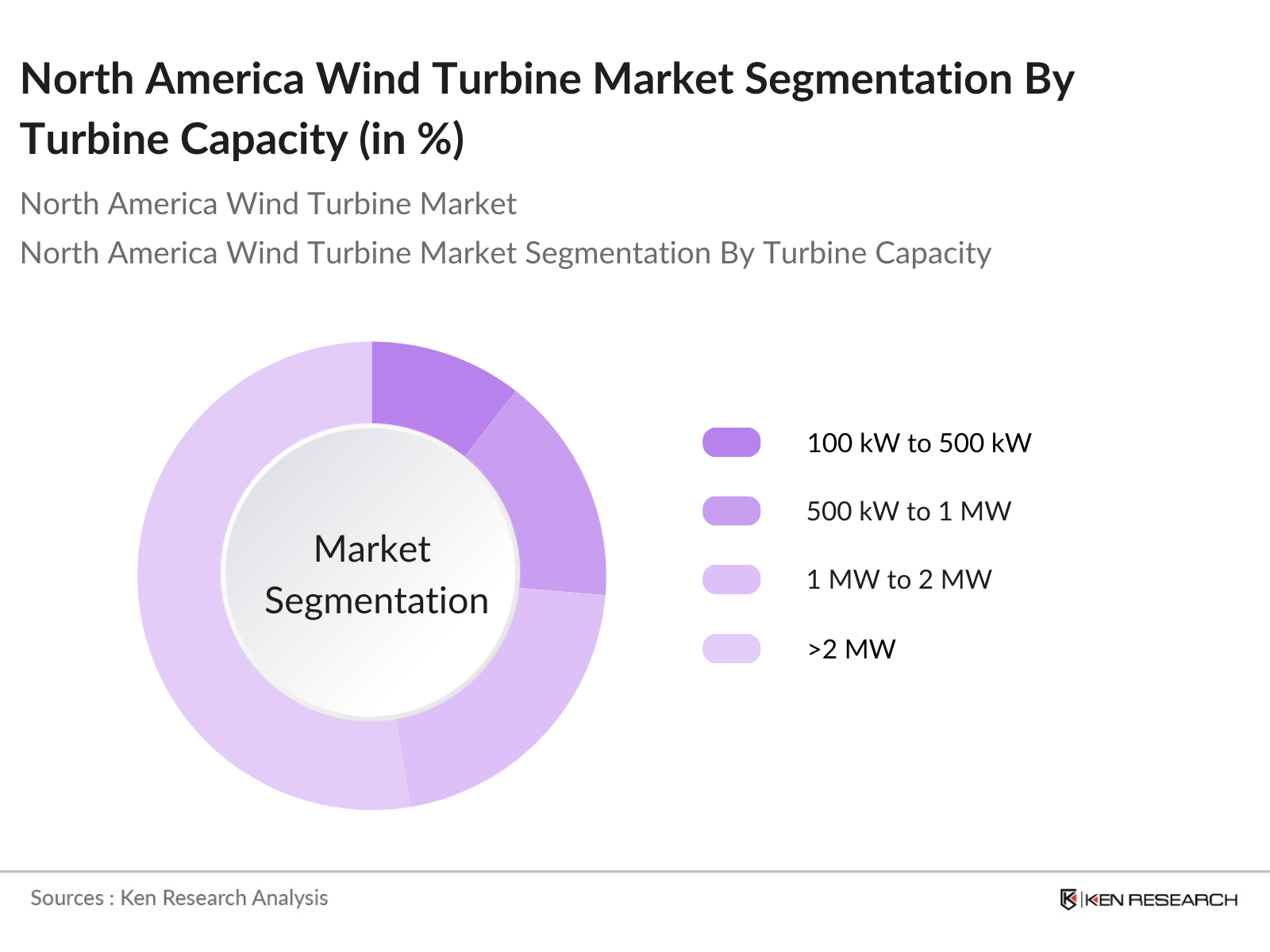
By Turbine Capacity: The market is also segmented by turbine capacity into <100 kW, 100 kW to 500 kW, 500 kW to 1 MW, 1 MW to 2 MW, and >2 MW. Turbines with capacities >2 MW hold the largest market share, driven by the demand for higher energy output and efficiency in utility-scale projects.
North America Wind Turbine Market Competitive Landscape
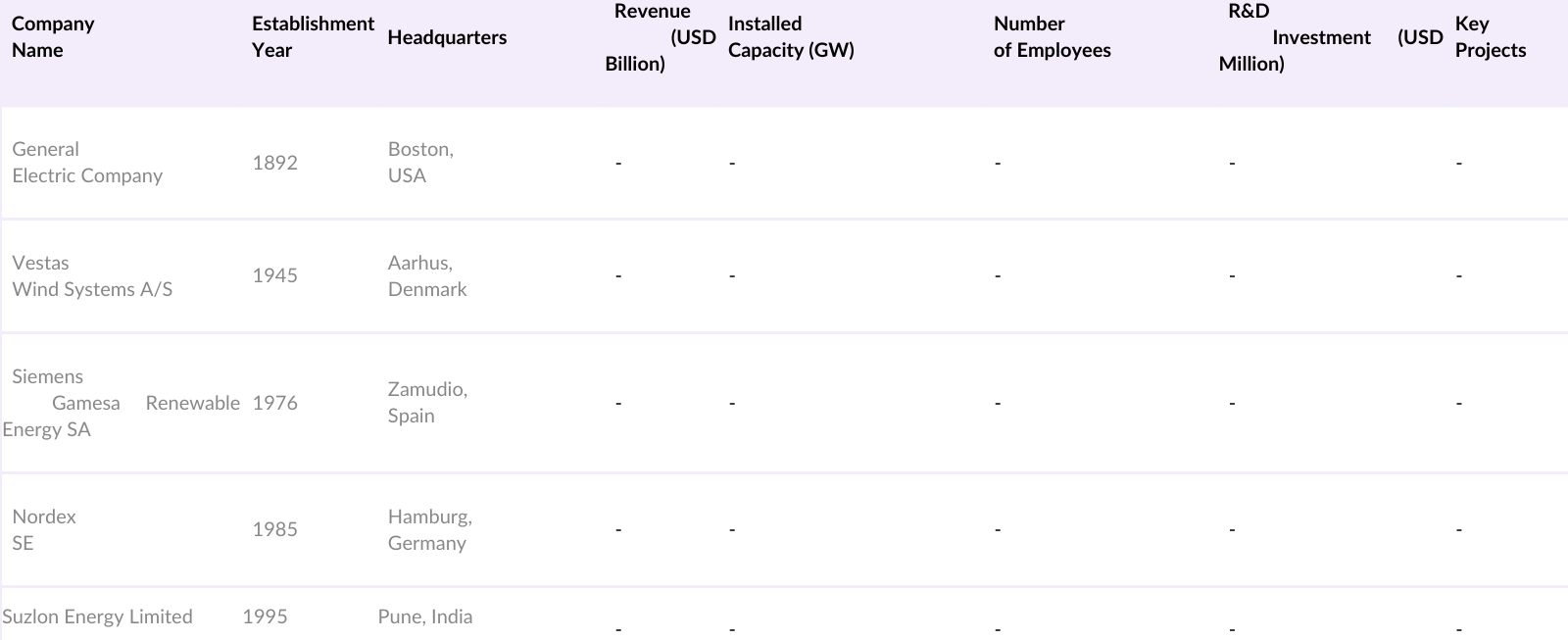
The North America Wind Turbine Market is characterized by the presence of key players such as General Electric Company, Vestas Wind Systems A/S, Siemens Gamesa Renewable Energy SA, Nordex SE, and Suzlon Energy Limited. These companies have established strong market positions through extensive product portfolios, technological innovations, and strategic partnerships.
North America Wind Turbin Industry Analysis
Growth Drivers
- Increasing Demand for Renewable Energy: The global energy landscape is witnessing a significant shift towards renewable sources. In 2023, zero-carbon technologies accounted for over 40% of global electricity production, with renewables like wind and solar contributing 17%, and hydroelectric and nuclear making up 24%. This transition is driven by the need to reduce greenhouse gas emissions and combat climate change. Countries are setting ambitious targets; for instance, the United States aims to achieve 100% clean electricity by 2035. This escalating demand underscores the pivotal role of wind energy in the global energy mix.
- Technological Advancements in Turbine Efficiency: Advancements in wind turbine technology have significantly enhanced efficiency and energy output. Modern turbines are now capable of generating more electricity at lower wind speeds, making wind energy viable in a broader range of locations. The development of larger turbines with capacities exceeding 10 MW has also contributed to increased energy production. These technological improvements have been instrumental in reducing the levelized cost of wind energy, making it more competitive with traditional energy sources.
- Decline in Levelized Cost of Wind Energy (LCOE): The cost of wind energy has seen a significant decline in recent years. According to the International Renewable Energy Agency (IRENA), over 75% of the renewable energy capacity added in 2023 was more cost-effective than fossil fuels. This reduction in LCOE is attributed to technological advancements, economies of scale, and increased competition in the market. The decreasing cost trend enhances the attractiveness of wind energy investments and supports its expansion in the global energy portfolio.
Market Challenges
- High Initial Capital Investment: Wind energy projects require substantial upfront capital for development, manufacturing, and installation. The World Bank notes that offshore wind farms, for example, can take between five to ten years to develop, with development costs ranging from $10 to $50 million. This high initial investment can be a barrier, especially in emerging markets where access to financing may be limited. Addressing this challenge necessitates innovative financing solutions and supportive policy frameworks to attract investors.
- Grid Integration and Intermittency Issues: Integrating wind energy into existing power grids presents technical challenges due to its intermittent nature. Fluctuations in wind speed can lead to variability in power generation, necessitating advanced grid management and storage solutions to maintain stability. The International Energy Agency (IEA) emphasizes the need for investments in grid infrastructure and the development of flexible energy systems to accommodate the growing share of wind energy. Without such measures, large-scale integration of wind power could face significant hurdles.
North America Wind Turbine Market Future Outlook
Over the next five years, the North America Wind Turbine Market is expected to experience significant growth, driven by continuous government support, advancements in turbine technology, and increasing investments in renewable energy projects. The expansion of offshore wind installations and the repowering of aging wind farms are anticipated to further contribute to market growth.
Market Opportunities
- Expansion in Offshore Wind Energy: Offshore wind energy presents a significant growth opportunity due to higher and more consistent wind speeds at sea. The World Bank estimates that the technical potential for offshore wind in countries like Brazil, India, and Vietnam is about 3.1 terawatts, which is approximately three times the installed electricity generating capacity of all EU countries. Advancements in floating turbine technology are further enabling the exploitation of deeper waters, expanding the feasible areas for offshore wind farms.
- Growth in Distributed Wind Energy Systems: Distributed wind energy systems, which are smaller-scale installations located close to the point of use, are gaining traction. These systems can provide energy solutions for rural and remote areas, reducing transmission losses and enhancing energy security. The U.S. Department of Energy reports that distributed wind capacity in the United States reached 1,145 MW in 2022, indicating a growing interest in localized wind energy solutions. This trend offers opportunities for market expansion, particularly in regions with limited access to centralized power grids.
Scope of the Report
|
Turbine Type |
Horizontal Axis Wind Turbines (HAWT) Vertical Axis Wind Turbines (VAWT) |
|
Installation Location |
Onshore Offshore |
|
Capacity |
<100 kW 100 kW to 500 kW 500 kW to 1 MW 1 MW to 2 MW >2 MW |
|
Application |
Residential Commercial & Industrial Utility |
|
United States Canada Mexico Rest of North America |
Products
Key Target Audience
Wind Turbine Manufacturers
Renewable Energy Project Developers
Utility Companies
Government and Regulatory Bodies (e.g., U.S. Department of Energy)
Investment and Venture Capital Firms
Environmental Advocacy Groups
Engineering, Procurement, and Construction (EPC) Contractors
Component Suppliers
Companies
Players Mentioned in the Report
General Electric Company
Vestas Wind Systems A/S
Siemens Gamesa Renewable Energy SA
Nordex SE
Suzlon Energy Limited
Goldwind
Envision Energy
MingYang Smart Energy Group Co.
Enercon GmbH
Senvion
Table of Contents
1. Market Overview
1.1 Definition and Scope
1.2 Market Taxonomy
1.3 Market Growth Rate
1.4 Market Segmentation Overview
2. Market Size (USD Billion)
2.1 Historical Market Size
2.2 Year-On-Year Growth Analysis
2.3 Key Market Developments and Milestones
3. Market Analysis
3.1 Growth Drivers
3.1.1 Increasing Demand for Renewable Energy
3.1.2 Government Incentives and Tax Credits
3.1.3 Technological Advancements in Turbine Efficiency
3.1.4 Decline in Levelized Cost of Wind Energy (LCOE)
3.2 Market Challenges
3.2.1 High Initial Capital Investment
3.2.2 Grid Integration and Intermittency Issues
3.2.3 Land Use and Environmental Concerns
3.3 Opportunities
3.3.1 Expansion in Offshore Wind Energy
3.3.2 Growth in Distributed Wind Energy Systems
3.3.3 Repowering of Aging Wind Farms
3.4 Trends
3.4.1 Adoption of Larger Turbine Capacities
3.4.2 Digitalization and Predictive Maintenance
3.4.3 Hybrid Renewable Energy Solutions
3.5 Government Regulations
3.5.1 Production Tax Credit (PTC) and Renewable Energy Standards
3.5.2 Offshore Wind Leasing Programs
3.5.3 State-Level Renewable Portfolio Standards (RPS)
3.6 SWOT Analysis
3.7 Stakeholder Ecosystem
3.8 Porters Five Forces Analysis
3.9 Competitive Landscape
4. Market Segmentation
4.1 By Turbine Type (In Value %)
4.1.1 Horizontal Axis Wind Turbines (HAWT)
4.1.2 Vertical Axis Wind Turbines (VAWT)
4.2 By Installation Location (In Value %)
4.2.1 Onshore
4.2.2 Offshore
4.3 By Capacity (In Value %)
4.3.1 <100 kW
4.3.2 100 kW to 500 kW
4.3.3 500 kW to 1 MW
4.3.4 1 MW to 2 MW
4.3.5 >2 MW
4.4 By Application (In Value %)
4.4.1 Residential
4.4.2 Commercial & Industrial
4.4.3 Utility
4.5 By Country (In Value %)
4.5.1 United States
4.5.2 Canada
4.5.3 Mexico
4.5.4 Rest of North America
5. Competitive Analysis
5.1 Detailed Profiles of Major Companies
5.1.1 General Electric Company
5.1.2 Vestas Wind Systems A/S
5.1.3 Siemens Gamesa Renewable Energy SA
5.1.4 Nordex SE
5.1.5 Suzlon Energy Limited
5.1.6 Goldwind
5.1.7 Envision Energy
5.1.8 MingYang Smart Energy Group Co.
5.1.9 Enercon GmbH
5.1.10 Senvion
5.1.11 Acciona Energy
5.1.12 NextEra Energy
5.1.13 rsted A/S
5.1.14 Invenergy LLC
5.1.15 EDP Renewables
5.2 Cross Comparison Parameters (Revenue, Headquarters, Market Share, R&D Investment, Installed Capacity, Key Projects, Regional Presence, Number of Employees)
5.3 Market Share Analysis
5.4 Strategic Initiatives
5.5 Mergers and Acquisitions
5.6 Investment Analysis
5.6.1 Venture Capital Funding
5.6.2 Government Grants
5.6.3 Private Equity Investments
6. Regulatory Framework
6.1 Wind Energy Standards and Certifications
6.2 Compliance with Environmental Impact Assessments (EIA)
6.3 Import and Export Regulations for Turbine Components
7. Future Market Size (USD Billion)
7.1 Market Size Projections
7.2 Key Drivers of Future Growth
8. Future Market Segmentation
8.1 By Turbine Type (In Value %)
8.2 By Installation Location (In Value %)
8.3 By Capacity (In Value %)
8.4 By Application (In Value %)
8.5 By Country (In Value %)
9. Analysts Recommendations
9.1 Total Addressable Market (TAM), Serviceable Available Market (SAM), and Serviceable Obtainable Market (SOM) Analysis
9.2 Customer Cohort Analysis
9.3 Marketing Initiatives
9.4 White Space Opportunity Analysis
Disclaimer Contact UsResearch Methodology
Step 1: Identification of Key Variables
The initial phase involves constructing an ecosystem map encompassing all major stakeholders within the North America Wind Turbine Market. This step is underpinned by extensive desk research, utilizing a combination of secondary and proprietary databases to gather comprehensive industry-level information. The primary objective is to identify and define the critical variables that influence market dynamics.
Step 2: Market Analysis and Construction
In this phase, we compile and analyze historical data pertaining to the North America Wind Turbine Market. This includes assessing market penetration, the ratio of marketplaces to service providers, and the resultant revenue generation. Furthermore, an evaluation of service quality statistics is conducted to ensure the reliability and accuracy of the revenue estimates.
Step 3: Hypothesis Validation and Expert Consultation
Market hypotheses are developed and subsequently validated through computer-assisted telephone interviews (CATIs) with industry experts representing a diverse array of companies. These consultations provide valuable operational and financial insights directly from industry practitioners, which are instrumental in refining and corroborating the market data.
Step 4: Research Synthesis and Final Output
The final phase involves direct engagement with multiple wind turbine manufacturers to acquire detailed insights into product segments, sales performance, consumer preferences, and other pertinent factors. This interaction serves to verify and complement the statistics derived from the bottom-up approach, thereby ensuring a comprehensive, accurate, and validated analysis of the North America Wind Turbine Market.
Frequently Asked Questions
1. How big is the North America Wind Turbine Market?
The North America Wind Turbine Market is valued at USD 24 billion, based on a five-year historical analysis. This market is primarily driven by advancements in wind turbine technology, including increased efficiency and durability, along with strong government incentives aimed at supporting renewable energy development.
2. What are the challenges in the North America Wind Turbine Market?
Challenges include high initial capital investment, grid integration and intermittency issues, and land use and environmental concerns. These factors can hinder the rapid deployment and expansion of wind energy projects in the region.
3. Who are the major players in the North America Wind Turbine Market?
Key players in the market include General Electric Company, Vestas Wind Systems A/S, Siemens Gamesa Renewable Energy SA, Nordex SE, and Suzlon Energy Limited. These companies dominate due to their extensive market presence, technological advancements, and strategic investments in both onshore and offshore wind projects.
4. What drives the growth of the North America Wind Turbine Market?
The market growth is propelled by government incentives, technological advancements, and increasing corporate commitments to renewable energy targets. Additionally, the rising focus on reducing carbon emissions has accelerated the shift toward wind energy as a sustainable power.
Why Buy From Us?

What makes us stand out is that our consultants follows Robust, Refine and Result (RRR) methodology. i.e. Robust for clear definitions, approaches and sanity checking, Refine for differentiating respondents facts and opinions and Result for presenting data with story

We have set a benchmark in the industry by offering our clients with syndicated and customized market research reports featuring coverage of entire market as well as meticulous research and analyst insights.

While we don't replace traditional research, we flip the method upside down. Our dual approach of Top Bottom & Bottom Top ensures quality deliverable by not just verifying company fundamentals but also looking at the sector and macroeconomic factors.

With one step in the future, our research team constantly tries to show you the bigger picture. We help with some of the tough questions you may encounter along the way: How is the industry positioned? Best marketing channel? KPI's of competitors? By aligning every element, we help maximize success.

Our report gives you instant access to the answers and sources that other companies might choose to hide. We elaborate each steps of research methodology we have used and showcase you the sample size to earn your trust.

If you need any support, we are here! We pride ourselves on universe strength, data quality, and quick, friendly, and professional service.