About the Report
Base Year 2024Russia Online Food Delivery and Cloud Kitchens Market Overview
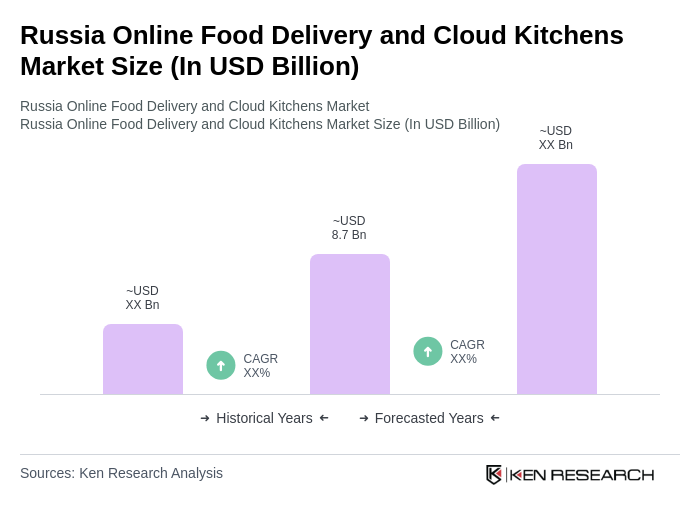
- The Russia Online Food Delivery and Cloud Kitchens Market is valued at USD 8.7 billion, based on a five-year historical analysis. This growth is primarily driven by the increasing adoption of digital platforms, changing consumer preferences towards convenience and variety, and the expansion of delivery services across urban areas. The rise in smartphone penetration and internet accessibility—reaching over 130 million users and 90% penetration—has further fueled the demand for online food delivery services. The sector is also benefiting from the integration of advanced technologies such as artificial intelligence, big data analytics, and GPS-enabled tracking, which enhance operational efficiency and customer experience .
- Key cities dominating this market include Moscow and St. Petersburg, which are characterized by a high density of restaurants and a tech-savvy population. The urban lifestyle in these cities, coupled with a growing trend of dining out and ordering in, has made them pivotal in shaping the online food delivery landscape. Additionally, the presence of major players and a competitive market environment contribute to their dominance .
- In 2023, the Russian government implemented regulations aimed at enhancing food safety standards in the online food delivery sector. This includes mandatory compliance with health and safety protocols for food handling and delivery, ensuring that all food delivery services adhere to strict hygiene practices. The primary regulatory instrument is the “Sanitary and Epidemiological Requirements for the Organization of Public Catering,” approved by the Chief State Sanitary Doctor of the Russian Federation (Order No. 18, 2021), which sets forth operational hygiene standards, staff training requirements, and food storage protocols applicable to online delivery and cloud kitchen operations .
Russia Online Food Delivery and Cloud Kitchens Market Segmentation
By Service Type:
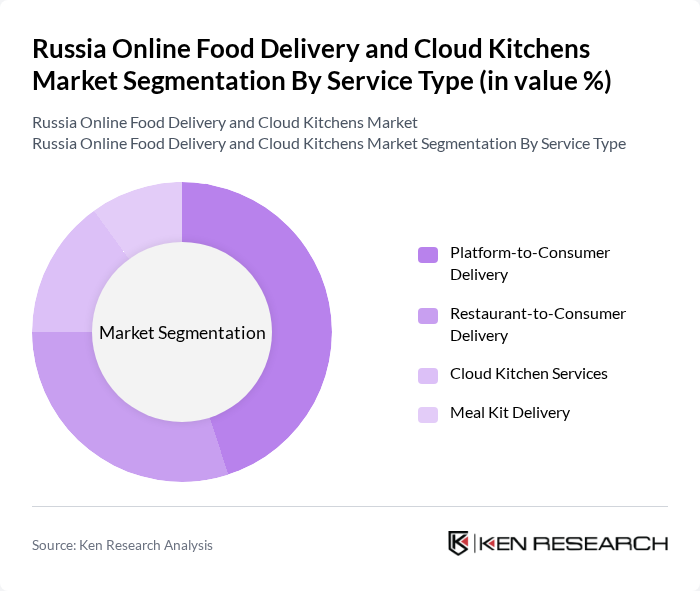
The service type segmentation of the market includes Platform-to-Consumer Delivery, Restaurant-to-Consumer Delivery, Cloud Kitchen Services, and Meal Kit Delivery. Among these, Platform-to-Consumer Delivery is the leading subsegment, driven by the convenience it offers consumers who prefer ordering food through mobile applications. The increasing number of restaurants partnering with delivery platforms has also contributed to its dominance. Restaurant-to-Consumer Delivery follows closely, as traditional restaurants adapt to the growing demand for home delivery services. Cloud Kitchen Services are gaining traction due to lower operational costs and the ability to cater to multiple brands from a single location. Meal Kit Delivery, while popular, remains a niche segment compared to the others .
By Business Model:
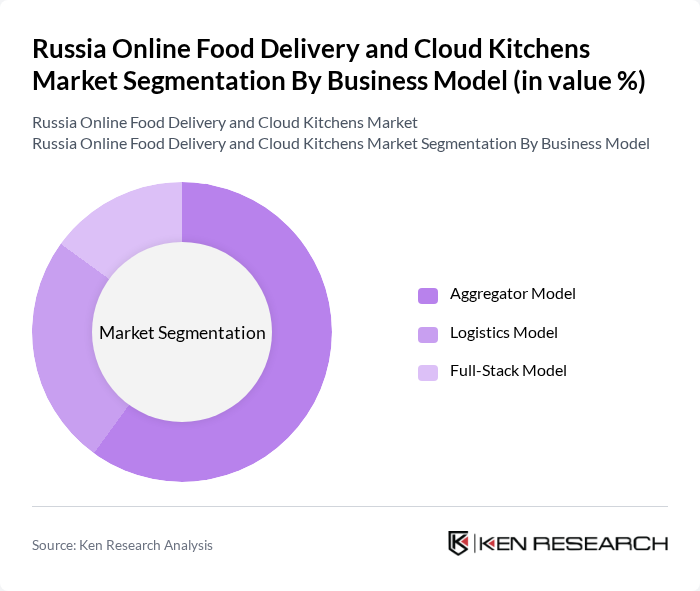
The business model segmentation includes Aggregator Model, Logistics Model, and Full-Stack Model. The Aggregator Model is the most prominent, as it allows consumers to access a variety of restaurants through a single platform, enhancing convenience and choice. This model has been widely adopted by major players in the market, leading to its dominance. The Logistics Model, while essential for efficient delivery, is often integrated within aggregator platforms, making it less visible as a standalone model. The Full-Stack Model, which encompasses both food preparation and delivery, is emerging but still represents a smaller share of the market .
Russia Online Food Delivery and Cloud Kitchens Market Competitive Landscape
The Russia Online Food Delivery and Cloud Kitchens Market is characterized by a dynamic mix of regional and international players. Leading participants such as Yandex.Eda, Delivery Club, SberMarket, Ozon Eats, VkusVill, Dodo Pizza, Teremok, Samokat, Perekrestok, Magnit, X5 Retail Group, Lenta, Auchan Russia, Metro Cash & Carry, Globus contribute to innovation, geographic expansion, and service delivery in this space.
Russia Online Food Delivery and Cloud Kitchens Market Industry Analysis
Growth Drivers
- Increasing Urbanization:Urbanization in Russia is accelerating, with over 74% of the population residing in urban areas as of future, according to World Bank data. This trend is driving demand for online food delivery services, as urban dwellers seek convenient meal options. The urban population is projected to reach approximately 110 million by future, creating a larger customer base for food delivery platforms. This demographic shift is a significant growth driver for the online food delivery market.
- Rising Demand for Convenience:The demand for convenience in meal preparation is surging, with a reported 60% of consumers in urban areas opting for food delivery services in future. This shift is influenced by busy lifestyles and the increasing number of dual-income households, which reached 40% in major cities. As consumers prioritize time-saving solutions, the online food delivery market is positioned to benefit significantly from this growing trend, enhancing its appeal and market penetration.
- Expansion of Delivery Infrastructure:The delivery infrastructure in Russia is rapidly evolving, with investments exceeding $1 billion in logistics and technology in future. Enhanced delivery networks, including partnerships with local courier services, are improving efficiency and reducing delivery times. This infrastructure development is crucial for meeting the rising consumer expectations for quick and reliable service, thereby driving growth in the online food delivery and cloud kitchen sectors across the country.
Market Challenges
- Intense Competition:The online food delivery market in Russia is characterized by fierce competition, with over 20 major players vying for market share in future. This saturation leads to aggressive pricing strategies, which can erode profit margins. Companies must continuously innovate and differentiate their offerings to maintain a competitive edge, making it challenging for new entrants to establish themselves in this crowded marketplace.
- Regulatory Hurdles:Regulatory challenges pose significant barriers to market entry and expansion. In future, new food safety regulations require compliance from all food delivery services, increasing operational costs. Additionally, licensing requirements for delivery services can delay market entry, particularly for startups. Navigating these regulatory landscapes is essential for companies aiming to succeed in the Russian online food delivery market.
Russia Online Food Delivery and Cloud Kitchens Market Future Outlook
The future of the online food delivery and cloud kitchens market in Russia appears promising, driven by technological advancements and changing consumer preferences. As urbanization continues, the demand for convenient meal solutions is expected to rise. Companies are likely to invest in AI and data analytics to enhance customer experiences and optimize delivery logistics. Furthermore, sustainability initiatives will play a crucial role in shaping consumer choices, as health-conscious and environmentally aware consumers increasingly seek responsible dining options.
Market Opportunities
- Expansion into Tier 2 and Tier 3 Cities:There is a significant opportunity for online food delivery services to expand into Tier 2 and Tier 3 cities, where the market is currently underdeveloped. With a combined population of over 30 million, these regions present untapped potential for growth, as consumer demand for convenient food options is on the rise.
- Partnerships with Local Restaurants:Forming partnerships with local restaurants can enhance service offerings and diversify menus. Collaborations with over 5,000 local eateries in future can help delivery platforms attract a broader customer base, catering to regional tastes and preferences while supporting local businesses, thus fostering community engagement.
Scope of the Report
| Segment | Sub-Segments |
|---|---|
| By Service Type | Platform-to-Consumer Delivery Restaurant-to-Consumer Delivery Cloud Kitchen Services Meal Kit Delivery |
| By Business Model | Aggregator Model Logistics Model Full-Stack Model |
| By Order Value | Below 500 RUB 1000 RUB Above 1000 RUB |
| By Cuisine Type | Russian Cuisine Asian Cuisine European Cuisine Fast Food Pizza & Italian Others |
| By Payment Method | Digital Payments Cash on Delivery Card Payments |
| By City Tier | Tier 1 Cities (Moscow, St. Petersburg) Tier 2 Cities Tier 3 Cities |
| By Customer Demographics | Age 18-25 Age 26-35 Age 36-45 Above 45 |
Key Target Audience
Investors and Venture Capitalist Firms
Government and Regulatory Bodies (e.g., Federal Antimonopoly Service of Russia, Ministry of Industry and Trade of the Russian Federation)
Food and Beverage Manufacturers
Logistics and Supply Chain Companies
Cloud Kitchen Operators
Online Food Delivery Platforms
Food Safety and Quality Assurance Organizations
Advertising and Marketing Agencies specializing in Food Services
Players Mentioned in the Report:
Yandex.Eda
Delivery Club
SberMarket
Ozon Eats
VkusVill
Dodo Pizza
Teremok
Samokat
Perekrestok
Magnit
X5 Retail Group
Lenta
Auchan Russia
Metro Cash & Carry
Globus
Table of Contents
Market Assessment Phase
1. Executive Summary and Approach
2. Russia Online Food Delivery and Cloud Kitchens Market Overview
2.1 Key Insights and Strategic Recommendations
2.2 Russia Online Food Delivery and Cloud Kitchens Market Overview
2.3 Definition and Scope
2.4 Evolution of Market Ecosystem
2.5 Timeline of Key Regulatory Milestones
2.6 Value Chain & Stakeholder Mapping
2.7 Business Cycle Analysis
2.8 Policy & Incentive Landscape
3. Russia Online Food Delivery and Cloud Kitchens Market Analysis
3.1 Growth Drivers
3.1.1 Increasing Urbanization
3.1.2 Rising Demand for Convenience
3.1.3 Growth of E-commerce
3.1.4 Expansion of Delivery Infrastructure
3.2 Market Challenges
3.2.1 Intense Competition
3.2.2 Regulatory Hurdles
3.2.3 Consumer Price Sensitivity
3.2.4 Quality Control Issues
3.3 Market Opportunities
3.3.1 Expansion into Tier 2 and Tier 3 Cities
3.3.2 Partnerships with Local Restaurants
3.3.3 Introduction of Subscription Models
3.3.4 Technological Innovations in Delivery
3.4 Market Trends
3.4.1 Growth of Cloud Kitchens
3.4.2 Increased Focus on Health and Wellness
3.4.3 Use of AI and Data Analytics
3.4.4 Sustainability Initiatives
3.5 Government Regulation
3.5.1 Food Safety Standards
3.5.2 Delivery Service Licensing
3.5.3 Tax Incentives for Startups
3.5.4 Labor Regulations
4. SWOT Analysis
5. Stakeholder Analysis
6. Porter's Five Forces Analysis
7. Russia Online Food Delivery and Cloud Kitchens Market Market Size, 2019-2024
7.1 By Value
7.2 By Volume
7.3 By Average Selling Price
8. Russia Online Food Delivery and Cloud Kitchens Market Segmentation
8.1 By Service Type
8.1.1 Platform-to-Consumer Delivery
8.1.2 Restaurant-to-Consumer Delivery
8.1.3 Cloud Kitchen Services
8.1.4 Meal Kit Delivery
8.2 By Business Model
8.2.1 Aggregator Model
8.2.2 Logistics Model
8.2.3 Full-Stack Model
8.3 By Order Value
8.3.1 Below 500 RUB
8.3.2 500-1000 RUB
8.3.3 Above 1000 RUB
8.4 By Cuisine Type
8.4.1 Russian Cuisine
8.4.2 Asian Cuisine
8.4.3 European Cuisine
8.4.4 Fast Food
8.4.5 Pizza & Italian
8.4.6 Others
8.5 By Payment Method
8.5.1 Digital Payments
8.5.2 Cash on Delivery
8.5.3 Card Payments
8.6 By City Tier
8.6.1 Tier 1 Cities (Moscow, St. Petersburg)
8.6.2 Tier 2 Cities
8.6.3 Tier 3 Cities
8.7 By Customer Demographics
8.7.1 Age 18-25
8.7.2 Age 26-35
8.7.3 Age 36-45
8.7.4 Above 45
9. Russia Online Food Delivery and Cloud Kitchens Market Competitive Analysis
9.1 Market Share of Key Players
9.2 Cross Comparison of Key Players
9.2.1 Market Share (%)
9.2.2 Revenue Growth Rate (CAGR %)
9.2.3 Average Order Value (RUB)
9.2.4 Customer Acquisition Cost (RUB)
9.2.5 Monthly Active Users (MAU)
9.2.6 Order Frequency per User
9.2.7 Average Delivery Time (minutes)
9.2.8 Commission Rate (%)
9.2.9 Geographic Coverage (cities)
9.2.10 Restaurant Partner Count
9.3 SWOT Analysis of Top Players
9.4 Pricing Analysis
9.5 Detailed Profile of Major Companies
9.5.1 Yandex.Eda
9.5.2 Delivery Club
9.5.3 SberMarket
9.5.4 Ozon Eats
9.5.5 VkusVill
9.5.6 Dodo Pizza
9.5.7 Teremok
9.5.8 Samokat
9.5.9 Perekrestok
9.5.10 Magnit
9.5.11 X5 Retail Group
9.5.12 Lenta
9.5.13 Auchan Russia
9.5.14 Metro Cash & Carry
9.5.15 Globus
10. Russia Online Food Delivery and Cloud Kitchens Market End-User Analysis
10.1 Procurement Behavior of Key Ministries
10.1.1 Budget Allocation for Food Services
10.1.2 Preference for Local Suppliers
10.1.3 Compliance with Health Regulations
10.2 Corporate Spend on Infrastructure & Energy
10.2.1 Investment in Delivery Logistics
10.2.2 Spending on Technology Integration
10.2.3 Budget for Marketing and Promotions
10.3 Pain Point Analysis by End-User Category
10.3.1 Quality of Food
10.3.2 Delivery Timeliness
10.3.3 Customer Service Issues
10.4 User Readiness for Adoption
10.4.1 Awareness of Online Delivery Options
10.4.2 Comfort with Technology
10.4.3 Trust in Delivery Services
10.5 Post-Deployment ROI and Use Case Expansion
10.5.1 Measurement of Customer Satisfaction
10.5.2 Analysis of Repeat Orders
10.5.3 Expansion into New Markets
11. Russia Online Food Delivery and Cloud Kitchens Market Future Size, 2025-2030
11.1 By Value
11.2 By Volume
11.3 By Average Selling Price
Go-To-Market Strategy Phase
1. Whitespace Analysis + Business Model Canvas
1.1 Market Gaps Identification
1.2 Business Model Framework
2. Marketing and Positioning Recommendations
2.1 Branding Strategies
2.2 Product USPs
3. Distribution Plan
3.1 Urban Retail vs Rural NGO Tie-ups
4. Channel & Pricing Gaps
4.1 Underserved Routes
4.2 Pricing Bands
5. Unmet Demand & Latent Needs
5.1 Category Gaps
5.2 Consumer Segments
6. Customer Relationship
6.1 Loyalty Programs
6.2 After-sales Service
7. Value Proposition
7.1 Sustainability
7.2 Integrated Supply Chains
8. Key Activities
8.1 Regulatory Compliance
8.2 Branding
8.3 Distribution Setup
9. Entry Strategy Evaluation
9.1 Domestic Market Entry Strategy
9.1.1 Product Mix
9.1.2 Pricing Band
9.1.3 Packaging
9.2 Export Entry Strategy
9.2.1 Target Countries
9.2.2 Compliance Roadmap
10. Entry Mode Assessment
10.1 JV
10.2 Greenfield
10.3 M&A
10.4 Distributor Model
11. Capital and Timeline Estimation
11.1 Capital Requirements
11.2 Timelines
12. Control vs Risk Trade-Off
12.1 Ownership vs Partnerships
13. Profitability Outlook
13.1 Breakeven Analysis
13.2 Long-term Sustainability
14. Potential Partner List
14.1 Distributors
14.2 JVs
14.3 Acquisition Targets
15. Execution Roadmap
15.1 Phased Plan for Market Entry
15.1.1 Market Setup
15.1.2 Market Entry
15.1.3 Growth Acceleration
15.1.4 Scale & Stabilize
15.2 Key Activities and Milestones
15.2.1 Activity Timeline
15.2.2 Milestone Tracking
Research Methodology
Phase 1: Approach1
Desk Research
- Analysis of industry reports and market studies on online food delivery trends in Russia
- Review of government publications and statistics related to food service and delivery sectors
- Examination of consumer behavior studies and demographic data relevant to food delivery services
Primary Research
- Interviews with key stakeholders in the online food delivery ecosystem, including restaurant owners and delivery service operators
- Surveys targeting consumers to understand preferences, frequency of use, and satisfaction levels with food delivery services
- Focus groups with culinary experts and food technologists to gather insights on cloud kitchen operations and innovations
Validation & Triangulation
- Cross-validation of findings through multiple data sources, including sales data and consumer feedback
- Triangulation of insights from primary interviews with secondary data trends to ensure consistency
- Sanity checks conducted through expert panel reviews to validate assumptions and projections
Phase 2: Market Size Estimation1
Top-down Assessment
- Estimation of market size based on national food service revenue and online penetration rates
- Segmentation of the market by type of cuisine, delivery model, and geographic region
- Incorporation of macroeconomic factors influencing consumer spending on food delivery
Bottom-up Modeling
- Collection of data from leading online food delivery platforms regarding order volumes and average transaction values
- Estimation of operational costs associated with cloud kitchens and delivery logistics
- Volume x cost analysis to derive revenue projections for various segments within the market
Forecasting & Scenario Analysis
- Utilization of time-series analysis to project growth trends based on historical data
- Scenario modeling based on potential regulatory changes and shifts in consumer preferences
- Development of baseline, optimistic, and pessimistic forecasts through 2030
Phase 3: CATI Sample Composition1
| Scope Item/Segment | Sample Size | Target Respondent Profiles |
|---|---|---|
| Consumer Preferences in Food Delivery | 120 | Regular Users, Occasional Users, Non-Users |
| Cloud Kitchen Operations Insights | 60 | Cloud Kitchen Owners, Operations Managers |
| Delivery Service Efficiency | 50 | Logistics Coordinators, Delivery Managers |
| Market Trends and Innovations | 40 | Industry Analysts, Food Technologists |
| Impact of COVID-19 on Food Delivery | 45 | Consumers, Restaurant Owners, Delivery Personnel |
Frequently Asked Questions
What is the current value of the Russia Online Food Delivery and Cloud Kitchens Market?
The Russia Online Food Delivery and Cloud Kitchens Market is valued at approximately USD 8.7 billion, reflecting significant growth driven by digital platform adoption and changing consumer preferences for convenience and variety in meal options.
What factors are driving the growth of online food delivery in Russia?
Which cities are the primary markets for online food delivery in Russia?
What are the main service types in the Russia Online Food Delivery Market?
Other Regional/Country Reports
Indonesia Online Food Delivery and Cloud Kitchens Market
Malaysia Online Food Delivery and Cloud Kitchens Market
KSA Online Food Delivery and Cloud Kitchens Market
APAC Online Food Delivery and Cloud Kitchens Market
SEA Online Food Delivery and Cloud Kitchens Market
Vietnam Online Food Delivery and Cloud Kitchens Market
Other Adjacent Reports
Philippines Last-Mile Delivery Software Market
Mexico Restaurant Management Systems Market
Kuwait Grocery Delivery Services Market
Japan Meal Kit Subscription Market
UAE Quick Commerce Market
Thailand Kitchen Equipment Manufacturing Market
Thailand Digital Payment Solutions Market
Egypt Food Packaging Materials Market
Kuwait Supply Chain Logistics Market
South Africa E-commerce Platforms Market
Why Buy From Us?

What makes us stand out is that our consultants follow Robust, Refine and Result (RRR) methodology. Robust for clear definitions, approaches and sanity checking, Refine for differentiating respondents' facts and opinions, and Result for presenting data with story.

We have set a benchmark in the industry by offering our clients with syndicated and customized market research reports featuring coverage of entire market as well as meticulous research and analyst insights.

While we don't replace traditional research, we flip the method upside down. Our dual approach of Top Bottom & Bottom Top ensures quality deliverable by not just verifying company fundamentals but also looking at the sector and macroeconomic factors.

With one step in the future, our research team constantly tries to show you the bigger picture. We help with some of the tough questions you may encounter along the way: How is the industry positioned? Best marketing channel? KPI's of competitors? By aligning every element, we help maximize success.

Our report gives you instant access to the answers and sources that other companies might choose to hide. We elaborate each steps of research methodology we have used and showcase you the sample size to earn your trust.

If you need any support, we are here! We pride ourselves on universe strength, data quality, and quick, friendly, and professional service.