
Saudi Arabia Agriculture Equipment Market Outlook to 2030
Region:Saudi Arabia
Author(s):Sanjeev
Product Code:KROD3359
Region:Saudi Arabia
Author(s):Sanjeev
Product Code:KROD3359
November 2024
94
Saudi Arabia Agriculture Equipment Market Overview
Saudi Arabia Agriculture Equipment Market Segmentation
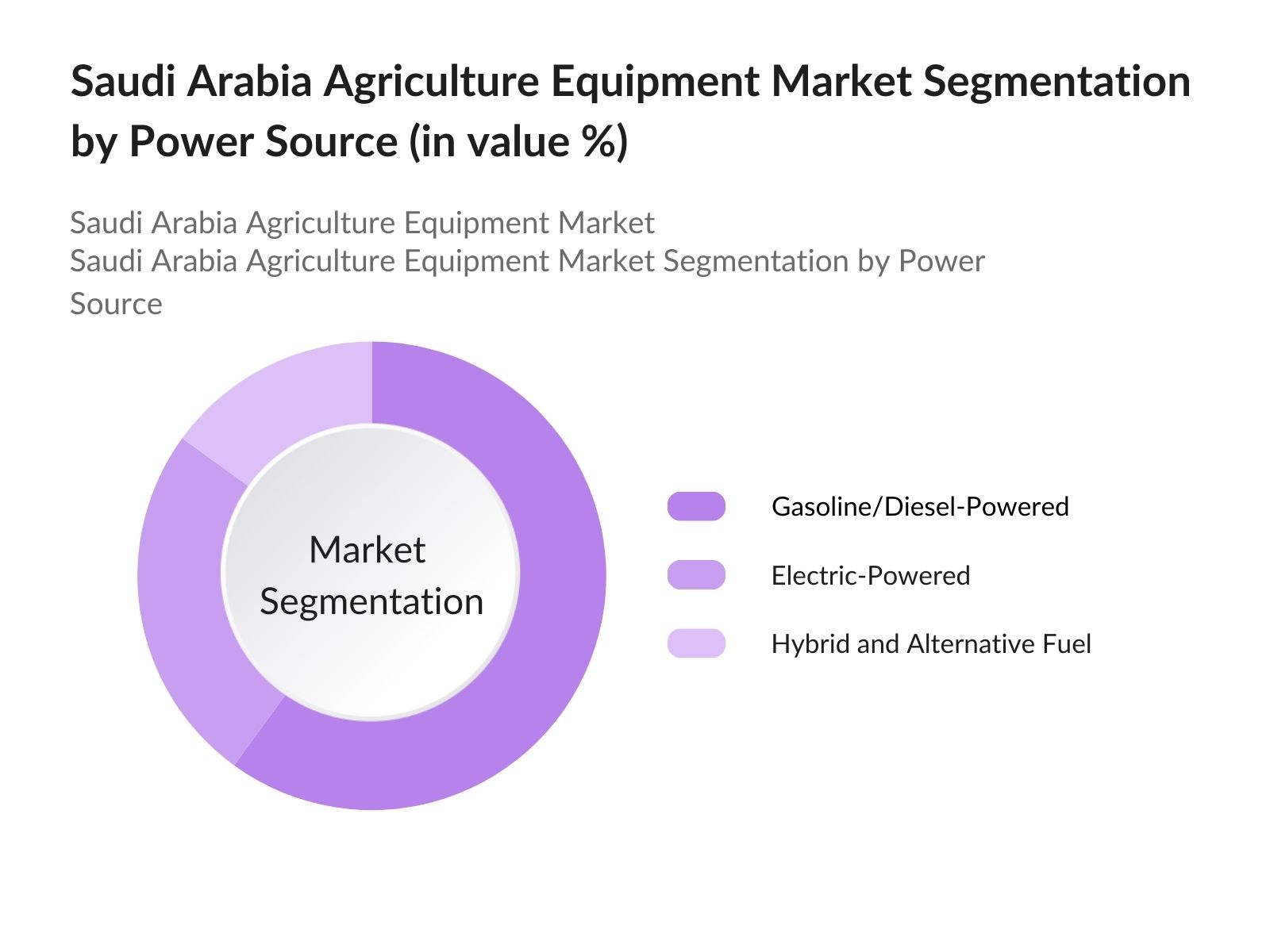
The Saudi Arabia Agriculture Equipment market is segmented by product type and by power source.

Saudi Arabia Agriculture Equipment Market Competitive Landscape
The Saudi Arabia Agriculture Equipment market is dominated by several key players, each contributing to a competitive landscape marked by innovation and strategic partnerships. Local companies benefit from government incentives, while international players leverage advanced technology to strengthen their presence.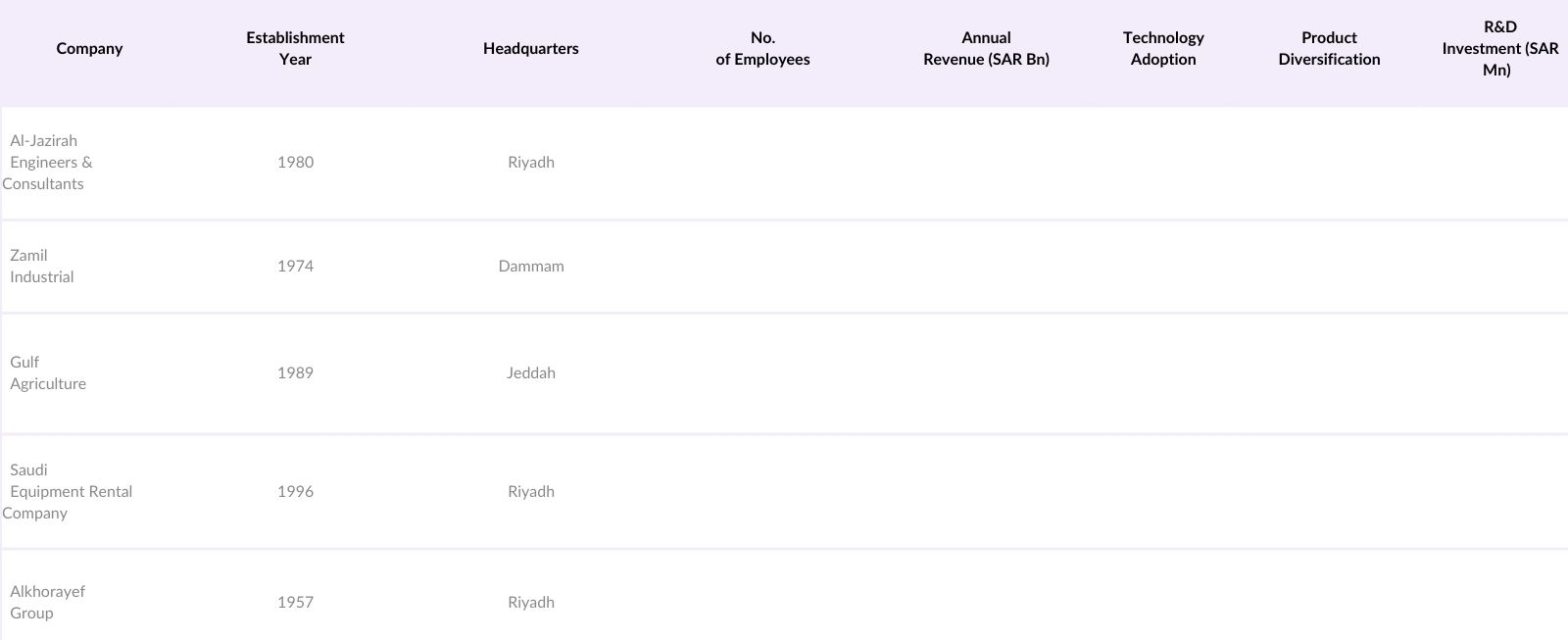
Saudi Arabia Agriculture Equipment Market Analysis
Growth Drivers
Market Challenges
High Cost of Modern Equipment: The initial investment required for advanced agricultural equipment is high, creating barriers for small and medium-scale farmers. For example, the cost of a basic mechanized plow ranges between SAR 150,000 and SAR 250,000 in 2024, according to the Saudi Agricultural Fund, posing a financial burden. Although subsidies are available, the capital-intensive nature of modern equipment discourages widespread adoption. The Saudi government has recognized this gap, yet the high costs continue to affect the markets expansion.
Limited Access to Skilled Labor: Operating advanced machinery requires skilled labor, which is limited in Saudi Arabias agricultural sector. In 2024, only 16% of the countrys 150,000 agricultural workforce received formal training in machinery operation, according to the Saudi Human Resources Development Fund. This shortage of trained personnel slows the adoption of technologically advanced equipment and impacts operational efficiency, creating a barrier to the broader use of high-tech solutions in farming.
Saudi Arabia Agriculture Equipment Market Future Outlook
Over the next five years, the Saudi Arabia Agriculture Equipment Market is projected to experience substantial growth, driven by increased government investment, a transition toward precision agriculture, and advancements in renewable energy-powered equipment. The governments commitment to achieving food security and promoting sustainable farming practices aligns with national priorities, fostering innovation in agriculture equipment and expanding the adoption of efficient machinery. Additionally, increased focus on desert farming and smart agriculture solutions is expected to attract further investment and technological advancements in the market.
Market Opportunities
|
||
|
By Flavor |
Crop Farming Livestock Management Aquaculture Horticulture |
|
|
By Ingredients |
Gasoline/Diesel-Powered Electric-Powered Hybrid and Alternative Fuel |
|
|
By Distribution Channel |
Direct Sales Online Retail Dealerships Third-Party Distributors |
|
|
By Region |
North East West South |
Key Target Audience
1.1 Definition and Scope
1.2 Market Taxonomy
1.3 Market Growth Rate
1.4 Market Segmentation Overview
2.1 Historical Market Size
2.2 Year-On-Year Growth Analysis
2.3 Key Market Developments and Milestones
3.1 Growth Drivers
3.1.1 Government Subsidies and Incentives
3.1.2 Technological Advancements in Machinery
3.1.3 Increasing Demand for Efficient Farming Solutions
3.1.4 Favorable Agricultural Policies
3.2 Market Challenges
3.2.1 High Cost of Modern Equipment
3.2.2 Limited Access to Skilled Labor
3.2.3 Environmental Impact and Sustainability Issues
3.3 Opportunities
3.3.1 Expansion in Desert Farming Techniques
3.3.2 Investment in Smart Agriculture
3.3.3 Strategic Partnerships and Collaborations
3.4 Trends
3.4.1 Rise in Use of AI and IoT in Equipment
3.4.2 Adoption of Precision Agriculture
3.4.3 Demand for Renewable-Powered Machinery
3.5 Government Regulation
3.5.1 Subsidy Programs for Agricultural Equipment
3.5.2 Compliance Standards and Certification
3.5.3 Import Regulations and Duties on Equipment
3.6 SWOT Analysis
3.7 Stake Ecosystem
3.8 Porters Five Forces Analysis
3.9 Competition Ecosystem
4.1 By Product Type (In Value %)
4.1.1 Tractors
4.1.2 Harvesters
4.1.3 Irrigation Systems
4.1.4 Plows and Cultivators
4.1.5 Seed Drills and Planters
4.2 By Application (In Value %)
4.2.1 Crop Farming
4.2.2 Livestock Management
4.2.3 Aquaculture
4.2.4 Horticulture
4.3 By Power Source (In Value %)
4.3.1 Gasoline/Diesel-Powered
4.3.2 Electric-Powered
4.3.3 Hybrid and Alternative Fuel
4.4 By Distribution Channel (In Value %)
4.4.1 Direct Sales
4.4.2 Online Retail
4.4.3 Dealerships
4.4.4 Third-Party Distributors
4.5 By Region (In Value %)
4.5.1 North
4.5.2 East
4.5.3 West
4.5.4 South
5.1 Detailed Profiles of Major Companies
5.1.1 Al-Jazirah Engineers & Consultants
5.1.2 Zamil Industrial
5.1.3 Gulf Agriculture
5.1.4 Saudi Equipment Rental Company
5.1.5 Alkhorayef Group
5.1.6 Al Mutlaq Establishment
5.1.7 Saudi Aramco (Agricultural Equipment Division)
5.1.8 Al Ruqee Group
5.1.9 Delmon Co. Ltd.
5.1.10 Mahindra & Mahindra Saudi Arabia
5.1.11 John Deere Saudi Arabia
5.1.12 CNH Industrial N.V.
5.1.13 Kubota Corporation
5.1.14 AGCO Corporation
5.1.15 CLAAS KSA
5.2 Cross Comparison Parameters (No. of Employees, Headquarters, Inception Year, Revenue, Market Share, Technology Adoption Level, Product Diversification, Regional Reach)
5.3 Market Share Analysis
5.4 Strategic Initiatives
5.5 Mergers and Acquisitions
5.6 Investment Analysis
5.7 Venture Capital Funding
5.8 Government Grants
5.9 Private Equity Investments
6.1 Environmental Standards and Guidelines
6.2 Compliance Requirements for Equipment Imports
6.3 Certification and Licensing Processes
6.4 Safety Standards and Regulations
7.1 Future Market Size Projections
7.2 Key Factors Driving Future Market Growth
8.1 By Product Type (In Value %)
8.2 By Application (In Value %)
8.3 By Power Source (In Value %)
8.4 By Distribution Channel (In Value %)
8.5 By Region (In Value %)
9.1 TAM/SAM/SOM Analysis
9.2 Customer Cohort Analysis
9.3 Marketing Initiatives
9.4 White Space Opportunity Analysis
Disclaimer Contact Us
The initial stage involves mapping the ecosystem and identifying all stakeholders within the Saudi Arabia Agriculture Equipment Market. Comprehensive desk research is undertaken to gather baseline data, focusing on critical variables impacting market trends, such as government policies, technological advancements, and distribution channels.
Historical data on market dynamics, including equipment adoption rates, sales trends, and supply chain analysis, are compiled. This process ensures a detailed understanding of revenue flow, product availability, and technological adoption rates, essential for an accurate market assessment.
Engagement with industry experts through structured interviews provides firsthand insights into market challenges, growth opportunities, and the competitive landscape. Expert input refines data accuracy and helps validate key trends and drivers in the Saudi Arabia Agriculture Equipment Market.
All gathered data undergoes a synthesis process, ensuring cohesive analysis and integration into the final report. Interactions with equipment manufacturers provide supplementary insights, reinforcing the reliability of market segmentation and growth projections.
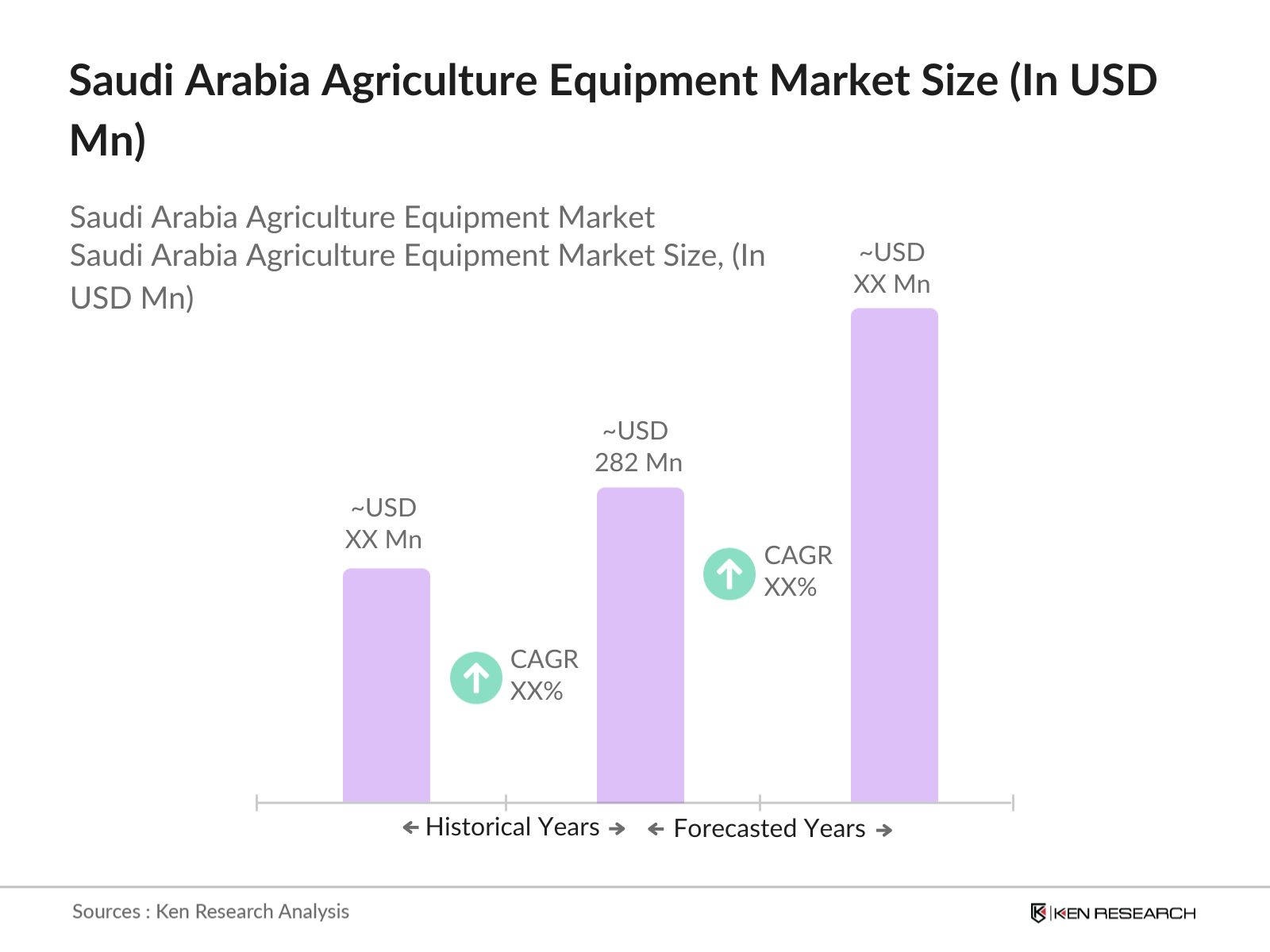
The Saudi Arabia Agriculture Equipment Market is valued at USD 282 million, driven by government incentives, advancements in farming technology, and a focus on sustainability.
Key challenges include the high cost of advanced machinery, limited access to skilled labor for equipment maintenance, and climate-related constraints that affect farming.
Major players include Al-Jazirah Engineers & Consultants, Zamil Industrial, Gulf Agriculture, and Alkhorayef Group, each contributing to the competitive landscape with diverse product offerings.
Growth drivers encompass government subsidies, the push for food security, and technological integration such as IoT and AI, which enhance farming efficiency and sustainability.
Government regulations support the adoption of sustainable farming practices, with subsidies and import regulations favoring modern, environmentally friendly machinery.
Riyadh and the Eastern Province dominate due to their robust farming infrastructure, government investments, and access to essential distribution networks.

What makes us stand out is that our consultants follows Robust, Refine and Result (RRR) methodology. i.e. Robust for clear definitions, approaches and sanity checking, Refine for differentiating respondents facts and opinions and Result for presenting data with story

We have set a benchmark in the industry by offering our clients with syndicated and customized market research reports featuring coverage of entire market as well as meticulous research and analyst insights.

While we don't replace traditional research, we flip the method upside down. Our dual approach of Top Bottom & Bottom Top ensures quality deliverable by not just verifying company fundamentals but also looking at the sector and macroeconomic factors.

With one step in the future, our research team constantly tries to show you the bigger picture. We help with some of the tough questions you may encounter along the way: How is the industry positioned? Best marketing channel? KPI's of competitors? By aligning every element, we help maximize success.

Our report gives you instant access to the answers and sources that other companies might choose to hide. We elaborate each steps of research methodology we have used and showcase you the sample size to earn your trust.

If you need any support, we are here! We pride ourselves on universe strength, data quality, and quick, friendly, and professional service.