
Saudi Arabia Pick-Up Trucks Market Outlook to 2030
Region:Middle East
Author(s):Sanjeev
Product Code:KROD6524
November 2024
82
About the Report
Saudi Arabia Pick-Up Trucks Market Overview
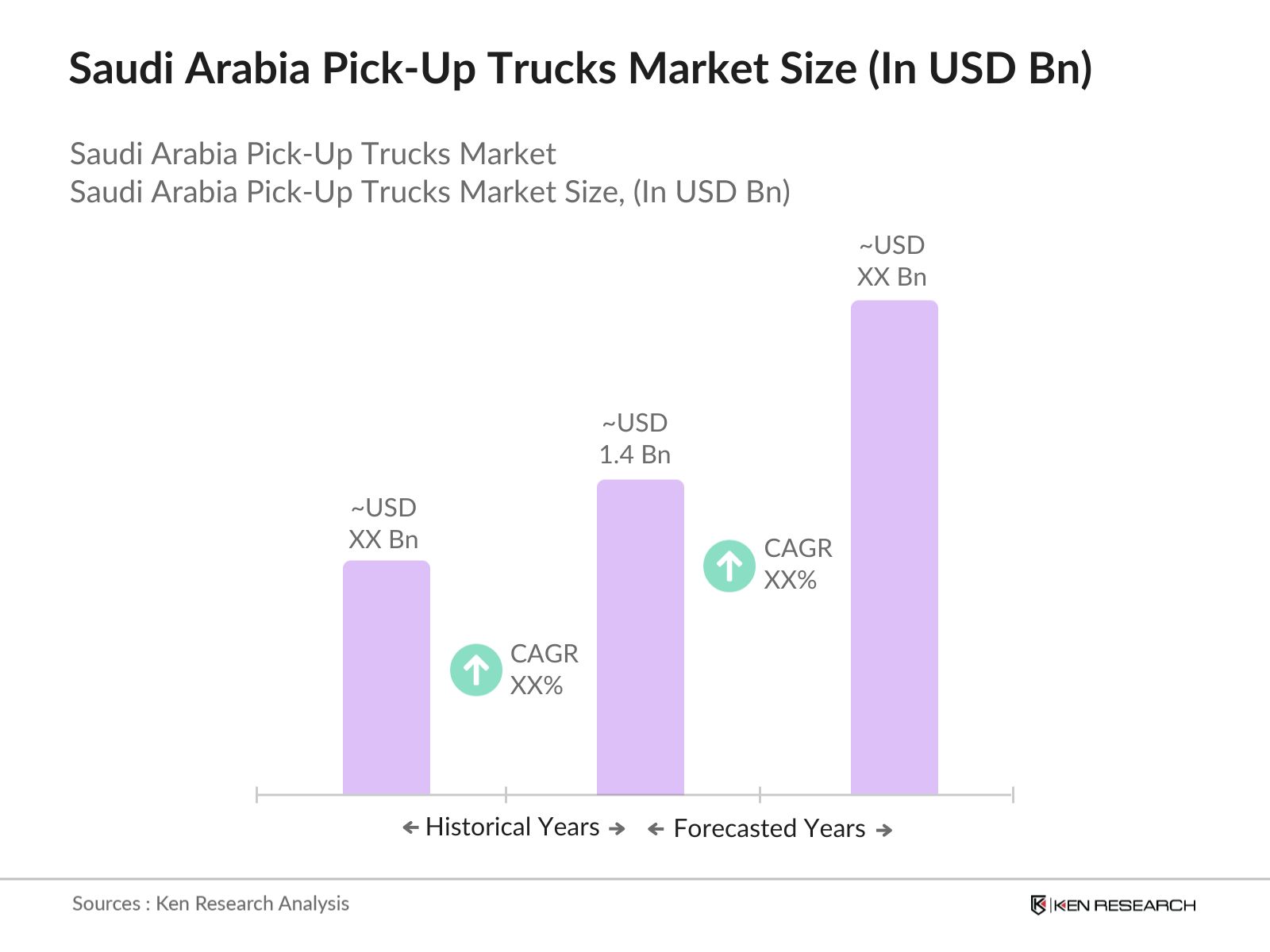
- The Saudi Arabia pick-up truck market is valued at USD 1.4 billion, driven by strong demand from industries such as construction, mining, and logistics. The market's expansion can be attributed to the increasing number of infrastructure projects under the Saudi Vision 2030 initiative, which has bolstered the need for durable and reliable vehicles like pick-up trucks. Additionally, the rising use of pick-up trucks for commercial purposes, particularly in e-commerce and last-mile delivery, has further contributed to market growth.
- The market is primarily dominated by the regions of Riyadh and the Eastern Province, which serve as the economic hubs of Saudi Arabia. These regions lead in infrastructure projects and industrial activities, creating strong demand for heavy-duty and versatile vehicles like pick-up trucks. Riyadh, as the capital, plays a pivotal role due to its large number of construction projects, while the Eastern Province benefits from its proximity to oilfields and industrial zones, driving its dominance in the market.
- Saudi Arabias Vision 2030 transportation plan, launched in 2020, continues to have a profound impact on the automotive market. In 2024, the Kingdom allocated $20 billion to improve transportation infrastructure, focusing on developing road networks, logistics hubs, and public transport systems. The plan promotes the adoption of modern vehicles, including pick-up trucks, to facilitate the transportation needs of growing urban centers like Riyadh and Jeddah.
Saudi Arabia Pick-Up Trucks Market Segmentation
- By Engine Type: The Saudi Arabia pick-up truck market is segmented by engine type into diesel, gasoline, and electric. Recently, diesel engines have dominated the market due to their higher fuel efficiency and performance in off-road and heavy-duty conditions. The demand for diesel pick-up trucks is also fueled by their ability to handle rugged terrains, making them ideal for industries like construction and oil and gas. Gasoline engines, while popular for lighter uses, have seen slower adoption compared to diesel, and electric trucks are still in their nascent stage in this market.

- By Payload Capacity: The market is also segmented by payload capacity into less than 1 ton, 1-3 ton, and more than 3-ton categories. Pick-up trucks with a payload capacity of 1-3 tons hold the largest market share. This segment's dominance is driven by its versatility across industries. These trucks are preferred for commercial applications such as logistics, construction, and agriculture, where they balance fuel efficiency and load-carrying capacity. Their adaptability in handling both urban and rural transport needs has made them highly sought after in the Saudi market.

Saudi Arabia Pick-Up Trucks Market Competitive Landscape
The Saudi Arabia pick-up truck market is highly competitive, with a mix of local and international players. The market is dominated by established brands that have invested in expanding their product offerings to meet the diverse demands of Saudi consumers, particularly in the commercial and industrial sectors. Brands like Toyota and Ford lead the market, offering models known for their durability, advanced features, and fuel efficiency. These brands also benefit from robust distribution networks across the country.
|
Company |
Establishment Year |
Headquarters |
No. of Models |
Production Capacity |
Revenue (USD Bn) |
Local Market Share |
Product Range |
Technological Integration |
|
Toyota |
1937 |
Toyota City, Japan |
||||||
|
Ford Motor Company |
1903 |
Dearborn, Michigan, USA |
||||||
|
Nissan |
1933 |
Yokohama, Japan |
||||||
|
General Motors |
1908 |
Detroit, Michigan, USA |
||||||
|
Isuzu Motors |
1916 |
Tokyo, Japan |
Saudi Arabia Pick-Up Trucks Industry Analysis
Market Growth Drivers
- Expansion of Construction and Mining Sectors: Saudi Arabia's construction and mining sectors are key drivers for pick-up truck demand, as these industries rely heavily on versatile, durable vehicles. In 2024, the Saudi government allocated approximately $61 billion for infrastructure projects, particularly those related to Saudi Vision 2030, which emphasizes the development of new urban centers like NEOM and the Red Sea Project. Additionally, the mining sector is set to grow significantly with the discovery of vast reserves of phosphate and gold, driving demand for heavy-duty pick-up trucks used in off-road conditions.
- Increasing Preference for Fuel-Efficient Vehicles: Fuel efficiency has become a significant consideration in Saudi Arabia, particularly after the government's move towards reducing energy subsidies. In 2024, the Kingdoms push to reduce fuel consumption aligns with its commitment to environmental sustainability under Saudi Vision 2030. The ongoing adoption of fuel-efficient internal combustion engines and hybrid technologies has attracted businesses, particularly in industries such as logistics and construction, to invest in fuel-efficient pick-up trucks, contributing to the market's growth.
- Growing Demand from SMEs for Last-Mile Delivery: The rise of small and medium enterprises (SMEs) in Saudi Arabia, which numbered over 663,000 as of 2023, has created a surge in demand for pick-up trucks, especially for last-mile delivery services. The rapid expansion of e-commerce, spurred by a youthful population and increasing internet penetration, has further intensified this demand. Many SMEs are utilizing pick-up trucks to efficiently manage deliveries across urban and rural areas, capitalizing on the flexibility and load capacity these vehicles offer.
Market Challenges
- High Upfront Costs: The initial cost of pick-up trucks remains a significant challenge for potential buyers, particularly small businesses and individual buyers. The average price of a mid-range pick-up truck in Saudi Arabia in 2024 is approximately $30,000, a considerable investment given current macroeconomic condition. Coupled with increasing interest rates, accessing financing for vehicle purchases has become more difficult, limiting the purchasing power of SMEs and individual entrepreneurs.
- Stringent Emission Standards and Regulations: Saudi Arabia has implemented more stringent emission standards as part of its efforts to reduce carbon emissions under its Saudi Vision 2030 goals. In 2024, the Kingdom rolled out new regulations focusing on lowering vehicle emissions, pushing manufacturers to develop cleaner technologies. These regulations are especially challenging for manufacturers and importers, as meeting them requires additional investment in research and development for compliance, potentially leading to longer lead times and supply chain bottlenecks.
Saudi Arabia Pick-Up Trucks Market Future Outlook
Over the next five years, the Saudi Arabia pick-up truck market is expected to experience significant growth driven by continued investments in infrastructure and construction projects. The market will also benefit from advancements in vehicle technology, including the integration of connected vehicle features and the adoption of electric and hybrid models. Furthermore, the expansion of logistics and transportation networks across Saudi Arabia, particularly in underdeveloped regions, will boost demand for pick-up trucks, creating new opportunities for market players.
Market Opportunities
- Increasing Government Spending on Infrastructure Projects: Saudi Arabias ongoing investment in infrastructure presents an opportunity for the pick-up truck market. In 2024, the government budgeted $91 billion for infrastructure projects as part of its Saudi Vision 2030 initiative, which includes major projects like the NEOM mega-city and the expansion of ports and airports. This is expected to fuel demand for robust and versatile vehicles that can navigate construction sites and deliver materials efficiently, making pick-up trucks an essential asset.
- Adoption of Electric and Hybrid Pick-Up Trucks: Saudi Arabia is gradually adopting electric and hybrid vehicles as part of its Vision 2030 environmental goals, creating new opportunities for pick-up truck manufacturers. In 2023, the government announced tax incentives for electric vehicle (EV) buyers, resulting in a 15% increase in EV registrations, including hybrid and electric pick-up trucks. The trend is expected to continue as more businesses look to modernize their fleets with eco-friendly vehicles, aligning with the government's broader sustainability initiatives.
Scope of the Report
Products
Key Target Audience
Commercial vehicle fleet operators
Construction companies
Agriculture firms
Logistics and transportation firms
Government and regulatory bodies (Ministry of Transport, Saudi Standards, Metrology and Quality Organization)
Automotive manufacturers
Banks and Financial Institutes
Investors and venture capitalist firms
Oil and gas companies
Companies
Players Mention in the Report:
Toyota
Ford Motor Company
Nissan
General Motors
Isuzu Motors
Mitsubishi Motors
Tata Motors
Mazda Motor Corporation
Great Wall Motors
Volkswagen AG
Mahindra & Mahindra
Fiat Chrysler Automobiles (FCA)
Honda Motor Co.
SsangYong Motor Company
Renault SA
Table of Contents
1. Saudi Arabia Pick-Up Trucks Market Overview
1.1. Definition and Scope
1.2. Market Taxonomy
1.3. Market Growth Rate
1.4. Market Segmentation Overview
2. Saudi Arabia Pick-Up Trucks Market Size (In USD Bn)
2.1. Historical Market Size
2.2. Year-On-Year Growth Analysis
2.3. Key Market Developments and Milestones
3. Saudi Arabia Pick-Up Trucks Market Analysis
3.1. Growth Drivers (e.g., Infrastructure Development, Off-road Applications, Rise in E-commerce)
3.1.1. Expansion of construction and mining sectors
3.1.2. Increasing preference for fuel-efficient vehicles
3.1.3. Growing demand from SMEs for last-mile delivery
3.2. Market Challenges (e.g., Supply Chain Disruptions, Regulatory Compliance)
3.2.1. High upfront costs
3.2.2. Stringent emission standards and regulations
3.2.3. Fluctuating fuel prices
3.3. Opportunities (e.g., Fleet Modernization, Technological Integration)
3.3.1. Increasing government spending on infrastructure projects
3.3.2. Adoption of electric and hybrid pick-up trucks
3.3.3. Growth in rural transportation needs
3.4. Trends (e.g., Customization Options, Advanced Safety Features)
3.4.1. Rising demand for connected vehicles (IoT, Telematics)
3.4.2. Shift towards eco-friendly vehicles
3.4.3. Preference for lightweight materials (Aluminum bodies)
3.5. Government Regulation (e.g., Vehicle Import Policies, Environmental Standards)
3.5.1. Implementation of the Saudi Vision 2030 transportation plan
3.5.2. Regulations on carbon emissions and fuel efficiency
3.5.3. Tax incentives for electric vehicle adoption
3.6. SWOT Analysis
3.7. Stakeholder Ecosystem (Manufacturers, Dealers, Suppliers)
3.8. Porters Five Forces
3.9. Competitive Ecosystem
4. Saudi Arabia Pick-Up Trucks Market Segmentation
4.1. By Engine Type (In Value %)
4.1.1. Diesel
4.1.2. Gasoline
4.1.3. Electric
4.2. By Payload Capacity (In Value %)
4.2.1. Less than 1 Ton
4.2.2. 1-3 Ton
4.2.3. More than 3 Ton
4.3. By Drive Type (In Value %)
4.3.1. Two-Wheel Drive
4.3.2. Four-Wheel Drive
4.4. By End-Use Industry (In Value %)
4.4.1. Construction
4.4.2. Agriculture
4.4.3. Logistics and Transportation
4.5. By Region (In Value %)
4.5.1. North
4.5.2. East
4.5.3. West
4.5.4. South
5. Saudi Arabia Pick-Up Trucks Market Competitive Analysis
5.1. Detailed Profiles of Major Companies
5.1.1. Toyota
5.1.2. Ford Motor Company
5.1.3. Nissan
5.1.4. General Motors
5.1.5. Isuzu Motors
5.1.6. Mitsubishi Motors
5.1.7. Tata Motors
5.1.8. Mazda Motor Corporation
5.1.9. Great Wall Motors
5.1.10. Volkswagen AG
5.1.11. Mahindra & Mahindra
5.1.12. Fiat Chrysler Automobiles (FCA)
5.1.13. Honda Motor Co.
5.1.14. SsangYong Motor Company
5.1.15. Renault SA
5.2. Cross Comparison Parameters (No. of Employees, Headquarters, Inception Year, Revenue, Production Capacity, Market Share, Product Range, Technological Adoption)
5.3. Market Share Analysis
5.4. Strategic Initiatives
5.5. Mergers and Acquisitions
5.6. Investment Analysis
5.7. Government Grants and Subsidies
5.8. Private Equity Investments
6. Saudi Arabia Pick-Up Trucks Market Regulatory Framework
6.1. Emission Standards
6.2. Import Restrictions
6.3. Safety Regulations
6.4. Vehicle Testing and Certification Processes
7. Saudi Arabia Pick-Up Trucks Future Market Size (In USD Bn)
7.1. Future Market Size Projections
7.2. Key Factors Driving Future Market Growth
8. Saudi Arabia Pick-Up Trucks Future Market Segmentation
8.1. By Engine Type (In Value %)
8.2. By Payload Capacity (In Value %)
8.3. By Drive Type (In Value %)
8.4. By End-Use Industry (In Value %)
8.5. By Region (In Value %)
9. Saudi Arabia Pick-Up Trucks Market Analysts Recommendations
9.1. TAM/SAM/SOM Analysis
9.2. Customer Cohort Analysis
9.3. Marketing Initiatives
9.4. White Space Opportunity Analysis
Research Methodology
Step 1: Identification of Key Variables
The initial phase involves identifying the key stakeholders in the Saudi Arabia pick-up truck market, including manufacturers, suppliers, and buyers. This process relies on extensive desk research using both proprietary and publicly available databases to gather critical market data.
Step 2: Market Analysis and Construction
This phase includes the collection and analysis of historical data, including market penetration rates and revenue generation by pick-up truck manufacturers. The data is used to evaluate market trends and the impact of various external factors on the markets performance.
Step 3: Hypothesis Validation and Expert Consultation
Market hypotheses are developed and validated through interviews with industry experts and stakeholders, who provide insights into market trends, challenges, and future opportunities. These consultations are critical for ensuring the accuracy of the collected data.
Step 4: Research Synthesis and Final Output
The final phase involves integrating feedback from industry participants, including vehicle manufacturers, and performing a bottom-up analysis to validate the market size and growth projections. The data is then compiled into the final report.
Frequently Asked Questions
01. How big is the Saudi Arabia pick-up truck market?
The Saudi Arabia pick-up truck market is valued at USD 1.4 billion, driven by the growing demand from construction, logistics, and industrial sectors across the country.
02. What are the challenges in the Saudi Arabia pick-up truck market?
Challenges in the Saudi Arabia pick-up truck market include high upfront costs, fluctuating fuel prices, and strict environmental regulations imposed by the government.
03. Who are the major players in the Saudi Arabia pick-up truck market?
Key players in the Saudi Arabia pick-up truck market include Toyota, Ford, Nissan, General Motors, and Isuzu Motors, dominating the market due to their extensive product range and advanced technological features.
04. What are the growth drivers of the Saudi Arabia pick-up truck market?
The Saudi Arabia pick-up truck market is driven by infrastructure development, rising e-commerce activities, and government projects under the Saudi Vision 2030 initiative, which demand durable and versatile vehicles like pick-up trucks.
05. How is the pick-up truck market segmented in Saudi Arabia?
The Saudi Arabia pick-up truck market is segmented by engine type (diesel, gasoline, and electric) and payload capacity (less than 1 ton, 1-3 ton, and more than 3 ton), with diesel and 13-ton capacity trucks dominating the market share due to their performance and versatility.
Why Buy From Us?

What makes us stand out is that our consultants follows Robust, Refine and Result (RRR) methodology. i.e. Robust for clear definitions, approaches and sanity checking, Refine for differentiating respondents facts and opinions and Result for presenting data with story

We have set a benchmark in the industry by offering our clients with syndicated and customized market research reports featuring coverage of entire market as well as meticulous research and analyst insights.

While we don't replace traditional research, we flip the method upside down. Our dual approach of Top Bottom & Bottom Top ensures quality deliverable by not just verifying company fundamentals but also looking at the sector and macroeconomic factors.

With one step in the future, our research team constantly tries to show you the bigger picture. We help with some of the tough questions you may encounter along the way: How is the industry positioned? Best marketing channel? KPI's of competitors? By aligning every element, we help maximize success.

Our report gives you instant access to the answers and sources that other companies might choose to hide. We elaborate each steps of research methodology we have used and showcase you the sample size to earn your trust.

If you need any support, we are here! We pride ourselves on universe strength, data quality, and quick, friendly, and professional service.