
Saudi Arabian Food & Grocery Retail Market Outlook to 2030
Region:Middle East
Author(s):Shivani Mehra
Product Code:KROD11441
November 2024
94
About the Report
Saudi Arabian Food & Grocery Retail Market Overview
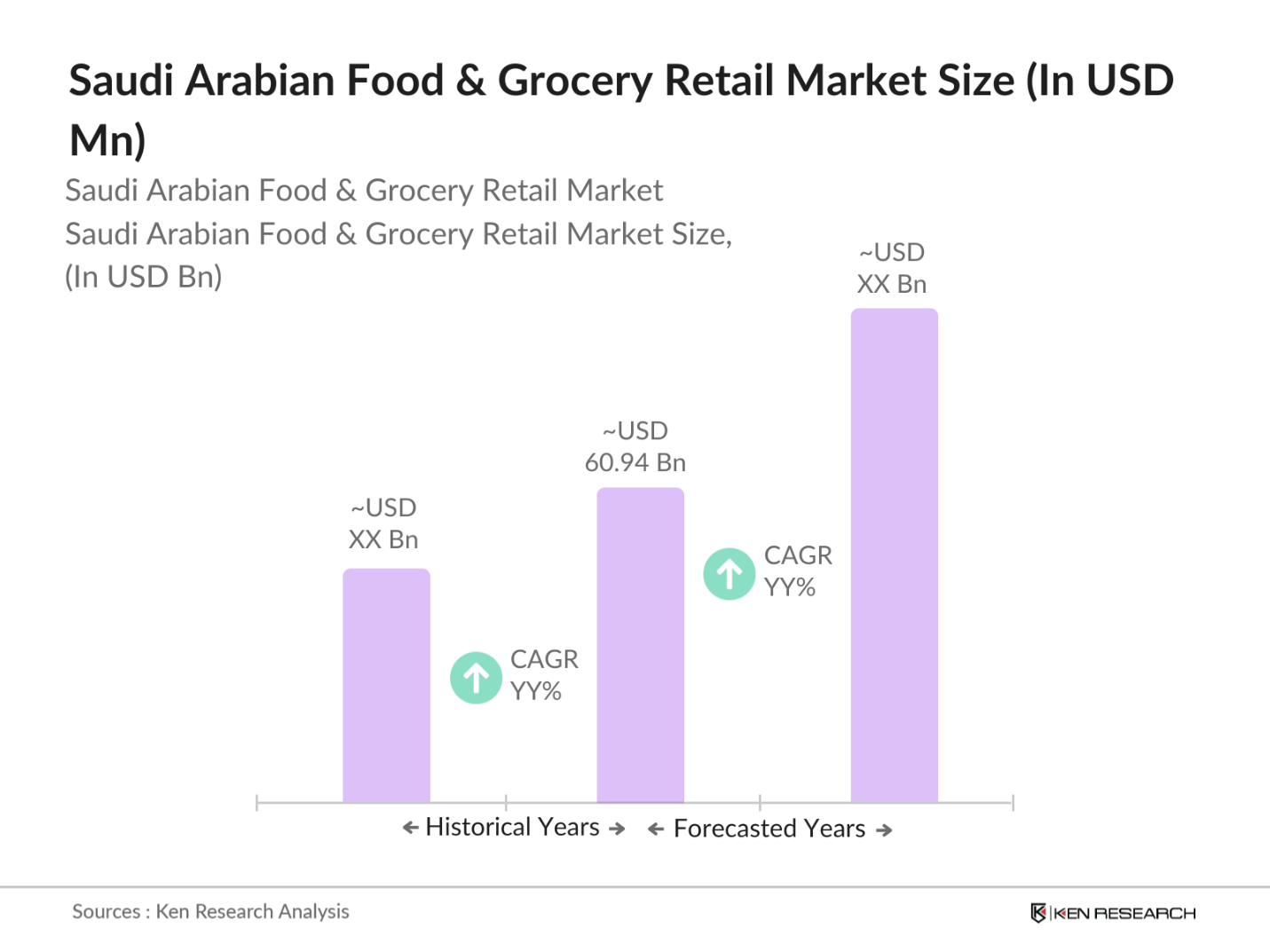
- The Saudi Arabian food and grocery retail market is valued at USD 60.94 billion, influenced by a growing population and increased consumer spending on food and groceries. Key drivers include urbanisation, with cities like Riyadh and Jeddah witnessing significant retail expansion, alongside a shift towards modern retail formats.
- Dominant cities in this market include Riyadh, Jeddah, and Dammam. Riyadh, as the capital, serves as a commercial hub with a diverse population that drives demand for a wide range of food products. Jeddah, being a major port city, benefits from its logistics capabilities, facilitating the import of various food items. Dammam, located in the Eastern Province, complements these markets with its strategic industrial presence, creating a robust retail landscape.
- Food safety standards in Saudi Arabia are stringent, with the Saudi Food and Drug Authority overseeing compliance. In 2023, of retailers reported that adherence to food safety regulations is a top priority, as violations can lead to significant fines and product recalls. Current regulations emphasize the importance of traceability, hygiene, and quality control in food products. In response, retailers are investing in training programs for staff to ensure compliance, which is essential for maintaining consumer trust and brand reputation in a competitive market.
Saudi Arabian Food & Grocery Retail Market Segmentation
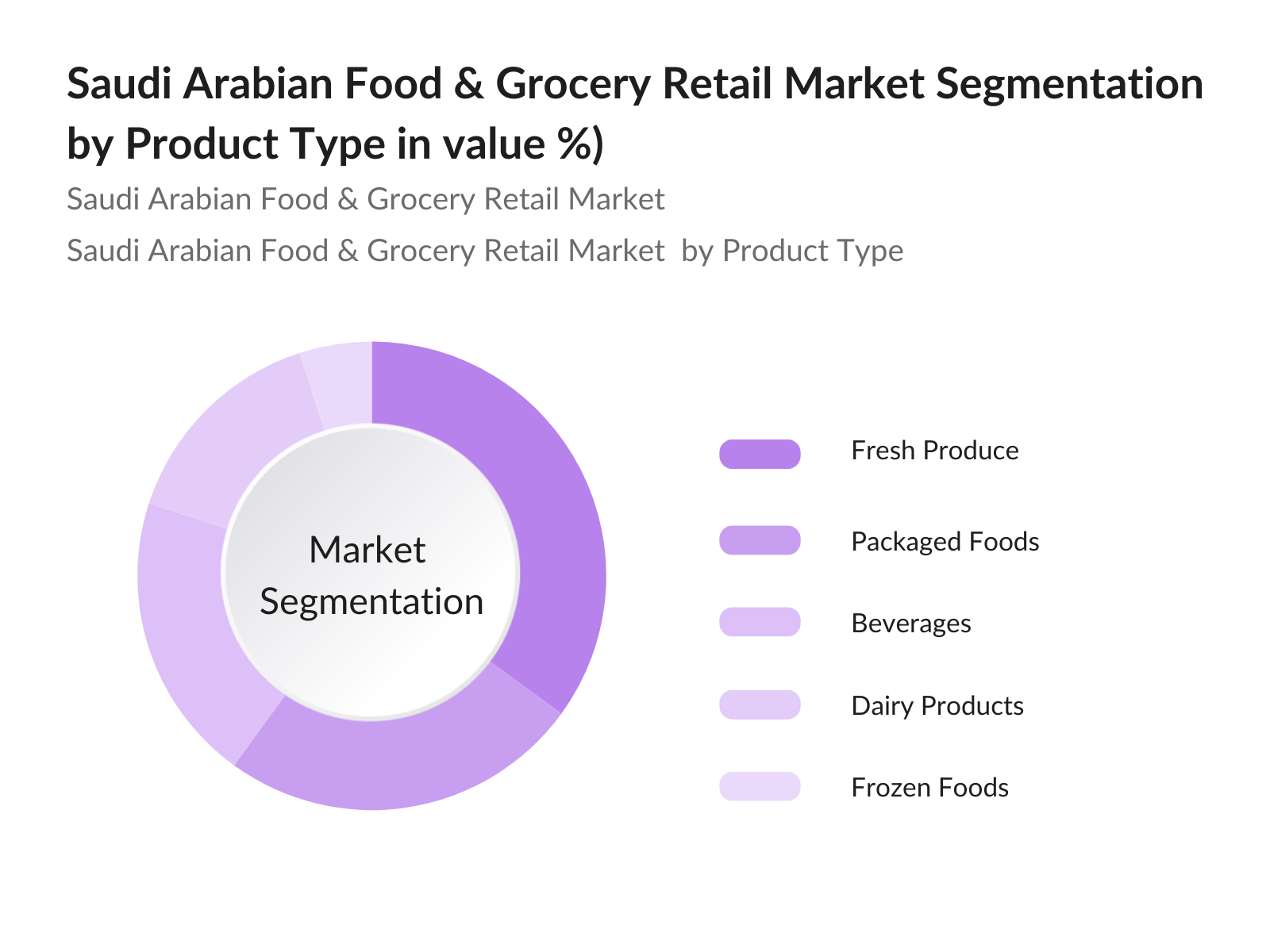
- By Product Type: The Saudi Arabian food and grocery retail market is segmented by product type into fresh produce, packaged foods, beverages, dairy products, and frozen foods. Among these segments, fresh produce holds a significant market share, primarily driven by the increasing consumer preference for healthy and organic food options. With consumers becoming more health-conscious, the demand for fresh fruits and vegetables has surged, leading retailers to enhance their supply chains to ensure the availability of high-quality products.
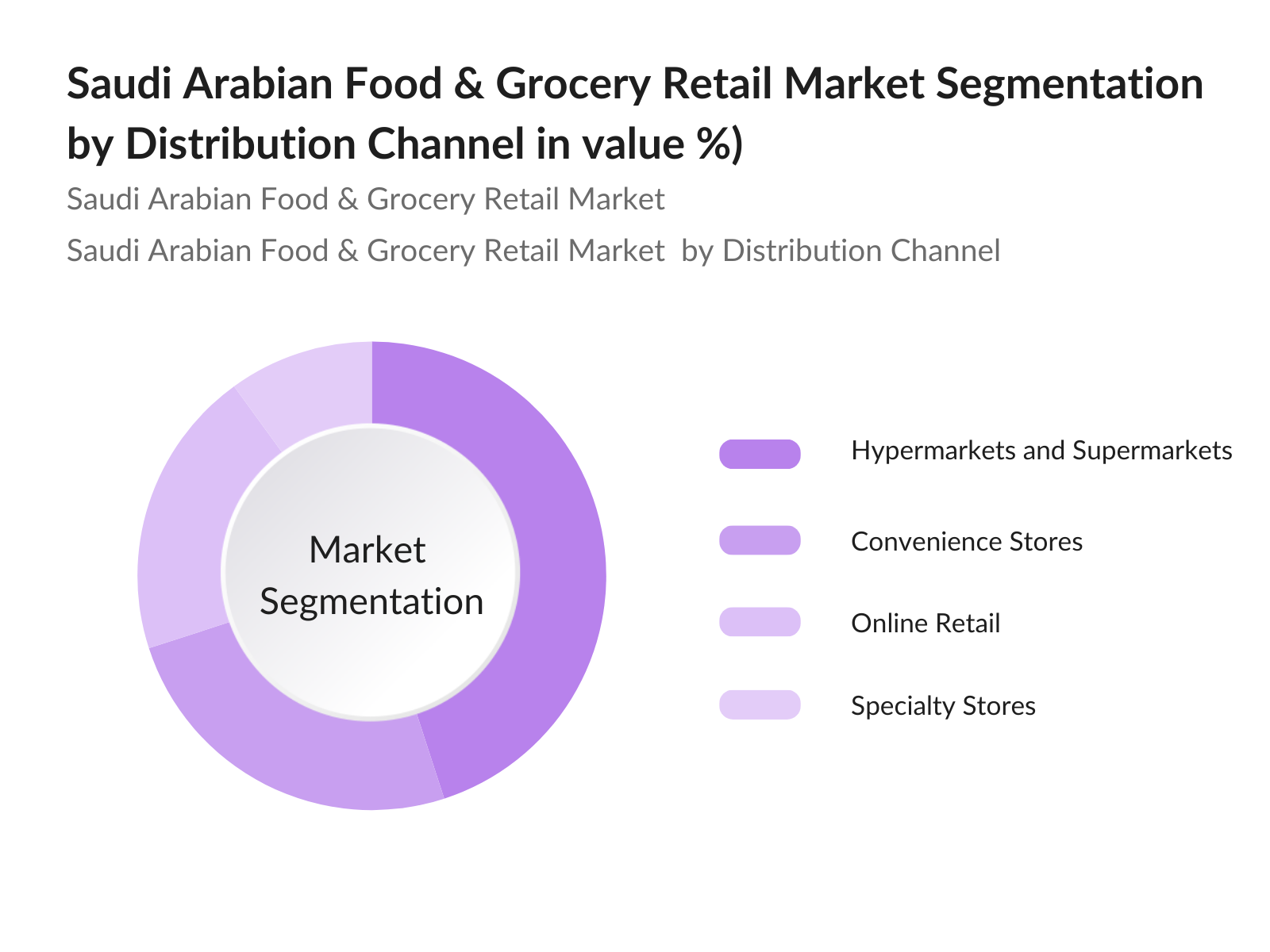
- By Distribution Channel: The market is also segmented by distribution channel into hypermarkets and supermarkets, convenience stores, online retail, and specialty stores. Hypermarkets and supermarkets dominate this segment, attributed to their ability to offer a wide variety of products under one roof, catering to the diverse needs of consumers. These formats have also invested significantly in enhancing the shopping experience through improved store layouts and customer service, further solidifying their leading position in the market.
Saudi Arabian Food & Grocery Retail Market Competitive Landscape
The Saudi Arabian food and grocery retail market is dominated by several major players, including local retailers and international chains. Key players include:
|
Company |
Establishment Year |
Headquarters |
Market Share |
Number of Outlets |
Product Range |
Online Presence |
Loyalty Programs |
Private Label Brands |
|
Al Othaim Markets |
1997 |
Riyadh |
- |
- |
- |
- |
- |
- |
|
Carrefour |
1992 |
Riyadh |
- |
- |
- |
- |
- |
- |
|
Panda Retail Company |
1978 |
Jeddah |
- |
- |
- |
- |
- |
- |
|
Lulu Hypermarket |
1995 |
Abu Dhabi |
- |
- |
- |
- |
- |
- |
|
Tamimi Markets |
1979 |
Riyadh |
- |
- |
- |
- |
- |
- |
Saudi Arabian Food & Grocery Retail Market Analysis
Market Growth Drivers
- Increasing Urbanization: Urbanization in Saudi Arabia is accelerating, with the urban population projected to reach approximately 84 million by 2025, increasing from 80 million in 2022. This urban expansion drives demand for food and grocery retail, as urban centers provide a higher concentration of consumers seeking diverse retail options. Additionally, urban areas tend to have better infrastructure and access to modern retail formats, fostering a shift toward supermarkets and hypermarkets. The increase in urban dwellers is also linked to higher consumption patterns, with urban households spending around SAR 8,000 more on groceries annually compared to their rural counterparts.
- Rise in Disposable Income: Disposable income in Saudi Arabia has been rising steadily, with estimates indicating an average of approximately SAR 110,000 per household. This growth is attributed to government initiatives aimed at diversifying the economy, emphasizing increased job creation and higher salaries across various sectors. As disposable income increases, consumers are likely to spend more on premium food products and health-conscious options, thereby boosting the grocery retail market. In 2023, the average household expenditure on food reached SAR 7,000 per month, reflecting changing consumer behaviors toward higher-quality grocery items.
- Government Initiatives Supporting Retail Growth: The Saudi government has launched several initiatives to support retail growth, such as easing regulations and promoting investment in the retail sector. The establishment of the Saudi Retail Development Program aims to enhance the competitiveness of retail businesses by providing financial support and fostering innovation. In 2023, investments in the retail sector reached SAR 12 billion, with government-backed projects focusing on modernizing supply chains and enhancing consumer experience. This proactive approach not only facilitates the growth of traditional retail but also encourages the expansion of e-commerce platforms in the grocery sector.
Market Challenges:
- Competition from E-commerce: The rapid growth of e-commerce poses significant challenges to traditional grocery retail in Saudi Arabia. In 2023, online grocery sales accounted for approximately SAR 4 billion, highlighting a shift in consumer purchasing behavior. The convenience of home delivery and the availability of diverse products online are enticing consumers away from physical stores. Established retailers are struggling to compete with e-commerce giants that offer competitive pricing and faster delivery services, forcing them to invest in their digital platforms to retain market share.
- Regulatory Compliance: Compliance with regulatory standards in food safety and quality poses challenges for grocery retailers in Saudi Arabia. The introduction of stringent food safety regulations requires retailers to invest in compliance measures, including staff training and technology upgrades. In 2023, a significant number of retailers indicated that meeting these regulatory requirements increased operational costs substantially. Non-compliance could result in hefty fines and damage to brand reputation, making it imperative for retailers to stay informed and proactive in regulatory adherence.
Saudi Arabian Food & Grocery Retail Market Future Outlook
Over the next five years, the Saudi Arabian food and grocery retail market is expected to experience significant growth, driven by the increasing population, urbanization, and evolving consumer preferences for quality and convenience. The shift towards online retail and the expansion of modern retail formats will also play crucial roles in shaping the market landscape. Additionally, government initiatives to enhance food security and support local agriculture will further bolster the sector.
Market Opportunities:
- Health and Wellness Focus: The health and wellness trend continues to shape consumer choices in the grocery retail market. In 2023, a significant number of consumers actively sought out healthier food options, driving a surge in demand for organic and functional foods. Retailers are increasingly expanding their health-oriented product lines to cater to this demographic, with sales of health-focused products experiencing notable growth compared to the previous year. This trend aligns with the Saudi government's emphasis on promoting healthier lifestyles among its citizens, thereby transforming the grocery landscape towards better nutrition.
- Omnichannel Retail Strategies: The adoption of omnichannel retail strategies is reshaping the grocery shopping experience in Saudi Arabia. Retailers are integrating physical and online channels to provide consumers with a seamless shopping experience. In 2023, many retailers have implemented click-and-collect services, allowing consumers to order online and pick up in-store. This trend caters to consumer preferences for flexibility and convenience, with a large portion of consumers expressing a desire for integrated shopping experiences. The omnichannel approach is becoming essential for retailers to enhance customer satisfaction and loyalty.
Scope of the Report
|
By Product Type |
Fresh Produce Packaged Foods Beverages Dairy Products Frozen Foods |
|
By Distribution Channel |
Hypermarkets and Supermarkets Convenience Stores Online Retail Specialty Stores |
|
By Consumer Demographics |
Age Groups Income Levels Family Size |
|
By Retail Format |
Traditional Retail Modern Retail |
|
By Region |
North-East Midwest West Coast Southern States |
Products
Key Target Audience
Retail Investors
Food Manufacturers
Grocery Distributors
Supply Chain Firms
E-commerce Platforms
Food Safety Regulatory Bodies (Saudi Food and Drug Authority)
Investments and Venture Capitalist Firms
Government and Regulatory Bodies (Ministry of Commerce and Investment)
Companies
Players mentioned in the report
Al Othaim Markets
Carrefour
Panda Retail Company
Lulu Hypermarket
Tamimi Markets
Danube Company
Extra Stores
Bin Dawood
Nesto Hypermarket
Monoprix
Saco World
Al-Ma'adeed Group
Farm Superstores
Spar Saudi Arabia
Othaim Holding
Table of Contents
1. Saudi Arabian Food & Grocery Retail Market Overview
1.1. Definition and Scope
1.2. Market Taxonomy
1.3. Market Growth Rate
1.4. Market Segmentation Overview
2. Saudi Arabian Food & Grocery Retail Market Size (In USD Mn)
2.1. Historical Market Size
2.2. Year-On-Year Growth Analysis
2.3. Key Market Developments and Milestones
3. Saudi Arabian Food & Grocery Retail Market Analysis
3.1. Growth Drivers
3.1.1. Increasing Urbanization
3.1.2. Rise in Disposable Income
3.1.3. Government Initiatives Supporting Retail Growth
3.1.4. Changing Consumer Preferences
3.2. Market Challenges
3.2.1. Competition from E-commerce
3.2.2. Supply Chain Disruptions
3.2.3. Regulatory Compliance
3.3. Opportunities
3.3.1. Expansion of E-commerce Platforms
3.3.2. Growth of Private Label Brands
3.3.3. Technological Innovations in Retail
3.4. Trends
3.4.1. Sustainability in Food Products
3.4.2. Health and Wellness Focus
3.4.3. Omnichannel Retail Strategies
3.5. Government Regulations
3.5.1. Food Safety Standards
3.5.2. Import Regulations
3.5.3. Labeling Requirements
3.6. SWOT Analysis
3.7. Stakeholder Ecosystem
3.8. Porters Five Forces
3.9. Competition Ecosystem
4. Saudi Arabian Food & Grocery Retail Market Segmentation
4.1. By Product Type (In Value %)
4.1.1. Fresh Produce
4.1.2. Packaged Foods
4.1.3. Beverages
4.1.4. Dairy Products
4.1.5. Frozen Foods
4.2. By Distribution Channel (In Value %)
4.2.1. Hypermarkets and Supermarkets
4.2.2. Convenience Stores
4.2.3. Online Retail
4.2.4. Specialty Stores
4.3. By Consumer Demographics (In Value %)
4.3.1. Age Groups
4.3.2. Income Levels
4.3.3. Family Size
4.4. By Region (In Value %)
4.4.1. Riyadh
4.4.2. Jeddah
4.4.3. Dammam
4.4.4. Mecca
4.4.5. Medina
4.5. By Retail Format (In Value %)
4.5.1. Traditional Retail
4.5.2. Modern Retail
5. Saudi Arabian Food & Grocery Retail Market Competitive Analysis
5.1. Detailed Profiles of Major Companies
5.1.1. Al Othaim Markets
5.1.2. Carrefour (Majid Al Futtaim)
5.1.3. Panda Retail Company
5.1.4. Lulu Hypermarket
5.1.5. Tamimi Markets
5.1.6. Danube Company
5.1.7. Saco World
5.1.8. Othaim Holding
5.1.9. Farm Superstores
5.1.10. Al-Ma'adeed Group
5.1.11. Extra Stores
5.1.12. Bin Dawood
5.1.13. Nesto Hypermarket
5.1.14. Monoprix
5.1.15. Spar Saudi Arabia
5.2. Cross Comparison Parameters (Market Share, Revenue, Number of Stores, Geographic Presence, Product Range, Customer Satisfaction, Online Presence, Brand Loyalty)
5.3. Market Share Analysis
5.4. Strategic Initiatives
5.5. Mergers and Acquisitions
5.6. Investment Analysis
5.7. Venture Capital Funding
5.8. Government Grants
5.9. Private Equity Investments
6. Saudi Arabian Food & Grocery Retail Market Regulatory Framework
6.1. Food Safety Regulations
6.2. Import and Export Regulations
6.3. Certification Processes
7. Saudi Arabian Food & Grocery Retail Market Future Size (In USD Mn)
7.1. Future Market Size Projections
7.2. Key Factors Driving Future Market Growth
8. Saudi Arabian Food & Grocery Retail Market Future Segmentation
8.1. By Product Type (In Value %)
8.2. By Distribution Channel (In Value %)
8.3. By Consumer Demographics (In Value %)
8.4. By Region (In Value %)
8.5. By Retail Format (In Value %)
9. Saudi Arabian Food & Grocery Retail Market Analysts Recommendations
9.1. TAM/SAM/SOM Analysis
9.2. Customer Cohort Analysis
9.3. Marketing Initiatives
9.4. White Space Opportunity Analysis
Research Methodology
Step 1: Identification of Key Variables
The initial phase involves constructing an ecosystem map encompassing all major stakeholders within the Saudi Arabian food and grocery retail market. This step is underpinned by extensive desk research, utilizing a combination of secondary and proprietary databases to gather comprehensive industry-level information. The primary objective is to identify and define the critical variables that influence market dynamics.
Step 2: Market Analysis and Construction
In this phase, we will compile and analyze historical data pertaining to the Saudi Arabian food and grocery retail market. This includes assessing market penetration, the ratio of marketplaces to service providers, and the resultant revenue generation. Furthermore, an evaluation of service quality statistics will be conducted to ensure the reliability and accuracy of the revenue estimates.
Step 3: Hypothesis Validation and Expert Consultation
Market hypotheses will be developed and subsequently validated through computer-assisted telephone interviews (CATIs) with industry experts representing a diverse array of companies. These consultations will provide valuable operational and financial insights directly from industry practitioners, which will be instrumental in refining and corroborating the market data.
Step 4: Research Synthesis and Final Output
The final phase involves direct engagement with multiple food and grocery retail manufacturers to acquire detailed insights into product segments, sales performance, consumer preferences, and other pertinent factors. This interaction will serve to verify and complement the statistics derived from the bottom-up approach, thereby ensuring a comprehensive, accurate, and validated analysis of the Saudi Arabian food and grocery retail market.
Frequently Asked Questions
01. How big is the Saudi Arabian food and grocery retail market?
The Saudi Arabian food and grocery retail market is valued at USD 60.94 billion, driven by increasing consumer spending, urbanization, and a growing population.
02. What are the challenges in the Saudi Arabian food and grocery retail market?
Challenges include intense competition among retailers, the need for technological advancements, and regulatory compliance, which can impact operational efficiency and profitability.
03. Who are the major players in the Saudi Arabian food and grocery retail market?
Key players include Al Othaim Markets, Carrefour, Panda Retail Company, and Lulu Hypermarket, known for their extensive distribution networks and diverse product offerings.
04. What are the growth drivers of the Saudi Arabian food and grocery retail market?
The market is propelled by factors such as urbanization, increasing disposable income, and changing consumer preferences for convenience and quality in food products.
Why Buy From Us?

What makes us stand out is that our consultants follows Robust, Refine and Result (RRR) methodology. i.e. Robust for clear definitions, approaches and sanity checking, Refine for differentiating respondents facts and opinions and Result for presenting data with story

We have set a benchmark in the industry by offering our clients with syndicated and customized market research reports featuring coverage of entire market as well as meticulous research and analyst insights.

While we don't replace traditional research, we flip the method upside down. Our dual approach of Top Bottom & Bottom Top ensures quality deliverable by not just verifying company fundamentals but also looking at the sector and macroeconomic factors.

With one step in the future, our research team constantly tries to show you the bigger picture. We help with some of the tough questions you may encounter along the way: How is the industry positioned? Best marketing channel? KPI's of competitors? By aligning every element, we help maximize success.

Our report gives you instant access to the answers and sources that other companies might choose to hide. We elaborate each steps of research methodology we have used and showcase you the sample size to earn your trust.

If you need any support, we are here! We pride ourselves on universe strength, data quality, and quick, friendly, and professional service.