
South America Non-Lethal Weapons Market Outlook to 2030
Region:Anguilla
Author(s):Yogita Sahu
Product Code:KROD4791
Region:Anguilla
Author(s):Yogita Sahu
Product Code:KROD4791
December 2024
98
By Weapon Type: The market is segmented by weapon type into chemical agents, impact munitions, electroshock devices, and directed energy weapons. Currently, chemical agents hold a dominant market share within this segment. The high usage of tear gas and pepper spray for crowd control and public safety in urban settings drives the popularity of chemical agents. Law enforcement agencies in South America favor these products due to their effectiveness in incapacitating individuals temporarily, which aligns with the regions approach toward non-lethal compliance.

By Application: The market is segmented by application into law enforcement, military, private security, and civilian and personal defense. Law enforcement dominates the application segment, driven by government investments in non-lethal weapons for domestic security and public order maintenance. Law enforcement agencies are the primary buyers of non-lethal weapons due to the need for effective crowd control methods that reduce fatalities and comply with human rights standards.

The market is led by several major players who drive technological innovation and strategic partnerships within the region. Key companies dominate the market by offering a wide range of non-lethal solutions, from electroshock devices to directed energy weapons, to law enforcement and private security sectors.

Over the next five years, the South America Non-Lethal Weapons industry is expected to grow due to the ongoing development in crowd control technologies, government focus on non-lethal security solutions, and rising demand for public safety measures.
|
Type |
Chemical Agents |
|
Application |
Law Enforcement |
|
Technology |
Kinetic |
|
Distribution Channel |
Direct Sales |
|
Region |
Brazil |
1.1. Definition and Scope
1.2. Market Taxonomy
1.3. Market Dynamics Overview
1.4. Market Segmentation Summary
2.1. Historical Market Size
2.2. Current Market Size Analysis
2.3. Key Developments and Milestones in Market
3.1. Market Drivers
3.1.1. Rising Demand in Law Enforcement Agencies
3.1.2. Increased Civil Unrest and Protests
3.1.3. Government Support for Non-Lethal Solutions
3.1.4. Technological Advancements in Non-Lethal Technologies
3.2. Market Challenges
3.2.1. Ethical Concerns and Public Perception
3.2.2. Regulatory and Compliance Barriers
3.2.3. High Initial Investment and Maintenance Costs
3.3. Opportunities
3.3.1. Expansion into Private Security Sector
3.3.2. Growing Demand for Crowd Control Solutions
3.3.3. International Collaboration and Export Potential
3.4. Trends
3.4.1. Adoption of Non-Lethal Drones
3.4.2. Integration of Non-Lethal Systems in Smart Surveillance
3.4.3. Use of AI-Enabled Non-Lethal Technologies
4.1. By Type (In Value %)
4.1.1. Chemical Agents
4.1.2. Impact Munitions
4.1.3. Electroshock Devices
4.1.4. Directed Energy Weapons
4.1.5. Others
4.2. By Application (In Value %)
4.2.1. Law Enforcement
4.2.2. Military
4.2.3. Private Security
4.2.4. Civilian and Personal Defense
4.3. By Technology (In Value %)
4.3.1. Kinetic
4.3.2. Acoustic
4.3.3. Optical
4.3.4. Others
4.4. By Distribution Channel (In Value %)
4.4.1. Direct Sales
4.4.2. Distributors
4.4.3. Online Retail
4.5. By Region (In Value %)
4.5.1. Brazil
4.5.2. Argentina
4.5.3. Colombia
4.5.4. Chile
4.5.5. Rest of South America
5.1. Detailed Profiles of Major Companies
5.1.1. Axon Enterprise, Inc.
5.1.2. Condor Non-Lethal Technologies
5.1.3. Rheinmetall AG
5.1.4. AMTEC Less-Lethal Systems, Inc.
5.1.5. Safariland, LLC
5.1.6. NonLethal Technologies, Inc.
5.1.7. BAE Systems, Inc.
5.1.8. Lamperd Less Lethal Inc.
5.1.9. FN Herstal
5.1.10. United Tactical Systems
5.1.11. Sage Control Ordnance, Inc.
5.1.12. Combined Systems, Inc.
5.1.13. Alsetex
5.1.14. Brgger & Thomet AG
5.1.15. Mace Security International
5.2. Cross-Comparison Parameters (Annual Revenue, Regional Presence, Product Range, Innovation Index, R&D Investment, Market Share, Key Partnerships, Strategic Initiatives)
5.3. Market Share Analysis
5.4. Strategic Initiatives
5.5. Mergers and Acquisitions
5.6. Investment Analysis
6.1. Regional Regulations
6.2. Compliance Standards
6.3. Certification Processes
6.4. Import and Export Regulations
7.1. Future Market Size Projections
7.2. Key Growth Catalysts
8.1. By Type (Future Value %)
8.2. By Application (Future Value %)
8.3. By Technology (Future Value %)
8.4. By Distribution Channel (Future Value %)
8.5. By Region (Future Value %)
9.1. Total Addressable Market (TAM) Analysis
9.2. Serviceable Available Market (SAM) Analysis
9.3. Strategy Optimization for Key Players
9.4. Emerging Opportunities in Non-Lethal Innovation
Disclaimer Contact Us
This stage involves mapping the South American Non-Lethal Weapons market landscape, covering primary stakeholders. An extensive desk research process was conducted to identify key variables that drive market growth and dynamics, such as regulatory support and technology advancements.
Historical data on market size, demand drivers, and product penetration was gathered and analyzed. Market segmentation and demand across applications like law enforcement and military were assessed to establish foundational insights on non-lethal technology's role in public safety.
Industry insights were validated through consultations with non-lethal weapon manufacturers and security professionals, utilizing a computer-assisted interview process. This step enabled the refinement of assumptions and provided operational insights directly from industry stakeholders.
A comprehensive synthesis of data from market players and historical trends provided a detailed market forecast. Final output included insights on non-lethal technology demand, regional preferences, and consumer patterns, delivering a robust analysis of the South American Non-Lethal Weapons market.
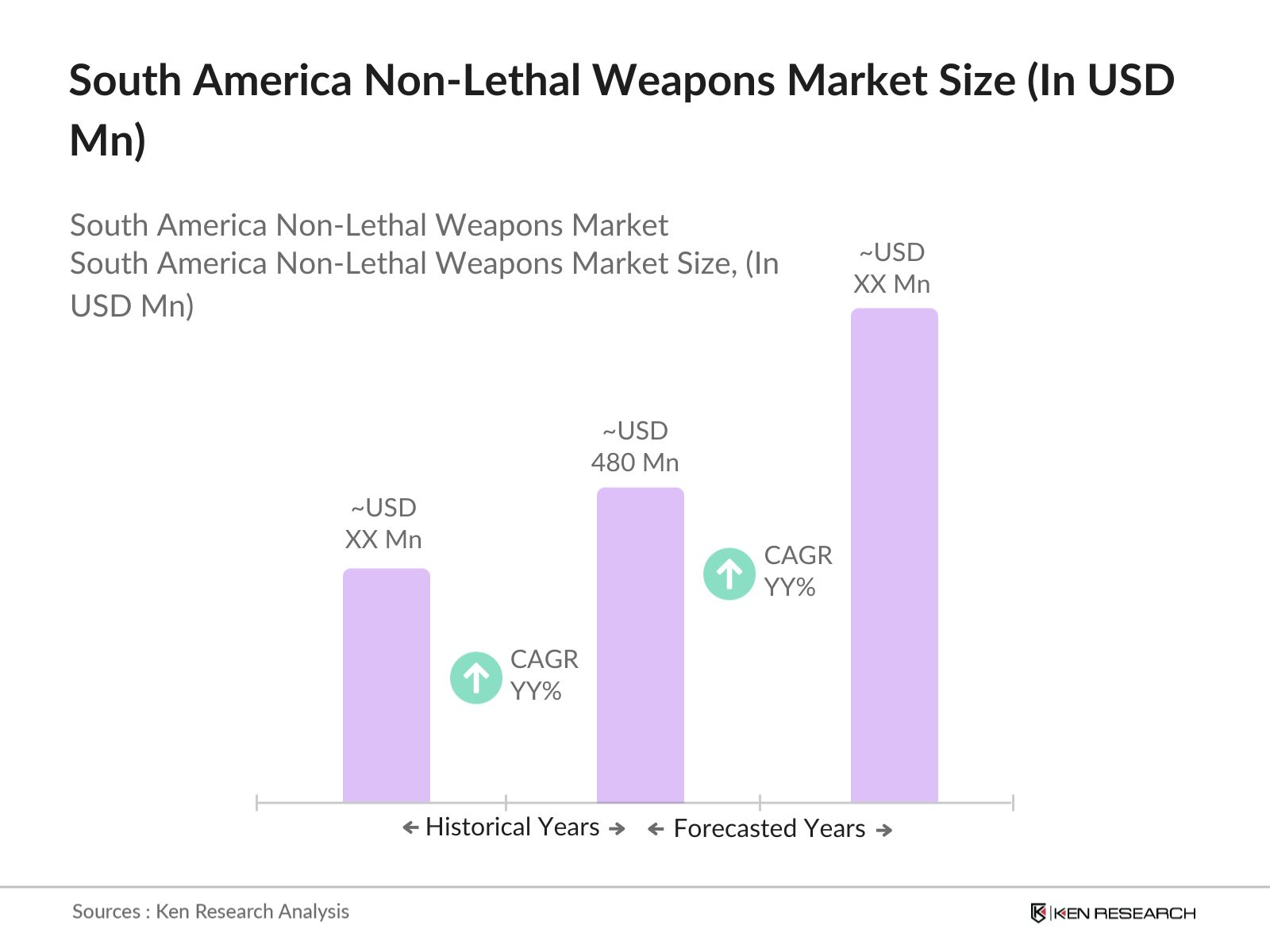
The South America Non-Lethal Weapons market is valued at USD 480 million, driven by increasing public safety measures and the adoption of non-lethal technologies in law enforcement.
Major challenges in the South America Non-Lethal Weapons market include regulatory hurdles, high initial investment costs, and public perception issues regarding the ethical use of non-lethal weapons.
Key players in the South America Non-Lethal Weapons market include Axon Enterprise, Condor Non-Lethal Technologies, Rheinmetall AG, and BAE Systems, which dominate due to their product range and partnerships with government agencies.
The South America Non-Lethal Weapons market is driven by rising demand from law enforcement for crowd control, government support for non-lethal alternatives, and advancements in non-lethal technology.

What makes us stand out is that our consultants follows Robust, Refine and Result (RRR) methodology. i.e. Robust for clear definitions, approaches and sanity checking, Refine for differentiating respondents facts and opinions and Result for presenting data with story

We have set a benchmark in the industry by offering our clients with syndicated and customized market research reports featuring coverage of entire market as well as meticulous research and analyst insights.

While we don't replace traditional research, we flip the method upside down. Our dual approach of Top Bottom & Bottom Top ensures quality deliverable by not just verifying company fundamentals but also looking at the sector and macroeconomic factors.

With one step in the future, our research team constantly tries to show you the bigger picture. We help with some of the tough questions you may encounter along the way: How is the industry positioned? Best marketing channel? KPI's of competitors? By aligning every element, we help maximize success.

Our report gives you instant access to the answers and sources that other companies might choose to hide. We elaborate each steps of research methodology we have used and showcase you the sample size to earn your trust.

If you need any support, we are here! We pride ourselves on universe strength, data quality, and quick, friendly, and professional service.