















US Agricultural Machinery Market Outlook to 2030
Region:North America
Author(s):Shubham Kashyap
Product Code:KROD428
October 2024
94
About the Report
US Agricultural Machinery Market Overview
-
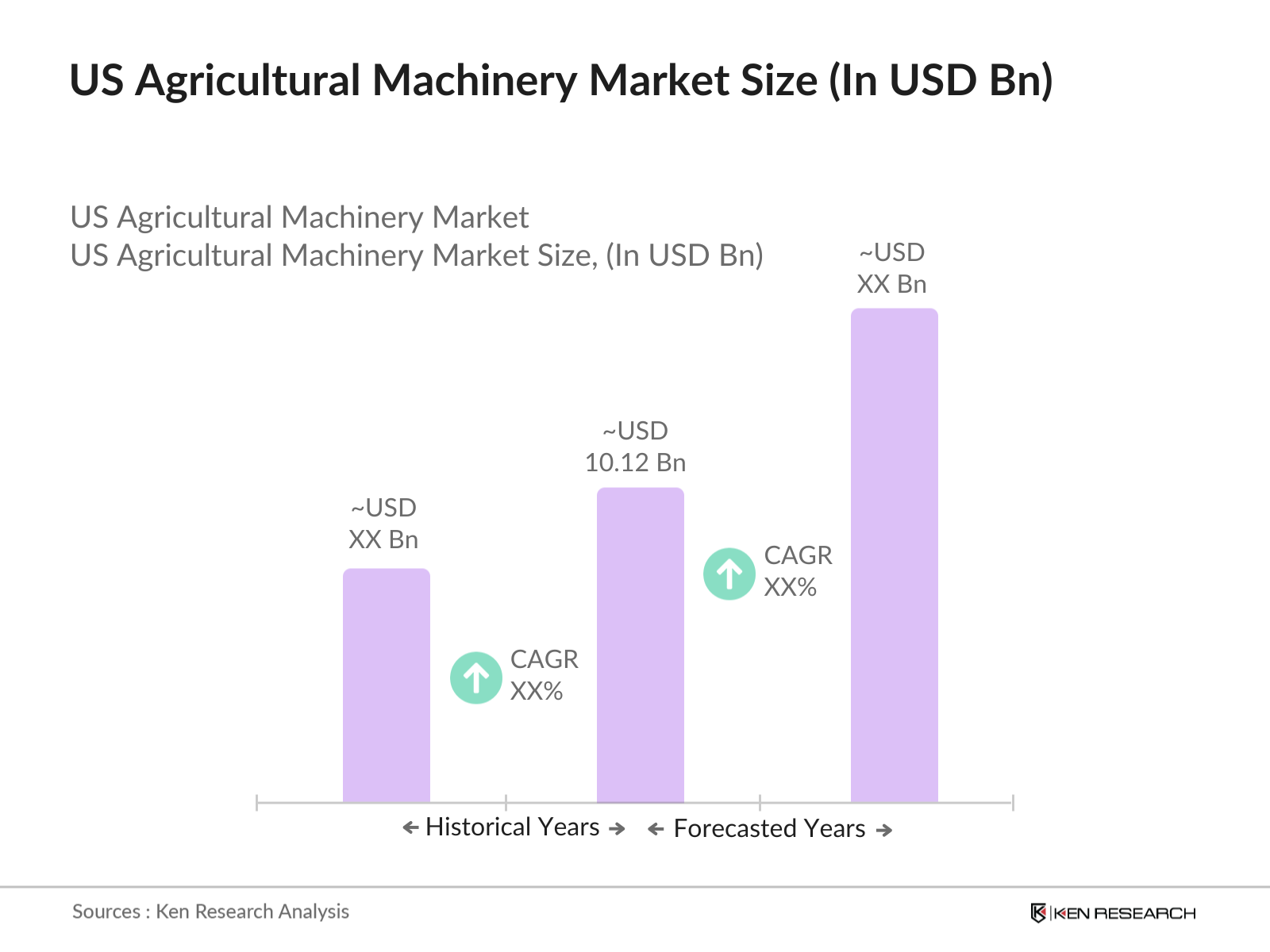
The US Agricultural Machinery Market was valued at USD 10.12 billion in 2023, driven by advancements in precision farming, increasing mechanization, and government support for modernizing agriculture. The adoption of smart farming technologies, including GPS-guided tractors and automated harvesters, has boosted market growth. The US government’s initiatives to promote sustainable agriculture and reduce environmental impact are further driving the market.
-
Major players in the US agricultural machinery market include John Deere, CNH Industrial, AGCO Corporation, Kubota Corporation, and CLAAS. These companies lead the market with innovative product offerings, extensive distribution networks, and strategic collaborations with technology providers to enhance product efficiency and sustainability.
-
Cities like Des Moines, Iowa; Moline, Illinois, and Omaha, Nebraska, lead in market share, reflecting their strategic importance in the agricultural output of the country. These cities are hubs for agricultural innovation and machinery adoption, driving the market forward. The market is predominantly concentrated in these cities owing to extensive farming operations and advanced agricultural practices.
-
John Deere unveiled its fully autonomous 8R tractor in 2023, designed for tillage applications. This advanced machine utilizes GPS, stereo cameras, and sensors to operate without a human driver. The company aims to develop a complete fleet of autonomous equipment by 2030, capable of handling all farming tasks from planting to harvesting, addressing labor shortages in agriculture.
US Agricultural Machinery Market Segmentation
The US Agricultural Machinery market is segmented by various factors such as product type, application, and region.
-
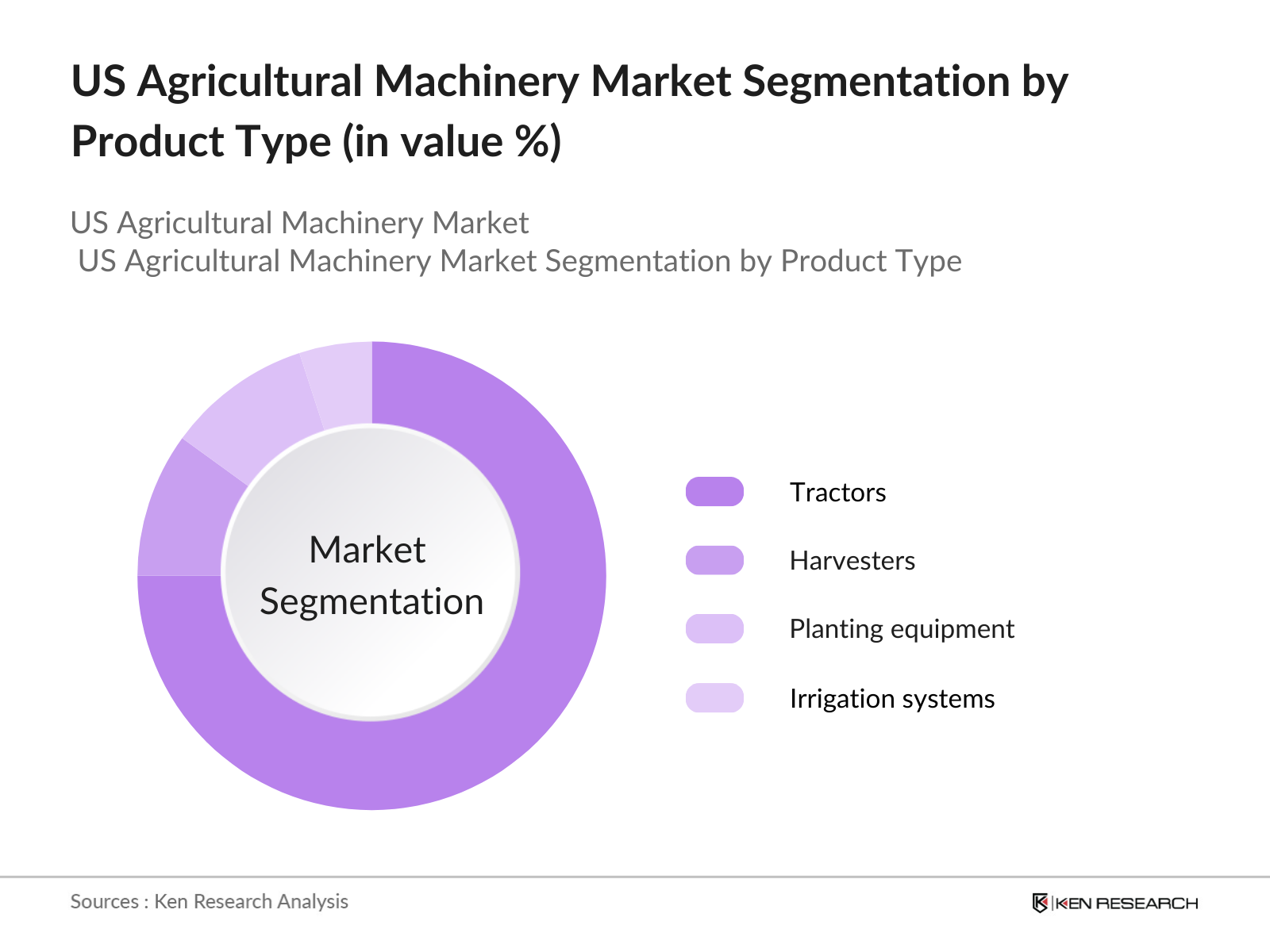
By Product Type: The market is segmented by product type into tractors, harvesters, planting equipment, and irrigation systems. In 2023, tractors held the dominant market share due to their essential role in various farming operations, from plowing to harvesting. John Deere and Kubota are leading manufacturers in this segment, providing a range of tractors equipped with advanced features like GPS and autonomous operation.
-
By Application: The market is segmented by application into crop production, livestock management, and forestry. Crop production dominated the market in 2023, driven by the increasing demand for high-efficiency machinery to meet the rising food production needs. The integration of precision farming tools has further enhanced productivity, contributing to the dominance of this segment.

-
By Region: The market is segmented regionally into the Midwest, South, West, and Northeast US. In 2023, the Midwest US dominated the market share due to its large-scale farming operations and the presence of key agricultural machinery manufacturers. The South US follows, with substantial adoption driven by diversified agricultural practices and increasing investment in modern farming techniques.
US Agricultural Machinery Market Competitive Landscape
|
Company |
Establishment Year |
Headquarters |
|
John Deere |
1837 |
Moline, Illinois |
|
CNH Industrial |
2013 |
London, United Kingdom |
|
AGCO Corporation |
1990 |
Duluth, Georgia |
|
Kubota Corporation |
1890 |
Osaka, Japan |
|
CLAAS |
1913 |
Harsewinkel, Germany |
-
CNH Industrial: In March 2021, CNH Industrial completed a minority investment in Monarch Tractor, a U.S.-based agricultural technology firm. This strategic partnership aims to accelerate the agricultural industry's shift towards autonomy and electrification, promoting long-term sustainability and enabling farmers to achieve profitable zero-emission farming practices.
-
AGCO Corporation: In August 2023, AGCO Corporation launched the new 30-foot Fendt Momentum planter, enhancing its lineup to improve seed placement and optimize crop yields. This innovative model features advanced technology for effective row cleaning and downforce, accommodating various soil conditions. With its capacity for 100 bushels of seed and 800 gallons of liquid fertilizer, it supports efficient planting operations.
US Agricultural Machinery Market Analysis
Growth Drivers
-
Rising Adoption of Precision Agriculture Technologies: The adoption of precision agriculture technologies in the US agricultural machinery market has been on the rise, driven by the need for higher productivity and cost efficiency. As of 2024, large-scale farms in the Midwest have integrated automated harvesters into their operations resulting in substantial increase crop yields and reduction in input costs. In 2023, the total farm production expenditures in the United States were estimated at nearly USD 460 billion, up USD 29 billion from the previous year showcasing impact of rising adoption of agriculture technologies in the country.
-
Increasing Mechanization in Small and Medium Farms: The trend towards increasing mechanization in small and medium-sized farms is another important growth driver in the US agricultural machinery market. In 2024, Small family farms, with gross cash farm income (GCFI) of less than USD 350,000, made up 88% of all farms in the U.S. Meanwhile, large-scale family farms, which generate USD 1 million or more in GCFI, represented only about 3% of all farms but contributed nearly 52% of the total value of agricultural production. That’s one of the factors increasing the mechanization small and medium-sized farms driven by the availability of more affordable machinery and government-backed financing programs.
-
Increasing Demand for High-Efficiency Equipment in Organic Farming: The demand for high-efficiency agricultural machinery in organic farming is driving growth in the US market. As of 2021, organic-certified land in the U.S. reached 4.89 million acres. Additionally, the USDA reports that organic sales accounted for about 3% of U.S. farm receipts in 2021, reflecting the growing interest and investment in organic farming. The growing consumer demand for organic produce has led to increased investment in equipment such as no-till seeders and precision sprayers, which help maintain soil health and reduce chemical usage.
Challenges
-
High Initial Investment Costs: One of the most important challenges facing the market is the high initial investment required for advanced equipment. The cost of new machinery, such as tractors, can be prohibitive for many small and medium-sized farms. Despite government subsidies, the expense of financing remains a barrier, with interest rates on agricultural loans adding to the financial burden. This limitation restricts smaller farms from adopting the latest technologies, potentially widening the productivity gap between large and small farms.
-
Environmental and Regulatory Pressures: The increasing scrutiny on the environmental impact of agricultural practices presents a challenge for the market. The Environmental Protection Agency (EPA) has reported that emissions from agricultural machinery contribute substantially to the total US greenhouse gas emissions. In response, stricter regulations on emissions standards for tractors and other machinery have been introduced, increasing compliance costs for manufacturers and farmers alike.
Government Initiatives
-
USDA Farm Service Agency (FSA) Loans: The USDA Farm Service Agency (FSA) Loans provide crucial financial support to farmers and ranchers, enabling them to start, expand, or sustain their agricultural operations. These loans can be used for purchasing land, livestock, equipment, and supplies. FSA offers both direct and guaranteed loans, catering especially to beginning farmers and those facing financial hardships.
-
Sustainable Agriculture Research and Education (SARE) Program: SARE is a grant program under the USDA that funds projects to advance sustainable innovations, including the development and adoption of new farm equipment and machinery. The program provides funding for on-the-ground research, demonstrations and education. SARE is funded at USD 48 million for 2024 to promote sustainable farming practices through various grants and educational initiatives.
US Agricultural Machinery Future Market Outlook
The US agricultural machinery market is expected to grow remarkably by 2028, driven by technological advancements, increasing mechanization, and supportive government policies.
Future Market Trends
- Expansion of Autonomous Machinery: By 2028, the adoption of fully autonomous machinery, including tractors and harvesters, is expected to become widespread, driven by the need for increased efficiency and reduced labor costs. The use of AI and robotics in agriculture will likely revolutionize farming practices, making them more sustainable and productive, enabling them to perform complex tasks with minimal human intervention.
- Integration of Blockchain Technology in Agricultural Supply Chains: Blockchain technology is anticipated to play an important role in the US agricultural machinery market by 2028, particularly in enhancing transparency and traceability in agricultural supply chains. By 2028, large farms are expected to implement blockchain solutions to track the lifecycle of their crops, from planting to market.
Scope of the Report
|
By Product |
Tractors Harvesters Planting Equipment Irrigation Systems |
|
By Application |
Crop Production Livestock Management Forestry |
|
By Region |
Midwest South West Northeast |
Products
Key Target Audience – Organizations and Entities Who Can Benefit by Subscribing to This Report:
- Farmers and Agricultural Cooperatives
- Agricultural Machinery Manufacturers
- Agricultural Equipment Dealers
- Supply Chain and Logistics Companies
- Farm Management Software Companies
- Agricultural Trade Associations
- Banks and Financial Institutions
- Venture Capitalist
- Government Agencies and Regulatory Bodies (USDA and EPA)
Companies
Players Mentioned in the Report:
- John Deere
- CNH Industrial
- AGCO Corporation
- Kubota Corporation
- CLAAS
- Case IH
- New Holland
- Massey Ferguson
- Mahindra & Mahindra
- Yanmar Co., Ltd.
- Fendt
- Challenger
- SAME Deutz-Fahr
- Versatile
- JCB Agriculture
Table of Contents
US Agricultural Machinery Market Overview
1.1 Definition and Scope
1.2 Market Taxonomy
1.3 Market Valuation and Historical Performance
1.4 Key Market Trends and Developments
1.5 Market Segmentation Overview
US Agricultural Machinery Market Size (in USD Bn), 2018-2023
2.1 Historical Market Size
2.2 Year-on-Year Growth Analysis
2.3 Key Market Developments and Milestones
US Agricultural Machinery Market Analysis
3.1 Growth Drivers
3.1.1 Technological Advancements
3.1.2 Government Support
3.1.3 Increased Mechanization
3.2 Challenges
3.2.1 High Initial Costs
3.2.2 Environmental Concerns
3.3 Opportunities
3.3.1 Expansion of Autonomous Machinery
3.3.2 Growth in Precision Farming
3.3.3 Integration with Sustainable Practices
3.4 Trends
3.4.1 Adoption of Electric-Powered Machinery
3.4.2 AI and IoT Integration
3.4.3 Increase in Smart Farming Solutions
3.5 Government Initiatives
3.5.1 2023 Farm Bill
3.5.2 Sustainable Agriculture Program 2024
3.6 SWOT Analysis
3.7 Stakeholder Ecosystem
3.8 Competition Ecosystem
US Agricultural Machinery Market Segmentation, 2023
4.1 By Product Type (in Value %)
4.1.1 Tractors
4.1.2 Harvesters
4.1.3 Planting Equipment
4.1.4 Irrigation Systems
4.2 By Application (in Value %)
4.2.1 Crop Production
4.2.2 Livestock Management
4.2.3 Forestry
4.3 By Region (in Value %)
4.3.1 Midwest US
4.3.2 South US
4.3.3 West US
4.3.4 Northeast US
US Agricultural Machinery Market Competitive Landscape
5.1 Detailed Profiles of Major Companies
5.1.1 John Deere
5.1.2 CNH Industrial
5.1.3 AGCO Corporation
5.1.4 Kubota Corporation
5.1.5 CLAAS
5.2 Cross Comparison Parameters (No. of Employees, Headquarters, Inception Year, Revenue)
US Agricultural Machinery Market Competitive Landscape Analysis
6.1 Market Share Analysis
6.2 Strategic Initiatives
6.3 Mergers and Acquisitions
6.4 Investment Analysis
6.4.1 Venture Capital Funding
6.4.2 Government Grants
6.4.3 Private Equity Investments
US Agricultural Machinery Market Regulatory Framework
7.1 2023 Farm Bill
7.2 Sustainable Agriculture Program 2024
7.3 Compliance Requirements and Certification Processes
US Agricultural Machinery Market Future Outlook (in USD Bn), 2023-2028
8.1 Future Market Size Projections
8.2 Key Factors Driving Future Market Growth
8.3 Future Market Segmentation
8.3.1 By Product Type (in Value %)
8.3.2 By Application (in Value %)
8.3.3 By Region (in Value %)
US Agricultural Machinery Market Analysts’ Recommendations
9.1 TAM/SAM/SOM Analysis
9.2 Customer Cohort Analysis
9.3 Marketing Initiatives
9.4 White Space Opportunity Analysis
Disclaimer
Contact Us
Research Methodology
Step: 1 Identifying Key Variables:
Ecosystem creation for all the major entities and referring to multiple secondary and proprietary databases to perform desk research around market to collate industry level information.?
Step: 2 Market Building:
Collating statistics on US agricultural machinery market over the years, penetration of marketplaces and service providers ratio to compute revenue generated for US agricultural machinery market. We will also review service quality statistics to understand revenue generated which can ensure accuracy behind the data points shared.?
Step: 3 Validating and Finalizing:
Building market hypothesis and conducting CATIs with industry experts belonging to different companies to validate statistics and seek operational and financial information from company representatives.?
Step: 4 Research Output:
Our team will approach multiple essential agriculture machinery companies and understand nature of product segments and sales, consumer preference and other parameters, which will support us validate statistics derived through bottom to top approach from agriculture machinery companies.?
Frequently Asked Questions
How big is the US Agricultural Machinery Market?
The US Agricultural Machinery Market was valued at USD 10.12 billion in 2023, driven by advancements in precision farming, increasing mechanization, and government support for modernizing agriculture.
What are the challenges in the US Agricultural Machinery Market?
Challenges in the US agricultural machinery market include high initial investment costs, regulatory pressures related to environmental standards, and ongoing supply chain disruptions that affect the availability of critical components.
Who are the major players in the US Agricultural Machinery Market?
Key players in the US agricultural machinery market include John Deere, CNH Industrial, AGCO Corporation, Kubota Corporation, and CLAAS. These companies dominate due to their advanced product offerings and extensive distribution networks.
What are the growth drivers of the US Agricultural Machinery Market?
The agricultural machinery market is propelled by the rising adoption of precision agriculture technologies, increasing mechanization in small and medium farms, and government subsidies aimed at promoting sustainable farming practices.
Why Buy From Us?

What makes us stand out is that our consultants follows Robust, Refine and Result (RRR) methodology. i.e. Robust for clear definitions, approaches and sanity checking, Refine for differentiating respondents facts and opinions and Result for presenting data with story

We have set a benchmark in the industry by offering our clients with syndicated and customized market research reports featuring coverage of entire market as well as meticulous research and analyst insights.

While we don't replace traditional research, we flip the method upside down. Our dual approach of Top Bottom & Bottom Top ensures quality deliverable by not just verifying company fundamentals but also looking at the sector and macroeconomic factors.

With one step in the future, our research team constantly tries to show you the bigger picture. We help with some of the tough questions you may encounter along the way: How is the industry positioned? Best marketing channel? KPI's of competitors? By aligning every element, we help maximize success.

Our report gives you instant access to the answers and sources that other companies might choose to hide. We elaborate each steps of research methodology we have used and showcase you the sample size to earn your trust.

If you need any support, we are here! We pride ourselves on universe strength, data quality, and quick, friendly, and professional service.