
US Intelligent Virtual Assistant Market Outlook to 2030
Region:North America
Author(s):Sanjana
Product Code:KROD2600
October 2024
97
About the Report
US Intelligent Virtual Assistant Market Overview
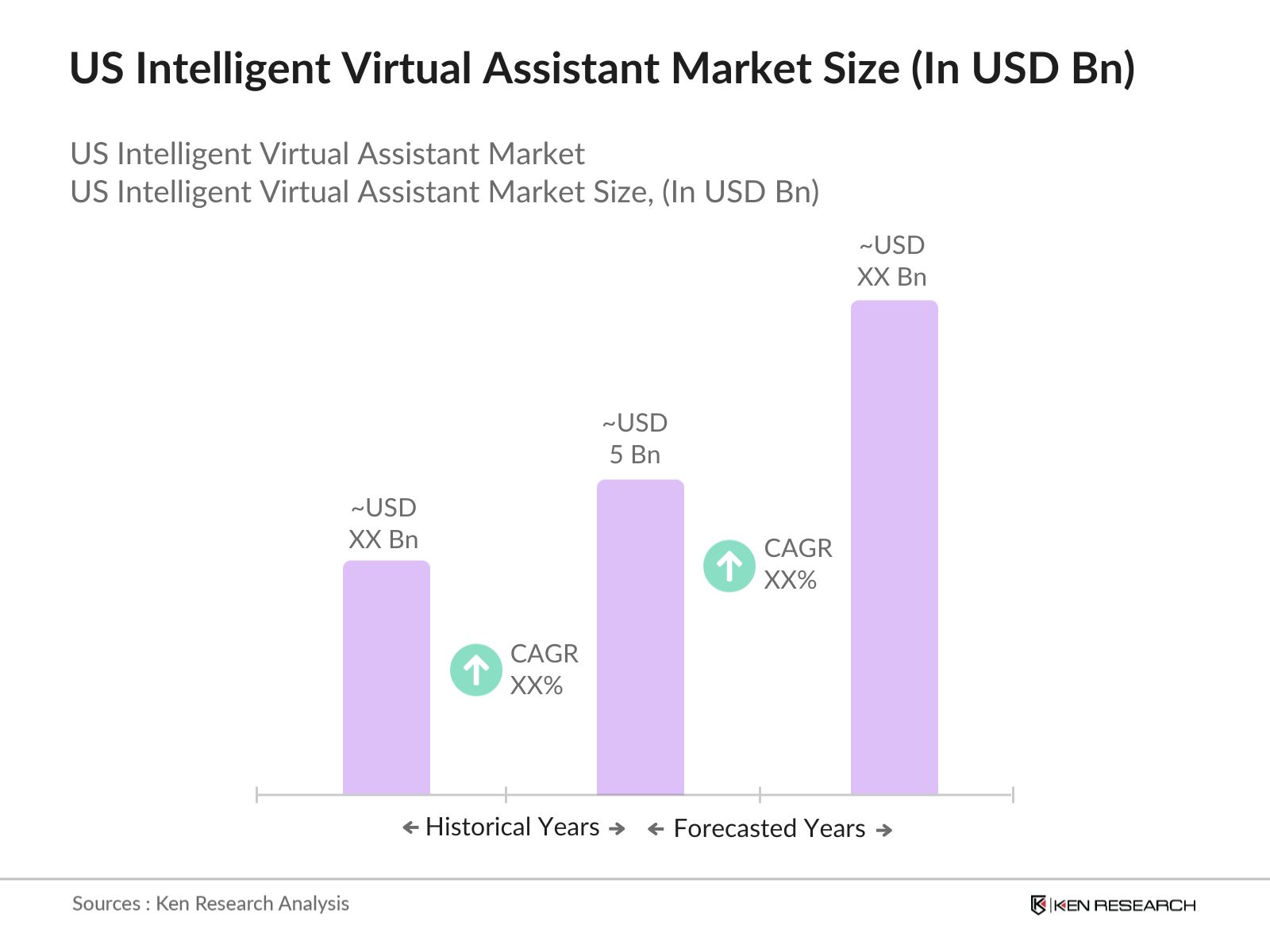
- U.S. Intelligent Virtual Assistant (IVA) market reached USD 5 billion in 2023, driven by increasing adoption across industries like healthcare, retail, and banking. This growth stems from rising demand for automated customer service, voice recognition technology and AI-enabled virtual assistants to improve customer experience.
- Leading players in the U.S. IVA market include Amazon (Alexa), Google (Google Assistant), Microsoft (Cortana), Apple (Siri), and IBM (Watson). These tech giants dominate the market due to their extensive investment in AI development and integration across consumer products.
- In 2024, Amazon has launched Rufus, a generative AI-powered chatbot designed to assist US customers with their shopping needs. Rufus can answer questions about products, provide comparisons, and make recommendations based on a user's inquiries. The chatbot is integrated into Amazon's shopping app and aims to enhance the shopping experience by consolidating product research and purchasing into one platform.
- Cities like San Francisco, New York, and Seattle lead the U.S. IVA market. San Francisco dominates due to its proximity to major tech firms like Amazon and Google, which drive innovation in AI and virtual assistants. New York is a hub for financial institutions that heavily invest in IVA for customer service automation, while Seattle benefits from Amazons headquarters and their expanding IVA solutions.
US Intelligent Virtual Assistant Market Segmentation
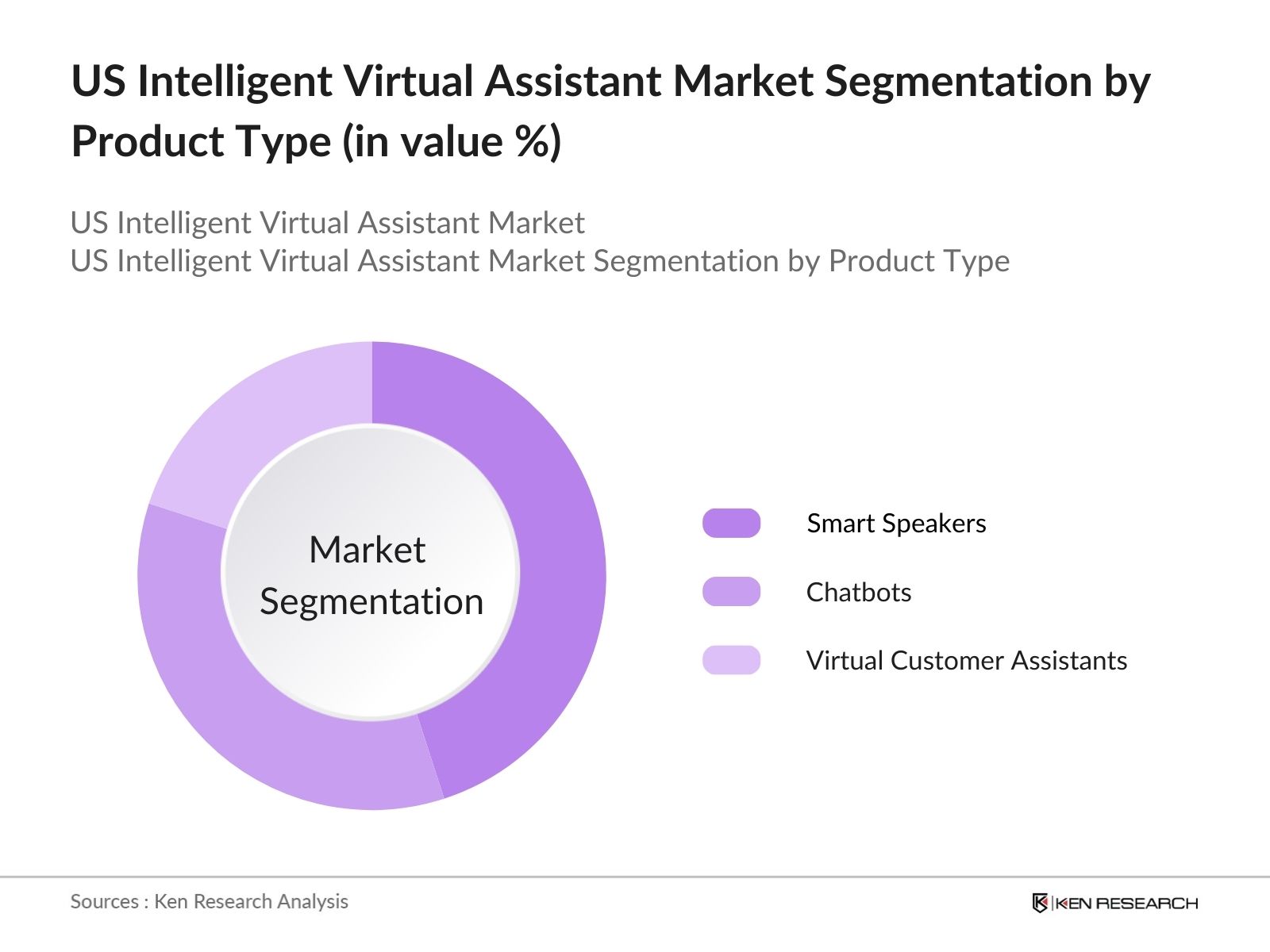
By Product Type: The U.S. IVA market is segmented by product type into smart speakers, chatbots, and virtual customer assistants. In 2023, smart speakers led the market due to their widespread consumer adoption for home automation and entertainment. The continued investment in voice-controlled smart home devices by key players like Amazon and Google ensures their dominance. The ease of use and seamless integration with other IoT devices make smart speakers a preferred option in homes across the U.S.
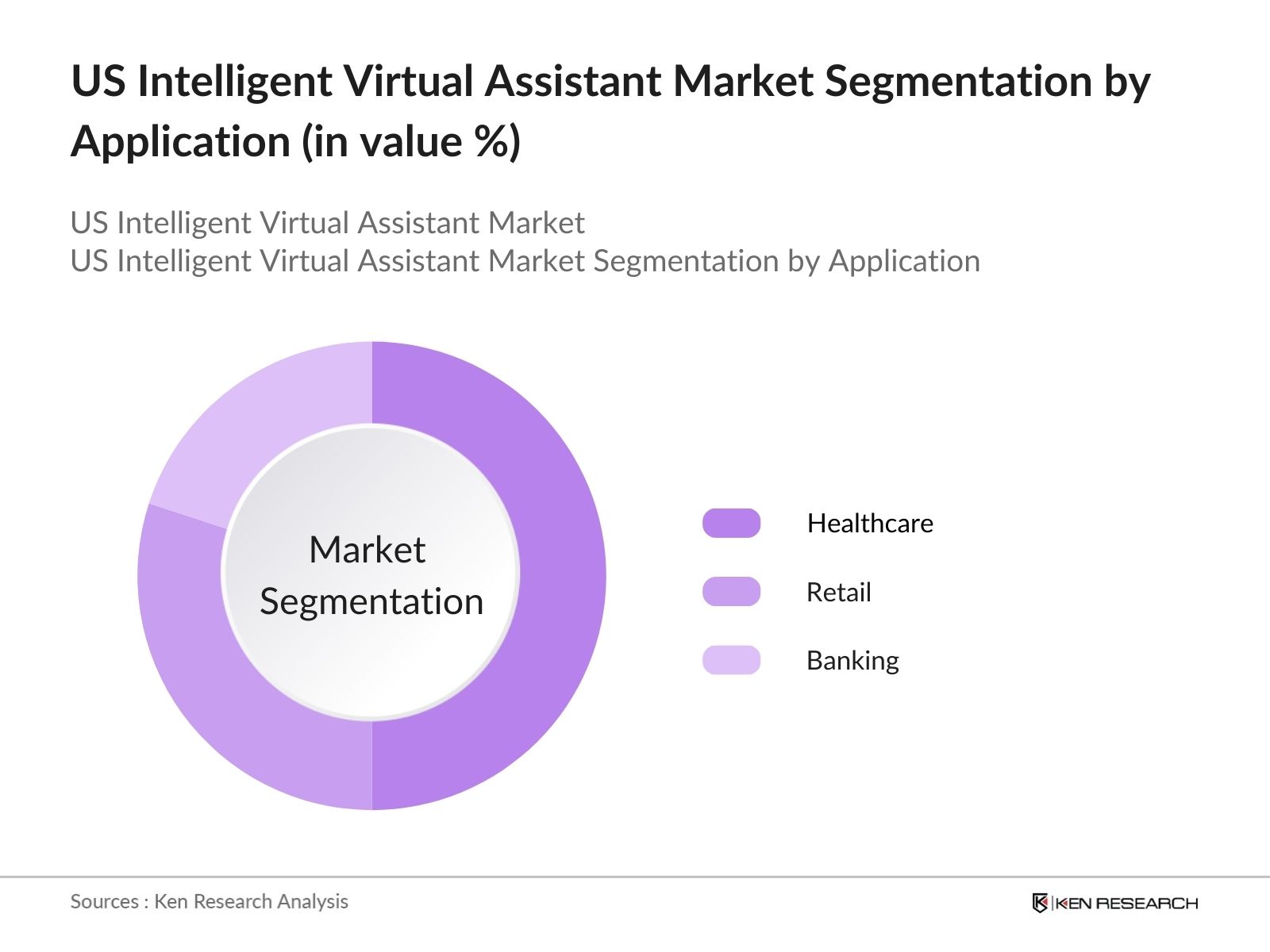
By Application: The U.S. IVA market by application is segmented into healthcare, retail, banking, and automotive. In 2023, the healthcare segment witnessed the largest market share, driven by the need for automated patient services, appointment scheduling, and telemedicine assistance. The COVID-19 pandemic accelerated the use of IVAs in healthcare, with hospitals increasingly deploying virtual assistants to streamline operations and enhance patient experiences. This trend is expected to continue as healthcare providers prioritize cost-efficiency and improved care.
By Region: Regionally, the U.S. IVA market is divided into West Coast, East Coast, and Midwest. The West Coast dominated the market in 2023, holding a substantial share due to its concentration of technology firms. These regions lead in AI research, development, and the commercialization of IVA solutions, particularly smart speakers and virtual customer assistants. The innovation-driven environment on the West Coast makes it a hotspot for new IVA technologies.
US Intelligent Virtual Assistant Market Competitive Landscape
|
Company |
Establishment Year |
Headquarters |
|
Amazon (Alexa) |
1994 |
Seattle, WA |
|
Google (Google Assistant) |
1998 |
Mountain View, CA |
|
Microsoft (Cortana) |
1975 |
Redmond, WA |
|
Apple (Siri) |
1976 |
Cupertino, CA |
|
IBM (Watson) |
1911 |
Armonk, NY |
- Apple: In 2024, Apple launched its iPhone 16 series, which is designed to enhance its virtual assistant, Siri, and integrate advanced AI capabilities branded as "Apple Intelligence." This new technology aims to automate tasks and improve user interaction with Siri, making it a more intelligent and versatile assistant. The iPhone 16 series includes specialized chips to support AI functionalities such as personalized emoji creation and improved image editing.
- Google: In 2023, Google is intensifying its automotive strategy by launching HD Maps for assisted driving and partnering with Mercedes-Benz to develop branded navigation. This partnership marks a shift from Google's usual data control approach, indicating a focus on building trust with automakers. As the automotive market evolves towards software-defined vehicles, Google aims to enhance its services, competing with Apple, which is also expanding its presence in the automotive sector through next-generation CarPlay.
US Intelligent Virtual Assistant Industry Analysis
Growth Drivers:
- Increased Integration of IVA in Healthcare: U.S. hospitals have adopted Intelligent Virtual Assistants (IVA) for administrative tasks, patient scheduling, and telemedicine services. 150 hospitals and outpatient centers in the Cleveland metropolitan area, is deploying Interactions IVA to streamline appointment scheduling and enhance patient experiences. They handle approximately 2.2 million calls annually, with 1.7 million related to appointment management.
- Rising Demand for Smart Home Integration: The adoption of smart home devices integrated with IVA technology surged, with connected devices, such as smart speakers and IoT-enabled appliances, operating in U.S. households. The percentage of U.S. households utilizing smart home technology has increased from 6.9% in 2015 to 22.3% in 2023, showing a direct link between IVA growth and the expansion of the smart home market (Source: U.S. Census Bureau, 2024).
- Enterprise Adoption for Enhanced Customer Service: the U.S. banking and retail sectors invested heavily in IVA technology to improve customer service operations. In the past year, banks significantly increased their investments in Intelligent Virtual Assistant (IVA) technology. Specifically, they spent approximately $1 billion on deploying IVA systems to automate routine queries and enhance customer interactions. These investments have significantly boosted customer engagement and streamlined services.
Challenges:
- Privacy and Data Security Concerns: With the widespread adoption of IVA technology, privacy issues have become a major challenge. The U.S. Federal Trade Commission raised concerns about inadequate data protection mechanisms and potential misuse of voice recordings by third-party applications. This has led to a growing demand for more robust security protocols within IVA solutions, increasing pressure on companies to enhance user privacy.
- Technological Limitations in Understanding Context: Many IVA queries are inaccurately processed or misunderstood due to limitations in natural language processing (NLP). This has led to user frustration and the need for more advanced algorithms capable of deeper contextual comprehension. As a result, enhancing NLP models to understand user emotions and intent is becoming a critical priority for improving the overall user experience.
Government Initiatives:
- Federal Data Strategy 2020 Action Plan: In 2020, the U.S. government released the Federal Data Strategy 2020 Action Plan, which included actions to leverage artificial intelligence (AI) and machine learning (ML) to improve government operations and service delivery. This plan supports the development and use of IVAs powered by AI and ML to enhance citizen engagement and streamline government processes. It also promotes data-driven decision-making to improve the efficiency and responsiveness of public services.
- Federal Artificial Intelligence Training: In 2021, the U.S. government launched the Federal Artificial Intelligence Training program to provide AI and ML training to federal employees. This initiative aims to build the necessary skills and knowledge to effectively implement and manage AI technologies, such as IVAs, within government agencies. The program emphasizes practical applications of AI to solve real-world challenges and improve public services. Additionally, it fosters a culture of innovation and collaboration by encouraging federal workers to explore new AI-driven solutions across various departments.
US Intelligent Virtual Assistant Future Market Outlook
U.S. IVA market is expected to grow significantly due to increasing enterprise adoption, government support for AI initiatives, and advances in AI technology. The market is expected to see widespread implementation across various industries, including healthcare, retail, banking, and smart cities
Future Trends
- Expansion of IVA in Healthcare: IVAs will become more ingrained in healthcare services. The focus will shift toward personalized care, where virtual assistants will assist healthcare professionals in diagnosing patients, managing care plans, and providing real-time medical insights. This trend will reduce the burden on healthcare workers and improve patient outcomes. Additionally, IVAs will enhance patient engagement by providing timely reminders and health tips, promoting better adherence to treatments.
- AI-Driven Smart Cities: IVA technology will be fully integrated into smart city infrastructure, enabling cities to manage services such as traffic control, waste management, and public safety through AI-driven automation. This will lead to more efficient and sustainable urban environments, with IVA technology playing a central role in city planning and management. Furthermore, IVAs will offer real-time communication between citizens and city services, ensuring more responsive and adaptive governance.
Scope of the Report
|
US Intelligent Virtual Assistant Market Segmentation |
|
|
By Product Type |
Smart Speakers Chatbots Virtual Customer Assistants |
|
By Application |
Healthcare Retail Banking |
|
By Region |
West Coast East Coast Midwest |
Products
Key Target Audience Organizations and Entities who can benefit by Subscribing This Report:
Technology and Software Development Companies
Consumer Electronics Manufacturers
Telecommunication Companies
Automotive Manufacturers
Healthcare Providers
Retail and E-commerce Businesses
Financial Services Companies
Government and Regulatory Bodies (e.g., U.S. Department of Health and Human Services, FCC)
Venture Capital and Investment Firms
Time Period Captured in the Report:
Historical Period: 2018-2023
Base Year: 2023
Forecast Period: 2023-2028
Companies
Players Mentioned in the Report:
Amazon
Google
Microsoft
Apple
IBM
Nuance Communications
Verint Systems
Oracle
Samsung
Facebook (Meta)
Baidu
SoundHound
Cisco Systems
Clinc Inc.
Inbenta Technologies
Table of Contents
1. U.S. Intelligent Virtual Assistant Market Overview
1.1. Definition and Scope
1.2. Market Taxonomy
1.3. Market Growth Rate
1.4. Market Segmentation Overview
1.5. Key Market Drivers
2. U.S. Intelligent Virtual Assistant Market Size (in USD Billion)
2.1. Historical Market Size
2.2. Year-on-Year Growth Analysis
2.3. Key Developments and Milestones
3. U.S. Intelligent Virtual Assistant Market Growth Drivers and Restraints
3.1. Growth Drivers
3.1.1. Rise of AI and Machine Learning
3.1.2. Increased Integration in Healthcare and Retail
3.1.3. Smart Home Adoption
3.2. Market Restraints
3.2.1. Privacy and Data Security Concerns
3.2.2. Natural Language Processing (NLP) Limitations
3.2.3. High Implementation Costs
4. U.S. Intelligent Virtual Assistant Market Opportunities
4.1. Expansion of AI-Driven Healthcare Solutions
4.2. IVA Integration in Smart City Infrastructure
4.3. Increasing Use of Voice Recognition in E-Commerce and Retail
4.4. Enterprise-Level IVA Integration for Customer Service (Banking, Retail)
5. U.S. Intelligent Virtual Assistant Market Segmentation
5.1. By Product Type
5.1.1. Smart Speakers
5.1.2. Chatbots
5.1.3. Virtual Customer Assistants
5.2. By Application
5.2.1. Healthcare (Operational Metrics: % Adoption in Hospitals)
5.2.2. Retail
5.2.3. Banking
5.2.4. Automotive
5.3. By Region
5.3.1. West Coast
5.3.2. East Coast
5.3.3. Midwest
6. Competitive Landscape of U.S. Intelligent Virtual Assistant Market
6.1. Market Share Analysis (Financial Metrics: Market Share in %)
6.2. Profiles of Key Competitors (15 Major Players, Financial Metrics: Revenue)
6.2.1. Amazon (Alexa)
6.2.2. Google (Google Assistant)
6.2.3. Microsoft (Cortana)
6.2.4. Apple (Siri)
6.2.5. IBM (Watson)
6.2.6. Nuance Communications
6.2.7. Samsung (Bixby)
6.2.8. Baidu (DuerOS)
6.2.9. Oracle Digital Assistant
6.2.10. SAP Conversational AI
6.2.11. Houndify by SoundHound
6.2.12. Verint IVA
6.2.13. iFLYTEK
6.2.14. Inbenta
6.2.15. Clinc AI
6.3. Strategic Initiatives (Partnerships, Mergers, Acquisitions)
6.4. Competitive Ecosystem Analysis (Financial and Operational Metrics: Investments in AI R&D)
7. U.S. Intelligent Virtual Assistant Market Regulatory Landscape
7.1. U.S. Federal Data Strategy 2020 Action Plan (Operational Metrics: Impact on IVA Adoption)
7.2. Privacy Laws and Data Security (Regulatory Metrics: Compliance Requirements)
7.3. Artificial Intelligence in Government Programs (Operational Metrics: Government Support for IVA)
8. Technological Landscape and Advancements in the U.S. Intelligent Virtual Assistant Market
8.1. Advances in Natural Language Processing (Operational Metrics: NLP Accuracy Rate)
8.2. AI and Machine Learning Algorithms for IVA (Technological Metrics: Training Data Size, Model Performance)
8.3. Integration with IoT and Smart Home Devices (Technological Metrics: Connected Device Growth Rate)
9. U.S. Intelligent Virtual Assistant Market Future Outlook
9.1. Projected Market Size (Financial Metrics: USD Billion)
9.2. Growth Projections and Key Factors
9.2.1. Healthcare Sector Expansion
9.2.2. Retail and Banking Automation
9.2.3. Adoption of IVA in Smart Cities
9.3. Emerging Technologies and Market Trends
9.3.1. AI-Powered Personalization
9.3.2. Conversational AI Integration in Autonomous Vehicles
9.3.3. Real-Time Data Processing
10. U.S. Intelligent Virtual Assistant Market Analyst Recommendations
10.1. TAM/SAM/SOM Analysis (Total Addressable Market, Serviceable Available Market, and Serviceable Obtainable Market)
10.2. Customer Cohort Analysis (Operational Metrics: Segmentation by Consumer Preferences)
10.3. Marketing and Investment Strategies (Operational Metrics: ROI on IVA Technology)
10.4. White Space Opportunities (Unaddressed Segments in Healthcare, Retail)
11. Appendix
11.1. Research Methodology
11.2. List of Abbreviations
11.3. Disclaimer
11.4. Contact Information
Research Methodology
Step 1: Identifying Key Variables:
Ecosystem creation for all the major entities and referring to multiple secondary and proprietary databases to perform desk research around market to collate industry level information.
Step 2: Market Building:
Collating statistics on US Intelligent Virtual Assistant Market over the years, penetration of marketplaces and service providers ratio to compute revenue generated for US Intelligent Virtual Assistant Market. We will also review service quality statistics to understand revenue generated which can ensure accuracy behind the data points shared.
Step 3: Validating and Finalizing:
Building market hypothesis and conducting CATIs with industry experts belonging to different companies to validate statistics and seek operational and financial information from company representatives.
Step 4: Research output:
Our team will approach multiple Intelligent Virtual Assistant companies and understand nature of product segments and sales, consumer preference and other parameters, which will support us validate statistics derived through bottom to top approach from Intelligent Virtual Assistant companies.
Frequently Asked Questions
01 How big is US Intelligent Virtual Assistant Market?
U.S. Intelligent Virtual Assistant (IVA) market reached USD 5 billion in 2023, driven by increasing adoption across industries like healthcare, retail, and banking. This growth stems from rising demand for automated customer service, voice recognition technology, and AI-enabled virtual assistants to improve customer experience.
02. What are the growth drivers of the US Intelligent Virtual Assistant Market?
Growth drivers of US Intelligent Virtual Assistant Market include the rising integration of IVAs in healthcare, increasing adoption of smart home devices, and enterprise demand for automated customer service solutions. Government support for AI development also plays a key role in boosting the market.
03 What are the challenges in US Intelligent Virtual Assistant Market?
Challenges of US Intelligent Virtual Assistant Market include privacy concerns over voice data collection, high implementation costs for businesses, and technological limitations in understanding nuanced human language. These issues can slow down adoption rates, particularly among small businesses and consumers.
04 Who are the major players in the US Intelligent Virtual Assistant Market?
Key players of US Intelligent Virtual Assistant Market include Amazon (Alexa), Google (Google Assistant), Microsoft (Cortana), Apple (Siri), and IBM (Watson). These companies dominate due to their advanced AI research, extensive product ecosystems, and significant investments in IVA technology.
Why Buy From Us?

What makes us stand out is that our consultants follows Robust, Refine and Result (RRR) methodology. i.e. Robust for clear definitions, approaches and sanity checking, Refine for differentiating respondents facts and opinions and Result for presenting data with story

We have set a benchmark in the industry by offering our clients with syndicated and customized market research reports featuring coverage of entire market as well as meticulous research and analyst insights.

While we don't replace traditional research, we flip the method upside down. Our dual approach of Top Bottom & Bottom Top ensures quality deliverable by not just verifying company fundamentals but also looking at the sector and macroeconomic factors.

With one step in the future, our research team constantly tries to show you the bigger picture. We help with some of the tough questions you may encounter along the way: How is the industry positioned? Best marketing channel? KPI's of competitors? By aligning every element, we help maximize success.

Our report gives you instant access to the answers and sources that other companies might choose to hide. We elaborate each steps of research methodology we have used and showcase you the sample size to earn your trust.

If you need any support, we are here! We pride ourselves on universe strength, data quality, and quick, friendly, and professional service.